
Free Feeding vs Scheduled Feeding for Dogs: Which Wins?
This post contains affiliate links. As an Amazon Associate, we earn from qualifying purchases.
In the free feeding vs scheduled feeding for dogs decision, scheduled meals win for most adult dogs. Measured meals 1 to 2 times daily make intake countable, appetite readable, and weight manageable. Free feeding suits a narrow set of cases, mainly small-breed puppies at hypoglycemia risk under veterinary direction.
Countable is the whole point of the free feeding vs scheduled feeding for dogs question. A bowl that gets topped up whenever it looks low hides how much actually went down the throat, and the scale at the next vet visit is the only honest witness. Once you can name the number, every other decision gets easier: whether the food is working, whether the dog is slowing down, whether a skipped meal means something.
What follows covers the two methods side by side, the numbers the veterinary bodies actually publish, the cases where free feeding is defensible, and the one measurement that beats every feeding chart on the market.
Key Takeaways
- Scheduled, measured meals are the default for adult dogs, and 1 to 2 meals a day is the range Merck’s manual accepts.
- Free feeding hides intake. A topped-up bowl can’t tell you how much went down, and free-fed animals score higher on body condition than meal-fed ones.
- Weigh food in grams. A scoop is a volume guess, and the bag’s feeding directions are written for an average animal under AAFCO rules.
- Split meals for deep-chested breeds. GDV risk factors include single large meals and fast eating.
- Free feeding has narrow legitimate use, mainly small-breed puppies at hypoglycemia risk, under veterinary direction.
Free Feeding vs Scheduled Feeding: The Head-to-Head
Scheduled feeding is a defined window with a measured amount inside it. Free feeding is a bowl that never empties, and the dog sets both the timing and the total.
Scheduled feeding means offering a measured amount of food at set times, one to four times daily. The bowl goes down, stays down for a defined window, and comes up empty or not. Free feeding leaves dry food available continuously, so daily intake is never counted and never attributed to a specific hour.
| Method | What It Does Well | Where It Breaks Down |
|---|---|---|
| Free feeding (dry, ad lib) | Convenient on long work days | Intake uncountable, and free-fed animals carry higher body condition scores |
| Scheduled, once daily | Simple routine, easy to remember | One large meal is a documented GDV risk factor in deep-chested breeds |
| Scheduled, twice daily | Countable intake and a readable appetite | Needs a scale and a consistent hour |
| Timed feeder | Holds the schedule when you can’t | The portion you program in still has to be right |
Only one column lets you answer “how much did he eat yesterday?” with a number. When you compare a free feeding vs scheduled feeding for dogs, the convenience argument starts to look thin, especially once you know the stakes.
APOP’s U.S. Surveys put roughly 55 to 60 percent of dogs in the overweight or obese range in recent years. That’s the population-level backdrop. Free-fed dogs and cats consistently show higher body condition scores than meal-fed ones, with the strongest evidence in cats.
What Do the Veterinary Bodies Actually Recommend?
WSAVA and AAHA both treat measured, scheduled feeding as the standard of care. Merck’s manual is the most permissive of the three, and that gap matters.
WSAVA publishes a 9-point body condition score with 5 as ideal, plus a five-step screening checklist covering body condition, muscle condition, current diet, feeding amount, and feeding method. Feeding method is on the list. AAHA’s nutritional assessment guidelines, first published in 2010 and updated in 2021, call for weight, body condition score, and muscle condition score to be recorded at every visit.
The Life-Stage Frequency Most Sources Agree On
- Puppies and kittens: 3 to 4 meals daily. Small stomachs, high energy demand.
- Adult dogs: 1 to 2 meals daily. Merck’s manual accepts this range.
- Seniors: 2 smaller meals. Fewer calories, more fiber or joint support.
- Diabetic pets: meal times locked to insulin doses. Consistency is the treatment.
The adult row is where the sources split, and I’ll come back to that.
What the Label Legally Has to Say
AAFCO model regulations govern the feeding-directions statement on every bag. That statement is calibrated to an average animal, not to the one in your kitchen. Flip the bag over on whatever you feed, and you’ll find the same structure: a weight range, a cups column, and no mention of your dog’s actual body condition.
For the fuller breakdown of meals per day, that’s a separate conversation from the one about method.
Why Free Feeding Makes Intake Impossible to Measure
An owner once told me her Labrador only ate when he was hungry. The bowl got topped up twice a day and never looked low, so she had no reason to doubt it. Then he stepped on the scale and the number had climbed again since his last visit. The bowl had been telling her nothing for months.
Free feeding doesn’t just make portions hard to count. It removes the count entirely, and with it the earliest signal you get when something is wrong.
There’s a sound that goes with the method. A free-fed dog noses an empty stainless bowl across a tile floor at three in the morning, and the whole house hears it. That scrape is the only intake information the bowl ever gives you.
In multi-dog homes it gets worse. Free feeding prevents portion attribution, so you can’t tell which dog is eating and which is standing guard. Veterinary nutrition literature links it to more food guarding and competition, not less. If that’s your household, feeding multiple dogs without food aggression covers the separation setup.
And free feeding masks anorexia. A dog that stops eating is handing you one of the earliest clinical signs of illness, and an always-full bowl erases it.
The Number on the Bag Is a Starting Point, Not a Prescription
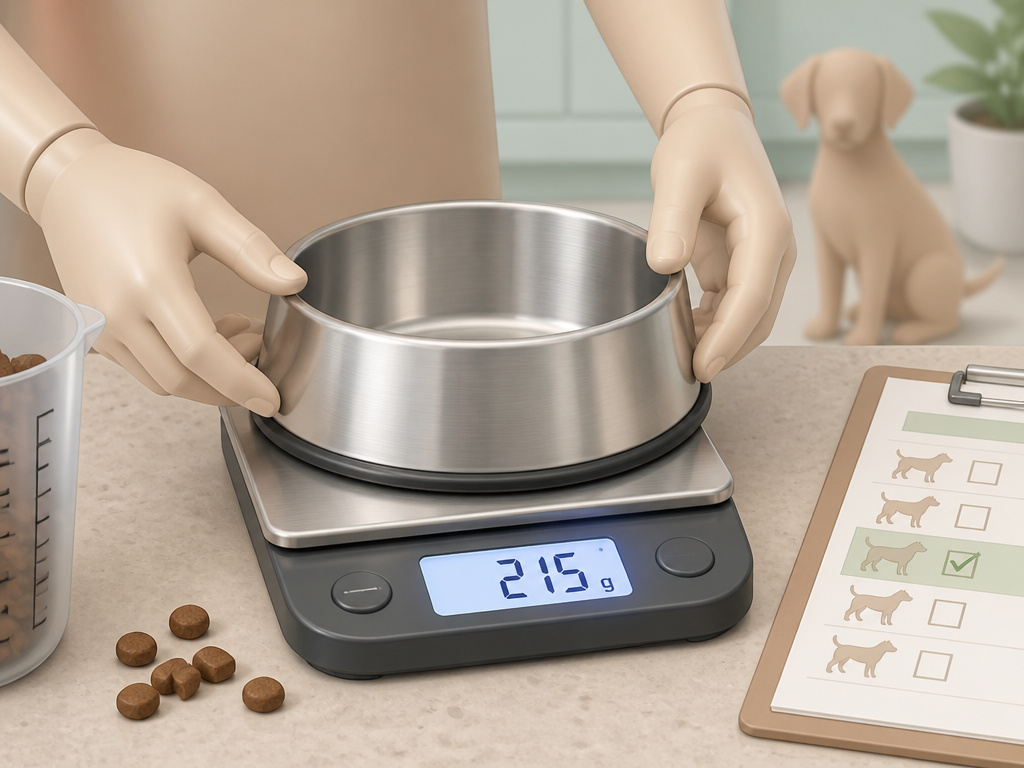
Run the numbers yourself, because nobody else will. AAFCO’s feeding-directions rule produces an amount calibrated to an average animal, and average animals don’t live at your address.
Weigh It in Grams, Not Cups
A scoop is a volume guess. Kibble settles differently every time you dip it, so two level scoops from the same bag can differ enough to matter over a month. Put the bowl on a gram scale and zero it out. Same number every time, and you can defend it.
Work From Resting Energy Requirement
Merck’s manual estimates adult maintenance energy at roughly 70 x (body weight in kg)^0.75 kcal per day, which is the resting energy requirement, then applies a life-stage multiplier on top. You don’t need to love the math. You need to know the figure exists, because it’s the only number in this process that’s actually about your dog.
Here’s the routine I’d hand anyone:
- Weigh the dog, not just the food. Same scale, same time of day.
- Score body condition on the 9-point scale. Ribs easy to feel, waist visible from above.
- Calculate the resting energy requirement, then apply the multiplier your vet gives you.
- Subtract treats. WSAVA puts the allowance at 10 percent of daily calories or less, though that figure is convention more than measured threshold.
- Weigh the kibble in grams against that total.
- Re-check body condition every few weeks and adjust.
Skip step 6 and the whole thing drifts. Dogs don’t hold weight steady on a fixed portion forever, and a number that worked in March can be wrong by June.
The how to measure dog food portions walkthrough goes deeper on the scale-versus-cup problem if you want the full version.
When Free Feeding Is the Right Call
Free feeding earns its place in about two situations, and “the dog seems fine” isn’t one of them.
The first is small-breed puppies at hypoglycemia risk. Toy breeds can crash fast between meals, and some veterinary guidance accepts free access during that window. That’s a veterinary decision, not a default you set yourself.
The second is a specific clinical or management scenario your vet has named. Merck’s manual accepts free feeding for certain healthy, non-obese adult cats, and even there AAHA’s weight management guidelines push back, because ad-lib dry feeding is a documented contributor to feline obesity. If you run a mixed household, free feeding cats is a genuinely different argument from free feeding dogs.
There’s a practical cost nobody mentions. Dry food that sits out all day goes soft and picks up a stale, faintly oily smell that owners stop noticing after a week. It also draws ants and mice.
And if your dog inhales every meal, free feeding doesn’t fix that. Splitting meals and using a slow feeder does. Slow feeders force the dog to work around ridges, which slows intake without changing the amount. The dogs that eat too fast problem has its own set of fixes, and bloat risk is the reason to take it seriously.
How Do You Switch From Free Feeding to Scheduled Meals?
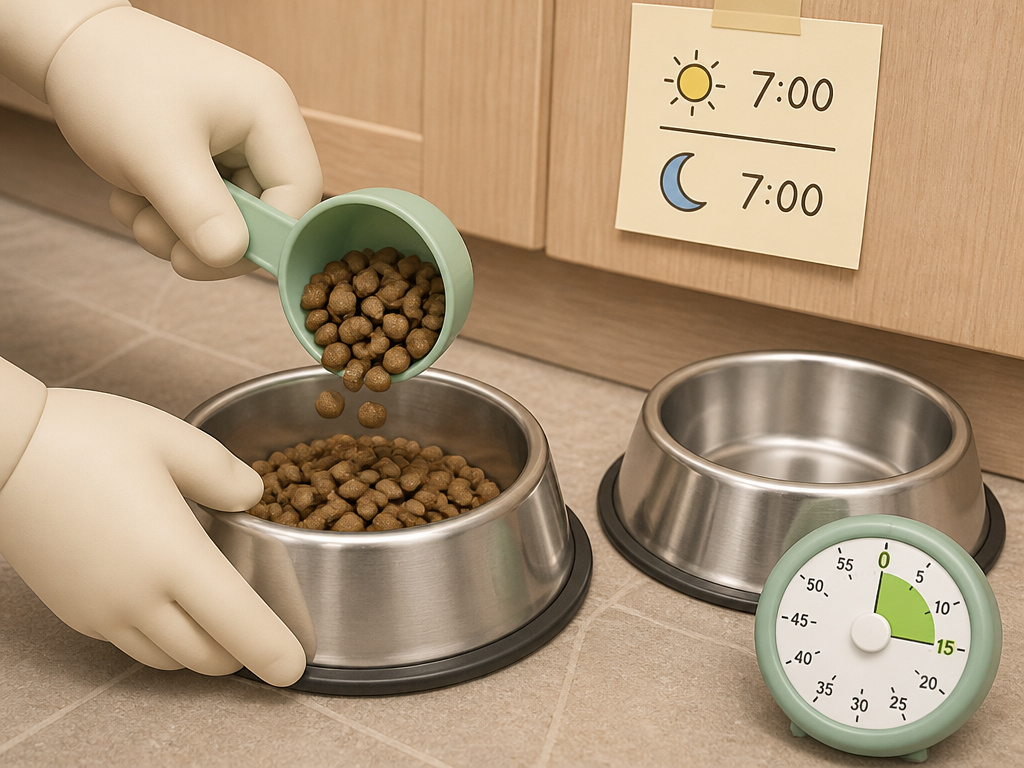
Pick two times you can actually hit every day, then move the dog onto them over about a week. Abrupt is where people get into trouble.
Before you start: A small-breed puppy under veterinary care for hypoglycemia can crash within hours if free access is pulled without a plan. A deep-chested dog fed one large meal carries documented GDV risk, so split the daily total across two or more meals. A diabetic dog’s meal times are locked to the insulin dose and shouldn’t move without the prescribing vet.
- Choose the times and write them down. Two meals, roughly twelve hours apart, works for most adults.
- Measure the daily total in grams first. Split it in half rather than guessing at each meal.
- Put the bowl down for 15 to 20 minutes, then lift it. A dog that walks away loses that meal until the next one.
- Expect a rough 48 hours. A dog used to grazing will skip a meal and then eat properly. Refusing food for more than a day is a vet call.
- Weigh weekly for the first month. This is where you catch the drift before it becomes a problem.
- Re-score body condition at the one-month mark. Adjust the grams, not the schedule.
Step 3 is the one people abandon. Lifting the bowl feels harsh for about two days, and then the dog figures out the new rule and stops testing it.
If your hours are unpredictable, a timed feeder holds the schedule for you. The automatic dog feeders category is worth a look. Set the portion wrong and you’ve just automated the overfeeding, so weigh what you load into it.
Puppies need a different structure entirely. Check a feeding schedule by age before you apply the two-meal rule to a growing dog. And if your shifts run long, feeding a dog when you work long hours covers the split-meal workaround.
Where the Guidance Disagrees
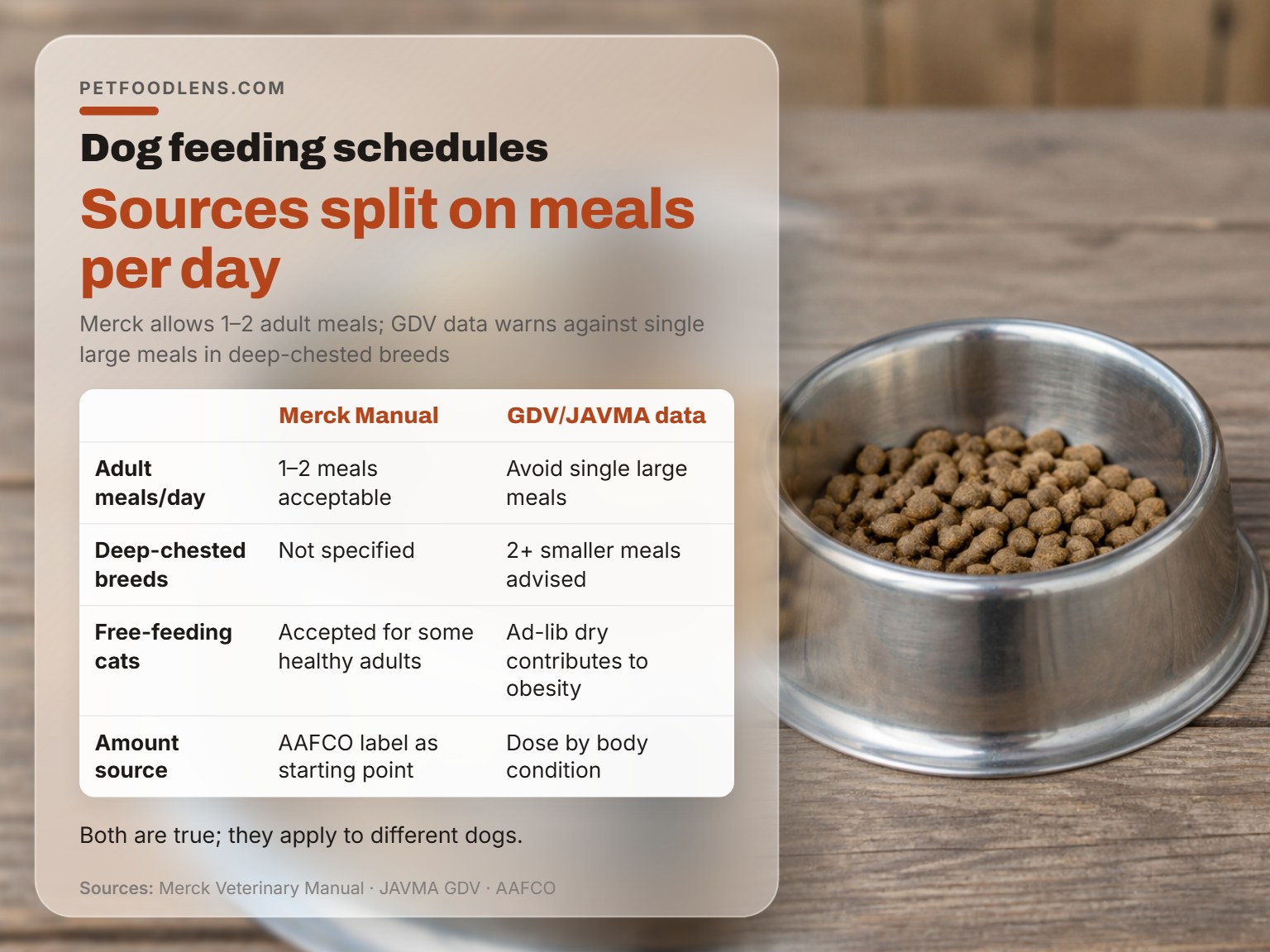
The sources don’t agree on everything, and pretending otherwise would be dishonest. Here’s where they split and how I’d resolve each one.
| Question | Position One | Position Two | How I’d Handle It |
|---|---|---|---|
| Meals per day, adult dog | Merck: 1 to 2 meals is acceptable | GDV literature: avoid single large meals in deep-chested breeds | Two meals if the chest is deep; one is fine for a small, sedentary dog |
| Free feeding cats | Merck: acceptable for some healthy, non-obese adults | AAHA: measured feeding preferred; ad-lib dry contributes to obesity | Measured, unless the vet says otherwise |
| Where the amount comes from | AAFCO label directions: start with the bag | WSAVA and AAHA: dose by body condition and measured portions | Bag as a starting point, body condition as the authority |
| The 10 percent treat ceiling | WSAVA toolkit: treats at 10 percent of calories or less | Nutrition literature: the derivation is weak, treat as convention | Keep it as a guardrail, not a law |
The meals-per-day row gets argued about most. Merck accepts one to two meals for adults. The GDV risk-factor work, including the JAVMA studies from Glickman and colleagues, identifies single large daily meals and rapid eating as risk factors in large, deep-chested breeds. Both are true. They just apply to different dogs.
Frequently Asked Questions
Is free feeding bad for dogs?
It can work, but it removes your ability to count intake and it’s linked to higher body condition scores in free-fed animals. For most adult dogs, measured meals give you more information for very little extra effort.
How many meals a day should an adult dog get?
Merck’s manual accepts one to two. For large or deep-chested breeds, the GDV literature favors two or more smaller meals over one large one.
Can I free feed a puppy?
Only in narrow cases, mainly small-breed puppies at hypoglycemia risk, and only under veterinary direction. Puppies generally need 3 to 4 meals daily, which is a schedule rather than a bowl.
Will my dog starve himself if I stop free feeding?
Healthy dog will skip a meal or two during the transition and then eat at the next window. If a dog refuses food for more than a day, that’s a veterinary question, not a training problem.
Does the amount printed on the bag work?
It’s a starting point for an average animal under AAFCO rules. Adjust it against your dog’s body condition score and actual weight, and recheck every few weeks.
What’s the most accurate way to measure?
Weigh the food in grams on a kitchen scale. A scoop measures volume, and volume changes with how the kibble settles in the bag.
The Bottom Line
Here’s the trigger I’d give you. If you can’t state how many grams your dog ate yesterday, you don’t have a feeding method. You have a habit with a bowl attached.
The first step is small and takes two minutes. Tonight, weigh the bowl before you fill it, write the number on the lid of the food container, and do it again tomorrow. Two data points beat a year of guessing.
One concession, and it’s an important one. Everything above assumes a healthy adult dog. A puppy at hypoglycemia risk, a dog on insulin, or a dog with a diagnosed condition needs the vet’s plan, not a general article. Free feeding exists as a legitimate tool in exactly those narrow cases, and a veterinarian is the one who decides when you’re in one.
For everyone else, two measured meals and a gram scale will tell you more about your dog’s health than any bowl ever could.
