
Koi Feeding Guide: Read the Water, Not the Bag
This post contains affiliate links. As an Amazon Associate, we earn from qualifying purchases.
A koi feeding guide starts with water temperature, not the calendar: feed 2-4 times daily at 73°F and above, 1-2 times daily from 65-72°F, once daily or less from 50-64°F, and most sources say stop below 50°F. Measure water, not air.
Koi are ectothermic, which means their body temperature, digestion, and oxygen demand all track the pond, not the forecast. A warm afternoon after a cold night doesn’t warm the water by the same amount.
What follows is the temperature bands, the label disagreements, and the ingredient-panel reading that decides whether your koi actually digest what you drop in.
Key Takeaways
- Measure water, not air temperature. A warm afternoon doesn’t move pond temperature, and air readings mislead you twice a day.
- Below 50°F, sources disagree. Hikari’s Wheat-Germ label allows feeding down to 41°F, K.O.I. And Blue Ridge Koi say stop at 50°F, and Koi Japan says it depends on heating and measured minimum temperature.
- Treat the five-minute window as a ceiling. Koi Japan warns against refilling for the full period.
- Pellet size matters more than protein percentage. A 3.5-4.0 mm small pellet suits 10 cm fish; 8.0-9.0 mm large suits 30 cm.
- Store food dry and closed. Moisture and condensation create mold risk, and a wet scoop is the fastest way to ruin a bag.
Why a Koi Feeding Guide Starts With Water Temperature
Koi are ectothermic. Their body temperature, metabolic rate, digestive efficiency, immune performance and oxygen demand are all set by the water they live in, not the air above it.
Koi are ectothermic animals. Body temperature, metabolic rate, digestive efficiency, immune performance and oxygen demand are controlled by the water they live in. A koi does not process food according to the label on the bag, but according to the temperature and oxygen conditions in the pond. Feeding below the thermal threshold delivers less nutrition than it costs in water quality.
POND Trade Magazine describes the relationship as an inverted bell curve. At the cold end, around 50°F (10°C) and below, koi may enter a semi-dormant state called torpor. Gut motility drops, enzyme activity reduces, and food processing diminishes. At the warm end, once pond temperatures move into the mid-80s°F, dissolved oxygen becomes a limiting factor and ammonia risk rises faster.
That warm-end detail matters more than most guides admit. Once pond temperatures move into the mid-80s°F, dissolved oxygen becomes a limiting factor and ammonia risk rises faster. Koi Japan’s advice is to check oxygen and breathing before feeding in summer, even when the fish look hungry.
Appetite is not a valid signal on its own. That’s the first thing to unlearn.
If you want the full seasonal breakdown, the koi feeding schedule is worth reading alongside this section.
What Temperature Do You Stop Feeding Koi?
Four sources give four different answers, and the gap between the lowest and highest cutoff is significant.
Koi Organisation International’s winter guidance is blunt: at water temperatures below 50°F, stop feeding koi anything. They can go all winter without eating. Blue Ridge Koi agrees and adds a reason: below 50°F, koi are unable to break down food at those temperatures, and eating can be detrimental to their health.
Hikari’s Wheat-Germ Formula label goes further down the scale. It allows feeding at 5-18°C (41-64°F) at no more than twice daily, and only says do not feed below 5°C (41°F). That’s a notable difference from the K.O.I. And Blue Ridge position.
Koi Japan refuses to pick a number at all. Its feeding guide says whether winter means stopping or feeding very little depends on heating, minimum water temperature, product conditions and fish activity. It explicitly warns against combining unlike manufacturers’ advice into one universal threshold.
| Source | Cold-Water Rule | Lowest Feed Temp |
|---|---|---|
| Hikari Wheat-Germ | Max 2x daily at 41-64°F | 41°F (5°C) |
| Koi Organisation International | Stop feeding anything | 50°F (10°C) |
| Blue Ridge Koi | Do not feed | 50°F |
| Koi Japan | Depends on heating and system | No fixed floor |
Unheated vs Heated Ponds
The practical answer depends on your pond. An unheated pond that sits at 45°F for weeks is a different situation from a heated pond that dips to 48°F for a few nights. Koi Japan’s point is the most useful one in the whole debate: agree a winter plan for your own system with the seller, and don’t merge thresholds from three different brands into one chart.
Where this goes sideways: Feeding below 50°F in an unheated pond. Food the fish can’t break down passes through as waste, and that waste hits the biofilter at the worst possible time of year.
For the winter-specific version of this decision, the K.O.I. Winter koi feeding guide covers water changes and the algae-foraging point that most winter articles skip. Koi Organisation International also publishes a cold water koi nutrition report that’s worth keeping on hand for planning.
How Often Should You Feed Koi at Each Temperature?
Three temperature bands cover most of the year, and the sources agree more closely than the cutoff debate suggests.
- Above 73°F: Hikari Staple 2-4x daily, Blue Ridge Koi 2-3x, Wheat-Germ 2-4x.
- 65-72°F: Hikari Staple 1-2x, Blue Ridge 1-2x, Wheat-Germ 2-4x.
- 50-64°F: Blue Ridge 1x, Wheat-Germ max 2x, Hikari Staple 1-2x above 60°F.
- Below 50°F: Stop per K.O.I. And Blue Ridge; Wheat-Germ allows max 2x down to 41°F.
The differences are small at the top and widen at the bottom. At 65-72°F, Hikari Staple and Blue Ridge Koi both give 1-2x daily, while Wheat-Germ allows 2-4x. At 50-64°F, Blue Ridge drops to once daily while Wheat-Germ still allows two. Below 50°F, the sources split entirely.
The consumption window varies by source: Hikari Staple says do not exceed the amount your fish will eat within three to five minutes, while Blue Ridge Koi recommends topping up repeatedly for a total of five minutes. Hikari Wheat-Germ uses a five-minute window. Blue Ridge Koi recommends a five-minute multi-round method: give a little food, wait until it’s eaten, give a little more, repeat for five minutes total, then stop and scoop up excess, while Koi Japan warns that a timed window does not mean continually topping up.
Koi Japan directly contradicts the common reading of that window. Its guide says if the package says to offer what fish eat within a few minutes, that does not mean continually topping up for the entire period.
I read a feeding chart the same way I read a cat food bag. The number on the front is a starting estimate, not a prescription. The chart doesn’t know your pond’s oxygen level or how many fish are competing for the same pellet.
Here’s the worked version of that. I’ve compared bag charts to calculated resting energy requirements for dogs and found them running high for a typical indoor, fixed animal. Koi charts are built the same way: a weight-bracket range that feeds the top of the bracket like the next size up. Nobody mentions that part.
If you want the portion math, how much to feed koi breaks down the scoop-versus-scale question.
What the Bag Chart Says vs What the Fish Actually Eats
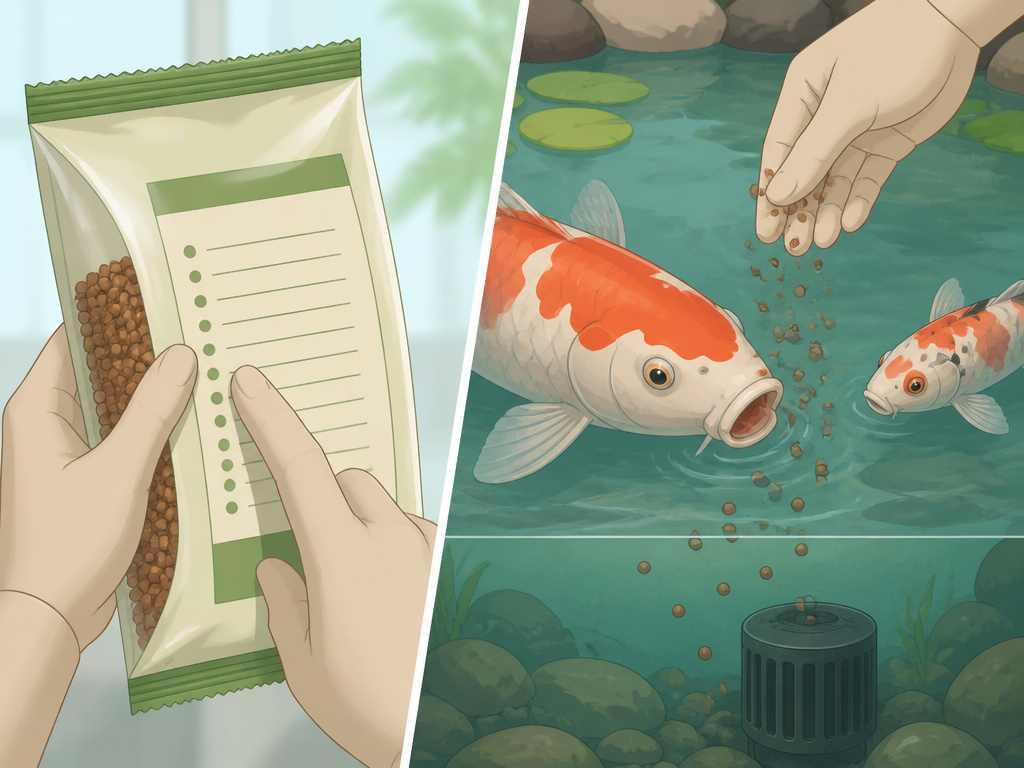
Everyone tells you to follow the label. The label is a starting estimate, and the fish in front of you is the real test.
I started reading fish food labels the way I read cat food bags. A named animal source first on the panel, not a grain, is a sign. A grain first with the animal source buried lower is a cereal with a fish theme. Koi pellets follow the same logic, and the front of the bag tells you very little about which one you’re holding.
That’s the part the front label skips. The protein percentage on a tub tells me little without knowing the source. Same lesson as cats: the percentage is the headline, the ingredient order is the story.
Koi Japan’s feeding guide adds the observation layer that no chart can give you. Watch distribution, repeated spitting and uneaten pellets. If smaller koi in a mixed group miss out, the pellet is too big or the feeding spot is wrong. POND Trade Magazine makes the same point: feeding 3 mm pellets to 2-6 inch koi, especially in mixed populations, ensures the smaller fish have access to food.
Common mistake: Topping up for the full five minutes. The timed window is a ceiling, and Koi Japan is explicit about it. The excess food ends up in the filter.
If you’re already seeing leftovers or cloudy water, the signs of overfeeding fish are worth checking before you change anything else.
How to Pick a Koi Food by the Ingredient Panel
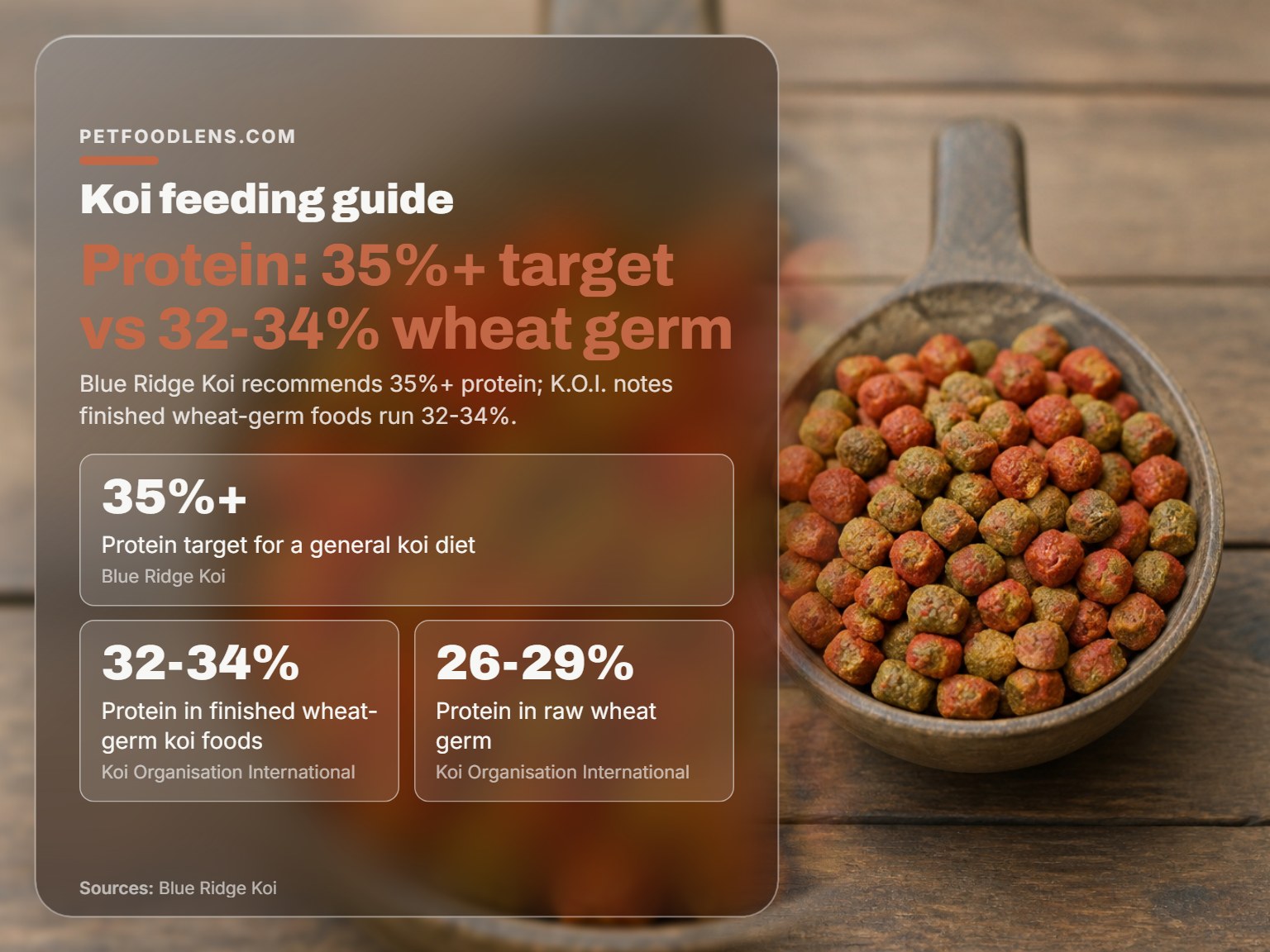
Protein percentage is the headline. The ingredient order is the story.
Blue Ridge Koi’s consumer guide recommends food high in protein, ideally 35% or higher, while K.O.I. Notes finished wheat-germ koi foods run around 32-34% protein. K.O.I.’s cold-water guidance notes that finished wheat-germ koi foods run around 32-34% protein, versus 26-29% in raw wheat germ. Those two figures describe different things: a target for a general diet versus what a specific cool-water formula actually contains. A wheat-germ food in the 32-34% range is doing its job, even though it sits below Blue Ridge’s 35% target.
What the Protein Number Actually Tells You
The rest of Blue Ridge’s checklist is more useful than the protein number:
- A named animal source first on the panel, not a grain
- Spirulina, for color and digestion support
- Vitamins A, B, C and D listed on the guaranteed analysis
- No low-protein, high-fat formulas
POND Trade Magazine adds a detail that matters for mixed ponds: koi clay should only be given when water temperature is above 60°F, and if you feed it separately, mix approximately 1/4 cup of clay with 4 cups of koi food a few times a week.
For a fuller comparison of formulations, the best koi food breakdown covers the ingredient panels side by side. If you keep goldfish in the same pond, koi food vs goldfish food explains where the formulations diverge.
The peer-reviewed koi cultivation review discusses typical maintenance feed composition. That’s the range most commercial foods are built around, and it’s a useful sanity check against any bag claiming a wildly different profile.
Pellet Size Reference
Hikari’s two lines use slightly different size bands, and the fish-length guidance applies to the Hikari product per Koi Japan’s guide, not to every brand.
| Pellet Size | Diameter Range | Approx. Fish Length |
|---|---|---|
| Baby | 2.5-2.8 mm (Staple only) | Not listed |
| Small | 3.5-4.0 mm | 10 cm and above |
| Medium | 4.0-5.5 mm (Staple) / 5.0-5.5 mm (Wheat-Germ) | 20 cm |
| Large | 8.0-9.0 mm | 30 cm |
Blue Ridge Koi recommends wheat germ-based formulas for the 65-50°F band, and Hikari Wheat-Germ Formula is one option below 64°F. For summer growth feeding, choose a food high in protein, ideally 35%+. The best pond fish food comparison covers where each one sits.
Storage, Leftovers, and the Five-Minute Rule
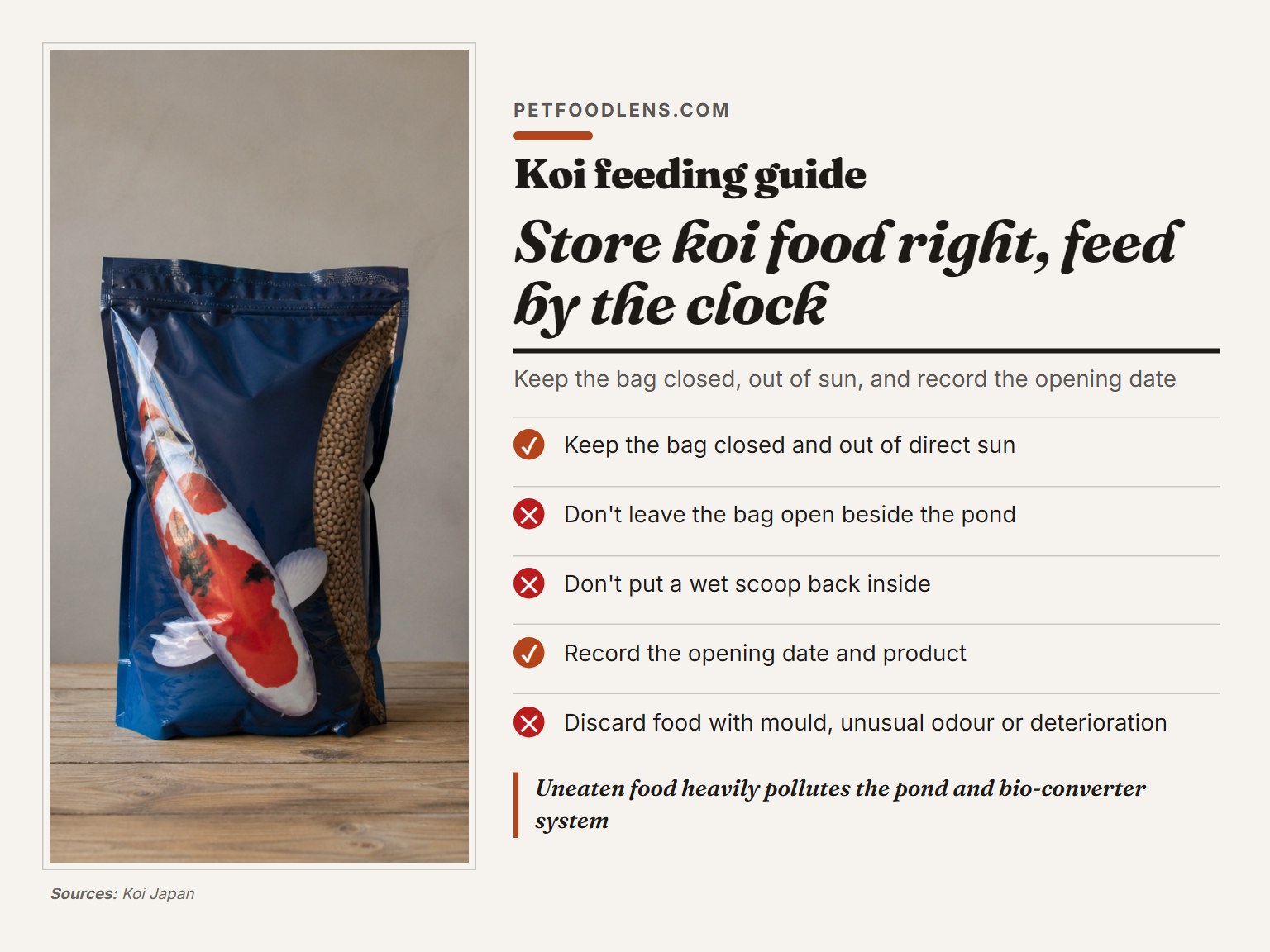
Opened koi food goes bad faster than most keepers think.
Koi Japan’s storage rules are specific: keep the bag closed and out of direct sun, don’t leave it open beside the pond, don’t put a wet scoop back inside, and record the opening date. Avoid repeated temperature changes that cause condensation. Discard food with mold, unusual odor or other deterioration.
A tub that’s taken on moisture may deteriorate before you see mold. That’s the tell.
The Five-Minute Rule in Practice
The feeding sequence that prevents most problems is short:
- Check water temperature with a thermometer, not your hand.
- Read the current food’s label for that product’s range.
- Watch the fish before you feed: appetite, swimming, breathing.
- Check water tests and equipment if anything looks off.
- Then measure a small ration and feed.
Skipping step 3 is how keepers end up feeding fish that are already in distress. Koi Japan’s guidance is to investigate before feeding if something is wrong, not after.
The five-minute rule has one more wrinkle. If you use an automatic pond feeder, Koi Japan flags a specific failure mode: splitting a daily ration across multiple events is not the same as repeating the full amount per event. Program the total, not the per-feed number.
Worth knowing before you start: Uneaten food doesn’t disappear. K.O.I. Calls overfeeding poor water quality management and says uneaten food heavily pollutes the pond and bio-converter system. Hikari’s labels say the same thing in fewer words: remove all remaining food after the feeding period.
Frequently Asked Questions
Can I feed koi bread or rice?
No. Koi Japan’s guide says to use a formulated koi diet for consistent nutrition. Human foods can unbalance the diet and pollute the water, so they shouldn’t replace the regular staple. An occasional treat is a different question from a staple food.
Should I feed extra before a holiday?
No. Koi Japan warns that extra food can leave waste and worsen water quality. Don’t leave a large ration in the water. Agree feeding and inspection arrangements with your supplier for the absence, and match the amount to the temperature and fish condition.
What protein level should koi food have?
Blue Ridge Koi recommends 35% or higher, while K.O.I. Notes finished wheat-germ foods typically run 32-34%. K.O.I. Notes that finished wheat-germ foods typically run 32-34%, versus 26-29% in raw wheat germ. For cool-water feeding, the wheat-germ range is normal. For summer growth diets, Blue Ridge Koi’s 35%+ target applies, while K.O.I.’s 32-34% figure describes finished wheat-germ foods.
Do koi need feeding in winter?
It depends on your pond. K.O.I. And Blue Ridge Koi both say stop below 50°F. Hikari’s Wheat-Germ label allows feeding down to 41°F at no more than twice daily. Koi Japan says the decision depends on heating, measured minimum temperature and fish activity.
Why do my koi spit out pellets?
Check pellet size first. Koi Japan says to review size if fish struggle to take a pellet, repeatedly spit it out, or smaller individuals miss out. Hikari’s pellet sizes run 3.5-4.0 mm small, 5.0-5.5 mm medium and 8.0-9.0 mm large for Wheat-Germ, with approximate fish lengths of 10 cm, 20 cm and 30 cm.
Can I mix feeding charts from different brands?
No. Koi Japan explicitly warns against combining unlike manufacturers’ advice into one universal threshold. Each product’s label is built around that product’s formulation. Pick one food, follow its chart, and adjust from observation.
The Bottom Line
If your pond drops below 50°F and you’re not heating it, K.O.I. And Blue Ridge Koi say stop feeding, while Hikari’s Wheat-Germ label allows reduced feeding down to 41°F and Koi Japan says it depends on your system. If you’re heating, measure your actual minimum and use the Hikari Wheat-Germ label as your guide down to 41°F.
This all assumes an unheated pond. A heated pond changes the calculus entirely, and Koi Japan’s point that winter stop/feed depends on heating and measured minimum temperature is the most useful sentence in the whole debate.
I’d rather see a keeper underfeed for a week than overfeed for a day. The fish can go up to 6 months without eating in cold water. The filter can’t go a week without clean water.
