
Rawhide Chews Pros and Cons: What the Label Hides
This post contains affiliate links. As an Amazon Associate, we earn from qualifying purchases.
The rawhide chews pros and cons are measurable: rawhide abrades tartar off teeth (a 67-dog JAVMA trial found it beat cereal biscuit), but gastric digestibility ranged from 8.41% to 86.90% across rawhide samples in a 2020 in vitro study, and the FDA recalled five brand families over an unapproved processing chemical.
Digestibility is the number nobody prints on the bag. An in vitro assay measures how much of a chew disappears in simulated stomach fluid, and rawhide produced the widest spread of any treat category tested, 35.10% to 95.70% in the intestinal phase.
What follows is the dental case, the three failure modes that actually send dogs to a vet, the label lines worth reading, and the dogs that should never get a rawhide at all.
Key Takeaways
- Digestibility varies by product, not category. Rawhide samples in the 2020 in vitro work ran from 8.41% to 86.90% gastric dry matter disappearance.
- The dental evidence is real but modest. A 67-dog JAVMA trial found rawhide removed supragingival calculus better than cereal biscuit, and the same paper says the optimal amount was never established.
- Brushing still outranks any chew. Today’s Veterinary Practice names regular tooth brushing as the most effective tartar control, with chews behind it.
- Five brand families were recalled over a quaternary ammonium compound not approved in the U.S. As a rawhide processing aid.
- Strong chunk-breakers should not get rawhide. The AKC rule is simple: if large pieces come off with little effort, take it away and bin it, while the ASPCA advises larger, durable products for aggressive chewers and limiting the amount consumed at any one time.
Rawhide Chews Pros and Cons Begin With What’s Actually in the Bag
Rawhide is a leather-industry by-product. Hides come off slaughterhouse kill floors and go into high-salt brines to slow decay, then travel to a tannery for liming, hair removal, and rinsing.
Rawhide production begins with rendering or tanning animal hides, which are then cut and trimmed to size. A finished chew often consists of multiple layers of hide. Hides move from slaughterhouse kill floors into high-salt brines, and weeks to months can pass before final manufacture. Most rawhide chews are manufactured in China.
That timeline is the part worth sitting with. A wet organic material that sits for weeks before processing needs help staying presentable, and the recall exists precisely because of what one company used as that help.
A finished chew often presses several layers of hide together. Two chews of identical weight can therefore behave completely differently in a dog’s stomach, which is the whole reason the digestibility numbers later in this piece are so scattered.
You can see the difference at home. A thick knotted rawhide softens and slicks at the edges within minutes of a determined chewer starting on it, then dries back into a hard, glassy sheet on the kitchen floor.
Four things the front of the bag won’t tell you:
- Where the hide came from. Most rawhide is manufactured in China, and U.S.-made chews are harder to find and more expensive, per the AKC.
- Whether it’s compressed or natural. The ASPCA lists both forms, and compressed chews are aimed at moderate to light chewers.
- How many hide layers are pressed into it. More layers means more material reaching the stomach at once.
- Anything about digestibility. Rawhide isn’t treated as a food, so no digestibility figure appears anywhere on the pack.
Do rawhide chews actually clean a dog’s teeth?
Sixty-seven dogs settled most of this in 1990. That JAVMA trial measured supragingival calculus, the hard deposit that builds above the gumline, before and after chewing.
Dogs removed calculus by chewing rawhide. Some teeth cleaned better than others, and rawhide beat processed cereal biscuit at the same job. The paper is also honest about what it didn’t settle: the optimal amount or frequency of rawhide treatment was not necessarily determined.
VCA Animal Hospitals describes the mechanism plainly. Rawhide-based oral hygiene chews have an abrasive texture that can help prevent or delay the formation of dental plaque and calculus.
Texas A&M’s Dr. Lori Teller frames the benefit the same way, saying rawhides can help limit plaque and tartar buildup, keep jaw muscles strong, and potentially slightly freshen a dog’s breath.
Then the counterweight. Today’s Veterinary Practice states that regular tooth brushing is the most effective way to control tartar, improve oral health, and reduce breath odor. The same review cites a survey where owners ranked a healthy diet and natural chews as more important to dental health than brushing, and some called brushing unnatural. That belief is doing an enormous amount of selling in the chew aisle.
The review also reports a study where raw femur bones cut calculus by 35.5% after 3 days and 70.6% after 12 days, with no complications observed. The FDA still warns against giving dogs real bones, because bones cut mouths and fracture teeth.
I’ve read the fronts of about 15 OTC “urinary health” bags for a different project. Nearly all of them said “supports” or “promotes,” and not one said “dissolves.” Rawhide packaging runs the same play with “dental” and “digestible,” and neither word carries a testing requirement behind it.
So the dental case for rawhide is real and small. It abrades. It does not replace a brush.
Why rawhide is not one product: the digestibility numbers
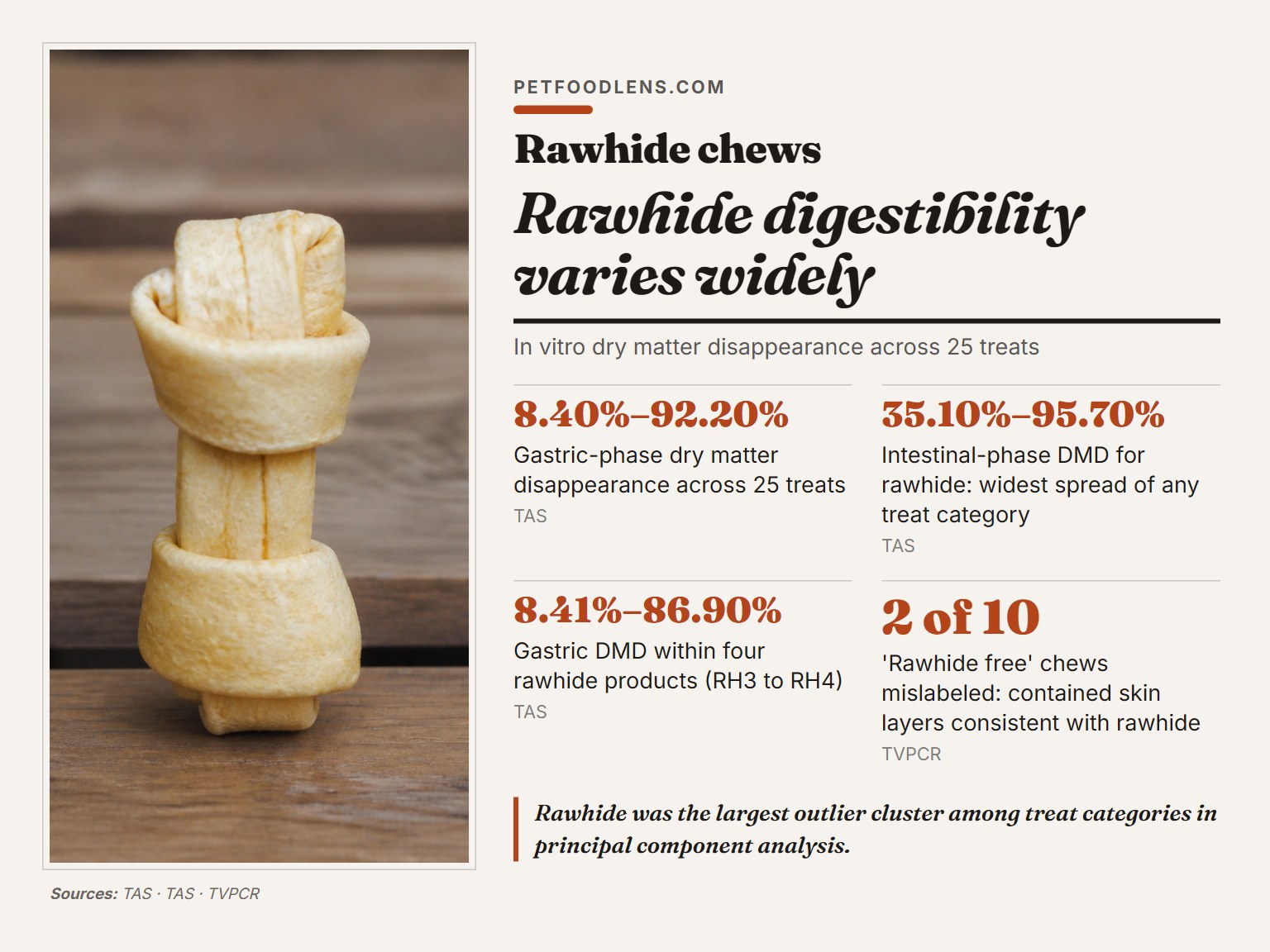
The 2020 in vitro work tested 25 treats, and rawhide came out as the largest outlier cluster in the whole analysis.
Across all 25 treats, gastric dry matter disappearance ranged from 8.40% to 92.20%, and the intestinal phase ran from 35.10% to 100%. Within the rawhide category alone, intestinal values spanned 35.10% to 95.70%, the widest spread of any category tested.
A second in vitro study, published in the British Journal of Nutrition, tested 19 treats across six categories. Gastric values across all treats ran from 6.9% to 88.8%, intestinal values from 10.7% to 100.0%, and bone came out as the least digestible category in both phases.
| Sample | Gastric phase DMD | Intestinal phase DMD |
|---|---|---|
| RH3, 2020 study | 8.41% | Not reported per sample |
| RH1, 2020 study | 15.63% | Not reported per sample |
| RH4, 2020 study | 86.90% | Not reported per sample |
| Rawhide 1, Br J Nutr study | 14.2% | 77.5% |
| Rawhide 2, Br J Nutr study | 73.1% | Above 99% |
| Rawhide 3, Br J Nutr study | 40.9% | Above 99% |
Read that table twice. Two rawhides in the same laboratory, run through the same assay, sat at 14.2% and 73.1% gastric digestibility. A third in the 2020 set landed at 8.41%.
Here is where the sources genuinely split. The 2020 paper characterizes rawhide as the widest, least predictable category. The British Journal of Nutrition paper reports two of its three rawhides clearing 99% in the intestinal phase, which reads far more kindly. Today’s Veterinary Practice takes a third position, stating that rawhide is not considered a food and its digestibility is often unknown or suspected to be poor.
All three are describing the same product category, and all three are right about their own samples. The variance is product-level. A bag labeled “rawhide” tells you nothing about which of those numbers applies to the chew inside it.
Where this goes sideways: Treating “rawhide” as one ingredient and picking any bag off the shelf. The 2020 data show gastric breakdown ranging from 8.41% to 86.90% within the category, so the bag you bought last month and the bag you buy this month can behave like different products.
There’s a documented consequence to the slow end of that range. The 2020 paper cites work from 1994 showing that indigestible leather fragments swallowed by dogs may lead to gastrointestinal blockage or diarrhea.
The recall, and what it says about where the hide came from
Picture a bag of Healthy Hide Good-n-Fit on a pantry shelf, stamped with an expiration date somewhere between 06/01/2019 and 05/31/2020. That bag was part of a voluntary recall.
What the recall actually covered
United Pet Group, a division of Spectrum Brands, recalled multiple brands of rawhide chews distributed to retail stores and sold online in the U.S. The company identified that its own rawhide manufacturing facilities in Mexico and Colombia, plus one supplier in Brazil, were using a quaternary ammonium compound mixture as a processing aid.
That compound is an antimicrobial chemical approved for cleaning food processing equipment. It has not been approved in the U.S. As a processing aid in the production of rawhide chews for dogs.
The recall covered all package sizes and weights, with lot codes beginning AH, AV, A, AI, AO, or AB. Five brand families were named: American Beefhide, Digest-eeze, Healthy Hide, Healthy Hide Good-n-Fit, and Healthy Hide Good-n-Fun.
Reported symptoms were reduced appetite, gastric irritation, diarrhea, and vomiting. The primary consumer complaint was an unpleasant odor. Owners were told to dispose of the product or return it for a full refund, and the consumer affairs line ran 1-855-215-4962 from 8:00 AM to 11:00 PM Eastern Standard Time.
Now the sourcing question, where the experts don’t line up. Texas A&M’s Dr. Lori Teller advises looking for rawhides sourced from American beef and processed in the U.S. The AKC concedes that U.S.-made rawhides are harder to find and more expensive than the average chew, and argues the benefits justify it. The ASPCA’s position statement gives no country-of-origin guidance at all, and instead points owners toward label directions and matching the product to the individual dog.
Three credible institutions, three different answers. The recall is the reason the first two lean where they lean.
The part nobody mentions: “Rawhide free” is not a verified claim. A study cited in the 2024 clinical review tested 10 products marketed that way with histologic staining, and 2 contained skin layers consistent with rawhides, inconsistent with their own labels. Four of the 10 carried bacterial and fungal organisms.
How much rawhide is too much? Three sources, three answers
The only controlled daily allowance in the literature comes from a 1990 trial, and no agency has replaced it since.
That trial found regular consumption of up to 3 rawhide strips per day for 3 weeks was safe in 67 dogs. It also said, in the same breath, that the optimal amount or frequency was not necessarily determined. Safe in a trial and optimal are two different claims.
| Source | Daily rawhide guidance | Basis |
|---|---|---|
| JAVMA, 1990 | Up to 3 strips per day for 3 weeks | 67-dog feeding trial |
| VCA Animal Hospitals | Once daily, or as directed by a veterinarian | Clinical dosing guidance |
| ASPCA | Limit the amount at any given time; no daily figure | Position statement |
VCA treats rawhide-based oral hygiene chews as a short-acting supplement, given once daily, that stops working within 24 hours. Effects may be prolonged in pets with liver or kidney disease.
The ASPCA takes a different route entirely. It advises limiting how much rawhide a dog consumes at any one time and discouraging consumption of significant pieces, without offering a daily number.
Here’s the practical read. Most dogs find rawhide highly palatable and will consume an entire chew in a single session, per the ASPCA. A chew that disappears in one sitting is a meal, not a treat, and the 2024 clinical review notes that treat labeling should disclose more about ingredients and that varying nutrient and caloric density should factor into whether a chew suits a particular dog.
Which dogs should never get a rawhide chew?
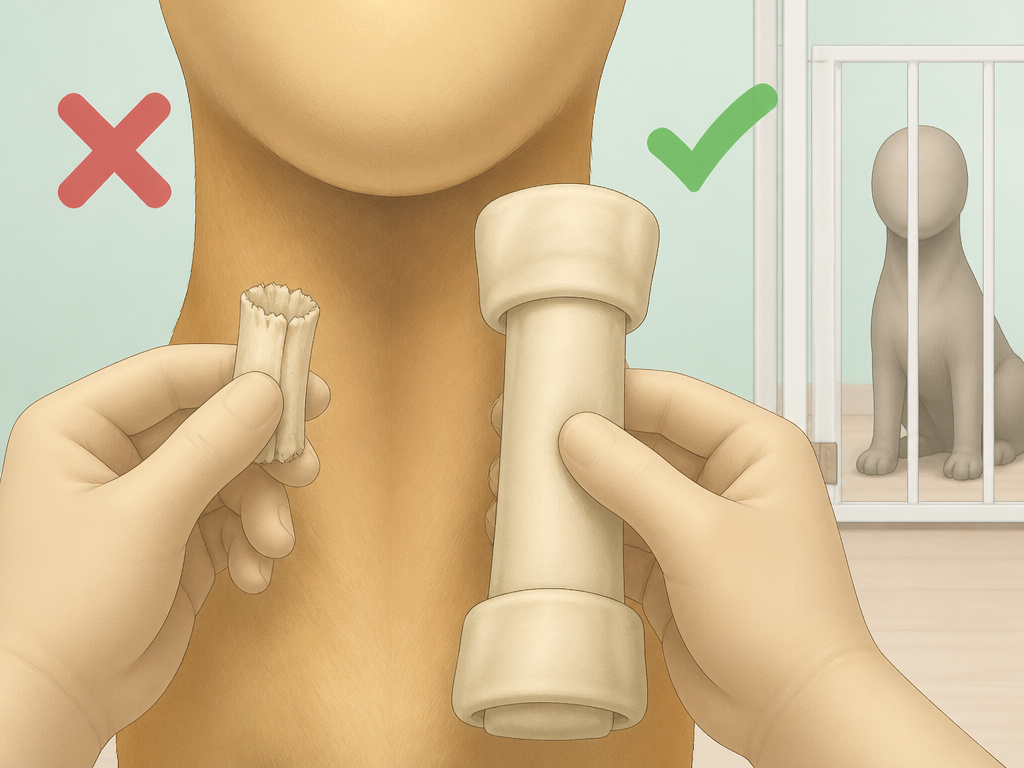
Some dogs should never see a rawhide. The AKC draws the line clearly: if a dog can break off large chunks with little effort, rawhide is not the chew for that dog, while the ASPCA advises larger, durable products for aggressive chewers and limiting the amount consumed at any one time. Take it away and discard it where the dog can’t reach it.
The ASPCA adds a size note. Obstruction may be more likely to occur in smaller dogs, and guardians should consult a veterinarian immediately if a dog consumes a chunk of chew material.
Before you start: Three hazards drive almost every rawhide emergency. A swallowed chunk can lodge in the esophagus or intestine, so size the chew above your dog’s throat and remove it once it shrinks. A worn end piece becomes a choke point, so bin it once it gets small. A second dog in the room turns chewing into a race, so separate them before any chew comes out.
The five-step supervision routine
- Match the chew to the dog’s weight and size. VCA and Texas A&M both call for the appropriate size for the pet, and an oversized chew gets abandoned while an undersized one gets swallowed.
- Separate the dogs first. Texas A&M recommends separating dogs in multi-dog households, because competition drives gulping. Skip this and the calmest dog in the house may bolt a half-chew.
- Rinse it if you follow AKC guidance. The AKC advises fully rinsing a rawhide in water before giving it, while the ASPCA lists no rinse step, so this one is a judgment call.
- Watch the whole session. The AKC says always supervise, and the ASPCA says actively observe, while VCA gives no supervision instruction. Leave the room and you lose the only window you had to intervene.
- Take it away when it gets small. Texas A&M’s rule is to remove any chew that has reached a size where it can cause choking or obstruction. A small stub is already past that line.
A dog working a rawhide makes a wet, rhythmic scrape against the back molars. When that sound turns into a dry crack, the piece is breaking off instead of wearing down, and the session is over.
Reading a rawhide bag in four checks
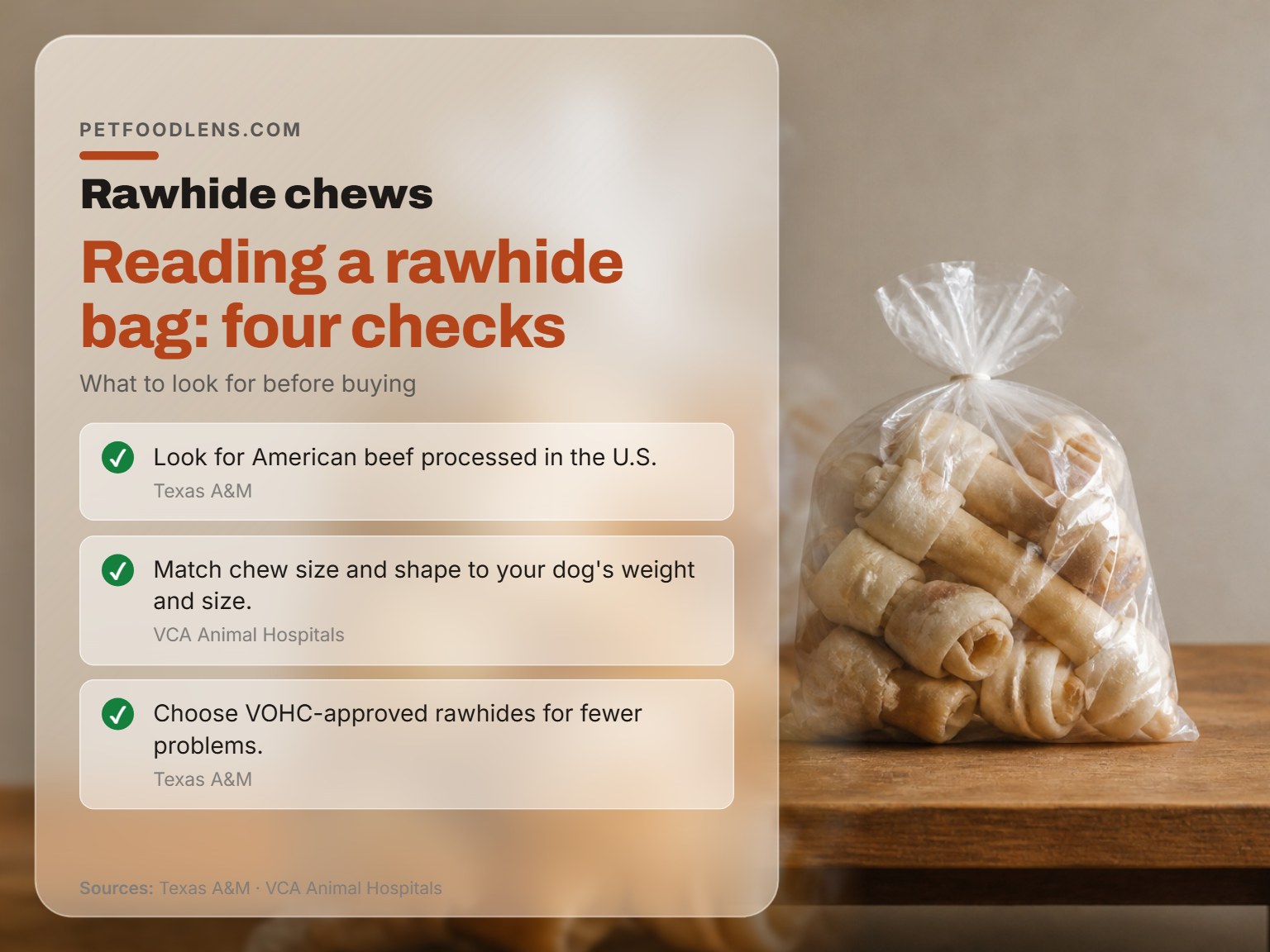
Four things are worth checking before the bag goes in the cart, and only one of them appears on the front.
- Origin and processing. Texas A&M advises American beef processed in the U.S.; the AKC notes that costs more and is harder to find. If origin isn’t printed, treat that as its own answer.
- Size and shape for your dog. VCA says to use the size appropriate for the pet’s weight and size. A chew sized for a Labrador is a hazard for a terrier.
- Thickness. The AKC argues thicker is better because it takes longer to chew, while the ASPCA sets no thickness rule and instead emphasizes size, shape, and discouraging large pieces.
- VOHC acceptance. Texas A&M notes that rawhides approved by the Veterinary Oral Health Council tend to be safer and cause fewer problems, while the ASPCA makes no VOHC recommendation.
That last one is the closest thing to a shortcut in this category. A VOHC seal means somebody tested the claim. If you want a starting point rather than a research project, read the best chew treats for dogs and then run each candidate through a safe chew checklist before you buy.
Rawhide vs the alternatives: which chew wins for which dog
So what do you hand over instead? It depends on one variable: how fast your dog destroys things.
A moderate chewer that takes real time on a thick knotted rawhide is the dog rawhide was designed for. A dog that reduces a knotted chew to paste quickly is not, and no supervision schedule fixes that. For that dog, a durable nylon chew is the honest swap, since the ASPCA advises larger, durable products for large breeds and/or aggressive or frenzied chewers.
If you want a dental claim without the hide, a dental chew keeps the ritual and drops the rawhide. If you want a rawhide-based dental chew with a named manufacturer behind it, VCA points to C.E.T. Enzymatic Oral Hygiene Chews, dosed once daily or as your veterinarian directs.
| Chew type | What the sources say | Main risk |
|---|---|---|
| Rawhide | Abrasive; digestibility varies widely by product | Chunk swallowing, obstruction |
| Nylon and hard plastic | Suited to aggressive chewers; wear down slowly | Thin worn sections break off |
| Antlers, bones, hooves | FDA warns against them | Fractured teeth, mouth cuts |
| Pig ears | Frequently contaminated with Salmonella | Risk to dogs and people |
| “Rawhide free” chews | Poorly regulated; 2 of 10 mislabeled | Unlisted hide content |
Rawhide vs bully sticks and yak cheese chews
Both belong in the same conversation, and both raise the same three questions: how hard is it, is it sized to your dog, and how fast does your dog get through it. If you’re weighing bully sticks or yak cheese chews, run them through the identical checklist rather than assuming a non-hide chew is automatically safer.
Rawhide vs antlers, bones, and no-hide chews
This is the comparison where the hardness argument lands hardest. Texas A&M notes that the FDA warns against real bones, antlers, and hooves because bones can cause cuts in the mouth and fracture teeth. A chew that resists a dog’s teeth is also resisting them hard enough to break one.
That’s why antlers and raw bones sit below rawhide on my list for most households, despite the dental numbers attached to femur bones. For owners who want to leave hide behind entirely, no-hide chews are the category to read carefully, given that mislabeling study. And if you’re still mapping the whole aisle, start with the types of dog chews before picking a favorite.
Frequently Asked Questions
Are rawhide chews safe for dogs?
For a moderate chewer, sized correctly and supervised, rawhide carries a long history of use and a documented dental benefit. The 1990 JAVMA trial fed up to 3 strips per day for 3 weeks with no safety finding against it. The risk sits with dogs that break off large chunks, and with products whose digestibility is unknown.
How long should a dog chew on rawhide?
VCA’s dosing guidance is once daily or as directed by a veterinarian, while a 1990 JAVMA trial found up to 3 rawhide strips per day for 3 weeks safe in 67 dogs, and the ASPCA avoids a daily figure and instead says to limit the amount consumed at any given time. Practically, end the session when the chew gets small enough to swallow, not when the clock runs out.
Do rawhide chews help with bad breath?
Partly. Texas A&M’s Dr. Lori Teller says rawhides can potentially slightly freshen a dog’s breath while limiting plaque and tartar. Today’s Veterinary Practice is clear that regular tooth brushing remains the most effective way to reduce breath odor, so treat the chew as a supplement.
Is rawhide actually indigestible?
The honest answer is that it varies enormously. The 2020 in vitro study found rawhide intestinal digestibility spanning 35.10% to 95.70%, while a British Journal of Nutrition study found two of three rawhides clearing 99%. Today’s Veterinary Practice describes rawhide digestibility as often unknown or suspected to be poor.
Should you rinse rawhide before giving it to a dog?
The AKC advises fully rinsing a rawhide in water before offering it, while the ASPCA’s position statement includes no rinse step and focuses on label directions, sizing, and observation. Both are defensible; rinsing costs nothing.
What does “rawhide free” mean on a chew label?
Less than the label implies. In a study cited by the 2024 clinical review, 2 of 10 products marketed as rawhide free contained skin layers consistent with rawhides, which contradicted their labeling. Four of the 10 also carried bacterial and fungal organisms.
The Bottom Line
Weigh the rawhide chews pros and cons on three things: where the hide came from, whether the chew is sized to your dog, and whether your dog breaks chunks off instead of wearing them down.
Here’s the threshold I’d use. If your dog can strip a chunk off a knotted rawhide with little effort, rawhide is off the list permanently, and no amount of supervision converts a gulper into a chewer. That’s not a judgment about the product. It’s a judgment about the match.
The first thing to do this week costs nothing: turn one bag over and find the country of origin and the lot code. If neither is printed, you’ve learned as much as the recall notice would have told you.
One concession, and it’s a real one. Rawhide earns its place for the right dog: a moderate chewer, correctly sized, supervised, working on a thick cut that takes actual time. The 1990 trial numbers support that dog. They say nothing about the dog that swallows.
