
How to Read a Pet Food Recall Notice: Lot Codes and Dates
This post contains affiliate links. As an Amazon Associate, we earn from qualifying purchases.
To read a pet food recall notice, match three things: the lot or batch code, the best-by date, and the exact product name and pack size. The FDA says lot numbers aren’t required on packaging, and the 2021 Mars Petcare UK alert listed the batch field as ‘0’ because every unit of those products was affected.
That ‘0’ is the trap. A whole-SKU recall means the batch code won’t narrow anything down, so an owner who checks only their lot number and finds no match walks away believing the food is safe. Knowing how to read a pet food recall notice means reading the notice format itself, then the code inside it.
What follows walks the four codes on the bag, the two regulators that publish these notices, and the how to read a pet food recall notice field most owners skip. By the end you’ll know whether your bag is in the recall, and what to do if it is.
Key Takeaways
- Lot numbers aren’t required on US pet food packaging, per FDA, though most companies print them anyway.
- The batch field can read ‘0’ in UK FSA notices, meaning every unit of that SKU is in scope.
- Best-by dates can double as lot codes, so a date match may not isolate the batch you actually have.
- Save the original bag until the food is gone; FDA says the packaging carries the plant and production date.
What the Recall Notice Actually Tells You
The notice is a short, structured document with a fixed set of fields. Once you know which field carries the answer, you can read one in the time it takes to check a receipt.
A recalling company’s notification lists the product description, brand, pack size and type, UPC, lot codes, sell-by or use-by dates, packaging photos, and distribution states or stores.
Two regulators publish the notices most owners will actually see: the FDA in the US, and the Food Standards Agency in the UK.
The FDA 101 product recalls explainer defines a recall as a company action to remove a product that violates US law, initiated voluntarily or at FDA request. More than 83,000 FDA-regulated products were recalled between 2014 and 2024, per that page. Pet food is a small slice of that total, but the notice format is the same.
I’ve read enough of these to know the how to read a pet food recall notice shape is predictable. Learn the fields once and the next notice reads fast.
How Do You Find the Lot Number on the Package?
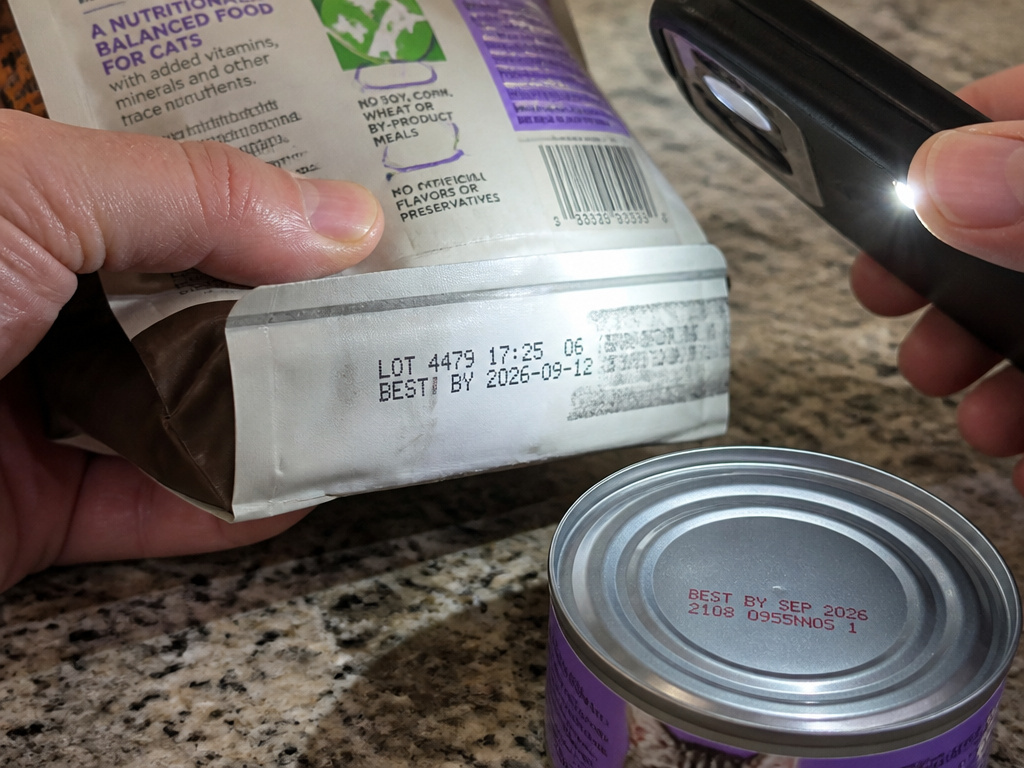
Start at the best-by date. The FDA says the lot number is always in close proximity to that date, if the product has one. On a bag or pouch, look on the bottom, the side, or a few inches from the top. On a can, look at the bottom first, then the lid.
Some companies print it with a ‘LOT’ prefix. Others print it with no label at all.
- Check the best-by date first. The lot code sits near it on almost every package.
- Look on the bottom seam of a bag, the side panel, or a few inches from the top.
- On a can, check the bottom, then the lid.
- If you can’t find it, photograph every code on the package and report them all.
The FDA guide to saving lot numbers says to report all the codes found on the packaging when in doubt, and to save the original packaging until the food is consumed.
The codes fade. Over time in a humid cupboard the ink on the bottom seam can smudge until you can’t read the last digits. In my experience, the lot code is the field owners skip first.
What If the Bag Has No Lot Code at All?
This is more common than it sounds. FDA says lot numbers aren’t required on pet food packaging, though most companies include them.
If yours is blank, fall back on the best-by date, the net weight, and the purchase location. When in doubt, report all the codes you find. FDA can work with the company to identify the product even if you don’t get the code completely right.
The Four Codes on the Bag and What Each One Does
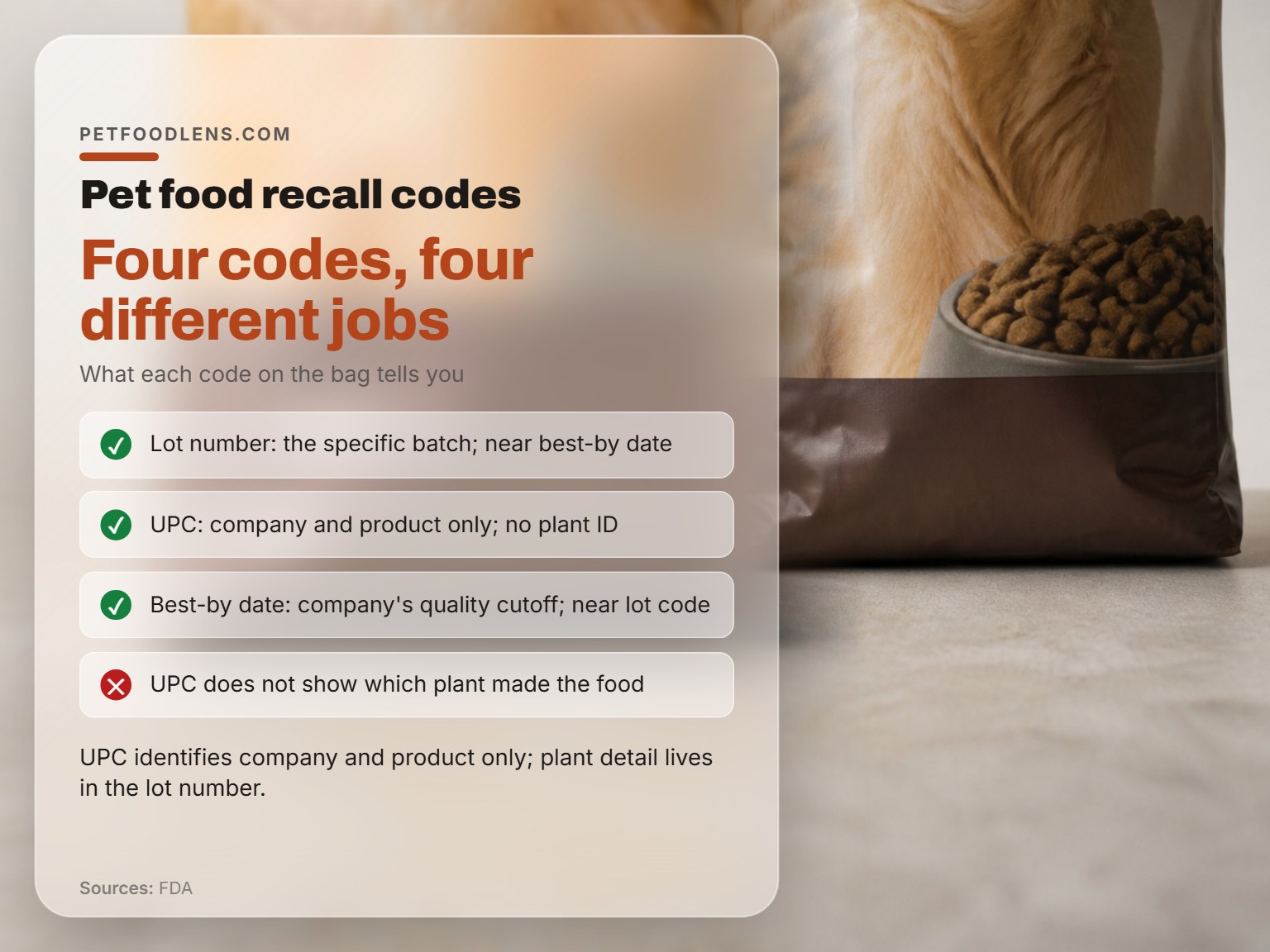
Turn the bag over. The four codes are all there, and each one answers a different question.
| Code | What It Identifies | Where to Find It |
|---|---|---|
| Lot number | The specific batch and plant | Near best-by date; bag bottom, side, or top |
| UPC | Company and product only | Barcode box on the package |
| Best-by date | Company’s quality cutoff | Stamped near lot code |
| Packing code | Manufacture date and time | Inside can code, not a use-by |
The UPC identifies the company and product but does not show which plant made the food, per FDA. That plant detail lives in the lot number.
When the Batch Field Says Zero: Whole-SKU Recalls
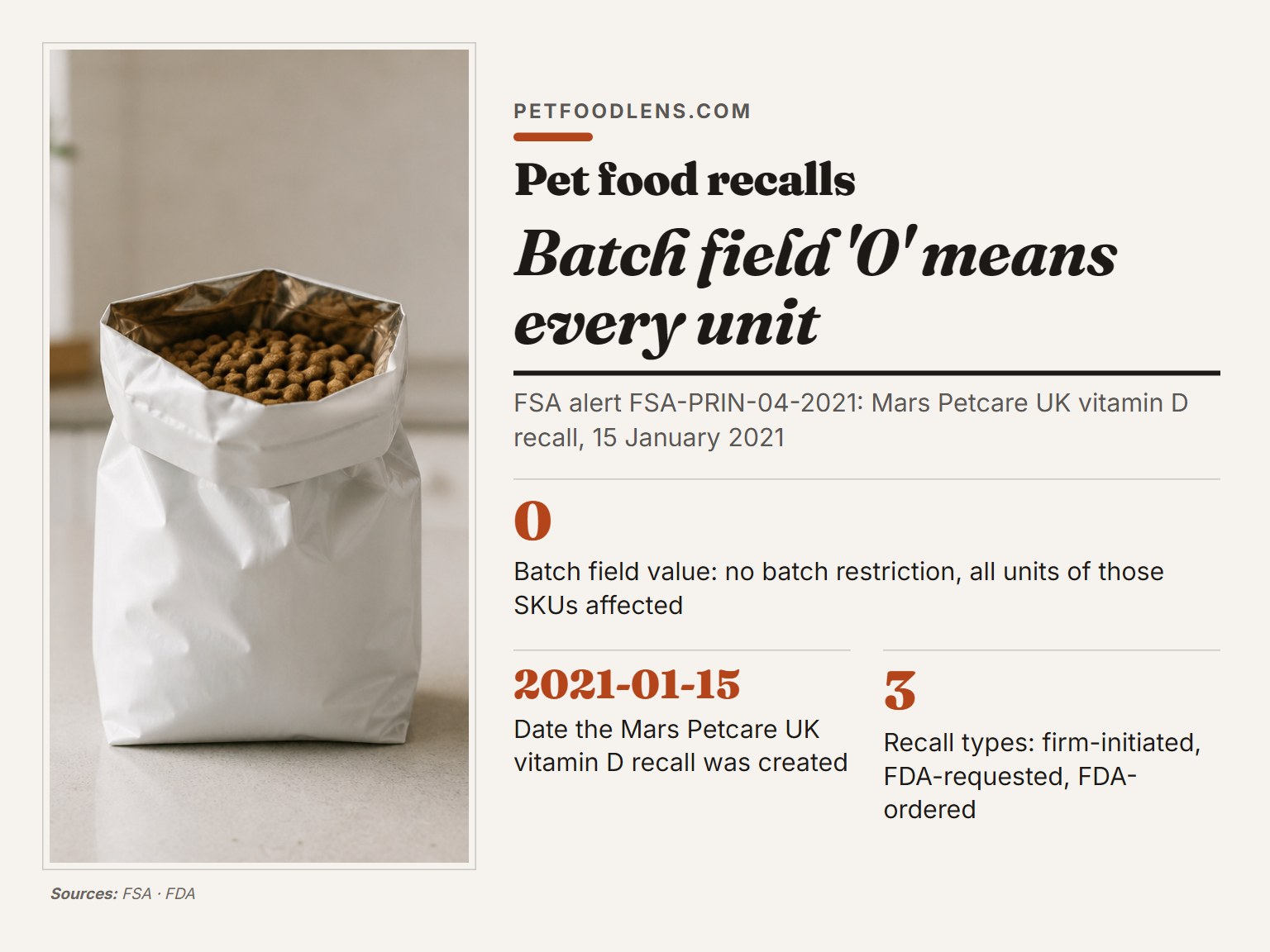
On 15 January 2021, the UK Food Standards Agency published alert FSA-PRIN-04-2021. Mars Petcare UK was recalling several Pedigree and Chappie dry dog foods because they may contain vitamin D above the maximum permitted intake. The batch description field read ‘0’.
A batch field of ‘0’ means no batch restriction. Every unit of those SKUs is affected, so a lot-code check that finds no match does not mean the food is safe.
Where this goes sideways: Checking only the lot code and walking away when it doesn’t match. The batch field says ‘0’, the recall covers every unit of that SKU, and you’ll feed the whole bag before symptoms show.
The FSA risk statement reads like a clinic note. Short-term elevated intake “should not cause undue concern,” but longer feeding can bring lethargy, stiffness, vomiting, diarrhoea, loss of appetite, increased thirst, increased urination, excessive drooling, and weight loss. At very high levels, renal dysfunction.
A dog with elevated vitamin D doesn’t look dramatic at first. The stiffness reads as age, the drooling as a messy drink, and the increased thirst as weather. The notice is what puts the pattern in order.
Formulation error runs on a separate track from Salmonella or aflatoxin, and it produces a different kind of notice.
The FDA pet food recalls and withdrawals page separates recalls from withdrawals, and the agency lists three recall types: firm-initiated, FDA-requested, and FDA-ordered.
I check the batch field before I check the lot code, because the field tells me whether the code even matters.
Best-By Date vs Lot Code: Why the Date Alone Won’t Save You
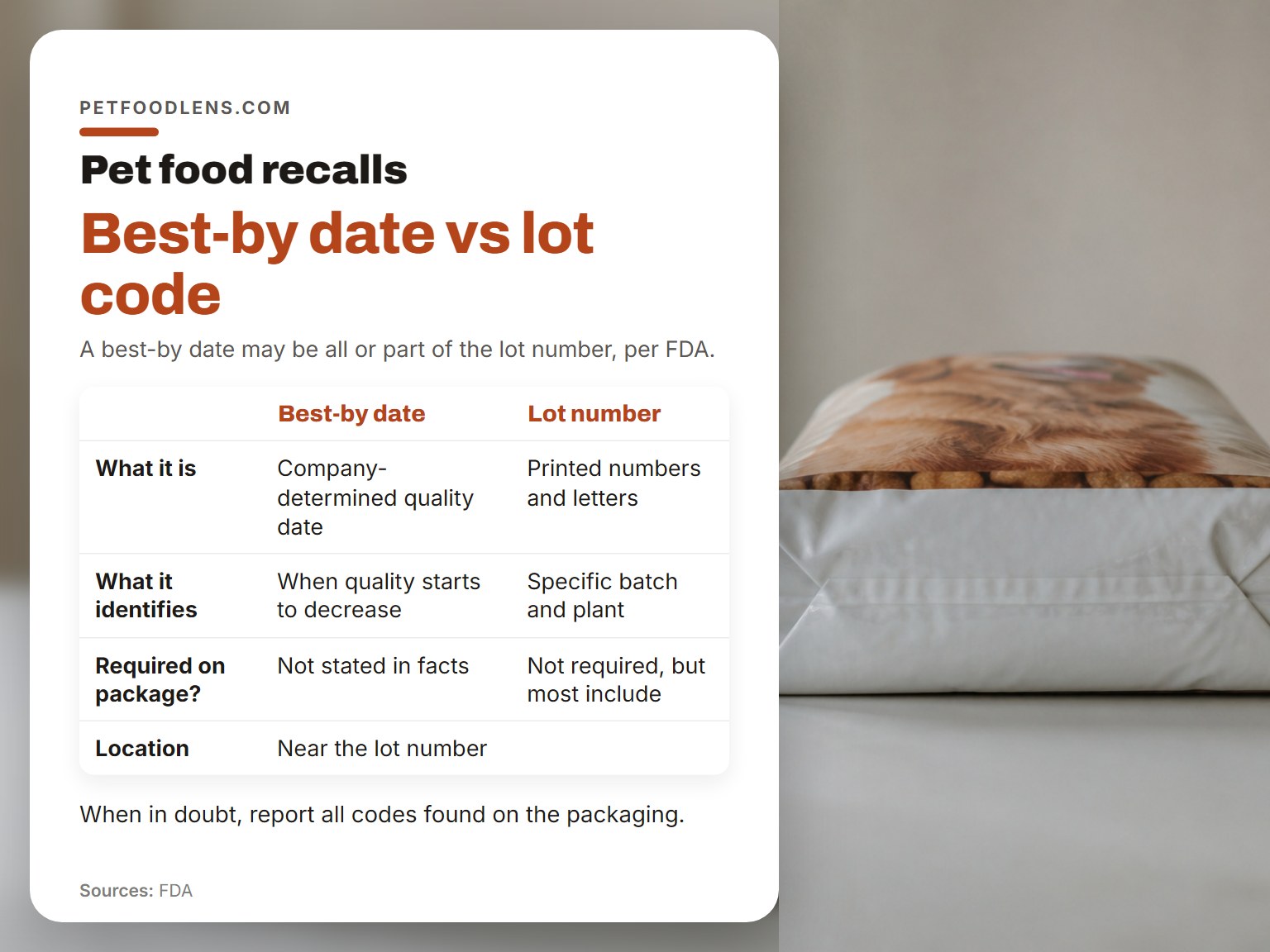
Some companies use the best-by date as the whole lot number or part of it, per FDA. That means a date match may not isolate the batch you actually have.
Why the UPC Isn’t the Answer
The UPC identifies the company and the product. It does not show which plant made the food. That’s the whole reason the lot number exists: to pin a specific batch to a specific plant on a specific production date. A UPC match tells you the brand, not the batch.
A fresh container is the most common moment for a problem to surface.
The ASPCA pet food recall guidance lists purchase red flags: off smell, damaged packaging, past expiration, bugs or mold, improper storage. Those checks catch problems the recall database hasn’t logged yet.
I’d rather see an owner photograph the codes and never need them than need them and not have them.
What to Do If Your Code Matches (and If It Doesn’t)
The bag math matters more than the price per pound. A large bag for a single cat can take months to finish, and the last portion has had a long time to oxidize. If a recall hits month four, you’re throwing out a bag you barely used and can’t return.
| Situation | Action | Source |
|---|---|---|
| Lot code matches | Stop feeding; return to store | FDA 101 |
| No match, but batch field is ‘0’ | Stop feeding; whole SKU is in scope | FSA |
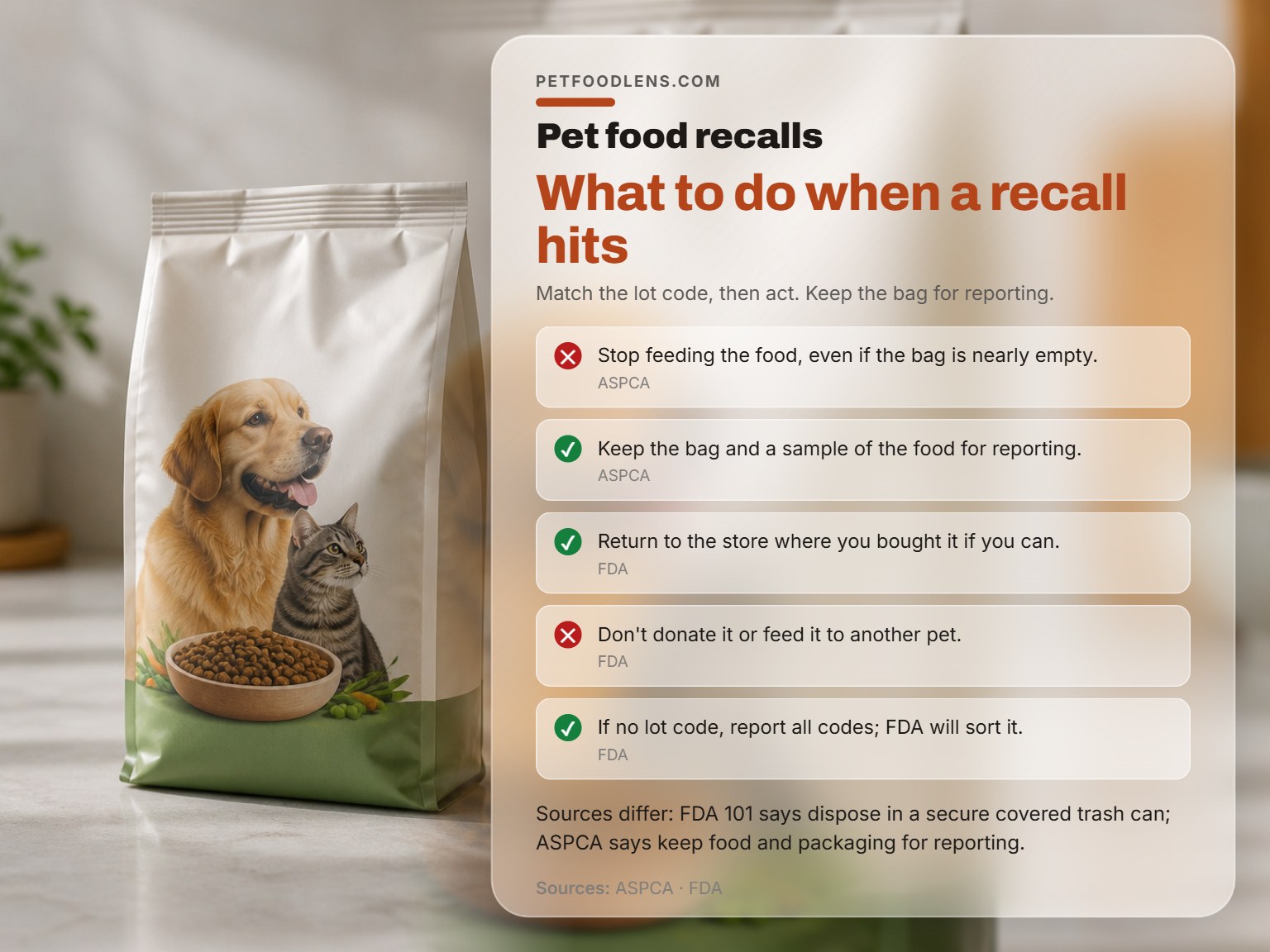
| No lot code on bag | Report all codes; FDA will sort it | FDA lot-number page |
| Pet is already sick | Call vet; call ASPCA poison control | ASPCA |
- Stop feeding the food, even if the bag is nearly empty.
- Keep the bag and a sample of the food for reporting.
- Return to the store where you bought it if you can.
- Don’t donate it or feed it to another pet.
The sources differ: FDA 101 says to dispose of a recalled product in a secure container in a covered trash can or dumpster following local disposal laws, while the ASPCA says not to throw away the packaging or the food yet because you’ll need both for reporting.
If a pet got sick, use the pet food illness reporting path through the Safety Reporting Portal, and have the vet records ready.
Where Do You Check for Recalls Before You Buy?
Three sources cover it: the FDA list, the AVMA page, and recalls.gov.
- The FDA recalls and withdrawals page for US products.
- The AVMA recalls and safety alerts page, which the ASPCA recommends monitoring.
- Recalls.gov, which consolidates six federal agencies into one list.
- The FDA subscription service for daily or weekly notifications.
That’s a lot of noise, but no missed notices.
If you only have time to check one thing before opening a new bag, photograph the lot code and best-by date. Two photos take ten seconds and cover every reporting field FDA asks for later.
I keep the FDA list bookmarked on my phone, and I check it before I open a new bag. It takes less time than finding the bag’s lot code after a notice appears.
Frequently Asked Questions
What if my bag has no lot number?
The FDA says lot numbers aren’t required on pet food packaging, though most companies print them. If yours is missing, check the best-by date, net weight, and purchase location. When in doubt, report all the codes you find. FDA can work with the company to identify the product even if you don’t get the code completely right.
Can a best-by date be the lot number?
Sometimes. FDA says some companies use the best-by date as the whole lot number or part of it. A date match alone may not isolate the batch, so check the other codes too.
What does a batch field of ‘0’ mean?
In UK FSA structured recall notices, a batch description of ‘0’ means no batch restriction. Every unit of the named SKUs is affected, so a lot-code check that finds no match does not mean the food is safe.
Do I need to keep the bag after I open it?
Yes. FDA says to save the original packaging until the pet food has been consumed, because it carries the variety, manufacturing plant, and production date. Photograph the codes when you open the bag as a backup.
What if my pet is already showing symptoms?
Stop feeding the food and call your veterinarian. The ASPCA Animal Poison Control Center is at (888) 426-4435 if you suspect a toxic exposure. FDA cannot pay for private lab testing or reimburse veterinary costs.
Should I donate a recalled bag?
No. FDA 101 says do not give a recalled product to others, including a food bank or a pet.
The Bottom Line
Don’t wait for symptoms. Vitamin D oversupply in the Mars Petcare case was flagged as “should not cause undue concern” over weeks or months, but the same notice lists renal dysfunction at very high levels. The window between those two outcomes is short enough that the safe move is to stop first and sort it out second.
One thing this doesn’t cover: if you’re in the UK, the FSA notice format will look different from the FDA’s, and the batch field is more likely to be populated. Check the FSA alert ID, not the FDA recall database, for UK products.
Start this week with one habit. When you open a new bag, photograph the lot code, the best-by date, and the UPC on the same photo. Most of the reporting fields FDA asks for are in that one image.
I’d rather see an owner over-report a suspected problem than sit on it. FDA can’t reimburse your vet bill, and private lab testing comes out of your pocket. But the report is free, and it’s the only way the surveillance system catches a batch before the next bag ships.
