
How to Freeze Raw Dog Food Portions: Step-by-Step
This post contains affiliate links. As an Amazon Associate, we earn from qualifying purchases.
To freeze raw dog food portions, divide the food into single-meal packages while it is still cold, seal each one in a container kept separate from other food, freeze it, and thaw only what you need in the refrigerator. The FDA found Salmonella in 15 of 196 raw pet food samples it tested, so the packaging step is a hygiene step, not a storage preference.
A freezer pauses bacterial growth and does nothing else. The FDA’s sampling found raw pet food more likely to carry disease-causing bacteria than the other pet food types it tested, so a portion handled badly gets contaminated twice: once from the bag, once from your counter.
What follows covers portion sizing, the container choice that actually matters, how long the freezer buys you, and the thaw method where the FDA and the CDC stop agreeing with each other.
Key Takeaways
- Freeze in single-meal packages, not one big tub. Every re-open is another chance to spread bacteria across your kitchen.
- Thaw in the refrigerator. The FDA permits a microwave; the CDC’s sheet lists the fridge only; a brand guide argues against the microwave entirely.
- Only the brand sources give a freezer duration. Houndsy says 6 to 12 months, dropping to about 6 months once the seal is broken. Neither the FDA nor the CDC states one.
- Households with children under 5, adults 65 or older, pregnant women, or immunocompromised people carry a materially higher risk from the handling, not just the pet.
- Freezer burn is a quality problem. It is not toxic, and small affected patches trim off after thawing.
What the Freezer Actually Does to Raw Dog Food
The FDA’s Center for Veterinary Medicine bought raw pet food online from different manufacturers and had the products shipped directly to six participating laboratories. Of the 196 raw samples, 15 came back positive for Salmonella and 32 for Listeria monocytogenes.
Freezing halts bacterial reproduction without killing the bacteria already present. Raw pet food sampled by the FDA between 2010 and 2012 showed Salmonella in 15 of 196 products and Listeria monocytogenes in 32 of 196, a higher contamination rate than dry or semi-moist pet food tested in the same program.
That is the whole reason this task has a procedure attached to it. A frozen portion is a preserved hazard, and the freezer just holds it in place until you decide what to do next.
The FDA raw pet food diet facts page is worth reading in full if you feed raw, because it separates the risk to the dog from the risk to the person holding the bag. The CDC raw pet food fact sheet goes further and states flatly that it does not recommend feeding raw pet food or treats to dogs and cats at all.
That position sits in direct conflict with the retail feeding guides, which present raw frozen diets as routine practice with no pathogen framing anywhere in the document. Both positions exist. You are allowed to know that and still make your own call.
Cornell’s Riney Canine Health Center puts the exposure odds at about 1 in 3 for Salmonella, Listeria, or toxigenic E. Coli in frozen raw diets bought online, a figure it derives from the same 2014 FDA data. One in three is not a rounding error.
How Big Should Each Frozen Portion Be?
I have portioned a lot of wet food into silicone molds over the years, and the lesson transfers cleanly. A portion goes into each cell of an ice-cube tray, the tray freezes, the cubes get bagged, and one cube comes out the night before a meal. Thawed in the fridge, the texture holds. Thawed on the counter, it turns to something the cat walks away from.
Raw dog food is the same problem with a worse safety margin. Get the portion wrong and you are either thawing more than the dog eats or refreezing the surplus, and refreezing is the step that turns a controlled process into a guess, which is why how to freeze raw dog food portions deserves real attention.
The form you buy decides most of this before you touch a knife. Mud Bay’s feeding guide splits raw frozen into three usable shapes, and each one has a different portioning logic.
- Nuggets, medallions, and chunks. Easy to measure and quick to defrost, which makes them the sensible pick for a small dog eating small meals.
- Patties. Easy to handle and generally better value than nuggets, and the right shape for medium and large dogs.
- Parts. Raw meaty bones, chicken necks, and other minimally processed pieces, used as rotational elements or as treats rather than as a measured meal.
Patties are the awkward one, because a patty is sized for a bigger dog. Cut while still frozen and you get shards. Cut after a partial thaw and you get smeared protein on the board. I would rather portion a patty into quarters with a heavy knife straight out of the freezer and accept the shards.
Nuggets, Patties, or Parts
If you are feeding a small dog, nuggets win on convenience and you should stop reading the value argument. Above that, patties win on both handling and cost per meal, and the portioning job is just cutting.
Mixing Raw With Kibble Without Doubling the Calories
Mud Bay reports that most owners of medium and large dogs combine 25% to 50% raw with a corresponding amount of kibble. The mechanics matter more than the percentage: reduce the kibble by 25% to 50% and feed 25% to 50% of the recommended raw amount, applying the same percentage on both sides. Compare it on the same basis or you will overfeed by a wide margin.
Here is the math for a 40% substitution. If the dog’s current kibble ration is the 100% line, you drop kibble to 60% of that and add raw at 40% of the raw feeding chart’s recommendation for that dog’s weight. Owners moving to a 40% to 50% kibble split should start at a 25% substitution and step up after a week.
If you want the full breakdown on how to portion raw food, that is where the weight-based math lives.
How to Freeze Raw Dog Food Portions: The 6-Step Routine
Six steps, and only two of them are about the freezer. The rest are about not spreading what is on the food onto everything else.
Before you start: Raw pet food carries Salmonella and Listeria monocytogenes, and the FDA lists countertops and the inside of refrigerators and microwaves among the surfaces that get contaminated. Wash your hands with soap and water for at least 20 seconds before and after handling, and keep a dedicated board and knife that never touch anything else.
- Work with the food cold. Open the tube or bag straight from the freezer and portion while it is still firm. A fully thawed portion smears, drips into the seam of your counter, and gives you far more contaminated surface to clean afterward.
- Set the station before you open anything. Containers, labels, marker, and a bowl for the finished packages, all within reach. Skipping this means you handle the bag, then the drawer, then the marker, and the contamination follows your hand.
- Portion into single meals, not into a week. Each package should be one feeding for your dog. A larger package gets re-opened repeatedly, and every re-open is another round of contact.
- Seal and press the air out. Flat, thin packages freeze faster and thaw faster than a solid block. A block that is frozen solid in the middle is a block that sits on your counter waiting.
- Label with the date and the contents. A blank silver package in a chest freezer is anonymous. Write the protein and the date on the bag before it goes in.
- Clean everything that touched the raw food. Hot soapy water first, then a disinfectant. The FDA gives a working concentration of 1 tablespoon of bleach to 1 quart (4 cups) of water, or 1/4 cup of bleach to 1 gallon (16 cups) of water for a larger batch.
Step 6 is the one people abbreviate. The FDA’s guidance is explicit that washing comes before disinfecting, and a disinfectant sprayed onto a greasy counter does very little.
Store the finished packages in a sealed container in the freezer, kept separate from other foods. That separation is the CDC’s instruction, and it exists so a leaking package does not drip onto anything you will eat.
Common mistake: Thawing a portion on the counter because the fridge takes too long. The outer layer sits in the temperature range where bacteria multiply fastest while the center is still rock hard, and you have created the exact conditions the freezer was preventing.
Which Container, and Why Freezer Burn Is Not the Real Problem
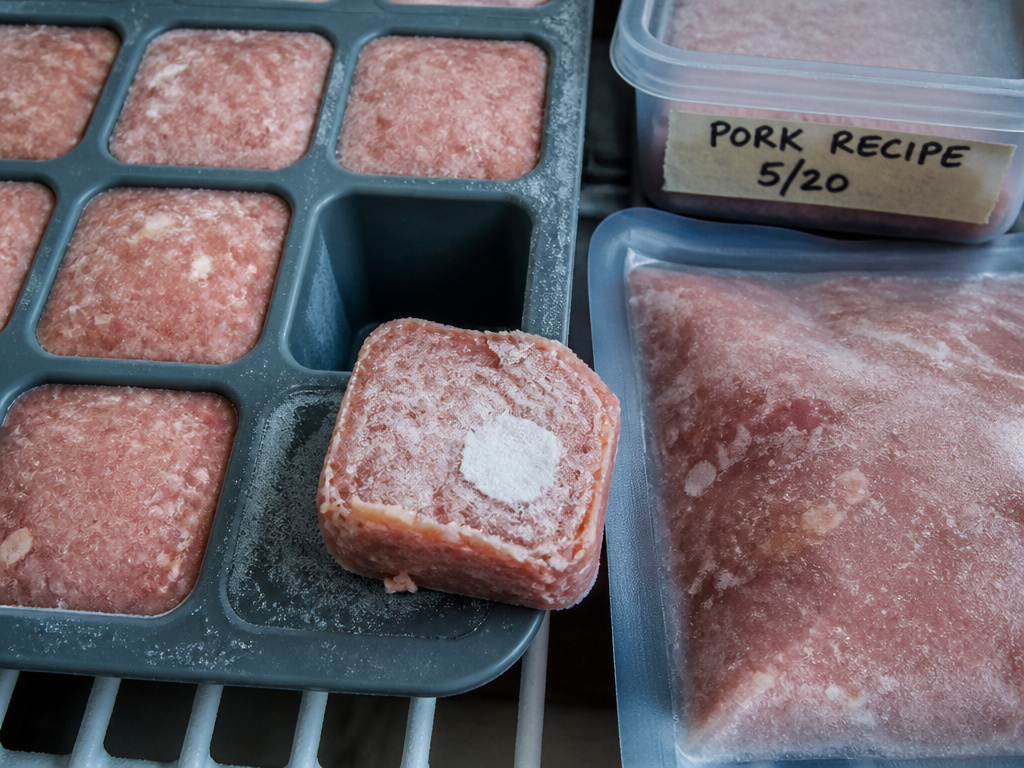
Freezer burn gets blamed for a lot. It is rarely the thing that makes a dog sick.
Houndsy describes freezer-burned food as not toxic but unappealing and short on moisture, and small affected patches can be trimmed off after thawing. What you will actually see is a portion with dry white patches across the surface and a leathery rim where it dehydrated. That is a quality loss, not a safety event.
The container decision is really about two things: how fast the portion freezes, and how much air sits against the meat.
- Silicone molds or ice-cube trays. Good for small dogs and for anything you are portioning by the cube. Freeze, pop out, bag.
- Stasher bags or a comparable reusable silicone bag. Flat-freezing works well here because you can press the air out and stack them.
- Small rigid containers. Easier to stack and label, slower to freeze because the food sits in a block.
I keep coming back to the same rule I use for kibble bins: the container gets washed between batches, not topped up. I emptied a pantry bin once and found a yellowish, tacky film on the walls and a sharp crayon-and-paint smell that had been sitting under fresh kibble. Every new batch met that residue on day one. Damp plastic plus fat residue is a bad pairing, and it takes longer to dry than people expect.
If you want the deeper version of this, the guide to freezing raw pet food covers packaging and flat-freezing in more detail, and the raw dog food safety piece covers the handling side.
How Long Does Raw Dog Food Last in the Freezer?
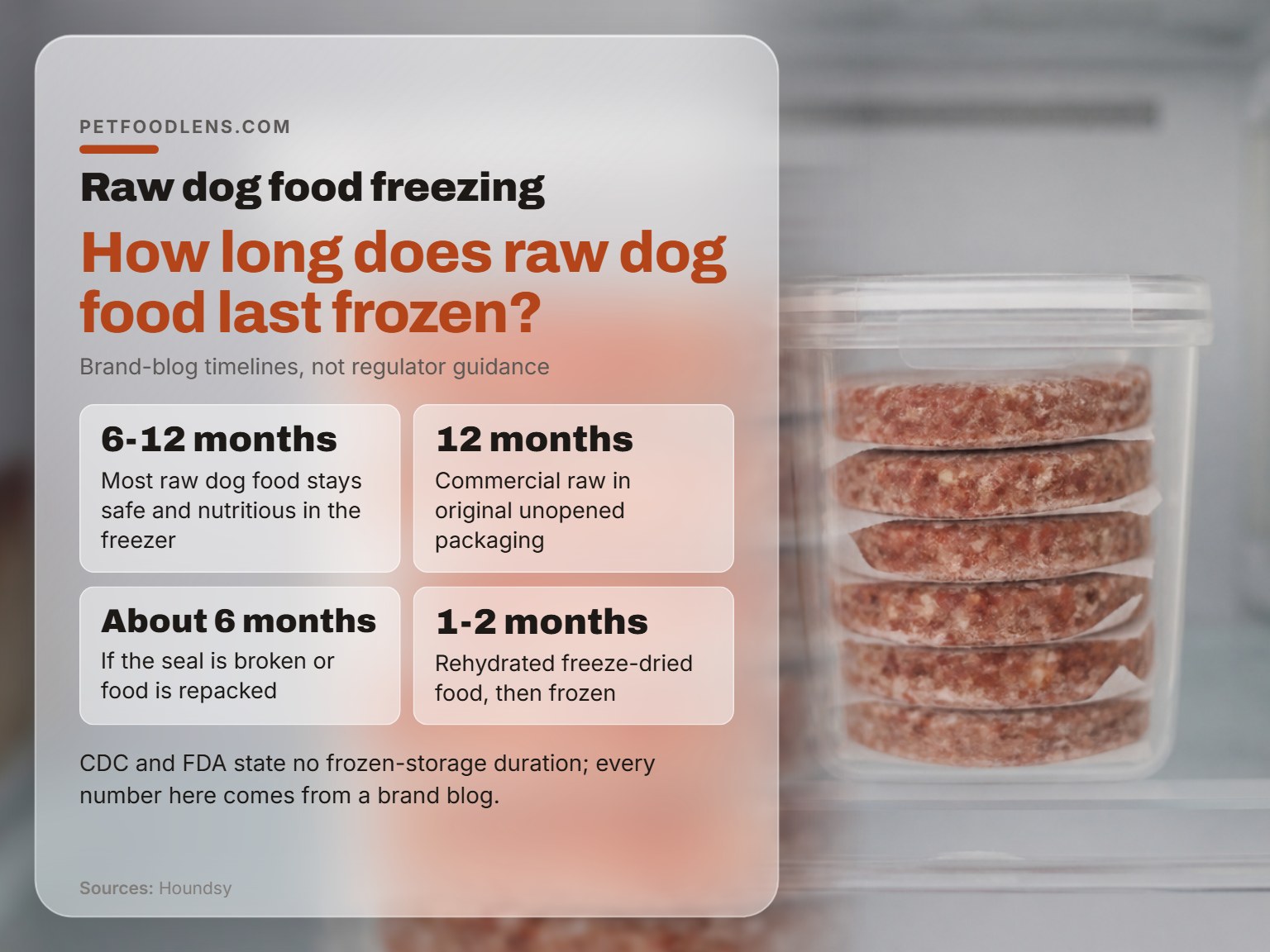
Houndsy gives 6 to 12 months generally, 12 months unopened, and about 6 months if the package has been opened or repacked.
Houndsy puts most raw dog food at 6 to 12 months in the freezer, with quality, texture, and nutritional value declining after a year even at a constant 0°F. In original unopened packaging, commercial raw usually lasts 12 months. Break the seal or transfer the food to a different container and that timeline drops closer to 6 months. Houndsy’s own recommendation is to discard raw dog food that has been frozen more than 12 months.
Here is the part worth flagging. Neither the CDC nor the FDA states a frozen-storage duration at all. The CDC says to freeze raw pet food until you are ready to thaw and use it. The FDA says to freeze until ready to use. That is the entire guidance. Every number in the table below comes from a brand blog, not a regulator.
| Format | Where it keeps | Practical use-by |
|---|---|---|
| Raw frozen, unopened | Freezer at 0°F | 12 months |
| Raw frozen, opened or repacked | Freezer | About 6 months |
| Rehydrated freeze-dried, then frozen | Freezer | 1 to 2 months |
| Freeze-dried, kept dry | Cool, dry place | 12 to 18 months |
| Dehydrated | Shelf-stable | No frozen timeline applies |
The last two rows are where people go wrong most often. The CDC’s own taxonomy separates raw frozen from freeze-dried (frozen, then dried in a vacuum) and dehydrated (dried with warm air), and both of those are shelf-stable. They do not follow frozen-portion logic at all. Cornell adds a sharper warning: freeze-drying is not equivalent to cooking, and bacteria can survive in a dried state for decades.
For the broader version of this, see raw food shelf life in the freezer.
Thawing Raw Dog Food: Where the Advice Actually Conflicts
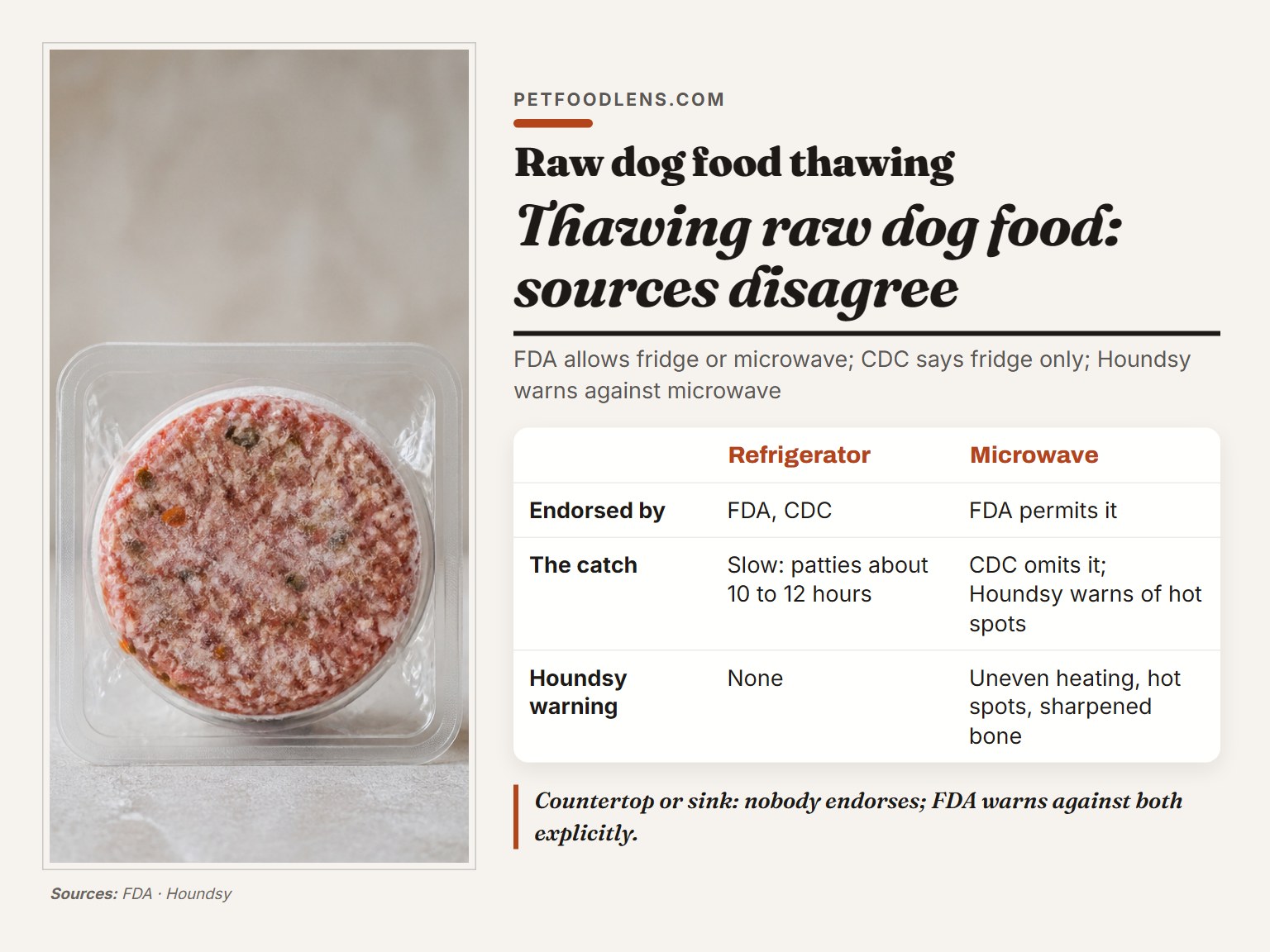
Thawing is the step where the agencies stop agreeing.
The FDA permits thawing raw meat and poultry in the refrigerator or the microwave, and explicitly warns against the countertop or the sink. The CDC’s sheet says to thaw frozen raw pet food in the refrigerator and does not mention the microwave at all. Houndsy advises against the microwave outright, citing uneven heating, hot spots, and ground bone hardening into sharp fragments.
| Method | Who endorses it | The catch |
|---|---|---|
| Refrigerator | FDA, CDC, Houndsy | Slow. Houndsy puts most patties at about 10 to 12 hours |
| Microwave | FDA permits it | CDC omits it; Houndsy warns of hot spots and sharpened bone |
| Countertop or sink | Nobody | FDA warns against both explicitly |
Three sources, three positions, and no way to average them into one rule. Pick the refrigerator and you land on the method the FDA, the CDC, and Houndsy all accept.
Houndsy’s practical version is to move the next day’s portion from the freezer to the fridge 24 hours ahead, and to use thawed food within 3 to 4 days. That timeline is the brand’s, not a regulator’s, but it is the only specific one in the material.
What to Do If You Thaw Too Much
The CDC’s instruction is to throw away leftovers that have been out at room temperature. The FDA’s instruction is to throw away leftovers that have been out at room temperature, and the CDC’s handling list carries the same line. A portion that has already been through a thaw has had its one chance.
If you want the full method, the guide to thawing raw dog food walks through the refrigerator timing.
One more fork in the road. Cornell advises cooking the product to 165 °F internal temperature if the owner chooses to cook it, which is a real option and also ends the raw premise. Retail feeding guides present the product raw with no cooking step. Both are describing the same bag of food.
Who Should Not Be Handling This at All
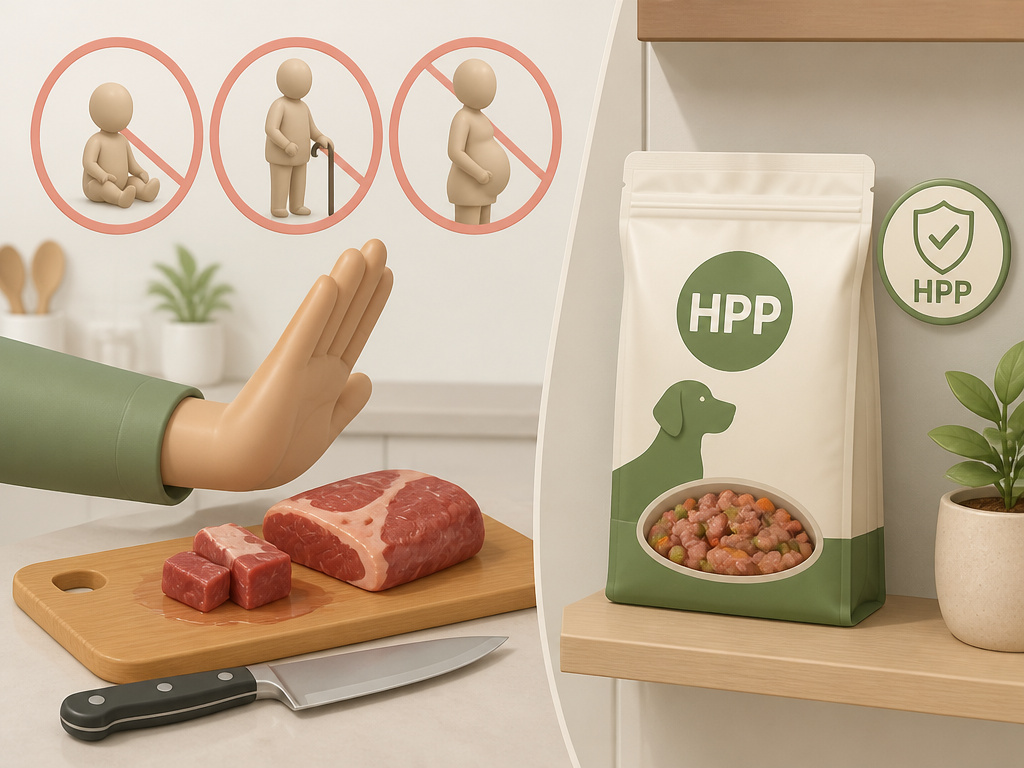
Some households should not be running this routine at all.
The CDC names the groups more likely to get very sick from foodborne germs: children under 5, adults 65 or older, people with weakened immune systems, and women who are pregnant. It names the pets too: puppies, kittens, and pets with a weakened immune system or other health conditions.
That changes the calculation. A freezer routine reduces risk. It does not remove it, and the person at the counter is the one absorbing what remains.
Mud Bay states that high-pressure processed foods are probably safer, especially for households that include elderly people, small children, or immunocompromised individuals. It is the one intervention in this whole category that reduces the hazard before the food reaches your kitchen.
If that describes your house, I would skip the DIY portioning question and buy HPP. Check availability on the brand sites rather than guessing from a freezer aisle.
I do not formulate dog diets. My work is commercial cat food, so I read the dog raw literature the way I read a competitor’s panel: carefully, and looking for what is not stated. The absence of a frozen-storage duration from both federal agencies is the loudest thing on the page.
Two handling rules that get skipped because they feel social rather than technical. The FDA says not to kiss your pet around the mouth and not to let your pet lick your face, especially right after a raw meal. And do not rinse raw meat, poultry, fish, or seafood before portioning, because the juices splash and carry bacteria onto surfaces you will not think to clean.
If you are feeding a complete frozen raw product, the roundup of frozen raw dog food covers what “complete and balanced” should mean on the label. And if your dog turns its nose up at a cold portion, the guide to warming up dog food covers getting it to room temperature without cooking it.
A dog that refuses to eat for more than 48 hours needs a veterinarian, not a different thaw method.
Frequently Asked Questions
Can you freeze raw dog food in the original packaging?
You can, and if you never open it the freezer timeline is longer. Houndsy puts most raw dog food at 6 to 12 months in the freezer, with unopened commercial raw at about 12 months and roughly 6 months once the seal is broken or the food is transferred to another container. The problem with a big original package is that you re-open it every day, which is the contact pattern you are trying to avoid.
Should you thaw raw dog food in the microwave?
The FDA permits it. The CDC’s fact sheet lists the refrigerator only and does not mention a microwave. Houndsy advises against it, citing uneven heating, hot spots, and ground bone hardening into sharp fragments. If you want the method the FDA, the CDC, and Houndsy all accept, use the refrigerator.
How long can raw dog food stay in the freezer?
The only specific figures come from a brand source, not a regulator. Houndsy gives 6 to 12 months generally, 12 months unopened, and about 6 months if the package has been opened or repacked, with a recommendation to discard anything past 12 months. Neither the FDA nor the CDC states a duration.
Is freezer-burned raw dog food safe?
Houndsy describes it as not toxic but unappealing and lacking moisture, and says small affected patches can be trimmed off after thawing. Expect dry white patches and a leathery rim. Expect dry white patches and a leathery rim; freezer-burned food is generally not toxic but unappealing and lacking moisture.
Do you need separate bowls and utensils for raw dog food?
Houndsy recommends a dedicated set of bowls and spoons used only for the dog’s raw food, and the FDA lists countertops and the inside of refrigerators and microwaves among the surfaces that get contaminated. Wash them with hot soapy water and follow with a disinfectant.
The Bottom Line
If anyone in your house is under 5, over 65, pregnant, or immunocompromised, Mud Bay says HPP foods are probably safer, especially for such households. Buy high-pressure processed raw or cook the product to 165 °F. Portioning discipline reduces a risk you should not be carrying in the first place.
For everyone else, the routine is genuinely simple and the failure points are predictable. Single-meal packages. Sealed container, separate from other food. Label with a date. Refrigerator thaw, 24 hours ahead. Clean with soap first and disinfectant second.
Tonight, before you open the next tube, put a silicone tray, a marker, and a roll of bags on the counter. The step that decides whether this goes well is the one you take before the food is out of the freezer.
