
How to Choose a Hypoallergenic Dog Food: Read the Label
This post contains affiliate links. As an Amazon Associate, we earn from qualifying purchases.
To choose a hypoallergenic dog food, match the diet type to the job: a hydrolysed or single novel-protein diet, fed exclusively for 8 to 12 weeks. A 2024 Veterinary Dermatology review puts the hydrolysis threshold at under 5 kD, and 33% to 83% of novel-protein diets tested carried protein from outside their label.
That contamination number is the one nobody prints on the bag. A diet can be built on a novel protein and still carry foreign protein from a shared production line, which is why the plant that made the food matters as much as the protein named on the front. Knowing how to choose a hypoallergenic dog food means asking about that plant.
What follows covers the three diet types, the label words that carry no legal weight, the trial schedule that actually settles the question, and the point where most owners quit.
Key Takeaways
- “Hypoallergenic” has no legal definition. AAFCO does not list the term, and a WSAVA congress paper argues its use should be dropped outright.
- Hydrolysis under 5 kD is the threshold that theoretically blocks IgE crosslinking. A partially hydrolysed diet let 40% of chicken-allergic dogs react in one small study.
- Novel-protein diets are the weaker bet on paper. Between 33% and 83% of them contained foreign protein when tested by PCR, ELISA, or microscopy.
- Budget 8 to 12 weeks, and expect skin to lag the gut by several weeks.
- One flavoured preventive or shared snack can void the whole trial.
What Does Hypoallergenic Dog Food Actually Mean on a Label?
Nothing, legally. The word sits outside AAFCO’s defined-terms list, and no agency certifies a food as hypoallergenic.
Hydrolysis breaks parent protein into fragments generally under 5 kD, a size at which immunoglobulin E crosslinking is theoretically prevented. The threshold matters because a partially hydrolysed diet leaves larger peptides intact, and 40% of chicken-allergic dogs in one ten-dog study reacted to a partially hydrolysed poultry-feather diet.
Three sources take three slightly different positions on the label word, and the gap between them is worth knowing. A WSAVA congress paper by N. Cave argues the term should be reserved for diets with a substantial reduction in antigenicity, and states plainly that its use is discouraged. Vetster’s clinical guide calls it a marketing term with no strict legal meaning. Webvet’s buyer’s guide lands in the same place: descriptive marketing, not a regulated claim.
Here is what the front of the bag actually tells you:
- “Hypoallergenic”: no legal definition, no certification, no test to pass.
- “Limited ingredient”: also unregulated. The only way to confirm a short recipe is to read the full panel yourself.
- “Grain-free”: a carbohydrate swap. Beef, dairy, and chicken are the frequent dog allergens; grain is rarely the culprit.
- “Hydrolysed”: this one describes a process, so it means something. Ask how far the protein was broken down.
So the label word is a starting point at best. The ingredient panel is where the argument actually lives.
The Three Diet Types, and Which One Fits a Real Trial
Three diet types exist, and sources disagree on how many belong in a diagnostic trial: VCA lists home-prepared novel protein as a valid type if formulated by a veterinary nutritionist, while the 2024 review notes home-cooked diets are often inadequate for long-term feeding.
| Diet type | What it does | Best for |
|---|---|---|
| Hydrolysed protein | Splits protein into fragments under 5 kD | Strict diagnostic trials |
| Novel protein | One protein the dog has never eaten | A first trial, if the plant is clean |
| Limited ingredient | Short recipe, one protein and one carbohydrate | Maintenance after the trigger is known |
| Home-prepared | Novel protein cooked at home plus a balancer | Owners who will actually finish it |
Sorting a hypoallergenic dog food shortlist by diet type before you sort it by brand cuts the how to choose a hypoallergenic dog food aisle time in half.
Hydrolysed Protein: The Boring, Reliable Option
The named products are Hill’s Prescription Diet z/d, Royal Canin Hypoallergenic Hydrolyzed Protein or Anallergenic, and Purina ProPlan Veterinary Diets HA Hydrolyzed. All three are prescription diets sold through a veterinarian.
The mechanism is straightforward. Hydrolysis chops the parent protein into fragments small enough that the immune system has less to grab onto. The 2024 review puts the general target at under 5 kD, and the ten-dog chicken-allergy study is the cleanest illustration of why the degree of hydrolysis matters: no reactions at under 1 kD, 40% reacting at partial hydrolysis.
Open a bag of the extensively hydrolysed stuff and the smell is often bitter rather than like the chicken pictured on the front. That is not a defect. Bitter peptides are what extensive hydrolysis produces, and bitterness peaks in hydrolysed soy between 4 and 2 kD before declining as fragments shrink further.
Here is where the sources split. The 2024 review notes that hydrolysed diets can contain peptides acting as T-cell epitopes, which suggests they may not be uniformly reliable. Purina Institute’s diet-trial guidance frames hydrolysed and elemental diets as the convenient default. Same category of product, opposite emphasis.
Novel Protein: When Sourcing Is the Problem
The named options are Hill’s Prescription Diet d/d, Royal Canin Selected Protein PD or RC, and Rayne Nutrition Kangaroo-MAINT, Rabbit-MAINT, or Crocodilia-MAINT.
The logic is intuitive. A dog that has eaten chicken and beef for six years has never seen kangaroo, so the immune system has nothing to recognise, which is the how to choose a hypoallergenic dog food question in miniature. The 2024 review still comes down on the hydrolysed side, stating that hydrolysed diets are currently preferred owing to difficulty sourcing novel protein. Purina presents both as equally valid depending on the dog’s diet history.
That is a real disagreement, and it has a practical edge. Novel protein only works if the protein is genuinely novel to your dog and genuinely absent from the bag. Both conditions fail more often than the marketing suggests.
Why 33% to 83% of Novel-Protein Diets Fail a Contamination Test
Between 33% and 83% of commercial novel-protein diets contained foreign elements when tested by PCR, ELISA, or direct microscopy, according to the 2024 Veterinary Dermatology review. The hydrolysed diets examined in the same body of work had no food contaminants.
VCA Animal Hospitals makes the manufacturing point directly: retail pet foods are not made with the same health and safety protocols to prevent cross-contamination as veterinary diets. That is the whole ballgame for a trial. A diet that is mostly venison but carries poultry protein is a failed experiment with a clean label.
Where this goes sideways: A “chicken-free” food that lists poultry fat or chicken fat further down the panel. Fat and digest are where cross-contaminants hide, and a dog that reacts will keep reacting for the full trial while you blame the novel protein.
The front of the bag is a mood. The ingredient list is the evidence.
If you want the full breakdown of which proteins trigger reactions most often, the dog food allergies overview covers the frequency data and how it has drifted since the 1985 to 2015 dataset the review consolidated.
How Long Does a Food Trial Take Before You Can Judge It?

Owners often quit before the trial has had time to work. The scratching may not have changed, the ear may look the same, and the only visible difference may be a slightly firmer stool.
That is the normal curve, not a failure. Purina Institute’s therapeutic nutrition guidance separates the two clocks: gastrointestinal signs improve within 1 to 4 weeks, dermatological signs within 4 to 8 weeks, and complete dermatological improvement may take up to 12 weeks.
| Stage | What improves | Timeline |
|---|---|---|
| Early | Stool, gas, vomiting | 1 to 4 weeks |
| Mid | Skin and ear inflammation | 4 to 8 weeks |
| Full | Complete dermatological improvement | Up to 12 weeks |
VCA and Webvet both give the flat figure of 8 to 12 weeks for the trial itself, which is the same window stated as a single number rather than three stages. Use the staged version to decide whether to keep going. Use the flat version to decide when to stop.
Before you start: Three things void a trial faster than a bad diet. Flavoured preventives and flavoured vitamins count as food, so switch to unflavoured versions first. Other pets in the house eat their own food, so feed separately and pick up bowls. And most hydrolysed elimination diets are adult maintenance, so a dog under 12 months, or a giant breed under 18 months, needs a growth-supporting diet or the trial has to be redone later.
The sequence that works:
- Get an accurate diet history first, including treats and preventives. Without it you cannot tell novel from familiar.
- Pick one diet and confirm it meets AAFCO nutrient profiles for your dog’s life stage.
- Transition over 7 to 10 days, starting at 75% old food and 25% new for days 1 to 3, moving to 50/50 for days 4 to 6, then 25% old and 75% new for days 7 to 9, and 100% new from day 10. Slow it to two weeks or more if the stomach is delicate.
- Feed nothing else for the full window. No scraps, no chews, no shared snacks.
- Reintroduce the old food at the end. If signs return within a week of the challenge, the diagnosis is confirmed.
That last step is the one owners skip. A trial without a challenge tells you the dog improved, not what caused it.
The elimination diet trial walkthrough covers the challenge phase in more detail, and allergy-friendly treats matters more than it sounds, because a single flavoured chew resets the clock.
Reading the Ingredient Panel for Proteins the Front Never Mentions
Flip the bag over and read the ingredient panel in order. Then hunt for the fractions: fat, digest, natural flavor, and hydrolysed liver. Those are the lines that can break a single-protein claim, and they often sit well below the ingredient the front panel is selling.
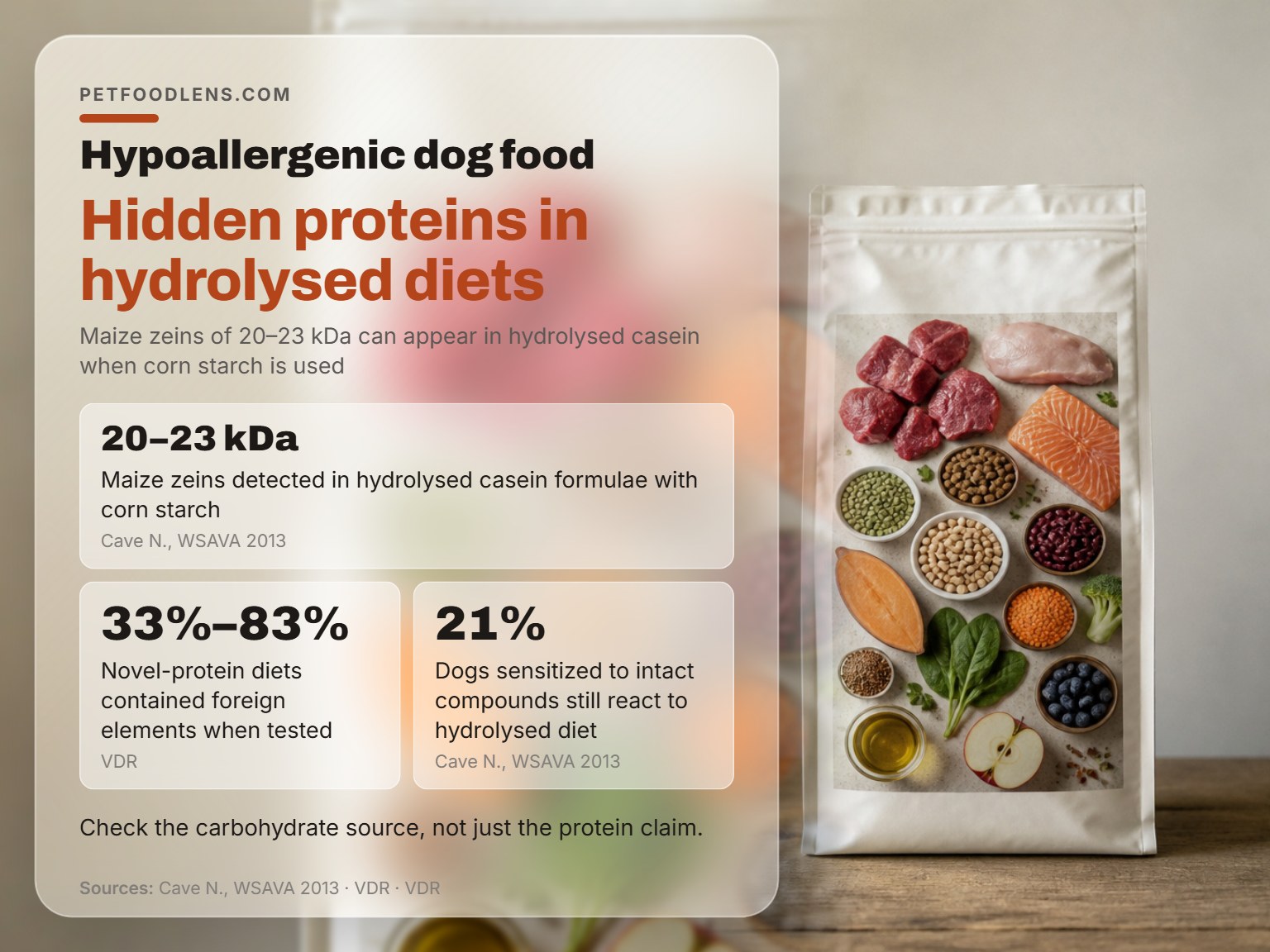
The 2024 review adds a wrinkle that catches even careful readers. Maize zeins, which are 20 to 23 kDa proteins, have been detected in hydrolysed casein formulae when corn starch is the carbohydrate source. The carbohydrate source in a hydrolysed diet can carry protein the process was supposed to remove.
Common mistake: Trusting a hydrolysed claim without checking the carbohydrate source. Corn starch in a hydrolysed casein formula can bring its own protein along.
This is the section where a dog food for allergies list earns its keep, but only if you read each entry’s full panel rather than its category label.
Home-Cooked and Limited-Ingredient Diets: Where They Break Down
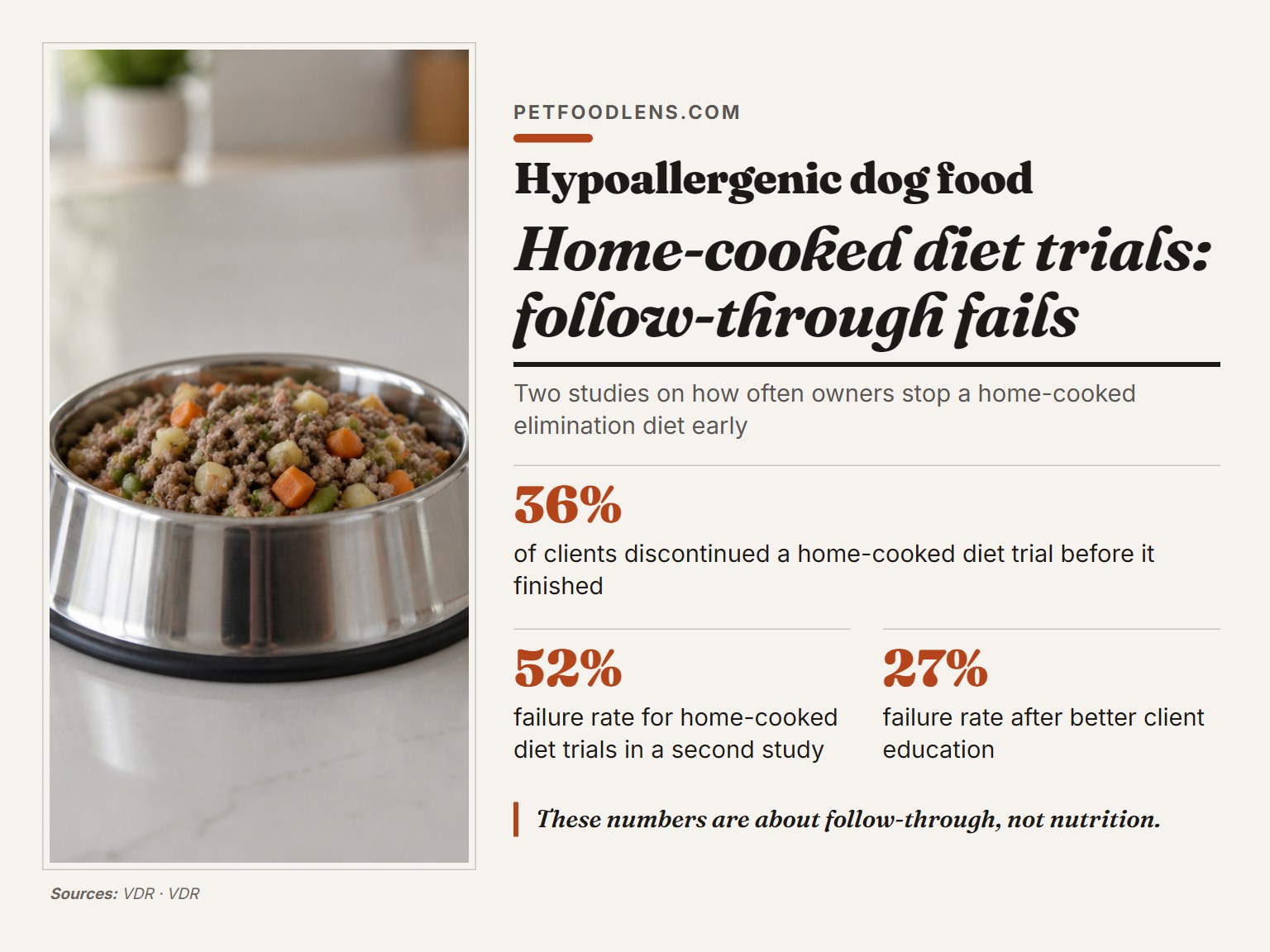
36% of clients in one study discontinued a home-cooked diet trial before it finished. A second study documented a 52% failure rate, dropping to 27% once client education improved.
Those numbers are about follow-through, not nutrition. And follow-through is exactly where the home-cooked route is weakest, because it asks the most of the owner every single day.
The sources disagree on whether that is a fatal flaw. The 2024 review states that home-cooked diets are often inadequate for long-term feeding, and notes there are no well-documented reports implicating additives as a problem in dogs and cats. VCA takes the other side of the practical question, listing a home-prepared novel protein diet as a valid type provided it is formulated by a veterinary nutritionist and typically balanced with a supplement such as Hilary’s Blend for Dogs or Balance IT.
Both positions can be true at once. A properly formulated home-cooked diet is legitimate. An improvised one is a nutritional gap with a nice story attached.
Limited-ingredient bags deserve their own skepticism. A limited ingredient dog food only does its job if the panel backs up the claim.
What a limited-ingredient bag has to prove before you buy it:
- The full panel is short, and you can name every ingredient without looking it up.
- Only one animal protein appears anywhere on the panel.
- The formula meets AAFCO nutrient profiles for your dog’s life stage.
- The manufacturer has controls to prevent cross-contact on the line.
Do Allergy Tests Help Before You Start a Trial?
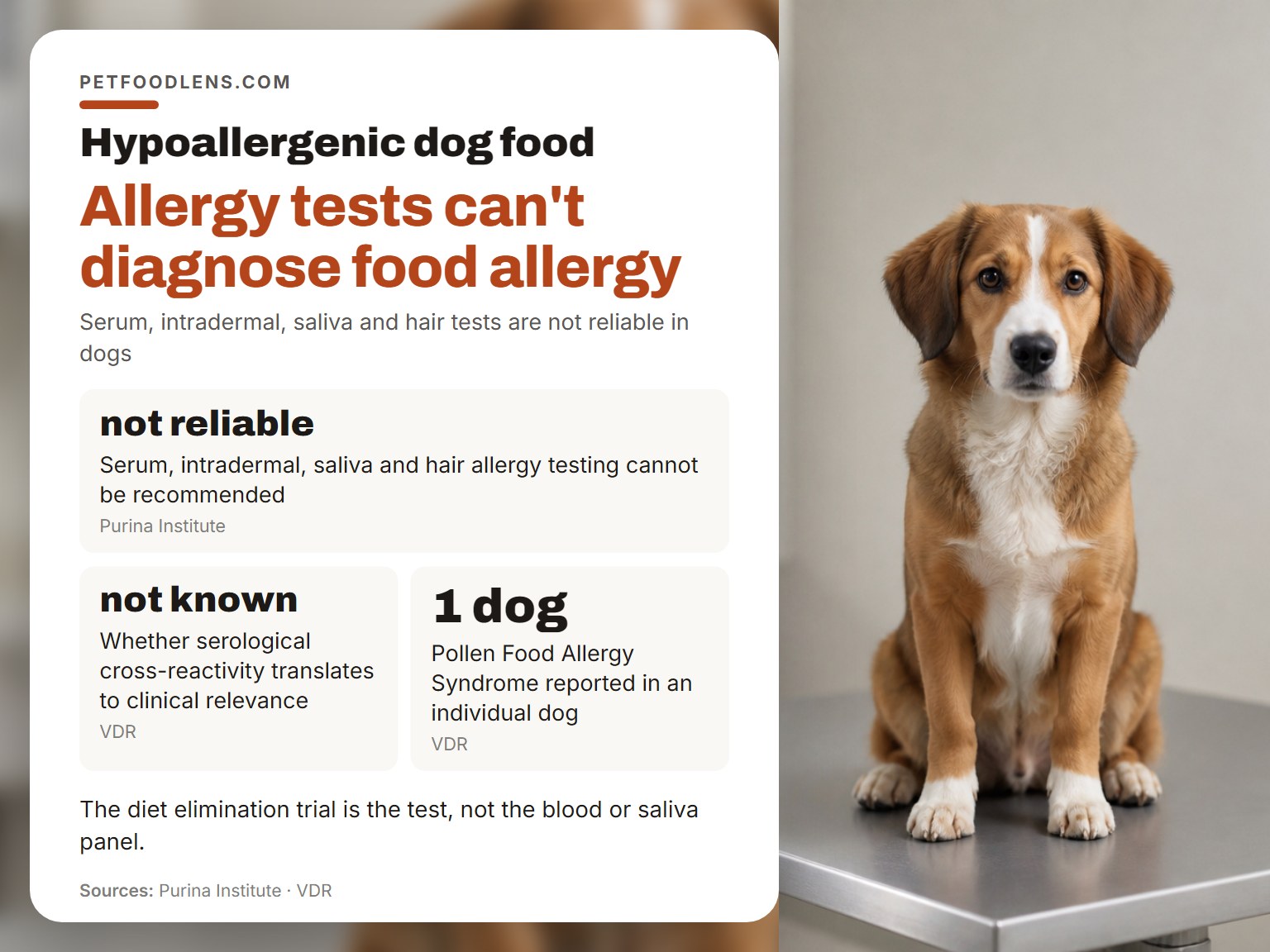
Purina Institute’s position is blunt: serum, intradermal, saliva, and hair allergy testing are not reliable in dogs and cats and cannot be recommended.
The 2024 review is more careful but lands in a similar place. Serological cross-reactivity is demonstrated in dogs, but whether it translates to clinical relevance is currently not known. The WSAVA paper adds that carbohydrates are incriminated in false-positive serum IgE ELISA results, which is one more reason a positive test is not a diagnosis.
So the trial is the test. If you want the detail on why the blood and saliva panels underperform, testing for food allergies covers the methodology and what a result actually means.
One edge case breaks the tidy version of this. Pollen Food Allergy Syndrome, where aero-allergen sensitisation produces a food reaction, has been reported in an individual dog. That is a single case report, not a pattern, but it means a clean diet history does not always explain a reaction.
Easy to miss: A dog with a struvite or calcium-oxalate history needs the S/O index checked on any new diet. Some commercial formulas carry one and some do not, and a trial is a bad time to discover the difference.
Frequently Asked Questions
How long should a hypoallergenic diet trial last?
VCA and Webvet both put it at 8 to 12 weeks. Purina Institute breaks the same window into stages: gut signs improve in 1 to 4 weeks, skin signs in 4 to 8 weeks, and full dermatological improvement can take up to 12 weeks. Judge at the end of the window, not at the halfway point.
Is grain-free the same as hypoallergenic?
No. Grain is rarely the culprit in dogs. The most common food allergens are animal proteins, especially beef, dairy, and chicken, followed by wheat and egg. Dropping rice or oats rarely fixes an itch that is driven by a protein.
Can I feed treats during an elimination trial?
Not unless the treat is the trial diet. VCA states that a true elimination trial allows no other foods, treats, or supplements, including flavoured vitamins and certain parasite preventives. Use pieces of the trial kibble as rewards and switch to unflavoured preventives before you begin.
What if my dog refuses a hydrolysed diet?
Acceptance is less of a problem than the reputation suggests. The WSAVA paper reports that the rate of acceptance by dogs fed hydrolysed protein diets as elimination diets is similar to those fed conventional select protein diets. If refusal happens, transition more slowly rather than switching diets.
Do I need a prescription for a hydrolysed diet?
Yes, in most cases. Hydrolysed diets are typically prescription products sold through veterinarians, which is why they are the usual choice for a strict diagnostic elimination trial. Over-the-counter novel-protein foods are the accessible lane, but they are not equivalent to a controlled trial diet.
Can a food allergy in dogs be cured?
No. There is no cure, and the only treatment is avoidance. A dog that has developed an allergy to one food may develop others later, which is why the diet history you write down now stays useful for years.
The Bottom Line
If your dog is under 12 months old, or a giant breed under 18 months, stop before you buy anything. Most hydrolysed elimination diets are adult maintenance, and a growing dog needs a growth-supporting formula or the whole trial has to be repeated later.
This week, write down every protein your dog has eaten. Include the treats, the chews, the flavoured preventives, and the table scraps. That list decides which diets are genuinely novel and which are just unfamiliar to you.
The clinical endpoints are not.
Read past the front of the package. The bag that wins is the one whose panel survives the trip to the register, and for a real diagnosis that usually means a prescription hydrolysed diet you feed for 8 to 12 weeks without a single exception.
