
Prey Model Raw Diet Explained: Ratios vs Formulation
This post contains affiliate links. As an Amazon Associate, we earn from qualifying purchases.
The prey model raw diet explained in one line: a ratio-based template built on 75-80% muscle meat, 10% raw edible bone, 5% liver, 5% other secreting organs, and 0-5% animal-based fibre. No AAFCO or FEDIAF regulator publishes that ratio, so it’s a community starting point, not proof of nutritional adequacy.
That community origin is the part worth sitting with. The prey model raw diet explained split gets repeated so often that owners assume somebody official signed off on it. Nobody did. Meanwhile the actual peer-reviewed work on raw feeding barely touches ratios at all, because the research money went into microbiology instead.
What follows covers the ratio itself, the two feeding formats, the FDA sampling numbers category by category, the places where credible sources flatly contradict each other, and the handling rules that reduce risk regardless of which side you land on.
Key Takeaways
- No AAFCO, FEDIAF, or equivalent body publishes the 75/10/5/5 ratio. It is community-defined, so treat it as a template rather than a nutritional standard.
- A Finnish study of frozen commercial raw diets found pathogens only sporadically by PCR and none by culture, which is a genuinely different result from the US retail sampling.
- Ratios don’t guarantee micronutrient adequacy. Calcium to phosphorus, taurine, and zinc are formulation questions, and the 2019 BSAVA review names inexpert formulation as a documented malnutrition risk.
- Households with small children, elderly members, or immunocompromised people face elevated transmission risk, per a 2025 review, so household composition matters as much as the recipe.
What the Prey Model Raw Diet Actually Specifies
The spec fits on an index card. Muscle meat takes 75 to 80 percent of the bowl, raw edible bone takes 10 percent, liver takes 5 percent, other secreting organs take 5 percent, and animal-based fibre takes 0 to 5 percent.
The prey model ratio allocates 75 to 80 percent of the diet to muscle meat, 10 percent to raw edible bone, 5 percent to liver, and 5 percent to other secreting organs, with 0 to 5 percent animal-based fibre added. No AAFCO, FEDIAF, or equivalent regulatory body publishes this allocation; it originates in raw-feeding community material.
That’s the entire framework. Everything else in raw feeding arguments is commentary layered on top of those five numbers.
| Component | Share of diet | What it covers |
|---|---|---|
| Muscle meat | 75-80% | Meat from any species, with fat attached |
| Raw edible bone | 10% | Bone the animal can actually crush and digest |
| Liver | 5% | One organ, and it carries the vitamin A load |
| Other secreting organs | 5% | Kidney, spleen, pancreas, brain |
| Animal-based fibre | 0-5% | Optional roughage from plant or animal sources |
Two formats deliver that same ratio. Whole prey means an intact animal with fur, feathers, blood, and glands still attached. Franken prey means several proteins assembled at the counter to hit the numbers. The organ meat portion is where most home-built plans quietly fall apart, because liver is easy to buy and kidney is not.
If you’re new to this at all, the raw feeding guide covers the logistics before you get to ratios.
Is the 75/10/5/5 Ratio Regulated by Anyone?
Zero. No AAFCO, FEDIAF, or other regulatory body publishes a prey model ratio, and the exact percentages trace back to raw-feeding community material rather than a government or industry document.
That matters for how much weight the number can carry. A regulatory nutrient profile gets built from controlled feeding work and reviewed by people who can be held to it. A community ratio gets built from accumulated practice and passed along. Both can be useful. Only one comes with a paper trail.
If a raw feeding plan hands you ratios but no micronutrient analysis, you have a starting point and nothing else. Ask what sits behind the ratio before you feed it for a year.
The other common confusion is treating prey model and BARF as the same system. They aren’t. The BARF vs prey model split comes down to how much plant material enters the bowl and how the bone gets delivered.
Whole Prey vs Franken Prey: What’s the Difference?
Two formats exist under the same ratio: whole prey and franken prey. The names sound like a joke. The practical difference is real.
Whole prey
An intact prey animal, typically a whole chicken, rabbit, quail, or rodent, with fur or feathers and internal organs included. You feed it as a unit, so the ratio is whatever the animal happened to be. That removes the arithmetic and removes your ability to adjust anything.
Franken prey
Multiple proteins and cuts assembled to hit the target percentages. You buy muscle meat here, bone-in product there, liver and kidney somewhere else, then portion it all together. This is what most home feeders actually do, and it’s the format that requires the most label attention.
Which one wins depends on your situation. For a household feeding one cat, franken prey wins because you can portion and freeze in batches without committing to a whole rabbit. For a multi-animal household with freezer space, whole prey wins on consistency, since the animal already did the balancing.
Whichever route you take, the bone fraction is the part that hurts animals when it goes wrong. The raw bone safety breakdown covers which bones are actually edible and which ones are a vet visit.
What the FDA Sampling Data Actually Shows
196 raw pet food samples went through the FDA’s Center for Veterinary Medicine between October 2010 and July 2012. Fifteen came back positive for Salmonella. Thirty-two came back positive for Listeria monocytogenes.
The comparison categories did almost nothing by comparison:
- 190 jerky samples: zero positives.
- 190 dry exotic animal food samples: zero positives.
- 120 semi-moist dog and 120 semi-moist cat samples: zero positives across both.
- 120 dry dog and 120 dry cat samples: one Salmonella positive, and it landed in the cat food.
Those are the FDA raw pet food facts as published, and the pattern is hard to argue with. Raw product carried the positives. The cooked and dry categories essentially didn’t.
The part nobody mentions: Canned pet food was excluded from the FDA study entirely. There is no comparative raw-versus-canned contamination data from that sampling window, so anyone quoting one doesn’t have it.
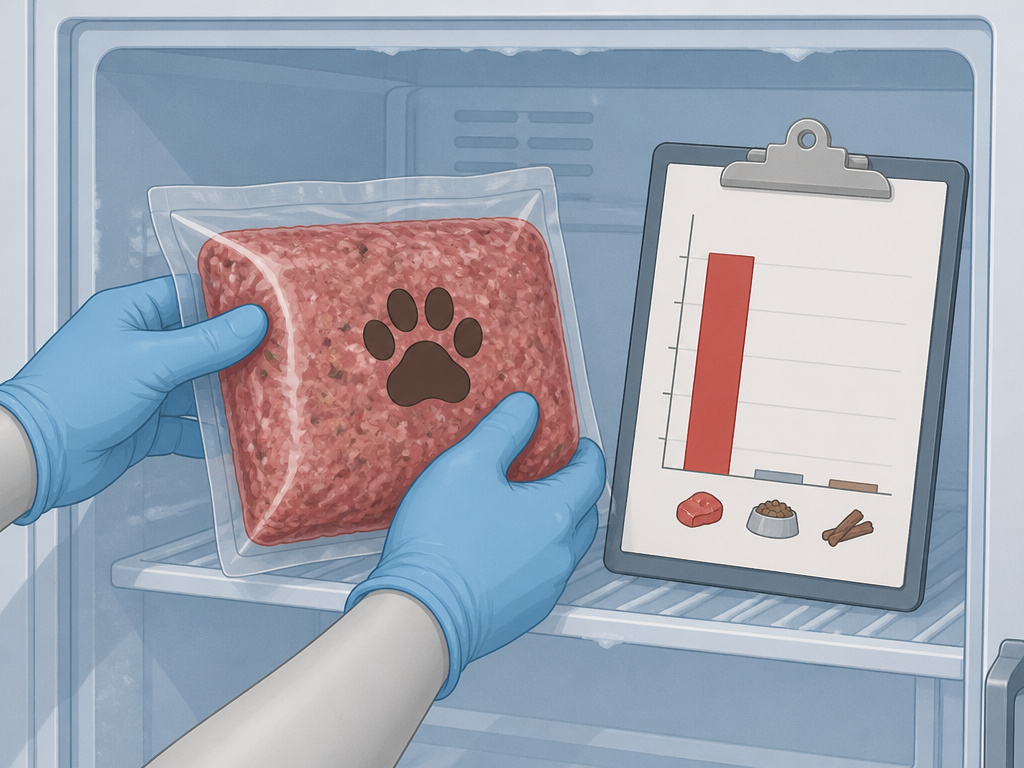
The FDA’s own guidance that follows from this is straightforward. Keep raw product frozen until use. Thaw it in the fridge or a microwave, never on the countertop or in the sink.
Where the Sources Disagree on Raw Feeding Risk
Both of the headline findings are correct, and they point in opposite directions. That’s the honest state of the evidence.
| Question | One position | The other position |
|---|---|---|
| Contamination level | FDA: 15 of 196 raw samples positive for Salmonella, 32 for Listeria | Finnish study: sporadic by PCR, none by culture in frozen diets |
| Owner infection risk | FDA: owners may face higher infection risk | Finnish study: link to shedding unclear, source unclear |
| Health benefits | 2025 review: advice often overlooks potential positives | 2019 BSAVA review: rejects most claims beyond microbiome and stool |
Start with contamination. The US retail sampling found a meaningful positive rate. The raw meat-based diet study from Finland tested frozen commercial product and concluded a low contamination level, with pathogens detected only sporadically by PCR and none by culture. Different products, different storage states, different methods. Do not merge those two results into one number.
Transmission certainty splits the same way. The FDA states owners may have a higher risk of infection from handling raw pet food. The Finnish authors say the association between feeding raw and pet shedding remained unclear, and the source of infection remained unclear. One is a precautionary read, the other is a null finding.
Benefits split too. A peer-reviewed review of raw feeding evidence published in 2025 notes that professional advice often overlooks potential positive health effects. The 2019 review concedes formal evidence for an altered intestinal microbiome and subjectively improved stool quality, then rejects most other benefit claims as lacking robust evidence or a plausible mechanism.
If you want the practical version of that argument, the raw diet pros and cons piece lays the trade-offs side by side.
Why Ratios Are Not Formulation

Clients ask me to boost a complete food with homemade extras more often than you’d think. In the cases I’ve reviewed, the additions diluted the balance of a diet that was already formulated, and the owner couldn’t see that from the ingredient list. Same logic applies to building a raw plan from ratios alone.
A ratio is arithmetic. Formulation is a nutrient calculation, and the two are not interchangeable.
The PMC microbiological hazards review makes the point directly: ratios don’t guarantee micronutrient adequacy. It names calcium to phosphorus, taurine, and zinc as the nutrients that slip, and it flags inexpert formulation and testing as a documented malnutrition risk for raw diets.
What a ratio can’t tell you
- Calcium to phosphorus balance, which depends on exactly how much bone is in the bowl, not on the 10 percent headline.
- Taurine, an amino acid cats cannot synthesize enough of, and one that varies with the cuts you choose.
- Zinc and other trace minerals, which shift with protein source and with how much organ tissue is included.
- Total calories, which determines whether the animal gains or loses weight on a diet that looks correct on paper.
That list is why the balanced raw diet question keeps coming back to formulation rather than ratios. It’s also why I’d rather see an owner pay for a nutrient analysis once than guess for a year.
Worth knowing before you start: A plan built from ratios alone can look perfect and still miss taurine or zinc for months. Deficiency signs in cats show up in coat, weight, and appetite long before anything dramatic happens.
One more thing I’d flag. When you change a diet, change one variable at a time. I learned that early, after switching food, portion, and feeding schedule in the same week and being unable to tell which change had helped or hurt. If you do move to raw, the raw transition timeline matters more than the recipe on day one.
Who Should Skip Raw Feeding Entirely
Picture a kitchen with a toddler on the floor, a dog bowl by the back door, and a ninety-year-old grandmother staying for the summer. That household is the one I’d push hardest toward cooked or commercial food.
The 2025 review explicitly flags elevated transmission risk for immunocompromised households, naming small children, the elderly, and immunocompromised people. That’s a household-composition finding, not a recipe finding. No amount of ratio accuracy fixes it.
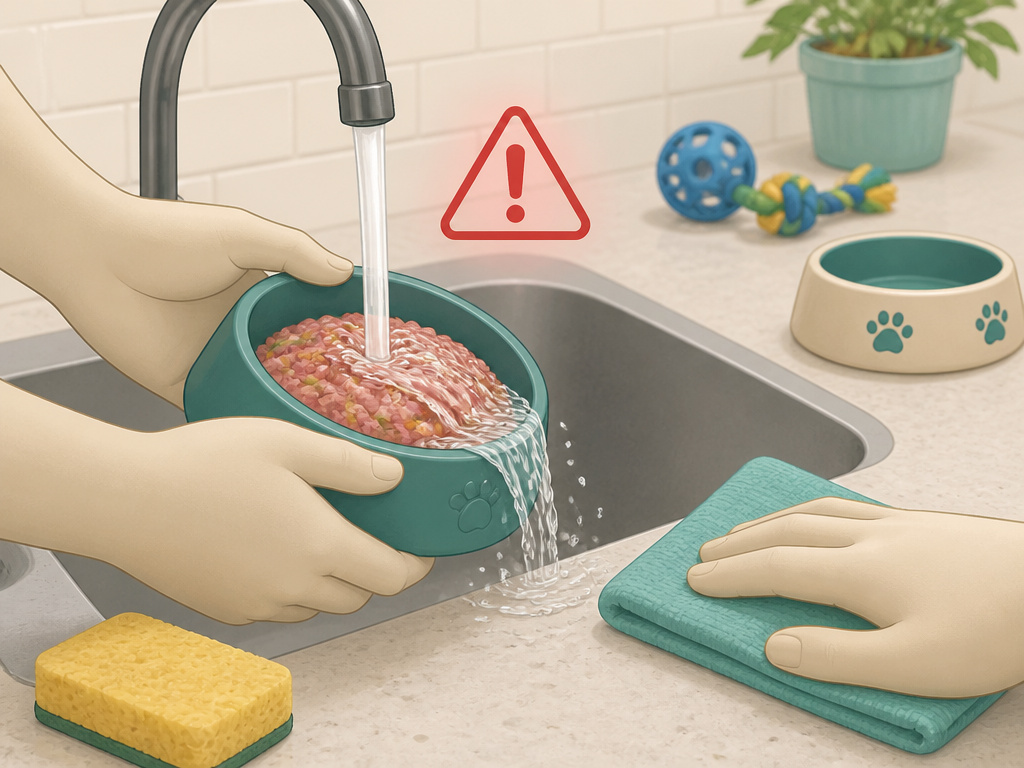
Where this goes sideways: Owners tighten up the recipe and leave the handling alone. The bowl gets rinsed in the kitchen sink, the sponge stays out, and the counter gets wiped with a dry cloth. Cross-contamination runs through the kitchen, not through the ratio.
There’s a second group worth naming. Anyone who wants a diet they can leave in a bowl while they’re at work all day is going to struggle with raw, because raw product can’t sit out.
And I’ll be honest about my own limits here. I know commercial cat formulations far better than I know dog nutrition, and my comparisons lean feline. For a dog with a diagnosed condition, a veterinary nutritionist should be building the plan, not a ratio card.
How to Handle Raw Pet Food Without Cross-Contaminating Your Kitchen
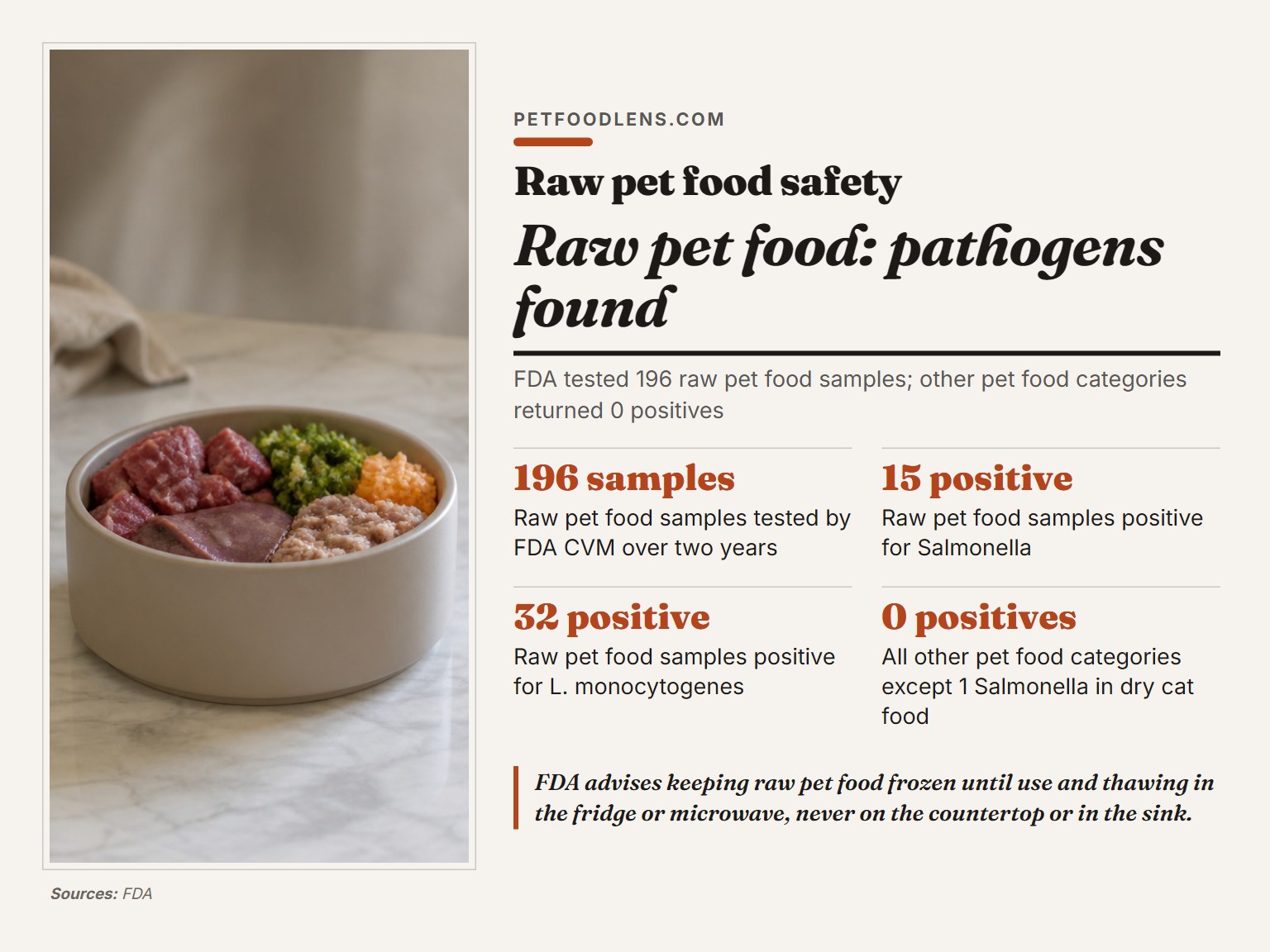
The FDA’s thawing guidance is the part that matters most, and it’s the part most owners skip. Keep the product frozen until you’re ready to use it. Thaw in the fridge or a microwave. Never on the countertop, never in the sink.
Before you start: Raw pet food can carry Salmonella and Listeria monocytogenes, both of which transfer to hands, counters, and sponges. Wear gloves or wash with hot soapy water immediately after handling. Use a dedicated cutting board that never touches human food, and clean the sink with a disinfectant rather than a rinse.
Here’s the sequence I’d follow:
- Portion while frozen. Cut or scoop the day’s amount before thawing, so you handle the raw product once instead of twice.
- Thaw in the fridge overnight, on the bottom shelf, on a rimmed tray. Skipping the tray means drips reach the shelf below, and you’ll find them a day later.
- Keep a separate board and knife. Cross-use is how a kitchen gets colonized, and it happens in seconds.
- Wash hands for a full twenty seconds after the bowl goes down. This is the step people abbreviate when they’re in a hurry.
- Discard leftovers within the same feed. Raw product left in a bowl at room temperature is a bacterial culture, not a snack.
- Sanitize the sink and counters with a disinfectant, not a rinse. The sponge goes in the dishwasher or the bin.
If you’re buying rather than building, the raw food sourcing question deserves its own attention, particularly for imported product. The 2019 review documents Brucella suis in raw pet meat imported into the EU and UK from Argentina, which is a regional import problem that US-centric guidance won’t mention.
There’s also an antimicrobial resistance angle worth knowing. The same review notes raw pet food commonly exceeds hygiene thresholds for Enterobacteriaceae counts and can carry ESBL and cephalosporin resistance genes. That’s a failure mode no ratio can catch. The broader raw feeding safety picture covers the rest.
Frequently Asked Questions
What is the difference between prey model raw and BARF?
BARF includes plant material, typically pureed vegetables, fruit, and sometimes grains, at a meaningful share of the bowl. The prey model strips that back to 0-5 percent animal-based fibre and pushes muscle meat to 75-80 percent. The bone and organ fractions are broadly similar between the two.
How much bone is in a prey model raw diet?
The community standard is 10 percent raw edible bone. The word edible matters, since it means bone the animal can actually crush and digest rather than a weight-bearing bone from a large animal. Bone content drives the calcium to phosphorus ratio, so getting it wrong has consequences beyond a loose stool.
Can cats and dogs eat the same prey model ratios?
The ratio is usually written for dogs, and cat plans often need different attention to taurine and to total fat. My own comparisons lean feline because that’s where I work, and I’d point a dog owner toward a formulation review rather than a straight ratio copy.
Is prey model raw feeding safe for kittens and puppies?
Growth is the stage where formulation errors compound fastest, and the 2019 review names inexpert formulation as a documented malnutrition risk. A ratio card isn’t a growth plan. Get a veterinary nutritionist involved before feeding raw to a growing animal.
Does freezing raw pet food kill bacteria?
Freezing slows bacterial growth, it doesn’t sterilize. The Finnish study found pathogens only sporadically by PCR and none by culture in frozen commercial raw diets, which suggests low levels rather than absence. The FDA still advises thawing in the fridge or microwave and never on the counter.
The Bottom Line
Here’s the trigger I’d give you. If a raw feeding plan arrives with ratios and nothing else, treat it as unfinished. Ask who formulated it, whether a nutrient analysis exists, and whether the person who built it can name the calcium to phosphorus ratio and the taurine level. If those three answers don’t come back clean, you’re feeding a template and hoping.
None of this settles whether raw feeding suits a particular animal. The 2019 review and the 2025 review don’t agree on the benefits. The FDA sampling and the Finnish study don’t agree on contamination. What they do agree on is that formulation and kitchen hygiene are the two variables an owner actually controls, and both get less attention than the ratio.
So that’s the honest version of the prey model raw diet explained in a page. Read past the front of the package, then read the numbers behind it. Details matter more than marketing.
