
Bones in Raw Diets Safety: What the Evidence Shows
This post contains affiliate links. As an Amazon Associate, we earn from qualifying purchases.
Bones in raw diets safety covers three documented problems: bacterial contamination, physical injury from bone fragments, and nutritional imbalance in DIY recipes. The FDA found Salmonella in 15 of 196 raw pet food samples and Listeria monocytogenes in 32. Cornell’s Riney Canine Health Center advises cooking raw product to 165 °F before feeding, a compromise that contradicts the raw premise, while raw-feeding proponents frame the ‘more natural’ rationale as a claim rather than a finding.
The three problems don’t arrive separately. A frozen tube of ground raw product carries bone fragments and bacteria in the same spoonful. That overlap is why a hygiene-only answer misses half the question, and a bone-only answer misses the other half.
What follows separates them: what a bone does mechanically, what three contamination studies actually found and where they disagree, and the handling numbers the FDA spells out precisely enough to follow.
Key Takeaways
- Bone fragments injure dogs raw or cooked. The splintering argument is about fragment size and shape, not about whether injury happens.
- The FDA found Salmonella in 15 of 196 raw samples and Listeria in 32, in a two-year survey of retail raw pet food.
- Published contamination rates don’t agree, because detection method and geography differ. A Finnish study found pathogens by PCR and not by culture.
- Thaw in the fridge or microwave, never on the counter, and wash for a full 20 seconds afterward.
- A complete-and-balanced statement outranks any protein claim on the front of the tub.
What a Raw Bone Physically Does to a Dog
The dog takes the bone at the back of the mouth and crushes it in one motion. A weight-bearing section of beef femur makes a short, dry crack when it goes. That crack is the moment the bone stops being a bone and becomes a set of fragments with edges.
Raw bone fragments reach the oesophagus, stomach, and lower bowel as sharp-edged pieces. Documented injuries include oral trauma, oesophageal lodging, constipation, obstruction, gastroenteritis, gastrointestinal perforation, and septic peritonitis. Fragment size, bone type, and whether the piece was swallowed whole decide which of those outcomes follows. The list comes from veterinary nutrition literature, not from a bag.
That list is longer than most raw feeding guides admit, and every item on it is a mechanical event. Nothing about it depends on whether the bone was cooked.
The Injury List, in the Order It Happens
- Oral trauma: fractured teeth and gum lacerations, usually from a bone dense enough to resist the molar.
- Oesophageal lodging: a piece that goes down and stops. This one shows up within hours.
- Constipation and obstruction: the delayed items. These turn up days after the meal, not the same evening.
- Gastrointestinal perforation and septic peritonitis: rare, and the reason the rest of the list matters.
Advocates of BARF diets believe raw bones are less likely to splinter than cooked ones, while BSAVA advises against raw bones and HVO notes raw bones still cause injuries. HVO’s nutrition brief records that as a belief held by proponents, not as a test result. The same brief then lists the injuries above as things raw bones still cause.
Size is the variable that decides which item on that list you meet. My own line is simple: if a dog can get the piece down in one motion without working at it, it’s the wrong piece. For a fuller look at where the raw bones argument actually lands, the pros and cons are worth reading side by side rather than one at a time.
Raw Bones vs Cooked Bones: Who Says What, and Why It Matters
The raw-versus-cooked bone argument gets settled differently depending on who you ask, and the disagreement is worth naming precisely rather than smoothing over.
| Position on bones | Who holds it | What the source records |
|---|---|---|
| Raw bones splinter less than cooked bones | BARF advocates, as recorded by HVO | A stated belief, not a test result |
| Raw bones cause injury regardless | HVO veterinary nutrition brief | Oral trauma, lodging, obstruction, perforation, peritonitis |
| Bones are a professional-body concern | WSAVA 2017 Congress proceedings | A formal veterinary position on bones |
| Cook the product to 165 °F first | Cornell Riney Canine Health Center | An internal temperature, checked with a thermometer |
Read that table top to bottom and the shape of the disagreement is clear. The advocate position is about relative splintering risk. The veterinary position is about absolute injury risk. Those are different questions, and answering one doesn’t answer the other.
Cooking changes the bone’s structure. A raw bone is still a hard object moving through a soft tube. If you want the cooked side of the argument laid out on its own terms, the cooked bones problem is better documented than most owners realize.
Cornell’s contribution sits oddly in this fight. The Riney Canine Health Center’s guidance is to cook raw product to 165 °F before feeding, which is a middle path that quietly contradicts the raw premise. Fair enough. It’s the only compromise position in the source set.
How Often Is Commercial Raw Pet Food Contaminated?
Fifteen of 196. That is the FDA’s Salmonella count from a two-year survey of retail raw pet food, and it is the number to start with.
The FDA’s Center for Veterinary Medicine screened over 1,000 pet food samples between October 2010 and July 2012. Raw product wasn’t in the first year. In year two, CVM added 196 raw pet food samples to the study. The products were usually frozen tubes of ground meat or sausage.
Of those 196 samples, 15 were positive for Salmonella and 32 for Listeria monocytogenes. Raw pet food came out more likely to be contaminated with disease-causing bacteria than the other pet food types tested. Canned food was excluded from the study entirely, so there’s no comparison there at all.
A thawed raw tube smells sweet and faintly sour at the same time, and the liquid that leaks out is thin and pink. Raw juices can splash and spread bacteria onto your countertop.
| Study | Method and sample | Reported finding |
|---|---|---|
| FDA CVM, US, 2010–2012 | Culture, 196 retail raw samples | 15 Salmonella, 32 Listeria monocytogenes |
| German RMBD study | 44 commercial raw diets | Salmonella in 2 of 10 tested; heavy aerobic counts |
| Finnish RMBD study | PCR and culture, frozen commercial diets | Pathogens found by PCR, not by culture |
| BARF diet study | BARF diet samples and dog stools | Salmonella in 80% of samples, 30% of stools |
Why the Finnish Study Found Almost Nothing
The Finnish authors reported pathogens detected only sporadically by PCR, and not by culturing, which they read as a low contamination level in frozen commercial raw diets. That is a real finding and a real methodological split.
PCR picks up DNA from organisms that culture won’t grow. Run the same product through both assays and you get two different prevalence numbers from one bag of food. So when someone tells you commercial raw is “low risk” or “high risk” as a flat statement, ask which assay produced the figure.
The FDA raw pet food safety warning is the most conservative reading of the US data. The raw meat-based diets review from Finland is the most permissive. Both are peer-reviewed or government sources, and neither one is lying.
The German Label Study: 44 Products, 45% Off on Protein
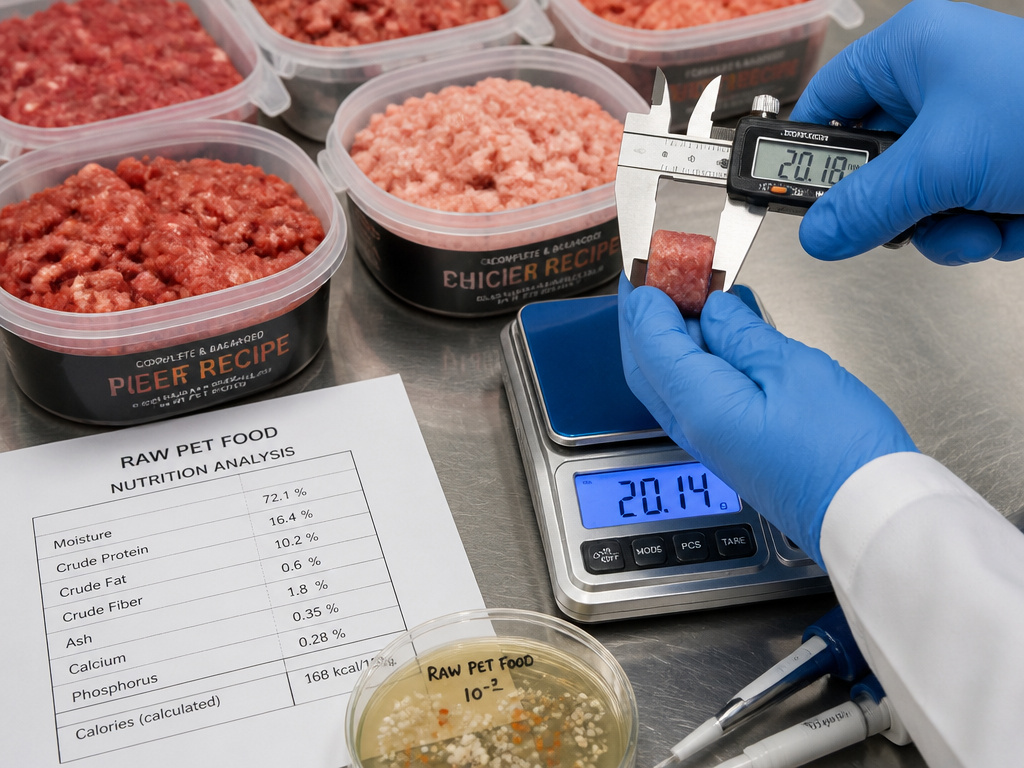
Forty-four commercial raw diets went to a lab in Germany, and the labels did not survive the trip.
Fat exceeded the tolerated deviation from declared values in 33% of products. Protein exceeded it in 45%. Mean fat content came in at 69 g/Mcal, with a range of 33 to 95. That unit is grams of fat per megacalorie of metabolizing energy, which is how you compare fat load across products with different moisture.
The correlation is the part worth sitting with. Fat was negatively correlated with protein at r = −0.74, p < 0.0001. In plain terms: the fattier the tub, the less protein it delivered. A product marketed on a high-protein story was frequently a high-fat product wearing that story.
Hygiene didn’t fare better. Aerobic colony count averaged 2.61 × 10⁸ CFU/g, Enterobacteriaceae averaged 3.61 × 10⁶ CFU/g, and Salmonella turned up in 2 of 10 products tested for it.
Convert to dry matter before you compare anything. A raw diet and a kibble cannot be compared on the numbers printed on the package, and any brand that makes the conversion hard is telling you something.
That conversion rule is the same one that governs a balanced raw diet, and it matters more here than in kibble because raw products vary so widely in water content.
What the Swedish Study Found in Raw-Fed Dogs
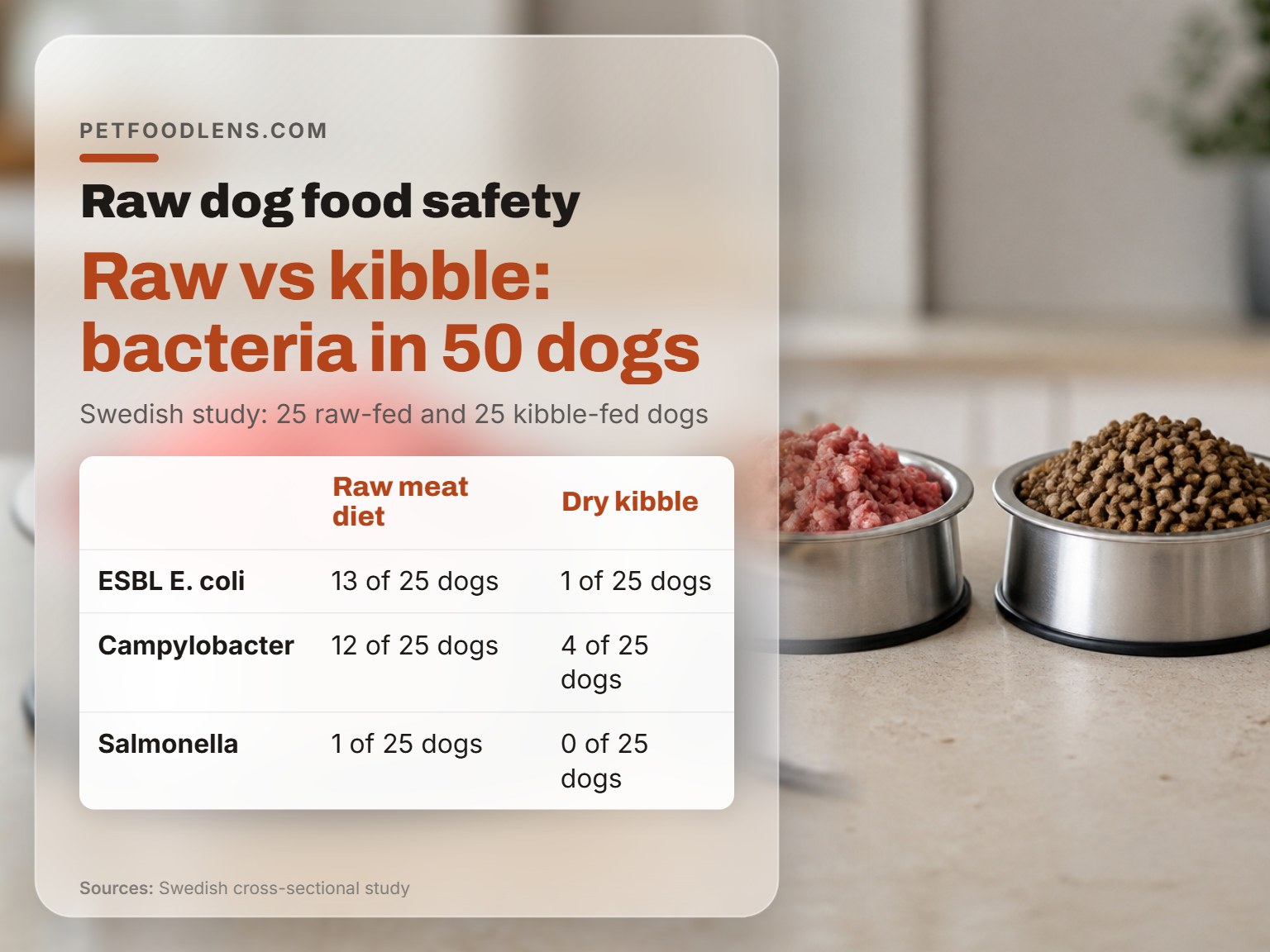
Fifty dogs is a small study, and the split was clean enough to be uncomfortable.
Twenty-five dogs were on raw meat-based diets and twenty-five were on dry kibble. In the raw group, 13 carried ESBL-producing E. Coli, 12 carried Campylobacter, and 1 carried Salmonella. In the kibble group, the same counts were 1, 4, and 0.
ESBL stands for extended-spectrum beta-lactamase. These are E. Coli that break down common antibiotics, which makes them a treatment problem rather than just a stool problem.
I care less about the Salmonella number in that study than the ESBL number. A dog shedding an antibiotic-resistant organism is a household issue that outlasts the bag of food, and it doesn’t announce itself with diarrhea.
The Swedish authors also handled the “more natural, wolf-ancestor” rationale carefully. They attribute it to proponents of raw feeding and frame it as a claim, not a finding. The cat in your kitchen has never met a wolf and has no plans to.
The raw meat diet pathogen study is worth reading in full for the methods, because the sampling frame shapes the result as much as the food does.
Bones in Raw Diets Safety: Who Else Lives in the House
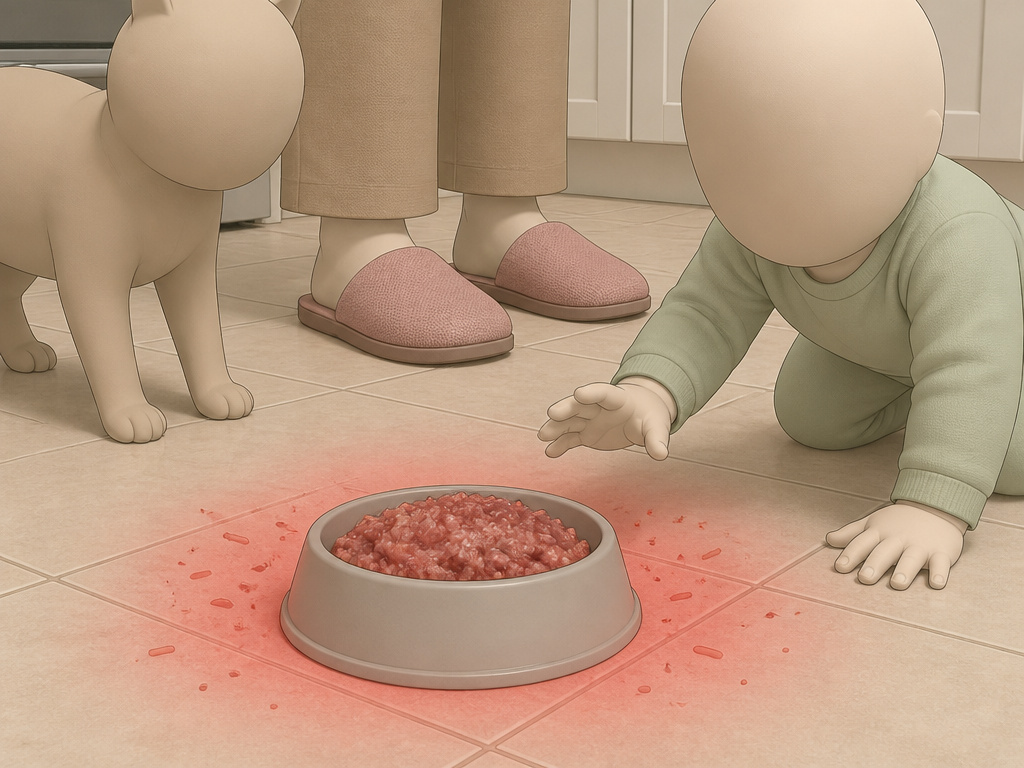
A raw bowl goes down on the floor, the dog eats, the bowl comes up, and a two-year-old crawls across the same tile twenty minutes later.
The FDA states plainly that owners who feed a raw diet may have a higher risk of infection with Salmonella and Listeria monocytogenes, and that you can spread the bacteria from the food to your own mouth by touching your face mid-prep. The Finnish authors go further and flag household composition as a variable in its own right.
The elevated-risk groups named in that work:
- Small children, who crawl on the floor where the bowl sat.
- Elderly household members, whose immune response is slower.
- Immunocompromised individuals, for whom a low dose can be a real illness.
There’s a fourth item the Finnish study adds that rarely makes it into feeding guides. Yersinia enterocolitica bioserotype 4/O:3 and Salmonella were detected only in the raw-fed dogs, and the authors concluded those organisms were probably transmitted from contaminated raw diets to indoor cats in the same household. The cat never ate raw food. The cat was still carrying.
Where this goes sideways: A bag of raw grind moves into a house with a toddler and an 80-year-old, and the risk calculation changes without anyone changing the food.
If you want the organism-by-organism detail, the salmonella risk breakdown covers what survives and where.
The Handling Steps the FDA Puts Numbers On
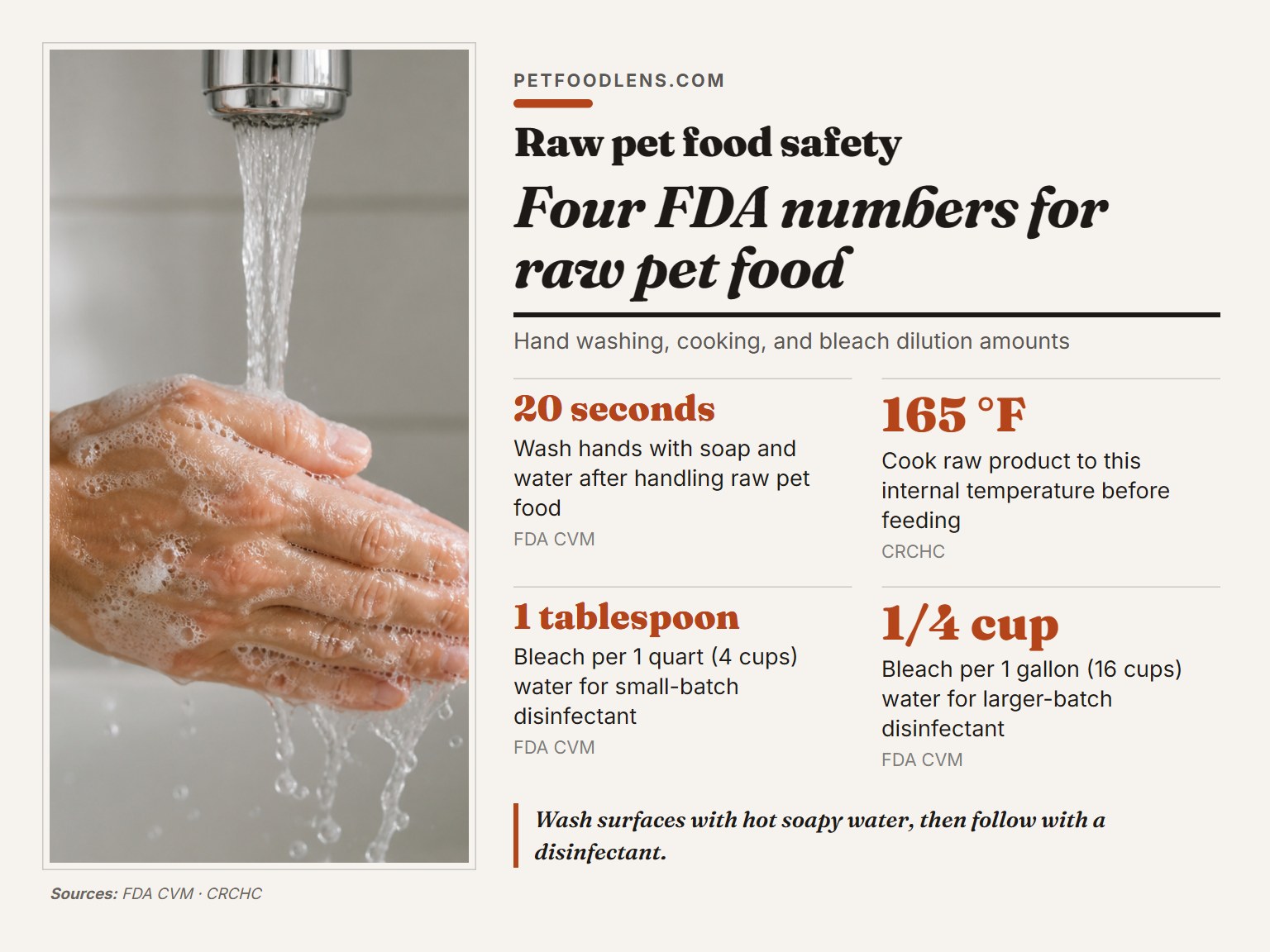
Four numbers carry most of the safety here: 20 seconds, 165 °F, 1 tablespoon, and 1/4 cup.
Before you start: Raw juices splash further than you expect and land on the sink rim, the sponge, and the fridge handle. Wash for a full 20 seconds, not a rinse. Keep the raw bowl off the surface where you prep human food, and thaw in the refrigerator or microwave rather than on the countertop.
- Freeze raw meat and poultry until you’re ready to use it, and thaw in the refrigerator or microwave. Thawing on the counter leaves the outside of the product in the temperature band where bacteria multiply fastest while the center is still solid.
- Don’t rinse raw meat, poultry, fish, or seafood. Rinsing doesn’t clean the surface, and the splash carries bacteria onto the sink, the sponge, and the counter behind you.
- Wash hands with soap and water for at least 20 seconds after handling raw pet food, and again after touching bowls, utensils, or the fridge handle. A quick rinse leaves the bacteria where it was.
- Wash surfaces with hot soapy water, then follow with a disinfectant. Skipping the wash leaves a film that the disinfectant can’t cut through.
- Don’t kiss the dog around the mouth or let it lick your face, especially right after a raw meal. That is the shortest path from the bowl to your mouth.
You’ll feel the difference on the counter after a wipe-down with hot soapy water followed by a disinfectant. It goes squeaky and matte, not slick.
The Bleach Dilution, Exactly
The FDA gives two ratios, and both are worth writing on the inside of a cabinet door.
- Small batch: 1 tablespoon bleach to 1 quart (4 cups) of water.
- Larger batch: 1/4 cup bleach to 1 gallon (16 cups) of water.
Items that fit can also go through the dishwasher after each use. The full sequence, wash then disinfect, is the part people compress into one step. For the wider routine, raw food handling covers the surfaces people forget, and raw food storage covers what happens between meals.
If You Are Going to Feed Raw Anyway
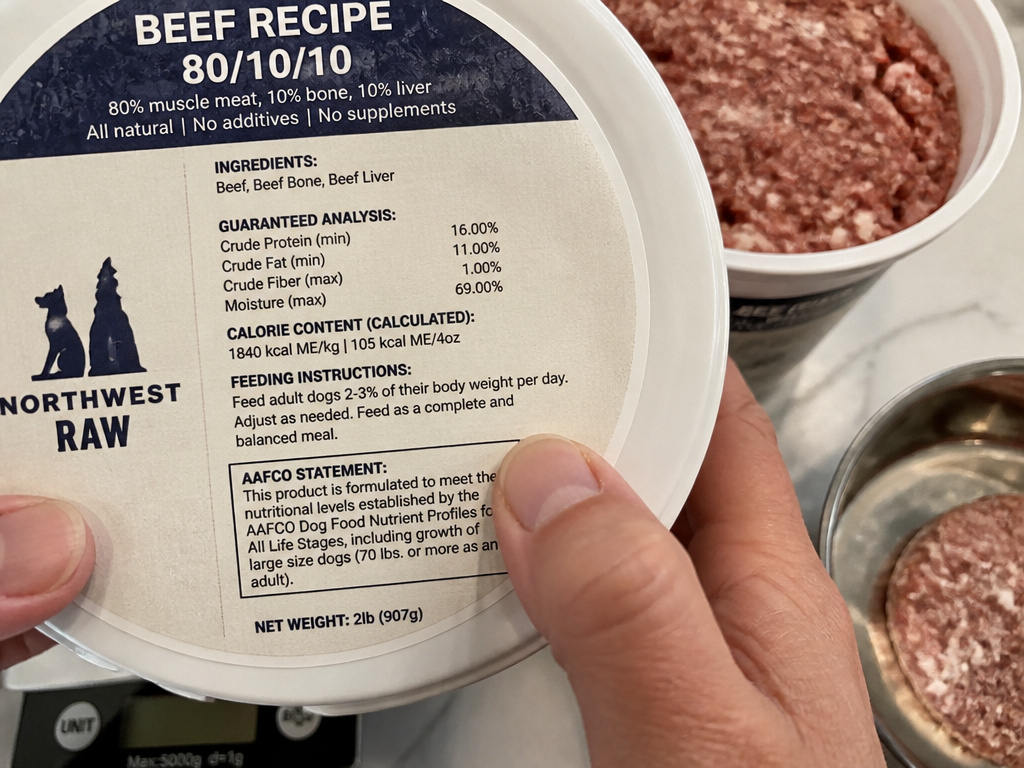
The first thing I read on any label is the nutritional adequacy statement, before the protein, before the ingredient list, before the front of the tub. It’s a fast filter. A product that doesn’t state it’s complete and balanced for a named life stage isn’t a diet, whatever the photography suggests.
That filter matters more in raw than anywhere else, because raw is the one category where you can buy something that is genuinely just meat.
What most people get wrong: Building a bowl from muscle meat and calling it balanced. Muscle meat is high in phosphorus and low in calcium, and variety across three proteins doesn’t fix that. It just gives you three unbalanced bowls.
High-pressure processing is the underrated part of this category. It’s a non-thermal treatment, and it’s a different process from cooking. Cornell’s 165 °F figure applies to cooking raw product, not to pressure treatment, and the sources gathered here don’t give a pathogen-reduction number for HPP. Treat any specific reduction claim as something to verify with the manufacturer.
Check it on the exact one you pick, because both companies also sell mixers and toppers that are not complete diets.
What to Look For on a Raw Product Label
- A complete-and-balanced statement naming a life stage, not just “for all life stages” in small print at the bottom.
- A guaranteed analysis you can convert to dry matter. If the moisture figure is missing, you can’t do the math.
- A named animal source on the front, matched to the same source in the ingredient list.
- A handling statement on the package. If the tub says nothing about thawing or surface cleaning, the manufacturer has left the hard part to you.
None of that replaces a veterinary opinion for a dog with a medical condition. I formulate and read labels for a living. I don’t diagnose, and I don’t manage kidney disease or diabetes. Where this crosses into a sick animal, a pregnant owner, or a toddler in the house, the vet’s call outranks mine.
Sourcing is the other half of the equation. Raw food sourcing covers what to ask a supplier, and the broader raw feeding safety picture is worth reading before you commit to the category rather than after.
Frequently Asked Questions
Are raw bones safer than cooked bones for dogs?
Sources disagree: advocates of BARF diets believe raw bones are less likely to splinter than cooked ones, while BSAVA advises against raw bones and HVO notes raw bones still cause injuries. Advocates of BARF diets believe raw bones are less likely to splinter than cooked ones, and HVO records that as a belief rather than a finding. The same source lists oral trauma, oesophageal lodging, constipation, obstruction, gastroenteritis, GI perforation, and septic peritonitis as injuries raw bones still cause.
Can freezing raw pet food kill Salmonella?
Freezing doesn’t reliably eliminate bacteria, and the German data complicates the assumption further. Frozen poultry and carcass products had higher Enterobacteriaceae counts than thawed counterparts, at p = 0.003. Freezing is a storage method, not a safety step.
How long can raw pet food sit out before it’s unsafe?
The FDA doesn’t publish a clock on this, and I won’t invent one. The guidance is a rule instead: freeze raw meat and poultry until you’re ready to use it, and thaw in the refrigerator or microwave, not on the countertop or in the sink.
Is high-pressure processing the same as cooking?
No. HPP is a non-thermal treatment and cooking is a thermal one. Cornell’s 165 °F threshold applies to cooking raw product. The sources here don’t give a pathogen-reduction figure for pressure treatment, so any specific number you see quoted should be checked with the manufacturer.
What should I do if my dog swallowed a bone and is vomiting?
Call your vet. The documented injury list includes oesophageal lodging, obstruction, and gastrointestinal perforation, and those are clinical events rather than feeding questions. I read labels for a living and I can’t examine a dog over the internet.
The Bottom Line
Here’s the threshold I’d actually use. If there’s a small child, an immunocompromised adult, or an elderly household member in the house, the raw bone question stops being a feeding-style debate and becomes a household exposure question. That’s the point where the FDA’s 20-second handwash and 1-tablespoon bleach dilution stop being suggestions and start being the whole plan.
For everyone else, the honest summary is that the evidence points one way and the enthusiasm points the other. Fifteen of 196 and 32 of 196 are not catastrophic numbers. They’re also not zero, and the German data says the label in your hand may be off by 45% on protein regardless of what you do about bacteria.
One concrete step this week: take whatever raw product is in your freezer and find the complete-and-balanced statement on it. If it isn’t there, you’re not feeding a diet. You’re feeding an ingredient and hoping the rest works out.
Bones in raw diets safety comes down to a decision you make before the bowl goes down, not after. Turn the tub over and read the back before you read the front.
