
How Much Fat Do Cats Need? A Label Reader’s Guide
This post contains affiliate links. As an Amazon Associate, we earn from qualifying purchases.
How much fat cats need starts with a floor of about 9% of dry matter. The National Academies sets the daily allowance at 5.5 g of total fat for a 9 lb adult cat and reports no known adverse effects from higher fat levels.
That undefined ceiling is where the arguing starts. A guaranteed analysis can print a fat percentage and tell you nothing about whether the fat came from poultry fat, fish oil, or a rendered tallow blend, and those three behave differently once they are inside the cat. How much fat do cats need is a separate question from where that fat comes from.
What follows: the daily gram allowances by life stage, the dry-matter math that makes two labels comparable, and the two places where the published research genuinely disagrees with itself.
Key Takeaways
- 9% of dry matter is the floor, not a target. The National Academies puts the minimum there, and commercial diets clear it by a wide margin.
- Convert to dry matter before comparing anything. A canned food and a dry food with similar fat percentages are not the numbers they appear to be.
- Fat source moves the blood work more than fat percentage does. Fish oil shifted triglycerides and LDL in a 2024 trial; sunflower oil and lard did not.
- The upper limit is unsettled. The National Academies reports no known adverse effects at high fat, while an 84-day trial found body-fat gain on a 30% fat diet.
- A nursing queen needs 12 g of fat a day against 5.5 g for an adult at maintenance, which is more than double.
How Much Fat Does a Cat Need Per Day?
The National Academies publishes daily fat allowances by life stage, and the numbers arrive in grams rather than percentages.
The National Research Council sets the minimum fat requirement for cats at roughly 9% of dry matter. Daily total fat allowances are published by body weight and life stage: 5.5 g for a 9 lb adult cat, 4 g for a 1.8 lb kitten, and 12 g for a 9 lb nursing queen with four kittens.
| Life stage | Body weight | Daily total fat |
|---|---|---|
| Adult maintenance | 9 lb | 5.5 g |
| Kitten | 1.8 lb | 4 g |
| Nursing queen, 4 kittens | 9 lb | 12 g |
Grams per day is the number that matters at the bowl. A percentage describes the food. Grams describe what the cat actually swallows, and the two only line up once you know the portion size and how much fat do cats need.
Here is the part the front of the bag never says. Feed a portion of an 18% fat dry food and the cat may take in more fat than the published allowance, because the allowance is a reference figure and the National Academies reports no known adverse effects from fat levels well above it. That is not automatically a problem, because the allowance is a reference figure and the National Academies reports no known adverse effects from fat levels well above it.
Kittens and nursing queens are the two stages where the allowance climbs or drops sharply. A queen feeding four kittens needs more than twice the fat of a cat at maintenance, which is why kitten and performance formulas carry higher fat percentages than adult maintenance diets.
If you want the energy side of the same calculation, the calorie needs figure is the one to pair with fat grams. Fat carries roughly twice the energy per gram of protein or carbohydrate, so a high-fat food delivers more calories per scoop whether or not the bag says so.
Fat also does not stand alone in the nutrient profile. The protein requirements for cats run higher than most owners expect, and the ratio between the two macros is what shapes the food’s overall balance.
The 9% Minimum and What It Actually Means on a Label
Flip the bag over and the guaranteed analysis lists protein, fat, fiber, and moisture percentages.
Those numbers are as-fed. They include the water in the food, which means a canned product at 12% fat and a dry product at 16% fat are not comparable until you strip the moisture out. This is the single most common error I see owners make when they ask how much fat do cats need, and it makes wet food look leaner than it is.
Here is the conversion, in order:
- Subtract the moisture from 100. Subtract the moisture percentage from 100 to get the dry matter percentage. Skip this and every comparison you make afterward is wrong.
- Divide the fat percentage by the dry matter figure. Divide the fat percentage by the dry matter figure to get the dry-matter fraction. Do this wrong and you will conclude a canned food is lower in fat when it is actually higher.
- Multiply by 100 to get the dry-matter percentage. That same food lands above the 9% minimum on a dry-matter basis.
- Compare only converted numbers. A 12% fat canned food with high moisture converts to a much higher fat percentage on a dry matter basis, which is a very different food from what the front label implies.
Details matter more than marketing here. The conversion takes only a moment with a calculator and it reframes every bag on the shelf.
There is a physical tell as well. High-fat kibble leaves a slick film on your fingers that a leaner formula does not. Rub a piece between thumb and forefinger and you can feel the difference before you ever look at a number.
Fiber sits in the same panel and interacts with all of this. The fiber requirements for cats matter because fiber dilutes caloric density, which is how a high-fat food can still be a weight-management food if the fiber level is high enough.
Why Fat Percentage Alone Tells You Almost Nothing
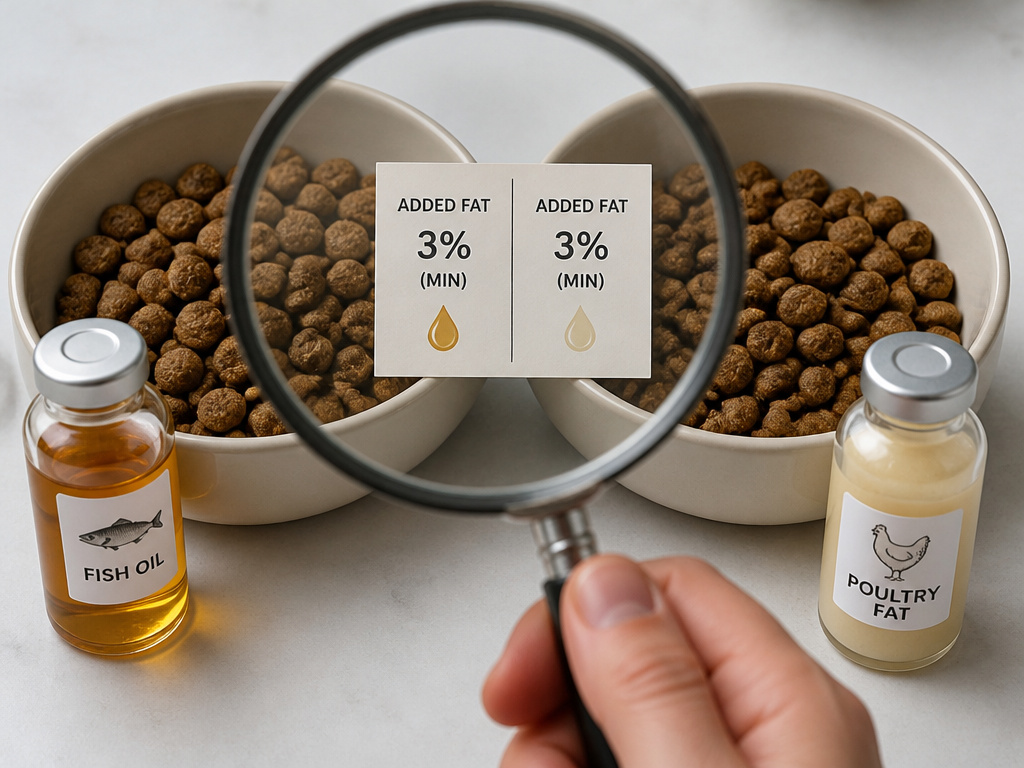
Two bags can both say 18% fat and behave nothing alike.
The difference is the source. Poultry fat, chicken fat, fish oil, flaxseed, and rendered tallow all count toward the same crude fat number, and the fatty acid profiles behind them are not interchangeable. A guide to animal fat in pet food is worth reading once, because the named sources on a label tell you more about the food than the percentage does.
The clearest evidence for this comes from a 2024 crossover trial in which sunflower oil, fish oil, and lard were added to the same base diet at identical rates. Only the fish oil lowered triglycerides and raised total and LDL cholesterol, and those effects were statistically significant. The other two fat sources did nothing comparable.
That result matters because it undercuts the idea that fat percentage is the lever. At the same inclusion rate, the source changed the outcome.
The omega-6 to omega-3 ratio is the number that captures most of this. Chicken fat and poultry fat run heavy on omega-6. Fish oil runs heavy on omega-3. Two foods at 18% fat can sit at opposite ends of that ratio.
Where this goes sideways: assuming a higher fat percentage means a richer omega-3 supply. Most high-fat dry foods get there on poultry fat alone, and the omega-3 content is negligible unless fish or a marine source appears in the ingredient list.
Fat also degrades in storage, and you can smell it. A bag stored in warm conditions can develop a sharp, crayon-like note before anything visible changes. Rancid fat still reads as fat on the guaranteed analysis.
For cats that genuinely need an omega-3 boost, the fish oil dosage for cats question is separate from the fat percentage question, and it should be. Dosing a supplement is not the same decision as choosing a maintenance diet.
I have compared enough labels to know that the named fat source tells you more than the crude fat number ever will. Some commercial foods name their fat sources specifically, which is one reason their panels read cleanly.
What the Feeding Trials Actually Found
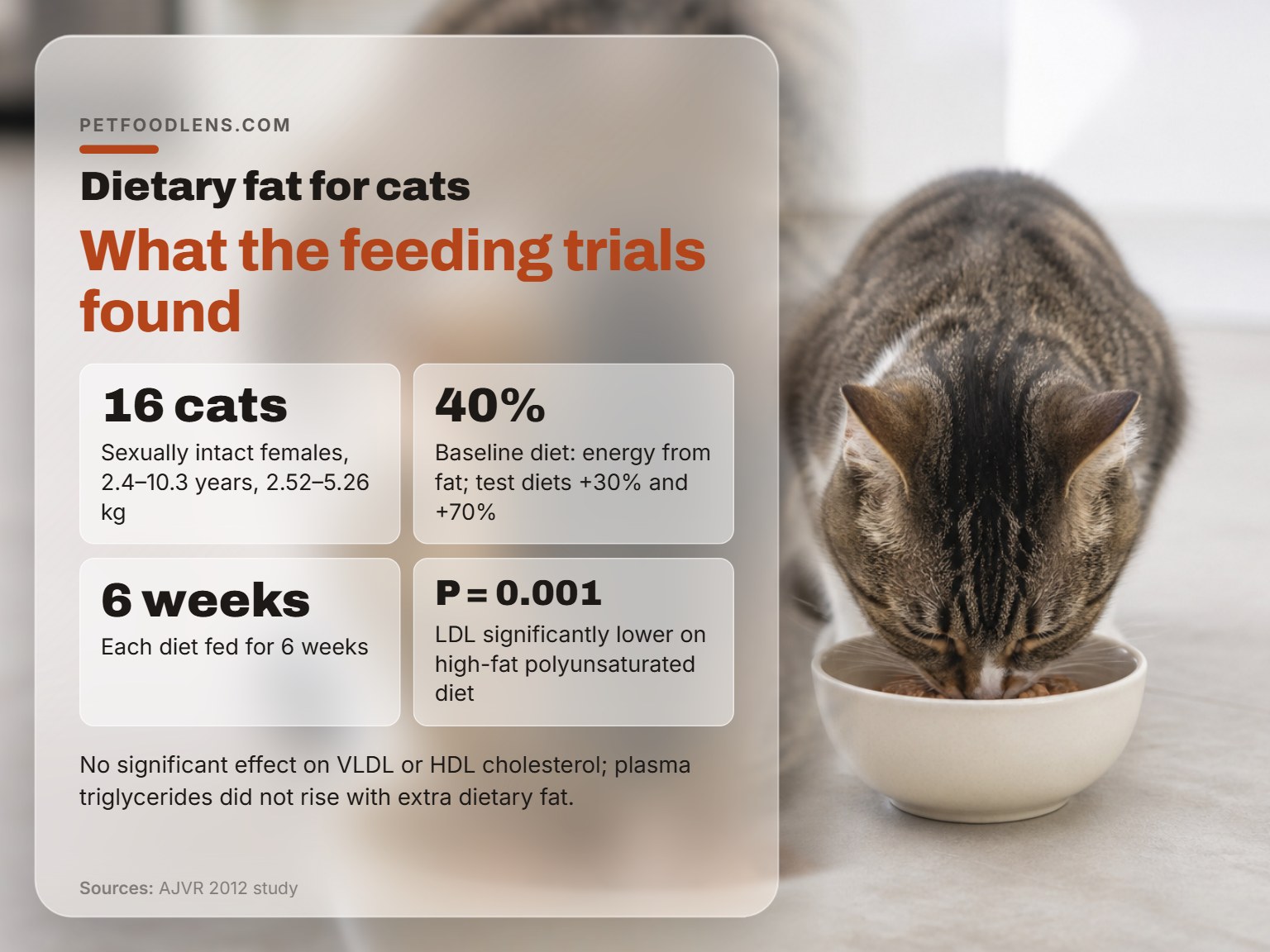
Sixteen cats, five diets, six weeks each.
That was the design behind the AVMA journal dietary fat study, which fed sexually intact female cats a baseline diet with 40% of energy from fat, then diets with fat increased by roughly 30% and roughly 70%. Every cat ate every diet in randomized order, which is a stronger design than the between-group studies that get cited more often.
The results were not what the fat-is-dangerous framing predicts. Diet, fat content, and the saturated-to-polyunsaturated ratio had no significant effect on VLDL or HDL cholesterol. Plasma triglycerides did not rise in response to the extra dietary fat. The only lipid change was a significantly lower LDL on the high-fat polyunsaturated diet.
The mechanism the authors proposed is worth understanding. Lipoprotein and hepatic lipase activities increased on the higher-fat diets, which suggests the cat upregulates the enzymes that clear triglyceride-rich particles. More fat in, more clearance capacity out.
I read the methods twice before that clicked. The cat is not passively absorbing fat and storing it. It is adjusting the machinery.
Where the sources genuinely disagree:
| Question | One position | The other position |
|---|---|---|
| Is there a safe upper limit? | National Academies: no known adverse effects at high fat | Cambridge trial: 30% fat diet raised body fat over 84 days |
| Does dietary fat raise blood cholesterol? | AJVR: no change up to about 66% of energy from fat | 2024 trial: fish oil raised total and LDL cholesterol |
| Does percentage or source drive the response? | AJVR: content and saturation ratio had little effect | 2024 trial: fish oil differed from lard and sunflower oil |
Both positions are real and both come from peer-reviewed work. Presenting either one as the settled rule would be dishonest.
The 2024 trial on dietary fat effects on blood values is the counterweight. Ten cats, a low-fat base diet, and three fat sources added at 0.5 or 1 g per kg of body weight across 3-week crossover periods. Fish oil lowered triglycerides and raised total and LDL cholesterol, and every value stayed inside the physiological reference range.
So the practical read is narrower than either headline. Fat percentage alone did not disturb the lipid panel in the AVJR work. Fat source did move it in the 2024 work, within normal limits.
Do High-Fat Diets Make Cats Fat?
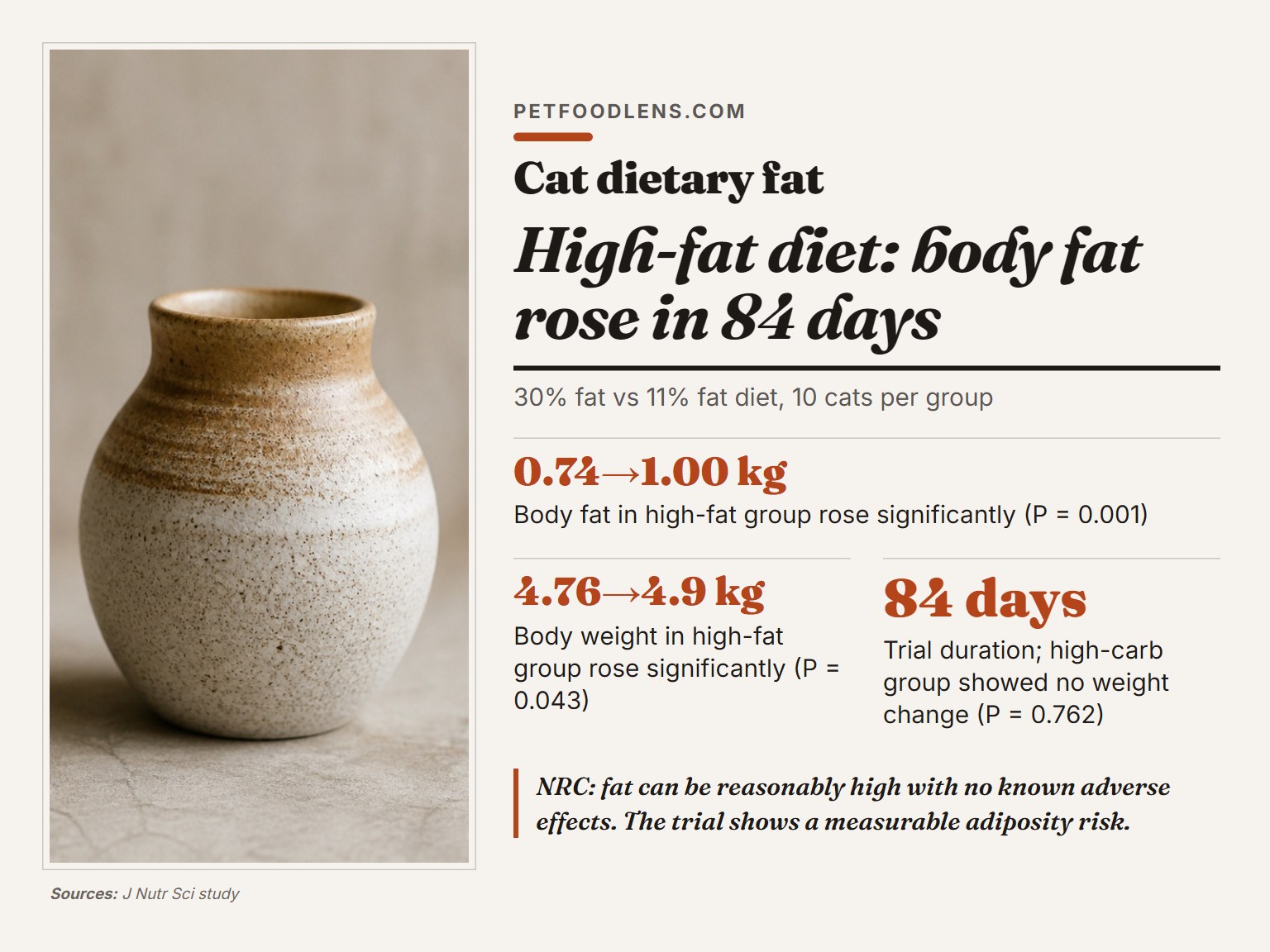
The published research does not settle this, and the studies cited most confidently are often the ones that measured the least.
The strongest evidence for a real risk comes from an 84-day trial comparing a high-fat diet at 30% fat and 26% carbohydrate against a high-carbohydrate diet at 11% fat and 47% carbohydrate, ten cats per group. There was no main effect of diet on body weight or composition. Within the high-fat group, though, body fat rose from 0.74 kg to 1.00 kg and body weight climbed from 4.76 kg to 4.9 kg, both statistically significant. The high-carbohydrate cats did not change weight at all.
The authors offered a mechanism: postprandial energy expenditure declined over the treatment period in the high-fat cats. Less energy burned after eating, over months, adds up.
Set that against the National Academies position that fat can run reasonably high with no known adverse effects, and you have a genuine split. One source is describing nutrient adequacy. The other is describing what happened to body composition over 84 days in a controlled feeding trial.
My read, and it is a read rather than a citation: both can be true. A cat can tolerate a high-fat diet physiologically and still gain adipose tissue on one, because tolerance and energy balance are different questions.
There is also the sex variable. Work on fatty acid oxidation in cats has examined how animals adjust fat burning to match intake across diets of different fat content, and the precision of that adjustment varies. Spayed females are the group most owners should be thinking about here, since they are also the group most likely to be indoors and under-exercised.
A separate study using a stearic-acid-rich diet at 23.9% crude fat against a 16.0% control, with equal total caloric intake across both groups, adds another wrinkle. Same calories, different fat level and different fatty acid makeup. That design isolates composition from volume, which most owner-facing comparisons never do.
Skip this if: your cat is a growing kitten, pregnant, or nursing. Restricting fat in those stages is a genuine risk, and the 12 g daily allowance for a nursing queen is more than double the adult figure for a reason.
How to Choose a Fat Level for Your Cat
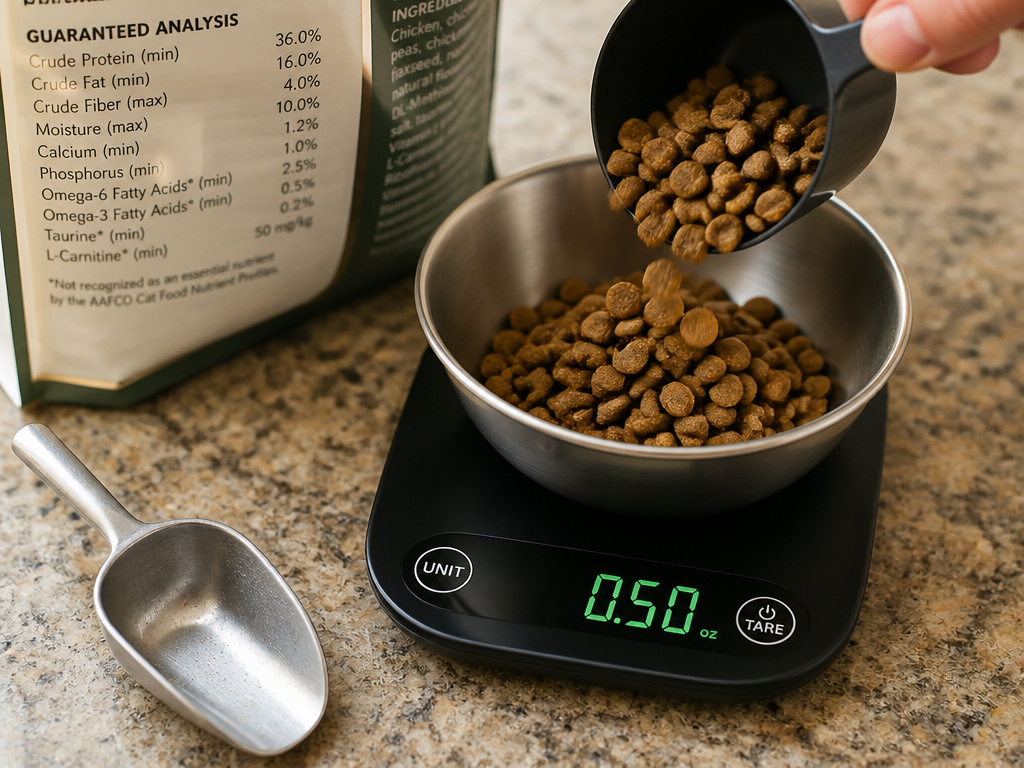
A client with an overweight indoor cat switched from a scoop to a kitchen scale for portions. Her cat’s daily intake dropped without any change of food at all, and over time the cat visibly slimmed.
That is the lesson I keep relearning. The measuring error hiding in a scoop is often larger than the difference between two formulas.
Match the fat level to the life stage first
Kittens and nursing queens need more fat, full stop. An adult at maintenance sits at the 5.5 g reference. A senior cat with reduced muscle mass needs a conversation with a vet before anyone changes the fat level, and that is a limit I will name plainly: complex clinical nutrition is not my area, and kidney or diabetes cases belong with a veterinary nutritionist.
Read the first five ingredients for the fat source
Named animal fat beats a generic “animal fat” every time. Some commercial foods list their fat sources specifically enough to evaluate. If the panel says “animal fat” with no species, you have learned nothing.
Check phosphorus alongside fat in older cats
Phosphorus is the number almost nobody looks at and the one that matters most for aging cats. It rarely appears on the front of the bag. Flip to the guaranteed analysis or the manufacturer’s full nutrient profile.
For cats already carrying extra weight, cat food for overweight cats is a narrower decision than a general fat-level question, because calorie density and fiber matter as much as the fat percentage itself.
What most people get wrong: dropping fat percentage to fix a fat cat while ignoring portion size. A reduction in daily volume does more than a drop in the fat column, and it happens faster than a seasonal change.
Easy to miss: the fat in treats. Freeze-dried treats can add fat to the day, which is a meaningful share of a 5.5 g allowance.
A few formulas I would actually reach for, depending on the cat. For a healthy adult at maintenance, a food with a named fat source, moderate fat, and a published nutrient profile is a reasonable default. For a cat that needs higher fat and a named animal source, choose a food that delivers it without leaning on a boutique protein. A food with an appropriate fat level and appealing aroma can help when a cat is a fussy eater, because those factors do more work than the ingredient list suggests. A wet food with a clearly named fat source and higher moisture is worth a look.
Frequently Asked Questions
What is the minimum fat percentage a cat needs?
The National Academies sets the minimum at roughly 9% of dry matter. Almost every commercial cat food clears that comfortably, so the minimum is rarely the binding constraint in a real feeding decision.
Is 20% fat too much for a cat?
There is no established upper limit. The National Academies reports no known adverse effects from fat levels well above the minimum, and a controlled trial fed cats diets at roughly 66% of energy from fat without raising triglycerides or cholesterol. Whether a specific cat gains weight on a high-fat food is a separate question about energy balance.
Do wet and dry cat food fat percentages compare directly?
No. The guaranteed analysis is as-fed, so moisture content distorts the comparison. A canned food with high moisture converts to a much higher fat percentage on a dry-matter basis than a dry food with low moisture.
Does fat source matter more than fat percentage?
The 2024 trial suggests it does. Fish oil, sunflower oil, and lard were added at identical rates to the same base diet, and only fish oil changed the lipid panel. At the same fat percentage, the source drove the outcome.
How much fat does a nursing cat need?
Twelve grams a day for a 9 lb queen nursing four kittens, against 5.5 g for an adult at maintenance. That is more than double and it is why kitten and performance formulas run higher in fat than adult maintenance diets.
The Bottom Line
If you take one number away, take the dry-matter conversion. Nine percent of dry matter is the floor, and any label comparison you make without converting first is a comparison of moisture content, not fat.
The threshold that should actually change your behavior: if your cat is spayed and indoors, treat the fat percentage as a calorie question rather than a nutrient question. The 84-day trial found body-fat gain on a 30% fat diet with no main effect across groups, which means the individual cat’s energy balance is what decides it.
The concession I owe you is this. Everything above assumes a healthy adult cat. Kidney disease, diabetes, pancreatitis, and pregnancy all move the fat target in directions I am not qualified to set, and a veterinary nutritionist should be making that call.
Here is the practical takeaway. Weigh the food before you change the formula. If the weight holds, the fat level is fine. If it climbs, the answer is usually in the bowl, not the bag.
