
Fish Oil for Cats Dosage Guide: EPA and DHA by Condition
This post contains affiliate links. As an Amazon Associate, we earn from qualifying purchases.
The condition matters because each figure traces back to a different study design. The heart failure number comes from a university handout built on clinical experience. The kidney and osteoarthritis numbers are back-calculated from what cats actually ate in two published trials. A fish oil for cats dosage guide must likewise distinguish between these sources.
What follows is the label math, the three published figures side by side, the research behind each one, and the cats that should skip fish oil entirely.
Key Takeaways
- Dose off EPA plus DHA, not total fish oil weight. A 1000 mg capsule carries far less than 1000 mg of the two fatty acids combined.
- Tufts’ heart failure guidance uses 65 mg/kg total (40 EPA plus 25 DHA). Kidney disease and osteoarthritis derive to 112 to 120 mg/kg. Same species, three different numbers.
- No safe upper limit exists for cats. Bauer’s 2011 review flags caution above 75 mg/kg of metabolic body weight per day, and the NRC never set a ceiling.
- The feline evidence base is thin. A systematic review screened 23 eligible randomized trials; three were in cats.
- Stop and call the vet for bruising, bleeding, incoordination, or seizures. Those sit on VCA’s serious-reaction list, not the mild one.
What Does a Safe Fish Oil Dose for Cats Actually Look Like?
Three published figures exist for cats, and none of them match.
Feline fish oil dosing is expressed as milligrams of combined EPA and DHA per kilogram of body weight per day. Published figures range from 65 mg/kg for cardiac support to roughly 120 mg/kg for chronic kidney disease and osteoarthritis. No National Research Council safe upper limit has been established for cats.
That last sentence in the fish oil for cats dosage guide does a lot of work. There is no ceiling to bump into, which means there is also no safety net if a dose runs high.
Bauer’s 2011 JAVMA review sets a caution threshold at 75 mg of combined EPA and DHA per kilogram of metabolic body weight per day. Watch the exponent. That is kg raised to 0.67, not straight kilograms.
Metabolic weight for a 4 kg cat works out to 2.5. Multiply by 75 and the caution line lands near 190 mg a day for that cat. A 6 kg cat scales to about 3.3, which puts its line near 245 mg.
So the caution threshold and the therapeutic figures live in different units. Comparing them without converting is how people talk past each other.
How much fat cats need in a day is a separate calculation from EPA and DHA dosing, and the two get confused constantly.
Why the Sources Give Three Different Numbers for the Same Cat
The gap between those figures in a fish oil for cats dosage guide comes from three different things.
| Source | Figure for cats | What it rests on |
|---|---|---|
| Tufts University handout | 65 mg/kg per day (40 EPA + 25 DHA) | Heart failure; clinical guidance |
| Today’s Veterinary Practice | 112 mg/kg (CKD), 120 mg/kg (OA) | Back-calculated from diet trials |
| Bauer, JAVMA 2011 | Caution above 75 mg/kg BW^0.67/day | Metabolic weight; no NRC ceiling |
Different indications, different mathematical bases, different tiers of evidence. None of the three is wrong. They answer different questions.
Today’s Veterinary Practice is explicit that data on omega-3 therapeutic supplementation in cats are scarce. That sentence sits in the middle of an otherwise confident article, and it is the most honest line in the source set.
Pick the number that matches the diagnosis, then confirm it with the vet who made the diagnosis. A dose pulled from a heart failure handout has no business treating arthritis.
The broader omega-6 to omega-3 balance matters too, because fish oil shifts a ratio the food already set.
Reading the Bottle: EPA and DHA per Capsule, Not “Fish Oil 1000 mg”
Flip the bottle over and the back panel gives you two numbers that matter and one that doesn’t. The front says fish oil 1000 mg. The back states the EPA and DHA in milligrams.
That gap is where dosing errors start. I have pulled 1000 mg softgels off a shelf with roughly 300 mg of combined EPA and DHA inside, which means the math changes by a factor of three depending on which bottle you grab.
Read past the front of the package.
Run the numbers for a 4 kg cat with kidney disease. At 112 mg/kg, that cat needs 448 mg of combined EPA and DHA a day. Two capsules land well past the derived figure.
That is the whole exercise. Weight, multiply, compare to the back panel.
Common mistake: Dosing off the total milligrams on the front of the bottle. A 1000 mg softgel delivers far less combined EPA and DHA than the front label implies, and the cat gets underdosed for months before anyone notices.
Liquid, Capsule, or Pump?
| Form | Best for | The catch |
|---|---|---|
| Liquid | Cats that fight pills | Measure carefully; oil oxidizes |
| Softgel capsule | Precise single doses | One pill a day, every day |
| Pump bottle | Multi-cat households | Dose drifts with each pump |
VCA’s handout names Eicosaderm, Dermapet, Welactin, and AllerG-3 as brand products, and labels should list EPA and DHA per serving rather than burying them. Welactin is the other one that turns up most often from clinics. VCA’s own handout names Eicosaderm, Dermapet, Welactin, and AllerG-3 as the brand products it sees.
What the Research Actually Supports (and What It Doesn’t)
The 2024 PKD pilot is the most specific feline data set available, and it is small.
What the PKD Pilot Actually Showed
A feline polycystic kidney disease pilot trial gave cats DHA-enriched fish oil at 250 mg/kg of body weight once daily for 28 days. A second group got 500 mg/kg and tolerated it for up to a month.
Some cats developed temporary soft stools at both doses. No other adverse clinical effects turned up, and blood and urine values stayed within reference intervals in the healthy cats.
That detail matters more than it looks.
The limits are real. The CKD in these cats came only from polycystic kidney disease. The authors say validation beyond two months has not been conducted.
An EPA/DHA companion animal systematic review screened 23 eligible randomized trials. Twenty were in dogs. Three were in cats.
That ratio is the honest state of the field. Most of what gets repeated about feline fish oil is borrowed from canine work.
The diet studies fill some of the gap. A retrospective look at seven commercial renal diets found the one with the highest EPA content, at 200 mg per 100 kcal, was associated with the longest survival in cats with chronic kidney disease. A separate blinded randomized study of 40 client-owned cats with osteoarthritis fed a diet containing 188 mg of EPA plus DHA per 100 kcal alongside green-lipped mussel extract, and objective mobility measures improved.
Both are diet-level findings. Neither tells you what a capsule should contain.
I would rather see an owner bring a printed label to the vet than a screenshot of a dosing chart from a forum. The label tells the vet what the cat is actually getting. The forum post tells them nothing.
Atopy and dermatitis sit high on VCA’s indication list, which is why skin and coat questions drive so much of the fish oil traffic.
I will say plainly where my own limits are. Complex clinical nutrition for a cat with advancing kidney disease is a veterinary internist’s call, not a label reader’s. My job is to make sure the number on the bottle is legible before that conversation starts.
Which Cats Should Not Get Fish Oil
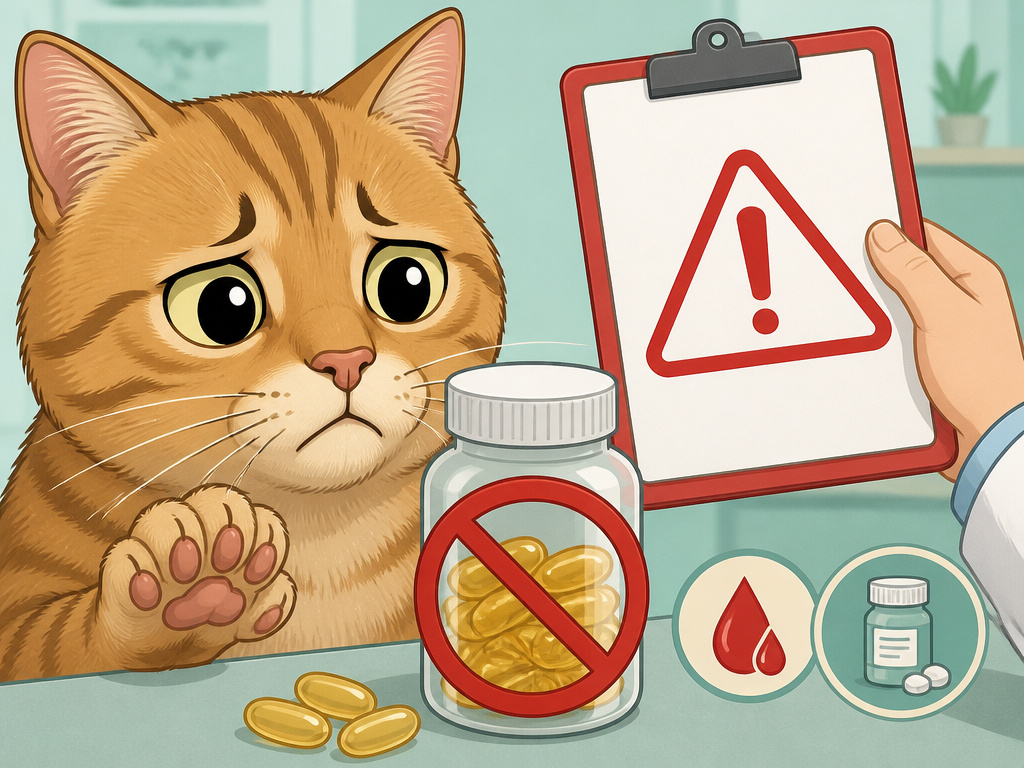
Some cats should never get this.
VCA lists an allergy to any component of the product as a straight contraindication. It also flags pets on several medications, because fish oil interacts with a list of drugs.
Before you start: Fish oil alters platelet function, so a cat on an anticoagulant or scheduled for surgery needs the vet’s sign-off first. Buy only from a seller who names the fish source, because heavy metal contamination is a documented risk with oil of unknown origin. If the cat has pancreatitis in its history, raise it before the first dose.
That heavy metal warning is not marketing caution. VCA states outright that fish oil should not be used where a reputable source cannot be obtained.
Stop and Call the Vet If You See This
- Irregular breathing, rash, fever, or puffiness and swelling around the face
- Abnormal bruising or bleeding, and VCA calls this out especially in cats
- Pancreatitis
- Appetite loss
- Incoordination or seizures
The mild list is shorter and less alarming: GI upset, fishy odor, delayed wound healing, oily coat, itchiness or skin flaking. Those get a phone call. The list above gets a phone call now.
How to Give It Without a Fight (and What to Watch For)
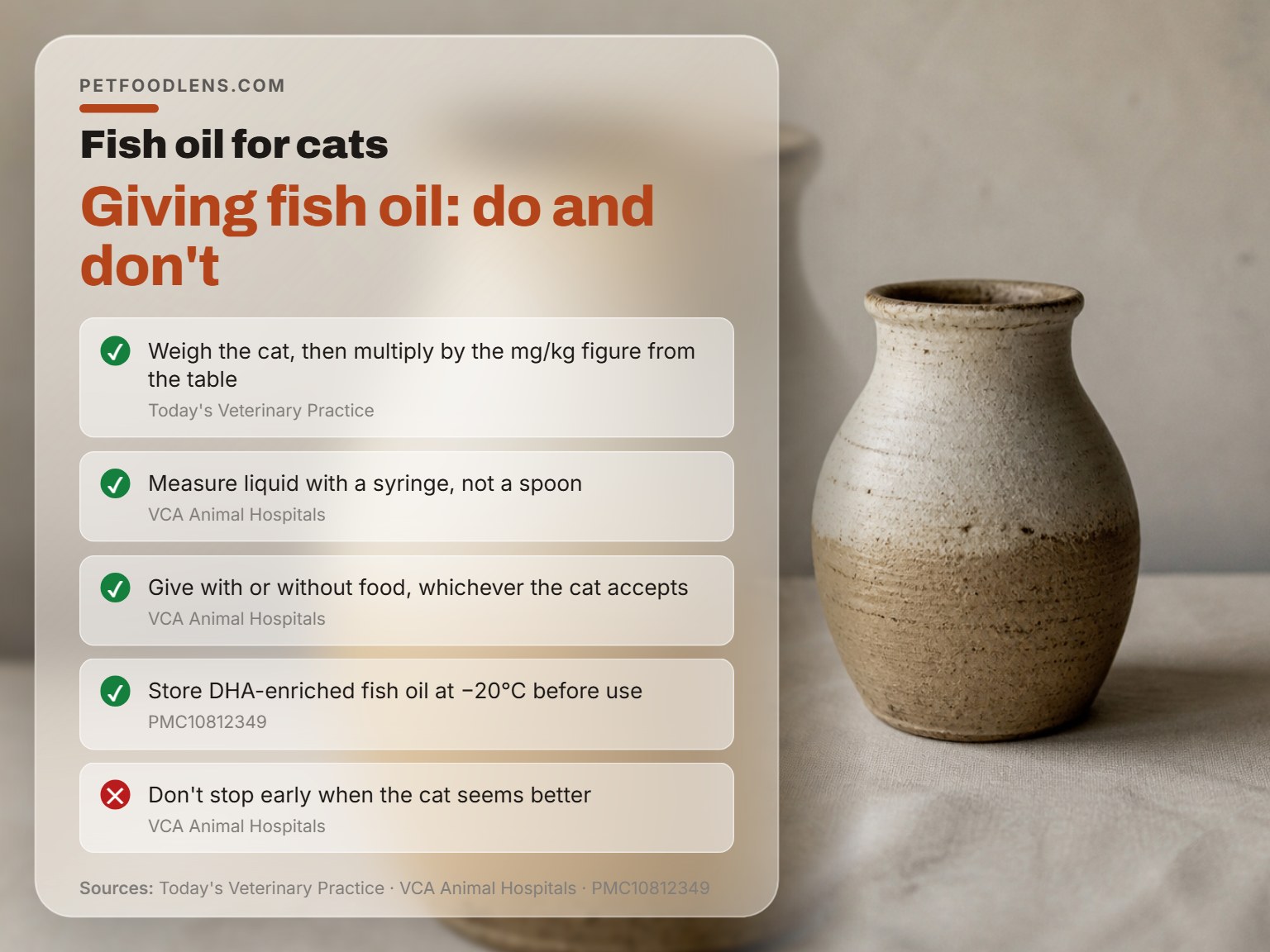
Three things decide whether this works: the form, the timing, and whether you write the dose down.
- Weigh the cat, then multiply by the mg/kg figure from the table above. Write the number on the bottle in marker. Skipping this is how a 4 kg cat ends up on a 6 kg dose.
- Measure liquid with a syringe, not a spoon. VCA specifically calls for careful measurement of liquid forms, and a kitchen spoon is not a precise measure.
- Give it with or without food, whichever the cat accepts. VCA lists both as fine, and a cat that refuses a medicated meal gets nothing at all.
- Keep the bottle cold and dark. The PKD pilot stored DHA-enriched oil at -20°C to prevent lipid oxidation, while VCA gives no temperature and points owners to the manufacturer’s refrigeration instructions.
VCA also says to give fish oil for the entire time prescribed, even after the pet seems better. That one gets ignored constantly.
The part nobody mentions: Fish oil goes rancid quietly. There is no mold and no off color, just a bottle that smells sharper than it did a month ago and a cat that has been getting oxidized fat for weeks.
Anti-inflammatory cuts both ways, and suppressed immune markers are not automatically a win.
What About Flaxseed and Cod Liver Oil?
Flaxseed oil is the wrong answer for a cat, and the gap isn’t small.
Cats lack the enzyme efficiency to convert the plant precursor into EPA and DHA at any useful rate.
The mechanism was dilution, not conversion failure, but the practical conclusion lands in the same place.
So the sourcing question has a short answer. Marine oil, named fish, EPA and DHA printed in milligrams. Anything else is a different product with a different job.
Frequently Asked Questions
How much fish oil should I give my cat?
Start from the condition, not the bottle. Kidney disease and osteoarthritis derive to roughly 112 and 120 mg of combined EPA plus DHA per kilogram. Convert that to milligrams for your cat’s actual weight before you measure anything.
Is 1000 mg of fish oil a day too much for a cat?
The 1000 mg figure describes the whole oil, not the active fatty acids. A capsule that size typically carries around 300 mg of combined EPA and DHA, which for a 4 kg cat sits below the derived kidney disease figure of 448 mg. Check the back panel rather than the front.
Can I use human fish oil capsules for my cat?
Only if the label states EPA and DHA in milligrams and the source is reputable. VCA warns against fish oil of unknown origin because of heavy metal risk. Human products also come in doses built for a 70 kg adult, so you will be splitting capsules.
How long before I see a difference?
The sources do not give a clean answer. The PKD pilot ran 28 days, and its authors note that validation beyond two months has not been done. Skin and joint changes are slow by nature, so judge at the two-month mark rather than the two-week mark.
Does fish oil help a cat with kidney disease?
The evidence is suggestive and thin. A retrospective study of seven renal diets linked the highest-EPA diet, at 200 mg per 100 kcal, to the longest survival. That is a diet-level association, not proof that a capsule does the same thing. The 2024 PKD pilot was small and had no DHA-free control group.
The Bottom Line
If the label does not state EPA and DHA in milligrams, put the bottle back. That single filter eliminates most of what sits on the supplement shelf, and it costs you nothing to apply.
Then do the arithmetic once. Weigh the cat, multiply by the figure that matches its diagnosis, and write the result on the bottle in marker. Two minutes of math beats a year of guessing.
Here is the concession. The feline evidence behind all of this is three randomized trials and a small pilot study. Anyone who tells you the dose is settled is reading dog data and calling it universal.
So bring two numbers to your vet: the cat’s weight and the combined EPA plus DHA per capsule on the label you bought. That conversation goes somewhere useful. A conversation about brands goes in circles.
