
How to Read AAFCO Statements: 3 Formats Explained
This post contains affiliate links. As an Amazon Associate, we earn from qualifying purchases.
To read AAFCO statements, match the nutritional adequacy line on the package to one of three permitted formats, then check the product name, the species, and the life stage in the blanks. AAFCO itself does not approve, certify or endorse any pet food, so there is no such thing as an AAFCO-approved product.
Three formats exist because a company has three ways to back a complete-and-balanced claim: formulate to the nutrient profiles, run a feeding trial, or point at a product that already passed one. The first is arithmetic on paper. The second is an actual test with animals. The third is a family resemblance argument, and AAFCO says it does not get used often.
What follows walks all three statements line by line, shows where the statement now sits on a modern package, and flags the two places a label can legally leave you knowing less than you assume about how to read AAFCO statements.
Key Takeaways
- AAFCO does not approve, certify or endorse pet food. Any bag using that language is running a claim the standards body explicitly disowns.
- Three statement formats exist, and only one of them involves feeding animals.
- The blanks carry as much weight as the sentence. The product name must match the front of the package, and both the species and the life stage must be stated.
- Treats, snacks and supplements sit in a gap. One AAFCO page exempts them from the adequacy statement; the label modernization rules cover them anyway.
- A guarantee is a floor or a ceiling. A single lab value says nothing about how the next batch will test.
What the Three AAFCO Statements Actually Say
Every complete-and-balanced claim on a US pet food package traces back to one of three sentences. AAFCO publishes all three word for word on its understanding pet food label statements page, and each one has two blanks to fill.
AAFCO permits three nutritional adequacy statements on pet food labels: formulated to meet the AAFCO Dog or Cat Food Nutrient Profiles, substantiated by animal feeding tests using AAFCO procedures, or comparable to a product substantiated by AAFCO feeding tests. Each format carries blanks for the product name and the life stage.
The three formats do not carry equal weight. One is a calculation, one is a trial, and one is a comparison.
| Statement format | Basis for the claim | What AAFCO says about it |
|---|---|---|
| Formulated to meet the profiles | Calculation against nutrient profiles | One of three recognized authorities |
| Feeding tests substantiate | Standardized AAFCO feeding protocol | One of three recognized authorities |
| Comparable to a tested product | Resemblance to a tested product | Not used often; called a “family product” |
Two rules apply to all three, and they are the core of how to read AAFCO statements. The first blank has to show the product name exactly as it appears on the front of the package, and the statement has to say whether the food is for dogs or cats.
Statement 1: Formulated to Meet the Profiles
The permitted wording reads: “ is formulated to meet the nutritional levels established by the AAFCO Dog (or cat) Food Nutrient Profiles for .”
This route is math. A formulator totals the nutrients and checks them against the published profiles, and no animals are fed. That makes it the cheapest path to a legal claim, which is why it shows up so often.
The Model Pet Food Regulations recognize only three authorities for an adequacy claim: the AAFCO Dog Food Nutrient Profiles, the AAFCO Cat Food Nutrient Profiles, and the AAFCO Dog and Cat Food Feeding Protocols.
Statement 2: Feeding Tests Substantiate It
The permitted wording reads: “Animal feeding tests using AAFCO procedures substantiate that ___ provides complete and balanced nutrition for ___.”
AAFCO procedures are standardized feeding protocols. They define how a trial is run and how the results get judged, which is what keeps two companies from grading their own homework differently.
When you see this sentence, animals ate the food under those protocols and the results cleared the bar.
Statement 3: Comparable to a Tested Product
The permitted wording reads: “___ provides complete and balanced nutrition for ___ and is comparable to a product which has been substantiated using AAFCO feeding tests.”
This is the family product route. The food is similar to something that passed a feeding trial, and the differences are minor formulation changes that do not touch the nutritional basis.
AAFCO notes this statement is not used often. When you spot it, you are looking at a claim built on resemblance rather than a fresh test.
Which Life Stage Goes in the Blank?
Four life stages are recognized: gestation/lactation, growth, maintenance, and all life stages. The second blank in every statement has to name one of them.
Gestation/lactation covers pregnant and nursing animals. Growth covers puppies and kittens. Maintenance covers adults. All life stages covers growth through adult in one claim.
| Blank on the label | Who it covers | What to check |
|---|---|---|
| Gestation/lactation | Pregnant or nursing animals | Species matches your pet |
| Growth | Puppies and kittens | Product name matches the front |
| Maintenance | Adult animals | Claim is narrower than it looks |
| All life stages | Growth through adult | Whether a kitten shares the bowl |
I check that blank before anything else on the package. A maintenance claim and an all life stages claim are not the same promise, and the gap matters in a multi-cat house where a kitten eats whatever is down.
Why “AAFCO-Approved” Does Not Exist
Bag fronts and retailer pages use the phrase constantly. AAFCO’s AAFCO pet food consumer FAQ answers it in one line: AAFCO does not approve, certify or otherwise endorse pet foods, and there is no AAFCO-approved pet food.
That leaves a real gap between the standards body and the shelf. AAFCO holds one position. Much commercial copy holds the other.
Two more splits are worth knowing, because they change how much weight the label can carry. The Model is often described as a de facto standard rather than law, and AAFCO notes that an individual state may have its own rules that vary somewhat from the Model. Most state feed laws reference the AAFCO Official Publication, which is why the standard travels so well.
Federal labeling is a separate layer again, though AAFCO Models and federal regulations are often treated as one combined standard. AAFCO describes the FDA’s federal requirements as rather minimal compared to the AAFCO Models, while noting they include some details the Models do not. A product can meet one and miss the other.
I have watched people reject a perfectly ordinary food because the bag did not say “AAFCO-approved,” then buy one that did. The phrase is marketing weight, not regulatory weight. Here is the practical takeaway: ignore it and read the adequacy statement instead.
The other thing worth knowing is what the phrase hides. Front-panel words like premium, holistic, and human grade carry far less regulatory weight than the adequacy line, and misleading pet food claims tend to cluster in exactly that space. If you want the fuller picture of what AAFCO actually does and does not do, that is a separate read.
Are Treats and Supplements Required to Carry One?
Short answer: the two AAFCO pages disagree, the Reading Labels page exempts snacks, treats and supplements, while the label modernization rules cover them, and both versions are worth knowing.
On the Reading Labels page, snacks, treats and supplements are exempt from the nutritional adequacy statement requirement. On the label modernization side, the updates apply to all pet and specialty pet foods, treats, food mixers, food supplements and veterinary diets included.
So the exemption and the modernization scope pull in opposite directions. Here is what that means at the shelf:
- A bag of biscuits may legally carry no adequacy statement at all, and that is not a red flag on its own.
- A tub of powder sold as a supplement can fall in the same gap, even when the front panel reads like a complete diet.
- A veterinary diet sits inside the modernization scope, so the statement should be there.
- A “mixer” is a topper, and toppers are not complete diets no matter how the bag is dressed up.
Worth knowing before you start: bulk-handled treats and chews are more exposed than sealed bags. AAFCO notes that post-manufacture Salmonella contamination is usually introduced after the product is manufactured and cooled, and open bins give it a place to land. If your household has young children or an immunocompromised person, buy the sealed bag and wash your hands after handling.
The regulatory side of this is still moving. AAFCO published nutritional adequacy claims model regulation guidance for small manufacturers in April 2025, which tells you the blanks and the placement rules are being tightened rather than loosened.
Where the Statement Sits Now: Inside the Facts Box
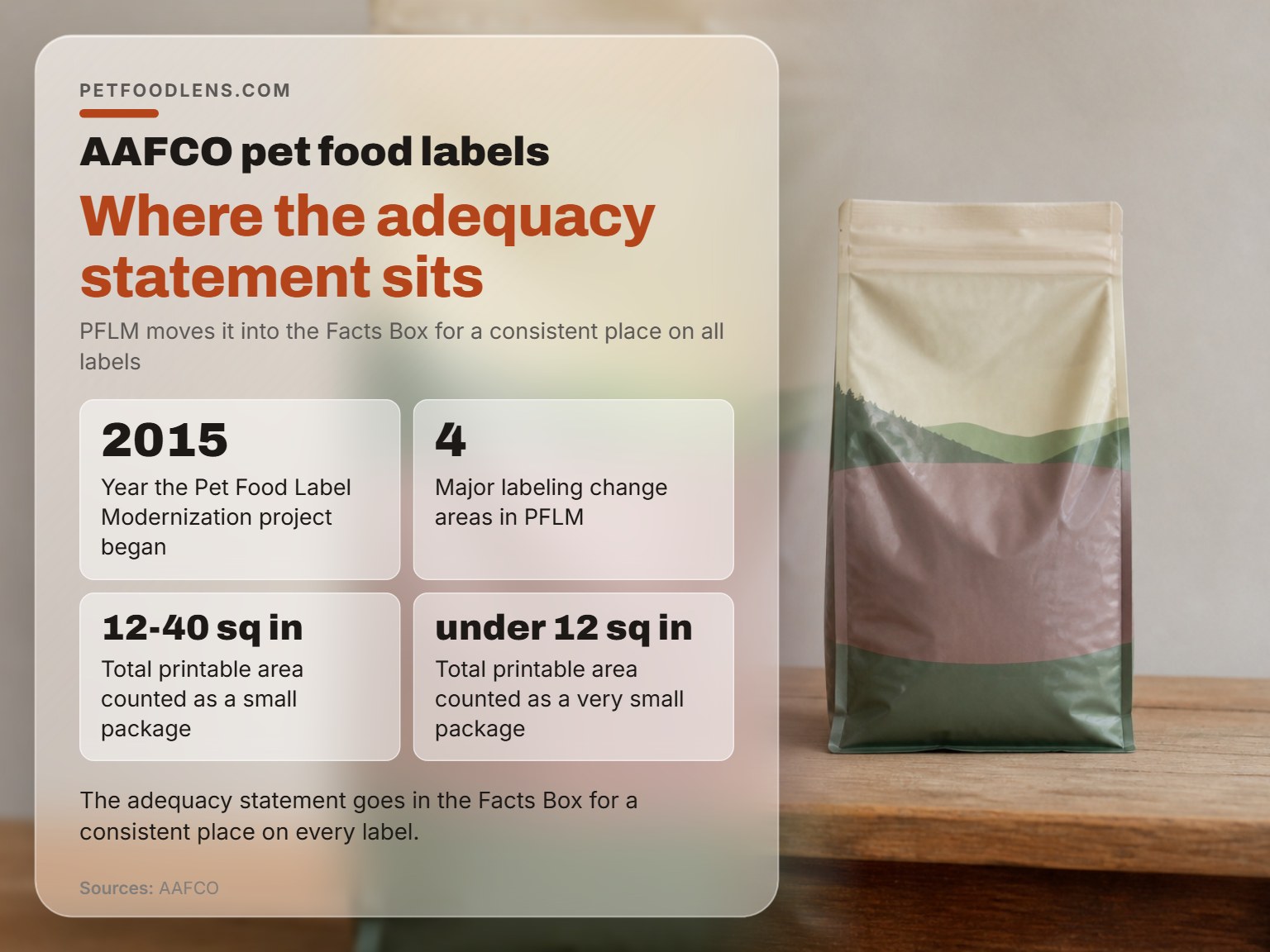
The Pet Food Label Modernization project began in 2015. One of its four major change areas moves the nutritional adequacy statement into the Facts Box so it lands in the same place on every package.
That differs from the common advice to look for the statement on the back of the bag, though AAFCO’s modernization rules place it in the Facts Box. The back panel is where it has lived, and plenty of packages still put it there. Under the modernized format, the box is the target.
The box has its own visual rules. Nutritional information is set off by hairlines, printed all black or in one color, on a white or neutral contrasting background. You can spot a compliant one from arm’s length in a dim aisle.
Here is what the example panel in the AAFCO pet food Nutrition Facts panel document actually shows. One cup, measured as an 8 oz standard measuring cup, equals 32 g. Protein minimum 4 percent, or 21 g. Fat minimum 2 percent, or 14 g. Total carbohydrate maximum 8.327 percent, or 39 g. Dietary fiber maximum 2 percent, or 8 g. Moisture maximum 8.0 percent, or 6 g.
Notice the household unit and the gram weight sitting side by side. That pairing is required, and it is the first thing that lets you compare two bags honestly.
Where this goes sideways: old packaging does not disappear on the day a rule changes. You will keep finding bags with the adequacy line floating loose on the back panel for a while yet. Read the statement wherever it sits, then check whether the box is present.
The rest of the modernized label is a bigger shift than most people realize, and the pet food label as a whole is being rebuilt around it. Small packages get allowances: total printable area of 12 to 40 square inches counts as small, and under 12 square inches counts as very small.
What the Statement Cannot Tell You
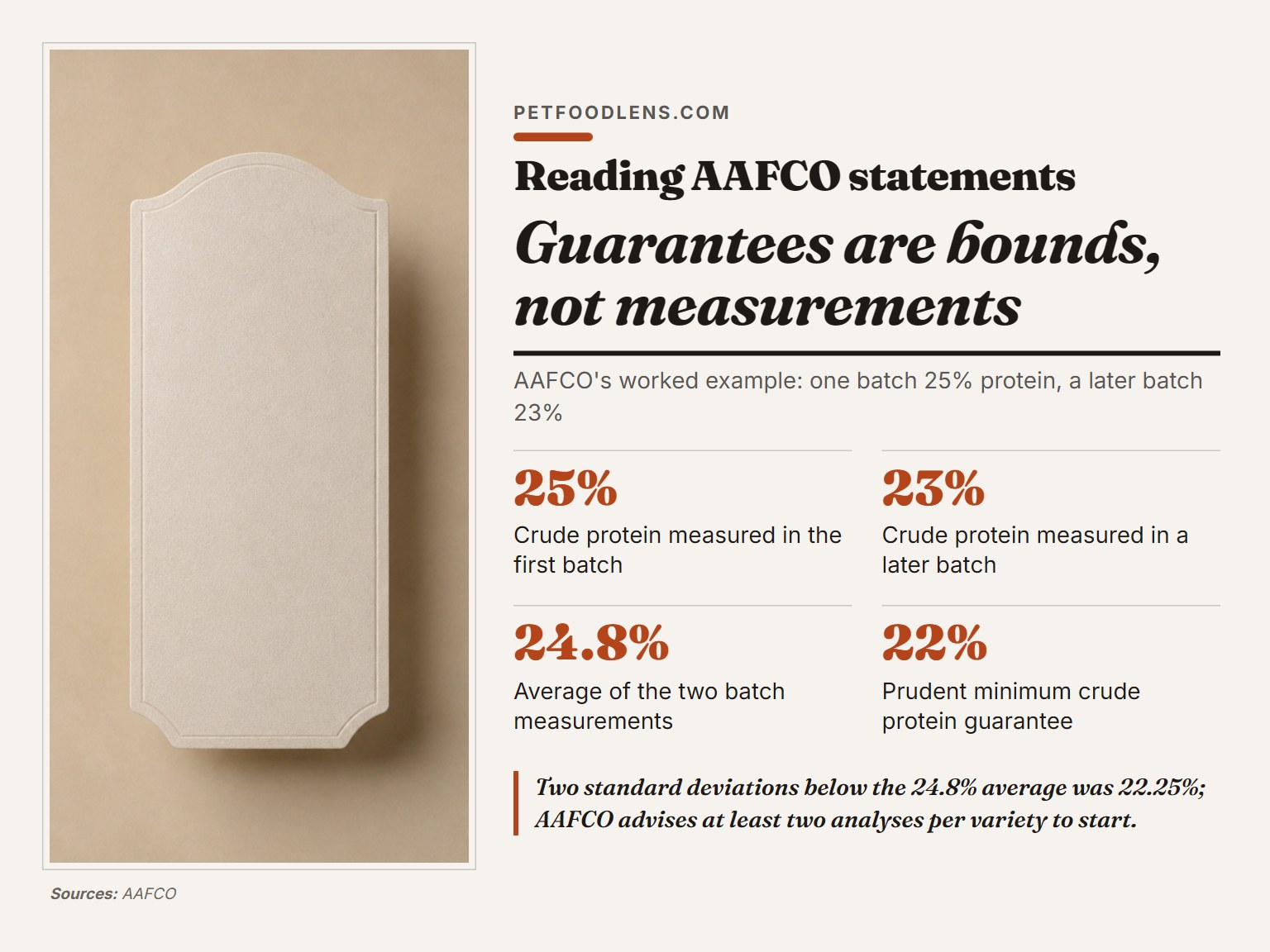
A guarantee is a floor or a ceiling, not a measurement, though the label guarantee is often read as the product’s actual nutrient content.
Four guarantees are required on a pet food label: minimum crude protein, minimum crude fat, maximum crude fiber, and maximum moisture. Every one of those is a bound, and a bound is a promise about a limit rather than a report of what is in the scoop.
The ingredient list has its own visual discipline. Everything is printed in the same type, size, style and color, so no ingredient in the list is allowed to shout. Ingredients run in descending order by weight, the first one carries the most weight, and the absolute amount of each is not quantified anywhere on the label.
That last point gets abused. Collective terms like “animal protein products” or “grain products” are banned on pet food, and so are brand names and any reference to quality or grade. Species has to be declared when the meat or byproduct comes from anything other than cattle, swine, sheep or goats.
Now the part most label readers skip. AAFCO’s own worked example shows why a single number is thin evidence. One batch measured 25 percent crude protein. A later batch came in at 23 percent. The average was 24.8 percent, and two standard deviations below that average was 22.25 percent. The prudent minimum guarantee for that product was 22 percent.
If a label guarantee were a measurement, that manufacturer would have printed 25 percent and been wrong within a year. A guarantee is a promise you can defend across batches, which is why AAFCO advises at least two analyses of each variety just to start.
That is also where the common reading of a guarantee breaks down, though the label guarantee is often read as the product’s actual nutrient content. A single analytical value does not give any indication as to expected batch-to-batch variation, so treating the panel as the food’s actual nutrient content is a stretch. The panel is a commitment about range.
Then there is the comparison problem. Crude percentages on a wet food and a dry food are not the same measurement, because moisture dilutes everything else. Convert to a dry matter basis before you compare anything, and the guaranteed analysis numbers start meaning something.
I do that conversion on every can and bag I put side by side. It is the single step that changes the ranking most often.
If you want to go past the label entirely, third-party certifications cover ground the adequacy statement never touches. AAFCO is a non-profit standards body, and its members are not practicing veterinarians. The AAFCO startup labeling guidance is written for manufacturers, but it is the clearest public explanation of how those guarantee numbers get set.
How to Read AAFCO Statements Without Trusting the Front of the Bag
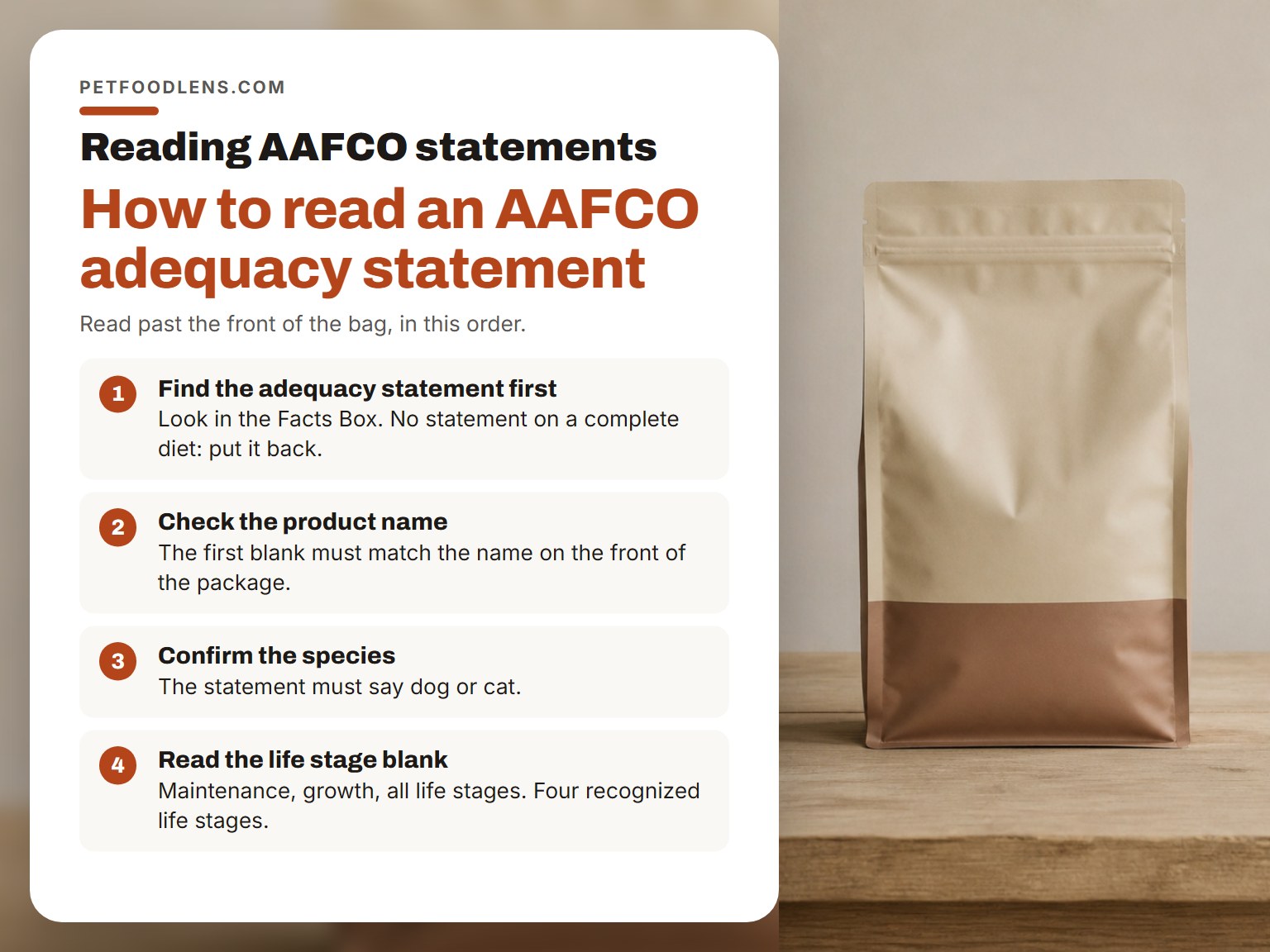
You are in the aisle with two bags in your hands and a cat waiting at home. The front panels are doing their job. Read past the front of the bag, in this order.
- Find the adequacy statement first. Look in the Facts Box, then the back panel. If a complete diet has no statement anywhere, put it back.
- Check the product name in the first blank. It has to match the name on the front of the package. When it does not, you are reading a statement about a different product.
- Confirm the species. The statement must say dog or cat. A food that never names the species is telling you something by omission.
- Read the life stage blank. Maintenance, growth, all life stages. Skipping this step is how a kitten ends up on an adult maintenance food for a year.
- Convert the guaranteed analysis to dry matter. Do this before you compare two foods. Skipping it lets a wet food’s low crude protein percentage scare you off a better diet.
Step five is where most comparisons fall apart. Two panels side by side look wildly different until you strip out the water, and then the ranking often flips.
One more front-panel word deserves a warning. “Human grade” is a claim with its own rules and its own enforcement history, and it says nothing about nutritional adequacy. If that phrase is doing the persuading on a bag, read human grade claims carefully before you pay for it.
Frequently Asked Questions
Does a feeding trial make a pet food better than one that was only formulated?
Not necessarily. A feeding trial is a live test that can catch problems a calculation misses, but it runs on a limited number of animals for a limited time. A carefully formulated food can meet every profile target without ever being fed to a test group. The statement tells you which method backed the claim, not which food your particular pet will thrive on.
What happens if the life stage on the statement does not match the life stage on the front of the bag?
That mismatch is a labeling problem, and it matters because the nutrient targets differ by life stage. A food for adult maintenance is held to different levels than one for growth or all life stages. If the two parts of the package disagree, treat the adequacy statement as the more specific claim and ask the manufacturer to explain the discrepancy before relying on it.
Can a product carry more than one of the three statements?
Generally no. A single product uses one format to support its complete-and-balanced claim, and the label should show that one statement rather than a mix. If you see language that blends formats or hedges between them, that is a reason to contact the company and ask which method actually applies to the food in the bag.
Where should I look for the statement on the package?
It typically sits near the guaranteed analysis or the ingredient list rather than on the front panel, so check the information panel and any side or back copy. The exact placement has shifted under label modernization, which is why the sentence can be easy to miss. If you cannot find it at all, the product may not be making a complete-and-balanced claim.
The Bottom Line
If a package carries no adequacy statement and it is not a treat, a snack or a supplement, put it back on the shelf. That single check takes about as long as reading the price tag.
Your first move this week: pull the bag or can you are feeding right now and find the statement. Identify which of the three formats it uses. If it is the formulated-to-meet-profiles sentence, you now know the food was never fed to animals before it was sold, which is useful context and not a scandal.
Two honest limits. None of this tells you whether your cat will eat the food, and none of it covers a cat with kidney disease, diabetes or a diagnosed allergy. Those are exam-room questions, and AAFCO says plainly that it does not provide veterinary advice.
Read the statement, do the dry matter math, then read the ingredient list. In that order, the front of the bag stops mattering much.
