
Named Meat vs Unnamed Meat in Pet Food: What Labels Hide
This post contains affiliate links. As an Amazon Associate, we earn from qualifying purchases.
Named meat vs unnamed meat in pet food is a labeling distinction with hard limits. A named species such as “beef” can legally be 4% of an EU product, and no regulation sets a minimum skeletal muscle content. An unnamed term like “meat and animal derivatives” names no species at all.
The 4% figure is where the arithmetic starts. The named meat vs unnamed meat in pet food question starts here: a headline claim on the front of a bag and the ingredient list on the back are two different documents, written to different standards. Ingredient order runs on pre-processing weight, and fresh meat wins that race on water alone.
What follows: what the legal terms actually cover, what the DNA testing found, where two credible sources flatly disagree about meat meal, and the one situation where an unnamed protein should end the purchase.
Key Takeaways
- “With beef” needs 4% beef under EU rules, so a headline species can be a rounding error in the formula.
- Ingredient order runs on pre-processing weight. Fresh meat is roughly 70% water, so first place overstates what it puts in the bowl.
- 14 of 17 UK wet foods carried bovine, porcine or chicken DNA that the label never named.
- No legal minimum exists for skeletal muscle content in EU pet food.
- Meat meal isn’t automatically the cheap option. A PLOS One trial found MDM-inclusive dry food scored higher on fatty acid profile and in vitro digestibility than a by-product formula, at a palatability cost.
What “Named Meat” Legally Means, and What It Doesn’t
The word “beef” on a panel is a legal category, and it’s wider than the picture on the bag suggests.
In EU labeling, “meat and animal derivatives” covers all products and derivatives from processing the carcass of warm-blooded land animals. No legal minimum exists for skeletal muscle content, and a named species such as “beef” may be a minor component provided the claim meets the 4% threshold. The generic term appears in virtually every EU ingredient list.
That definition is doing a lot of quiet work. It covers tissue, fat, skin, bone and organ, not the steak the front panel implies. The researchers behind a 2015 survey of UK wet foods put the named meat vs unnamed meat in pet food issue directly: “beef” and “chicken” should be read as bovine and chicken protein derivatives, not as skeletal muscle.
So a named species tells you which animal. It says nothing about which part.
| Label term | What it covers | What it doesn’t tell you |
|---|---|---|
| “Beef” or “Chicken” | A named species, minimum 4% in the EU | Whether it’s skeletal muscle |
| “Meat and animal derivatives” | Any tissue from warm-blooded land animals | Species and tissue type |
| “Meat meal” | Rendered, dried animal tissue | Species, unless named |
| “By-products” | Organs, blood, bone, fat, other parts | Species and the ratio used |
| “Human-grade” | No definition in animal feed law | Anything you can verify |
What the 4% Threshold Actually Permits
Four percent is the number to hold onto. A product headlined “with beef” can meet that claim with a small fraction of the total animal protein, and the rest can be pig, chicken or anything else in the category.
A good pet food label guide will walk the panel line by line, but the short version is this: treat a named species as a floor, and treat the panel as silent on proportion.
That distinction matters most for a cat with a suspected food allergy. The owner is trying to remove one protein, and the label won’t confirm it left.
Why “Chicken First” Doesn’t Mean What the Front of the Bag Says
Fresh chicken at the top of a panel is mostly water, and water is heavy.
Ingredients are listed in order of pre-processing weight. Meat runs about 70% moisture, so a chicken entry near the top is carrying weight that isn’t protein. The meat used in pet food can contain as little as 8% protein once skin, fat, connective tissue and bone are in the mix.
Do the arithmetic. A fresh chicken entry listed first can lose the protein argument to a chicken meal listed fourth, because the meal has already had the water cooked out.
A meat that’s 70% water can sit first on the panel and still lose the protein argument to a meal listed fourth.
I bought the “meat first” logic for years. What changed my reading was water weight, plain and simple. Once you see the moisture number, ingredient order stops looking like a ranking.
Three things shift the order once you correct for moisture:
- Fresh meat entries carry roughly 70% water before processing.
- Rendered meals sit around 10% moisture and stay stable at room temperature for months.
- Smaller brands and infrequently made products lean on meals more often, because fresh meat is expensive to move fast from the processing plant to the mixer.
The order on the panel is a weaker signal than it looks, and it says nothing about quality.
What Did the DNA Tests Actually Find?
Seventeen leading UK wet dog and cat foods went through qPCR testing, and 14 of them carried bovine, porcine or chicken DNA that the label never named.
QPCR is a DNA test. It amplifies trace genetic material until the amount can be measured, which is how a lab can find a species the panel never mentions. The popular wet pet foods DNA test reported undeclared species in 14 of 17 products. Horse DNA came back at zero across all seventeen.
The headline claims fared worse. Of seven products marketed “with beef,” only two carried more than 50% bovine DNA against pig and chicken combined.
Two results ran against label expectations. Hill’s Prescription Diet R/D Feline Weight Loss came back with no chicken DNA, and Cooperative Gourmet Terrine with Chicken and Game came back at 1% (the study flagged both as contrary to expectations).
Open those cans and they look identical. That’s the part that gets me. A uniform loaf gives you nothing to check with your eyes, so the panel is the only evidence you have.
Not everyone reads those numbers the same way. The AVMA has noted that PCR is qualitative: it detects presence, not quantity, so a minute amount of cross-contact can register without meaning much. The study authors read the same results as a transparency failure and called for full species and tissue disclosure.
Both positions have something behind them. A trace positive is weak evidence of a swapped formula and solid evidence that the label and the contents don’t fully match.
Where this goes sideways: An elimination trial built on a formula with unnamed proteins can tell you nothing, because the protein you were trying to remove may never have left the bowl.
The same testing has been applied elsewhere. A raw meat diet DNA detection study reported undeclared species in commercial raw diets, and US work has used real-time PCR pet food identification on commercial products.
Reading the 14-of-17 Figure Honestly
Fourteen of seventeen is a striking number, and it describes one product type in one country. The study tested wet foods only. Dry foods, raw diets and treats sat outside its scope, so the figure describes a shelf in the UK rather than the whole market.
Where Two Credible Sources Disagree on Meat Meal
The Whole Dog Journal and a PLOS One feeding trial land on opposite sides of the same question, and both show their work.
The Whole Dog Journal’s position: meat meal supplies most of the protein in a meat-and-meal formula, and neither a meal-free formula nor a “meat first” formula is automatically better. The publication declines to list any food that uses unspecified protein sources.
The PLOS One position: an MDM-inclusive dry dog food beat a meat-by-product formula on fatty acid profile and in vitro digestibility, and lost on palatability. The paper calls the demonization of by-products unjustified and notes that processed animal proteins supply protein, energy and minerals.
| Question | Position A | Position B |
|---|---|---|
| Fresh meat vs meat meal | Whole Dog Journal: meal supplies most of the protein; “meat first” alone proves nothing | PLOS One: MDM inclusion raised fatty acid profile and in vitro digestibility over by-products |
| Is MDM safe? | PLOS One: no microbiological hazards in either product | Same paper: polyamines higher after six months, flagged as a possible hazard |
| Does “beef” mean beef muscle? | PMC study: no; a named species can be 4% and need not be muscle | Whole Dog Journal: named meats are still the category worth insisting on |
| Does undeclared DNA matter? | PMC study: yes, that’s a transparency failure | AVMA: PCR is qualitative; trace cross-contact may be detected and harmless |
The same paper holds two ideas at once on safety. Microbiological risk assessment found no hazards in either product. After six months of storage, though, polyamine values came in at 0.37 g/kg in the MDM food against 0.27 g/kg in the by-product food, and the authors flagged that as a possible hazard needing more study. Total mesophilic counts stayed between 1.77 and 2.09 log CFU/g for both.
The meat meal vs whole meat distinction comes down to water and heat: one is fresh tissue, the other is tissue with the water cooked out. The rendering process is what pulls a meat product down to roughly 10% moisture, which is why a meal keeps for months at room temperature. Organs, bone and blood are the parts that make people flinch, and the by-products in pet food argument has real evidence on both sides.
Here’s the part that gets skipped. A rendered meal is stable for months. A finished bag is not. A large bag can take months to finish for a single cat, and the last portion sits open that whole time. Fat oxidizes, and oxidized fat smells waxy and flat, like a crayon left in a warm car. Buy what you’ll finish while it’s still fresh.
How Do You Read an Ingredient Panel Without Getting Fooled?
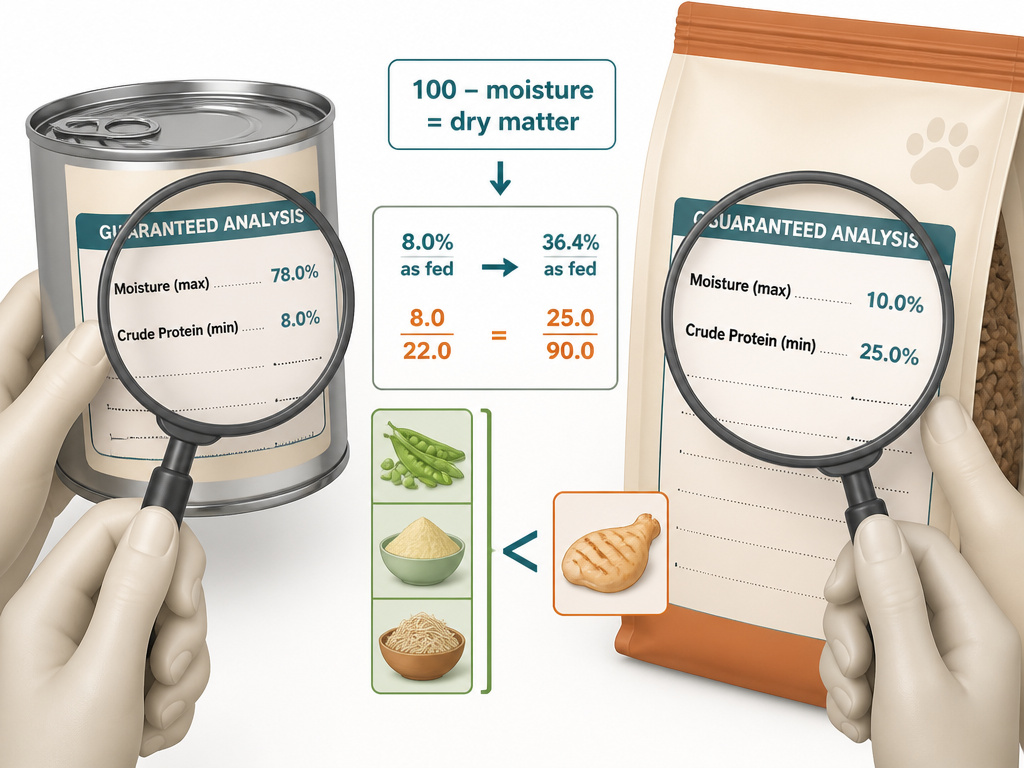
Start with the guaranteed analysis, because the percentages are the only part of the label with a defined meaning.
The Dry Matter Conversion, Step by Step
- Find the moisture percentage on the guaranteed analysis. Skip this and you’ll compare a canned food against a kibble as if the numbers meant the same thing.
- Subtract moisture from 100 to get dry matter. A canned food at high moisture has correspondingly little dry matter.
- Divide the nutrient percentage by the dry matter figure. A low protein percentage on a canned food rises substantially once converted to a dry basis.
- Compare only converted numbers. Unconverted percentages make wet food look protein-poor when the reverse is usually true.
What most people get wrong: Comparing the protein number on a can to the protein number on a bag. The can’s protein percentage is measured with the water still in it. The bag’s is measured at around 10% moisture, so the two are not directly comparable.
Then regroup the ingredient list. Manufacturers split one source into several entries so no single plant ingredient climbs to the top. Peas, pea protein and pea fiber counted separately can outweigh the named meat above them. The ingredient splitting breakdown shows how to add them back together.
Ingredient lists alone are overrated anyway. A panel tells you what went in. The guaranteed analysis tells you what came out.
For cats specifically, the cat food ingredient quality checklist covers what to convert and what to ignore.
The Claims That Do the Most Work With the Least Behind Them
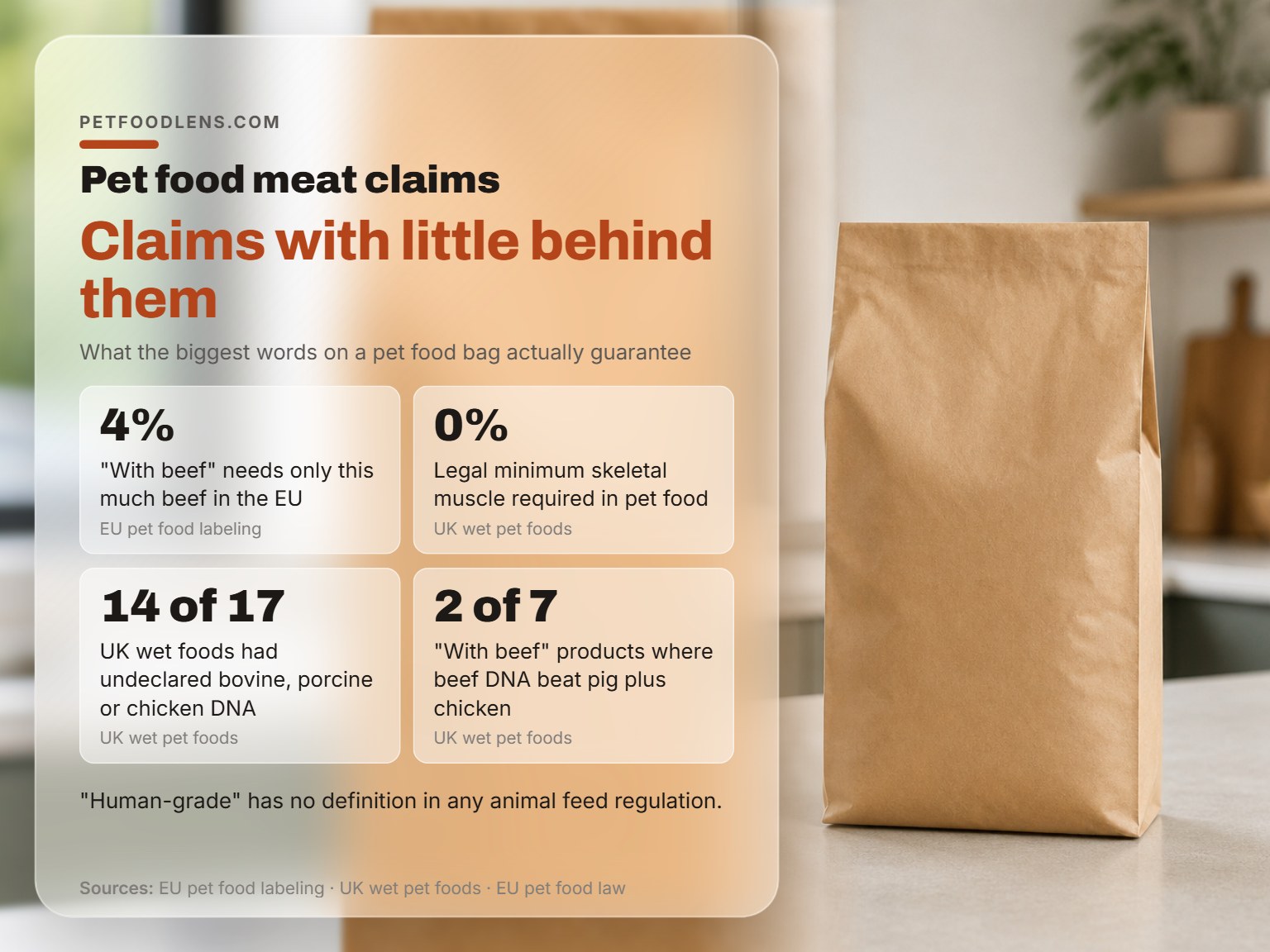
Two phrases on a bag carry almost no enforceable meaning, and both are printed in the largest type.
“Human-grade” has no definition in any animal feed regulation. It reads like a standard and carries no definition at all.
Others do less than they appear to:
- “With beef” — a 4% minimum in the EU, nothing more.
- “Meat first” — an ordering claim that ignores moisture weight.
- Superfood add-ins — blueberries, kale and cranberries at doses too small to matter for a carnivore.
The misleading claims rundown covers the rest of the vocabulary.
I don’t pay extra for a bag that lists blueberries and kale. A cat is an obligate carnivore, and a sprinkle of cranberry in a batch is decoration for the person holding the bag.
When Unnamed Meat Is Fine and When It Isn’t
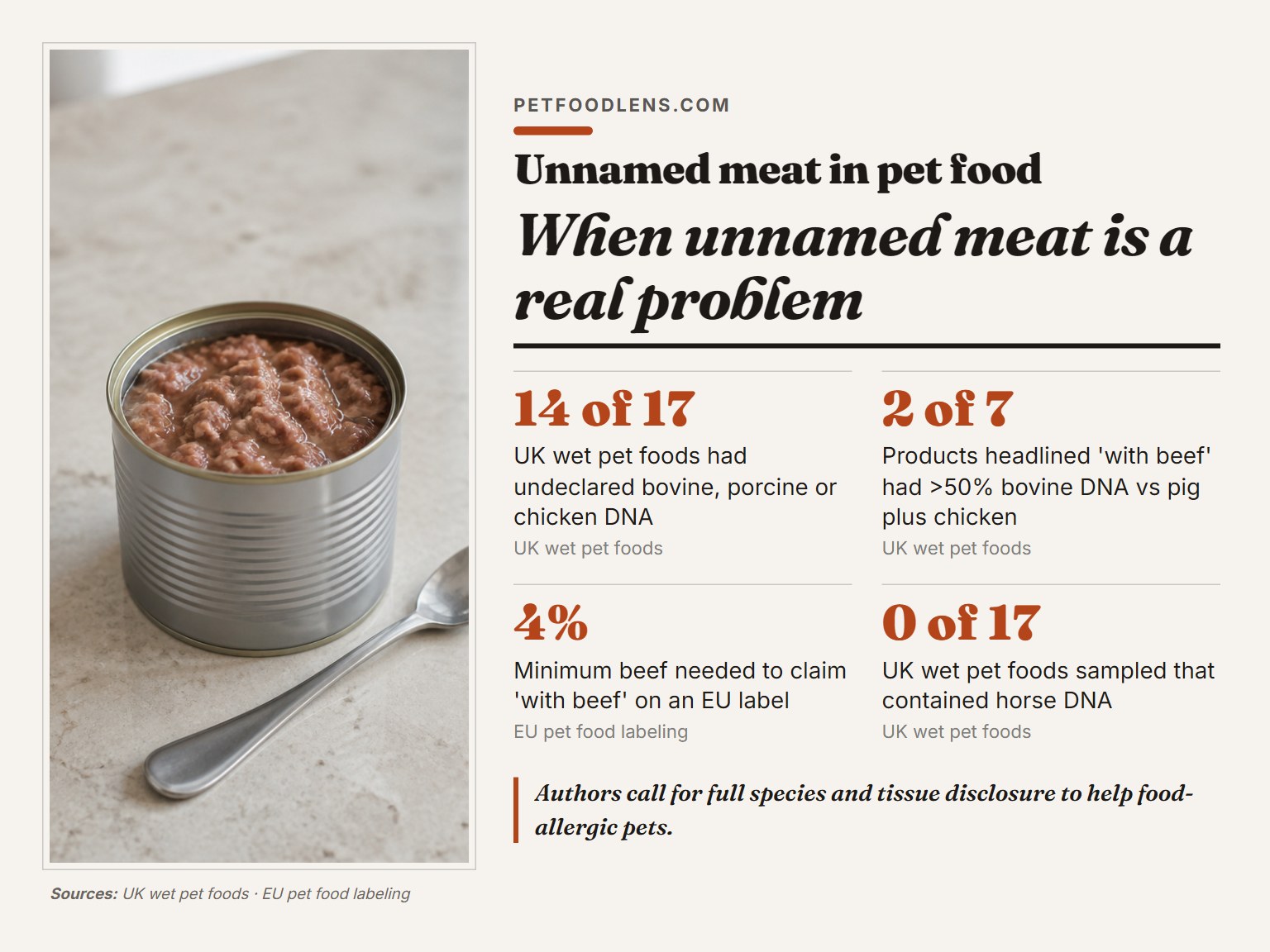
An unnamed protein source is a real problem in exactly one situation: an elimination trial for a suspected food allergy.
The study authors cite three reasons for full species and tissue disclosure. Food-allergic pets need to know what they’re avoiding, shoppers misread the claims, and religious constraints can’t be checked against a generic term. All three collapse under “meat and animal derivatives.”
For a healthy adult cat with no reaction history, an unnamed term is a labeling annoyance and little more.
When to Insist on a Named Species
Reach for the named version when any of these apply:
- You’re running a food trial, or your cat has reacted to a food before.
- A religious or ethical constraint rules out certain species.
- You’re feeding a cat with kidney disease, diabetes or a diagnosed allergy, where a vet has already set the diet.
That last one is where my advice stops. I’m not a vet. I can read a panel and do the arithmetic, but I can’t diagnose a food allergy, and a cat with chronic vomiting or skin disease needs an exam before any diet change.
The microarray undeclared species diets work tested exactly the diets sold for elimination purposes, which is the uncomfortable part. The ingredient labeling discrepancy review reached a similar conclusion across the published literature, and it noted there isn’t enough evidence yet that a contaminant actually triggers a clinical reaction.
If you want one answer: buy the formula that names the species on the ingredient line and prints a guaranteed analysis you can convert. Choose a formula that names the species on the ingredient line and prints a guaranteed analysis you can convert. For dogs, the dog food ingredient quality guide covers the same ground, and dog food with real meat narrows it to formulas that name the species.
Frequently Asked Questions
Is named meat always better than unnamed meat in pet food?
Not automatically. A named species tells you which animal, and the 4% threshold means it can still be a minor part of the formula. What it gives you is something to check, which an unnamed term never does.
Does “meat and animal derivatives” mean low quality?
Not by itself. The EU category covers tissue, fat, organ and bone from warm-blooded land animals, and processed animal proteins are a genuine source of protein, energy and minerals. What the term withholds is species and tissue type.
What does “with beef” actually guarantee?
In the EU, a minimum of 4% beef content. It doesn’t guarantee beef is the main animal protein, and it doesn’t guarantee the beef is skeletal muscle.
Can a DNA test tell how much of an ingredient is in the food?
Not reliably. PCR is qualitative. It detects whether a species is present, not how much, so a trace positive can come from cross-contact rather than a swapped formula.
Should I avoid meat meal?
There’s no blanket reason to. A PLOS One trial found an MDM-inclusive dry food scored higher on fatty acid profile and in vitro digestibility than a by-product formula, though the dogs preferred the by-product food. The trade-off runs both ways.
The Bottom Line
The trigger I’d give anyone: if your cat has had an unexplained itch, a loose stool, or an ear problem that keeps coming back, treat every unnamed protein as an uncontrolled variable and start the trial with a named species. That’s the case where the 4% rule stops being trivia and starts mattering for an elimination trial.
For everyone else, the practical move is smaller. Buy a bag you’ll finish while it’s still fresh, convert the guaranteed analysis to a dry matter basis before you compare anything, and treat the ingredient list as a rough sketch rather than a spec sheet.
And the contrarian bit: I’d rather see a named chicken meal fourth on a panel than “fresh chicken” first. One of those tells me what’s in the bag. The other tells me what’s in the water.
None of this replaces an exam. But you can read a panel in a couple of minutes, and the arithmetic works the same way every time.
