
Soy in Pet Food Pros and Cons: What the Studies Show
This post contains affiliate links. As an Amazon Associate, we earn from qualifying purchases.
Soy in pet food is a 44.6% crude protein ingredient in its solvent-extracted meal form, and dogs have eaten commercial soybean meal at up to 17% of the diet across a 24-week trial, and its pros and cons both trace to processing: whole or under-processed soy lowers digestibility and raises fecal moisture as inclusion climbs.
Processing is the whole argument. A raw soybean carries anti-nutritional factors that cut bioavailability in dogs, and heat is what knocks them down. Get the heat right and soy behaves like a respectable plant protein. Get it wrong in either direction and the bag underperforms.
What follows walks the seven soy ingredients that turn up on labels, the digestibility numbers from two dog trials that don’t agree, and the one label habit that hides how much soy is really in the bag.
Key Takeaways
- Processing decides the outcome. Too little heat leaves anti-nutritional factors intact, and too much denatures protein and costs you amino acids.
- Soy measured lower than poultry meal on single-ingredient digestibility, at 0.870 dry matter against 0.913.
- Flatulence may track a dose rather than a protein source. The AVMA trial found diets under 22.4 g stachyose/kg and 2 g raffinose/kg raised no flatulence, while the USSEC sheet attributes flatulence to soy oligosaccharides generally.
- Whole soybeans are not soybean meal. Graded whole-bean inclusion cut digestibility linearly in beagles.
- Count soy ingredients together. Meal, isolate, and hulls listed separately are one source split three ways.
What Form of Soy Is in the Bag?
Soybean meal, soy flour, grits, hulls, protein concentrate, protein isolate, and textured vegetable protein all get called “soy” on a bag. They are not interchangeable.
Soybean meal is the workhorse. Solvent-extracted meal runs 44.6% crude protein, 1.4% fat, and 6.2% crude fiber on an as-is basis, according to the US Soybean Export Council companion animal report. It smells like plain flour and feels slightly gritty between the fingers.
Isolated soy protein runs 84.3% crude protein and 0.5% fat. Same plant, different product, different job.
| Soy product | Crude protein | Fat | Gross energy (kcal/kg) |
|---|---|---|---|
| Solvent-extracted meal | 44.6% | 1.4% | 4,150 |
| Soy grits | 49.3% | 2.6% | 4,019 |
| Protein concentrate | 65.8% | 1.5% | 4,520 |
| Isolated soy protein | 84.3% | 0.5% | 5,370 |
| Full fat soy flour | 38.9% | 20.9% | 5,227 |
| Soy hulls | 11.0% | 1.9% | 3,980 |
Soy hulls carry 11.0% crude protein, 36.4% crude fiber, and 58.0% neutral detergent fiber on an as-is basis. Neutral detergent fiber is the cell-wall fraction, the part that resists digestion. That fraction ferments in the hindgut rather than feeding the dog protein, which is why hull inclusion shifts short-chain fatty acid production and fecal output together.
Soybean meal vs soy protein isolate
Meal carries fiber and a moderate protein load. Isolate is a protein concentrate with almost no fat and almost no fiber, so a formulator reaches for it to lift the protein number without dragging in bulk.
Concentrate lands in the middle at 65.8% crude protein.
Hulls are the odd one. At 11.0% crude protein and 36.4% crude fiber, they’re a fiber source wearing a soy name. Whether that counts as a filler depends on the dose, and the fillers in pet food question usually stops before anyone checks the number.
Soy also arrives as a replacement. Corn or wheat comes out, soy goes in, and the grains in pet food argument carries on as if the swap changed the math.
Do Dogs Digest Soybean Meal as Well as Poultry Meal?
The 2006 AVMA trial measured poultry by-product meal at 0.913 dry matter digestibility and soy-based diets at 0.870.
Then a longer trial came along. The 2014 Journal of Animal Science study fed commercial soybean meal at 0, 6.0, 11.5, and 17.0% as-fed, replacing dried chicken protein across 36 spayed adult hounds over 24 weeks. That meal ran 48% crude protein and covered up to 30% of the protein in the diet.
Crude protein and fat digestibility went up as soybean meal went up.
So you have a short single-ingredient comparison where poultry meal wins, and a 24-week dose-response where more soy improved digestibility. Both are real. They answer different questions.
- The 2006 figure compares isolated ingredients in a controlled assay, not finished diets.
- The 2014 figure compares graded inclusion in a complete diet, which is closer to what your dog actually eats.
- Neither one tested the bag in your kitchen, and neither used the same soy form.
Comparing 44.6% as-is meal against a meat meal means converting both to a protein on a dry matter basis, because the moisture load differs between them.
I’d rather see soybean meal listed at a known inclusion than “fresh chicken” sitting first on the panel. Fresh chicken is mostly water, so its position overstates what it contributes once that water is gone. Read the guaranteed analysis before you trust the order.
Soy in Pet Food Pros and Cons: The Flatulence Number
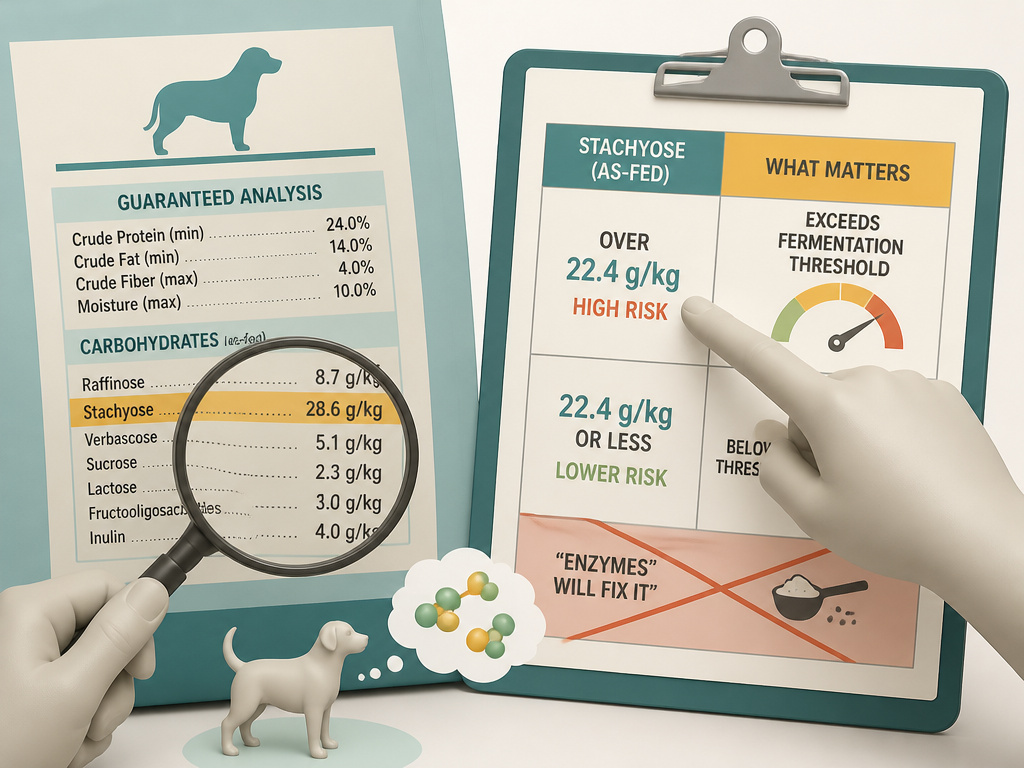
The industry sheet attributes flatulence to soy oligosaccharides. That’s the claim that follows soy around, and it’s the one most people repeat.
The AVMA trial put a threshold on it: diets containing less than 22.4 g stachyose/kg and less than 2 g raffinose/kg did not alter digestibility or increase flatulence in dogs, though the USSEC sheet attributes flatulence to soy oligosaccharides generally.
The same trial found no difference in any flatulence component across protein sources, and no effect from beta-mannanase dosed at 5 g/kg on dry matter digestibility, nitrogen digestibility, or digestible energy.
| The claim | Where it comes from | What was measured |
|---|---|---|
| Soy causes gas | US Soybean Export Council sheet | Attributes flatulence to soy oligosaccharides |
| Gas depends on dose | AVMA 2006 trial | No difference across protein sources |
| Enzymes fix it | Neither source claims it | Beta-mannanase at 5 g/kg changed nothing |
| Soy loosens stool | USSEC sheet | More fecal moisture; stool quality unaffected |
Common mistake: Reading “low oligosaccharide” on a bag as a guarantee. The threshold that mattered in the AVMA trial was under 22.4 g stachyose/kg, and no label prints a stachyose figure.
The two sources disagree. The USSEC sheet attributes flatulence to soy oligosaccharides, while the AVMA trial found no difference in any flatulence component across protein sources and tied effects to a specific stachyose/raffinose dose.
Why Whole Soybeans and Soybean Meal Behave Nothing Alike
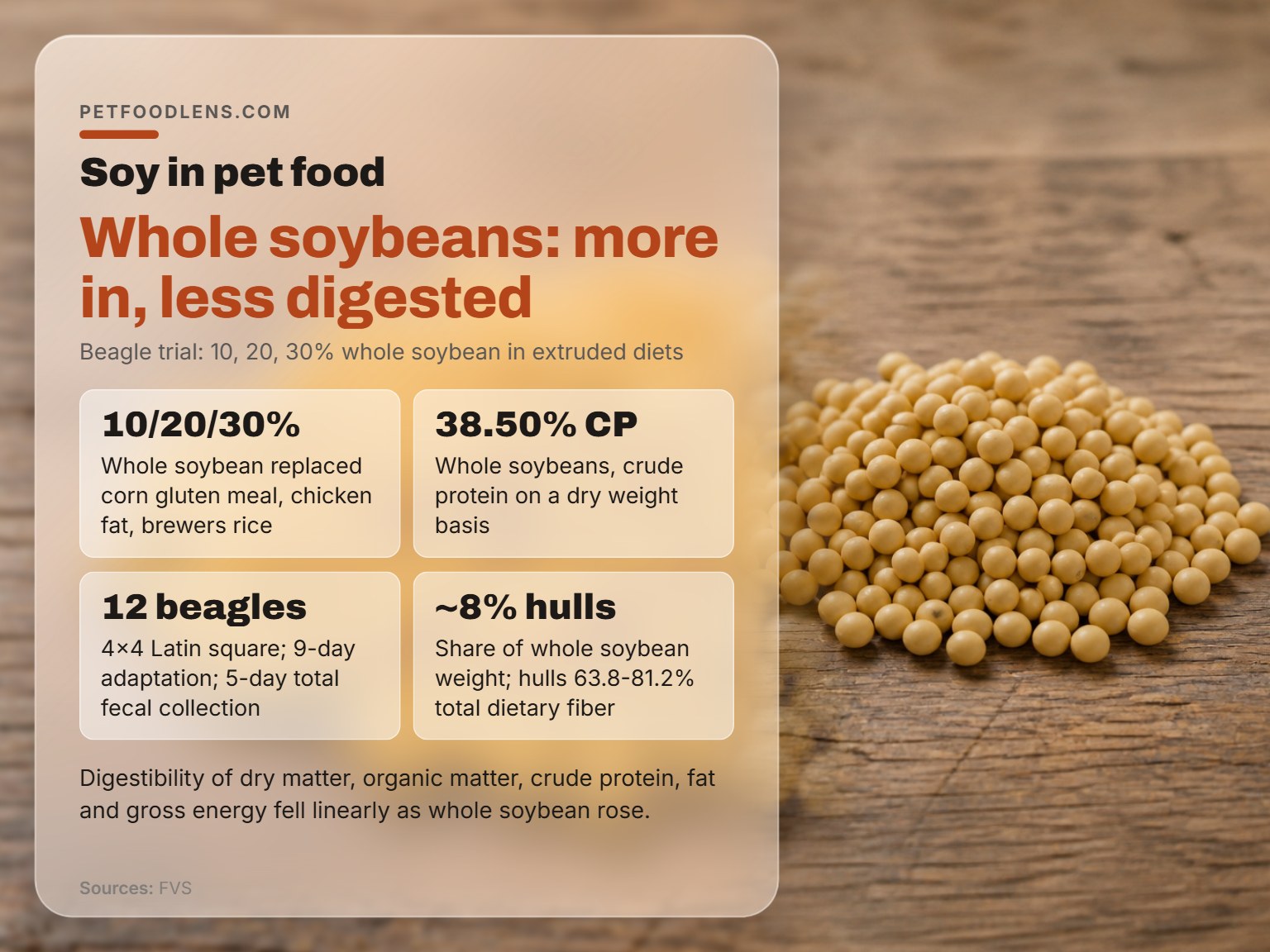
A 2023 Frontiers in Veterinary Science trial replaced corn gluten meal, chicken fat, and brewers rice with whole soybeans at 10, 20, and 30% of an extruded diet. Twelve beagles, 4×4 Latin square, 9 days of adaptation, 5 days of total fecal collection per period.
Every digestibility measure fell as whole soybean rose: dry matter, organic matter, crude protein, fat, and gross energy. All linear.
Fecal moisture, fecal output, and defecation frequency climbed in a straight line too. Fecal pH dropped. Acetate, propionate, and total short-chain fatty acids rose while branched-chain fatty acids fell.
That’s fermentation, not spoilage. The hindgut was working harder on more fermentable substrate.
Fecal moisture and output rose linearly with whole soybean inclusion, though the Frontiers 2023 study found stool quality itself was not affected, while the USSEC sheet lists more voluminous, higher-moisture feces as a weakness of soy.
Under-processed soy
Whole soybeans ran 38.50% crude protein on a dry weight basis, with roughly 8% of that weight in hulls. Raw soy carries anti-nutritional factors that cut bioavailability in dogs, and the Frontiers authors concluded that extra thermal processing before extrusion may improve nutrient digestibility.
Over-processed soy
The other edge is real too. A soybean meal dog digestibility systematic review notes that extrusion can over-process meal, denature protein, and compromise amino acid bioavailability.
Heat fixes soy. Heat also breaks soy. The window sits between the two, and you can’t see which side a bag landed on from the front panel.
If a formula lists whole soybeans rather than soybean meal, treat the protein number on the front as an upper bound. The beagle trial found digestibility fell at every step up in whole-bean inclusion, from 10% to 30%.
Soy is a legume, so the legumes in pet food conversation about plant protein runs alongside this one. Same family, different question.
If you’re weighing a plant-heavy formula, the vegetarian dog food comparison covers what else has to pick up the slack.
What the Isoflavone Trial Found, and What 20 Dogs Can’t Tell You
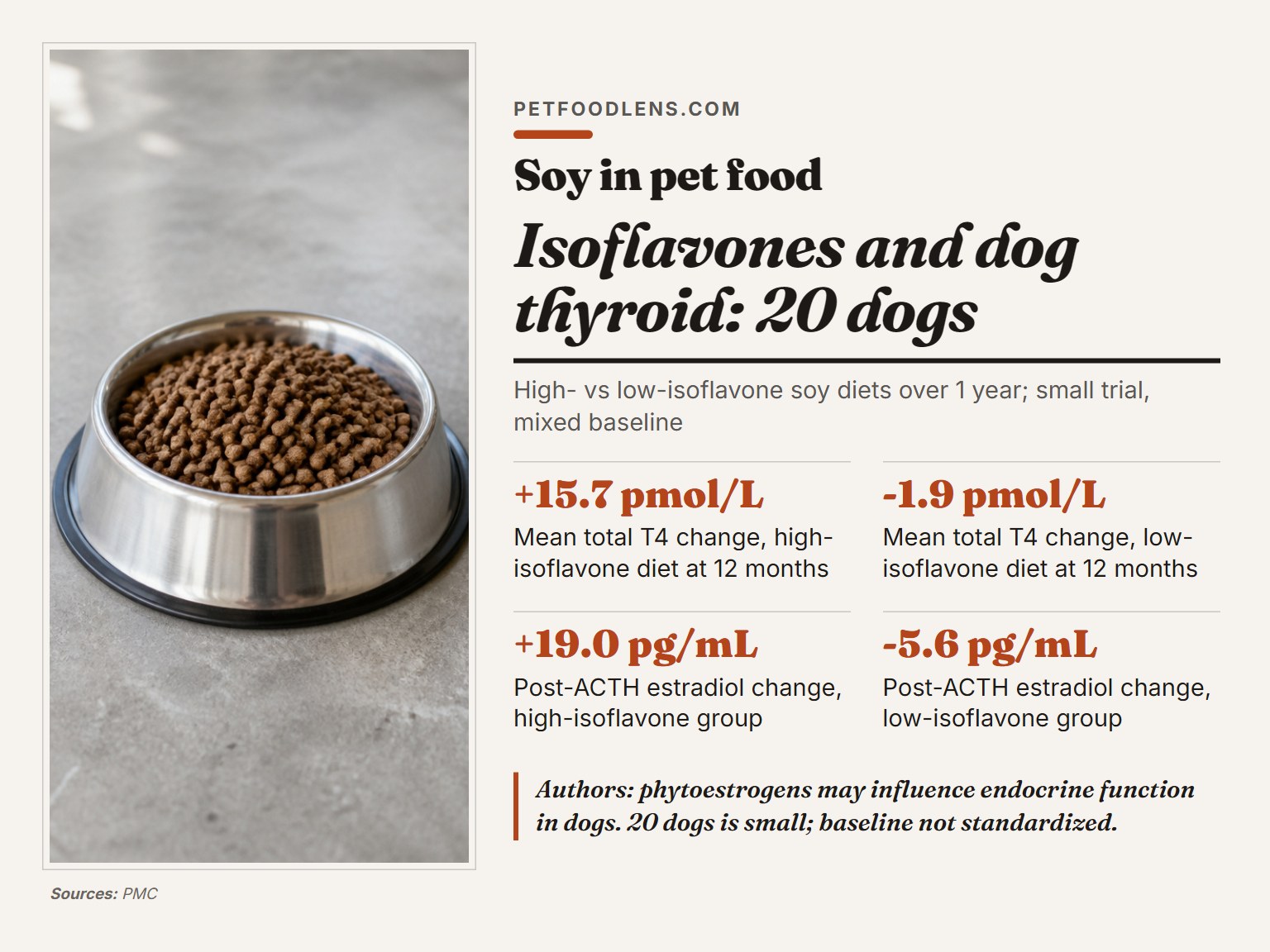
Twenty dogs, one year, two diets built on a hydrolyzed soy isolate base. One kept its isoflavones. The other had them stripped out through alcohol extraction. Both were manufactured by Royal Canin in Rolla, Missouri.
At 12 months, mean total T4 rose +15.7 pmol/L in the high-isoflavone group and moved -1.9 pmol/L in the low-isoflavone group. Post-ACTH estradiol changed +19.0 pg/mL against -5.6 pg/mL.
The authors wrote that phytoestrogens may influence endocrine function in dogs.
Exposure was real, not theoretical. Serum and urine genistein, daidzein, and glycitein ran 5 to 10 times higher in the high-isoflavone group. Urinary values in those dogs averaged 1.2, 1.0, and 0.8 nmoles/mg creatinine, close to human values of 1.2, 1.9, and 0.6.
Here’s where I slow down. Twenty dogs is a small trial. The authors flagged that the dogs weren’t standardized on a single diet before the study began, which muddies the baseline.
I’m not a veterinarian. I can read a label and I can read a trial design, and I stop there. If your dog has a thyroid diagnosis, this belongs with the vet who ran the panel.
Worth asking at that appointment:
- Does the soy level in this diet matter given my dog’s current T4?
- Is the food a tested therapeutic formula or a maintenance diet with a health claim on the front?
- Should we recheck bloodwork after a diet change, and on what schedule?
Soy in Pet Food Pros and Cons: How to Read the Label
Flip the bag over and read the panel: soybean meal, soy protein isolate, soy protein concentrate. Three soy lines, none of them near the top.
That’s the trick. Split one ingredient into three names and no single name has to sit high on the list, even when the combined weight would put it first.
People ask me whether they can judge a food by its first ingredient. They can’t, and the list itself is the reason.
The regroup test
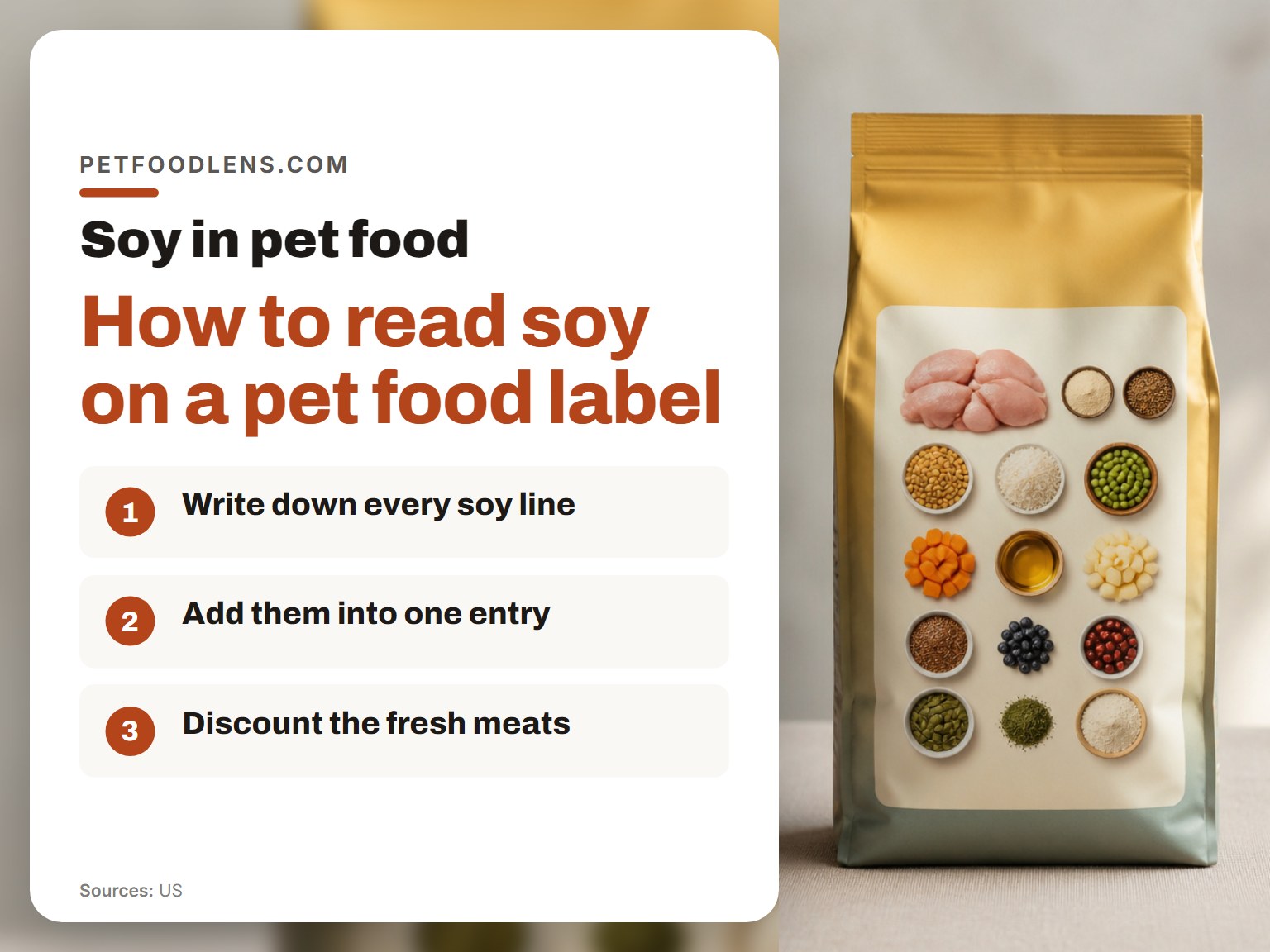
- Write down every soy line. Meal, isolate, concentrate, hulls, grits, flour. Miss one and a formula with a lot of soy reads as a chicken food.
- Add them into a single entry. If combined soy outweighs the first named animal ingredient, you’re holding a soy-based food with meat in it.
- Discount the fresh meats. Fresh chicken and fresh beef carry water weight onto the panel, so their position overstates what they deliver once that water is gone.
- Check the guaranteed analysis last. The protein percentage on the front is as-fed, and wet food and dry food don’t compare until both are converted.
That last step is where most label reading falls apart. Two bags can print the same protein percentage and land in completely different places once you account for moisture.
Where this goes sideways: Grouping soy with corn and wheat as one “filler” category. They behave differently, digest differently, and carry different amino acid profiles, so lumping them together hides the one ingredient you were trying to evaluate.
The ingredient splitting habit isn’t unique to soy. It shows up with wheat in pet food too, where bran, germ, and flour can occupy three separate lines.
Frequently Asked Questions
Is soy bad for dogs?
No blanket answer holds. Adequately processed soybean meal fed at graded levels up to 17% of the diet supported normal digestibility in a 24-week hound trial. Whole or under-processed soy is a different ingredient with measurably lower digestibility. The form and the dose decide it.
Meal runs 44.6% crude protein, so it’s a protein source, though the rooster assay work notes soybean meal alone is not a complete amino acid profile for all species and complementary proteins or supplemental amino acids are needed. Soy hulls are the fiber fraction at 11.0% crude protein and 36.4% crude fiber, and those are the lines worth counting separately when you scan a panel.
Does soy cause gas in dogs?
The AVMA trial tied flatulence to a specific oligosaccharide dose rather than to soy as a category. Diets under 22.4 g stachyose/kg and 2 g raffinose/kg didn’t increase flatulence, and the study found no difference across protein sources.
Can cats eat soy?
The rooster assay work found soybean meal had no first-limiting amino acid for cats, with all indispensable amino acids above 100%. That doesn’t make meal a complete diet on its own. The same work notes complementary proteins or supplemental amino acids are still needed.
Does soy in pet food cause heart disease?
Nothing in the trials covered here tested cardiac endpoints, so none of them can answer that. If dilated cardiomyopathy is your concern, it’s a conversation for your vet, not a conclusion you can pull off a bag.
The Bottom Line
If your dog has loose stool and the panel lists whole soybeans or soy flour, change that variable first. Before you blame the protein percentage, before you switch brands entirely. Whole-bean inclusion cut digestibility linearly in the beagle trial, and it’s the easiest thing on the label to rule out.
One concession, and it matters. Almost all of the controlled work behind soy in pet food pros and cons was done in dogs. Cats got the amino acid assay and not much else. I’d be guessing if I told you the thyroid findings transfer cleanly to a cat, and I’d rather say so than fill the gap with confidence I haven’t earned.
Read the panel, count the soy lines, and convert the numbers before you decide. The label didn’t lie. It just didn’t help.
