
Nyjer Feeder Pros and Cons: Mesh vs Tube vs Sock
This post contains affiliate links. As an Amazon Associate, we earn from qualifying purchases.
The nyjer feeder pros and cons split by format: mesh and sock feeders let finches cling and cost little, tube feeders hold more seed and slow the flow, and every design trades port size against clogging. Nyjer runs about 40% oil, so seed that sits and cakes is the real failure point.
The seed itself explains the engineering. Nyjer is small and slick with oil, so it moves more like dry sand than like a sunflower heart. A port sized for sunflower hearts dumps it on the grass by mid-morning.
What follows is a format-by-format look at what each design does well, where the trade body and the manufacturers split, and the two failure modes that show up in owner reports again and again.
Key Takeaways
- Mesh and sock feeders suit clinging finches and cost the least, but the seed sits exposed to weather.
- Tube feeders with small ports slow the flow, which matters when nyjer carries roughly 40% oil and pours fast.
- Port size is a genuine trade-off. RSPB sizes ports down to stop waste, and one Heath 593M owner reported ports too small to dispense seed at all.
- Brown nyjer gets eaten at up to two or three times the rate of black, per WBFI Research Foundation consumption studies. That undercuts the “black is better” line.
- Cleaning decides whether a feeder lasts a second season. Click-off ports and twist-off bases beat perch count every time.
Why Does Nyjer Need Its Own Feeder?
Nyjer is the seed of Guizotia abyssinica, and it carries roughly 40% oil by weight, according to the Wild Bird Feeding Institute Nyjer FAQ. That oil load explains why finches work a nyjer feeder hard, and why wet seed turns into a mat so fast.
Nyjer seed measures small enough to pour through gaps that hold sunflower hearts in place. Feeders built for nyjer use reduced port openings, fine wire mesh, or fabric sleeves so the seed stays put instead of sifting onto the ground. The same geometry that slows the flow also traps moisture once a port packs shut.
RSPB states the mechanical reason on their own product page: nyjer is fine enough to flow too quickly out of a standard seed feeder, so their nyjer line uses smaller ports to slow it down.
Pour a scoop into a polycarbonate tube and it hisses like dry sand, then settles into a flat, level surface.
That hiss is the whole design problem.
The nyjer seed guide covers the botany in more depth. The practical point is narrower. A feeder built for sunflower hearts has ports sized for a much larger seed, and nyjer drains straight through them.
What a nyjer feeder does not do is keep seed dry or keep squirrels off. Those are separate jobs, handled by a roof, a cage, or a baffle.
Mesh, Sock, and Tube: Three Formats, Three Different Jobs
Three formats cover almost everything sold as a nyjer feeder: fine wire mesh, fabric socks, and ported tubes.
Mesh and Wire Feeders
WBFI lists wire mesh as a great option for holding tiny nyjer seed, and the geometry backs that up. Finches cling rather than perch, so they can feed from any point on the surface.
The Duncraft Four Winds Nyjer Feeder holds 2 lbs and uses curved fine wire mesh sized for finch bills. It has clinging space on both sides, two wide built-in bottom perches, and a body made from recycled plastic.
Fabric Sock Feeders
Socks are the cheapest way to find out whether finches will use your yard at all. WBFI endorses them alongside mesh for exactly that reason.
They also soak through in a wet week, and wet nyjer clumps into a solid plug.
Ported Tube Feeders
Tubes hold more seed and slow the flow, which is the only format RSPB builds, though WBFI also recommends wire mesh and fabric socks as great options. The RSPB Ultimate easy-clean nyjer feeder comes in a Small at 31 cm with 2 ports and 500 ml, and a Medium at 49 cm with 4 ports and 1 L. Both run a 6.3 cm tube.
The build is zinc alloy for the lid, base and perches, with a UV-stabilised polycarbonate tube. Quick-release ring perches come off for cleaning, and the lid carries extra ventilation to cut condensation.
The flo Lifetime Nyjer Bird Feeder keeps a 2.7 in tube diameter across all three sizes, so the port spacing does not change when you size up.
| Format | Best For | Main Weakness |
|---|---|---|
| Fine wire mesh | Clinging finches, year-round hanging | Seed exposed to rain and snow |
| Fabric sock | Cheap trial, small gardens | Soaks through, tears, short life |
| Ported tube | Larger seed volume, less spill | Clogs when a port packs with wet seed |
The nyjer feeders that get recommended most often are tubes, while the finch feeders built around clinging birds are mesh. Both lists exist because both formats work.
Where the Sources Disagree About Nyjer Feeders
WBFI calls wire mesh and fabric socks great options and adds that tube feeders with tiny ports also work, while RSPB’s entire nyjer range is ported tubes.
WBFI calls wire mesh and fabric socks great options, then adds that tube feeders with tiny port holes under the perch also work. RSPB’s entire nyjer range is ported tubes, engineered with smaller ports to stop the seed running straight through.
An owner review on the Nature Niche Quick-Clean tube goes the other way from WBFI. That reviewer says the tube design wastes much less seed than wire mesh sleeves.
I read the WBFI line as “several formats work” and the RSPB line as “this is the format we engineer for.” Neither is wrong. A mesh feeder in a wet climate and a mesh feeder in a dry one are different products wearing the same name.
Climate does the deciding. Mesh drains and dries; a tube holds a reservoir of seed that stays dry until a port packs.
The word thistle is the other place the trade and the shopper part company. WBFI states plainly that nyjer is not derived from any thistle plant, that it sits closer to the sunflower family, and that the term is frowned upon in the industry. Shoppers still type it, which is why thistle bird feeders still turn up in searches.
Port Size Is the Whole Ballgame
Port size decides whether a nyjer feeder feeds birds or feeds the lawn.
RSPB’s stated logic is that smaller ports keep nyjer from flowing too quickly and going to waste. That position is consistent across their whole nyjer line, which suggests it came out of testing rather than a copywriter.
The counter-case is real. An owner review of the Heath 593M reported holes too small to get seed from, a missing part, and seed leaking out of that hole.
One report, not a pattern. But it names the failure mode precisely.
Where this goes sideways: A port that is too tight does not just slow the flow. Seed bridges across the opening, the tube looks full, and finches on the perch get nothing.
A feeder that birds ignore is usually a feeder with a bridge, not a feeder with the wrong seed. If you want to know whether your setup is working at all, the same principles that attract finches to any feeder apply here: cover, proximity to shelter, and a clean food source.
How Do You Keep a Nyjer Feeder From Clogging?
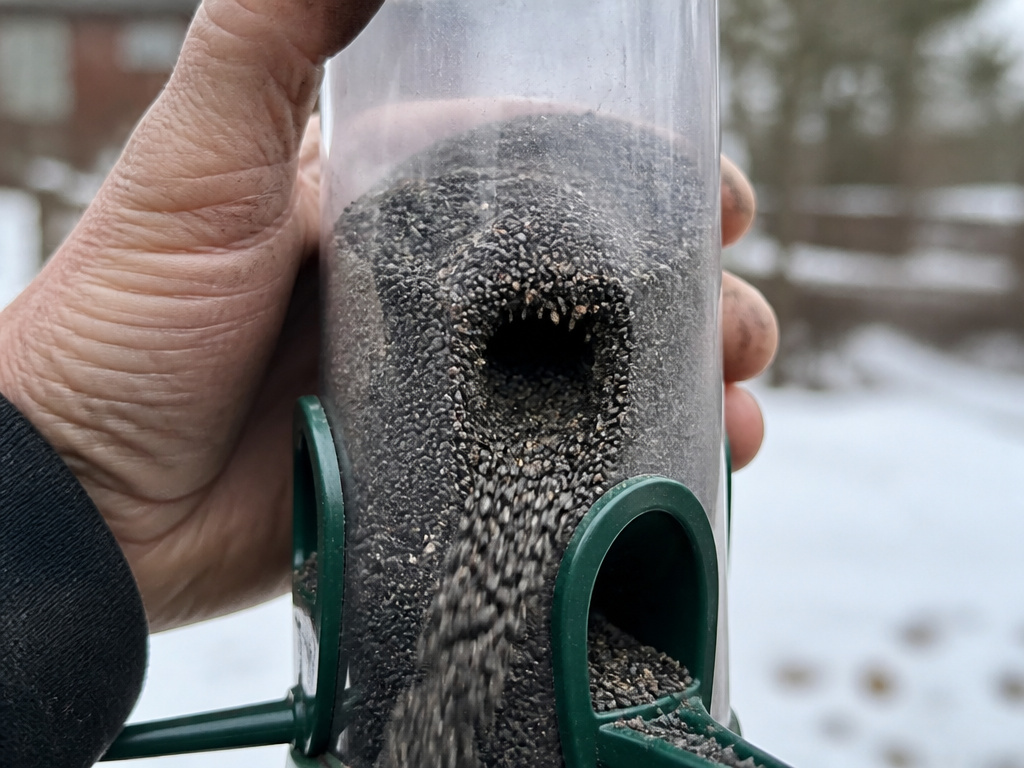
The first big snow lands, the feeder goes quiet, and every port is packed with a grey mat of seed.
An owner review of the Droll Yankees CC24N describes exactly that. Birds quit after the first heavy snow, and most holes were covered with seed masses. The reviewer suspected saliva or water getting in through the large port count.
Wet seed is the whole story. Nyjer at roughly 40% oil does not dry back out once it clumps; it holds shape and blocks the port behind it.
| Symptom | Likely Cause | Fix |
|---|---|---|
| Ports packed with a grey seed mat | Wet seed caking after rain or snow | Empty, dry fully, refill less |
| Feeder looks full, no birds | Seed bridged above the port | Shake the tube, top up |
| Upper ports stop working | Seed level dropped below them | Refill or use a shorter tube |
| Seed pouring onto the ground | Ports oversized for nyjer | Switch to a nyjer-specific feeder |
Four habits prevent most of it:
- Leave some headspace. Leaving headspace limits the mass pressing down on the lowest ports; a packed tube forces damp seed through the openings.
- Shake the tube before refilling. Bridged seed sits in a hollow dome above the port; shaking collapses it and shows you whether the feeder was ever actually empty.
- Check the ports after any rain or snow. A port that has already packed will not clear itself, and the seed behind it keeps wicking moisture.
- Keep a spare tube or sock dry and ready. Swapping a wet feeder out beats drying one on the counter while birds queue up.
Seed choice feeds into this too. The bird seed for finches that flows cleanly is fresh, dry, and stored in a sealed container, because oily seed picks up moisture from a damp shed.
Black or Brown Nyjer: Does the Color Matter?
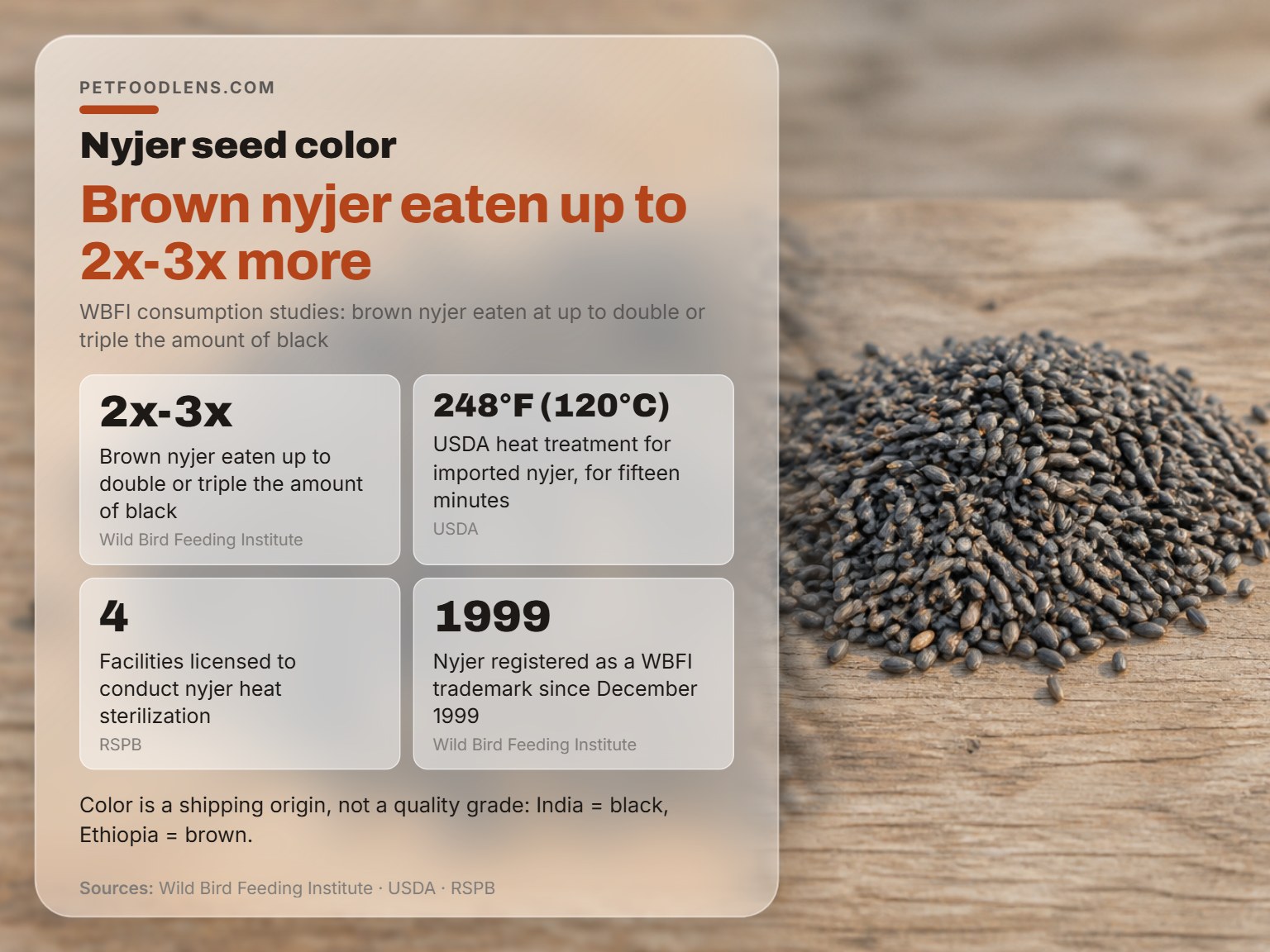
Brown nyjer gets eaten at up to double or triple the rate of black, according to WBFI Research Foundation consumption studies.
The “black seed is better” line is a long-held misconception in WBFI’s own words. Their feeding studies put brown ahead by a wide margin, which runs against what most packaging implies.
Origin explains the color. Nyjer from India is generally black and nyjer from Ethiopia is generally brown, per WBFI.
Imported nyjer is controlled by the USDA under treatment schedule T412-a, a heat treatment at 248°F (120°C) for fifteen minutes. Only four facilities, in the United States and India, are licensed to run that sterilization.
What that means at the feeder:
- Color is a shipping origin, not a quality grade. Black and brown both pass the same USDA heat schedule.
- Brown moving faster is a consumption finding, not a guarantee for your specific yard or your specific supplier.
- The trademark matters more than the color. Nyjer has been a registered WBFI trademark since December 1999, and since January 1, 2023 the licensing moved to a member system with an annual fee for non-members.
None of that changes how the seed behaves in a tube. It changes what you should expect to pay attention to on the label.
Cleaning and Build Quality Decide the Second Year
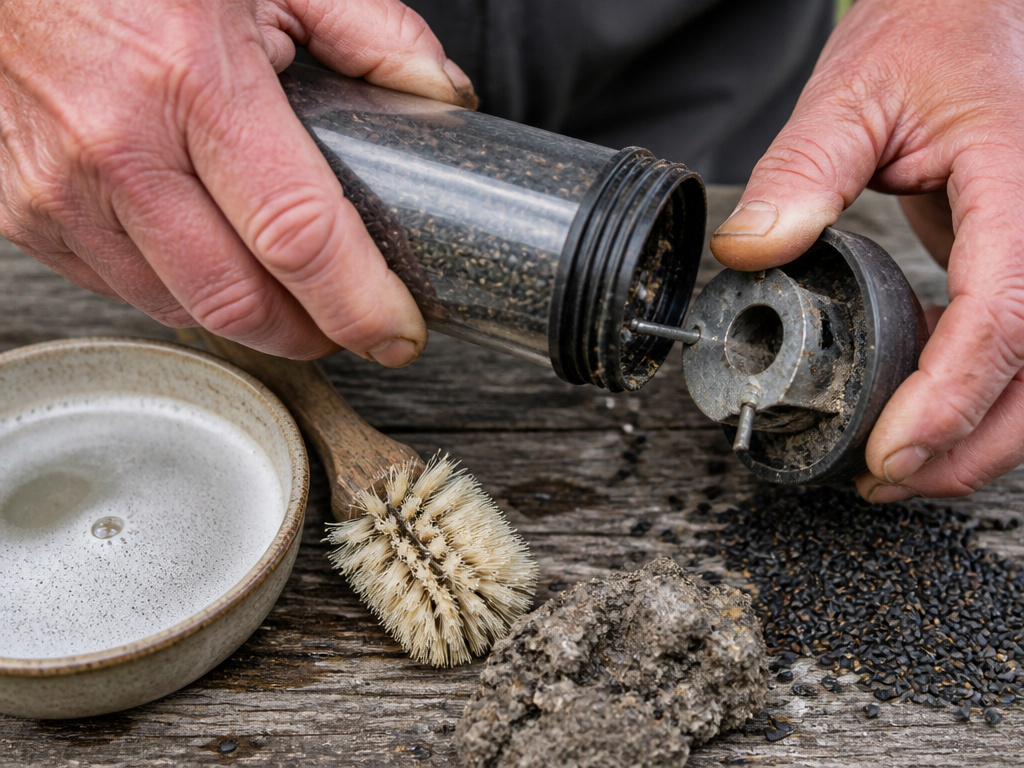
A nyjer feeder’s second season depends on how fast it comes apart with cold hands.
Jacobi Jayne builds the Ring-Pull Click Nyjer feeder around a twist-off base and metal ports that click off instantly. They describe the ports as designed to let nyjer flow freely while limiting waste and clogging.
RSPB takes a different route to the same end, with quick-release ring perches and extra ventilation in the lid to minimise condensation.
A CC24N reviewer made the trade-off explicit, calling straight-through perch designs impossible to clean properly and siding with cleanability over bird capacity.
Old seed clumps into a dull, matte grey mass that keeps its shape when you crumble it. Fresh seed breaks apart.
Buy the feeder you can strip down quickly with cold hands. Bird capacity is a number on the box; cleanability is what keeps finches coming back through February.
The part nobody mentions: Ventilation in the lid matters more than port count. A sealed tube collects condensation on the inside wall, and that damp film is enough to cake the seed sitting against it.
A workable routine:
- Strip and wash every time the seed clumps or the tube fogs, using mild soap and a soft brush, then dry completely before refilling.
- Empty the feeder fully rather than topping up over old seed. Layering fresh seed on a damp base just buries the problem.
- Retire a sock the moment it stops drying out between fills. Fabric that stays damp is a lost cause.
If goldfinches are the target, the same cleaning discipline is most of what attract goldfinches to a feeder in the first place. They are picky about spoiled food.
Nyjer Feeder Pros and Cons: Which One Fits Your Yard?
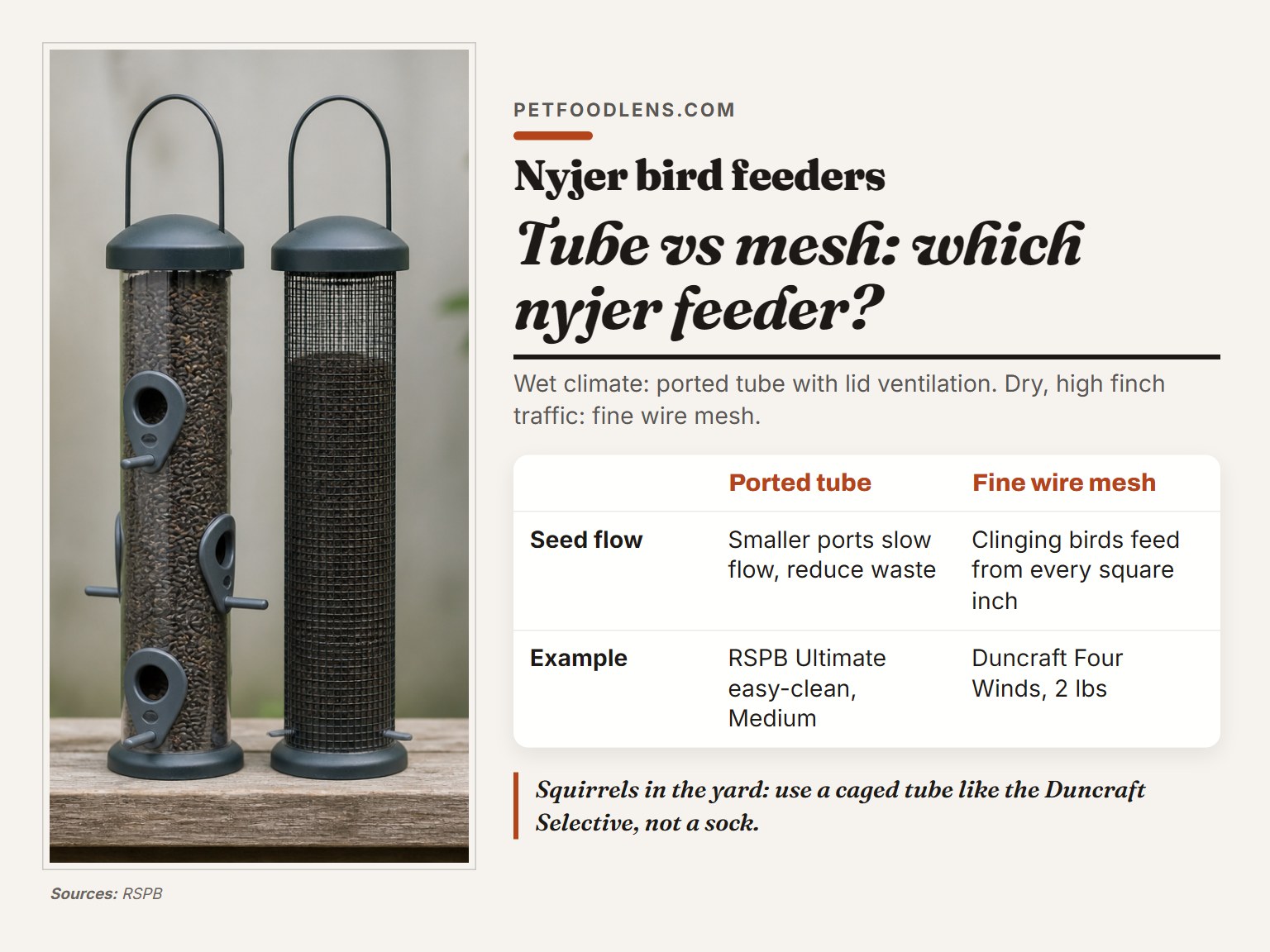
One feeder covers most gardens.
For a first nyjer feeder in a wet climate, the RSPB Ultimate easy-clean nyjer feeder in Medium is the pick. Four ports, 1 L of capacity, a 6.3 cm zinc alloy and polycarbonate body, and ring perches that release for cleaning.
If squirrels and larger birds are stripping the feeder, the Duncraft Nyjer Selective Feeder holds 1.5 lbs behind an all-metal outer cage, with an overhanging roof and squirrel lock plus an open grid bottom so seed cannot accumulate.
If you want the cheapest honest test of whether finches will visit, the Duncraft Four Winds Nyjer Feeder at 2 lbs and fine wire mesh does the job for a season.
Quick verdict by situation:
- Wet, windy garden: ported tube with lid ventilation. Mesh stays wet too long.
- Dry climate, high finch traffic: fine wire mesh, because clinging birds feed from every square inch.
- Squirrels in the yard: caged tube like the Duncraft Selective, not a sock.
- Balcony or window mount: the smallest tube you can find, refilled often.
The bird feeders for finches worth shortlisting are almost all tubes or mesh, and the bird feeder guide covers the mounting and baffle side that nyjer feeders do not solve.
Frequently Asked Questions
Do nyjer feeders actually attract more finches than a regular feeder?
They attract finches more reliably because the port size matches the seed. A standard feeder with sunflower-heart ports drains nyjer onto the ground before a bird gets to it. WBFI also notes that tube feeders with tiny ports under the perch let goldfinches feed upside down, which is how they naturally work a seed head.
Should I buy black or brown nyjer?
Brown, if the WBFI Research Foundation consumption studies hold for your yard. They found brown seed eaten at up to double or triple the rate of black, and they call the “black is preferred” belief a long-held misconception. Brown generally comes from Ethiopia and black from India, so color tracks origin more than quality.
How often should I clean a nyjer feeder?
Clean it whenever the seed clumps or condensation fogs the inside of the tube, and strip it fully at every refill if the weather has been wet. Nyjer is high-oil seed, so damp seed cakes and stays caked. A feeder that looks full but has gone quiet is usually a feeder with packed ports.
Is a mesh feeder better than a tube feeder for nyjer?
Mesh wins in dry climates and for clinging birds, because finches can feed from any point on the surface. Tubes win in wet weather and hold more seed. WBFI recommends mesh and socks; RSPB builds only ported tubes. One Nature Niche reviewer found the tube wasted far less seed than mesh sleeves.
Will nyjer sprout weeds under the feeder?
Unlikely. Imported nyjer is heat-treated under USDA schedule T412-a at 248°F (120°C) for fifteen minutes to devitalize weed seeds. WBFI adds that any plant that did sprout would be sterile without pollination. The seed is also unrelated to thistle despite the old nickname.
The Bottom Line
Here is the trigger to act on: if your feeder goes quiet after rain or snow, stop adding seed and strip it down first. A packed port looks identical to a full feeder from the kitchen window, and topping up over a damp base just buries the problem deeper.
Weighing the nyjer feeder pros and cons for your own yard, the deciding factor is how fast you can take the thing apart. Port count, capacity, and squirrel cages all matter, but none of them matter if the tube stays sealed and damp through a wet week.
One concession worth stating plainly. If you garden somewhere dry and windy, mesh is the better answer and most of the cleaning argument above gets easier, because mesh drains and dries on its own.
Skip the fabric sock if you get real weather. It is a fine short-term experiment and a poor permanent feeder.
