
How to Attract Goldfinches to a Feeder: Step-by-Step
This post contains affiliate links. As an Amazon Associate, we earn from qualifying purchases.
To attract goldfinches to a feeder, offer nyjer or black oil sunflower, hang the feeder 5-6 ft off the ground with escape cover within 10 ft, and clean it before the seed clumps. Oregon State University Extension sets those placement numbers, and the cleaning half is the part that decides whether birds stay.
Seed that sits too long in a tube feeder turns clumpy and damp. A goldfinch that lands, sorts through the ports, and drifts off without eating is telling you the seed failed before any disease did. Knowing how to attract goldfinches to a feeder starts with fresh seed.
What follows walks the seed choice, the height and spacing argument two credible sources don’t agree on, the feeder styles that waste the least, and the cleaning routine that keeps a feeder from becoming a hazard.
Key Takeaways
- Nyjer and black oil sunflower cover nearly every goldfinch visit; skip blends heavy in milo or millet.
- 5-6 ft high and 6-8 ft from vegetation is the Extension recommendation, though a controlled study found goldfinches strongly preferred feeders far higher than that.
- Conserving Carolina puts safe glass distance at less than 3 ft or more than 30 ft. Nothing in between, per that guidance.
- Toss the leftovers instead of topping them up in humid weather, so damp seed doesn’t clump.
What Seed Actually Brings Goldfinches In
Nyjer and black oil sunflower cover nearly every goldfinch visit to a feeder. Oregon State University Extension lists nyjer (sold as niger or thistle) and sunflower chips as the finch favorites, and its bird table marks nyjer as the American goldfinch’s favorite seed.
Nyjer seed is small enough that a specialty feeder can meter out one seed at a time, and that single-seed access is what limits waste. Wide tube ports spill a steady trickle onto the ground, where damp soil and rain turn spilled seed into a mold reservoir within days. Goldfinches sort around the clumped portion and leave the rest.
I learned the spoilage problem the slow way. Nyjer in a tube feeder goes stale and clumps faster than the bag suggests once humidity climbs. Goldfinches still showed up, but they would land, pick at the ports, and leave. That is the seed telling them no.
Now I dump the leftover nyjer at every refill and rinse the tube with the bleach solution before it goes back out. Visit counts came up within a week.
The mechanism is boring and worth knowing. Nyjer has a thin hull and a small seed body, so it takes on moisture from humid air faster than a sunflower seed does. Once the seeds pack together, a goldfinch can’t work one loose, and the whole port reads as empty.
| Seed | What It Draws | The Catch |
|---|---|---|
| Nyjer (niger, thistle) | Goldfinches, pine siskins | Expensive, and it clumps fast |
| Black oil sunflower | Most feeder birds, goldfinches included | Hulls pile up under the feeder |
| Sunflower chips | Finches, no hull mess | Spoils faster than whole seed |
| Milo and millet blends | Starlings, English sparrows, rodents | Most wild birds won’t eat it |
Nyjer, Sunflower Chips, and the All-Year Finch Mix
Goldfinches and pine siskins prefer nyjer especially from spring through fall, per Extension guidance. Mixing sunflower chips with nyjer makes a finch mix that holds up as an all-year food, which is the practical answer if you’d rather buy one bag than two.
If you want the full breakdown of what nyjer seed is and how it differs from thistle sold under other names, that’s worth ten minutes of how to attract goldfinches to a feeder research before you buy.
Why Milo-Heavy Blends Backfire
Cheap blends are cheap for a reason, and the reason is filler. Extension guidance warns that mixes heavy in milo or millet pull in starlings, English sparrows, and rodents, and that most wild birds won’t eat those seeds at all.
Read past the front of the bag. A seed mix has an ingredient list the same way a can of cat food does, and the order tells you what you’re actually paying for.
The best finch seed is usually a short list, not a long one.
There is a real disagreement on millet, though, and it’s worth stating plainly. The US Fish and Wildlife bird feeding guide names black oil sunflower and proso millet as the two seeds the majority of songbirds eat. Extension guidance treats millet as a filler that draws the wrong crowd. Both can be true: millet feeds ground-feeding birds like juncos and doves, and it also feeds sparrows you may not want.
How High Should a Goldfinch Feeder Hang?
Oregon State University Extension says 5-6 ft off the ground. That same guidance puts the feeder 6-8 ft from nearby vegetation, with escape cover within 10 ft so birds can bolt.
That’s the working number for most yards, and it’s easy to service at that height. But it is not the whole story.
A controlled experiment published in the Journal of Field Ornithology hung two identical tube feeders on a pulley, one at 3.4 m and one at 6.1 m, and goldfinches showed a strong preference for the higher one. The authors attributed the pull to self-protective behavior and cautioned that more study was needed before recommending high feeders to homeowners.
| Source | What It Recommends | The Caveat |
|---|---|---|
| OSU Extension (EC 1554) | 5-6 ft up, 6-8 ft from cover | Practical and easy to refill |
| Dunn & Hussell (1991) | Goldfinches preferred 6.1 m over 3.4 m | Authors asked for more study |
| Cornell Lab (All About Birds) | Sway and open ground are tolerated | Behavior note, not a spec |
So you have two defensible answers. If you want the feeder height and distance that most extension offices still teach, hang at 5-6 ft. If you have a tall pole and a clear line of sight, going higher won’t hurt you, and the peer-reviewed goldfinch feeding study suggests the birds may reward it.
The OSU Extension feed wild birds guide is the source for the 5-6 ft figure, and it’s a free PDF worth keeping on your phone at the feed store.
Hang the feeder where you can see it from a window you actually sit near. A feeder you watch is a feeder you notice going quiet, and going quiet is the first symptom of almost everything in this article.
Three Feet or Thirty: The Window Rule and Squirrels
Three feet or thirty. Those are the two distances Conserving Carolina says matter next to glass.
Conserving Carolina puts the safe zones at less than 3 ft from a window or more than 30 ft away, because anything in between gives a bird enough speed to hit fatally. A feeder at 12 ft from your sliding door is the worst of both.
Sway is a separate how to attract goldfinches to a feeder question, and here the sources part ways. Cornell Lab’s American Goldfinch species profile notes that goldfinches don’t mind feeders that sway in wind and will happily feed on the ground on spilled seed, while Extension placement guidance leans the other way, favoring sheltered, quiet siting over hard surfaces you can clean.
Squirrels get their own geometry lesson. Extension guidance warns that squirrels often jump onto a feeder from below the shield, which is why a baffle alone fails. The fix is a squirrel-proof feeder hung with clear air underneath, not a wider dome.
What most people get wrong: Hanging the feeder over a lawn because it looks tidy. Spilled seed on grass is impossible to rake clean, and damp hulls under a feeder are where mold and salmonella hang out.
Why a Dirty Feeder Is Worse Than No Feeder
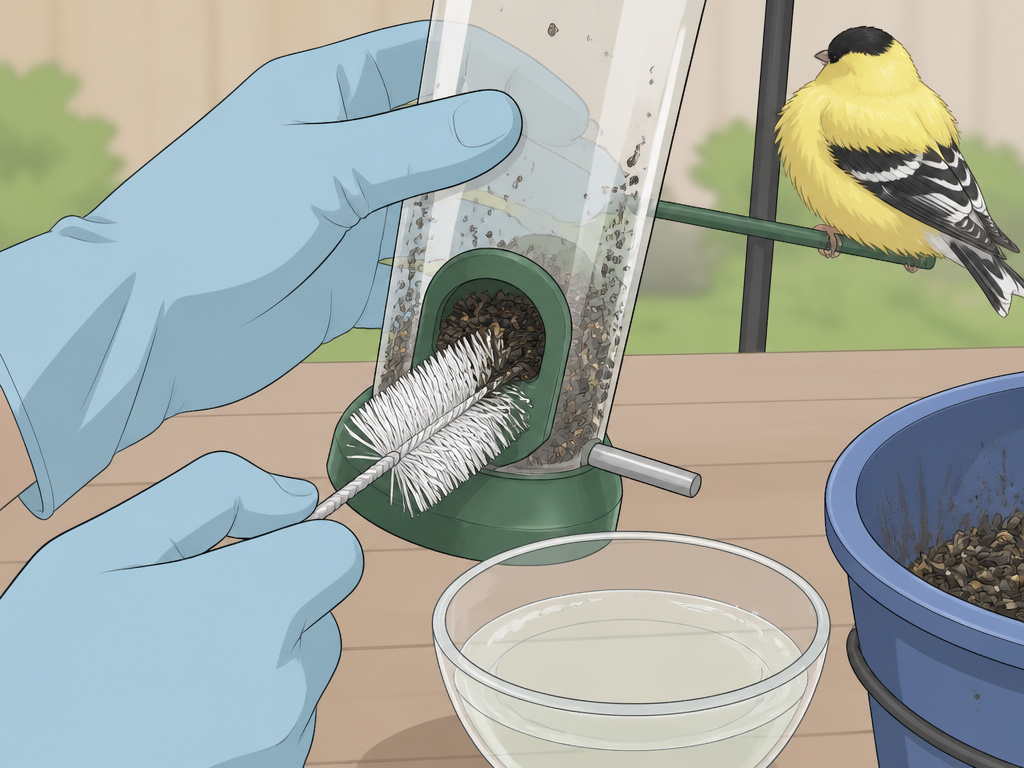
A goldfinch sits on the perch with its feathers puffed into a ball and doesn’t move when you walk past. That bird is sick, and the feeder is the reason.
Conjunctivitis and salmonella spread fastest where birds crowd a small perch. This is the part the front of the seed bag never mentions.
In winter I fill smaller amounts more often, so seed stays dry and doesn’t clump. Frozen, clumped seed under a feeder is a cleaning problem first and a weather problem second.
Before you start: Use a diluted bleach solution, not a stronger one, and wear gloves while you scrub. Keep the solution away from your eyes and rinse the feeder thoroughly before it goes back out, because residual bleach will put birds off the port for days.
Here’s the routine that has worked:
- Empty the feeder completely into the bin rather than back into the bag. Leftover seed carries the moisture that started the problem, and topping up over it just buries the clump.
- Scrub every port and the base with a bottle brush and the bleach solution. The base is where damp seed packs down, and it’s the spot most people skip.
- Rinse until the water runs clear, then let the feeder dry in the sun before refilling. A wet feeder re-clumps fresh nyjer inside a day.
- Rake or sweep under the feeder on the same trip. Cornell Lab’s guidance is explicit about raking the ground to protect against contagious disease at feeders.
You can hear the difference before you see it. Tip a clean tube and the seed rattles loosely; tip a spoiled one and it thuds.
If you want a longer protocol, this walkthrough on how to clean a feeder covers the soak times and the brush sizes that fit narrow tube ports.
What a Sick Bird Looks Like at the Feeder
Fluffed-up, lethargic finches parked on the perch for long stretches are the cue to act. Extension guidance is to clean the feeder thoroughly, wait 2 or 3 weeks, and then put it up in a new spot. That waiting period is the hard part, and it’s the part that works.
The Winter Feeding Schedule That Prevents Clumping
Smaller fills, more often. Filling smaller amounts more often keeps the tube turning over before moisture has a chance to set in, and it means you’re inspecting the ports on a schedule instead of when you happen to notice.
Which Feeder Type Wastes the Least Nyjer?
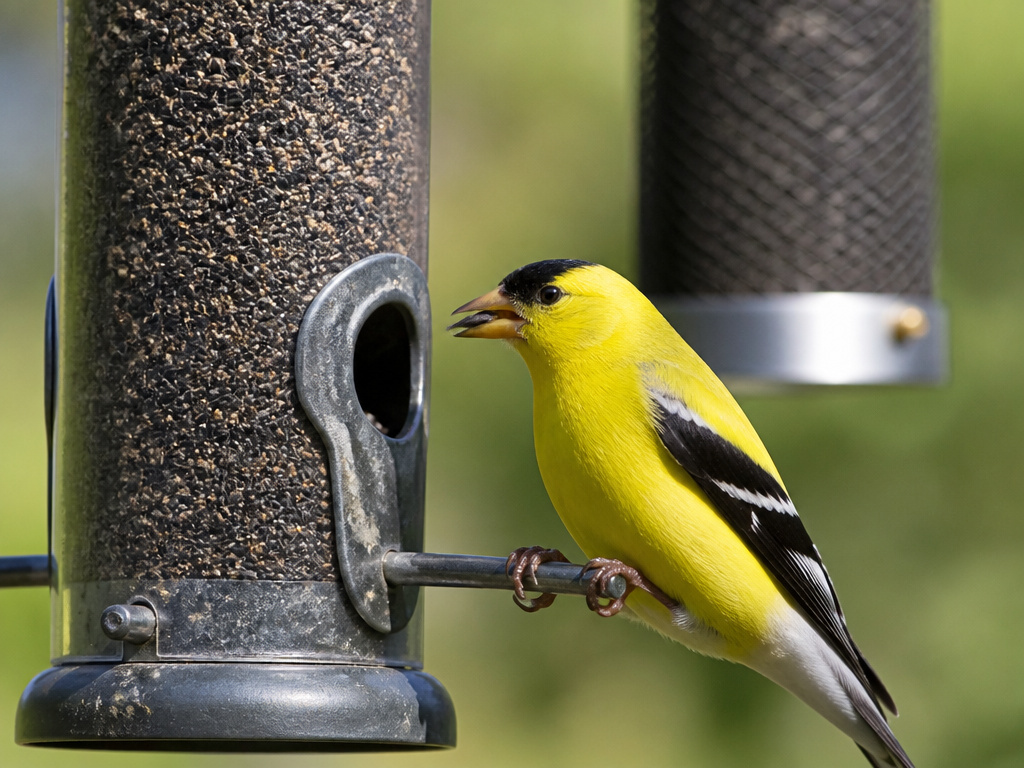
A nyjer feeder that meters one seed at a time wastes less than a wide-port tube. Extension guidance is direct on this: specialty nyjer feeders limit birds to a single seed at a time, which is what prevents waste, and that matters because nyjer is an expensive seed.
The trade-off is capacity. A flock can empty a small tube in a few hours or a day, and a metering feeder holds less than a hopper.
- Tube feeder with small ports. The default. A small-port tube holds up in weather and the ports don’t dump seed, though you’ll refill often in a busy yard.
- Nyjer sock or mesh bag. Cheap, and goldfinches take to them fast. They also soak through in rain, and a wet sock is a mold factory.
- Platform feeder. Good for ground-feeding species and easy to sweep. Bad for nyjer, which blows out and gets wet.
- Hopper or house feeder. High capacity, low maintenance, and the wrong tool for nyjer.
Tube vs sock, if you want a straight answer: a small-port tube wins for most yards because it keeps seed dry. A thistle feeder of the sock type wins only if you’re in a dry climate or you’re willing to swap socks after every storm.
I keep one nyjer sock up in summer because goldfinches find it fast and it’s cheap to replace. Everything from October on runs through a small-port tube. The sock is a seasonal tool, not a year-round one.
If you’re deciding between styles, this comparison of goldfinch feeders goes deeper on port sizes and squirrel hardware.
What Keeps Goldfinches Around After the Seed Runs Out
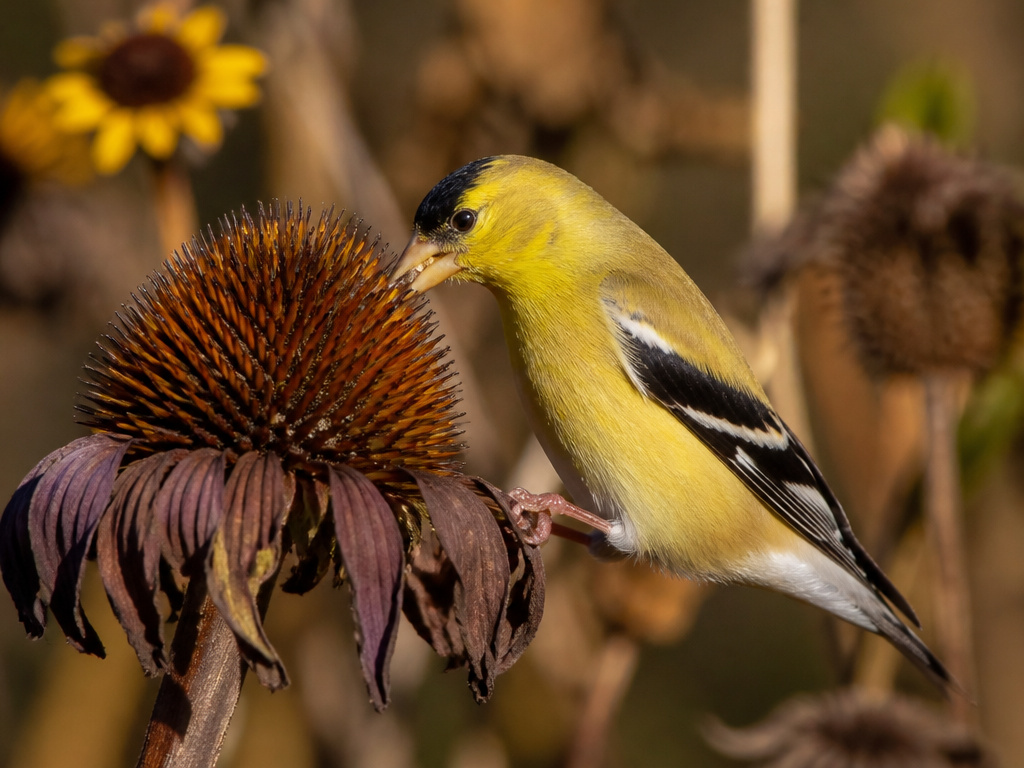
Coneflowers do more for goldfinches than most feeder accessories. Conserving Carolina calls coneflowers one of the best plants for the species, and the reason is timing.
Goldfinches nest late, waiting until June or July for thistle, ragweed, sunflowers, milkweeds, and cattails to go to seed. They use the fluffy seed down for insulation and the seeds themselves to feed chicks.
That late nesting is unusual, and it explains something people find odd about the species. Goldfinches are strictly vegetarian, while 96% of songbirds require insects when raising babies. A yard that produces seed through three seasons feeds them; a yard of lawn does not.
- Plant mostly native flowers that bloom across spring, summer, and fall, so there’s seed and nest material on a rolling schedule.
- Leave the spiderwebs. Goldfinch nests are bound so tightly with spider silk that a finished nest can hold water, and silk is not optional.
- Skip the fall cleanup on coneflower and sunflower stems. The seedheads are the point.
The nesting numbers are worth knowing if you’re watching for them. Nests sit 4-10 ft up, usually in dogwood, willow, or hawthorn. Females lay 2-7 light blue or greenish-blue eggs, which hatch in 12 days and take another 12 before the chicks fledge. Adults molt twice a year, in spring and fall.
If goldfinches are already visiting and you want to widen the yard to other species, the same principles apply to attracting finches generally.
Frequently Asked Questions
Do goldfinches prefer nyjer or black oil sunflower?
Both get eaten. Extension tables mark nyjer as the American goldfinch’s favorite seed, and black oil sunflower is the most popular food for wild birds using feeders overall. A mix of sunflower chips and nyjer covers the whole year.
How often should I clean a goldfinch feeder?
More often than most people do. In humid weather nyjer clumps, and a feeder that’s drawing sick birds needs to come down for 2 or 3 weeks entirely before it goes back up somewhere new.
Why did my goldfinches stop coming?
Check the seed first. Clumped, damp nyjer is the most common answer, and goldfinches will visit a feeder with spoiled seed and leave without eating. Crowding from larger birds drawn by millet-heavy mixes is the second.
Will goldfinches use a feeder that sways in the wind?
Cornell Lab’s guidance says yes, and adds that goldfinches will feed on the ground under a feeder on spilled seed, while Extension guidance still favors sheltered siting, so treat sway tolerance as permission rather than a recommendation.
Where should I not put a goldfinch feeder?
Conserving Carolina puts the safe zones at less than 3 ft or more than 30 ft, because the middle distance is where window strikes turn fatal.
Do goldfinches eat millet?
Extension tables list white millet as something American goldfinches will eat, but the same publication warns that millet-heavy mixes pull in starlings, English sparrows, and rodents. It’s not a seed to build a blend around.
The Bottom Line
If you can’t commit to dumping and rinsing a feeder regularly, don’t hang nyjer. Black oil sunflower in a tube you clean regularly does less harm and still pulls goldfinches, and the birds are no worse off for it.
The height question is genuinely unsettled, and I’d rather say so than pretend otherwise. Extension says 5-6 ft. The one controlled study I trust found goldfinches preferred a feeder nearly twice that high, and its own authors asked for more work before anyone rewrote the guidance. Start at 5-6 ft, and if your yard allows a taller pole, try it and watch what happens.
One concession worth making: I read ingredient panels for a living, and a seed bag is a much simpler label than a cat food can. Short list, named seeds, no milo filler. That’s the whole test.
Hang it 5-6 ft up, 6-8 ft off the cover, 3 ft or 30 ft from glass. Then the only variable left is whether you clean it.
