
How to Attract Finches to a Feeder: What Actually Works
This post contains affiliate links. As an Amazon Associate, we earn from qualifying purchases.
To attract finches to a feeder, offer nyjer seed or sunflower chips in a tube feeder or seed sock, hang it 5-6 feet off the ground, and give it a few days to a few weeks. Black oil sunflower works too, but it won’t fit a thistle feeder. Clean weekly, because mold drives finches away.
The seed-fit problem is mechanical. Nyjer is small enough to slip through a thistle feeder’s fine mesh, and sunflower chips are too wide for that mesh but easy for a finch to pick up. Get the pairing wrong and the feeder sits full while birds pass it by. Knowing how to attract finches to a feeder starts with matching the seed to the mesh.
What follows covers the seed debate, the feeder styles that actually work, the placement advice that splits the sources, the timing question, and the cleaning routine that keeps finches coming back.
Key Takeaways
- Nyjer and sunflower chips both work; the feeder’s mesh size decides which one you can offer.
- Give it a few days to a few weeks; house finches and goldfinches both take time to warm to a new feeder.
- A dirty feeder loses finches faster than an empty one; mold and clumped seed send them looking for a cleaner yard.
- Skip filler-heavy mixes that are mostly milo and millet; birds kick those out.
What Seed Actually Brings Finches In?
The seed aisle at a farm store is a marketing exercise. Every bag shows a bright goldfinch on the front and lists “premium blend” in a font that takes up a third of the label. Flip the bag over and the first ingredient is often milo or millet, which most wild birds won’t eat, according to OSU Extension.
Nyjer seed and sunflower chips are the two seeds most finches prefer. Nyjer is small enough for fine-mesh thistle feeders, while sunflower chips fit tube and hopper feeders. Black oil sunflower seed is the most popular food for wild birds overall, but the size keeps black oil sunflower out of thistle feeders entirely.
The sources split on which seed wins. OSU Extension calls nyjer and sunflower chips the favorites for finches and notes that goldfinches and pine siskins prefer nyjer, especially spring through fall. Pennington says sunflower chips in a tube or hopper feeder are the fastest and most reliable way to draw house finches. Kaytee’s take is that the nyjer-and-sock combination is the best bet for American goldfinches. All three agree those two seeds work; they disagree on which is faster when you compare a how to attract finches to a feeder.
| Seed | Best For | Feeder Type | Notes |
|---|---|---|---|
| Nyjer (thistle) | Goldfinches, pine siskins | Fine-mesh thistle feeder or sock | Preferred spring through fall |
| Sunflower chips | House finches, general finches | Tube or hopper | Fastest for house finches per Pennington |
| Black oil sunflower | Chickadees, nuthatches, grosbeaks | Tube, hopper, platform | Too large for thistle feeders |
| Milo/millet mixes | Starlings, sparrows, rodents | Skip | Birds kick fillers out of the feeder |
Common mistake: Buying a bagged mix because the label shows four finch species. Milo and millet make up most of the volume, and OSU Extension notes birds kick those fillers out of the feeder.
Seed freshness matters more than most labels admit. Perky-Pet’s guidance is to pinch a nyjer seed with a fingernail; if oil doesn’t come out, the seed is old and finches will pass on it. The seed should be jet black and glossy, not brown and dried out. Store fresh nyjer in the freezer to slow the drying-out, and buy only what the birds will eat in about a month.
Reading a finch seed guide label top to bottom tells you more than the photo of the bird. If sunflower isn’t the first ingredient, you’re paying for something else. That’s the same label-reading habit I’d use on a bag of cat food, and it works here for the same reason.
If you want a bagged blend that’s actually built for finches, Kaytee Wild Finch Blend is designed for American goldfinches, pine siskins, purple finches, lesser goldfinches, and redpolls. For straight sunflower chips, choose a bag of sunflower chips, which are easy to eat and high in energy.
The Feeder Type That Matches Finch Behavior
Tube feeders beat hopper feeders for finches, and the reason is perching. A tube feeder has multiple ports, which lets several finches feed at once and discourages larger, more aggressive birds, per Pennington. A hopper holds more seed and gives stable perches for flock feeding. Both work. The tube is the better first feeder for a small yard.
The fine-mesh thistle feeder is a separate category. OSU Extension notes that special nyjer feeders allow birds to access only one seed at a time, which helps prevent waste. That matters because nyjer is expensive. A generic tube feeder defeats the how to attract finches to a feeder purpose if the seed pours out faster than the birds eat it.
| Feeder Style | Best For | Why It Works |
|---|---|---|
| Tube | Multiple finches at once | Ports discourage larger birds |
| Nyjer sock | Goldfinches, small flocks | Mesh holds tiny seed, birds cling |
| Hopper | Larger flocks, less refilling | Holds more seed, stable perches |
| Platform | Ground-feeding species, fruit | Open tray, easy to clean under |
Kaytee names Finch Stations, Feeder Socks, and Feeder Tubes as the best options. The sock is a mesh bag that holds nyjer; finches cling to the fabric and pull seeds through the weave. It’s the cheapest way to test whether nyjer works in your yard before you commit to a tube feeder. A thistle sock is a reasonable starting point.
Why Sock Feeders Work for Goldfinches
Goldfinches have smaller beaks than house finches, and a sock feeder matches that. The mesh weave holds nyjer in place while the bird pulls one seed at a time, which is the same principle OSU Extension describes for specialty nyjer feeders. If you want to attract goldfinches specifically, the sock-plus-nyjer combination is the one Kaytee recommends.
The best finch feeders share one trait: multiple ports and a perch that a small bird can grip. Skip the open tray if goldfinches are the target.
When a Tube Feeder Beats a Sock
A tube feeder earns its spot when you want sunflower chips in the mix. Sunflower chips won’t fit a sock’s mesh, but they drop cleanly through a tube feeder’s ports. If you’re trying to draw both house finches and goldfinches, run two feeders side by side: nyjer in the sock, chips in the tube.
If larger birds like grackles are pushing finches off the feeder, small bird feeders with short perches or mesh cages solve that problem faster than moving the feeder. The mesh size and perch absence are design levers, not placement ones.
A tube feeder with metal port rings may hold up better than plastic-tube feeders. That’s the one I’d buy if I were hanging a feeder where squirrels can reach it.
Where to Hang It (and Why the Sources Split)
The placement advice splits, and that split is the most useful thing to know before you drill a hole in a post: OSU Extension’s EC 1554 recommends 6-8 feet from vegetation, while Pennington and Perky-Pet recommend placing feeders near trees and shrubs for cover. OSU Extension’s EC 1554 recommends placing feeders 5-6 feet off the ground and 6-8 feet from nearby vegetation, with escape cover within 10 feet. Pennington says to place feeders near trees, shrubs, or brush piles for cover. Perky-Pet says a feeder out in the open makes finches feel vulnerable and that placing it near a shrub or tree makes them feel safe. OSU’s Dana Sanchez goes further: birds won’t use feeders if there’s no shrub nearby, even when the feeder is placed where humans can see it.
The three positions aren’t as far apart as they look. OSU’s 6-8 feet is a distance from vegetation, not a ban on vegetation. Pennington and Perky-Pet are describing the same principle: finches want cover within a short flight, not zero cover. The 6-8 foot gap is what makes the difference between “near cover” and “inside the bush.”
Where this goes sideways: Hanging the feeder inside the shrub canopy. The finches get cover, but the seed stays damp, and mold sets in fast enough that OSU Extension recommends cleaning every week.
The feeder placement question gets easier once you accept that “near cover” and “not inside cover” are two different instructions. The EC 1554 wild bird feeding publication is the source for the 5-6 foot height and the 6-8 foot vegetation gap. Not every aspect of placement has been settled by controlled study; the peer-reviewed goldfinch feeder study is worth reading if you want to see how the question has been tested.
The placement rules that survive all three sources:
- 5-6 feet off the ground (OSU EC 1554).
- 6-8 feet from vegetation, with cover within 10 feet (OSU EC 1554).
- Near a shrub or tree so finches feel safe (Perky-Pet, Pennington).
- Far enough that squirrels can’t jump once the feeder is discovered (Perky-Pet).
Distance matters. A feeder hung inside the canopy gets the cover but loses the drying. Perky-Pet warns a feeder in the open can make finches feel vulnerable, while OSU Extension’s EC 1554 recommends starting with a seed mix in an open place to see which seeds are wasted.
How Long Does It Take for Finches to Find a New Feeder?
A few days to a few weeks. That’s the honest window, and both Pennington and Perky-Pet land on it independently. Pennington says most house finches discover a new feeder within a few days to a few weeks, depending on the seed offered. Perky-Pet says it can take birds days or even weeks to use a new feeder, because birds are creatures of habit and need to warm up to something new in the yard.
Here the sources split on whether to remove other feeders. Perky-Pet recommends temporarily removing other feeders so birds forage outside their usual routine and find the new one. OSU Extension’s EC 1554 says the opposite: once birds have started coming to your yard, it’s easier to lure them to separate feeding stations. Both are describing different starting points. If you’re trying to move birds from one feeder to another, remove the old one temporarily. If you’re adding a second feeder, don’t remove anything.
Perky-Pet also suggests filling a new feeder half-full, which seems to attract birds. That’s a low-cost experiment; try it before you fill the whole thing. The birds to a new feeder problem is mostly patience, but the seed choice accelerates it.
A new feeder that sits untouched for a few weeks isn’t failing. It’s still in the discovery window. Change one variable at a time: seed first, then placement, then feeder style.
I’ve watched a plain black oil sunflower feeder pull in cardinals, chickadees, titmice, and a blue jay while the multi-species mix next to it sat mostly ignored. The mix had a bigger variety on the label and fewer birds on the perches.
Cleaning Cadence That Keeps Finches Coming Back
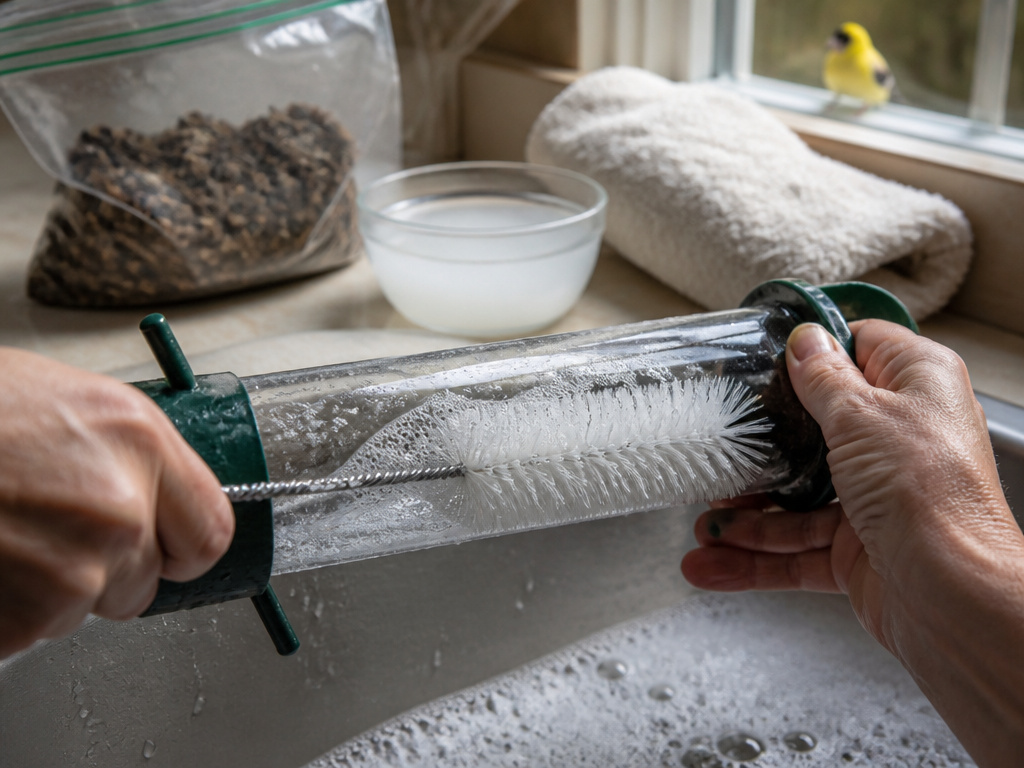
The nyjer in my tube feeder went stale faster than I expected. In humid weather, it clumped at the bottom of the tube, and the goldfinches would land, look at it, and leave without eating. That’s a seed-freshness problem, but it’s also a cleaning problem.
OSU Extension’s Dana Sanchez is blunt: cleaning all bird feeders once a week is essential, because moisture contributes to mold, which can cause disease. Perky-Pet adds that finches avoid a feeder if it’s moldy or otherwise unclean, and that a weather guard prevents seed from getting wet and clumping. The two recommendations stack: clean weekly, and keep the seed dry between cleanings.
Once I started dumping the leftover nyjer and rinsing the tube with a diluted bleach solution between refills, visits picked up. The seed was fresh; the feeder was clean; the birds came back. That’s the cleaning bird feeders routine in practice.
The Weekly Cleaning Routine
- Empty the feeder into a bag. Throw out any clumped or damp seed rather than topping it off.
- Scrub the tube or sock with a bottle brush and hot soapy water.
- Soak in a diluted bleach solution for a few minutes, then rinse thoroughly.
- Let it dry completely before refilling. Damp seed clumps within days.
- Refill with fresh seed and hang it back up.
In winter I fill smaller amounts more often so seed stays dry and doesn’t clump. Frozen, clumped seed under a feeder is a bad sign, and I treat it as a cleaning problem first. Sanchez’s OSU Extension winter bird feeding tips also cover fruit on a platform feeder for waxwings, grosbeaks, chickadees, and robins.
Clean weekly. That’s the whole rule.
What About Squirrels and Unwanted Visitors?
Three things show up at a finch feeder that you didn’t invite: squirrels, starlings, and House Sparrows. Each one has a different fix.
- Squirrels jump from below the shield, so distance from launch points beats any baffle.
- Starlings show up for milo and millet; straight nyjer in a fine-mesh sock excludes them.
- House Sparrows crowd small perches; a feeder with short perches or a mesh cage limits their access.
OSU Extension’s EC 1554 notes that squirrels often jump on the feeder from below the shield, so a shield alone doesn’t solve access. Perky-Pet’s advice is to place the feeder near a shrub or tree so finches feel safe, then move it far enough away once they’ve discovered it that squirrels can’t jump to it. The squirrel proof strategy that actually works is distance, not a baffle.
Easy to miss: A feeder that attracts starlings usually has milo or millet in it. Check the ingredient list before you blame the feeder.
Straight nyjer seed in a fine-mesh sock is the cleanest way to exclude starlings without excluding finches. Milo and millet attract starlings and House Sparrows, per OSU Extension. If those birds are dominating the feeder, switch to straight nyjer or sunflower chips and skip the bagged mix.
When to Take the Feeder Down
Fluffed-up, lethargic finches sitting at a feeder for long stretches are a cue to take the feeder down. Conjunctivitis and salmonella are the two I watch for, and both spread fastest where birds crowd on one small perch. Pull the feeder, scrub it, and wait before hanging it back up.
Frequently Asked Questions
What is the best seed to attract finches?
Nyjer and sunflower chips are the two finches prefer, per OSU Extension. Goldfinches and pine siskins lean toward nyjer, especially spring through fall. House finches lean toward sunflower chips, which Pennington calls the fastest and most reliable option. Both work; the feeder’s mesh decides which one you can offer.
How high should I hang a finch feeder?
OSU Extension’s EC 1554 recommends 5-6 feet off the ground, with 6-8 feet of clearance from nearby vegetation and escape cover within 10 feet. That gap is what keeps seed dry while still giving finches a short flight to cover.
Do finches prefer nyjer or sunflower?
It depends on the species. Goldfinches and pine siskins prefer nyjer, especially spring through fall, per OSU Extension. House finches prefer sunflower chips, per Pennington. If you want both, run two feeders side by side.
How long does it take for finches to find a new feeder?
Few days to a few weeks. Pennington and Perky-Pet both land on that window. Birds are creatures of habit and need to warm up to something new in the yard.
Should I remove other feeders to attract finches to a new one?
Perky-Pet recommends temporarily removing other feeders so birds forage outside their usual routine. OSU Extension says the opposite: once birds are coming to your yard, it’s easier to add separate feeding stations. If you’re moving birds from one feeder to another, remove the old one. If you’re adding a second feeder, leave the first one up.
How often should I clean a finch feeder?
Once a week, per OSU Extension’s Dana Sanchez. Moisture contributes to mold, which can cause disease, and Perky-Pet adds that finches avoid a feeder if it’s moldy or unclean. Clean weekly, and keep the seed dry between cleanings.
Before You Go
Here’s the concession: none of this guarantees finches. A feeder 6-8 feet from vegetation, filled with fresh nyjer, cleaned weekly, can still sit empty for a month if the local flock hasn’t found it yet. The birds aren’t rejecting your setup; they haven’t discovered it.
The first step this week is smaller than you think. Dump the bagged mix, buy a single bag of nyjer or sunflower chips, and put it in one feeder. Watch which seeds disappear and which get kicked to the ground. That observation tells you more than any bag label will.
And if you only do one thing, skip the fancy feeder and clean the one you have. A dirty feeder full of fresh seed is worse than an empty feeder, because it draws birds in and then makes them sick.
