
How to Attract Blue Jays to a Feeder: Step-by-Step
This post contains affiliate links. As an Amazon Associate, we earn from qualifying purchases.
To attract blue jays to a feeder, offer peanuts and black-oil sunflower seed in a hopper or platform feeder on a post, and hang a suet cage nearby. Jays are large birds. They need a perch wide enough to land on, they take whole food, and Cornell’s guidance puts tray and hopper styles ahead of hanging feeders.
Peanuts and sunflower do most of the work, and the hardware is where the advice splits. Three credible sources describe jays and feeders in ways that do not line up, and that disagreement changes what you should buy.
What follows covers what jays eat, which feeder shapes they use, how to read a seed bag before you pay for filler, and the cleaning routine that keeps a feeder from turning into a hazard.
Key Takeaways
- Peanuts and black-oil sunflower are the two foods that pull jays in. Corn works too, but only in dry weather.
- A hopper or raised platform on a post suits a jay’s size better than a small hanging tube, though the sources do not fully agree on how much that matters.
- Skip bags where milo, oats, or wheat sit near the top of the list. Filler seed ends up on the ground under the feeder.
- Clean regularly with a diluted bleach solution. A platform feeder with a mesh bottom drains droppings instead of holding them.
- Corn soaks up water and becomes vulnerable to rot and aflatoxin contamination, which UF/IFAS calls extremely toxic to birds even at low levels. Pull it when the forecast turns wet.
What Do Blue Jays Actually Eat?
Peanut kernels and oil-type sunflower seed top the list of what blue jays eat, according to the Virginia Cooperative Extension feeding guide. Whole-kernel corn also makes the list: Cornell’s winter feeding note names jays among the birds that favor it.
A jay is a heavy bird with a stout bill, built to pick food up whole and carry it off. That shapes the menu. Peanuts and sunflower seeds travel in a beak. Millet and niger do not.
Cornell’s Seed Preference Test adds a wrinkle that matters for the how to attract blue jays to a feeder question. Most ground-feeding species prefer white millet or red milo to black-oil sunflower, while many tree-feeding species prefer sunflower. A jay feeds on the ground and in trees, so it can use both a platform and a hopper.
Blue jays take whole peanuts, oil-type sunflower seed, and whole-kernel corn. Cracked corn is easier for smaller birds to handle, while whole kernels suit jays, pigeons, doves, quail, and pheasants. Suet cages and hopper feeders both draw jays, and platform feeders placed higher above ground reach the same bird mix as tube and hopper styles.
Three foods earn a place at a jay feeder:
- Whole peanuts, shelled or unshelled. Big, easy to carry, and gone fast.
- Black-oil sunflower. Cornell calls sunflower the overall favorite food, and the thin black-oil shell opens for both large and small birds.
- Whole-kernel corn. Favored by jays specifically, per Cornell, though the moisture problem below applies.
If you would rather not build a mix from scratch, the short list of blue jay food worth putting out is a faster read than the seed aisle. And if you are not sure whether the bird on the tray is a jay or a grackle, the Cornell Lab Blue Jay overview covers identification and range.
Which Feeder Gets Jays to Land?
The feeder advice for jays contradicts itself, and pretending otherwise does not help you pick one.
UF/IFAS Extension puts it plainly: hopper feeders attract all the same species as tube feeders, along with larger birds like blue jays, cardinals, grosbeaks, and woodpeckers. That sentence implies a tube feeder already serves jays.
Cornell’s guidance points a different way. Jays prefer tray or hopper feeders on a post rather than hanging feeders. A Virginia Cooperative Extension summary goes further and frames tube feeders as the opposite of a jay feeder, noting that tubes let goldfinches avoid competition with blue jays and grackles that take over platform feeders.
Three sources, three positions. Here is what each one is describing.
| Feeder | What it gives a jay | The catch |
|---|---|---|
| Hopper on a post | Wide perch, big seed volume, rain cover | Holds enough seed to feed squirrels |
| Raised platform | Open landing for ground and tree feeders | Droppings collect without a mesh base |
| Tube | Small ports, hangs anywhere | Ports sized for finches; jays want a post |
| Suet cage | A jay can cling and peck | Warm weather turns plain suet rancid |
Hopper Feeders: Volume, a Wide Perch, and a Squirrel Problem
Hopper feeders hold a lot more seed than other styles and need filling less often. That is the selling point and the problem. The volume that keeps you out of the seed bin also keeps squirrels coming back, and UF/IFAS flags exactly that trade-off.
Platform Feeders: The Mesh Bottom Matters
Studies cited by UF/IFAS give platform feeders a higher rate of disease transmission, because droppings collect on the flat surface and mingle with the food. A platform with a wire mesh bottom lets rain wash the droppings through. Height changes the guest list too: platforms placed higher above ground attract many of the birds that visit tube and hopper feeders.
Suet Cages: The Cheap Second Feeder
UF/IFAS lists jays as regular suet visitors, alongside woodpeckers, bluebirds, cardinals, chickadees, nuthatches, titmice, and wrens. A suet cage is the least expensive way to add a second feeder type, and Cornell recommends offering suet in a plastic-coated wire cage.
UF/IFAS recommends installing at least two different types of feeders if you want a wide diversity of birds. That is the closest thing to a rule in this whole topic, and it costs less than upgrading a single feeder. A hopper plus a suet cage covers most of a jay’s day.
Shopping for feeders for blue jays mostly means choosing between a hopper and a raised platform. The hopper feeder options that suit cardinals suit jays too, since both birds want the same wide perch. And the bird feeder types that fail for jays fail for one reason: the perch is too narrow for a heavy bird to land on.
I would buy a hopper on a post and a suet cage, then stop. A couple of feeders, cleaned properly, beat many feeders that rarely get scrubbed.
Read the Seed Bag Like an Ingredient Panel
The back of a seed bag lists ingredients in descending order by weight, the same way a pet food panel does, and it tells you more than the photo of the cardinal on the front.
Flip the bag over. Cornell warns that commercial mixtures may have a high percentage of filler seeds. UF/IFAS is blunter: seed mixes are not usually the best choice because they contain more milo, oats, and red proso millet than sunflower. Both sources are describing the same bag.
Run a hand through a cheap mix and the texture tells you. Small, hard, round milo kernels sift down to your palm while the sunflower stays on top.
The two sources part company on the fix. UF/IFAS points you toward single seeds. Cornell offers a low-cost alternative: build the mix yourself, at a ratio anyone can remember.
- Pour one 25-pound bag of black-oil sunflower, one 10-pound bag of white proso millet, and one 10-pound bag of cracked corn into a clean trash barrel. Skip the barrel and you will be stirring open bags.
- Mix it with a broomstick. Mix it with a broomstick.
- Replace the lid tightly. Cornell’s warning about tight, waterproof containers is not decoration: damp seed molds, and moldy seed is the thing you were trying to avoid.
- Use metal storage where rodents are a problem. Cornell notes metal containers stop rodents gnawing into the food supply. Metal containers deter rodents from gnawing into the food supply.
A seed bag that lists milo, oats, or wheat near the top of the ingredients is mostly ground litter with a cardinal printed on it. Buy single seeds and mix them yourself. All you need is a clean barrel and a broomstick.
What most people get wrong: Buying a bag labeled for cardinals and assuming it covers jays. Those blends lean on milo and safflower, and a jay kicks most of it to the ground.
The proportions above come from Cornell’s winter bird feeding note, which also covers high-energy foods for cold snaps. If you would rather buy than build, cardinal and blue jay seed is the blend to look for, provided sunflower leads the list.
How to Attract Blue Jays to a Feeder Without Feeding Everything Else
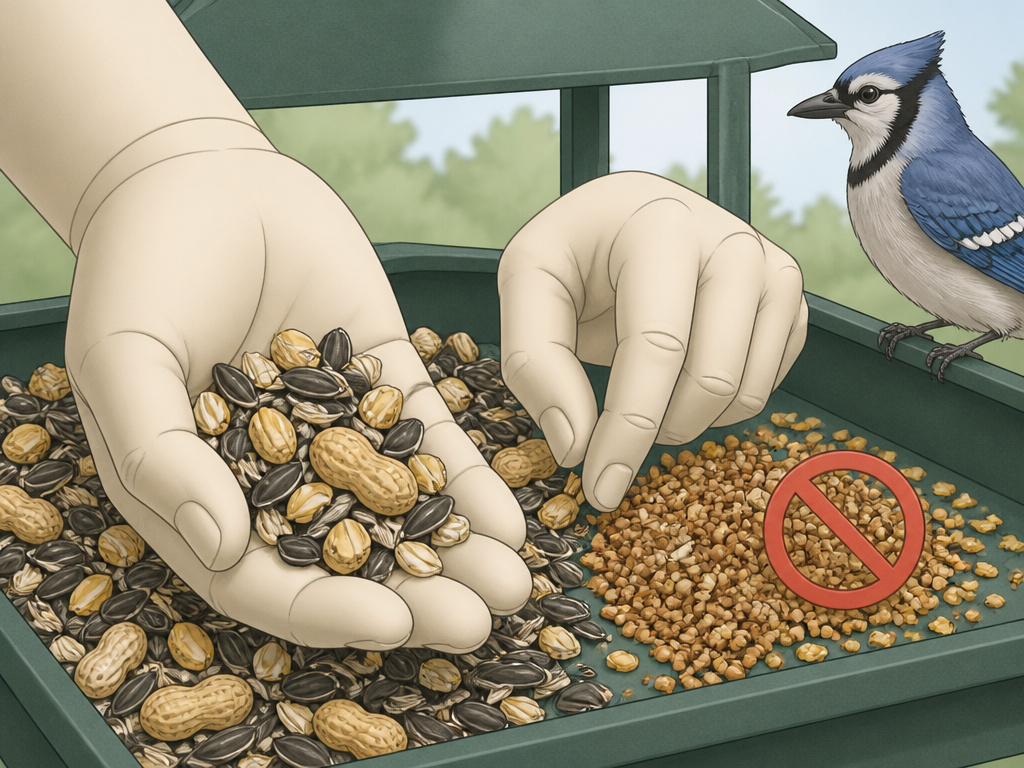
The feeder is empty, and the ground beneath it is a carpet of small round seeds nobody ate. That is milo, and it is what you paid for.
Cracked corn is the other open invitation. UF/IFAS notes that cracked corn, like millet, can attract cowbirds, house sparrows, and European starlings. None of those are jays, and all three compete at the same feeder.
Cornell is direct about table scraps: they may attract European Starlings, House Sparrows, rats, or raccoons, and any scrap that is moldy can harm the birds.
Safflower is where the sources disagree most. A Virginia Cooperative Extension summary says safflower can discourage blue jays while still attracting cardinals and mourning doves. Cornell’s note says safflower has limited appeal for starlings, House Sparrows, and squirrels, and that cardinals appreciate it. Cornell does not mention jays at all. If jays are the goal, treat safflower as a maybe and test it in a single feeder rather than filling several.
What to leave on the shelf:
- Blends built on milo and wheat. Cheap by weight, expensive by the pound of seed a jay will actually eat.
- Cracked corn in a wet climate. It pulls sparrows and starlings, and it spoils.
- Table scraps. Table scraps may attract rats and raccoons.
- A second feeder with no plan for squirrels.
I would rather see a clean hopper on a baffled post than a yard full of scattered feeders. Every feeder you add is another surface to scrub and another place for damp seed to sit. Start with two, get the routine down, then expand.
Getting feeder placement right matters as much as the seed does, and a feeder set away from low cover gets used by whatever is boldest rather than by jays. Squirrel-proofing a hopper usually means a baffle on the post, since the seed volume that makes a hopper convenient is the same thing that keeps squirrels interested.
Easy to miss: Topping up a hopper without emptying it first. The old seed at the bottom stays damp, and the new seed on top hides it until the whole feeder smells wrong.
Where Wet Corn and Warm Suet Go Wrong
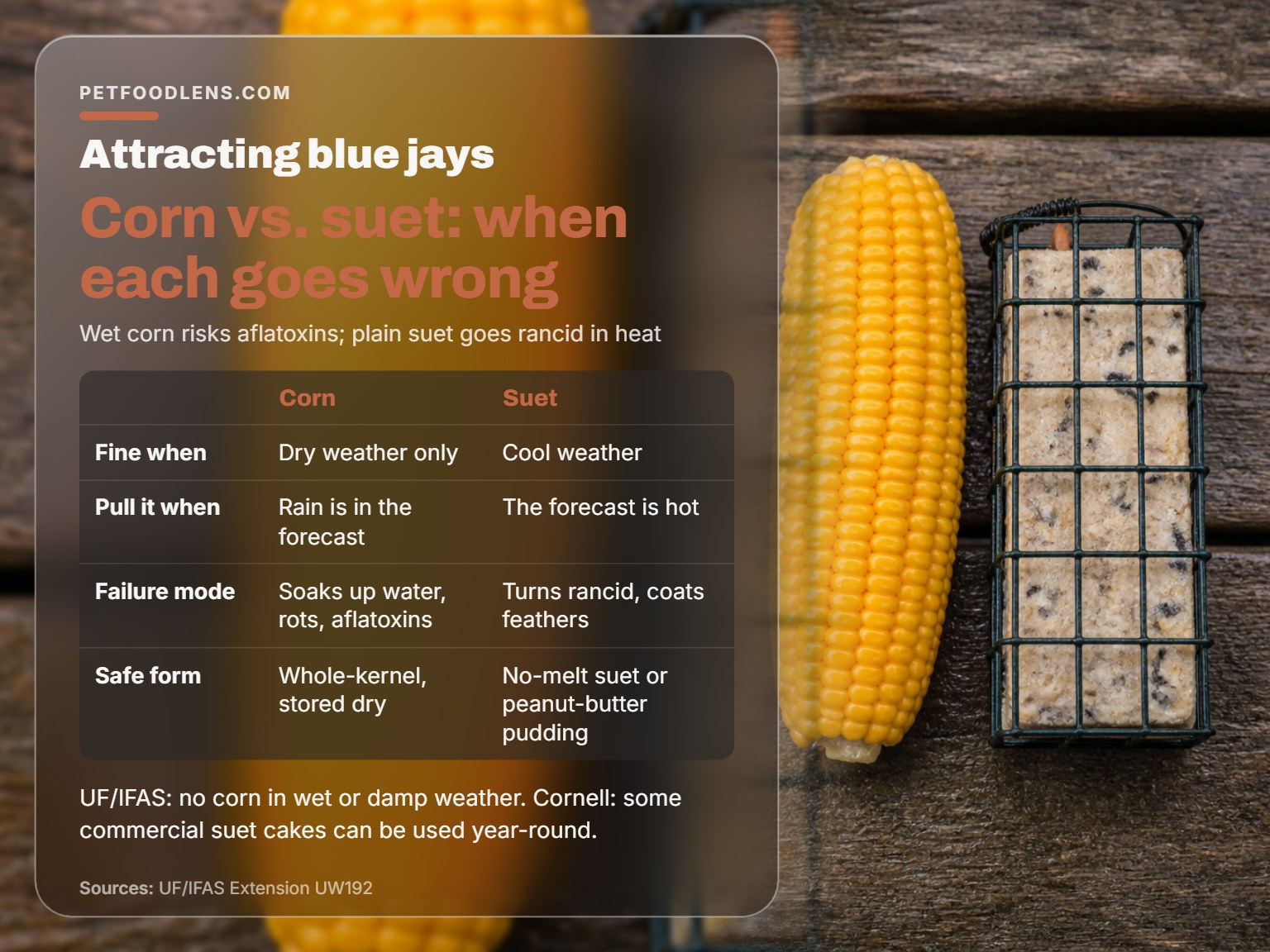
Corn is the one food on this list that can hurt a jay.
UF/IFAS explains why. Corn kernels rapidly soak up water, which leaves them open to rot and contamination by aflatoxins, which are extremely toxic to birds even at low levels. The rule that follows is short: no corn in feeders in wet or damp weather, and careful storage the rest of the time.
The Corn Rule: Dry Weather Only
Whole-kernel corn is the form Cornell’s note describes as favored by jays. Cracked corn is easier for blackbirds, finches, and sparrows to eat, which tells you something about who shows up when you put it out. Either way, wet corn is the failure mode.
Corn that has been rained on goes slick and smells sour, and by the time you notice, the damage is done.
Suet: Cage It and Watch the Weather
Suet is the second place the sources split. UF/IFAS says regular suet should be avoided in very hot weather, when it can turn rancid or coat and damage birds’ feathers, and points to no-melt suet or peanut-butter pudding instead. Cornell agrees that plain suet goes rancid in warm weather but notes that some commercial suet cakes and doughs can be used year-round. Read the label on the cake, not the season on the calendar.
Plain suet left out through a hot spell goes soft and rancid. Once it coats the feathers around a bird’s face, the bird loses insulation it needs.
Cornell also notes there is no evidence birds choke on sticky peanut butter, and that mixing it with corn meal or oatmeal removes any doubt. Birds in cold climates especially appreciate high-energy foods like peanut butter or suet, which makes a suet cage the best winter addition to a hopper.
| Food | Fine when | Pull it when |
|---|---|---|
| Black-oil sunflower | Year round | Seed clumps or smells off |
| Whole peanuts | Year round, stored dry | Hulls look damp or spotted |
| Cracked corn | Dry weather only | Rain is in the forecast |
| Suet | Cool weather | The forecast is hot |
| Table scraps | Fresh and unmoldy | Any scrap that is moldy |
The Cleaning Schedule That Keeps Jays Coming Back
I ran nyjer in a tube feeder through one humid summer and watched goldfinches land, pick twice, and leave. Before long the seed had clumped into a mat against the mesh. The birds were reading the seed better than I was. I dumped the tube, rinsed it with the diluted bleach solution, dried it in the sun, and refilled. Visits picked up soon after.
Nyjer feeds finches rather than jays, and the lesson carries anyway. Seed that sits goes stale, and stale seed gets sampled once and abandoned.
A stale tube feeder smells like a damp basement when you open the lid. That is the tell.
Platform feeders need more attention than the rest. Studies cited by UF/IFAS give them a higher rate of disease transmission because droppings collect on the flat surface and mingle with the food. A wire mesh bottom lets rain wash the droppings through, which is the cheapest fix in this entire article.
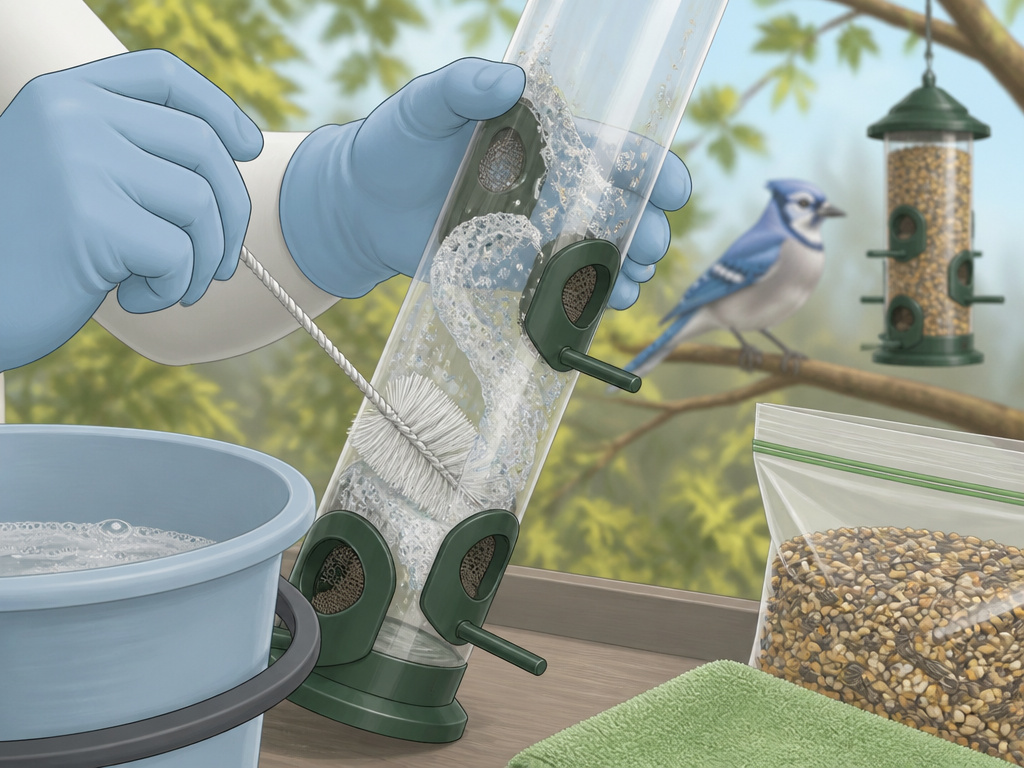
Before you start: Diluted bleach solution burns skin and eyes on contact, so wear gloves and keep your face back from the bucket. Never mix bleach with anything ammonia-based, and rinse every surface until you cannot smell chlorine. Work outdoors or at a utility sink, never over a kitchen counter.
- Empty the feeder into a bag and throw the old seed out. Topping up over stale seed is how mold builds at the bottom.
- Scrub every surface with the diluted bleach solution and a bottle brush. Ports and corners hide residue; skip them and the next fill starts dirty.
- Rinse until the chlorine smell is gone. Residual bleach puts birds off a feeder for days.
- Dry completely before refilling. Damp seed in a clean feeder molds as fast as damp seed in a dirty one.
- Repeat regularly, and more often in humid weather.
Cornell notes that a dependable supply of fresh water will attract many birds, including species that do not normally visit feeders, and that a shallow, easy-to-clean birdbath is best. Cornell also pushes back on one bit of winter lore: providing water in extreme cold is less urgent than people think, because wetted feathers can freeze.
If a feeder has been up for a while with no jays, the attract birds to a new feeder checklist is worth a pass before you change the seed.
Frequently Asked Questions
What food brings blue jays fastest?
Peanuts and black-oil sunflower seed. Both are large enough for a jay to pick up and carry, and sunflower is the overall favorite food in Cornell’s seed work. Suet runs close behind, and UF/IFAS lists jays as regular suet visitors.
Do blue jays use tube feeders?
Sometimes, and the sources do not agree on how often. UF/IFAS notes that hopper feeders attract all the same species as tube feeders plus larger birds like jays, which implies tubes serve jays too. Cornell’s guidance says jays prefer tray or hopper feeders on a post.
Is cracked corn bad for blue jays?
In dry weather it is fine. The problem is moisture: corn kernels soak up water and become vulnerable to rot and aflatoxin contamination, which UF/IFAS describes as extremely toxic to birds even at low levels. Keep corn out of feeders when it is wet or damp, and store it dry.
Where should I put a feeder for blue jays?
On a post, if you can. Cornell’s guidance favors tray and hopper feeders on a post over hanging feeders, and UF/IFAS notes that platform feeders placed higher above ground attract many of the birds that visit tube and hopper feeders.
Do blue jays scare off smaller birds?
At a platform feeder, yes. A Virginia Cooperative Extension summary notes that jays and grackles take over platform feeders, which is one reason tube feeders exist in the first place. Running two feeder types gives smaller birds somewhere to work while the jays hold the hopper.
The Bottom Line
One threshold decides most of this. If your seed bag lists milo, oats, or wheat near the top of the ingredients, you are paying for ground litter, and the jays will sort it out on the lawn for you.
This week: put one hopper or raised platform on a post, fill it with black-oil sunflower and whole peanuts, and hang a suet cage within sight of a window. Two feeder types. UF/IFAS recommends at least two for a reason, and the second one costs less than the first.
None of this fixes a dirty feeder. If you will not commit to regular scrubbing, a smaller feeder that empties faster beats a big hopper that sits. That is the honest version of how to attract blue jays to a feeder: the seed gets them there, and the cleaning keeps them.
And if you only do one thing, skip the blend. Single seeds, mixed yourself, in a clean feeder, will outdraw any bag with a cardinal on the front.
