
What Do Parrots Eat? Pellets, Produce, and Seeds
This post contains affiliate links. As an Amazon Associate, we earn from qualifying purchases.
Parrots eat a pellet-based diet: about 75-80% formulated pellets, 15-20% fresh fruits and vegetables, and seeds strictly limited or eliminated. That split comes from the University of Florida College of Veterinary Medicine, which ties seed-heavy diets to obesity, high cholesterol, and fatty liver disease in parrots, though Gilardi & Toft’s wild data show seeds making up as much as 70% of wild parrot diet.
That split is where the arguing starts. A wild parrot in the Peruvian Amazon pulls as much as 70% of its diet from seeds, and a 2012 field study of 224 foraging observations found those seeds carried more protein and fat than the leaves and pulp around them. What do parrots eat, then, when the menu changes with the setting? A captive bird in a living room is not that bird, and the distance between the two is the whole subject.
What follows works through the wild data, the captive numbers, the species that break the pattern, and the conversion process that stalls out more often than it should. Where the veterinary sources disagree with each other, you will see both positions rather than a smoothed-over average.
Key Takeaways
- 75-80% pellets, 15-20% produce is the split published by the University of Florida, though a 2014 WSAVA congress proceedings puts formulated diet at roughly 60% with vegetables making up the remainder.
- Seeds are the contested food, not the forbidden one. Merck calls strictly seed diets suboptimal; a controlled Amazon parrot trial found 18% seed by wet weight may not imbalance the diet.
- Never starve a bird onto pellets. UF states plainly that this can kill the bird. The safe ceiling is 1-2% of body weight lost per week.
- Weigh the food for 7 days before you change anything, then feed that average daily intake as the new total.
- Lories, hyacinth macaws, and African greys need different numbers from the generic split, and the differences are large.
What Do Wild Parrots Actually Eat?
Two hundred and twenty-four foraging observations, 17 parrot species, 8 genera, and 102 tree species. That is the dataset behind a widely cited field study by Gilardi and Toft, published in PLOS ONE in 2012 after two dry seasons and one wet season in the Peruvian Amazon.
Wild parrot diet composition varies by species and season. Across 224 field observations in the Peruvian Amazon, seeds made up as much as 70% of intake, and parrots also consumed fruits, flowers, leaves, bark, and insect larvae. Seeds measured higher in protein and lipid and lower in fiber than the other plant parts sampled.
The details matter more than the headline number when you ask what do parrots eat. Three large macaw species ate foods higher in protein and lipid and lower in fiber than the plant parts they passed over. They also ate foods lower in phenolic compounds than the ones they avoided, though the foods they did eat still carried measurable toxicity. Macaws did not appear to pick foods based on mineral content at all.
So the wild picture is a seed-heavy, chemically complicated, species-specific diet that no bowl in a pet shop reproduces. Pesquet’s Parrot eats nothing but fig pulp. Lorikeets run on nectar and pollen. Most parrots sit somewhere in between, eating seeds at various stages of ripeness as the primary component.
Newer survey work pushes the picture wider still. A 2024 review of reported feeding habits found alternate foodstuffs such as foliage, invertebrates, and wood appearing well outside the plant-only framing.
Worth knowing before you start: The World Parrot Trust argues you cannot replicate a wild diet and should not try. Gilardi and Toft’s data and the 2024 review both argue wild feeding behavior should inform captive choices. Both positions are held by people who know parrots well.
Here is my read, and it is the read of someone who works mainly on the formulation side. The wild data tells you what a parrot’s digestive system evolved around. It does not tell you what to put in a bowl, because the wild bird flies miles, burns the calories, and eats 102 tree species across a year. Your bird does none of that.
The Captive Ratio: 75-80% Pellets, 15-20% Produce
The University of Florida College of Veterinary Medicine publishes a specific split, though other sources such as a 2014 WSAVA congress proceedings put formulated diet at roughly 60%. Pellets at 75-80% of the diet, fruits and vegetables at 15-20%, seeds and nuts strictly limited or eliminated.
UF does not hedge on the last part. The same page lists what a seed-heavy diet produces: obesity, strokes, high cholesterol, heart problems including heart attack, and fatty liver disease.
Not every source lands on the same pellet number. A 2014 WSAVA congress proceedings puts formulated diet at roughly 60%, with vegetables making up the remainder. That is a 15-20 point gap for the same recommendation, from two credible veterinary sources.
| Source | Formulated share | Seed guidance |
|---|---|---|
| University of Florida CVM | 75-80% pellets | Strictly limit or eliminate |
| WSAVA 2014 proceedings | About 60% formulated | Not specified |
| Merck Veterinary Manual | Pellets improve intake | Strictly seed diets suboptimal |
| Amazon parrot feeding trial | 60-75% formulated | 18% seed tolerated in one arm |
The reason the ratio matters more than the exact brand is that parrots self-select, which is why the what do parrots eat question is really about what they choose. Dr. Ian Tizard at Texas A&M describes the problem directly: given free choice of food, parrots pick out the unhealthy components and leave the healthy ones uneaten. A bowl of mixed seed, nuts, and pellets is a bowl where the bird sets the ratio, and the bird picks fat and salt.
Formulated diets solve that by construction. Grains, seeds, vegetables, and fruits get blended and baked into a pellet, so there is nothing left to sort. Texas A&M calls this a suitable choice for exactly that reason.
Both are formulated diets in the sense Tizard means.
What most people get wrong: Treating the pellet bag as the whole diet. The 15-20% produce share is not decoration. Skip it and you have swapped one narrow diet for another, just with better vitamin A numbers.
The practical takeaway on the parrot diet is that pellets carry the nutrition and produce carries the variety. If you want to see how those proportions shake out in a real week, the breakdown of how much of a bird diet should be pellets is worth reading next to this section.
Why Seed Mixes Fail, and Where the 18% Argument Comes From
Seed mixes get defended harder than any other food in the parrot aisle, and part of that defense holds up under scrutiny.
Start with what Merck says. Strictly seed diets are suboptimal for psittacines regardless of supplementation, because seeds are deficient in vitamin A, protein (lysine and methionine in particular), calcium, and other nutrients. That word “regardless” is doing real work. Sprinkling a vitamin powder on sunflower seed does not fix the amino acid profile.
Then look at the disease list from UF: obesity, strokes, high cholesterol, heart problems, fatty liver disease. Those are the outcomes of a long-term seed-heavy diet in a sedentary bird, and they show up over months and years rather than weeks.
Now the counterweight. A controlled feeding trial in seven adult captive Amazon parrots tested three diet formulations. The mix at 50% produce, 25% formulated, and 25% seed came out deficient in calcium, sodium, and iron and exceeded recommended fat. The mix at 60% pellet, 22% produce, and 18% seed had acceptable calcium and a workable calcium-to-phosphorus ratio.
That trial’s own conclusion was that small quantities of seeds may not produce a nutritionally imbalanced diet. Eighteen percent seed, by wet weight, was the number that survived.
Rule of thumb: If your bird’s seed share is above a fifth of the bowl, you are outside the range the trial tested and back into UF’s warning zone. Below that, the argument is about which pellets and which vegetables, not about whether seeds exist.
There is a physical tell here that no label gives you. A parrot working through sunflower seed makes a steady ticking sound as it cracks hulls, and the floor of the cage fills with husks. A parrot eating a formulated diet makes almost no sound at all, because there is nothing to crack. If your bird’s bowl is loud, you know what it is eating.
I read pellet bags the way I read cat food bags, which is to say I start at the guaranteed analysis and work backward. The pellets vs seed mix for birds comparison covers the label side of that in more detail, and the seed-only diet writeup tracks the failure timeline if you want the longer version.
A controlled trial of this size, run on the formulations in this captive Amazon parrot diet study, is a small study. Seven birds is not a population. Treat the 18% figure as a tested upper bound in one species, not a universal license.
Species That Break the Generic Numbers
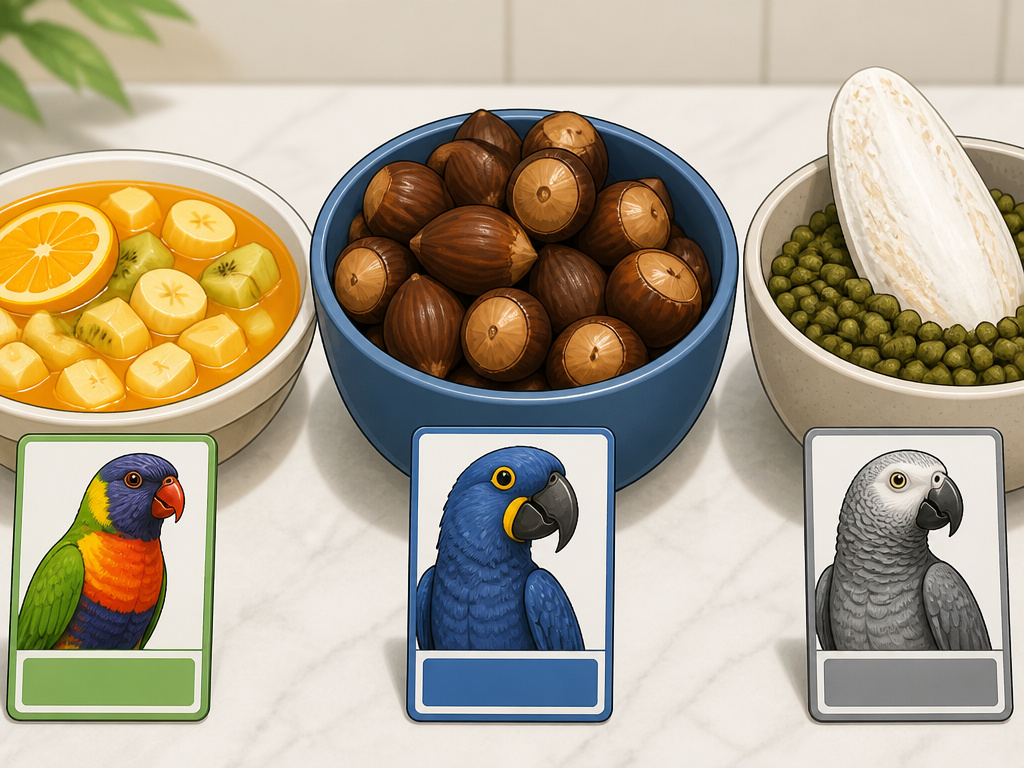
Three groups of parrots need a different bowl than the rest: lories and lorikeets, hyacinth macaws, and African greys. The generic pellet ratio does not transfer cleanly to any of them.
Lories and lorikeets are nectar feeders. Merck specifies diets with high water content, easily digestible carbohydrates, a protein mixture, and a balanced vitamin and mineral supplement. Their protein needs run low, in the 3-5% range, because their natural diet is low in fiber and easy to digest.
Hyacinth macaws run the opposite direction. Their natural diet is high-fat palm nuts, and Merck notes they need more dietary fat than other psittacines. The practical lever is nuts at 15% of the total daily diet, which is far above what you would feed a cockatiel.
African greys sit in a third category. VCA Animal Hospitals flags them as more prone to calcium deficiency on a predominantly seed-based diet than other large parrots, and vulnerable to vitamin A deficiency and obesity on top of that. Merck puts their adult maintenance protein at 10-15%, above the 7-12% recommended for budgerigars and cockatiels.
| Nutrient | Recommended level | Species note |
|---|---|---|
| Protein | 7-12% | Budgerigars and cockatiels, adult maintenance |
| Protein | 10-15% | Grey and Timneh parrots |
| Protein | 3-5% | Lories and lorikeets on low-fiber diets |
| Fat | 5-12% of diet | At least 1% as polyunsaturated fat |
| Vitamin A in pellets | 5,000-8,000 IU/kg | Higher amounts should be avoided |
| Oral vitamin D | 500-1,000 IU/kg | Grey parrots, absent natural sunlight |
One more species-specific hazard worth naming. Merck states that feeding a carnivorous diet should be prevented because it causes iron storage disease in grey parrots, which are predominantly herbivorous. Table food that looks harmless in a cat bowl is not harmless in a parrot bowl.
If you keep a macaw and want to work nuts in without blowing past the 15% mark, the nuts for birds guide covers which ones carry the fat load most efficiently.
How Much Food Goes in the Bowl Each Morning?
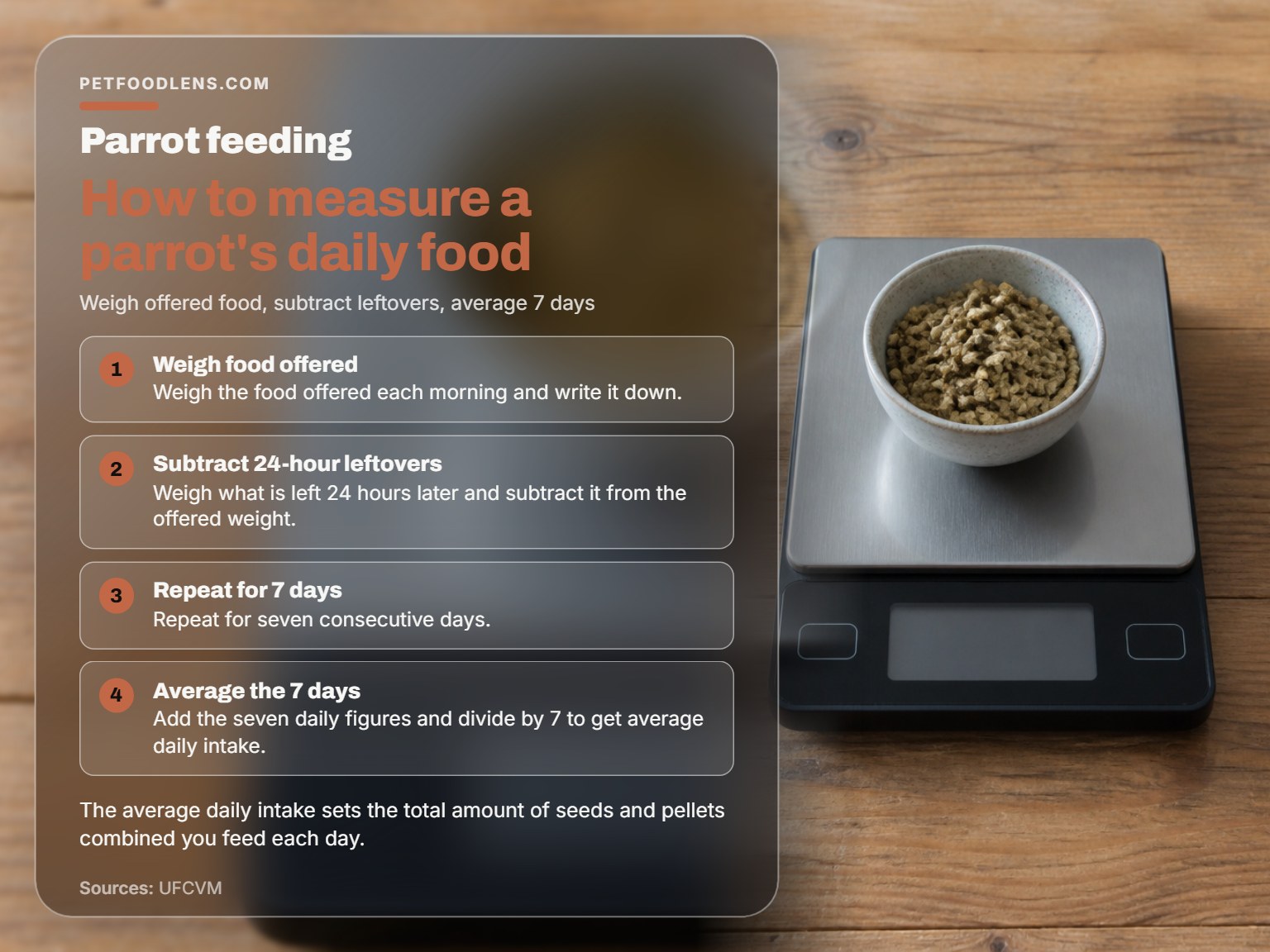
Weigh what the bird actually eats before you decide anything. UF lays out the method: weigh the amount given, subtract the amount left after 24 hours, repeat for 7 days, add the daily figures, and divide by 7.
That average daily intake is the number that sets the total amount of seed and pellets combined you feed each day. Not a scoop size. Not a bowl filled to the rim. The measured average.
- Weigh the food offered each morning on a digital gram scale and write it down.
- Weigh what is left 24 hours later and subtract it from the offered weight.
- Repeat for seven consecutive days, including the days you think nothing changed.
- Add the seven daily figures and divide by 7.
- Use that average as your daily total during and after the switch.
The first time I ran that measurement on a bird, the number came out well below what the owner’s bowl held. She had been refilling to the same line every morning for years without ever checking what disappeared. The bowl was a habit, not a measurement.
Texas A&M adds a simpler guardrail: feed only what the parrot can eat in one day, and monitor intake so obesity does not creep in. Fresh, clean water at all times, bowls cleaned regularly.
Easy to miss: The measurement takes a week and most people skip it because the bird looks fine. Without a baseline, you have no way to tell a healthy appetite from a bird that is eating half of what it did last month.
If you are building the produce side of that daily total, the balanced bird diet breakdown shows how the pieces divide across a week rather than a single bowl.
How to Switch a Parrot Off Seeds Without Starving It
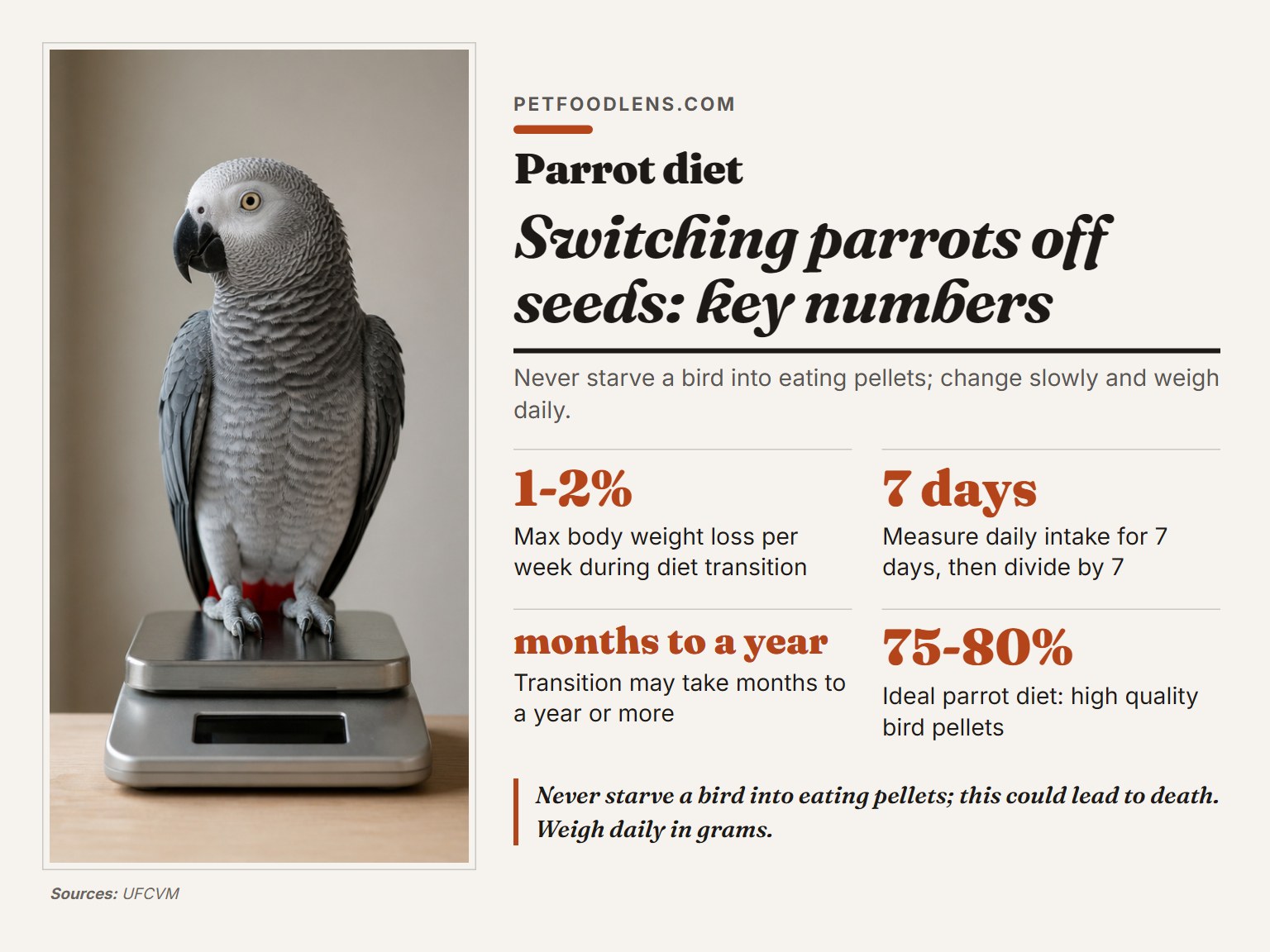
The cold-turkey switch kills birds. UF states plainly that starving a bird into eating pellets can lead to death, and the warning exists because owners try it.
Before you start: A parrot that refuses food burns through reserves fast, and the danger sign is a bird sitting fluffed on the cage floor rather than on a perch. Weigh daily on a digital gram scale that reads in grams, not ounces. If weight drops more than 1-2% in a week, stop the conversion and go back to the previous ratio.
The timeline is longer than anyone expects. UF puts the transition at months to a year or more for birds that have only ever known seed. That sounds extreme until you remember these birds live for decades on a formulated diet.
VCA adds the rule that keeps the process safe: do not remove familiar food until you are certain the bird is eating enough of the new diet, and weigh daily in grams throughout. A bird that eats less or loses weight needs a veterinarian, not a longer stare at the bowl.
- Measure the 7-day average intake first, so you know the daily total you are working with.
- Hold the total steady and shift the composition, replacing a small portion of seed with pellets.
- Keep the familiar seed visible in the bowl while the bird learns the pellets are food.
- Weigh the bird daily in grams and log it. The scale catches a problem before the bird looks sick.
- Reduce seed further only after the bird is reliably eating pellets at the current ratio.
Where this goes sideways: Removing the last of the seed in one move because the bird “seems to be eating pellets now.” A bird can look busy at a bowl and still be eating very little. The scale is the only honest report you get.
Some birds stall for months. Use them as a bridge, not a destination.
Grit, Extra Vitamins, and Other Things You Probably Don’t Need
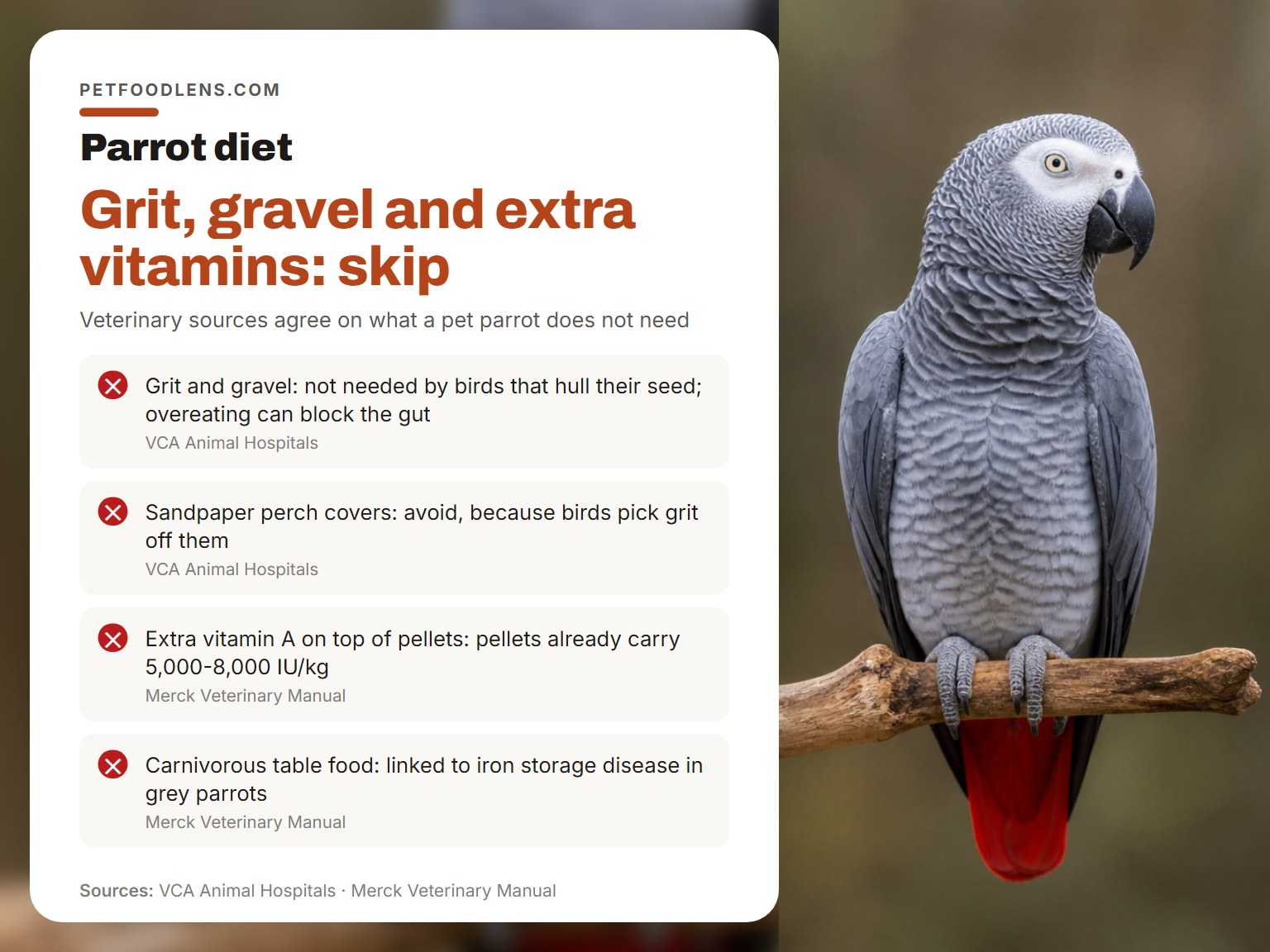
Grit is a product Merck says is not needed by psittacines that remove seed hulls, while VCA advises against offering it to African greys at all. Merck states that grit, needed by some passerines and pigeons to grind seeds swallowed whole, is not needed by psittacines that remove seed hulls before ingesting.
VCA goes a step further for African greys and says grit and gravel should not be offered at all, because some birds eat too much and develop potentially life-threatening intestinal blockages. VCA also flags sandpaper perches, since birds pick grit off them.
Two sources, slightly different positions, same practical answer for a pet parrot: skip it.
- Grit and gravel: not needed by birds that hull their seed, and a blockage risk in birds that overeat it.
- Sandpaper perch covers: avoid them entirely, per VCA, because they double as a grit source.
- Extra vitamin A on top of a pellet diet:
- Carnivorous table food: linked to iron storage disease in grey parrots.
The vitamin numbers are where well-meaning owners do damage. Merck puts vitamin A in pellets at 5,000-8,000 IU/kg of feed and says higher amounts should be avoided. If the pellet already carries that, adding a vitamin A supplement on top is stacking, not topping up.
Vitamin D has the same shape of problem. In the absence of natural sunlight, Merck estimates the minimum oral vitamin D requirement for grey parrots at 500-1,000 IU/kg. Owners should provide direct sunlight with cautions about heat, or a properly used UVB bulb, because glass blocks the UVB that does the work.
For poultry, levels that may be toxic begin at 5,000 IU/kg of feed, though some studies suggest up to 40,000 IU/kg may be safe. Macaws are noted as sensitive to excess dietary vitamin D and may develop soft tissue calcification and renal failure.
That is a wide, uncertain range, and I will not pretend otherwise. The honest position is to use a formulated pellet that already carries the vitamins and stop adding more without a veterinarian’s instruction.
Fruits, Vegetables, Nuts, and the Human Food Question
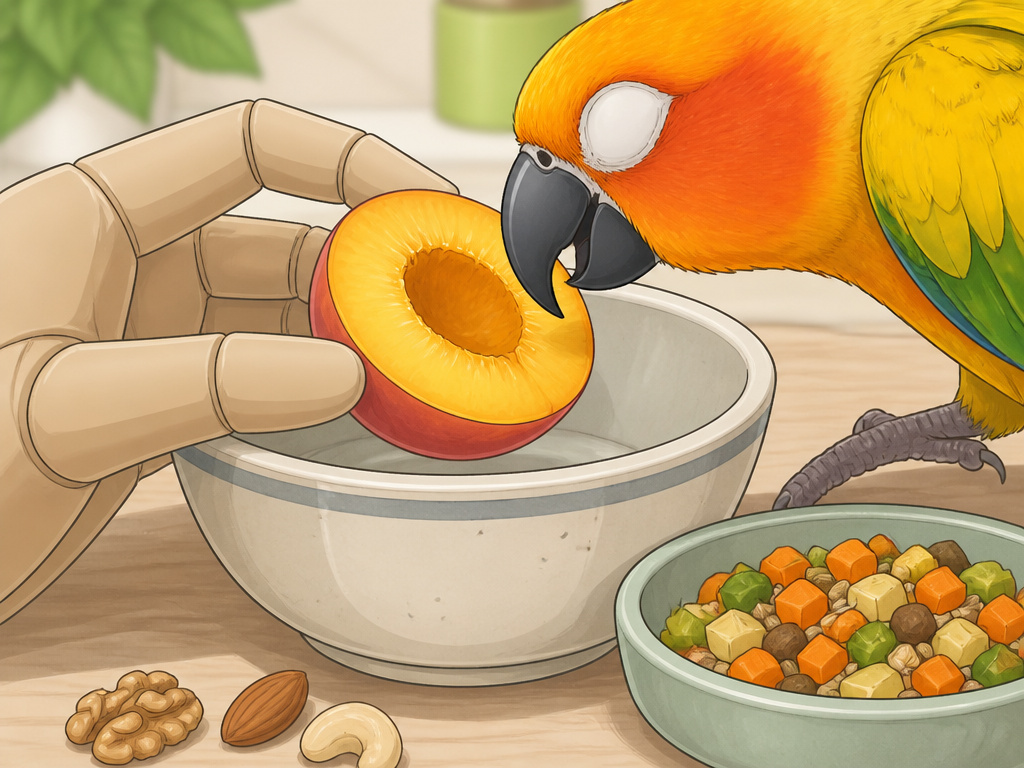
You are eating a peach at the kitchen table and a beak appears over the rim of the bowl. What happens next decides whether your bird gets a balanced diet or a very pleasant habit.
Fruits and vegetables belong in the bowl at 15-20% of the diet, and variety is the point. Texas A&M notes that occasional fruit or nut snacks are good as a reward or for food variety, but they are not necessary. That framing is useful. A treat is a tool, not a food group.
Fresh, not thawed, is the better call.
The fruits and vegetables for birds list covers what is safe and what is not, and the avocado and birds question deserves its own answer rather than a footnote.
A bird that turns its beak up at a new vegetable is not broken. Chop it finer, mix it through the pellets, and give it a week before you decide the bird hates it.
Frequently Asked Questions
Can parrots live on seeds alone?
No. Merck states that strictly seed diets are suboptimal regardless of supplementation, because seeds are deficient in vitamin A, the amino acids lysine and methionine, calcium, and other nutrients. UF links long-term seed-heavy feeding to obesity, strokes, high cholesterol, heart problems, and fatty liver disease.
How long does it take to switch a parrot to pellets?
UF puts the transition at months to a year or more for birds that have only eaten seed. The pace depends on the individual bird, and the safe limit is 1-2% of body weight lost per week. A faster switch is not a better switch.
Do parrots need grit?
Merck states that grit is not needed by psittacines that remove seed hulls before swallowing. VCA advises against offering grit or gravel to African greys at all, noting that some birds eat too much and develop potentially life-threatening intestinal blockages.
How much food should I feed a parrot each day?
Measure the bird’s average daily intake over 7 days, then feed that amount as the combined total of seed and pellets. Texas A&M’s simpler version is to feed only what the bird can eat in one day and watch for weight gain.
Is avocado safe for parrots?
None of these appear as hazards in the wild diet research, which makes them a captive-specific risk rather than a natural one.
Before You Go
One number to keep on the fridge: if your bird loses more than 1-2% of its body weight in a single week during a diet change, stop and call an avian veterinarian. That threshold comes straight from UF’s 1-2% weekly guidance, and it is the earliest warning you will get.
Everything above assumes a healthy adult bird of a common species. A hen in breeding condition, a bird with diagnosed liver disease, or a hand-feeding chick runs on different protein and fat numbers, and the generic split does not cover them.
I spend most of my working life on cat formulations, and I will say the honest thing: avian nutrition has thinner data behind it than feline nutrition does. The 43% of parrot species with poorly resolved dietary habits is a real gap, not a formality. Read the veterinary sources, weigh your bird, and let the scale overrule the marketing on the bag.
