
Millet Spray vs Loose Millet for Birds: Which to Feed?
This post contains affiliate links. As an Amazon Associate, we earn from qualifying purchases.
Millet spray vs loose millet for birds is mostly a format choice: the spray is whole millet still on the stalk, while loose millet is the same grain threshed off it. Nutrition barely changes between the two. What changes is how much work the bird does for each seed, how fast the grain spoils, and how precisely you can portion it.
A seed the bird has to pry out of a tight cluster takes time, and time is the part that changes behavior. Strip that grain off the stalk and drop it in a dish, and the same calories arrive in seconds with no work attached. That gap is where most of the real difference in the millet spray vs loose millet for birds question lives, and it’s why the two formats get used for different jobs.
What follows walks the guaranteed analyses side by side, the portion numbers the manufacturers actually publish, and the two places where avian veterinarians disagree with the brands outright.
Key Takeaways
- The stalk is the only structural difference. Spray millet is finger millet left on the stem; loose millet is the same grain threshed free of it.
- Crude fiber ceilings disagree, from Kaytee’s 12.0% max to HARI’s and Sunseed’s 20.0% max, so treat any single guaranteed analysis as a quality-control target rather than a measurement.
- Kennedy Wild Bird Food caps small birds at 1-2 short sprays per week and cockatiels, lovebirds and small parrots at up to 2-3.
- Removal guidance runs from 1-2 days to replacing weekly or more frequently depending on the source, so take the shorter window in a warm room.
- Neither format rescues a seed-heavy diet. VCA Animal Hospitals and New Plymouth Vet Group call millet nutritionally thin next to a fortified base diet, while Kaytee, HARI, Sunseed and Haith’s treat it as a complementary or supplementary food within a balanced diet.
Millet Spray vs Loose Millet for Birds: What Actually Differs?
Finger millet is the grain in both formats, and the stalk is the only structural difference between them. Kaytee describes spray millet as grain left on the natural stalk, with individual sprays running several inches long with hundreds of seeds on each.
Spray millet is finger millet retained on the natural stalk, with seeds packed into clusters along a stem several inches long. Loose millet is the same grain threshed free of that stem.
The stalk changes practical things such as how long the bird spends eating and how fast the grain goes stale inside a cage. None of those show up on a guaranteed analysis.
Here’s the part that surprised me when I started comparing these labels. The two formats get sold with completely different marketing language, and the underlying grain is identical. One bag talks about foraging enrichment, the other talks about value and mixability. Same seed.
The Guaranteed Analysis Spread Is Wider Than the Format Difference
Four manufacturers publish guaranteed analyses for spray millet, and the crude fiber ceiling alone ranges from 12.0% to 20.0%.
| Product | Crude protein (min) | Crude fat (min) | Crude fiber (max) |
|---|---|---|---|
| Kaytee Spray Millet | 7.5% | 3.0% | 12.0% |
| HARI Spray Millet (Hagen) | 8.0% | 2.0% | 20.0% |
| Sunseed Golden Spray Millet | 8% | 2% | 20% |
| Brown’s Extreme! Natural Millet Spray | 7.5% and 8.0% | 2.0% | 16.0% and 20.0% |
All four list moisture at 12.0% max. Brown’s publishes two separate analyses on the same product page, which is either a labeling error or two production specs printed together. Either way, it tells you something about how carefully these panels get proofread.
The important caveat: guaranteed analyses are minimums and maximums, not measurements. Kaytee’s 12.0% fiber ceiling and HARI’s 20.0% ceiling describe two different quality-control targets for what is nominally the same ingredient. Neither number is a lab result from the bag in your hand.
Now the gap nobody fills. Not one manufacturer in this comparison publishes a separate guaranteed analysis for loose millet. The closest baseline is the spray data above, which means the nutrition question can’t be settled from labels at all. If you want the broader feeding picture on millet for birds, the species ranges and portion sizes matter more than the fiber number.
How Long Can a Spray Stay in the Cage?
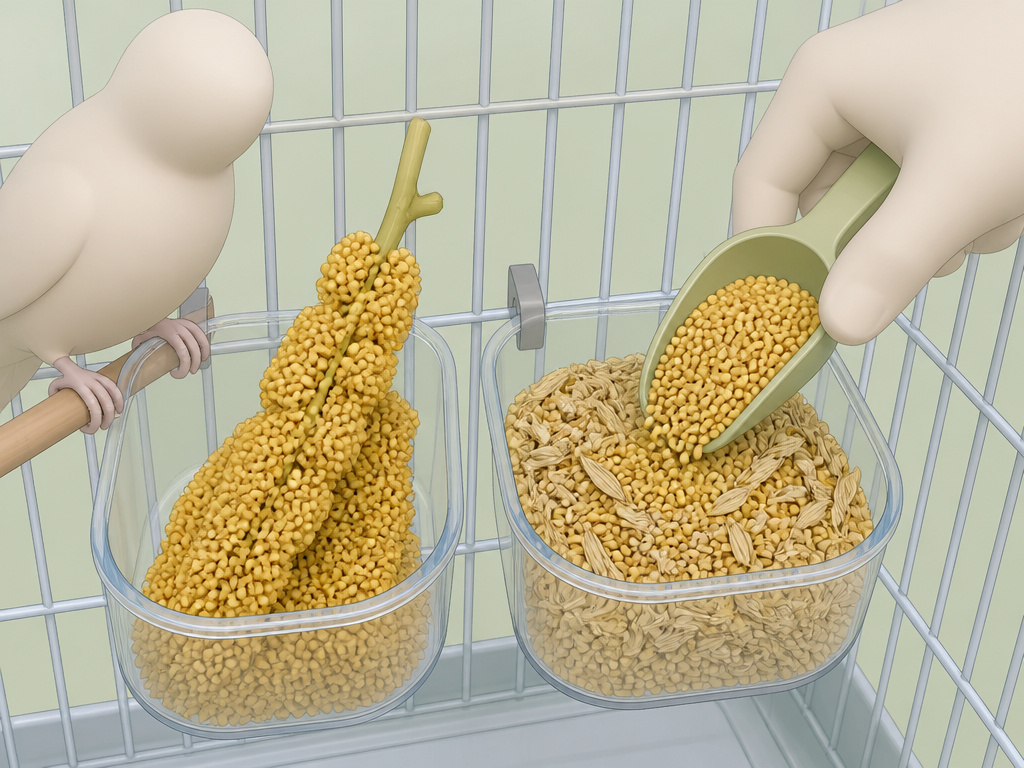
Three sources give three different removal windows, and the shortest one is the safest default.
| Source | Removal guidance | What it implies |
|---|---|---|
| Kennedy Wild Bird Food | Remove uneaten spray after 1-2 days | Treats the spray as perishable |
| Kaytee | Replace weekly or more frequently if desired | Longer window, freshness checked by eye |
| HARI | Remove once the bird has eaten all the seeds | Consumption-driven, no clock at all |
The HARI approach works for a bird that strips a spray in one sitting. It fails for a bird that nibbles one cluster a day and leaves the rest hanging. Kaytee’s weekly window assumes you are watching the spray; the company states that a shiny appearance indicates fresh healthy seeds, which gives you a visual test rather than a calendar.
Common mistake: Topping up the food dish when the husks are still in it. The shells left behind look like uneaten food, so the bowl gets refilled on a bird that has already eaten.
Loose millet makes this specific problem worse, because the husks and the grain sit in the same dish. A spray at least keeps the remaining seeds attached where you can count them.
When Loose Millet Wins and When the Spray Wins
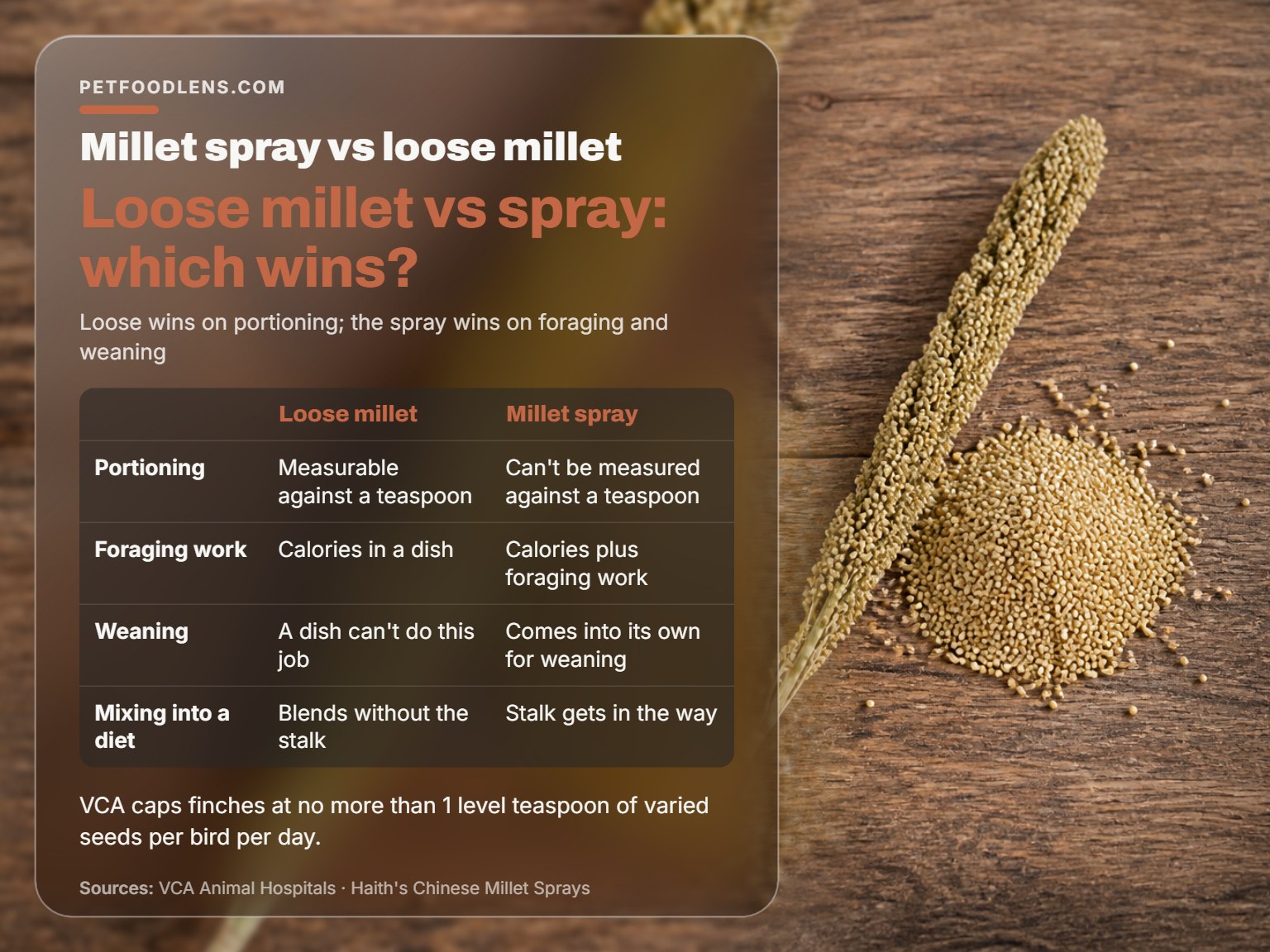
Loose millet wins on portioning. The spray wins on almost everything else.
Loose millet wins when you need a number
VCA Animal Hospitals puts a ceiling on finch feeding at no more than 1 level teaspoon of varied seeds per bird per day. You can’t measure a spray against a teaspoon. You can measure loose grain, which makes loose millet the format for anyone trying to hold a finch to a fixed ration or mix millet into a measured chop.
Loose grain also blends into a formulated mix without the stalk getting in the way.
The spray wins when the bird needs a job
HARI states that spray millet stimulates exercise and encourages natural foraging behaviors. Loose grain in a dish delivers calories. A spray delivers calories plus foraging work.
For weaning, the spray is the obvious pick. Haith’s notes that millet sprays come into their own when babies are being weaned. That’s a job a dish of loose grain can’t do.
For many companion birds, I’d keep the spray and skip the loose bag entirely. The seed sticks and millet sprays category exists precisely because the delivery format is doing half the work.
Which Birds Millet Suits, and Where the Sources Split
Species fit is the one place where the manufacturers openly contradict each other.
- Kaytee states spray millet is best for smaller birds with more delicate bills, and that larger birds such as macaws and cockatoos don’t tend to enjoy millet as much.
- HARI recommends it for all pet birds across all sizes, naming budgies, canaries, finches, cockatiels and other companion parrots.
- Sunseed lists parakeets, cockatiels, finches and canaries, then extends the list to chickens, turkeys, pheasants, quail, ducks and geese.
Small bills versus big bills
The Kaytee position is the one that matches what I’ve watched at a food bowl. A budgie has to pry each seed out of the cluster, and that effort is the enrichment.
That doesn’t make HARI wrong. A large parrot will still eat millet. It just won’t work for it, and the enrichment claim quietly stops applying.
Match the grain to the bill. A budgie has to pry each seed out of the cluster, which is the entire point.
The Malnutrition Argument Nobody Settles
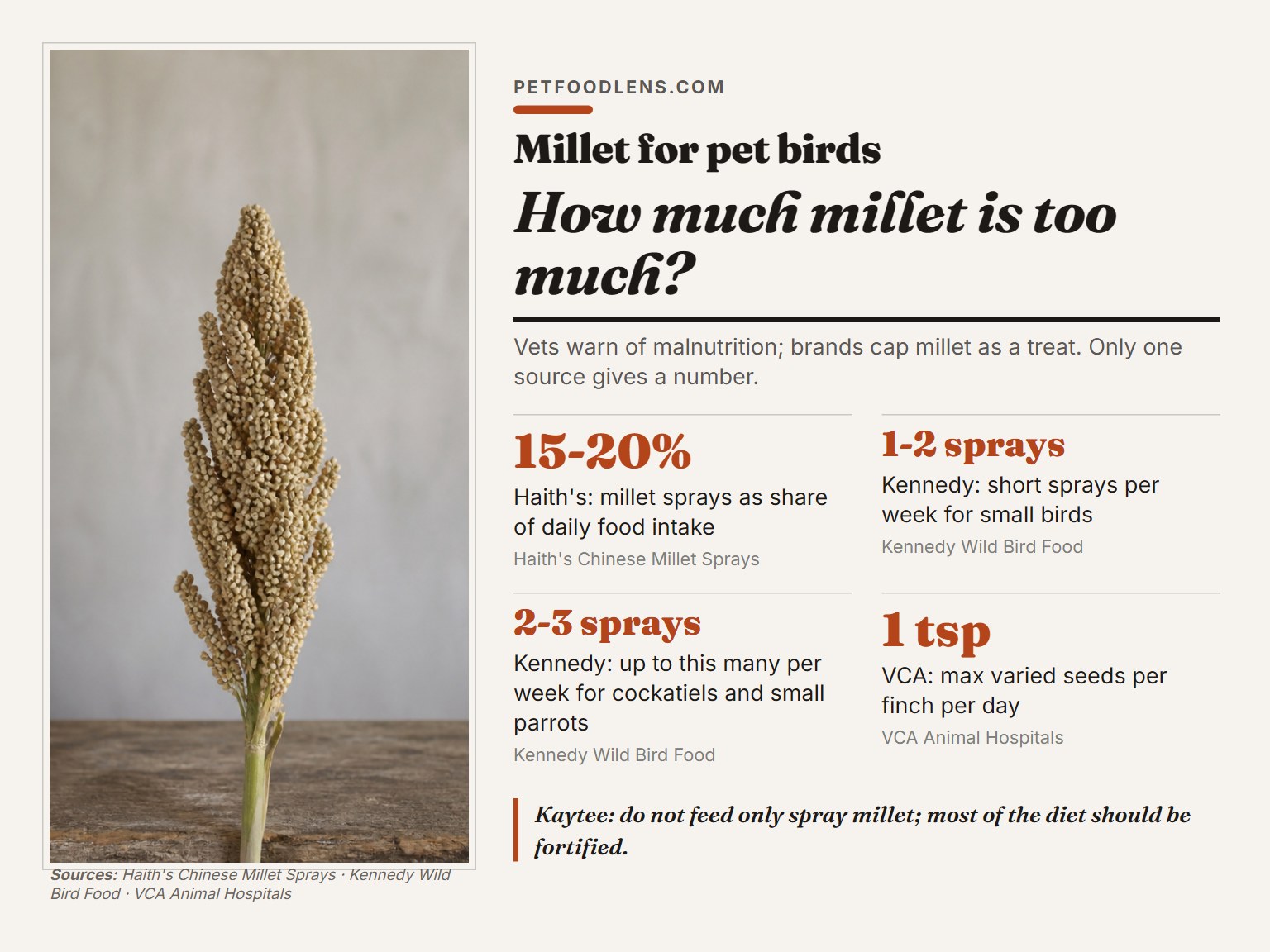
A New Zealand veterinary practice calls a millet spray a route to malnutrition. Kaytee states spray millet adds recommended nutritional variety to a bird’s diet.
New Plymouth Vet Group states plainly that giving a millet spray or branch is more of the same seed and leads to further malnutrition. VCA Animal Hospitals sits close to that position, describing millet as offering little nutrition and being devoid of several essential vitamins and minerals, while noting that finches often prefer millet seed over the rest of the bowl.
On the other side, Kaytee states that spray millet should only be offered occasionally as part of an overall balanced diet, and that a bird should not be allowed to eat only spray millet. HARI calls it a complementary treat to be used as an addition to the regular food. TRILL states the sprays are not intended to be the basis of the diet. Haith’s is the only source that commits to a number, putting millet sprays at approximately 15-20% of the bird’s daily food intake.
Read those positions together and the fight is about the base diet, not about millet. Both criticisms land on a bowl that was already seed-heavy. If the bird is on a fortified pellet and the millet is capped, the malnutrition argument has nothing to bite on. If the bird is picking millet out of a seed mix and leaving the rest, adding a spray just moves the problem around. The seed-only diet risks are where that conversation actually belongs.
One more thing worth flagging. Kaytee states that millet is highly alkaline and therefore easier for birds to digest. Marketing is not nutrition, and an uncited digestibility claim on a care page is exactly the kind of line I’d want a citation for.
I would rather see a bird work a short spray on a pellet base than see a seed bowl topped up every morning. Kennedy Wild Bird Food’s own rate for small birds sits at 1-2 short sprays per week, and that’s the number I’d hold to.
Reading the Bag: Origin, Best Before, and Freshness Cues
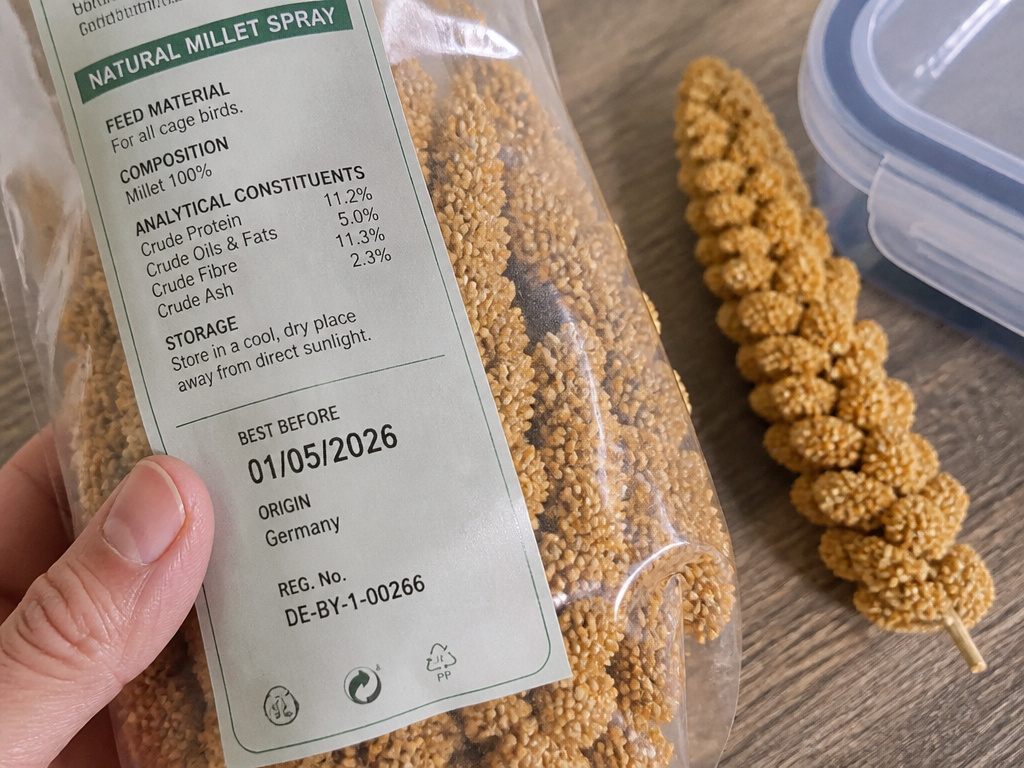
Three things on the pack tell you more than the front panel: origin, best-before, and whether the seeds look shiny.
Origin is genuinely split. HARI states its spray millet is grown in the USA. Sunseed states the same. Brown’s says its spray millet is made in the USA and France. Haith’s states its Chinese Millet Sprays ship to the UK direct from China. Four brands, three different answers, and all of them printed on the label where you can check.
Best-before is rarer. Haith’s states a Best Before of 6 months, which is the only shelf-life figure in this comparison. Everyone else tells you how to store it and leaves the date to your judgment. Kaytee’s instruction is a cool, dry location for the bag and a cool, dry, airtight container for unused sprays.
Freshness you can see. Kaytee states that a shiny appearance indicates fresh healthy seeds, and that sprays may be reddish or a lighter tan depending on the type.
What Haith’s registration numbers actually tell you
Haith’s publishes a Feed Hygiene Approval Number, GB86500027, and an ABP Regulations (1069/2009) Registration No, U1279316/ABP/WILD. Those are regulatory identifiers for animal by-product handling and feed hygiene, not marketing badges. Read the back first, and a number you can look up beats a photo of a bird on the front.
Haith’s also relays a breeder practice worth knowing: some breeders recommend soaking and washing sprays thoroughly with an aviary disinfectant, which softens the sprays and makes them easier for young birds to eat. Kaytee and HARI both describe their millet as natural with no additives. That’s a real disagreement about handling, and it’s the kind of thing you should decide before the bag is open.
If you’re building a mix rather than feeding a single treat, whole grains for birds covers how millet sits alongside the rest of the grain group.
How to Switch a Bird From Spray to Loose Millet
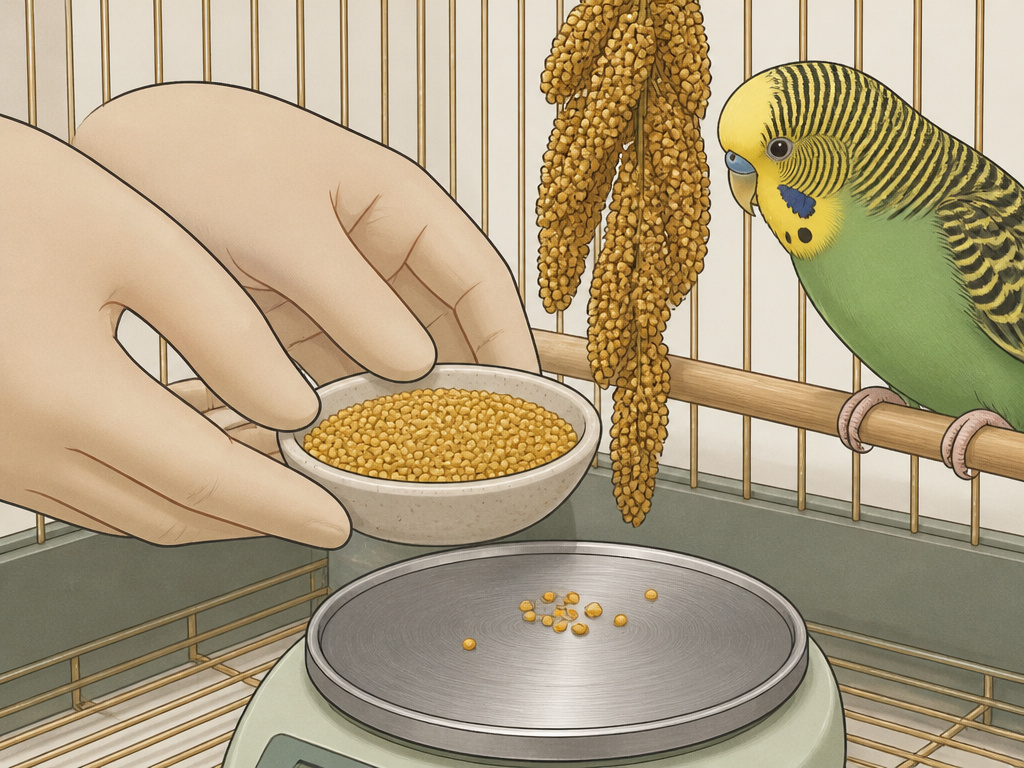
Change one variable at a time and most birds follow.
Before you start: Never leave a soaked or washed spray hanging overnight. And keep any spray off the cage floor, where Kaytee warns it can become contaminated.
- Weigh what you’re replacing. Haith’s 15-20% band is a proportion of daily intake.
- Offer the loose grain in the same spot, at the same time of day. TRILL notes that some birds look at a new item apprehensively before accepting it.
- Cut the spray portion rather than removing it. Add a small dish alongside it.
- Watch the dish, not the bird. Husks in the dish read as uneaten food. Empty husks mean the grain is gone.
- Track weight weekly. HARI states that weekly weight tracking is vital to overall health, and it’s the only objective check on whether a swap is working.
Bottom line: the format swap is easy. The portion math is the part that needs a scale.
If you’re still deciding what belongs in the bowl at all, choosing bird treats is the framework I’d apply before adding another item. And if you want the pros and cons laid out per format, the millet treats for birds breakdown covers the same ground from the treat side.
Frequently Asked Questions
Is loose millet more nutritious than millet spray?
No manufacturer in this comparison publishes a separate guaranteed analysis for loose millet, and the grain is the same finger millet either way. The published spray analyses range from 7.5% to 8.0% minimum crude protein and 2.0% to 3.0% minimum crude fat. Format changes handling and portioning, not the kernel.
How much millet should a bird get per week?
Kennedy Wild Bird Food gives 1-2 short sprays per week for budgies, finches and canaries, and up to 2-3 sprays per week for cockatiels, lovebirds and small parrots. Haith’s puts all millet at approximately 15-20% of daily food intake. VCA Animal Hospitals caps finches at no more than 1 level teaspoon of varied seeds per bird per day.
Should I remove a millet spray after a day or leave it in?
Kennedy Wild Bird Food advises removing uneaten spray after 1-2 days. Kaytee advises replacing weekly or more frequently. HARI advises removing the spray once the bird has eaten all the seeds. In a warm or humid room, take the 1-2 day window.
Can I feed millet spray to a macaw or cockatoo?
Kaytee states that larger birds such as macaws and cockatoos don’t tend to enjoy millet as much, though they will still nibble at the seeds. HARI lists spray millet as suitable for all pet birds across all sizes. Both can be true: a large parrot will eat it without getting the foraging benefit.
Is millet spray bad for birds?
It depends on what else is in the bowl. New Plymouth Vet Group calls a millet spray more of the same seed and a route to further malnutrition, while VCA notes millet is devoid of several essential vitamins and minerals. Kaytee and HARI both position it as an occasional complementary treat alongside a fortified base diet.
The Bottom Line
The number worth keeping is the one almost nobody prints: how much of the daily ration the millet is replacing. Haith’s is the only source in this comparison that commits to a figure, at approximately 15-20% of daily food intake. Everyone else describes millet as a treat and leaves the arithmetic to you.
So do the arithmetic. Weigh the day’s food, take a fifth of it out, and put millet in that slot. On a fortified pellet base with stable weight, that swap costs you very little. On a seed mix where the bird already picks millet first, you’ve moved the problem around without solving it.
One concession. None of this settles the loose-versus-spray call for a sick bird. A parrot refusing everything else is a case for a veterinarian, and HARI’s suggestion to keep a fresh supply of spray millet in an avian emergency kit is the one piece of advice here I’d follow without argument.
Start with the removal window. Pick one, write it on the bag, and stop guessing.
