
Quinoa for Birds Guide: The Rinse Step Decides It
This post contains affiliate links. As an Amazon Associate, we earn from qualifying purchases.
Quinoa for birds belongs at 15% of the diet or less, and only after rinsing the seed. Saponins in the outer hull run 0.14% to 0.73% by weight and depress intake; unwashed quinoa sharply cut broiler chick survival in controlled trials, while washed quinoa came close to a maize-soy diet.
The spread between 0.14% and 0.73% is the part that catches people out, because you cannot tell from looking which bag you drew. A quinoa for birds guide can help you identify what is in each bag.
What follows covers the dose ceiling, the rinse mechanics, and the species gap that turns most of this quinoa for birds guide into an extrapolation the moment you leave poultry behind.
Key Takeaways
- Rinse before anything else. Saponins sit in the outer layers of the hull and wash off; dehulling alone produced only a slight improvement in the broiler trials.
- 15% is a ceiling, not a target. Extension guidance caps quinoa at 15% of a poultry diet, a 2022 trial fed 20% with no reported mortality, and an Ecuadorian trial got its best feed conversion at 14%.
- Raw seed is the actual failure mode, not the dose. Broilers on raw quinoa showed reduced growth and dramatically reduced survival compared with washed or polished seed.
- A low-protein base diet makes it worse. Raising crude protein from 13.2% to 18% and then 23% improved growth and survival in quinoa-fed groups.
- Companion bird data barely exists. The FAO states plainly that the nutritional requirements of caged and companion birds remain poorly understood.
Why the Rinse Step Decides Everything
The University of Kentucky extension puts saponin content between 0.14% and 0.73% of seed weight, and that range is wide enough that the same grain behaves differently from batch to batch.
Quinoa carries saponins in the outer layers of the seed hull at 0.14% to 0.73% of seed weight. The compounds are bitter, and bitterness depresses intake in poultry. Washing removes them. Dehulling removes some, but the published broiler trials found washing more effective than polishing at stripping the anti-quality factors.
Rinse quinoa in a bowl and the water comes off milky and slightly slick under the fingers. Run it under a fine strainer until the runoff goes clear and that slickness is gone. The froth in the bowl is the saponins coming off.
The quinoa for birds guide makes clear the bitterness is not a flavor problem. It is an intake problem. The Kentucky factsheet notes that the same bitterness which protects the growing crop makes quinoa unpalatable to poultry, and unpalatable feed gets sorted out of the dish and onto the cage floor.
Here is what the rinse does and does not change:
- It strips surface saponins, which is the fraction depressing intake.
- It leaves the amino acid profile untouched, so lysine stays at 6.7% of crude protein and methionine at 2.9%.
- It does nothing about phytic acid or tannins, which the Brigham Young University authors also identified in the seed alongside only small amounts of trypsin inhibitor.
If you are building a mixed grain base rather than feeding quinoa alone, the same logic applies across the whole bowl. The whole grains for birds breakdown covers which grains carry similar anti-nutrient coatings and which do not.
How Much Quinoa Belongs in the Dish?
So what is the actual ceiling? University of Kentucky extension guidance caps quinoa at 15% of a poultry diet, while a 2022 trial fed 20% with no reported mortality.
The peer-reviewed work does not agree on a hard number.
| Source | Quinoa inclusion | What was reported |
|---|---|---|
| University of Kentucky extension | 15% ceiling | Upper limit for poultry diets |
| PLoS ONE 2022 (Hubbard) | 5%, 10%, 20% | 20% fed with no reported mortality |
| Archivos de Zootecnia (Ross 308) | 0%, 10%, 12%, 14% | Best feed conversion at 14% |
Read those three together and 15% looks less like a toxicological threshold and more like a sensible working ceiling. The quinoa poultry feeding explainer is the origin of the 15% figure, and it is worth reading in full rather than quoted secondhand.
One detail the summaries miss: the 2022 Hubbard trial’s strongest growth result came at 50 g/kg, the lowest dose it tested, not the highest. The PLOS One quinoa chicken study reports a substantial difference in growth performance at 5% and no reported mortality at 20%. Those two facts sit in the same paper.
Common mistake: Treating 15% as a target to hit. The best growth response in the Hubbard trial came at the lowest dose tested, and the Ecuadorian trial’s best feed conversion came at its highest dose of 14%. There is no single optimum, and pushing to the ceiling buys you nothing but a thinner margin for error.
For the rest of the bowl, millet for birds is the grain most seed mixes lean on, and it is worth knowing what you are balancing quinoa against.
What Raw Quinoa Did to Broiler Chicks
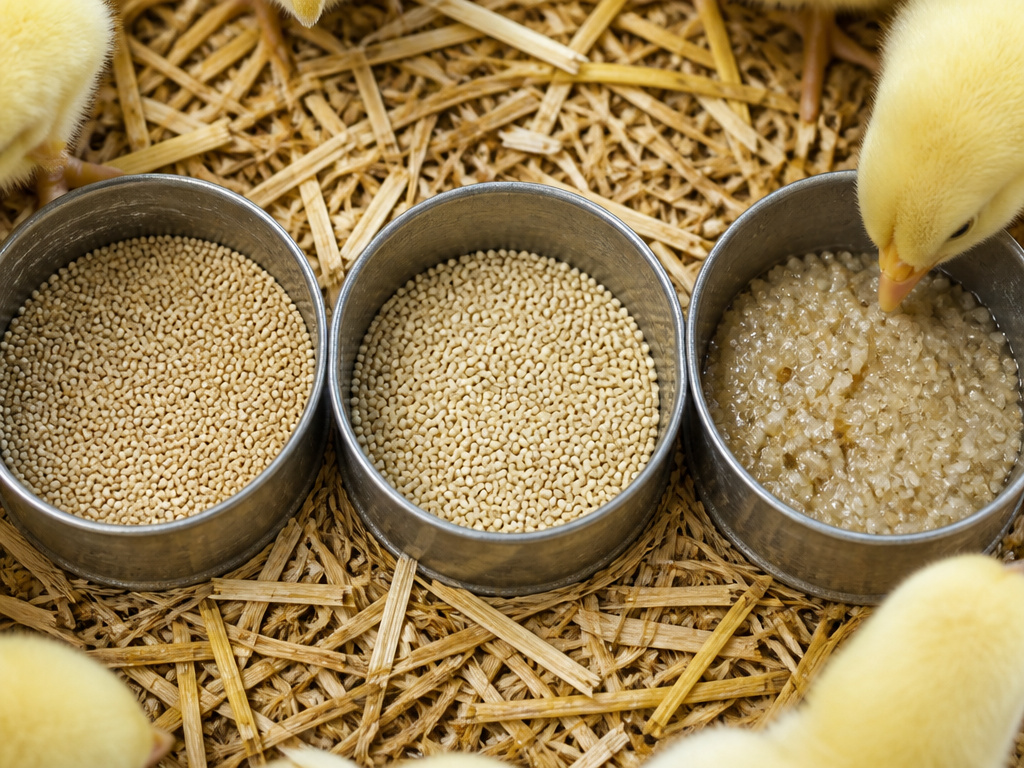
One hundred fifty chicks went onto raw, polished, wheat, sorghum, and maize diets for 28 days at 13.2% crude protein. That was Trial 1 of the Brigham Young University work.
The raw-quinoa group showed reduced growth and dramatically reduced survival compared with the washed and polished groups. A second trial ran 120 chicks for 14 days at 13.3% crude protein and confirmed the same ordering.
| Processing | Digestible CP | Broiler outcome |
|---|---|---|
| Raw | 78% | Reduced growth, sharply reduced survival |
| Polished (dehulled) | 7 points above raw | Slight improvement only |
| Washed | 83% | Nearly matched maize-soy |
The digestibility numbers are the interesting part. Removing the hull raised digestible crude protein by 7 percentage points, yet washed seed outperformed polished seed in the birds. The raw washed polished quinoa comparison is explicit that washing was more effective than dehulling at removing the anti-quality factors.
Digestibility is not the same as palatability. A seed can be more digestible in a lab and still get sorted out of the dish.
Three things stand out from that trial series:
- Raising dietary protein from 13.2% to 18% and then 23% improved growth and survival, but it never fully rescued raw quinoa. At 23% CP, raw-quinoa survival improved and was still significantly lower at 28 days.
- The seed used in the trial ran 12.2% crude protein, which sits at the bottom of the published range rather than the middle.
- Dehulling alone was reported elsewhere as only slightly improving broiler performance, which matches the trial result here.
If you want the other side of the seed question, sprouted seed vs dry seed covers what changes when a seed starts germinating rather than sitting in a dish.
Does Quinoa Beat Maize? Two Trials Disagree
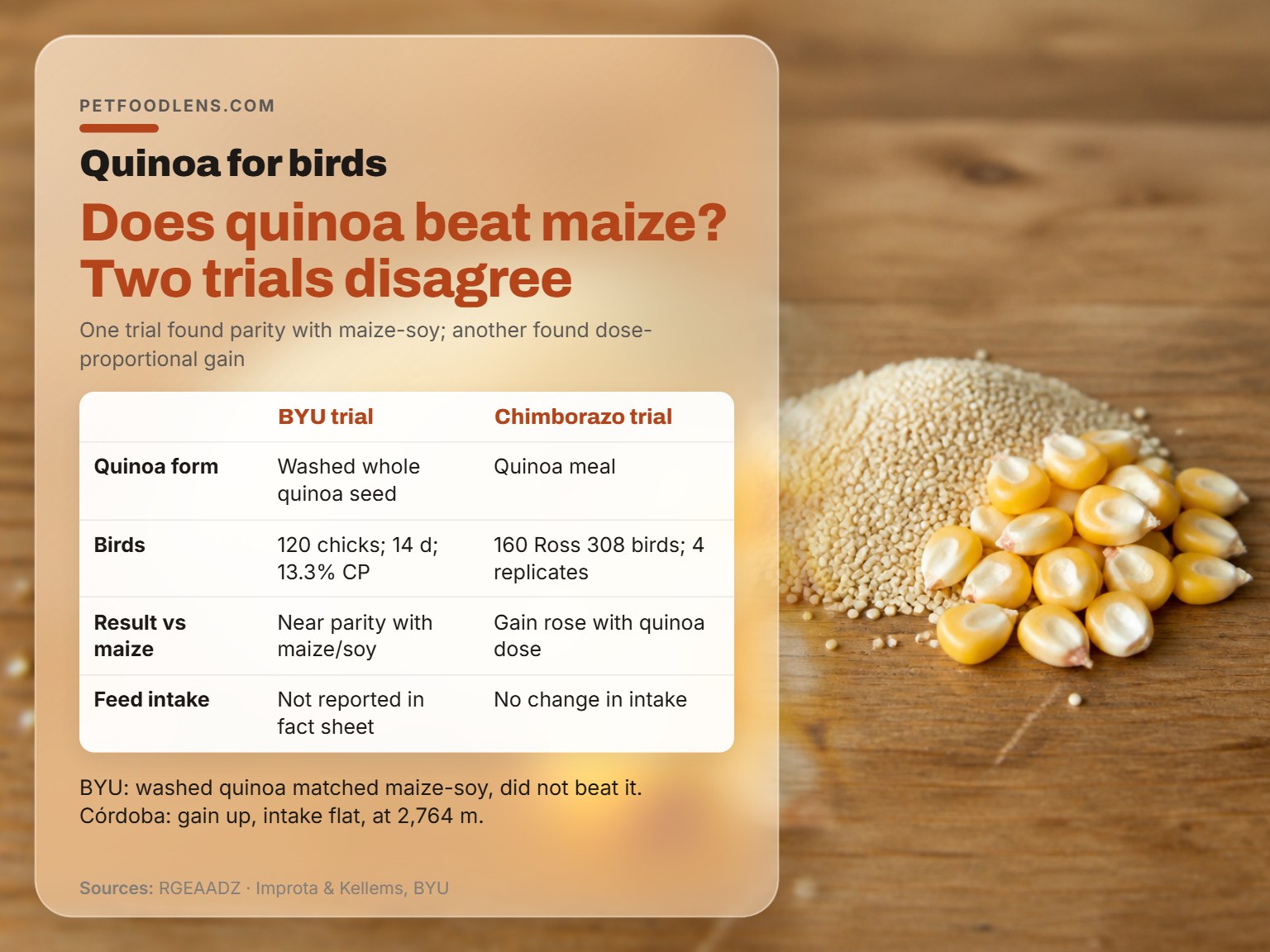
Two trials asked the same substitution question and came back with opposite framings.
The Parity Reading
The Brigham Young University work found that chicks receiving washed quinoa performed nearly as well as those on maize and soybean meal. Nearly as well. That is parity, not an improvement, and the authors framed it that way.
The Improvement Reading
The Ecuadorian trial at Chimborazo used 160 Ross 308 birds across four treatments of 0%, 10%, 12%, and 14% quinoa, with four replicates, at 2,764 metres elevation and 75% relative humidity. Bird weight and weight gain rose in proportion to the quinoa dose. Feed consumption did not change. Best feed conversion came at 14%.
Note that this trial used quinoa flour, not whole seed, which is a different ingredient with a different particle size and a different saponin load per gram.
I would not read the Ecuador result as quinoa beating maize. Feed intake stayed flat while gain went up, which is a feed-efficiency story, and it happened at 2,764 metres in Chimborazo. The BYU trial is the cleaner comparison for a home keeper: washed quinoa matched maize-soy, it did not beat it.
If you are rotating grains anyway, oats for birds is the other cereal worth having in the rotation, and it behaves nothing like quinoa in water.
The Quail Extract Study Is Not About Whole Quinoa
This one gets cited wrong constantly, so let me put the numbers side by side.
The MDPI Animals paper used quinoa seed extract, not seed:
- Dose: 0.1, 0.2, and 0.4 g/kg of extract, not whole grain.
- Birds: 400 Japanese quail chicks in four replicates of 25.
- Measure: pH, thiobarbituric acid, peroxide value, and total psychrophilic bacteria on breast meat held at 4°C and sampled on days 0, 1, 3, 5, and 7.
- Result: all four markers ran lower than control across the storage window at p < 0.05.
Now do the arithmetic. The top extract dose tested was 0.4 g/kg of extract, not whole grain. A 10% to 15% whole-quinoa inclusion is a far larger dose of quinoa than the extract study used. That is a different intervention at a different order of magnitude from the extract dose.
The extract work is genuinely interesting for shelf life. It tells you nothing about whether a 15% whole-quinoa diet helps a parrot, because it is a different intervention at a different order of magnitude.
How to Prep and Serve Quinoa Without Wrecking It
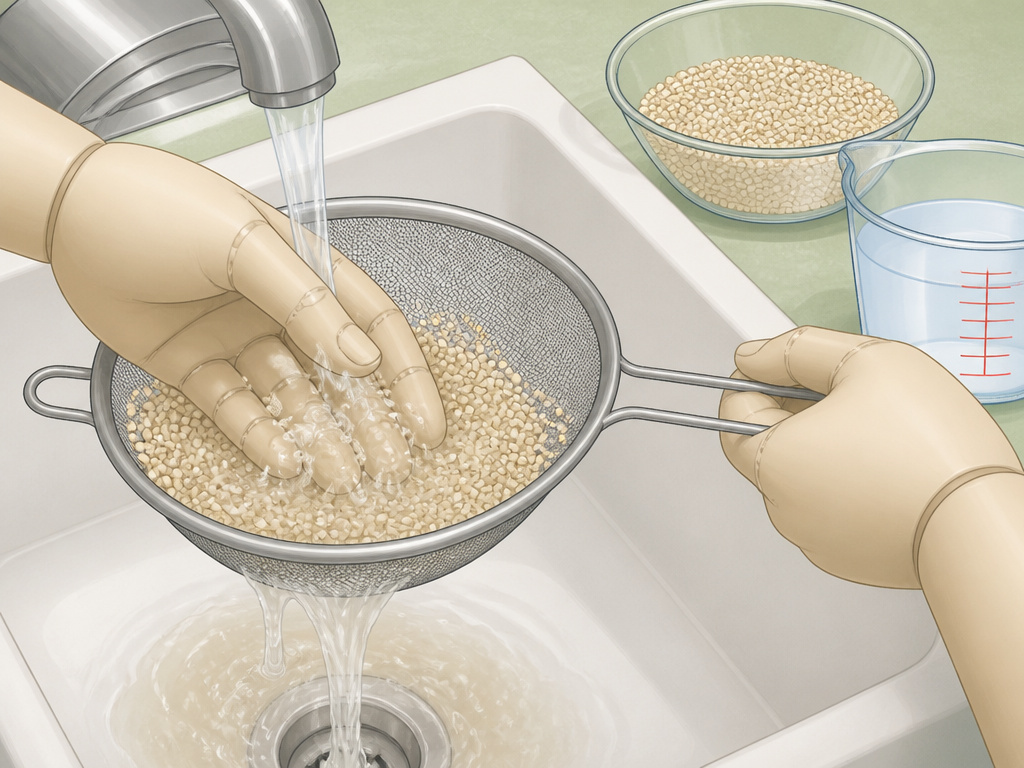
Three things happen in order: rinse, cook or soak, and measure the grain against the rest of the dish.
- Rinse under cold water in a fine strainer until the runoff stops looking milky. Skip it and you are feeding the exact seed condition that depressed intake and survival in the broiler trials.
- Cook in plain water with no salt and no oil, then let it come to room temperature before it goes into the bowl. Hot grain raises the temperature of everything around it and pushes the whole dish toward spoilage faster.
- Measure the quinoa dry, before cooking. Cooked grain holds water, so the same scoop weighs considerably more once it has plumped, and eyeballing cooked volume will overshoot your percentage.
- If you are sprouting instead, soak for several hours and germinate for 24 to 48 hours. That is the FAO’s stated window for sprouting seed, and quinoa appears on its list of suitable seeds.
Before you start: Soaked or cooked quinoa left at room temperature turns fast, and the smell is the tell. It goes sour and faintly yeasty before any visible mold shows up. Refrigerate anything you are not serving promptly, and dump the soak water rather than reusing it.
If You Are Sprouting Instead of Cooking
Sprouting changes the handling risk rather than removing it. A wet seed in a warm kitchen is an environment for things you do not want in a bird dish, and the failure is quiet for the first day or two. The how to sprout seeds for birds walkthrough covers rinse frequency and airflow, which are the two variables that decide whether a batch works.
Where this goes sideways: Sprouting in a sealed jar with no airflow. The seeds stay wet, the batch sours, and you find out by smell two days later when the whole jar has to go.
What About Parrots and Caged Birds?
Does any of this transfer to a parrot? Honestly, only by extrapolation.
Every trial number on this page came from poultry. Broilers, layer-type chicks, Japanese quail, Ross 308. Not one of them used a companion parrot, a budgerigar, or a cockatiel.
The FAO is direct about the gap: the nutritional requirements of caged and companion birds remain poorly understood. That sentence sits in a UN agency publication, not a hobby forum.
What the FAO does give you is a baseline. Typical caged bird food contains 12% to 16% protein, 12% fat, 6% to 10% fibre, and a maximum of 11% moisture. Quinoa, at 11% to 18% crude protein depending on the sample, lands inside that protein band rather than above it. That is worth sitting with, because quinoa gets called a superfood in almost every article written about it.
The FAO also lists quinoa among the common grains found in wild bird seed mixtures, and notes that mixes for exotic birds can run 20 to 25 different ingredients. One major UK supplier lists no fewer than 20 separate mixes. Variety is easy to buy. Balance is harder to confirm.
Treat 15% as the outside edge for a formulated base diet, not as a daily target, and treat the whole number as an extrapolation from poultry. If your bird is on a complete pellet, quinoa is a garnish. If your bird is on a seed mix, quinoa is one better grain inside a mix that still needs fixing.
The UC Davis avian feeding guide is a reasonable second reference for general companion bird feeding, and the FAO major grains bird seed chapter is where the grain composition figures come from.
If you are building meals rather than scattering seed, chop for parrots is where quinoa usually ends up, and homemade bird food recipes will show you how it behaves next to cooked vegetables and legumes.
Frequently Asked Questions
Should quinoa be cooked or raw for birds?
Neither the raw nor the cooked form has been tested head to head. The trials compared raw, washed, and polished seed, so cooking is an extrapolation from the washing result rather than a tested treatment. Rinsing is the step with evidence behind it.
Can birds eat quinoa every day?
There is no published long-term study on daily quinoa for companion birds. The 15% figure is a proportion of the diet, not a frequency, and the BYU poultry trials ran 14 to 28 days. Rotate it rather than making it the daily grain.
Does rinsing really remove the saponins?
The University of Kentucky extension states that saponins sit in the outer layers of the hull and can be removed by washing. The BYU trials found washing more effective than dehulling at stripping the anti-quality factors. Rinse until the runoff stops looking milky.
Is quinoa better than millet for birds?
No published head-to-head exists in the sources behind this piece, so I will not pretend there is one. Quinoa runs 11% to 18% crude protein and typical caged bird food runs 12% to 16% overall, which puts quinoa inside the band rather than above it.
Can I sprout quinoa for my bird?
The FAO lists quinoa among seeds suitable for sprouting, soaked for several hours and germinated for 24 to 48 hours. Handle it like any sprout: airflow, regular rinsing, and refrigeration, because a wet jar with no air sours quickly.
The Bottom Line
Here is the practical takeaway. If your bird is already eating a complete pellet, quinoa is a garnish and the 15% number is irrelevant to your situation. If your bird is on a seed mix and picking out the sunflower, quinoa is not the fix either. The fix is the base diet.
The one change I would make this week: rinse quinoa before it goes anywhere near a dish, every single time, including bags sold as pre-rinsed. The saponin range runs from 0.14% to 0.73% and you cannot tell from looking which bag you got.
And the honest limit. Every trial figure on this page came from poultry, not parrots. If your bird has a diagnosed kidney or liver issue, the protein load matters far more than the grain choice, and that is a conversation with your vet rather than with a label.
