
Sunflower Seeds for Birds Pros and Cons: The Trade-Offs
This post contains affiliate links. As an Amazon Associate, we earn from qualifying purchases.
Sunflower seeds for birds pros and cons break into two halves: the seed delivers high fat and thin shells most seed-eaters can crack, but it brings mess, squirrel traffic, and rancidity risk if stored wrong. In controlled trials, birds ate the highest-oil variety 31-49% more than any other.
That preference comes down to fat and hull thickness. A bird weighing a seed in its beak is testing for the calories it needs to survive a cold night, and a thin hull means less work to get at them. The sunflower seeds for birds pros and cons trade-offs start once you look at what else comes in the bag.
What follows covers the two sunflower types side by side, the storage mistakes that turn a bag rancid, the squirrel and mess problems nobody warns you about, and where the mycotoxin research actually lands.
Key Takeaways
- Black-oil beats striped on oil content – birds ate the highest-oil variety 31-49% more in controlled trials.
- Thin shells mean more species can eat it, and more husk mess under the feeder.
- Storage is the real risk – sunflower goes rancid because of its oil content; buy fresh and keep it dry.
- Striped seed has one job – the thicker shell deters House Sparrows and blackbirds, per the Almanac.
- Shelled hearts spoil fast – offer no more than a day or two’s worth.
What Makes Sunflower Seed Work at a Feeder?
The black-oil sunflower’s case rests on two traits: a thin hull and a high-fat kernel. Both matter, and both come with a downside.
Black-oil sunflower seeds carry a thin shell that most seed-eating birds can crack without effort, and a kernel high in fat. In three controlled trials, consumption of the highest-oil variety ran 31-49% above every other variety tested, and oil content rose as seed length fell and depth and weight increased.
That last detail is the interesting one. Birds are not reading the oil percentage on the bag. They’re weighing seeds in their beak, and the study authors found that oil content went up as seeds got shorter, deeper, and heavier.
So a small, heavy black-oil seed is doing two things at once: it’s easy to open, and it’s dense with the fat a chickadee needs to make it through a cold night. Compare that to a striped sunflower seed, which is larger and has a thicker shell. More work, less reward, unless you’re trying to keep certain birds out.
The thin shell is also the source of the mess. Every seed a bird opens leaves a husk behind, and a busy feeder can produce a surprising volume of them in a week. If that’s the trade-off you want to avoid, no-mess bird seed – hulled sunflower hearts and chips – solves the husk problem at the cost of faster spoilage.
Fresh black-oil seed pours with a hard, dry clatter against a metal scoop. Seed that’s been sitting in a hot garage pours with a duller, softer sound, and the shells look matte instead of glossy.
That difference in sound and sheen is the first thing to check before you buy. More on that below.
Sunflower Seeds for Birds Pros and Cons: Black-Oil vs Striped
Two sunflower types reach the feeder, and they don’t behave the same way. The difference is mostly in the shell, and the shell decides which birds can open the seed.
| Trait | Black-Oil | Striped |
|---|---|---|
| Shell thickness | Thin, easy to crack | Thick, hard for sparrows |
| Oil content | Higher (drives preference) | Lower |
| Seed size | Small | Larger |
| Best for | Most seed-eaters | Deterring House Sparrows, blackbirds |
| Main downside | Mess, squirrel magnet | Fewer species can open it |
Compare it side by side and the trade-off is obvious. Black-oil is the seed most birds actually want. Striped is the seed you reach for when the birds you want are being crowded out by the birds you don’t.
The Old Farmer’s Almanac makes the case for striped directly: the thicker shell is “much harder for House Sparrows and blackbirds to crack open,” and switching is the first thing to try if unwanted species have taken over. That’s a real use case, and it works.
But it conflicts with the preference data. Collins & Horn found that birds ate the highest-oil seed 31-49% more than any other variety, and that low-oil, fibrous-hull sunflower types bred in the 1980s were less attractive to feeder birds. Striped seed differs from those fibrous-hull varieties, but the direction is similar: less oil, less appeal.
Why the Almanac and the Research Disagree
They’re answering different questions. The Almanac is answering “how do I get rid of House Sparrows?” The research is answering “what seed do most birds prefer?” Both answers are correct, and the choice depends on which problem you’re trying to solve.
If your feeder is a peaceful mix of chickadees, finches, and the occasional cardinal, stay on black-oil. If House Sparrows have moved in and won’t leave, striped is a targeted tool, not a permanent switch.
I’d keep black-oil as the default and treat striped as a targeted tool. The Almanac’s advice to switch is sound if House Sparrows have taken over your feeder, but you’re trading away the seed most birds actually want.
For a third option that addresses pest birds without giving up oil content, safflower seeds are worth a look.
The Watchbird journal sunflower article makes a related point about gray versus black striped seed: laboratory analysis shows minute, if any, nutritional difference between the two, and the preference claims for the more expensive gray seed are anecdotal.
For most feeders, black oil sunflower seeds are the default for a reason. They’re the seed with the widest species appeal and the least work per calorie for the bird.
How Long Does an Open Bag Stay Good?
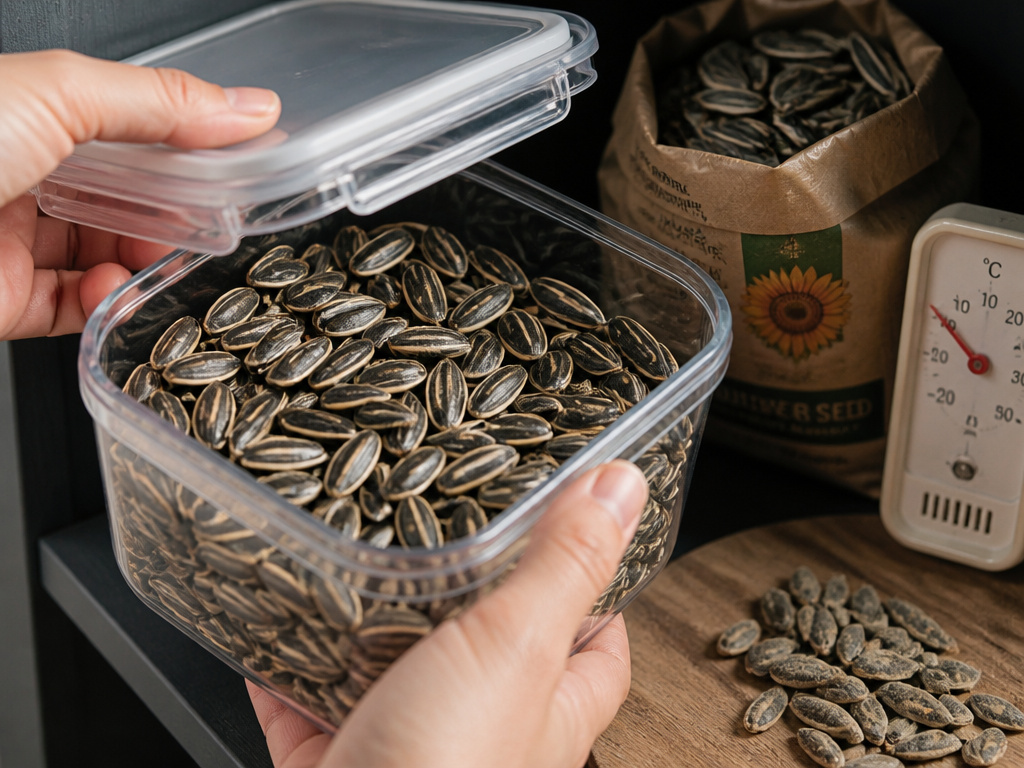
Most of the failures with sunflower seed happen after you buy it. The FAO’s guidance on small seed production is blunt about why: sunflower seeds “tend to go rancid during prolonged storage because of their high oil content.”
That’s the whole problem in one sentence. The oil that makes sunflower attractive to birds is the same oil that turns against you once the bag is open and the seed is exposed to heat, light, and moisture.
The FAO’s single most important storage factor is keeping seed from taking up moisture, because moisture leads to spoilage. Seed should be stored away from water and sunlight, out of contact with chemicals and pesticides, and protected from insects, birds, and rodents.
Where this goes sideways: Mixing fresh seed into a bin that already has old seed at the bottom. The old seed keeps going rancid, the birds keep avoiding it, and you keep buying more without solving the problem. Empty the bin completely before every refill.
The Signs Fresh Seed Gives Off
Rancid sunflower seed smells like old cooking oil left in a warm cupboard – faintly sour, with a paint-like edge. Fresh seed smells like almost nothing, which is the point.
The FAO’s quality markers line up with that: seed should be shiny, look and smell fresh, and have a high specific weight. Dull, dusty seed that smells musty has already started to turn.
Here is the practical takeaway: smell the bag before you buy it, and smell it again before you fill the feeder.
A Simple Storage Routine
- Buy from a store with turnover. Fresh seed smells neutral and looks glossy. If the bag smells sour on the shelf, walk away.
- Transfer to an airtight container the day you get it home. The original bag is not airtight, no matter what it says.
- Keep it cool and dark. A hot garage is the worst place for it.
- Check monthly for moisture, insects, or a musty smell.
- Discard the whole bag if it clumps or smells off. Don’t try to salvage it by mixing.
The FAO small seed production guide covers the processing side in more detail, including keeping seed from taking up moisture.
| Symptom | Likely Cause | Fix |
|---|---|---|
| Seed clumps in the bag | Moisture uptake | Discard; store airtight next time |
| Musty or sour smell | Mold growth | Discard the whole bag |
| Small holes in bag | Insects or rodents | Discard; inspect storage area |
| Seed looks dull, not shiny | Age or heat exposure | Use fast or replace |
| Birds ignore the feeder | Stale or rancid seed | Replace with fresh |
For winter feeding specifically, winter bird feeding puts a premium on freshness because birds are relying on the feeder for calories when natural food is scarce.
Bottom line: fresh seed in, old seed out, and never top off a bin that already has stale seed at the bottom.
The Squirrel, Mess, and Sprout Problems
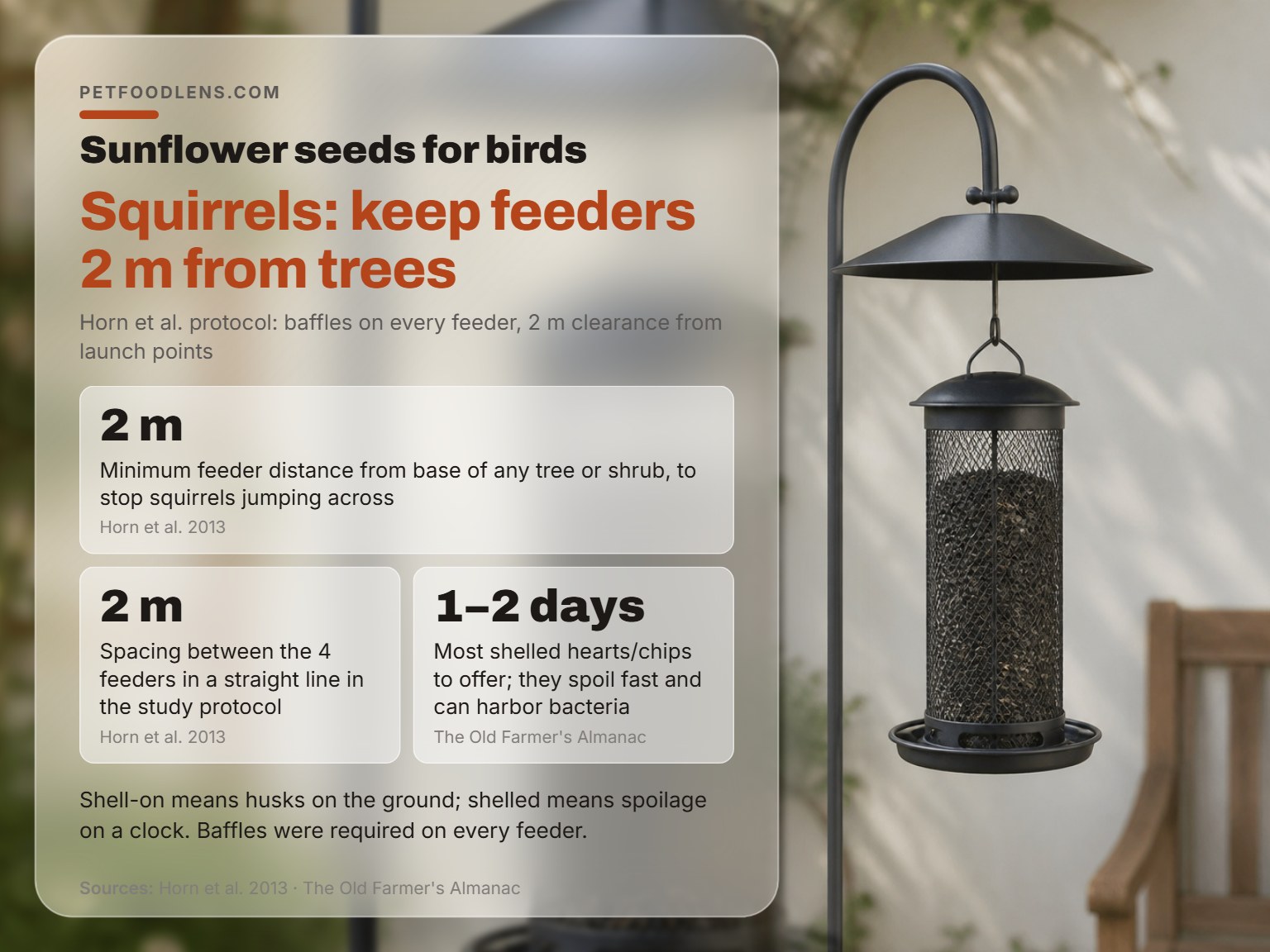
Squirrels will find your feeder. The question is how much seed they take before you fix it.
Sunflower is one of the seeds squirrels target hardest, and a feeder without a baffle is an open invitation. The Horn et al. Study protocol required baffles on every feeder specifically to keep mammals out, and placed feeders no closer than 2 m from the base of any tree or shrub to stop squirrels from jumping across.
That 2 m number is worth remembering. It’s the minimum distance the researchers used, and it’s a reasonable starting point for a home setup.
- Baffle on the pole or line – the Horn et al. Protocol required one on every feeder.
- 2 m clearance from any tree or shrub a squirrel can launch from.
- A feeder that closes under weight – works better than a fixed baffle for determined squirrels.
For a feeder design that holds up better against squirrels, squirrel-proof seed and a baffled feeder together do more than either one alone.
The mess problem is separate. Black-oil sunflower husks pile up under the feeder, and they can smother grass if the volume is high enough. Raking or vacuuming under the feeder weekly keeps the lawn from dying back.
The sprout problem is smaller but real. Birdseed is generally untreated and raw, so black-oil seed can germinate. The Almanac notes that germination rate and quality are unknown, so you might get a few straggly sunflowers and you might get nothing. Treat it as a curiosity, not a gardening plan.
Easy to miss: Hulled sunflower hearts and chips spoil much faster than seed in the shell. The Almanac’s guidance is to offer no more than a day or two’s worth, and to avoid tube feeders where moisture can collect. If you’re switching to no-mess, switch your feeder too.
That’s the mess trade-off in one line: shell-on means husks on the ground, and shelled means spoilage on a clock.
What the Mycotoxin Research Actually Says
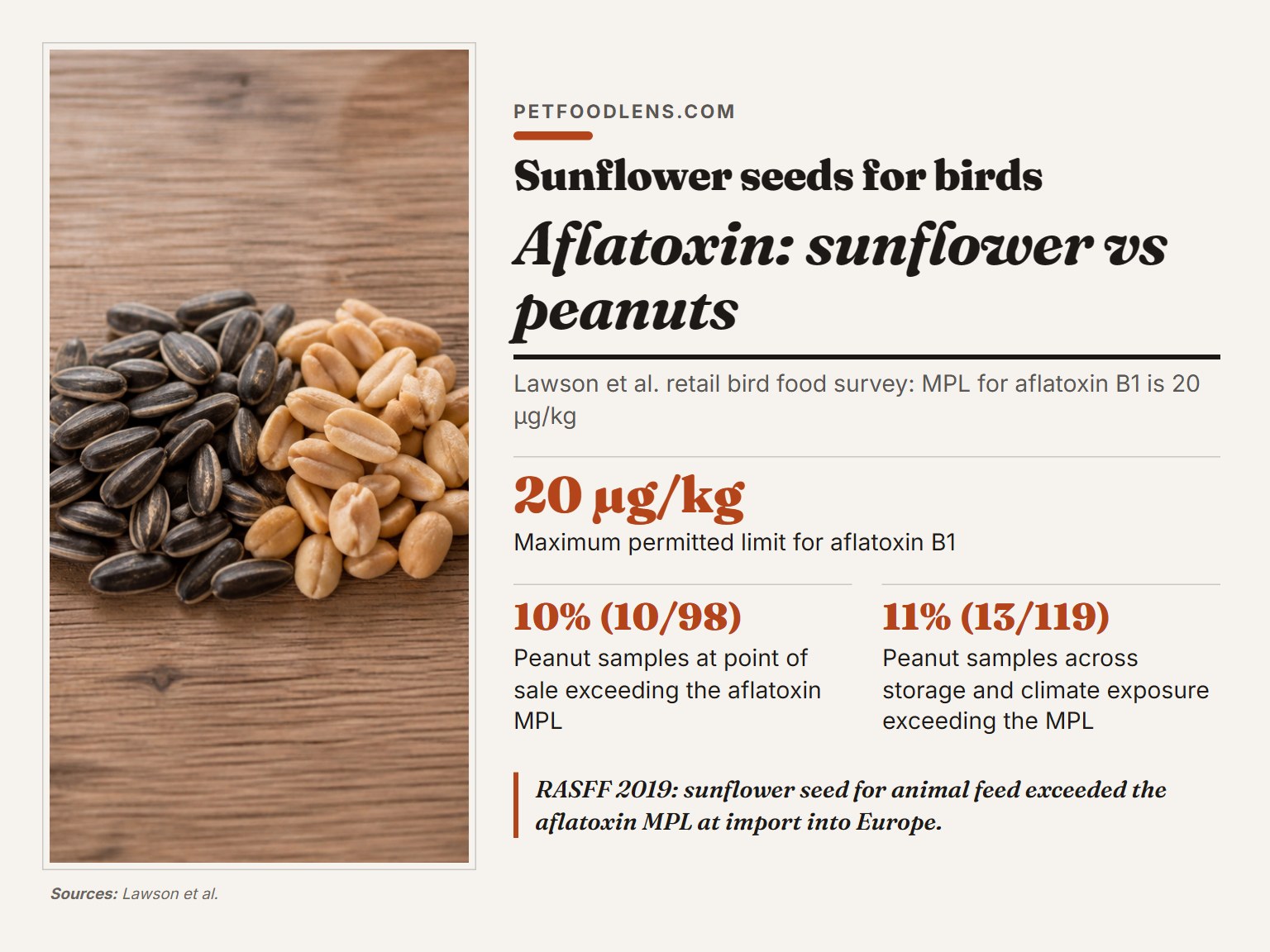
Aflatoxin is the one contaminant that turns a bag of seed into a bad one. The UCL study by Lawson et al. Is the most detailed survey of the problem in retail bird food, and its findings are more nuanced than the headlines suggest.
The maximum permitted limit for aflatoxin B1 is 20 µg/kg. In the Lawson survey, 10% (10/98) of peanut samples at point of sale exceeded that limit, and 11% (13/119) exceeded it across storage and climate exposure. Peanuts are the high-risk ingredient.
Lawson et al. Found sunflower seeds were the least likely of the foodstuffs tested to have aflatoxin residues, with no samples exceeding the MPL for AFB1, though the same paper cites RASFF 2019 records of sunflower seed for animal feed exceeding the aflatoxin MPL at import into Europe. That’s a real point in sunflower’s favor.
But the picture is not entirely clean. Lawson et al. Also cite a RASFF 2019 record of sunflower seed intended for animal feed exceeding the aflatoxin MPL at import into Europe. The documented contamination route is at the import level.
The study tested whether British climate or post-sale storage could produce mycotoxins, and it did not prove that it does. The precautionary principle still applies, which is why the authors recommend best-practice steps anyway.
The UCL aflatoxin wild bird food study is worth reading in full if you want the sampling detail. My read is that sunflower is a low-risk ingredient, peanuts are a higher-risk one, and neither branded nor non-branded products showed a difference in detection rates.
Disease transmission is a separate concern.
A feeder that stays dry and gets cleaned regularly does more for bird health than any seed choice. Moisture is what keeps the parasite alive; a dry feeder breaks the transmission cycle.
The part nobody mentions: The Lawson study found no significant difference in mycotoxin detection between branded and non-branded products. A premium label is not a safety guarantee. Buy fresh, store dry, and inspect what you pour.
Which Birds Actually Eat Sunflower Seed?
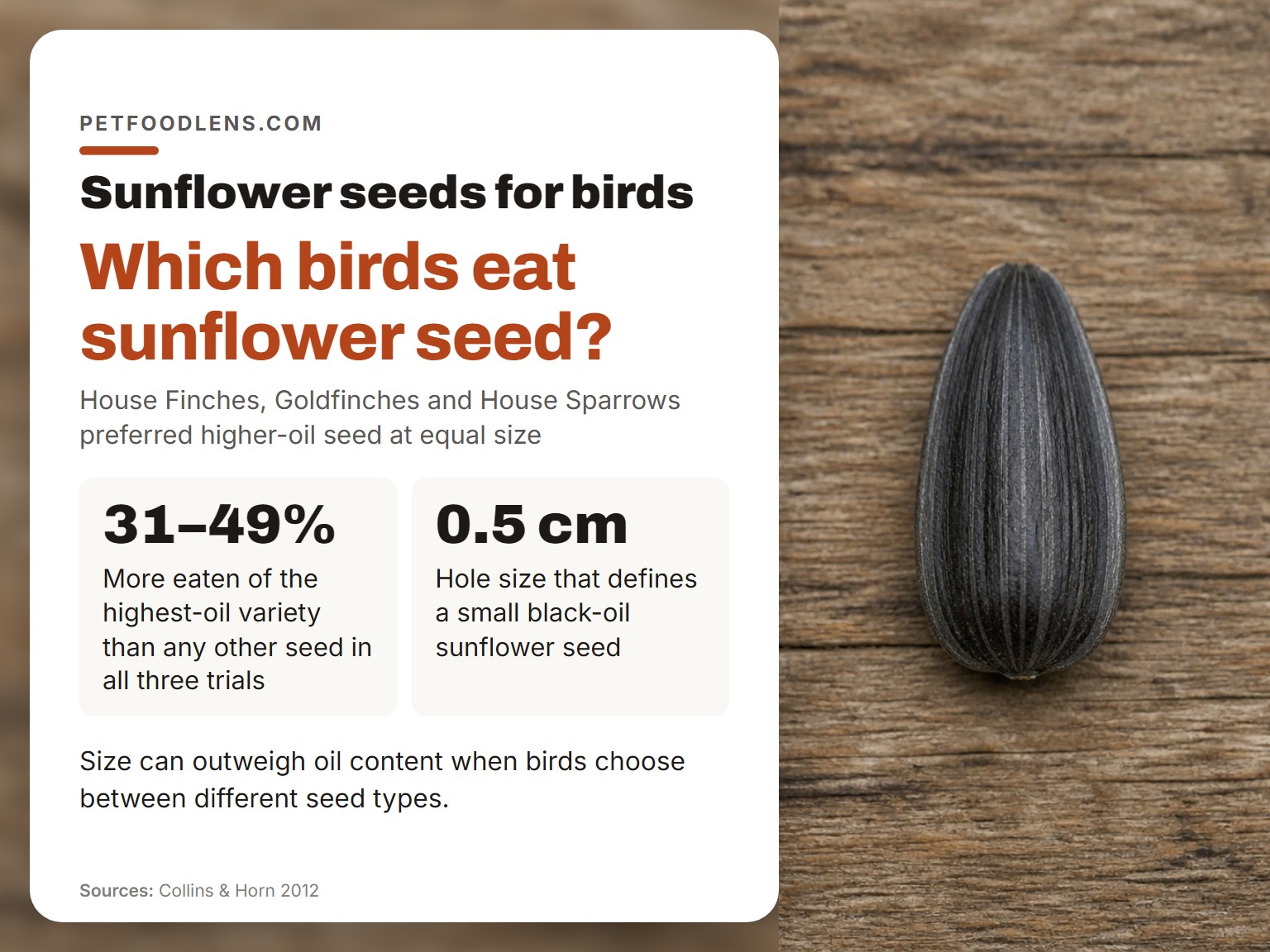
Species preferences are not uniform. The Collins & Horn study found that House Finches, American Goldfinches, and House Sparrows preferred higher-oil seed when size was equal, and would take shorter, deeper, lower-oil seeds at equivalent levels to larger higher-oil ones when both were available.
That’s a more nuanced finding than “birds prefer high oil.” They prefer it at equal size, but size can outweigh oil content when the choice is between different seed types.
Species by Species
- Chickadees and nuthatches – black-oil is their mainstay. They take one seed at a time to a branch and hammer it open.
- Cardinals and Blue Jays – black-oil is the reliable choice; both species hit it hard.
- House Finches and Goldfinches – prefer higher-oil seed at equal size (Collins & Horn).
- House Sparrows – the reason people switch to striped. They can’t crack the thicker shell as easily.
- Woodpeckers – Almanac readers report downy, hairy, and occasional pileated woodpeckers eating black-oil daily, though that’s anecdotal rather than from a controlled study.
If you want to pull cardinals and blue jays specifically, cardinals and blue jays are the two species most reliably drawn by black-oil, and both will take striped if that’s what’s on offer.
For a feeder that suits black-oil best, a sunflower seed feeder with a baffle and a tube or hopper design does the job. Tube feeders work for seed in the shell; skip them for hearts and chips. The Horn et al. Study used tube-style feeders, and a tube or hopper design is a solid choice for black-oil.
One more consideration: sunflower is not a complete diet. A feeder that offers only sunflower will attract birds, but it won’t meet every species’ nutritional needs. The seed-only diet risks are worth understanding before you commit to a single-seed strategy.
Frequently Asked Questions
Is black-oil or striped sunflower better for birds?
Black-oil is better for most birds because of its higher oil content and thinner shell. The Almanac recommends striped as a targeted tool when House Sparrows or blackbirds have taken over a feeder because the thicker shell is harder for them to open, while Collins & Horn found birds ate the highest-oil seed 31–49% more than any other variety.
Do sunflower seeds attract squirrels?
Yes, and they’re one of the seeds squirrels target hardest. A baffle on the feeder and placement at least 2 m from any tree or shrub is the minimum the Horn et al. Study used to keep mammals out.
How often should I change sunflower seed in the feeder?
Refill when the feeder is empty, not on a fixed schedule. Check the seed for a sour or musty smell before every refill, and discard the whole bag if it clumps or smells off.
Can birds eat shelled sunflower hearts?
Yes, but they spoil faster than seed in the shell. The Almanac recommends offering no more than a day or two’s worth, and avoiding tube feeders where moisture can collect.
Is it safe to feed sunflower seed that’s been in storage?
It depends on how it was stored. Sunflower goes rancid during prolonged storage because of its oil content, so seed that’s been open in a warm garage for a season is likely to be refused by birds. Smell it before you use it.
The Bottom Line
The one thing I’d change about how most people feed sunflower seed: buy smaller bags more often. Freshness beats volume every time, and a bag that goes off before you finish it is just waste.
Black-oil is the right default. It’s the seed with the widest species appeal, the highest oil content, and the least work per calorie for the bird. Striped seed has a real use case, but it’s a targeted tool, not a permanent switch.
The storage rule matters more than the seed choice. Rancid seed gets refused, and no amount of feeder placement or baffling fixes a bag that’s already turned.
If you take one thing from this: smell the bag before you buy it, and smell it again before you fill the feeder. That’s the whole trade-off in one habit.
