
How to Culture Daphnia: Setup That Doesn’t Crash
This post contains affiliate links. As an Amazon Associate, we earn from qualifying purchases.
The short answer to how to culture Daphnia: use chlorine-free water at pH 7-8, hold temperature near 20 C (68 F), feed 5 drops per litre of yeast or microalgae 2-3 times a week, and keep density under 30 animals per litre. Flinn Scientific advises against aeration because bubbles float animals, while Science in School warns low dissolved oxygen is lethal, so surface area matters; restart the colony monthly before waste buildup crashes it.
That monthly restart is the part of how to culture daphnia that gets skipped, and it’s the difference between a culture that produces for a season and one that dies in a green soup. Daphnia don’t die of old age in a jar. They die of their own waste, and the timeline is shorter than you’d think.
I’m not an aquaculturist. I work from published protocols, and where they disagree, I say so. What follows is where the sources agree, where they don’t, and the numbers behind each decision.
Key Takeaways
- 20 C (68 F) is the safe midpoint; Flinn Scientific warns higher temperatures may be fatal, and Science in School permits 18-25 C.
- 5 drops per litre, 2-3 times a week is the standard feeding rate; overfeeding is the number one culture killer.
- 30 Daphnia per litre is the density cap in Science in School; the EPA protocol runs lower at roughly 12.5 per litre.
- Aeration is disputed; Flinn says bubbles lodge under the carapace and float animals to the surface to die, while Science in School warns low dissolved oxygen is lethal and Carolina’s protocol calls for gentle aeration.
- Restart monthly; Flinn notes cultures last several months before waste and pH shifts crash them.
What Temperature Actually Works for Daphnia?
Flinn Scientific’s care guide puts the critical temperature at 20 C (68 F), and it’s blunt about the failure mode: higher temperatures may be fatal, lower temperatures slow reproduction.
Daphnia cultures tolerate a narrow thermal band. Flinn Scientific recommends holding water near 20 C (68 F), noting that warmer water may prove fatal and cooler water slows reproduction. Science in School permits 18-25 C, while the EPA protocol fixes a daily mean of 20 +/- 1 C for bioassay work.
The pattern is clear: 20 C is the anchor for Daphnia. Science in School’s 18-25 C band is the practical range for a home culture, and the EPA’s tighter +/- 1 C is for bioassay work where temperature drift changes the test result.
| Source | Recommended Range | Notes |
|---|---|---|
| Flinn Scientific | Near 20 C (68 F) | Higher may be fatal; lower slows reproduction |
| Science in School | 18-25 C | Wider band for classroom cultures |
| EPA protocol | 20 +/- 1 C daily mean | 20 +/- 2 C instantaneous ceiling |
| UF/IFAS (Moina) | 24-31 C optimum | Different genus; tolerates 5-31 C |
A protocol with no numbers is like a truck ad with no payload rating. It looks fine and tells you nothing. Flinn’s guide gives the number.
The UF/IFAS numbers are for Moina, a different genus. Don’t apply 24-31 C to Daphnia magna. That’s the kind of species mismatch that makes a protocol look wrong when it’s actually being used on the wrong animal.
The Science in School Daphnia model organism article is the one I’d read first for the classroom range. It’s written for teachers, and the numbers are explicit.
When you compare a how to culture daphnia guide, I’d start at 20 C and adjust from there. Room temperature swings more than people think. A jar near a window can run warmer than the room.
The Aeration Question Nobody Agrees On
Two supplier protocols say opposite things about aeration, and both are worth reading.
Flinn Scientific is direct: do not aerate a Daphnia culture. The air bubbles collect under the Daphnia and force them to float to the top, where they die. Science in School warns that low levels of dissolved oxygen are lethal. Carolina Biological Supply’s teacher protocol reportedly calls for gentle aeration through an air line. The two constraints collide in small sealed jars.
I won’t put an air stone in a one-gallon Daphnia jar. Flinn’s warning about bubbles lodging under the carapace is real, and a well-meaning aeration upgrade can float the whole jar. If the jar is wide and shallow, surface exchange does the job.
Where this goes sideways: A sealed lid with no surface exchange. Low dissolved oxygen is lethal per Science in School, and a tight lid turns a healthy jar into a kill jar within a day.
The practical answer is a wide-mouth jar with surface area, no bubbling, and a watchful eye on animals hanging at the surface. If they’re at the top and not moving, check both the aeration and the oxygen levels.
Check both.
Water, Light, and Container Setup
Flinn’s setup is specific: a large, clear plastic or glass jar, filled with pond or spring water, left undisturbed and uncovered for several days before any animals go in.
- Choose a large, clear jar. Flinn specifies large clear plastic or glass. A wide mouth gives surface area for gas exchange.
- Fill with pond or spring water. Flinn says pond or spring; Science in School permits aged, dechlorinated tap water at pH 7-8. Let it sit uncovered for several days to let harmful gases escape.
- Add non-filamentous algae. Flinn names Chlorella, Euglena, or Chlamydomonas. Wait 2-3 days until the water looks green.
- Introduce the Daphnia. Flinn says submerge the container holding the Daphnia into the larger jar to release them.
- Set the light. Flinn says strong sunlight; Science in School specifies a 16-hour photoperiod from an LED or fluorescent aquarium light.
Green water that’s ready has a faint grassy smell and a clear, even tint. Water that’s turning sour smells like a wet basement and looks cloudy at the bottom.
Flinn warns that water needs several days to off-gas before animals go in. Rushing that step is how you get animals hanging at the surface for a day and then stopping.
Growing the Green Water First
Scenedesmus is the microalgae Science in School uses. The recipe is chlorine-free water at pH 7-8, a minimum temperature of 16 C (18-25 C is the working range), and a minimum 12-hour photoperiod from an LED or fluorescent aquarium light. The culture needs an aerated container to supply CO2 and prevent the algae from settling. Every 15 days, add 3-5 drops per litre of commercial liquid plant fertilizer as mineral salts.
Flinn Scientific names Chlorella, Euglena, and Chlamydomonas as suitable non-filamentous algae if you don’t have a green-water aquarium to draw from.
A dechlorinator handles the chlorine in tap water; check availability before you mix a batch. You can also obtain Daphnia magna cultures from a supplier if you don’t want to collect from a pond.
How Much and How Often to Feed
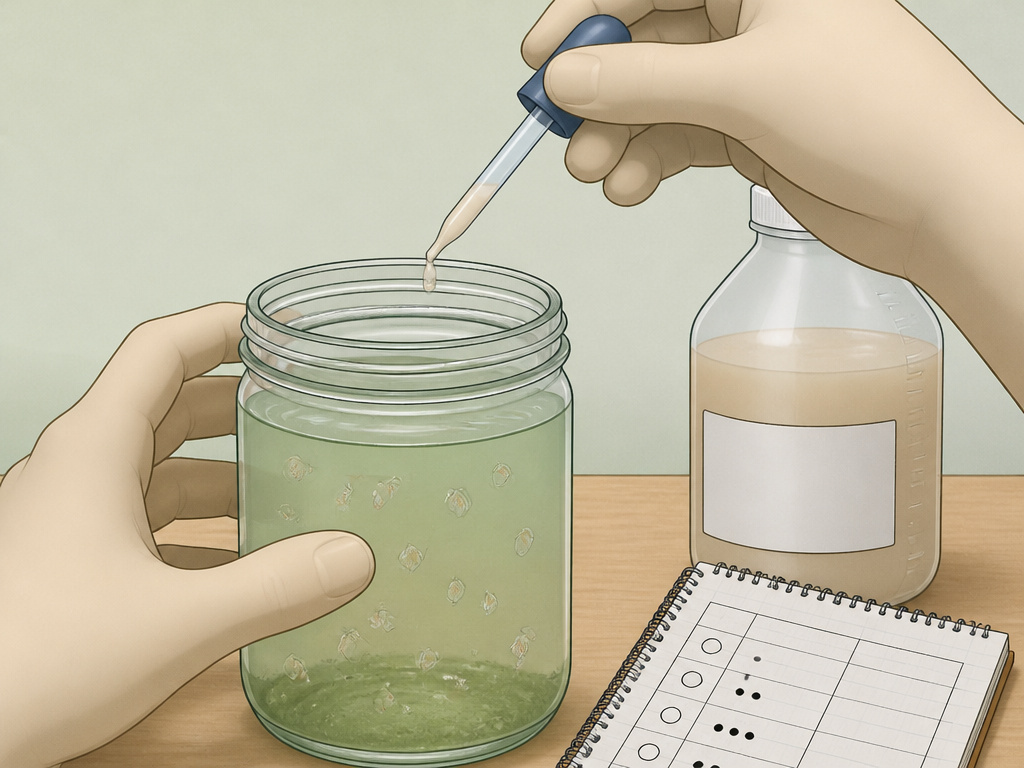
Science in School’s recipe is the one I’d start with: 5 drops per litre of yeast suspension or microalgae, 2-3 times per week.
The yeast suspension is 2 g of baker’s yeast stirred into a 1 litre container of chlorine-free water. Store it in the refrigerator at 4 C and agitate before every use to resuspend the yeast.
| Source | Rate | Frequency |
|---|---|---|
| Science in School | 5 drops/L yeast or microalgae | 2-3 times per week |
| EPA protocol | Not specified in fact sheet | Mon/Wed/Fri |
| ASTM | Not specified in fact sheet | Not specified in fact sheet |
The ASTM Daphnia culture recommendations address test duration standards rather than a specific feeding rate. That’s a more precise measure than drops, and it’s the one to use if you’re scaling up.
Nearly every Daphnia culture I’ve lost died of overfeeding, not neglect. The jar goes from thriving to a sour-smelling green soup if the yeast or green water gets too heavy. Now I measure the yeast suspension with a pipette and feed on a schedule, not by eye.
Common mistake: Feeding by eye instead of by drop. A cloudy jar that smells sour means the food load has outrun the filter feeders, and a crash can follow.
Measure it.
How Many Daphnia Fit in a Litre?
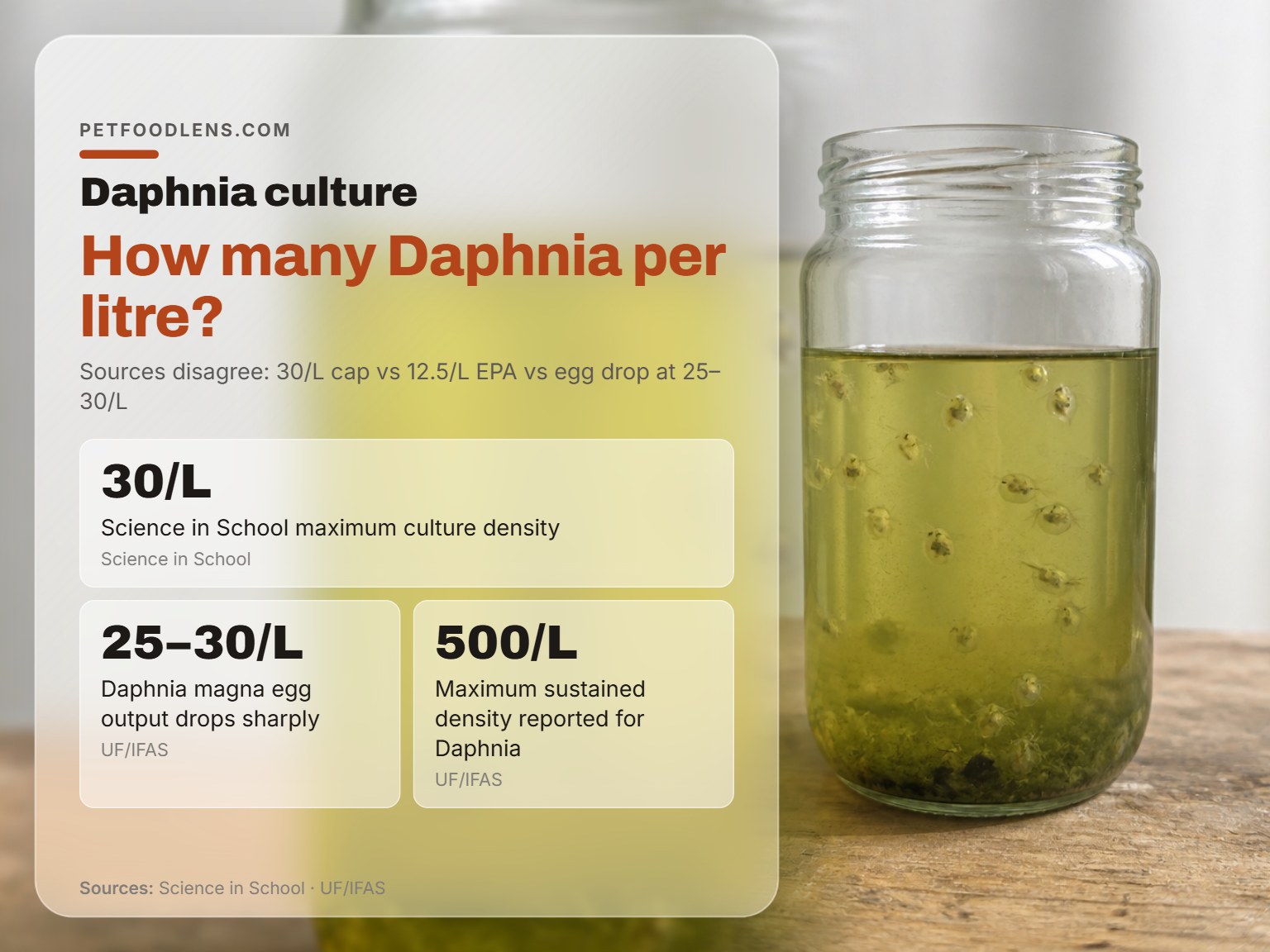
Science in School caps a Daphnia culture at 30 animals per litre. The EPA protocol runs closer to 12.5 per litre, and UF/IFAS reports that Daphnia magna egg output drops sharply at 25-30 per litre.
The 30-per-litre cap is a ceiling, not a target. The EPA’s lower density is for bioassay work where reproduction matters. The UF/IFAS numbers are for Moina, which routinely reach 5,000 per litre. That’s a different animal with different biology.
Show me the numbers, and the numbers say the safe zone is lower than the ceiling. I’d aim below the 30 ceiling, not at it. The lower density gives you a buffer when a feed goes heavy.
If a Daphnia culture looks overcrowded, it probably is. The fix is a partial water change, not a bigger jar.
When the Culture Crashes: Ephippia, Waste, and Restarting
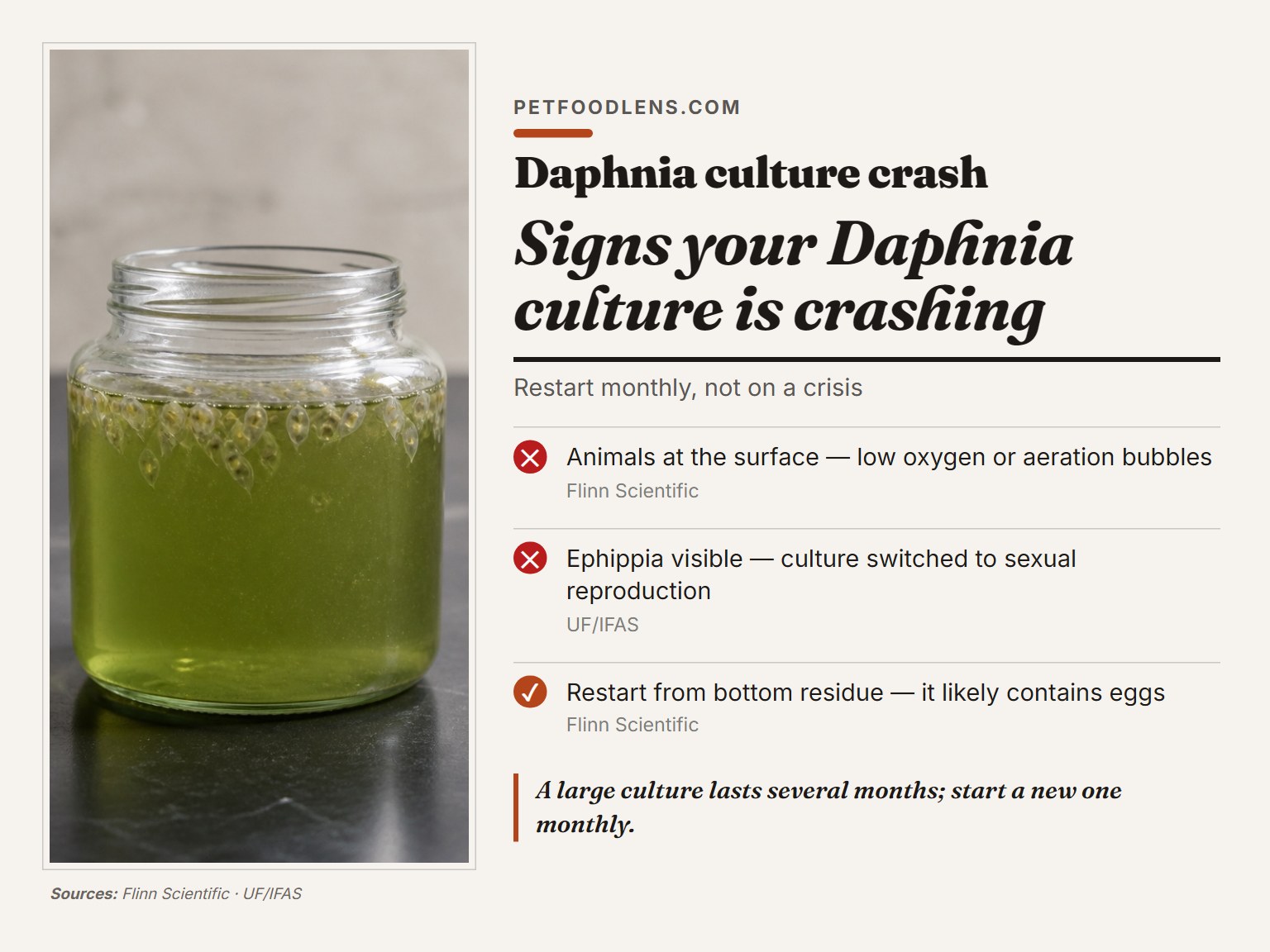
Flinn’s guide gives a large Daphnia culture several months before metabolic waste accumulates and pH shifts crash the population. The fix is a monthly restart, not a rescue.
The how to keep live fish food alive question comes down to the same answer: restart on a schedule, not on a crisis.
Reading the Crash Signs
A crashing culture smells sour before it looks wrong. The water goes from clear green to a cloudy olive, and the animals hang at the surface instead of swimming in jerky bursts.
Ephippia are the sexual resting eggs. UF/IFAS says an abrupt reduction in food triggers the switch from asexual to sexual reproduction and ephippia production. Carolina’s protocol says the population drastically decreases once ephippial eggs appear from overcrowding or metabolite buildup.
- Sour smell — the food load has outrun the filter feeders.
- Cloudy olive water — bacterial bloom, not algae.
- Animals at the surface — low oxygen or aeration bubbles.
- Ephippia visible — the culture has switched to sexual reproduction.
Restarting from Bottom Residue
Flinn notes that bottom residue likely contains eggs. Restart from the residue, not just the swimming animals. Drain half the tank and refill, or start fresh and discard half the animals.
The part nobody mentions: The bottom sludge is not waste to dump. Flinn notes it likely contains resting eggs, and a restart from residue often outperforms a restart from swimming animals alone.
I keep a backup jar started after the main one. The main culture always fails the week you need it, and a backup costs almost nothing.
Restart it.
Daphnia vs Moina: Which One Should You Culture?
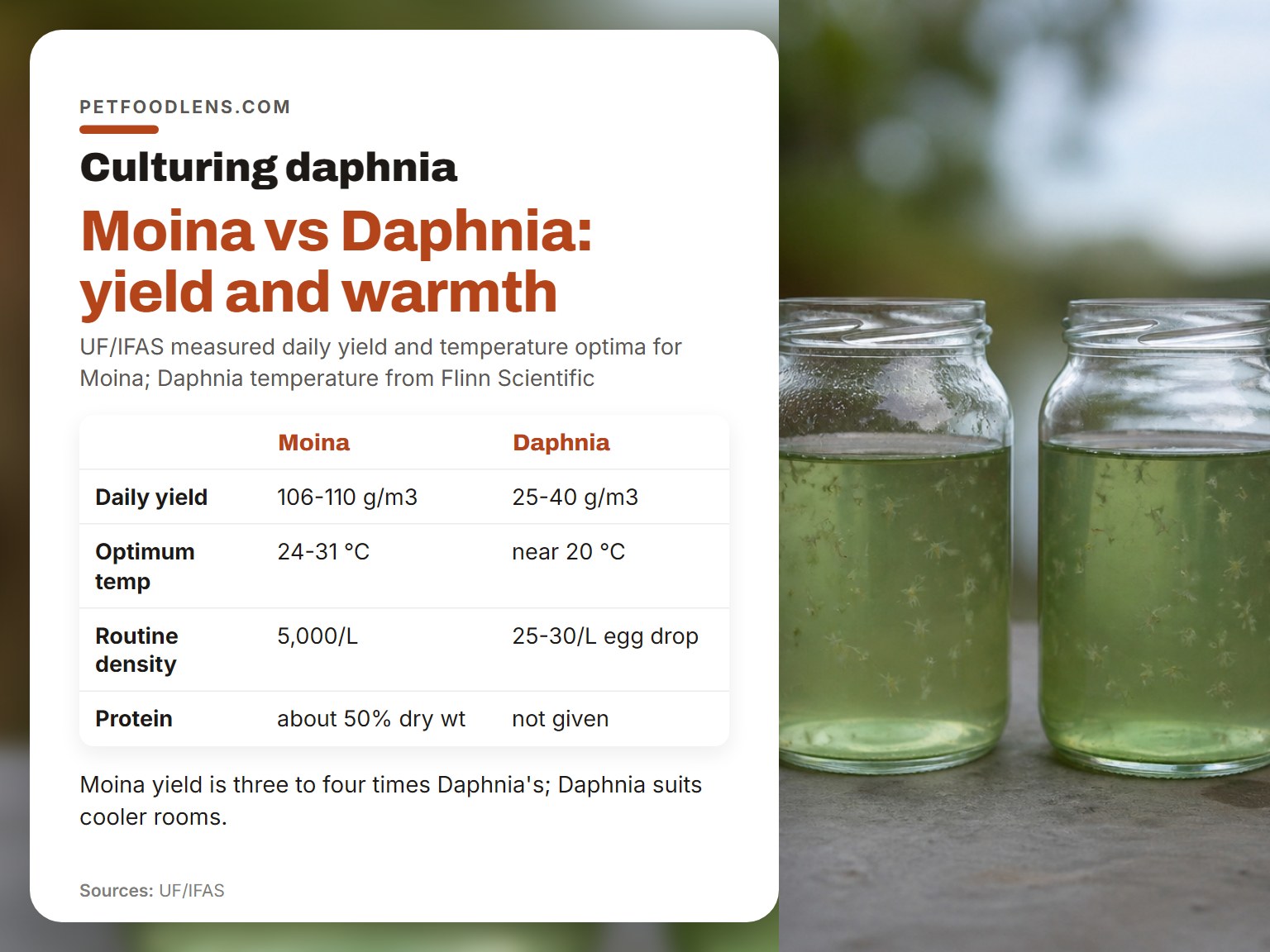
If the goal is feeding fish fry, Moina outperforms Daphnia on almost every metric UF/IFAS measured.
The UF/IFAS Moina culture techniques publication reports a daily yield of 106-110 g/m3 for Moina versus 25-40 g/m3 for Daphnia. That’s three to four times the production. Moina protein averages about 50% of dry weight, with fat at 20-27% for adult females and 4-6% for juveniles.
Moina fed as sole food give 95-99% survival to 20 mm in fry of many ornamental tropical fish species. That’s why feeding fish fry with Moina is standard practice in commercial hatcheries.
The catch is temperature. Moina’s optimum is 24-31 C, while Daphnia’s is near 20 C. If your fish room runs warm, Moina is the easier culture. If it runs cool, Daphnia is the safer bet.
If you want live food for fish beyond Daphnia and Moina, there are several other options worth culturing:
- Microworms are forgiving, fast, and a backup; see how to culture microworms.
- Grindal worms are another forgiving backup; how to culture grindal worms.
- Vinegar eels are a low-maintenance option for small fry; how to culture vinegar eels.
- Infusoria is a first food for fry too small for Daphnia; how to culture infusoria.
- Brine shrimp are the standard hatchery food; how to culture brine shrimp.
Frequently Asked Questions
How long does a Daphnia culture last?
Flinn Scientific says a large culture is likely to last several months before metabolic waste accumulates and pH shifts crash the population. Start a new culture monthly to stay ahead of the crash.
Can I use tap water for Daphnia?
Science in School permits aged, dechlorinated tap water at pH 7-8. Flinn specifies pond or spring water rested for several days. Either works if the chlorine is gone.
Do I need to aerate the culture?
Flinn Scientific says no, because bubbles float the animals. Science in School warns that low dissolved oxygen is lethal. The disagreement is real; use a wide jar with surface area and watch the animals.
How often should I feed Daphnia?
Science in School recommends 2-3 times per week at 5 drops per litre. The EPA protocol feeds Monday, Wednesday, and Friday. Overfeeding is the most common cause of a crash.
What temperature kills Daphnia?
Flinn Scientific warns that temperatures above 20 C (68 F) may be fatal. Science in School permits up to 25 C. The EPA fixes a daily mean of 20 +/- 1 C for bioassay work.
Why are my Daphnia floating at the top?
Aeration bubbles lodge under the carapace and float animals to the surface, per Flinn. Low dissolved oxygen also drives them up, per Science in School. Check both.
The Bottom Line
If you take one thing from this: start with a wide, clear jar, fill it with dechlorinated water, and wait three days before any animals go in. That waiting period is the step people skip, and it’s the one that prevents the first crash.
The aeration disagreement isn’t going away. Flinn says don’t bubble; Science in School says low oxygen kills. If your jar is wide and shallow, you can probably skip the air line. If it’s tall and narrow, test the water and watch the animals.
I’d rather see a new culturist start with a 30-per-litre jar and a monthly restart than an overcrowded jar and a rescue plan. The lower density forgives mistakes.
The protocols are the starting point. Your jar, your water, and your room temperature will teach you the rest.
