
How to Culture Vinegar Eels: Step-by-Step
This post contains affiliate links. As an Amazon Associate, we earn from qualifying purchases.
To culture vinegar eels, start with unpasteurized apple cider vinegar, a slice of apple, and a loosely covered jar kept at room temperature out of direct sunlight. Adults reach only 2 mm, and a single female can drop as many as 40 live young at once, so one jar keeps producing for months.
Pasteurized vinegar is the first thing that goes wrong when you learn how to culture vinegar eels. Commercial vinegar is heat-treated to stop organism growth, which is the opposite of what a new jar needs. Flinn Scientific’s care sheet says bulk, non-pasteurized vinegar is the media, and a pasteurized bottle needs 3 to 4 days uncovered before any eels go in.
What follows puts four published protocols next to each other: Flinn Scientific, Ohio State, the International Betta Congress, and the British Killifish Association. They agree on the apple. They disagree on nearly everything else, and the disagreements are where new cultures fail.
Key Takeaways
- Unpasteurized apple cider vinegar is the base. A pasteurized bottle needs 3 to 4 days uncovered before eels go in.
- Hold the jar at room temperature or, per Blades Biological and the British Killifish Association, between 20 and 30 C, out of direct sunlight, with a loose lid, perforated plastic, or a small air hole.
- Split or restart on differing schedules: Flinn Scientific says at least 4 times a year, Barbara Shardy (Ohio State) and the British Killifish Association say every 3 to 4 months, and the International Betta Congress stretches it to 6 months or a year.
- Cloudiness means the culture is peaking, not dying. Red ochre and a broken-down apple mean it’s spent.
- Sources disagree on rinsing or purging before feeding fry: Barbara Shardy (Ohio State) says nematodes must be purged in dechlorinated or RO water, the British Killifish Association filters and rinses, and the International Betta Congress’s floss-bottle method says rinsing isn’t required.
What Actually Goes in the Jar
A vinegar eel culture needs four things: a vinegar base, an apple, a container, and a starter.
Vinegar eels are free-living nematodes that feed on the mother of vinegar, the fungal and bacterial mat that forms in unpasteurized vinegar. Adults reach 2 mm, and a single female can produce as many as 40 live young at once. Cultures run indefinitely with regular subculturing.
Most live food cultures follow the same shape: a medium, a food source, and a container that breathes. Here’s the parts list.
- Vinegar base. Unpasteurized apple cider vinegar is what Flinn and the British Killifish Association both reach for. Unpasteurized apple cider vinegar with the mother still in it is what Flinn and the British Killifish Association both reach for.
- An apple. A few small slices, washed. The International Betta Congress says the apple alone feeds the culture and calls a pinch of sugar or yeast an unnecessary step.
- A container. A quart jar works. Kilner jars are the standard in the UK care sheets, and a 1 to 2 liter jar is what the IBC uses.
- A starter. Roughly a cup of old media, or about 100 mL decanted with some of the debris.
The medium is where the four protocols split hardest. Flinn uses bulk vinegar undiluted. Ohio State dilutes it, about 500 mL of water to 200 mL of vinegar. The IBC goes 1:1 with treated tap water, and the British Killifish Association goes 50:50 with aquarium water.
Common mistake: Building the jar on the pasteurized bottle because that’s what the store had. Flinn’s workaround is 3 to 4 days uncovered before the eels go in. Skip it and the jar can sit clear well past the 2 to 4 weeks a healthy starter needs.
How to Culture Vinegar Eels: The Four Published Protocols Side by Side
Flinn Scientific, Ohio State, the International Betta Congress, and the British Killifish Association all publish a method, and no two agree on the medium.
| Source | Vinegar mix | Subculture | Aeration |
|---|---|---|---|
| Flinn Scientific | Undiluted bulk vinegar | At least 4 times a year | Forced air via pipet |
| Ohio State (Shardy) | 500 mL water to 200 mL vinegar | Every 3 to 4 months | None described |
| Intl Betta Congress | 1:1 vinegar to treated water | Every 6 to 12 months | None described |
| British Killifish Assn | 50:50 vinegar to aquarium water | Every 3 to 4 months | None described |
Compare it on the same basis and the table tells you something useful. Three of the four dilute the vinegar. Only Flinn runs it neat.
Where the Four Protocols Actually Agree
Strip out the ratios and the overlap is smaller than you’d expect, but it’s real:
- Unpasteurized cider vinegar, not white distilled.
- A slice of apple as the food source.
- A loose or perforated cover, never a sealed lid.
- Room temperature, out of direct sunlight.
- Some form of splitting or restarting on a calendar.
That’s the whole consensus. Everything past that line is one source’s preference.
Where They Split: Aeration
Flinn is the only one of the four that calls for forced-air aeration through a clean pipet. The Ohio State vinegar eel culture guide describes a loosely lidded container with no aeration step at all, and the International Betta Congress vinegar eel guide seals the jar with a small air hole and leaves it alone between splits.
Four of the five care sheets in front of me describe a static jar. Flinn is the outlier.
If you want the biology rather than the jar setup, the Florida extension nematology publication covers the organism itself.
Why Does My Vinegar Eel Culture Look Cloudy?
Cloudiness is usually good news.
The IBC says a culture that’s ready to feed looks just the slightest bit cloudy when it’s teeming with eels. So a faint haze is the sign you’ve been waiting for. Heavier cloudiness is different. That’s the IBC’s cue to refresh, which means pouring half the culture into a new jar and topping both off with fresh diluted vinegar.
Hold the jar against a window and you can tell the difference. A working culture reads as weak iced tea with a haze near the surface, and the eels show up as fine threads moving against the glass. A spent culture goes the other way: the light amber darkens toward red ochre and the apple slumps into mush.
| What you see | What it means | What to do |
|---|---|---|
| Slight haze, eels visible | Culture is peaking | Harvest and split |
| Cloudy throughout | Past its best | Pour half into a new jar, top both off |
| Light amber turns red ochre | Culture is spent | Restart; soak the jar in 10% bleach overnight |
| Smelly debris layer, no eels | Crash | Seed a new jar from the debris |
| Rubbery white mat on top | Mother forming | Shake it back into the liquid |
| Nothing visible at 4 weeks | Cold jar or pasteurized vinegar | Check 20-30 C; change the vinegar |
Before you start: The 10% bleach soak is for the empty jar, not for anything alive. Rinse it thoroughly and let it dry before the next culture, and never pour bleach solution near a tank or a drain that feeds one.
That crash row is worth pausing on. The British Killifish Association describes cultures that appear to die and leave a smelly layer of debris, and the fix is to start a new jar using a little of that debris as the starter. A few eels show up swimming within a week.
Harvesting Without Drowning Your Fry in Vinegar
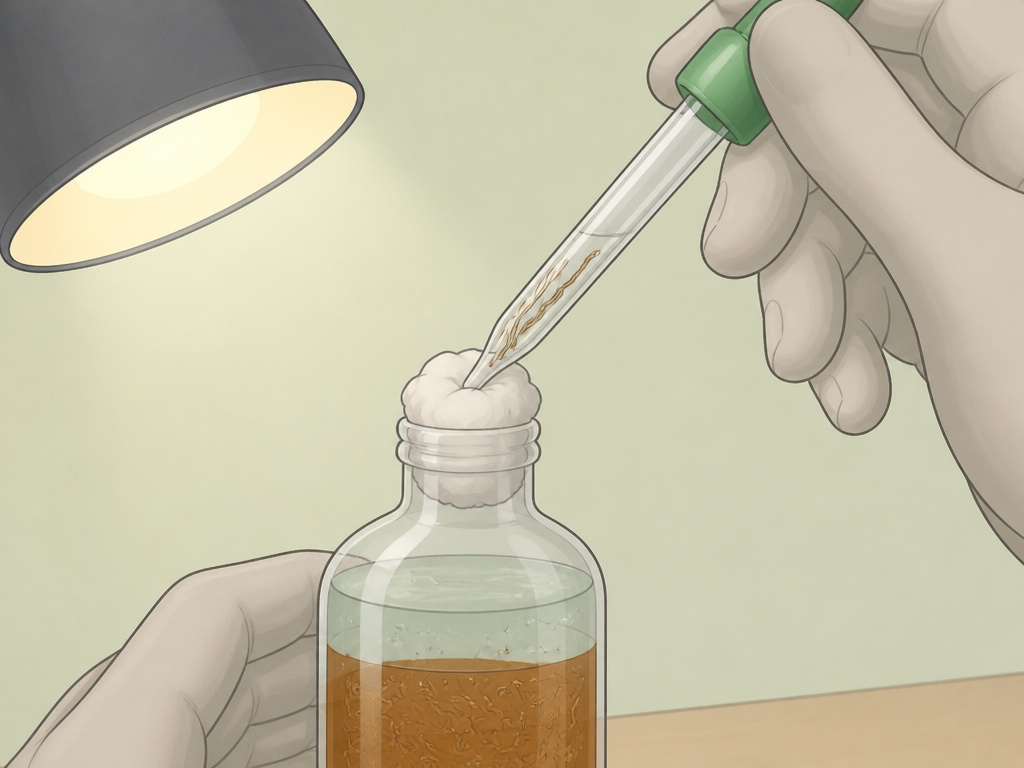
You pull the pipet out of the top of the bottle and squirt it into the fry tank. If the plug was packed right, what comes out is mostly water and eels. If it wasn’t, you just dosed the tank with vinegar.
The Floss Bottle Method
The IBC’s bottle method is the one most breeders settle on, because you set it up once and feed from it daily.
- Fill a narrow-neck bottle to the bottom of the neck with culture. Overfilling leaves no room for the floss to seat, and the eels have nowhere to climb.
- Pack a cotton ball or filter floss into the neck so it touches the liquid but sits no more than halfway in. Push it too deep and the vinegar wicks up through the plug, which defeats the whole setup.
- Top the bottle with fresh water and set a light over it. The eels swim toward the light overnight.
- Pipet from the top of the bottle the next morning. Refill the fresh water daily if you’re feeding daily.
The floss is the trick. It keeps the vinegar below and the fresh water above, so the IBC says rinsing isn’t required at all.
The Net and Rinse Method
The British Killifish Association does it differently. Pour some culture through a brine shrimp net or a coffee filter, rinse it, then transfer the eels to fresh water for pipetting. The filtered vinegar goes back in the jar.
Ohio State goes further and says the nematodes must be purged in dechlorinated tap water or RO water before they go to fry. Three sources, three positions on the same welfare step.
For fry too small to take a 2 mm nematode, infusoria is the earlier rung on the ladder, and a fry food guide covers the size progression better than I can here.
If the floss plug sits more than halfway into the culture, the vinegar wicks up through it and the whole point of the bottle is gone. Pack it tight, seat it shallow.
How Often Should You Restart a Vinegar Eel Culture?
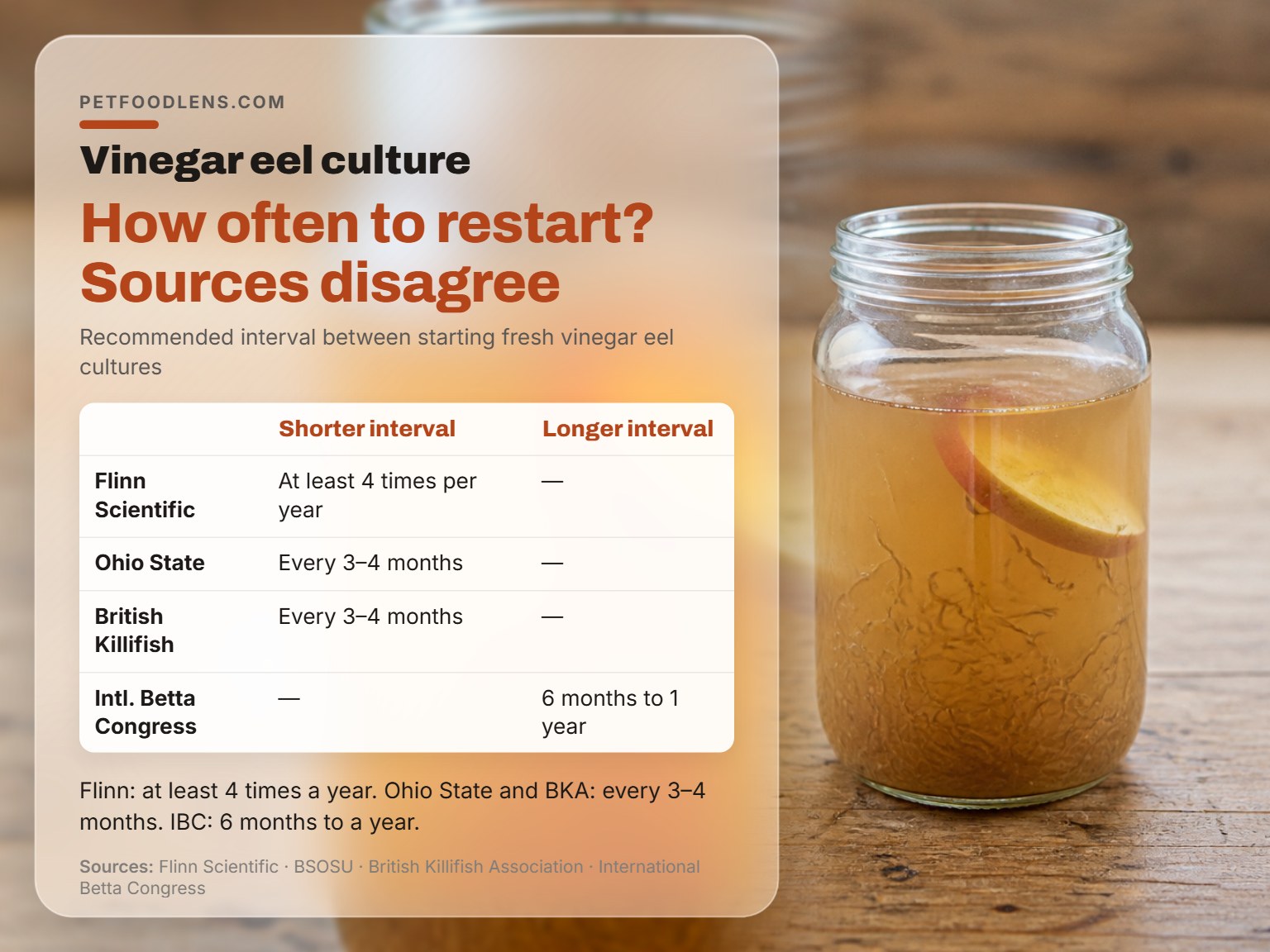
The protocols disagree on interval: Flinn Scientific says at least 4 times a year, Barbara Shardy (Ohio State) and the British Killifish Association say every 3 to 4 months, and the International Betta Congress goes 6 months to a year.
Flinn says subculture at least 4 times a year. Ohio State says cultures produce well for about 3 to 4 months. The British Killifish Association says set up a fresh one every 3 to 4 months. The IBC says it splits every 6 months or so and sometimes lets it run a full year with nothing added in between.
I’d run the shorter interval. A culture past its peak still has eels in it, but you’re harvesting from a jar that’s slowly filling with waste, and the BKA’s smelly-debris crash is what that looks like at the end.
Ohio State’s habit of keeping 4 to 6 cultures on hand solves the timing problem outright. Stagger them and there’s always one at peak. The same logic that governs keeping live food alive applies: cool, dark, and not overfed.
Split on the calendar, not on the look of the jar. By the time a culture visibly declines, you’ve already lost a month of good harvests.
Temperature, Light, and the Range You Can Actually Check
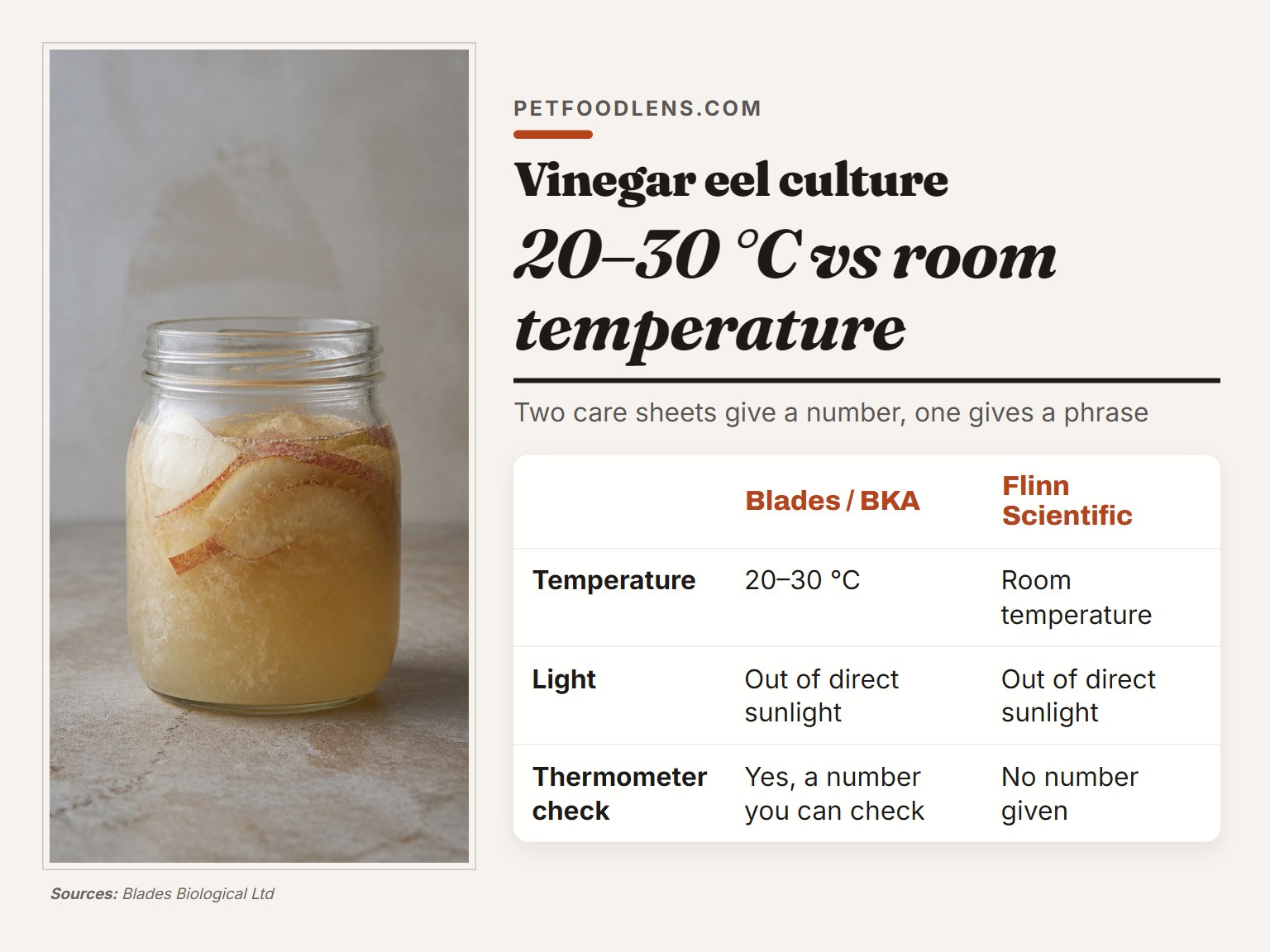
Two of the care sheets give a number and one gives a phrase.
Blades Biological Ltd says keep cultures at 20 to 30 C. The British Killifish Association says the same, and adds that within that range the culture develops clouds of eels near the surface. Flinn says room temperature, out of direct sunlight.
The 20 to 30 C figure comes from Blades Biological and the British Killifish Association, while Flinn Scientific says room temperature out of direct sunlight, so the two positions don’t always point at the same place. “Room temperature” in a basement in February is often below 20 C, so the Flinn phrasing and the Blades number don’t always point at the same place.
I’d take the 20 to 30 C range over “room temperature” every time. It’s the only figure in these care sheets you can check with a thermometer.
Where this goes sideways: Leaving the jar on a south-facing windowsill. Every protocol says out of direct sunlight, and a windowsill is the fastest way to push a small jar out of the published range.
Blades also notes that fresh vinegar should be added to balance evaporation. A jar left to concentrate gets saltier and more acidic, and the eels slow down before they die.
The Porridge Method, and When a Liquid Jar Is the Wrong Tool
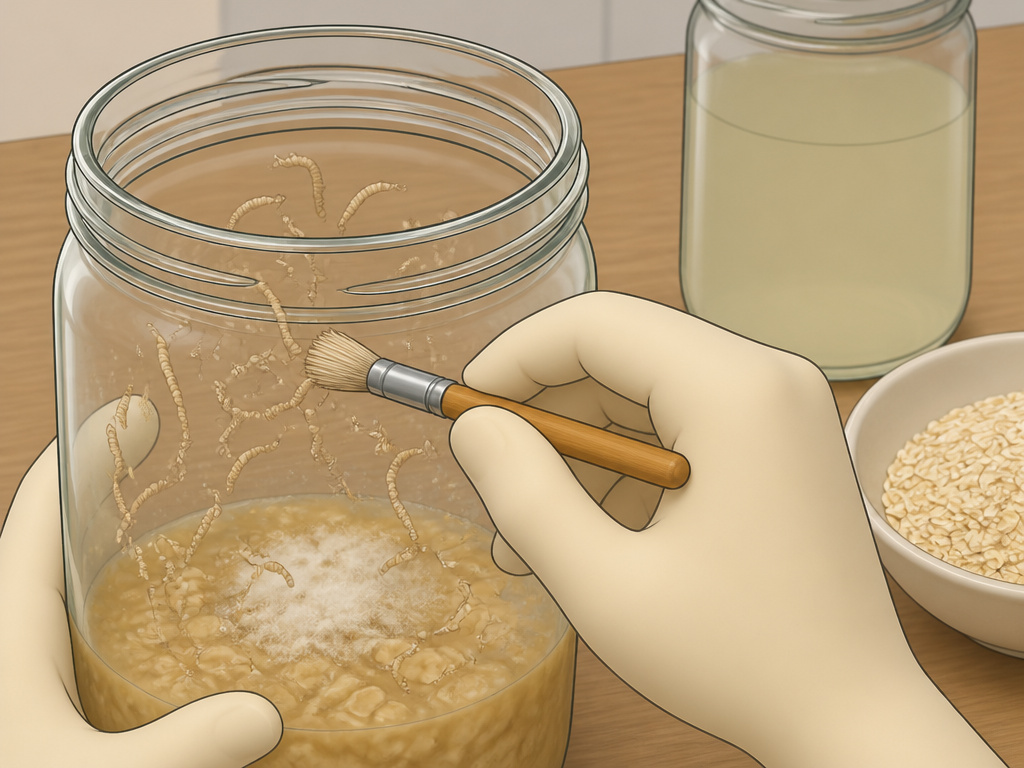
The British Killifish Association’s second method doesn’t use a liquid culture at all, and for some keepers it’s the better one.
The porridge method starts with vinegar and an equal volume of boiled water poured over porridge oats. You harvest with a paint brush for 1 to 2 months, wiping eels off the sides of the container until the culture slows down.
The setup looks like this:
- Vinegar and boiled water, roughly equal parts, heated through.
- Porridge oats as the solid substrate, no apple.
- A distinct mould stage, which the BKA calls the mother, that the eels feed on.
- A paint brush for harvest, not a pipet.
That mould stage alarms people the first time. The BKA says it can grow large enough to suffocate the eels, and the fix is to shake it back into the porridge mixture. Boiling the liquid at the start may slow the mother down and give a first culture a foothold.
First-time porridge cultures take longer to establish than microworms, about 10 days instead of 7. Once established, the timing evens out.
The payoff is contamination. The BKA says eels harvested by paint brush from a solid culture are much less likely to carry vinegar than eels filtered out of a liquid one. That’s the whole argument in a single line.
The porridge method is the one I’d hand a beginner who keeps killies. It’s messier to set up and the mother looks alarming, but you harvest with a paint brush and skip the rinsing argument entirely.
If you’d rather stay in liquid, grindal worms and daphnia cover the size classes above and below vinegar eels without any of this.
Frequently Asked Questions
How long does it take to start a vinegar eel culture?
The International Betta Congress puts it at about 2 to 4 weeks, sooner if you start with a large starter culture. Blades Biological says the population becomes dense within a few weeks. The British Killifish Association’s porridge method runs about 10 days for a first-time setup.
Do I need to aerate a vinegar eel culture?
Flinn Scientific says yes, by forcing air into the liquid with a clean pipet. Ohio State, the International Betta Congress, Blades, and the British Killifish Association all describe static jars with loose or perforated covers and no aeration step. Four of the five sources skip it.
Can I use pasteurized apple cider vinegar?
Flinn says pasteurized vinegar can work if you let it sit uncovered for 3 to 4 days before adding eels, because commercial pasteurization is designed to inhibit organism growth. The International Betta Congress takes the opposite view and says apple cider vinegar with or without the mother is fine, no resting step required.
Do vinegar eels need to be rinsed before feeding fry?
Ohio State says the nematodes must be purged in dechlorinated tap water or RO water first. The British Killifish Association filters through a brine shrimp net or coffee filter and rinses. The IBC’s floss-bottle method claims rinsing isn’t required, because the plug keeps the vinegar from mixing with the water at the top.
Why did my vinegar eel culture turn red?
Ohio State describes the light amber color turning to red ochre as the signal that a culture is finished, along with the apple breaking down completely. At that point the advice is to dispose of the remaining fluid and particles, soak the container in a 10% bleach solution overnight, and start fresh.
What temperature is too warm for vinegar eels?
Blades Biological and the British Killifish Association both give 20 to 30 C as the working window, and Flinn says room temperature out of direct sunlight. Above 30 C you’re outside every care sheet in this set.
The Bottom Line
Start with one quart jar. Not six, not a shelf of them. Run it through a full cycle, harvest from it, and find out whether you actually use the eels before you give up counter space to a staggered rotation.
One caveat on everything above: these are care sheets, not controlled trials. None of the four sources publishes a side-by-side yield comparison, so the interval and dilution advice is field experience rather than measurement. Where they disagree, I’ve told you who holds which position instead of picking a winner for you.
And the honest position on live food generally: most keepers don’t need it. If you’re raising fry that will take a 2 mm nematode, a vinegar eel jar is the most reliable thing you can keep on a shelf. If you’re not, the jar is a hobby. Hobbies are allowed.
That’s the short version of how to culture vinegar eels: one jar, one apple, one loose lid, and a calendar reminder set to whichever subculture interval you follow.
