
Goldfish Feeding Guide: How Much and How Often
This post contains affiliate links. As an Amazon Associate, we earn from qualifying purchases.
A goldfish feeding guide starts with three numbers: 100 litres of water per adult fish, 3% of body weight daily (Merck’s figure for adult fish), and a portion the fish clears in a few minutes. OATA says feed once a day; Hikari says up to four times, capping each meal at what gets eaten fast.
The goldfish feeding guide gap between once a day and four times a day shows up in the peer-reviewed record, not just on the side of a tub. So the tub, the trade association care sheet and the trial data do not line up.
What follows sorts out which number applies to your tank, your fish size and your water temperature, then covers the ration itself, the two-month clock on an opened tub, and the one visual check that catches overfeeding before the water clouds.
Key Takeaways
- Cap every meal at what the fish clears in a few minutes, whichever frequency you settle on. OATA and Hikari agree on that even though they disagree on everything else.
- OATA says once a day, Hikari says up to four times, and a Journal of Nutrition trial found four meals beat one on growth and feed conversion.
- 3% of body weight daily is Merck’s maintenance figure for adult fish; fry and fingerlings go up to 5%.
- Discard dry food two months after opening at room temperature, six months if it lives in the freezer.
- White or yellow waste means the ration is too big. Healthy goldfish waste is dark brownish green or black.
How Often Should You Feed a Goldfish?
OATA’s care sheet says once a day. Hikari’s own tub says up to four times. Both are describing the same species, and both cap the meal at what the fish clears in a few minutes.
Goldfish feeding frequency is set by two separate limits. The first is the volume a fish will clear in a few minutes, which caps each meal. The second is how many of those meals the tank’s filtration and bacterial load can absorb in a day. A tank that clears the first limit can still fail the second.
The two camps are measuring different things. OATA counts meals. Hikari counts portions. Merck counts body weight. Put them side by side and the shape of the argument gets clearer.
| Source | Frequency it recommends | What the number is based on |
|---|---|---|
| OATA care sheet | Once a day | Food cleared within a few minutes |
| Hikari Sinking Goldfish Excel | Up to 4 times daily | Smaller, more frequent meals |
| Merck Veterinary Manual | At least daily for most fish | 3% of body weight per day |
If you want the frequency question worked through by age and size, how often to feed a goldfish goes fish by fish.
Why the Once-a-Day Advice Still Circulates
OATA’s reason for the cap is water quality rather than fish biology. Uneaten food breaks down and releases toxic waste into the water, and one oversized meal puts more of it in the tank than the filter bacteria can process. That is a real mechanism, and it is why the once-a-day rule survives.
Where this goes sideways: Running four small meals into a new or heavily stocked tank. The fish clear every one, ammonia still climbs, and the limit turns out to be the filter rather than the appetite.
What 3% of Body Weight Actually Looks Like
A goldfish feeding guide starts with a kitchen scale, a plastic tub of tank water, and a fish that will not hold still. That is the practical version of a 3% ration, which is why the pinch-and-sprinkle method survives.
Merck gives the figure plainly: adult fish at 3% of body weight daily for maintenance, fry and fingerlings up to 5%. For a fish of any given weight, the ration is 3% of it, and that is less food than it sounds once it is sitting on a scale.
Hikari works off a different measure entirely. Hikari says do not exceed the amount consumed within a few minutes. Those two methods do not convert into each other. One is gravimetric, the other is behavioural.
Here is the sequence that gets you a real number:
- Weigh the fish, or estimate weight from a length measurement taken through the glass. Skip this and every later step is guesswork.
- Multiply by 0.03 for an adult, or up to 0.05 for fry. Getting the multiplier wrong is how a maintenance ration becomes a growth ration.
- Weigh that food amount on a scale. Eyeballing it is where most rations drift upward.
- Split it across smaller portions so the fish get time to eat rather than competing over one drop.
- Watch the substrate after the last portion. Food still sitting there means the total was too big, regardless of what the chart said.
That is why I treat any chart, including one on a fish tub, as a starting estimate rather than a prescription.
Body length is the workaround when you cannot weigh the fish. Published models for predicting food allowances from body length in ornamental fish let you estimate weight from a length measurement, which is far easier to take through glass than a scale reading. Whichever method you use, how much to feed runs into the same two limits: what the fish will clear and what the filter will process.
Does Feeding Frequency Change in Cold Water?
Hikari draws hard lines at 10 C and 30 C. Nothing else in this set of sources does.
Below 10 C (50 F) or above 30 C (86 F), Hikari says to reduce the amount fed, scaled to how active the fish are and what condition the tank is in. The instruction is to cut the amount, not to skip days.
An older position comes from the US Bureau of Fisheries, whose 1922 report on goldfish care advised feeding every day in summer and every other day in winter. Merck’s veterinary manual takes a third line: most aquarium fish should be fed at least daily, with the exception of carnivores that take large meals.
Three sources, three answers, and none of them is describing the same setup. The 1922 advice was written for unheated aquaria and planted bowls with no mechanical filtration in the modern sense. Hikari’s temperature band assumes a product in a tank you control.
The practical read for an indoor tank: Hikari says below 10 C to cut the amount and watch whether the fish are still interested, while the 1922 Bureau of Fisheries report advised every other day in winter and Merck says most aquarium fish should be fed at least daily. If they are sluggish and ignoring food, cut it further. In a heated indoor tank sitting in the normal range, Hikari’s temperature-based reduction does not apply, though the 1922 Bureau of Fisheries report advised every other day in winter and Merck says most aquarium fish should be fed at least daily.
If the fish have moved to an outdoor pond, the goldfish food vs koi food question comes up every autumn, and it matters more in cold water because the ration is already being cut.
Reading the Tub: What the Panel Tells You and What It Doesn’t
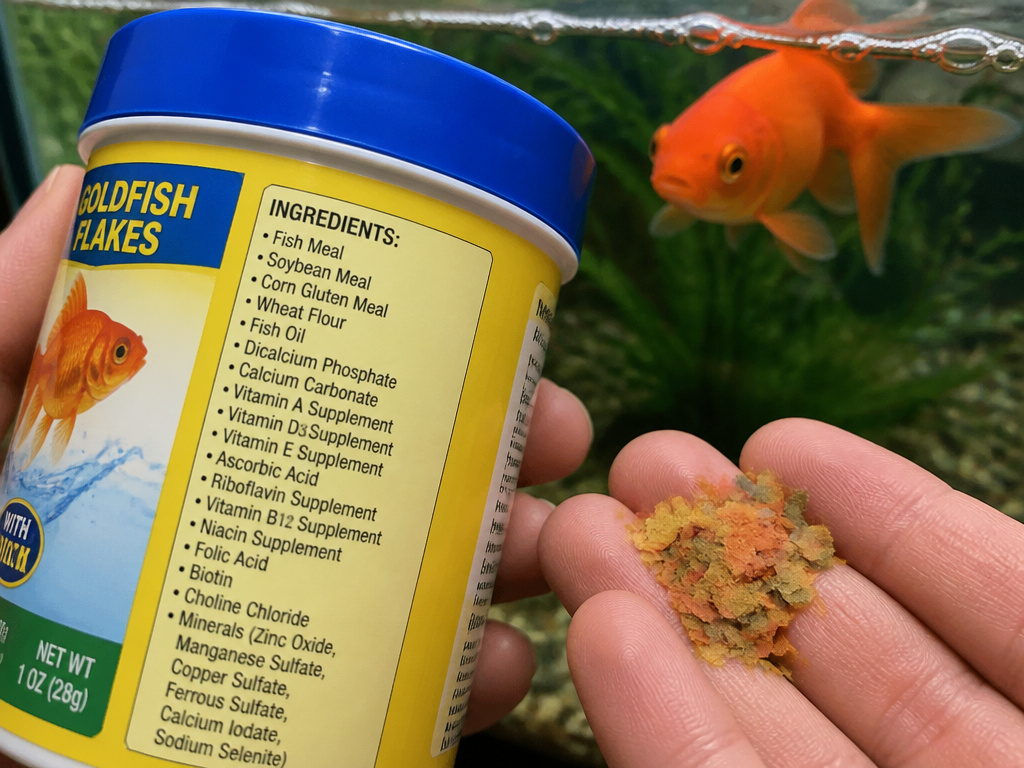
Flip the bag over. A fish flake tub reads a lot like a cat food label, and the same rule applies: whatever sits first is what the tub is mostly made of. Fish meal first, then wheat flour, then a vitamin premix is a decent flake. Wheat flour first, with fish meal buried fourth, is a cereal with a fish theme.
The protein percentage on the front tells you less than the ingredient order. A high protein claim means nothing until you know where the protein came from, and the panel is the only place that answers it.
I read fish tubs the way I read cat food bags, and the lesson transfers cleanly. The percentage on the front is the headline. The ingredient order is the story. A tub that leads with wheat flour and lists fish meal fourth is a cereal with a fish on the label.
Where the panel does earn its keep is the protein-to-energy balance. A Scientia Agricola trial on goldfish fingerlings recommended 38.0 to 40.0% digestible protein at 3,200 kcal/kg.
The same paper warns that diets exceeding requirements can reduce water quality and trigger disease outbreaks, so a richer food is not automatically a better one.
Flakes or Sinking Pellets?
Merck’s rule is position-based: surface feeders get floating feed, bottom-dwellers get items that sink rapidly. The same reference notes that flaked feed may be too large for a small-mouthed fish, and that flakes can be crushed to fix it.
Hikari Sinking Goldfish Excel is built around the sinking idea, with a pellet size the manufacturer rates for goldfish above 3 cm or 1.2 inches.
A flake feed still works for small fish, though Merck’s note about crushing applies. Break the flake between your fingers before it goes in. It takes two seconds and it stops a small fish from losing the meal to a bigger tankmate.
The flakes vs pellets choice is really a choice about where in the water column the food lands and how fast it gets eaten. For a full comparison of what is on the shelf, best goldfish food covers the panel differences between the main lines.
When Two Fish Need Two Different Rations
OATA is blunt about one pairing: comet goldfish should not be kept with fancy goldfish, because comets swim faster and out-compete the fancies for food. That is a feeding problem wearing a stocking-problem costume.
The same logic applies to a mixed-size shoal. Merck’s guidance is to pick a particle size the smaller fish can eat, not the larger one. Feed a single pellet size to a mixed group and the small fish lose every time.
Merck adds the bottom-dweller case. In a mixed population, bottom-feeding fish should get targeted feeding rather than leftovers from the surface feeders. Dropping one food type in and walking away leaves part of the tank short.
The Two-Month Rule Nobody Prints on the Lid
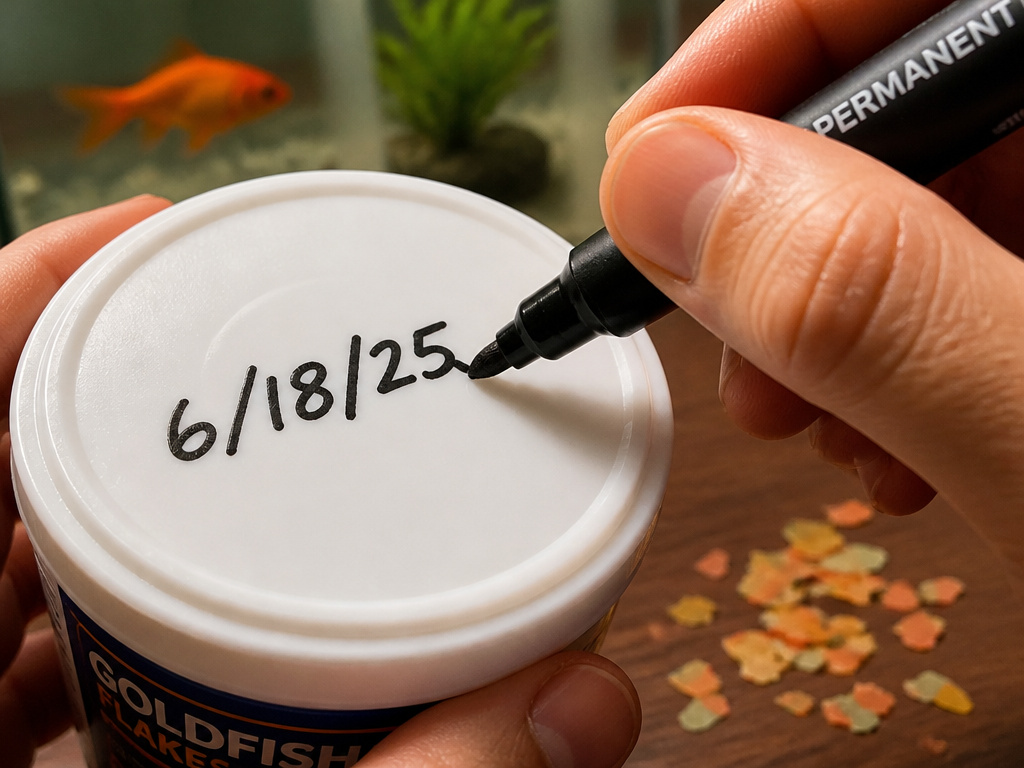
Two months. That is how long an opened container of dry fish food lasts at room temperature before Merck says to discard it, and the clock starts at opening rather than at the date on the base.
Merck’s reasoning is that fish feeds carry high protein and oil content and deteriorate fast. High humidity and high temperature drive degradation, mold growth, potential mycotoxin production and rancidity. Dry feed belongs in a pest-proof container, in a low-humidity, low-temperature spot.
You can smell the difference before you can see it. A tub that has sat through a humid summer opens with a flat, rancid-oil smell, like old nuts, and the flakes clump instead of separating when you shake them out.
| Feed type | Storage | Discard after |
|---|---|---|
| Dry feed, room temperature | Sealed, pest-proof, low humidity | 2 months from opening |
| Dry feed, freezer | Sealed, pest-proof | 6 months |
| Frozen brine shrimp, bloodworms, mysids, glassworms | Kept frozen, never refrozen once thawed | 1 year |
If the tub has been open since last spring, suspect the food first when a fish goes off its feed. Replacing a stale tub is cheaper and faster than treating whatever the oxidized oil is doing to the tank.
I have thrown out more half-full tubs than I would like to admit, and every one of them was a tub I had been meaning to finish. Write the opening date on the lid with a marker. It is the only part of this hobby where the label genuinely tells you nothing.
Easy to miss: Storing the tub next to a warm radiator or in a bathroom cabinet. Merck names high humidity and high temperature as the two drivers of mold and rancidity, and a steamy room supplies both.
What Does Overfeeding Look Like Before the Water Clouds?
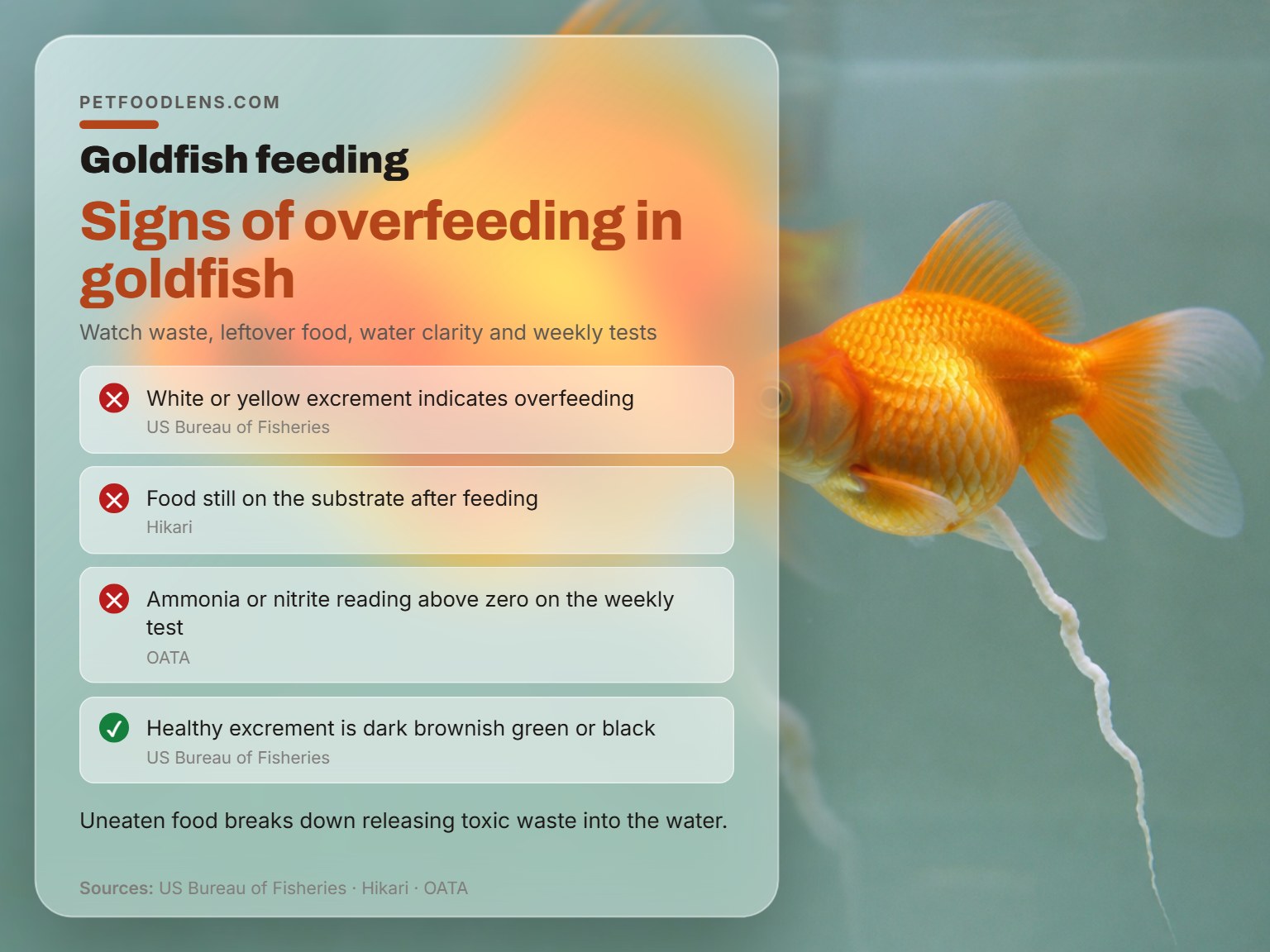
Have you ever watched a goldfish trail a long white string and assumed it was sick? Check the ration first.
The 1922 Bureau of Fisheries report gives the cheapest diagnostic in the hobby. Healthy goldfish excrement is dark, either brownish green or black. White or yellow excrement indicates overfeeding.
That single observation is worth more than any feeding chart, because it is a reading of the fish rather than a reading of a label. I check the waste before I check anything else when a goldfish looks off.
The water-quality side of overfeeding is slower and more expensive. OATA notes that uneaten food breaks down and releases toxic waste into the water, and the association recommends testing ammonia, nitrite, nitrate, pH and water hardness every week, especially during initial set-up and after adding fish.
What to watch, roughly in order of how quickly it shows up:
- White or yellow trailing waste within a day of a big meal. That is the ration, not an infection.
- Food still on the substrate after feeding. Cut the next portion and see if it clears.
- Hazy water a day or two later. By then the food has already broken down, and how to feed fish without clouding water is the cleanup conversation.
- Ammonia or nitrite reading above zero on the weekly test. That is the filter telling you the load is too high.
Common mistake: Cutting meals to every other day to fix cloudy water. The cloudiness is a bacterial bloom fed by dissolved waste, and a starving fish produces less waste but does not fix the filter. Reduce the portion, keep the frequency, and test.
If you want the full list of tells, signs of overfeeding covers the ones that show up after the waste does.
Fry Break Every Rule Above
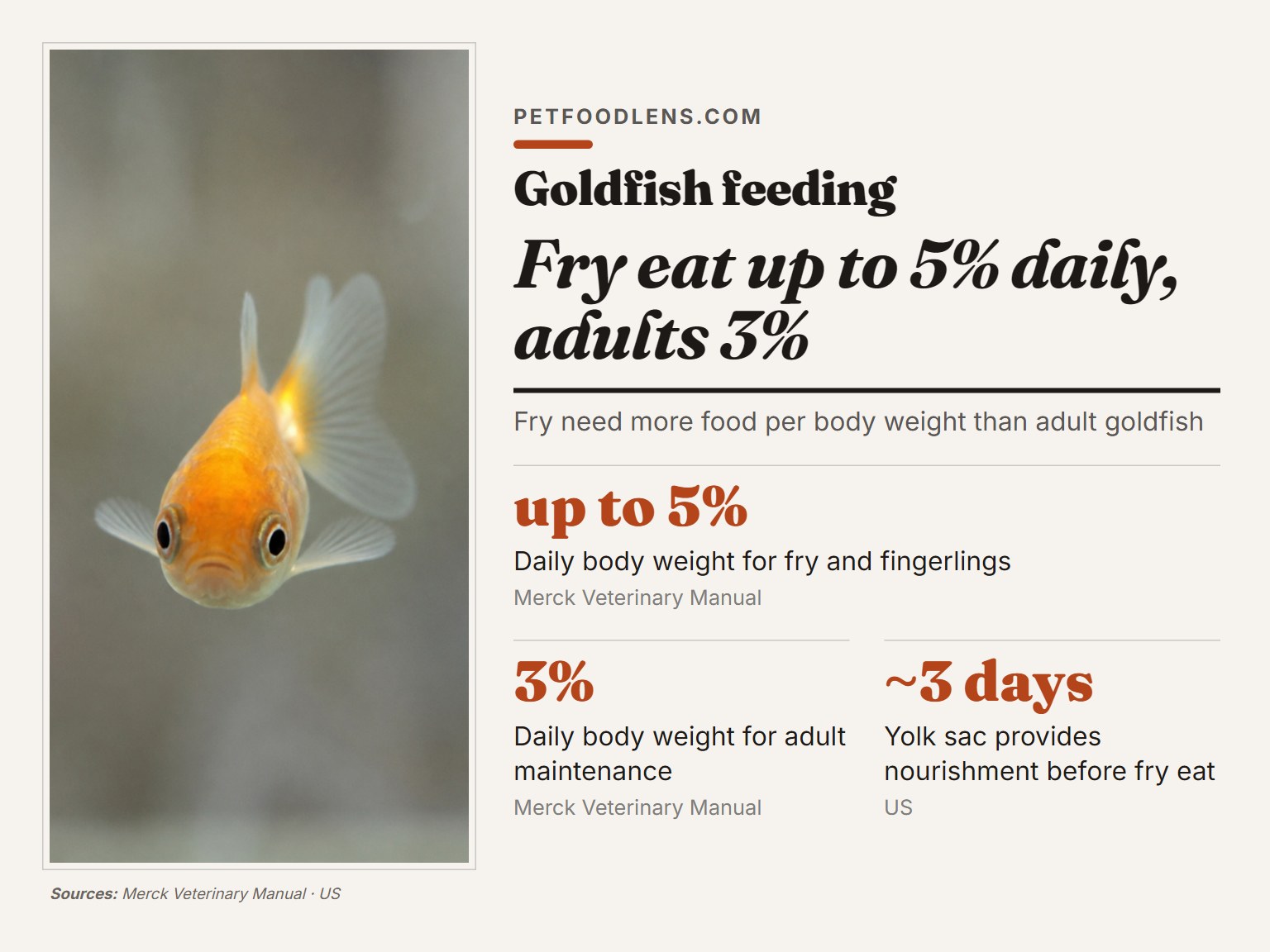
Fry break every rule above, in this order: yolk sac first, microscopic food second, powdered solids third.
US Fish and Wildlife Service Leaflet 57 puts the yolk sac at about three days. Once it is absorbed, fry subsist on microscopic organisms found in the water, and the leaflet names powdered egg yolk mixed with water as a substitute. Merck puts fry and fingerling intake at up to 5% of body weight daily, against 3% for adults.
That is a real difference, not a rounding one. A fry eating at adult rates is underfed, and an adult eating at fry rates is being overfed into a water-quality problem.
The same leaflet adds a rule that has nothing to do with food and everything to do with what happens after it. New fish should be isolated for a week before going into an aquarium or pool. That week is when a fish that arrived carrying something stops being a risk to the ones already eating well.
Frequently Asked Questions
How often should I feed my goldfish?
OATA says once a day, Hikari says up to four times, and Merck says most aquarium fish should be fed at least daily. In an unheated tank below 10 C, Hikari says cut the amount rather than adding meals, while the 1922 Bureau of Fisheries report advised every other day in winter and Merck says most aquarium fish should be fed at least daily.
How much food should I give a goldfish?
Merck’s maintenance figure is 3% of body weight per day for adult fish, and up to 5% for fry. If you cannot weigh the fish, use the time-to-consume rule and stop when they lose interest. Both limits point the same way: a weighed portion, not a pinch.
Should I feed less in winter?
Three sources give three answers. The 1922 Bureau of Fisheries report advised every other day in winter. Hikari says reduce the amount when water sits below 10 C or above 30 C. Merck says most aquarium fish should be fed at least daily. In a heated indoor tank, none of the winter reductions apply.
How do I know if I’m overfeeding?
The 1922 report gives the clearest tell. Healthy waste is dark brownish green or black, and white or yellow waste indicates overfeeding. Food still sitting on the substrate after a meal is the other signal. Neither one requires a test kit.
Does fish food go off?
Quickly. Merck says an opened container kept at room temperature should be discarded after two months, and freezer-stored dry food after six months. Frozen feeds such as brine shrimp and bloodworms last a year and should never be refrozen once thawed.
What protein level should goldfish food have?
Scientia Agricola trial on goldfish fingerlings recommended 38.0 to 40.0% digestible protein at 3,200 kcal/kg. That is a ratio, so a protein number on its own tells you very little.
The Bottom Line
One trigger is worth memorising. If the tub has been open more than two months at room temperature, replace it before you change anything else about the routine. Stale food and an oversized ration produce the same symptoms, and swapping the food is the cheaper test.
The frequency argument does not resolve cleanly, and I would not pretend it does. OATA’s once-a-day rule holds up in a modest, unheated tank. The four-meal result comes from a controlled trial with water quality pinned at zero ammonia. Your tank sits somewhere between those two, and the fish’s waste tells you which end.
Start with the panel. Whatever the front of the tub promises, the ingredient order and the opening date decide more about what your fish actually gets than the feeding chart on the back.
