
Color-Enhancing Fish Food Pros and Cons: What Works
This post contains affiliate links. As an Amazon Associate, we earn from qualifying purchases.
Color-enhancing fish food works, but only within narrow limits. Carotenoids like astaxanthin must come from the diet because fish cannot make them, and the research shows dose, dietary lipid level, and pigment source all change the outcome. The pros are real. The cons are mostly dose and label problems.
Carotenoids are fat-soluble pigments. That single chemical fact explains most of what follows: why dietary lipid level shifts the result, why digestibility falls as dose rises, and why two bags at the same listed dose can behave differently in the same tank. It also explains why color-enhancing fish food pros and cons depend so heavily on formulation.
What follows: the actual dose ceiling, the synthetic vs. Natural split, the withdrawal question, and the label traps that make two bags at the same dose behave differently.
Key Takeaways
- Fish can’t make carotenoids – pigment has to come from food, and tissue concentration tracks dietary supply.
- The safe ceiling is 100 mg ATX/kg diet (138 mg ATX-DMDS/kg) for salmonids, other fish, and crustaceans under the EFSA 2019 opinion.
- Lipid level changes the timeline – Arctic charr on 26% lipid hit 4 mg/kg flesh by week 12; on 10% lipid the same dose took 20 weeks.
- Synthetic vs. Natural isn’t settled – trout trials favor synthetic; a 2025 clownfish trial found shrimp-shell and copepod pigments matched or beat it.
- Color fades after withdrawal – clownfish held red hue but lost saturation; trout trials imply continuous feeding is needed.
What Color-Enhancing Fish Food Actually Does
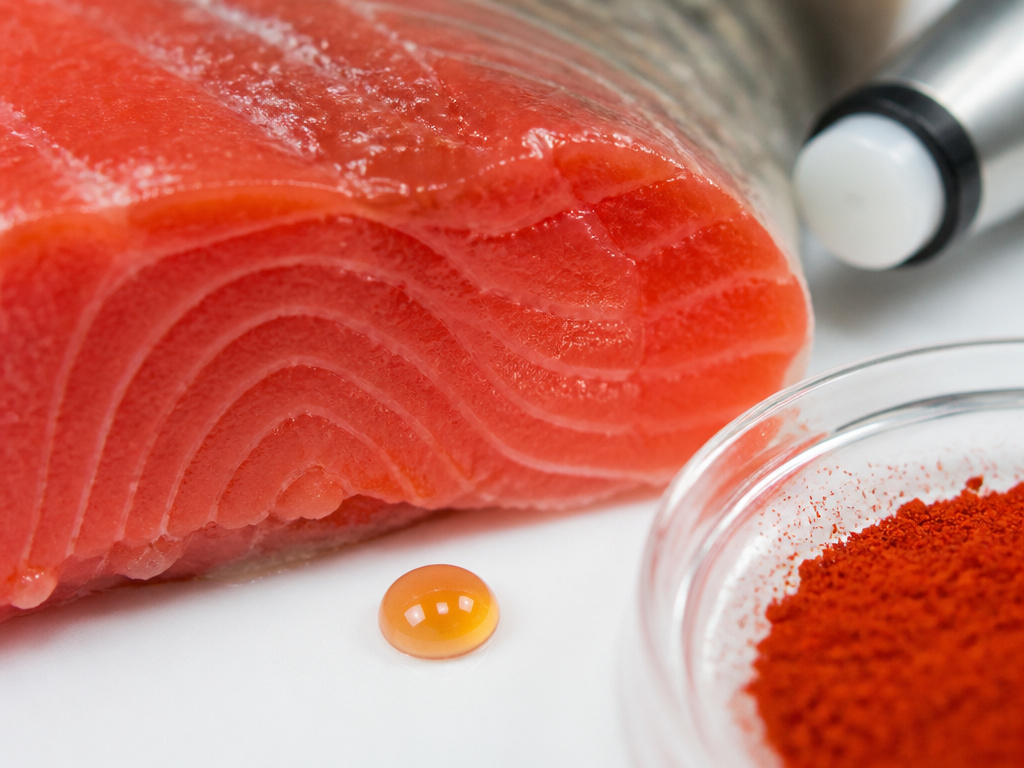
The pigment in a color-enhancing food doesn’t create color from nothing. It deposits carotenoids into skin and flesh, and the fish has to eat them because it can’t make them.
Carotenoids are fat-soluble pigments deposited in fish integument and muscle tissue. Fish cannot synthesize them de novo, so dietary supply controls tissue concentration. Pigment uptake depends on dietary lipid level, carotenoid dose, and the physical form of the source, not on the front-of-pack claim alone. Two bags at the same listed dose can perform differently.
That last sentence is the whole game. A goldfish study archived in PMC found that crude astaxanthin extracts containing natural lipids enhanced skin color in goldfish, which fits the pattern: the pigment and the fat that carries it both matter. The PMC goldfish pigmentation study also confirmed the baseline fact that fish cannot synthesize carotenoids on their own.
The front of the bag is marketing. The ingredient panel is the actual composition. You should not buy a color food because the bag has a bright fish on it.
Here is what the research actually establishes about carotenoids in fish diets:
- They’re dietary, not endogenous. Fish cannot make them, so tissue concentration tracks intake.
- They’re fat-soluble. The lipid level in the food changes how much pigment crosses the gut wall.
- They’re form-dependent. The physical state of the pigment source matters as much as the dose printed on the label.
- They deposit, they don’t create. A silver fish doesn’t turn red.
The Astaxanthin Dose Question: Safe Ceiling vs. Efficient Dose
The EFSA FEEDAP Panel set the ceiling. The Springer charr trial showed why the ceiling isn’t the target.
EFSA’s 2019 opinion on Carophyll Stay-Pink 10%-CWS put the maximum authorised astaxanthin level at 100 mg ATX/kg complete diet, equivalent to 138 mg ATX-DMDS/kg, for salmonids, other fish, and crustaceans. That’s a safety number. It tells you the top of the range, not the best spot in it.
The Springer 2024 Arctic charr trial found the apparent digestibility coefficient of carotenoids was inversely correlated with carotenoid dose. In plain terms: push the dose from 40 to 80 ppm and the fish absorbs a smaller share of what you feed. The color-enhancing fish food pros and cons include that the safe ceiling and the efficiency optimum are two different numbers, and the label rarely tells you either.
| Study | Species | Dose | Key Result |
|---|---|---|---|
| EFSA 2019 | Salmonids, other fish, crustaceans | 100 mg ATX/kg (138 mg ATX-DMDS/kg) | Safe ceiling |
| Springer 2024 | Arctic charr | 40/60/80 ppm | Digestibility falls as dose rises |
| PMC10984719 | Rainbow trout | 100 mg/kg | Synthetic beat wall-broken algae |
| JWAS 2010 | False clownfish | 0/20/50/100 ppm | Astaxanthin only one raising red hue by week 5 |
| Fas. 2025 | Clownfish | 250 mg/kg | Shrimp-shell/copepod matched synthetic |
Common mistake: Reading “100 mg/kg” on a label as a target. It’s a ceiling. The charr data shows the dose-response curve flattens well before you get there.
Synthetic vs. Natural Carotenoids: Where the Evidence Splits
The trout data and the clownfish data point in opposite directions. The split reflects the state of the research: two species, two doses, two endpoints.
What the Trout Trial Found
A 9-week rainbow trout trial starting at 561 g found that synthetic astaxanthin at 100 mg/kg produced higher dorsal fillet redness and gross energy than wall-broken Haematococcus pluvialis at the same dose. Wall-unbroken H. Pluvialis performed worst for pigmentation at identical mg/kg. The recommended wall-broken H. Pluvialis dose for rainbow trout is 75-100 mg/kg. The full comparison of astaxanthin sources in trout is worth reading if you want the raw numbers.
What the Clownfish Trial Found
A 2025 trial in Fisheries and Aquatic Sciences fed clownfish shrimp-shell and copepod carotenoids at 250 mg/kg for 75 days. Those animal-derived pigments matched or beat synthetic Carophyll Pink 10% on growth and redness, with p>0.05 against the synthetic group. The Fisheries and Aquatic Sciences carotenoid paper is the counterweight to the trout result.
The color-enhancing fish food pros and cons show different species, different dose, different endpoint. Trout are being judged on fillet color for market; clownfish are being judged on skin hue for the ornamental trade. Those are not the same measurement.
There’s also a wrinkle in the trout data itself: the physical form of the product matters. A JWAS paper found that E/Z isomer ratio and coating material of the astaxanthin product altered rainbow trout pigmentation at the same nominal dose. Same number on the label, different result in the fish.
A label dose without a pigment form and a lipid level is a number without context. Compare foods on the same basis or don’t compare them at all.
Why Does Dietary Lipid Level Change the Result?
26% dietary lipid got Arctic charr past 4 mg/kg flesh by week 12. At 10% lipid, the same pigment dose took 20 weeks.
The Springer 2024 trial fed charr 40, 60, and 80 ppm astaxanthin against 10, 18, and 26% dietary lipid for 24 weeks. The results split cleanly by fat level. The full dietary lipid and astaxanthin pigmentation research lays out the timeline.
| Dietary Lipid | 60-80 ppm ATX: >4 mg/kg Flesh | 40 ppm ATX: >4 mg/kg Flesh |
|---|---|---|
| 26% | 12 weeks | 16 weeks |
| 18% | Not reported | 20 weeks |
| 10% | 20 weeks | 24 weeks |
The mechanism is straightforward. Carotenoids are fat-soluble, so a higher-lipid diet gives the pigment more to dissolve into and carry across the gut wall. Low-lipid food at the same listed dose underperforms, and the label won’t tell you that.
The Hunter color values confirm the pattern: fillet and belly-skin L values were inversely related to carotenoid level, while a and b* values were strongly correlated with total carotenoid concentration. In non-colorimeter language, the fish gets darker and redder as pigment load rises.
Does Color Fade When You Stop Feeding It?
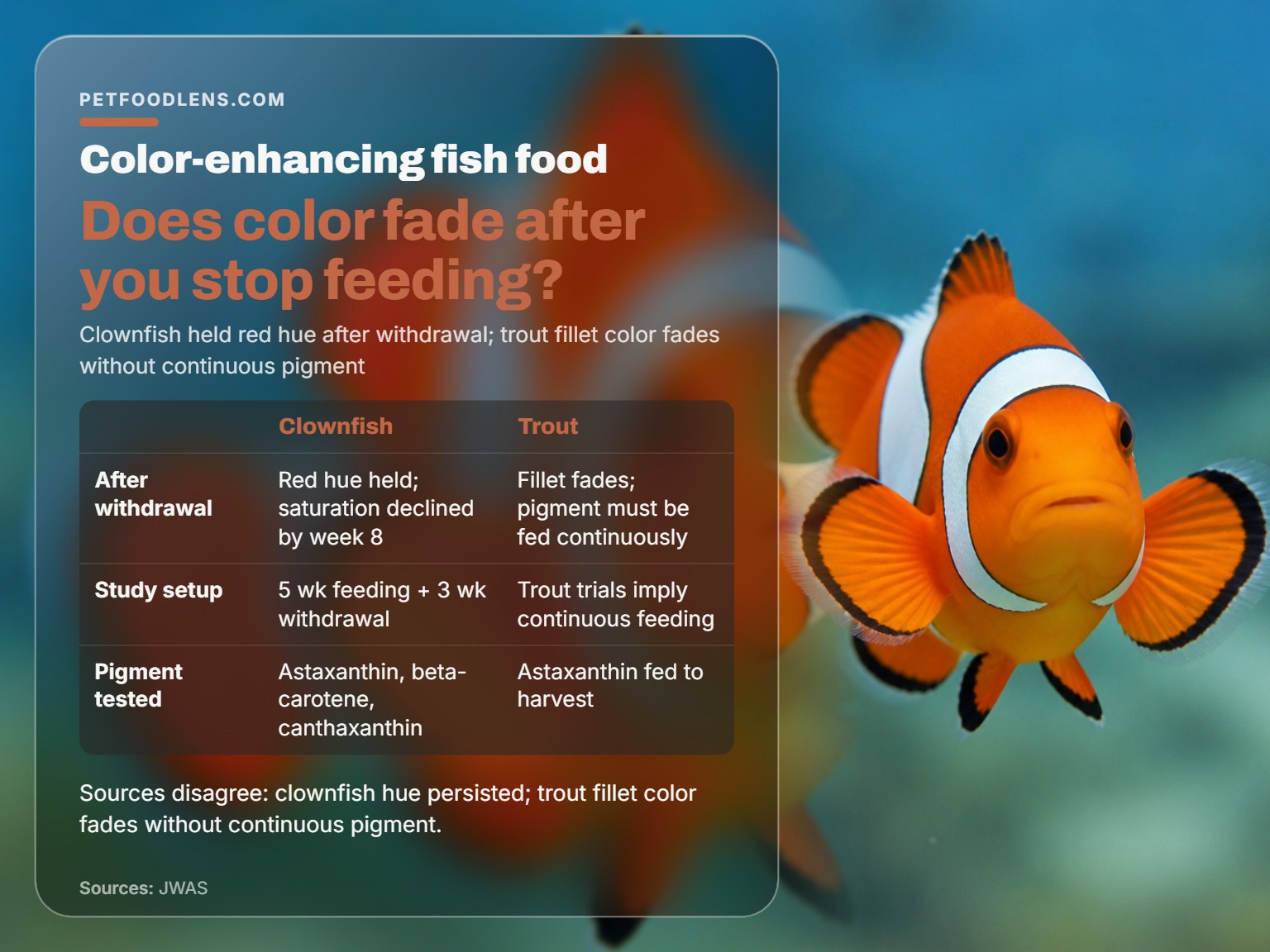
It depends on the species, and the two studies that address it don’t agree.
The 2010 false clownfish trial fed astaxanthin, beta-carotene, and canthaxanthin at 0/20/50/100 ppm for 5 weeks, then withdrew all three for 3 more. Astaxanthin was the only one of the three that raised red hue by week 5. When it was withdrawn, red hue did not drop, but saturation declined through week 8. Beta-carotene and canthaxanthin withdrawal cut saturation and brightness immediately. The carotenoid effects on fish pigments paper has the full withdrawal data.
Trout trials point a different direction. The implication there is that pigment must be fed continuously to hold fillet color, which is why commercial salmon farms feed astaxanthin right up to harvest.
My take: don’t assume a fish will hold color on a maintenance diet after a color run. In clownfish the hue held; in trout the fillet fades. If the fish is going into a show tank, keep the color food going. If it’s a pet, expect some drift in saturation after withdrawal of the pigment.
Reading a Color-Enhancing Fish Food Label
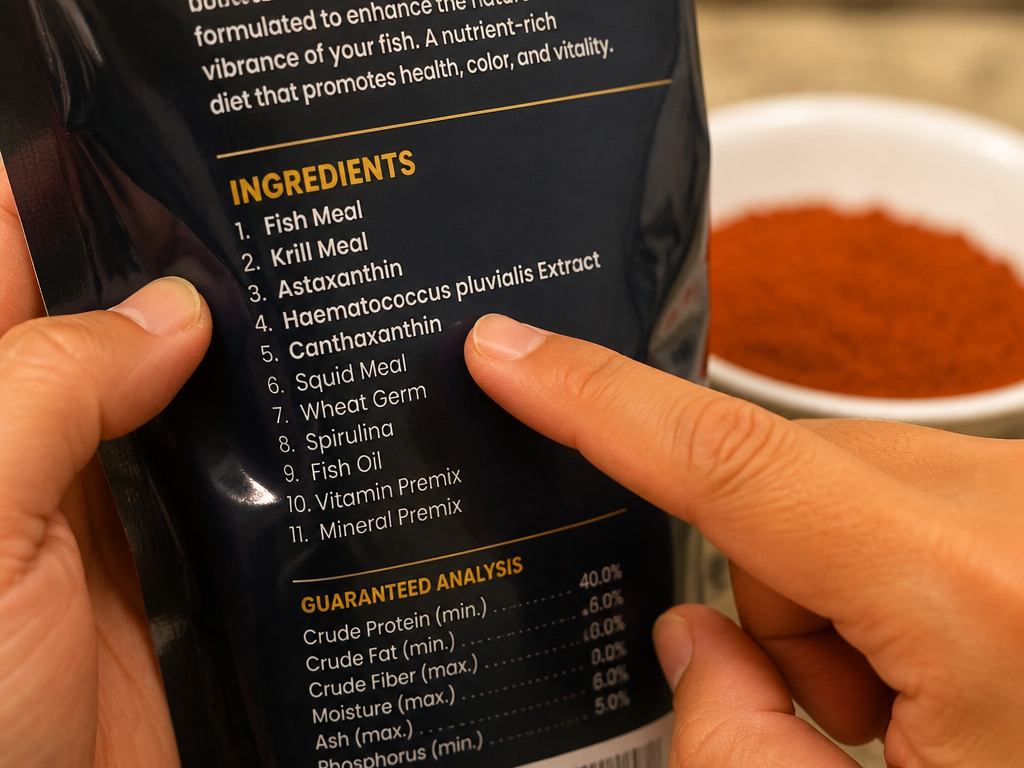
The front of the bag tells you what the marketing team wanted. The ingredient panel tells you what the food actually contains.
Most guaranteed analyses on fish food list crude protein, crude fat, crude fiber, and moisture. They do not list pigment. To find the pigment you have to read the ingredient panel, and you have to know which names to look for: astaxanthin, Haematococcus pluvialis, Carophyll, Paracoccus carotinifaciens, canthaxanthin, beta-carotene.
The First Five Ingredients
Flip the bag over. The first five ingredients tell you more about the food than the front panel ever will. If a named pigment source shows up early in the ingredient list, the dose is probably meaningful. If it shows up late in the ingredient list, the dose is probably a token.
This is the same lens that applies to artificial colors in pet food. A red pellet and a red fish are different things. One is dye, the other is deposited pigment. The label doesn’t always make the distinction obvious, so read carefully.
Wall-Broken vs. Wall-Unbroken Algae
If the label says Haematococcus pluvialis, look for “wall-broken” or “cracked cell” language. The trout trial found wall-unbroken algae performed worst for pigmentation at identical mg/kg. The trout trial found wall-unbroken algae performed worst for pigmentation at identical mg/kg.
The part nobody mentions: A bag can list Haematococcus pluvialis and still underperform a synthetic astaxanthin product at the same dose, because the algae form matters as much as the dose.
Format matters too. Fish flakes and frozen fish food both deliver pigment, but the delivery differs by format. If the fish is a slow eater, consider how the format delivers pigment.
Before you start: Paracoccus carotinifaciens, a pigment source in some color foods, is classified by EFSA as a dermal and respiratory sensitiser and an eye irritant. Open the bag away from your face, avoid inhaling the dust, and wash your hands after handling. If you have asthma or sensitive skin, wear a mask and gloves.
When Color-Enhancing Food Isn’t Worth It
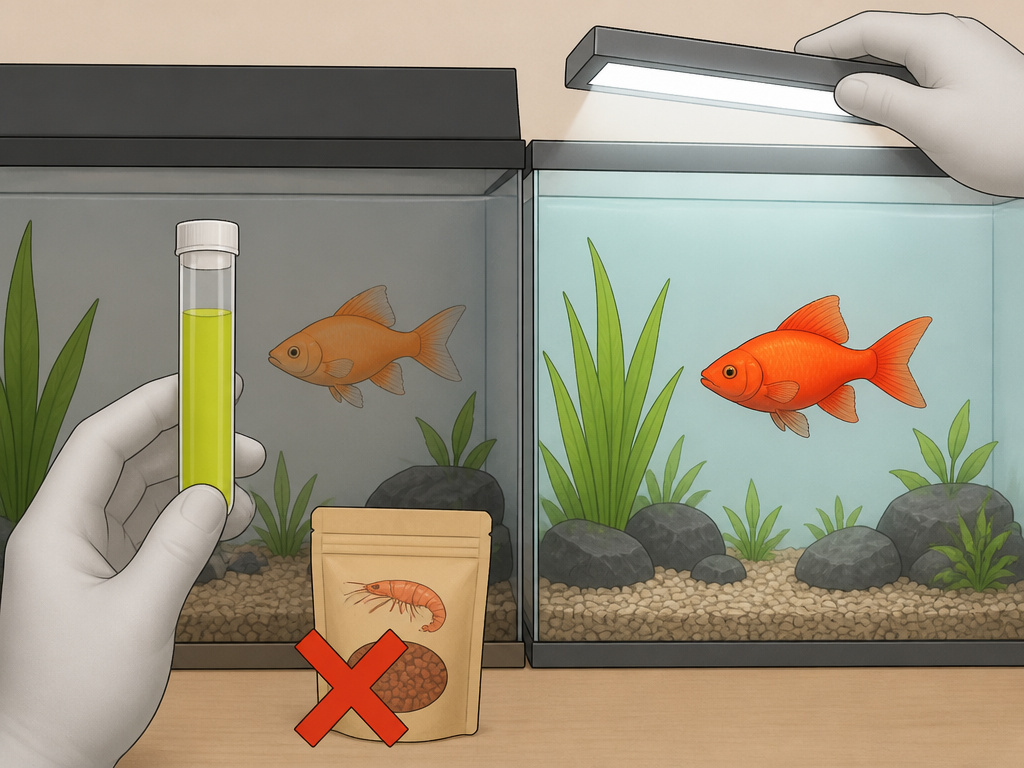
Some fish don’t need it. Some tanks can’t show it. Some bags don’t deliver it.
Fish that don’t naturally produce red or orange pigment won’t turn red from a color food. Fish that don’t naturally produce red or orange pigment won’t turn red from a color food. A GloFish is a different case; its color comes from the genome, not the diet, though a GloFish food still supports general health.
Tanks with weak lighting hide the color the fish actually has. A fish that’s red under good lighting can look dull under poor lighting. Before you buy a color food, check the light.
Here is the decision order I use:
- Test the water first. Ammonia, nitrite, nitrate. A pale fish in bad water is a water problem, not a pigment problem.
- Check the lighting. Good lighting helps show color that’s already there.
- Check the species. Non-red fish won’t turn red. GloFish are genetically colored.
- Then consider the food. Only after the first three steps pass does a color food make sense.
Skip this if: Your fish is pale because of stress, disease, or poor water quality. Color food does not fix a water problem. Test ammonia, nitrite, and nitrate first.
If you’re already feeding a varied diet with a mix of foods, a dedicated color food is an addition, not a replacement for the rotation.
For a betta that’s already showing good base color, a color enhancing betta food is the default. It’s built for the fish most owners actually keep, and check the panel for a named pigment source. For a community tank, a color food with a lower pigment load covers the same ground. A higher-dose color food is the step up if you want more pigment per feeding.
If you want one answer and you have a single betta or a goldfish: choose a color food that lists a named pigment source. That covers the large majority of household setups.
Frequently Asked Questions
Do color-enhancing fish foods actually work?
Yes, within limits. Carotenoids deposit in skin and flesh when fish eat them, and the research shows measurable color change in trout, charr, clownfish, and goldfish. The catch is that dose, dietary lipid level, and pigment source all change the result, so a bag that lists a pigment source but not a dose tells you very little.
How long does it take to see color change?
In Arctic charr on 26% dietary lipid, flesh carotenoid content passed 4 mg/kg by week 12 at 60-80 ppm. On 10% lipid, the same dose took 20 weeks. Clownfish showed raised red hue by week 5. The lipid level in the food is the biggest variable, not the calendar.
Is natural astaxanthin better than synthetic?
The evidence splits. A 9-week rainbow trout trial found synthetic astaxanthin at 100 mg/kg outperformed wall-broken Haematococcus pluvialis on fillet redness. A 2025 clownfish trial found shrimp-shell and copepod carotenoids matched or beat synthetic Carophyll Pink 10% at 250 mg/kg. Different species, different doses, different endpoints. Neither side has a clean win.
Can you overdose a fish on color-enhancing food?
EFSA set the safe ceiling at 100 mg ATX/kg complete diet for salmonids, other fish, and crustaceans. Above that, the regulatory concern is residue in edible tissue. For ornamental fish, the practical risk is wasted pigment: digestibility falls as dose rises, so more is not better.
Does color fade if you stop feeding it?
It depends on the species. In false clownfish, red hue held through week 8 after astaxanthin withdrawal, though saturation declined. In trout, the implication from commercial practice is that pigment must be fed continuously to hold fillet color. In clownfish the hue held; in trout the fillet fades.
The Bottom Line
Here’s the threshold that decides it: if the food lists a pigment source but not a dose, treat it as a maintenance food, not a color food. You can’t compare it to anything.
The second threshold: if your food is low in dietary lipid and the fish isn’t showing color, the lipid level is the likely bottleneck, not the pigment. The charr data is clear on this. Fat carries the pigment.
I’m not a fish vet. If your fish is pale and the water tests clean, consider whether the food lists a pigment source and dose. If the water doesn’t test clean, fix that first. Color food does not fix a water problem.
