
Freeze-Dried Fish Food Pros and Cons: Read the Panel
This post contains affiliate links. As an Amazon Associate, we earn from qualifying purchases.
Freeze-dried fish food pros and cons balance on water activity. At 0.85 or below, the FDA threshold for shelf-stable dried fish, the product keeps without refrigeration. Above it, the porous structure reabsorbs moisture fast, and 180-micron LDPE packaging has already been shown to fail.
That 0.85 line exists because Staphylococcus aureus grows at a lower water activity than any other pathogen the FDA tracks in dried fish. Hold the product under the line and the rest of the list can’t grow either. Drift over it and you get a slow incubation chamber inside a jar that still looks and smells normal.
What follows is the ledger. What freeze-drying genuinely buys you, where it quietly loses ground, and the two numbers that decide whether the jar in your cabinet is still worth feeding.
Key Takeaways
- Shelf stability comes from water activity, not from the word “preserved” on the lid. FDA puts the pathogen barrier at 0.85 or below.
- The same porosity that speeds rehydration speeds moisture pickup. A 180-micron LDPE vacuum pack let water activity climb from 0.167 to 0.539 over 240 days at 24 C.
- Freeze-drying doesn’t automatically beat other drying methods. It won on saithe protein powder only when lyoprotectants were added.
- Warm storage costs you color. Freeze-dried surimi held at 22 C yellowed significantly.
- Feed it inside the window, not at the edge of it. Free amino nitrogen in freeze-dried prawn rose sharply after 3 to 4 months of storage.
What Water Activity Actually Measures in a Jar of Freeze-Dried Food
Water activity is the share of water in a food that microorganisms can actually use, and it isn’t the same number as moisture content.
Water activity measures the water in a food that is available for microbial growth. A value of 0.85 or below prevents growth and toxin production by all pathogenic bacteria, including Staphylococcus aureus and Clostridium botulinum. Staphylococcus aureus grows at the lowest water activity of the group and is therefore the target organism for shelf-stable drying.
USDA ARS researchers ran pink, sockeye, and chum salmon through a 9-hour freeze-dry cycle and landed below 10% moisture and under 0.4 water activity. Yield came in at 26 to 28.4%, and shrinkage stayed under 12%.
| Water activity | What it means | Source |
|---|---|---|
| 0.85 or below | No pathogen growth or toxin formation | FDA drying guidance |
| Below 0.97 | C. Botulinum type E and non-proteolytic B/F held; refrigeration still required | FDA drying guidance |
| Below 0.60 | No microbial proliferation of any kind | Freeze-drying review |
Two thresholds get quoted in this space, and they answer different questions. The FDA fish hazards and controls guidance sets 0.85 as the line below which no pathogenic bacteria, S. Aureus included, can grow or form toxin. A separate freeze-drying review puts the no-proliferation line at 0.60.
Both can be right. One is a pathogen-toxin barrier for a shelf-stable product. The other is a broader ceiling for any microbial growth at all.
The FDA line is the one that matters for a jar on your shelf, because it’s the one built around the organism most likely to hurt something.
Freeze-Dried Fish Food Pros and Cons: The Case For It
Three things freeze-drying genuinely gets right: weight, shelf life, and no freezer required.
The weight part is arithmetic. USDA ARS measured freeze-dried salmon cubes coming out at 26 to 28.4% of their starting weight, which means roughly three-quarters of the original mass is gone before the USDA ARS fish research publication ever gets cited in a storage discussion.
Shake a sealed jar and the cubes rattle. That dry clatter is the sound of a product with almost no water left in it.
- No freezer, no thaw cycle. A sealed jar sits on a shelf until you open it, and there’s no drip tray to clean afterward.
- Portion control by the piece. Drop two cubes and stop. That’s harder with a frozen blister pack.
- Fast rehydration. Sublimation leaves a sponge behind, and a sponge takes water back quickly.
- Light and easy to store. A fraction of the original mass means the jar fits where a frozen pack won’t.
The freeze-dried bloodworms sold in most shops are midge larvae, and the drying method does more to the final product than the species on the label does.
If you want one product to start with, a single-ingredient freeze-dried bloodworm jar is a reasonable pick, for a boring reason: it tells you exactly what you’re feeding and nothing else.
The Case Against: Moisture Rebound, Protein Damage, and Yellowing
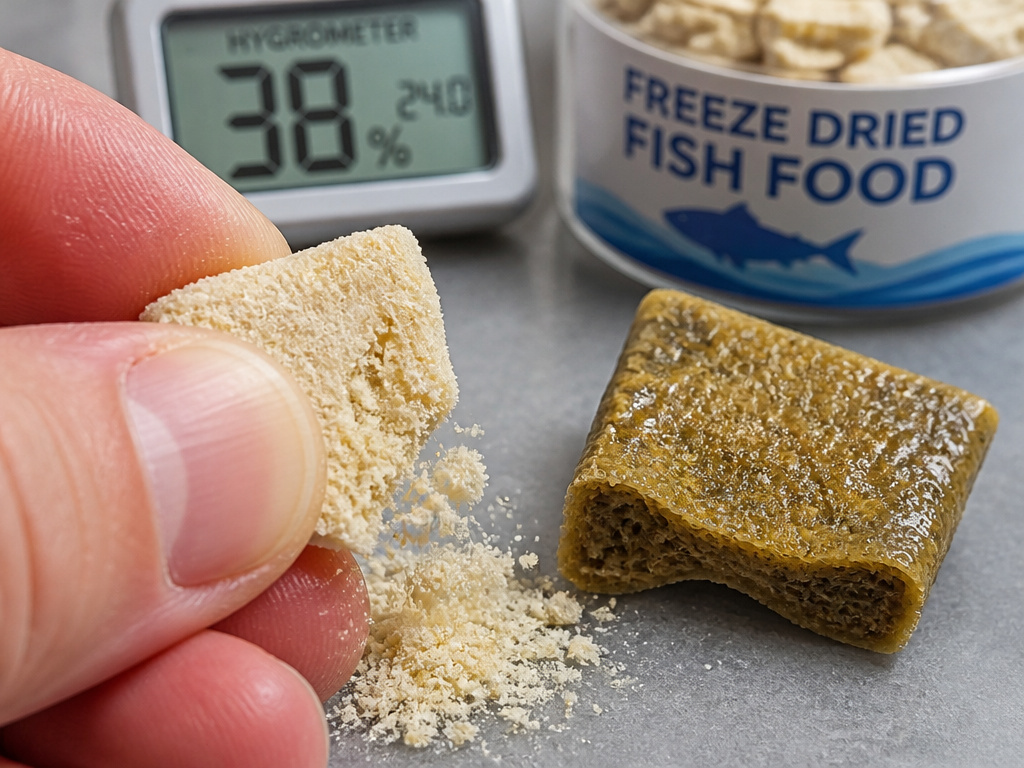
Freeze-dried food fails in slow motion, and the failure is invisible from the outside.
A cube that’s still good crushes to powder between your fingers with a dry snap. One that’s spent a season in a soft bag bends instead, and the smell shifts from a faint marine tang to something closer to old cooking oil.
That’s the porosity working against you. Sublimation leaves a sponge, and a sponge pulls water back out of humid air, out of a damp lid, out of the tank itself.
Protein takes a hit too, and the size of that hit is where the literature gets interesting. Govindan’s work on prawn found 21% of salt-extractable protein rendered insoluble by freeze-drying, while water-extractable protein came through undamaged. Other reviews describe broader irreversible denaturation, with the magnitude depending on the matrix.
The honest position: the damage is real, its extent is disputed, and the species matters.
Fat is the other clock. Reynolds, Park and Choi found freeze-dried Pacific whiting surimi yellowed significantly when stored at 22 C, which is roughly a warm cupboard in a kitchen.
- Moisture rebound. The sponge reabsorbs water from air, and once it does, the safety margin shrinks.
- Protein insolubilization. A fifth of the salt-extractable fraction in prawn, per Govindan.
- Lipid yellowing. Visible at warm storage temperatures, and it doesn’t reverse.
- Flavor drift. Free amino nitrogen climbed sharply after 3 to 4 months in the prawn trials.
The broader chemical and nutritional changes in dried fish run through lipid oxidation, protein cross-linking, and vitamin loss. None of them stop because the jar is sealed.
Packaging Is Where Freeze-Dried Food Quietly Fails
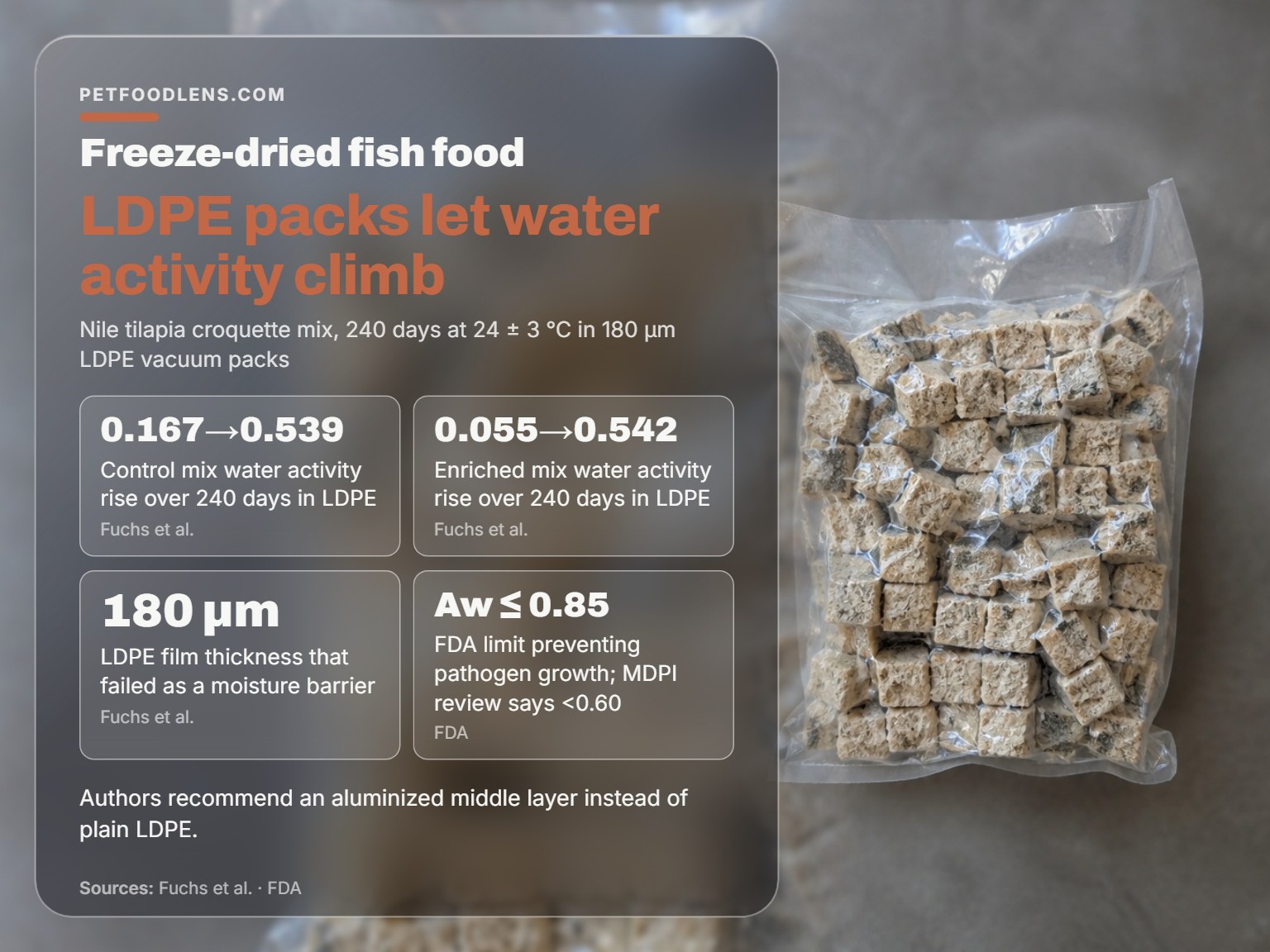
In 240 days at 24 C, a 180-micron LDPE vacuum pack let water activity climb from 0.167 to 0.539.
Fuchs and colleagues freeze-dried a Nile tilapia croquette mix at minus 55 C and 290 Pa for 24 hours, packed it in 180-micron LDPE bags measuring 20 by 35 cm, and stored it at 24 plus or minus 3 C for 240 days. The control mix went from 0.167 to 0.539. The enriched mix went from 0.055 to 0.542.
Same destination, different starting point.
The authors’ conclusion was blunt. LDPE failed as a moisture barrier, and an aluminized middle layer is what they recommend instead.
- The film. Plain polyethylene passes water vapor. A metallized or foil layer is what stops it.
- The closure. FDA guidance calls for closures free of gross defects, because a lid that doesn’t seat is a hole with a gasket around it.
- The storage temperature. Warm air holds more water, so a jar near a stove or a radiator is fighting a harder battle than one in a cool cupboard.
Where this goes sideways: Decanting freeze-dried food into a plain zip-top bag to save space. Over 240 days at room temperature that’s close to the exact configuration that let water activity pass 0.5 in the tilapia trial, and the food looks and smells fine the entire way.
When the barrier gives, the cubes clump into one lump at the bottom of the jar before anything visible grows on them.
What a Good Barrier Actually Looks Like
Choose a metallized or foil layer, a lid with a real gasket, and a jar small enough that you’ll finish it while it’s still good. A clear polyethylene tub with a press-fit lid is the worst of both worlds.
Get the fish food storage right and a jar holds for months. Get it wrong and the product starts degrading on the drive home.
Does Freeze-Drying Actually Preserve Protein Better?
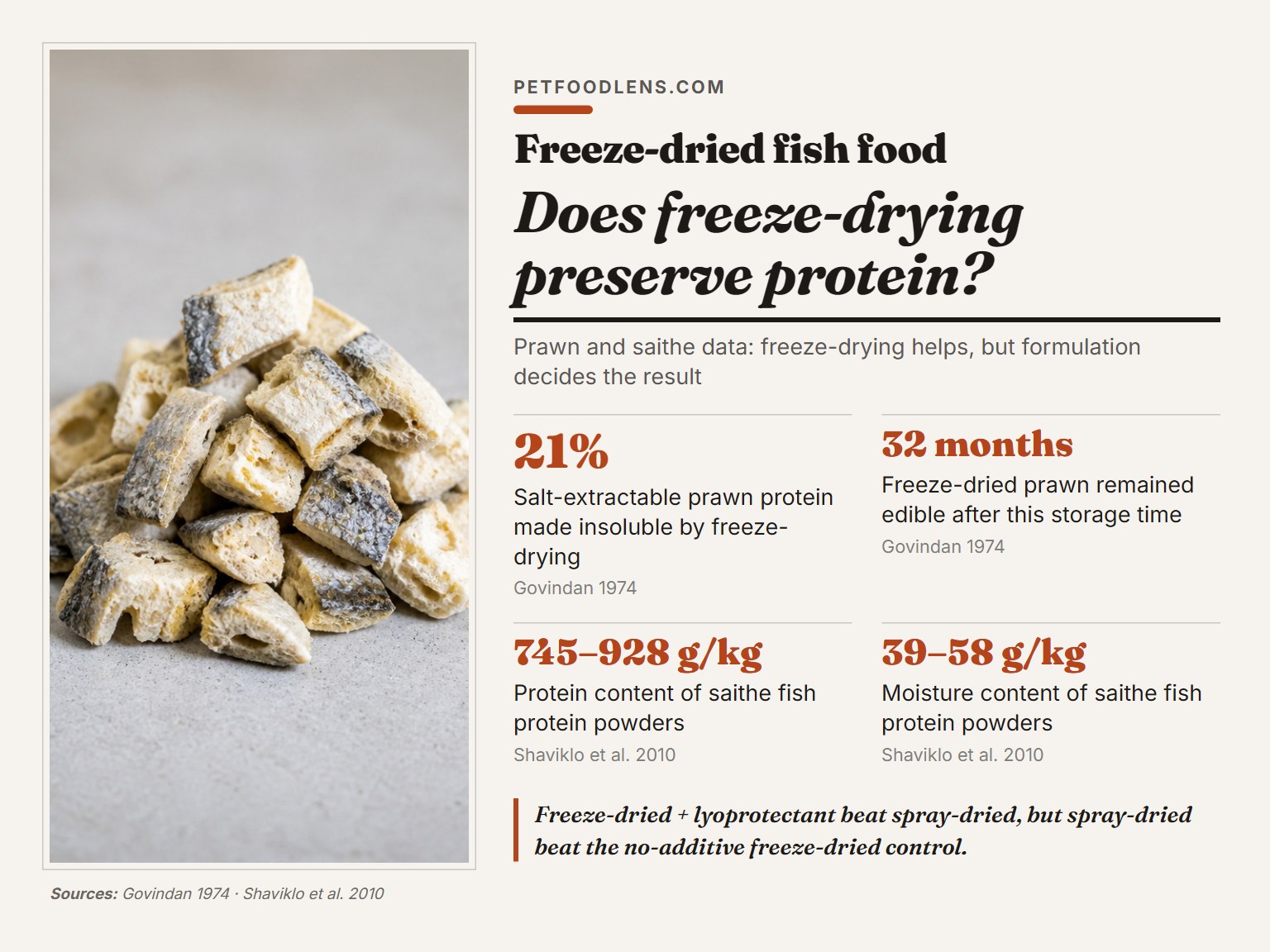
Sometimes, and the qualifier carries more weight than the headline.
Govindan’s prawn work is the cleanest single data point in the set. Freeze-dried prawn held 21% of its salt-extractable protein in insoluble form, water-extractable protein came through intact, and the product was still edible after 32 months.
The saithe fish protein powder quality study is messier and more useful. Freeze-dried powder with lyoprotectants beat spray-dried powder on water-binding, emulsion, solubility, and lipid oxidation. Spray-dried had the lowest viscosity.
But spray-dried still beat the freeze-dried control that had no additives at all.
So freeze-drying wins when the formulation is built for it, and loses when it isn’t. The saithe powders ran 745 to 928 g/kg protein, 39 to 58 g/kg moisture, and 21 to 32 g/kg fat, which is a wide enough spread to swamp a drying-method comparison on its own.
I’d rather see a named lyoprotectant in the formulation than a lid that leans on “freeze-dried” as the entire selling point. The drying method sets the ceiling. The recipe decides whether you get anywhere near it.
How Long Does Freeze-Dried Fish Food Last?
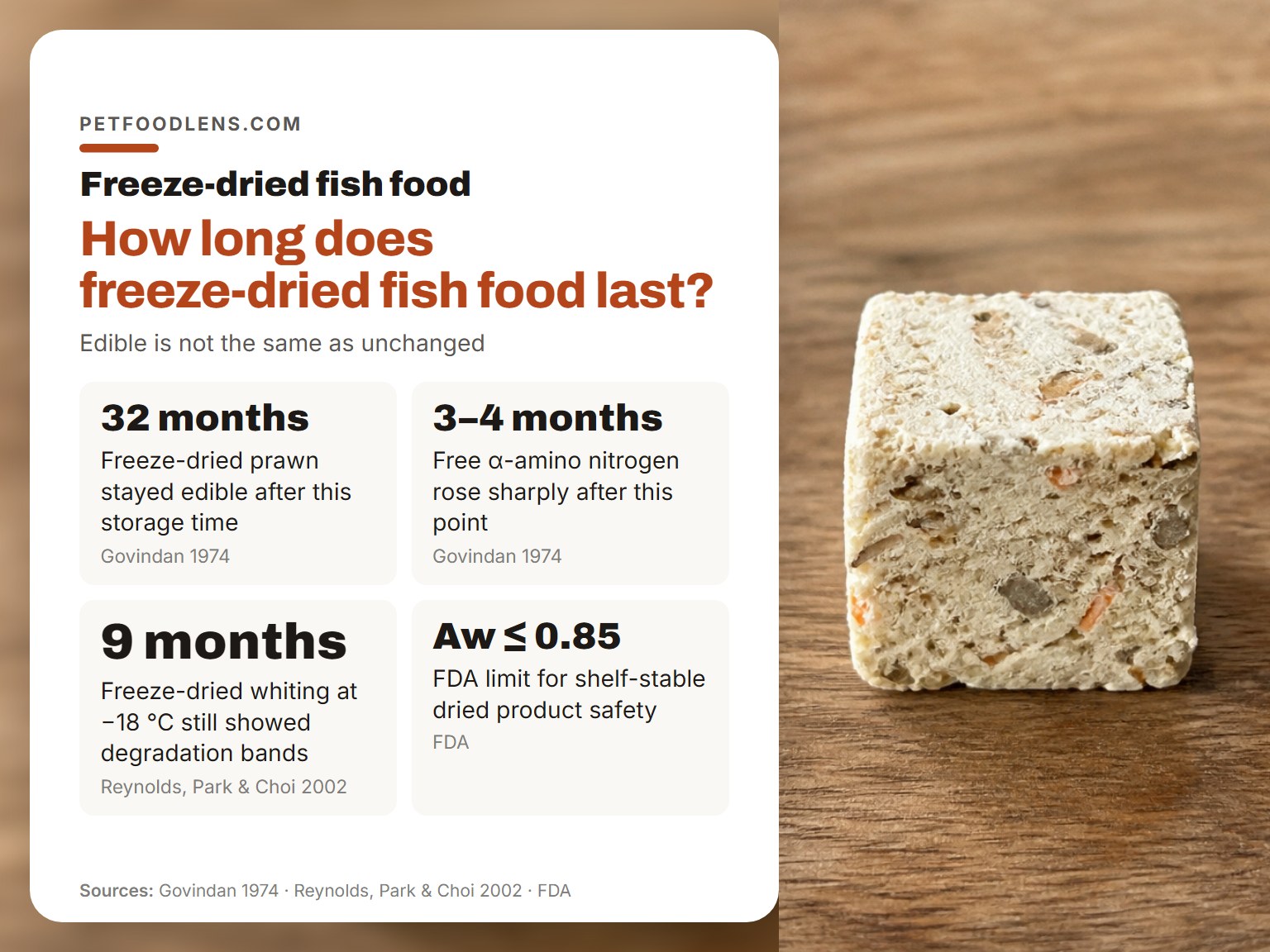
Thirty-two months is the longest documented run in this literature, and it came with a caveat.
Govindan’s freeze-dried prawn stayed edible after 32 months of storage. Free alpha-amino nitrogen, a marker of protein breakdown, rose sharply after 3 to 4 months. So “edible” and “unchanged” are two different claims, and only one of them is good news.
The freezing and storage effects on surimi work tracked freeze-dried Pacific whiting at minus 18 C for 9 months. It retained the highest salt-extractable protein and the lowest dimethylamine of any method tested. Proteolytic degradation bands still showed up at 6 and 9 months.
- Smell first. Rancid oil is the earliest tell, and it reads as old cooking oil rather than fish.
- Texture second. Soft, bendy cubes have taken on water.
- Color third. Yellowing means lipid oxidation has been running a while.
- Water activity last, because you can’t see it. There’s no figure in this literature for how long an opened jar stays under 0.85 in a home.
The practical read on fish food shelf life is that the sealed jar is a different product from the opened one. The clock that matters starts the day you break the seal.
Freeze-Dried vs Frozen vs Flake: Which Fits Your Tank
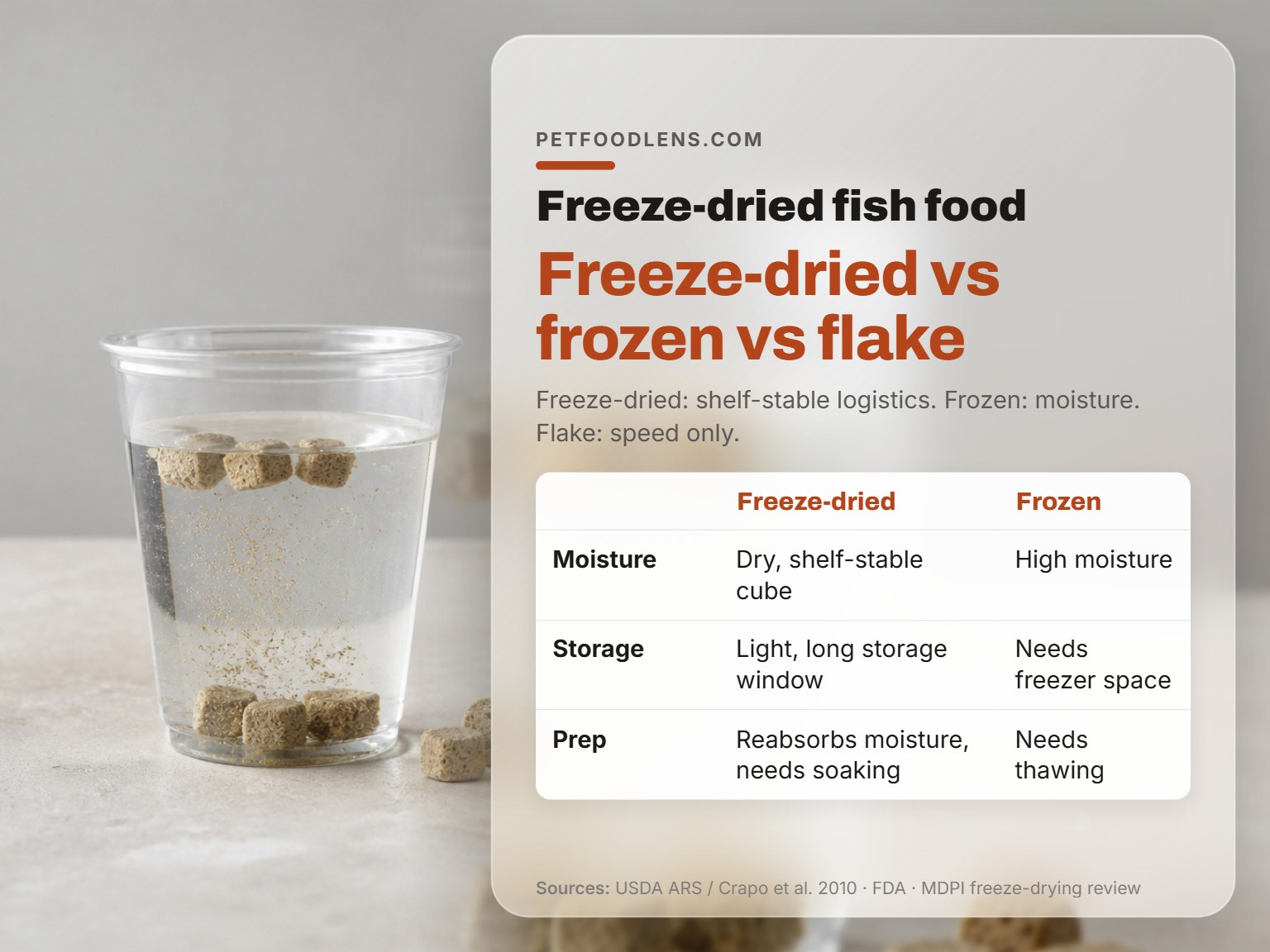
Frozen wins on moisture and feeding response. Freeze-dried wins on logistics. Flake wins on speed and loses on almost everything else.
| Format | What you get | Where it falls short |
|---|---|---|
| Frozen | High moisture, strong feeding response | Needs freezer space and thawing |
| Freeze-dried | Shelf-stable, light, long storage window | Reabsorbs moisture, needs soaking |
| Flake | Fast, floats, easy to portion | Degrades quickly once opened |
If your fish take frozen reliably and you have the freezer room, frozen is the better food. The frozen fish food route delivers moisture that a dry cube simply doesn’t carry.
Freeze-dried is the better choice when freezer space is tight, when you feed lightly and a frozen pack would thaw and refreeze, or when the tank sits somewhere you can’t keep anything cold.
Flake earns its place for small fish that won’t take a larger piece, but fish flakes are the format that goes downhill fastest once the container is open.
Live food beats both on feeding response, and it’s the only format that triggers hunting behavior rather than just feeding. The live food trade-off is that you’re now culturing something, which is a hobby inside the hobby.
Rehydrating Before It Hits the Water
A dry cube dropped straight in floats, and a fish that feeds mid-water may never touch it.
Soak it first. Put the cubes in a small cup of tank water, let them sit until they sink, then pour the whole cup in. The rehydrate freeze-dried fish food step takes a few minutes of your attention and solves the floating problem completely.
Freeze-dried bloodworms soften quickly in tank water and hold their shape well enough to sink. Freeze-dried copepods suit small fish better than a bloodworm does.
Frequently Asked Questions
Is freeze-dried fish food safe to leave in the tank?
Uneaten cubes should come out. Once rehydrated they’re a wet food sitting in warm water, and the water activity protection that kept them shelf-stable is gone the moment they soak. Net out what isn’t eaten within a few minutes.
Does freeze-dried food lose nutrition over time?
Yes, and the loss shows up in stages. Free amino nitrogen in freeze-dried prawn rose sharply after 3 to 4 months, and lipid oxidation yellowed surimi stored at 22 C. Protein damage from the drying itself is separate and happens before the jar is ever opened.
What water activity should freeze-dried fish food be at?
For a shelf-stable product, 0.85 or below is the FDA pathogen barrier, and S. Aureus is the organism that sets it. A freeze-drying review puts the broader no-proliferation line at 0.60. Those numbers answer different questions, and both are legitimate.
How can I tell if freeze-dried food has gone bad?
Smell it, then squeeze a cube. Rancid oil reads as old cooking oil, and a cube that bends instead of snapping has taken on moisture. Yellowing is the third sign, and it means lipid oxidation has been running for a while.
Can I feed freeze-dried food every day?
You can, as long as you rehydrate it and the fish are getting enough moisture elsewhere. A dry product contributes almost no water to the tank, so fish that eat only dry food are relying entirely on what they drink and what the tank provides.
The Bottom Line
One rule worth keeping: if a jar has been open in a humid room for a season, treat it as suspect even when it looks perfect. Water activity is invisible, and the tilapia trial showed it climbing past 0.5 in packaging that never leaked a drop.
That’s the concession I’d make to anyone who likes this format. Freeze-dried is the most convenient shelf-stable fish food you can buy, and that convenience is exactly what makes people leave the lid loose.
Weigh the freeze-dried fish food pros and cons against your own feeding routine rather than the marketing copy. If you feed a small tank once a day, buy the smallest jar that lasts you a couple of months and finish it. A big tub only pays off if you actually reach the bottom before the moisture does.
