
Seed Sticks for Birds Guide: What the Pack Says
This post contains affiliate links. As an Amazon Associate, we earn from qualifying purchases.
Seed sticks for birds are a supplement to a balanced base diet, and this guide starts where the pack does: the feeding instruction. Witte Molen caps its sticks at 20% of the daily menu, Versele-Laga says feed freely, and Vitakraft says hang one per habitat. Three brands, three answers.
That spread is real, and it comes from the products themselves. A canary stick and a cockatiel stick are different objects with different coatings, so each maker writes a rule that fits its own item. Wild Harvest goes further and labels its stick intermittent or supplemental only. A seed sticks for birds guide helps owners compare these differing rules.
What follows: the four things worth checking on any pack, a side-by-side of the feeding lines, the wood-versus-rawhide split, and the sugar line most buyers walk straight past.
Key Takeaways
- Read the feeding line on the pack you actually bought. Witte Molen caps at 20% of the daily menu, Versele-Laga says feed freely, Vitakraft says one stick per habitat.
- The core material changes the risk profile. Vitakraft and Nestor use wood for beak wear; Wild Harvest uses beef hide and calls its stick supplemental only.
- “No added sugars” and honey can both be true across a category. Versele-Laga claims none added; Nestor lists honey at 4%; Vitakraft lists honey and maltodextrins.
- A stick is seed and grain, so it competes with the fortified food that carries the vitamins. Keep it a small share of the week.
- Check the colour line. Wild Harvest’s own ingredient list names FD&C Yellow #5, Red #40 and Blue #1.
What Is a Seed Stick Made Of?
A baked seed stick is seed, grain and a coating bound around a rigid core. That’s the whole architecture, and nearly every difference between brands sits in one of those three parts.
A baked seed stick binds seed and grain around a rigid core, then coats the outside. Triple-baked products are dipped between baking steps, so vitamins and minerals sit in layers on the surface. The core sets how long the stick survives a beak, and the coating sets how much sugar and colour the bird takes in.
Nestor Classic Sticks (article 066) lists biscuit at 5.5% and honey at 4% in its composition. Versele-Laga’s Prestige Sticks for small parrots publish nuts at 4%, split evenly between hazelnut and walnut, plus raisins at 2% and oyster shells at 4%.
Those two lists show how differently one category can be built. One leans on grain and a sweet binder. The other leans on nut and fruit pieces with a calcium source bolted on.
Here’s what to check on any pack:
- First ingredient. A named seed such as millet as the first ingredient tells you more than “grain products” does.
- The binder. Honey, maltodextrins or a syrup is what holds the seed together.
- The core. Wood, rawhide, or an edible stick.
- The colour line. Turmeric and paprika oleoresin are plant-derived; FD&C numbers are synthetic dyes.
The Feeding Instructions Disagree, So Read the One on Your Pack
Every pack in this category carries a feeding line, and the lines contradict each other. That isn’t a scandal. A canary stick and a cockatiel stick are different objects, so each maker writes a rule that fits its own product.
| Brand | Feeding line on the pack | What it gives you |
|---|---|---|
| Witte Molen PUUR Sticks | Maximum 20% of the daily menu | A hard cap |
| Versele-Laga Prestige Sticks | Provide freely as an addition to the main feed | No cap at all |
| Vitakraft Crunch Sticks | Hang one stick per habitat | A unit dose |
| Wild Harvest Treat Stick | Intermittent or supplemental feeding only | No number |
| Zoo Roco (retailer guidance) | Use in moderation as a supplement | A principle |
Versele-Laga’s “freely” wording is the outlier, and it’s worth reading closely. It says freely as an addition to the main feed, which puts the base diet first and the stick second. The word freely is doing less work than it looks.
Vitakraft’s single-stick instruction is the most usable of the lot, because it’s a count rather than a percentage. You hang one, you see how long it lasts, and you learn your bird’s actual rate.
What most people get wrong: Treating “one stick per habitat” as a daily ration. The instruction tells you how many to hang at a time, not how often to replace it. A cockatiel can strip a stick quickly, and refilling it the moment it’s gone turns a treat into a food group.
How Much of the Daily Menu Should a Stick Take Up?
Witte Molen puts a 20% ceiling in writing, while Versele-Laga says provide freely as an addition to the main feed and Vitakraft says hang one stick per habitat. Witte Molen states that PUUR Sticks should make up a maximum of 20% of the bird’s daily menu. Everything else is looser language.
That seed sticks for birds guide number is worth respecting for a mechanical reason. A seed stick is seed and grain, and seed and grain are exactly what a fortified pellet is designed to balance against. Fill a fifth of the day with stick and the bird still has room for real food. Push past it and the bird eats the sweet part and leaves the vitamins.
Portion drift is the quiet problem in every feeding guide I’ve worked with. A client once told me she was following the printed measuring cup exactly. Her scoop held more than the cup did. I ask people to weigh portions on a kitchen scale now, and I’d ask the same of anyone eyeballing a seed stick.
Rule of thumb: Witte Molen caps its sticks at 20% of the daily menu, while Versele-Laga says provide freely as an addition to the main feed; either way, know which rule you’re following. You’re feeding a diet and hoping.
If the stick is already the main event, that’s a seed-only diet problem wearing a treat’s clothing. Cut the stick first and watch what the bird does with the bowl.
Wood Core vs Rawhide Core: Two Answers to the Same Question
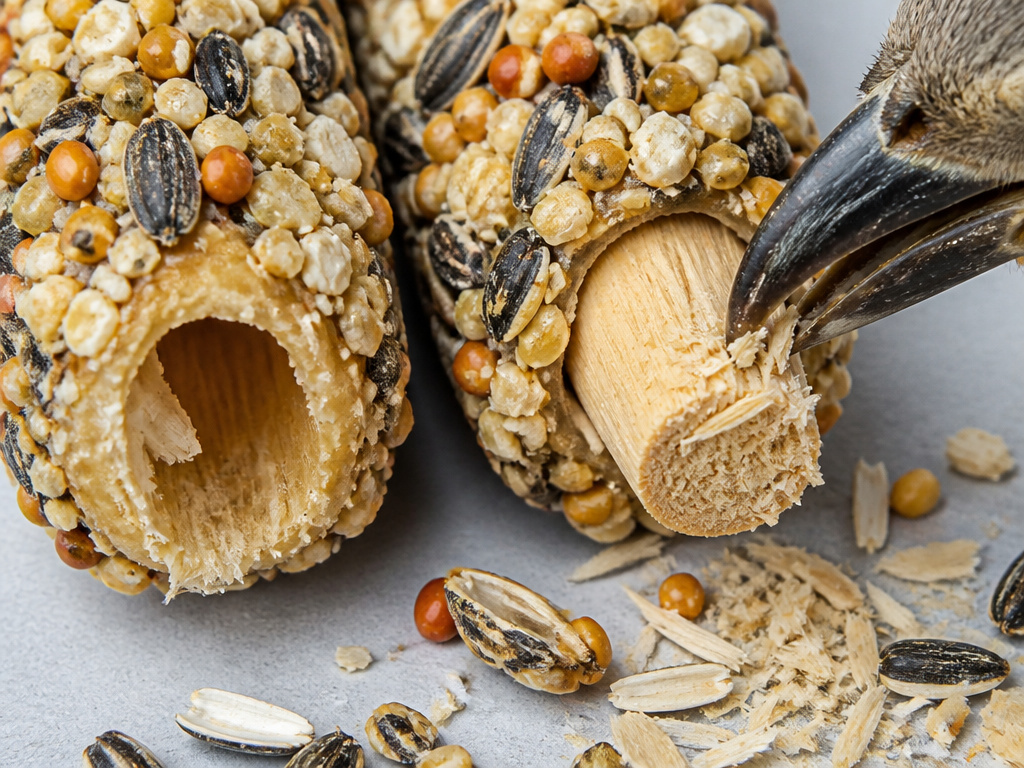
The core is the part the bird works on after the seed is gone, and the two materials behave very differently in a beak.
Wood: Vitakraft and Nestor
Vitakraft states that each stick’s wooden center encourages chewing to wear down a bird’s beak. Nestor makes the same claim for its wooden core, saying it helps keep the beak in shape. Both are describing resistance: the bird has to work at the wood, and the working is the point.
A wood core gives the bird something to work at, and the working is the point. That’s the mechanism doing the job.
Rawhide: Wild Harvest, With Its Own Caveat
Wild Harvest takes the opposite route, using a rawhide center prepared especially for birds. Its ingredient list names beef hide outright, and the same page carries two caveats: not for human consumption, and intended for intermittent or supplemental feeding only.
Rawhide behaves nothing like wood. It is an animal-hide product, and the manufacturer’s own label limits it to supplemental feeding.
That difference matters if you’re comparing choosing safe bird treats across brands. Two sticks can claim the same function, beak wear, while being made of materials that break down in completely different ways. Wild Harvest itself doesn’t present the two as equivalent.
The part nobody mentions: A rawhide core is an animal-hide product, and the manufacturer’s own label limits it to supplemental feeding. If your bird swallows chunks rather than working them down, the wood-core products are the more predictable choice.
Read the Sugar Line Before the Flavour Line
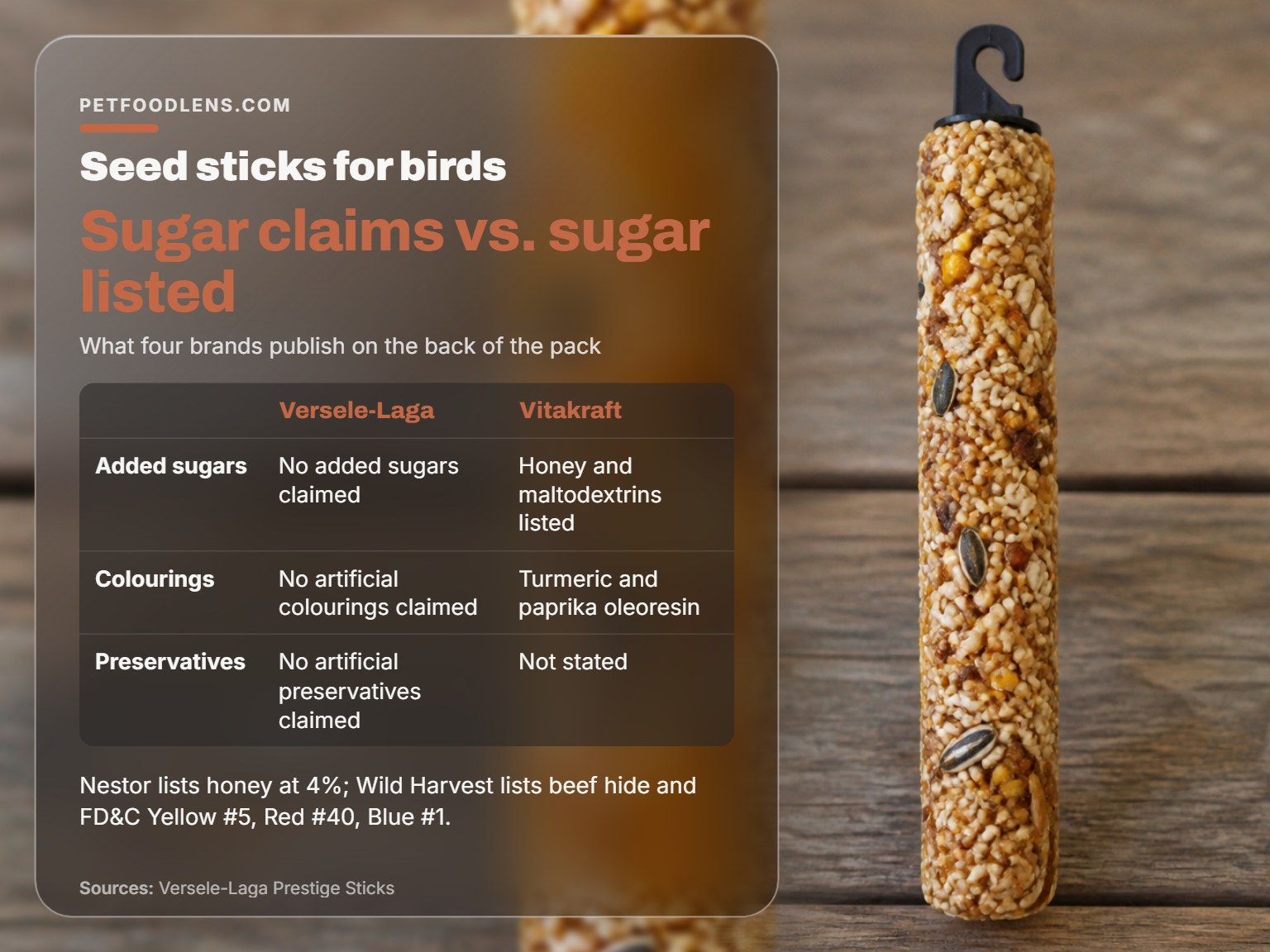
Flip the pack over. The front says apricot and peach; the ingredient list says honey, maltodextrins and two colourants.
That gap is the whole reason a seed sticks for birds guide says to read the back. Here’s what the four brands actually publish:
- Versele-Laga claims its Prestige Sticks contain no added sugars, and no artificial preservatives or colourings.
- Nestor lists honey at 4% in its composition.
- Vitakraft lists honey and maltodextrins in its MENU Treat Sticks ingredients.
- Wild Harvest lists beef hide and FD&C Yellow #5, Red #40 and Blue #1 in its ingredient list.
None of these is a scandal on its own. Honey at 4% is a small number. The point is that “no added sugars” is a claim one brand can make while a competitor’s pack lists two sugar sources, and both are legal and both are on the shelf next to each other.
If you want the longer version of that argument, honey sticks get their own treatment. The short version: a sweet binder is what makes the seed stick together, and it’s also what makes the bird come back to it.
A honey-coated stick feels tacky on the fingers, and that tack is the sugar doing its job as glue.
Natural Colour Still Counts as Colour
Vitakraft lists turmeric and paprika oleoresin as colour in both its MENU and Crunch Sticks lines. Those are plant-derived, which is a different standard from synthetic dye. Wild Harvest’s ingredient list includes FD&C Yellow #5, Red #40 and Blue #1.
Worth knowing before you start: Synthetic dyes are listed on some sticks, and a dyed stick can tint the droppings, so check what you hung before assuming illness. If you see colour in the cage and assume illness, check what you hung before you call anyone.
What the Guaranteed Analysis Actually Tells You
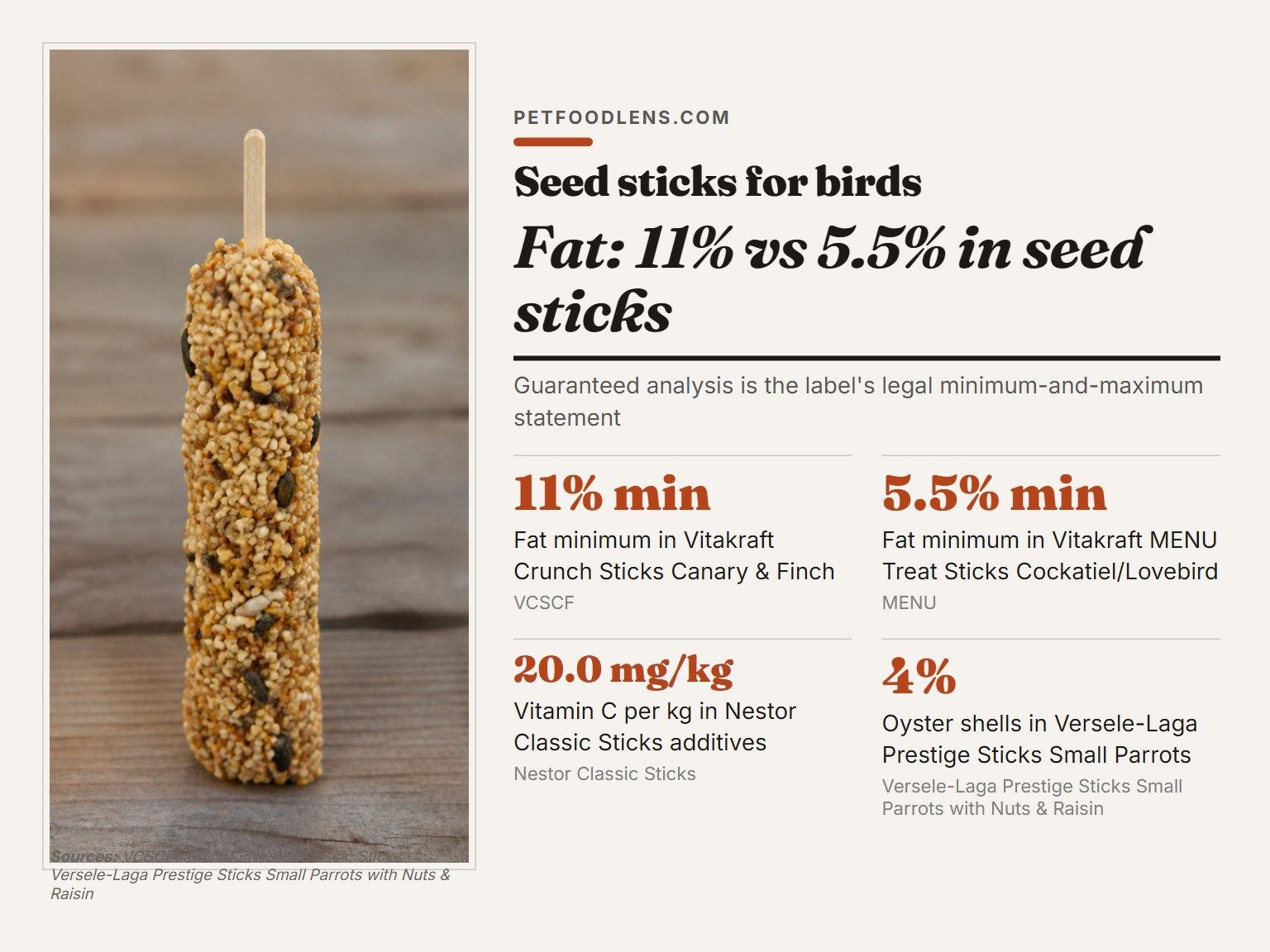
Guaranteed analysis is the only part of the label a marketing team can’t reword. It’s a legal minimum-and-maximum statement, and it lets you compare two sticks without reading a single adjective.
| Product | Pack format | Published numbers |
|---|---|---|
| Vitakraft MENU Treat Sticks Cockatiel/Lovebird | 3.5 oz, 2 sticks | Protein min 10%, fat min 5.5%, fibre max 10.4% |
| Vitakraft Crunch Sticks Canary & Finch | 1.4 oz, 2 sticks | Protein min 13%, fat min 11%, fibre max 8.7% |
| Nestor Classic Sticks | 2 x 85 g | Biscuit 5.5%, honey 4% |
| Versele-Laga Prestige Sticks Small Parrots | 2 x 30 g | Nuts 4%, raisins 2%, oyster shells 4% |
Read the fat line first. The canary and finch stick runs a minimum of 11% fat, compared with 5.5% on the cockatiel and lovebird stick. That’s a real difference for a small bird with a fast metabolism and a small body to carry it.
Nestor goes a different route and publishes vitamins instead: per kilogram, B1 at 0.8 mg, B2 at 3.0 mg, B6 at 1.5 mg, K3 at 1.5 mg and C at 20.0 mg. That’s a micronutrient panel rather than a macronutrient one, and it tells you the stick was built as a supplement from the start.
Easy to miss: A guaranteed analysis covers protein, fat, fibre and moisture. It says nothing about sugar. The honey and maltodextrins live in the ingredient list, not the numbers, so you need both halves of the label.
I read the guaranteed analysis before the ingredient list now, because the numbers are the part nobody can spin. Then I read the ingredients to find what the numbers left out.
Where Seed Sticks for Birds Fit in a Week
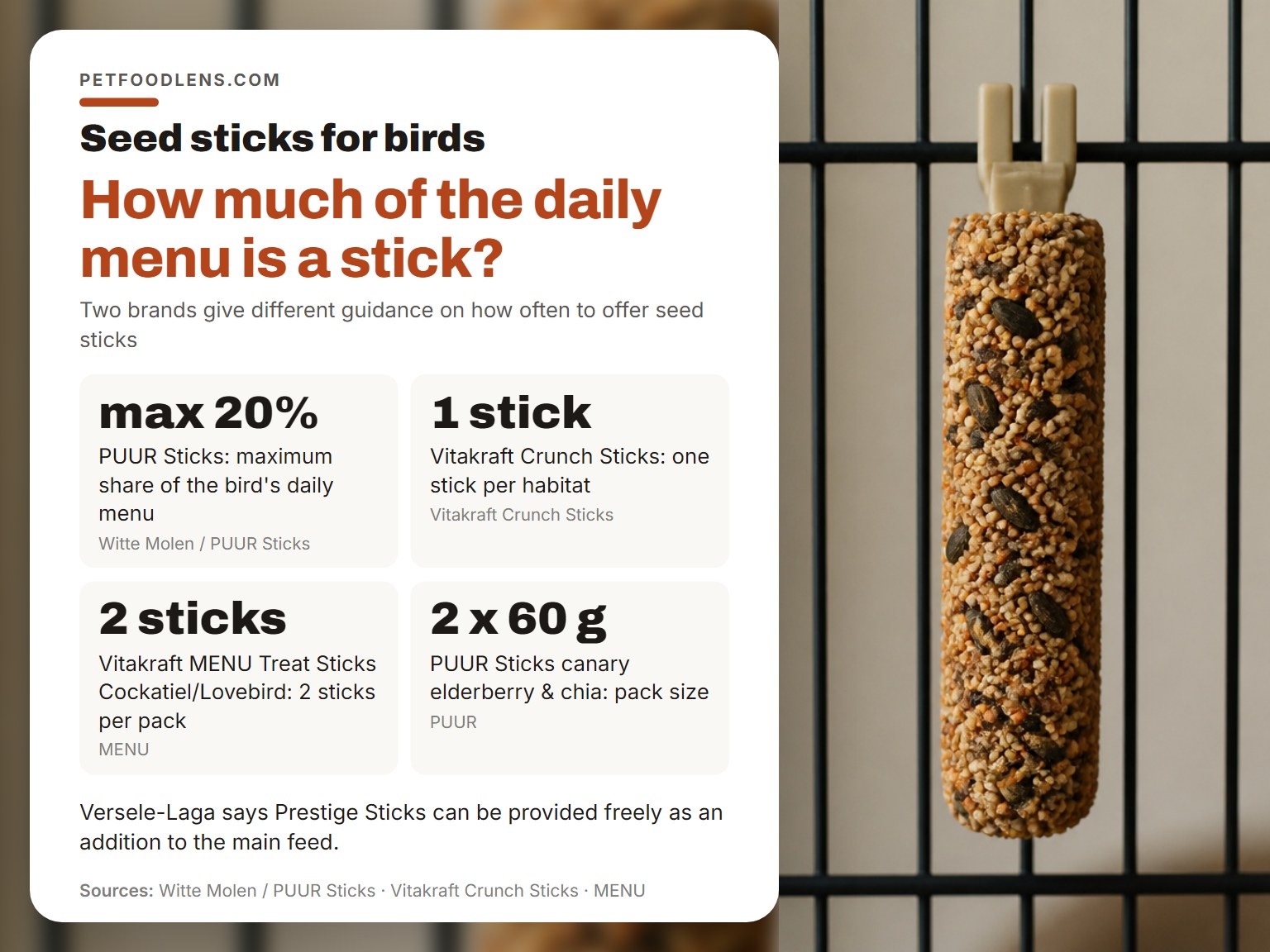
Three places a stick earns its keep: a foraging distraction, a beak-wearing surface, and a bribe for a bird that needs to move from one side of the cage to the other.
Here’s the check I’d run before hanging one:
- Confirm the base diet is actually being eaten. If the pellet bowl is going down, the stick is a treat. If it isn’t, the stick is the problem.
- Match the stick to the species size. Vitakraft sells separate sticks for canary and finch, for cockatiel and lovebird, and for conure. A “small parrot” stick is a specific product, not a category.
- Check the seed mix inside the coating. More on this below.
- Set a replacement rule before you hang it. One stick at a time, and no refill until you’ve counted how long the last one lasted.
That last step is the one people skip. Without it, “occasional treat” quietly becomes a permanent fixture clipped to the bars.
The Sunflower Problem
Wombaroo warns that birds eating sunflower-heavy mixes often reject the wheat, sorghum and dried corn, which generates waste and can leave a bird unhealthy and overweight in captivity. It recommends a Small Parrot Mix diluted 50/50 with Budgie Mix instead.
That warning is about bagged seed, but it applies directly to stick coatings. Wild Harvest markets a seed blend with real sunflower and safflower as the coating. Sunflower is the seed a bird will pick out first, every time.
The same source flags sprouted and soaked seed as a contamination risk, especially in warm weather. Contaminated seed smells off and looks gluggy or dirty, and Wombaroo’s instruction is blunt: if in doubt, don’t feed it. Sticks don’t sprout, but the seed inside them is still seed, and bird seed storage matters for the bag you’re pulling from.
If you’d rather control the ingredients entirely, homemade bird treats let you skip the binder question altogether.
I keep a short list of what I’d actually buy for a bird that needs occupying: a wood-core stick from Vitakraft or Nestor for the beak work, and a chopped raw vegetable for everything else. The vegetable costs almost nothing and holds attention longer. That’s not a knock on the sticks. It’s a note on what they’re for.
Frequently Asked Questions
How many seed sticks can a bird have in a day?
No manufacturer publishes a per-day count, and the two written limits don’t match. Witte Molen caps its sticks at 20% of the daily menu; Vitakraft says hang one stick per habitat. Witte Molen caps its sticks at 20% of the daily menu, Versele-Laga says provide freely as an addition to the main feed, and Vitakraft says hang one stick per habitat.
Is honey in a seed stick bad for birds?
Honey is a sugar source, and it appears at 4% in Nestor’s composition and alongside maltodextrins in Vitakraft’s ingredient list. Versele-Laga states its Prestige Sticks contain no added sugars. A small amount in a treat is normal for the category. The issue is frequency, not the honey itself.
What is the difference between a wood core and a rawhide core?
Vitakraft and Nestor use wooden cores and state they help wear down the beak through chewing resistance. Wild Harvest uses a rawhide center made from beef hide and labels the stick for intermittent or supplemental feeding only. The materials break down differently in the beak.
Can seed sticks replace pellets?
No. A stick is seed and grain, which is the part of the diet a fortified base food exists to balance. Zoo Roco describes feeding sticks as a supplement to a balanced basic diet, and every manufacturer’s feeding line assumes a main feed is already in the bowl.
Do seed sticks go stale?
They’re baked and dry, so they keep longer than fresh food, but the seed inside still ages. Store the pack sealed and dry, and don’t hang a stick in a humid cage for weeks on end. If it smells off or the seed clumps, bin it.
The Bottom Line
The single most useful thing you can do with a seed stick is read the feeding line on the pack in your hand and follow that one, not a rule you read somewhere else. The four brands in this category genuinely disagree, and the disagreement is legitimate because the products differ in weight, coating and core.
Here’s the trigger I’d give you. If your bird starts leaving the pellet bowl alone, or the droppings change colour and you haven’t changed anything else, the stick comes out of the cage first. Not forever. Just until you’ve seen the bowl go down again.
And a concession, because it’s honest: I work mainly on cat food, and my read on species-specific limits for birds is thinner than I’d like. Where a bird has a diagnosed liver, kidney or weight problem, an avian vet sets the ceiling and this article doesn’t. What I can tell you is how to read the pack. That part transfers.
