
Dried Fruit for Birds Guide: What’s Safe and How Much
This post contains affiliate links. As an Amazon Associate, we earn from qualifying purchases.
Dried fruit for birds works as an occasional treat. This guide’s short answer: one or two small pieces of plain, unsulphited fruit. Pits and seeds from apricots, peaches, plums, cherries, pears and apples contain amygdalin, a cyanogenic glycoside, and never belong in a bird’s bowl.
The amygdalin warning covers the pits. The rest of the risk sits in the drying process, and most of it is printed in small type on the back of the packet, as any dried fruit for birds guide will tell you.
What follows covers portion size, the sulphite codes worth screening for, where the veterinary sources flatly disagree about dried versus fresh, and the storage mistake that turns a packet soft and dull.
Key Takeaways
- Pits and seeds from apricots, peaches, plums, cherries, pears and apples carry amygdalin and never go in a bowl.
Dried Fruit for Birds Guide: How Much Can a Bird Have?
Two sources give portion guidance, and they use different units, which is why a dried fruit for birds guide can help.
I learned this the slow way, with a client’s feeding guide. I assumed her scoop matched the measuring cup the guide was written around. It held more than the cup did, which meant every “one scoop” she served was quietly a different number.
Before you start: Pits and seeds from apricots, peaches, plums, cherries, pears and apples carry amygdalin, a cyanogenic glycoside, and the AAV says none of them should ever reach a pet bird. Check dried apricot and plum products for pit fragments before the fruit goes in the bowl.
A workable serving routine looks like this:
- Start with one piece. Offer a single small piece of plain dried fruit and watch what the bird does with it. A bird that swallows it whole gets smaller pieces next time.
-
Serve it in the bowl, not on the cage floor. VCA is explicit that food should not sit where droppings fall. 3.
-
Count it against the fruit share, not on top of it. Dried fruit is still fruit. If the bird already had fruit today, this is the second serving.
Sulphites 220 to 228: Read the Packet Before the Fruit
Sulphur dioxide and related sulphites keep dried fruit from browning on the shelf, and on Australian labels they show up as additive numbers 220 to 228.
Dried apricots, sultanas and apple rings are the products where Queenslander Aviaries says you’ll meet them most often. Plain freeze-dried fruit usually skips them entirely, because freeze drying doesn’t rely on a sulphite preservative to stay shelf-stable.
You can often smell the difference before you read it. Sulphited apricots have a sharp, faintly acrid edge under the sweetness, closer to a struck match than to fruit. A plain dried apricot smells like apricot and not much else.
| What you see on the packet | What it means | What to do |
|---|---|---|
| Sulphites 220 to 228 | Preservative used to stop browning | Choose a plain version if one exists |
| Sugar, syrup, or “sweetened” | Sugar added on top of the fruit’s own | Put it back |
| “Naturally dried” | A process claim, not an ingredient claim | Read the ingredient line anyway |
| Pit fragments in the bag | Amygdalin risk from the stone | Discard the whole packet |
Sulphites are one line on a longer list of ingredients to avoid in bird food, which also covers the onion and garlic problem VCA flags for a bird’s blood cells.
Common mistake: Buying a bag of dried fruit sold for people and assuming it’s bird-safe because the only ingredient is fruit. The fruit is fine. The sulphites and the added sugar often aren’t, and neither are the pit fragments in a cheap apricot.
The “naturally dried” line deserves its own note. It describes a process, not a contents list. A fig can be naturally dried and still carry a sulphite dose, because the two claims answer different questions.
Dried, Freeze-Dried or Fresh: Where the Sources Disagree
The sources contradict each other on dried fruit, and neither one is being careless.
What AFA Watchbird says
An article in the peer-reviewed Fruit in the Avian Diet article states that because dehydrated food has no water, it will always have greater nutritional value than fresh fruit, though some vitamins are lost in the dehydration process.
That’s a per-weight claim. A gram of dried apricot carries more of everything than a gram of fresh, including sugar.
What VCA says
VCA Animal Hospitals takes the other position: freeze-dried fruits and vegetables are less nutritious than fresh or frozen ones.
That’s a different measurement. It’s about what survives the process, not what’s left per gram.
Both statements can hold at once, and neither source resolves the other’s question. I’m not going to pretend one wins.
| Form | What the sources say | Watch for |
|---|---|---|
| Fresh | VCA calls fresh the most nutritious option | Wash it; birds are sensitive to pesticide sprays |
| Frozen or thawed | VCA accepts it, ranked below fresh | Thaw fully, then treat it as moist food |
| Freeze-dried | VCA ranks it below fresh and frozen | Concentrated by weight; a handful is a lot |
| Conventional dried | AFA Watchbird: denser per weight than fresh | Sulphites 220 to 228, added sugar |
A shortlist of dried fruit for birds still has to pass the packet check above. The form on the front doesn’t override the ingredient line on the back.
Where this goes sideways: Treating a small handful of freeze-dried berries as one serving because it looks small. Queenslander Aviaries points out that a handful can represent considerably more fresh fruit than it appears to, so the portion that looks modest is often the biggest one in the bowl.
What Share of the Bowl Should Fruit Take?
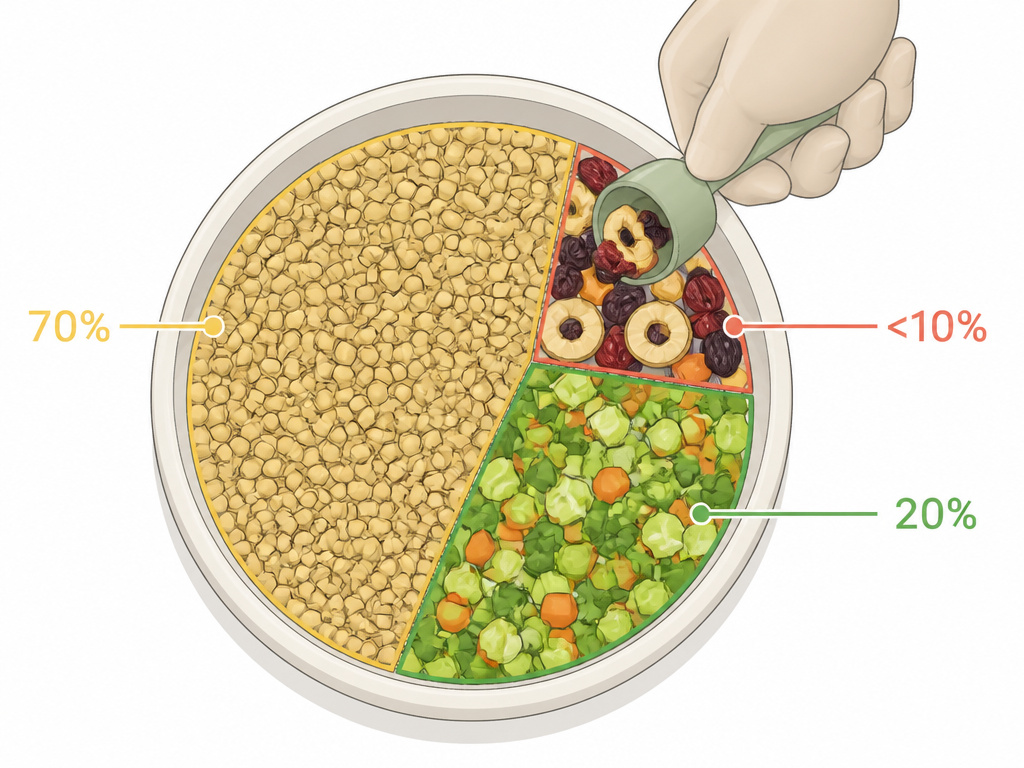
Two sets of published numbers describe the same bowl and don’t match.
The UC Davis bird nutrition guide puts fruit under 10 percent of the diet, vegetables at roughly 25 to 40 percent, and pellets at 50 to 75 percent. VCA gives a single combined figure: fresh produce, fruit and vegetables together, at no more than 20 to 40 percent of the diet, with no separate cap on fruit.
Those aren’t the same instruction. UC Davis draws a line between fruit and vegetables. VCA folds them together and caps the total. An owner following one will build a different bowl than an owner following the other, and neither source is wrong on its own terms.
What both agree on is direction. Fruit is the smaller half of the produce portion, and produce is the smaller part of the bowl. Queenslander Aviaries lands in the same place from the practical side, advising fruit in smaller amounts than vegetables and mixed through rather than served alone.
If you can’t remember which set of numbers you’re following, default to the tighter one. Fruit under a tenth of the bowl, vegetables doing the rest of the produce work, and a formulated pellet carrying the base.
Which Fruits Are Safe, and Which Pits Never Are
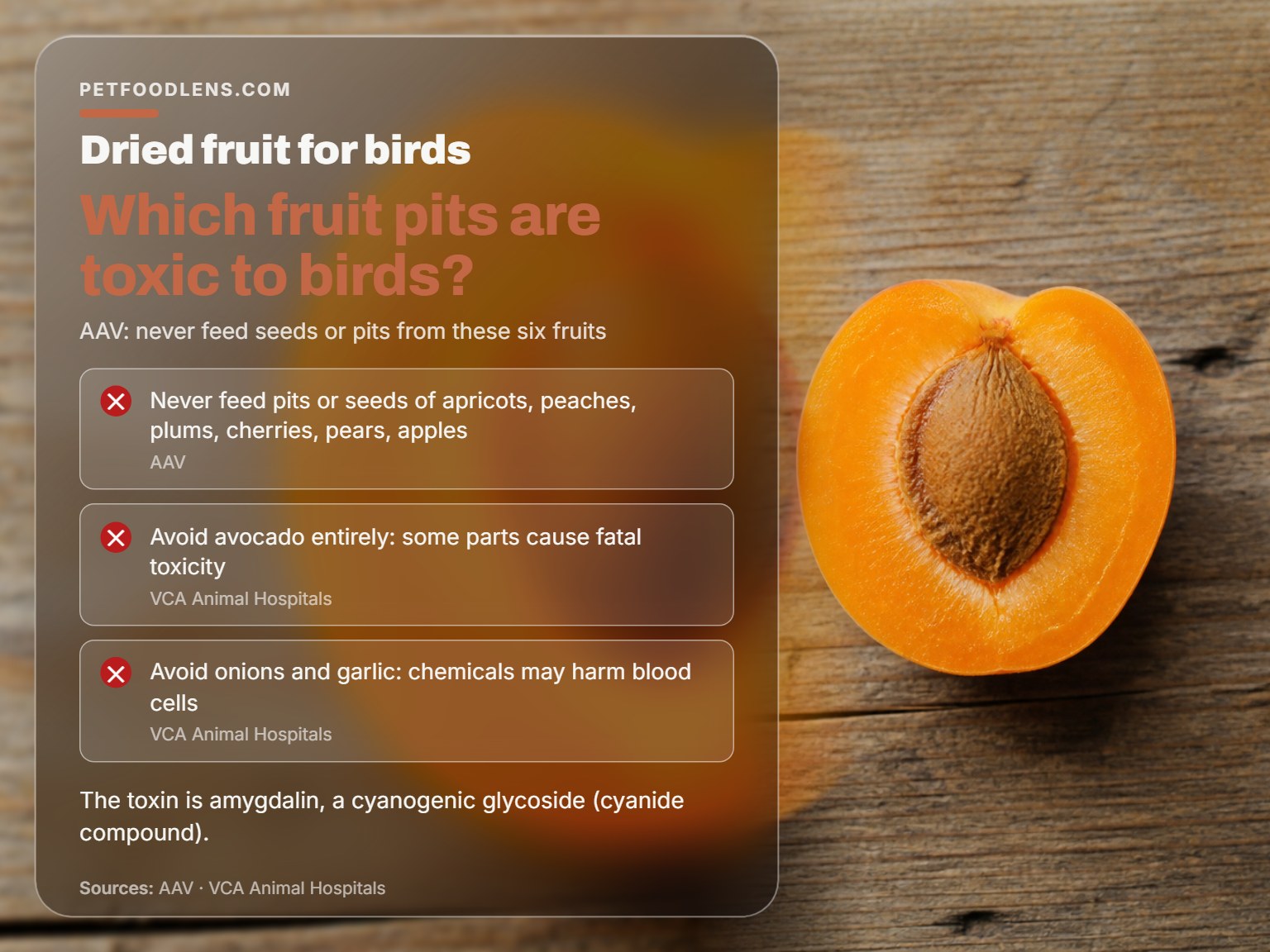
The Association of Avian Veterinarians names six fruits whose pits and seeds should never reach a pet bird.
The AAV toxic seeds and pits guide identifies the toxin as amygdalin, a cyanogenic glycoside, which is a cyanide compound. The warning covers parrots, passerines, columbiforms and poultry, which is about as broad as a warning gets.
- Stone fruit: apricots, peaches, plums and cherries. Remove the stone, and check dried products for fragments.
- Pears and apples: the seeds carry amygdalin too, which surprises people who cut up an apple for a parrot.
- Avocado: VCA and the SPCA Tampa Bay bird diet guide both say never feed it, because some parts cause fatal toxicity.
- Onions and garlic: VCA flags chemicals in both that may harm a bird’s blood cells.
The fruit seeds question comes up constantly, and the short version is that small seeds inside berries and melons are a different case from stone fruit pits. The amygdalin list is specific, and it’s about the stone, not every seed in the bowl.
Colour is a shortcut for one nutrient. VCA notes that bright yellow, red and orange produce contains a great deal of vitamin A for birds, which is why a dull beige bowl of seed is a problem no treat fixes.
Merck adds a caveat worth repeating here. Feeding fresh, not thawed, blueberries is recommended, because the active amount of flavonoids declines when berries are frozen. Frozen is acceptable. It isn’t identical.
Storing Dried Fruit So It Doesn’t Spoil in a Warm Room
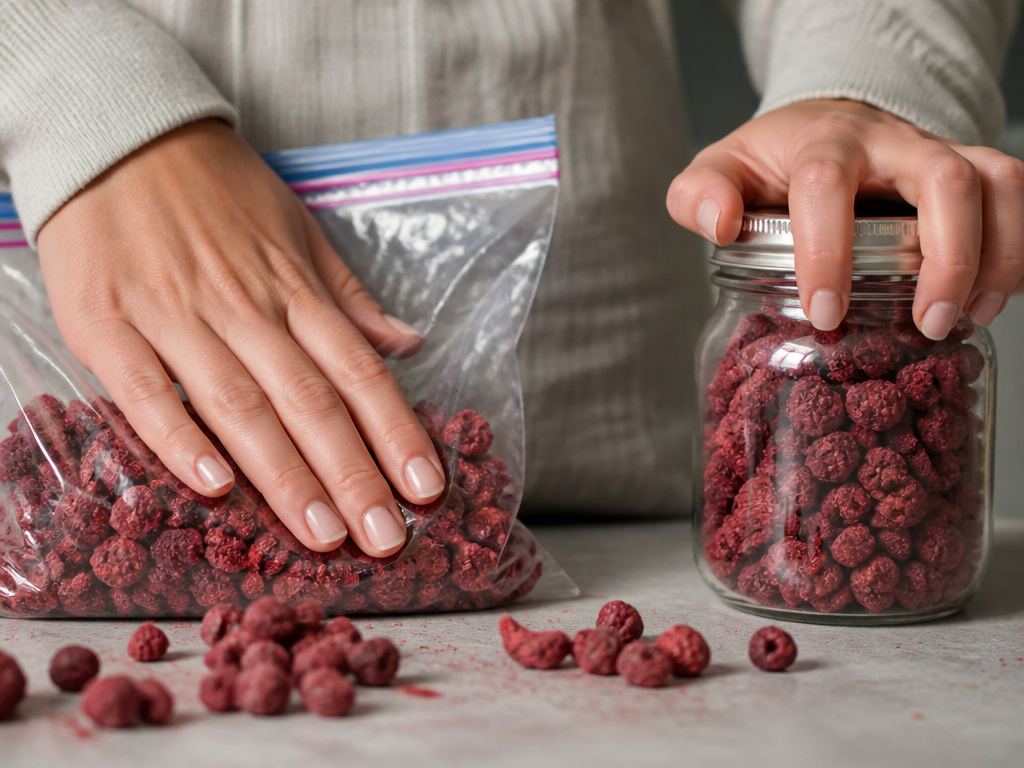
A freeze-dried berry that crunched when fresh goes chewy in a humid kitchen.
Queenslander Aviaries is blunt about it: freeze-dried food readily absorbs moisture, and in warm, humid climates it softens and spoils rapidly once the packet is opened. Reseal it and keep it cool and dry.
The long shelf-life figure that circulates around freeze-dried food comes from the long-term food-storage industry. It doesn’t apply to an opened bird-food packet.
You can feel the change before you see it. A freshly opened freeze-dried berry snaps and leaves a dry dust on the fingers. One that’s taken on moisture bends, then sticks to itself in the bag.
- Reseal after every use, pressing the air out before the packet goes back in the cupboard.
- Keep it out of the steam zone. Above the kettle or beside the dishwasher is the worst shelf in the kitchen.
- Portion out a small tub and leave the main packet sealed.
- Smell it first. A musty or sour note means the batch is done.
I keep dried fruit in a screw-top jar rather than the original bag, because a bag gets opened and half-closed repeatedly and never seals the same way twice.
Storage rules for how to store bird food carry over almost unchanged: cool, dry, sealed, rotated. AFA Watchbird adds one number for anyone buying fresh fruit by the case, which is to hold it at 32 to 40 degrees Fahrenheit.
When Dried Fruit Is the Wrong Call
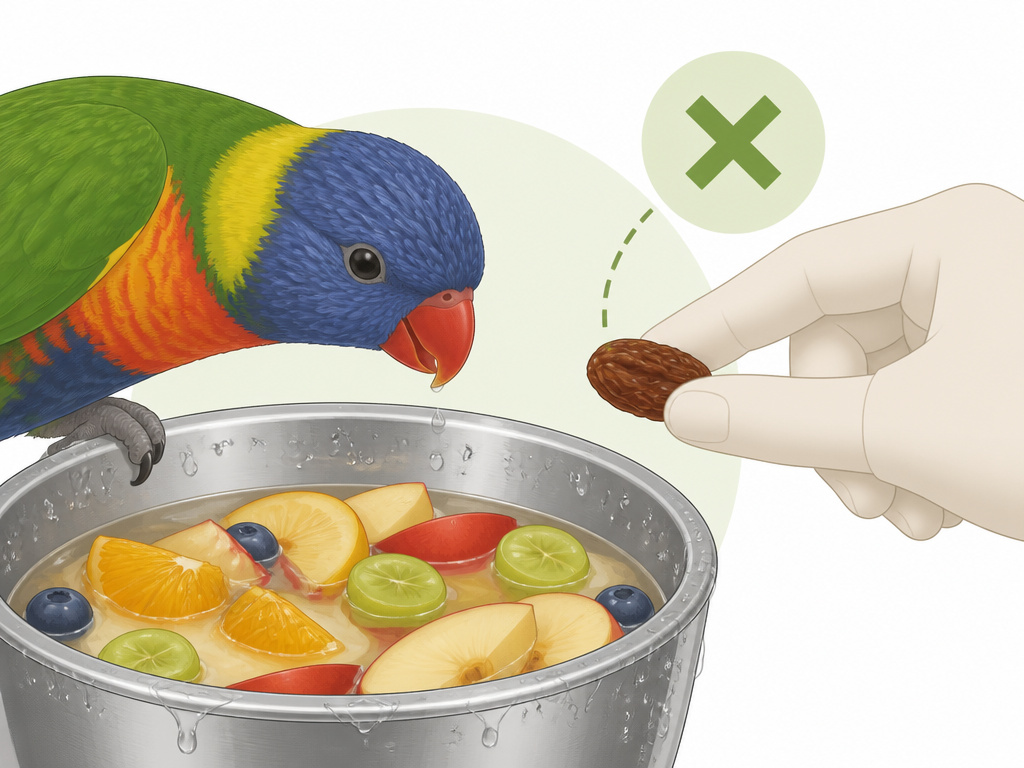
Some birds shouldn’t get fruit at all.
Species that need a different diet entirely
VCA lists toucans, toucanets, lories and lorikeets as species requiring specialized diets, and says the diet should be researched before the bird is acquired. Merck goes further on lories and lorikeets, describing a need for high water content, easily digestible carbohydrates, a mixture of proteins, and a balanced vitamin and mineral supplement.
Dried fruit fits none of that. A lorikeet’s bowl is built around water, and dried fruit is the opposite of water.
When the base diet is already off
Merck’s guidance is that extra items like fruits and vegetables shouldn’t disturb the ingredient and nutritional balance of the diet. If a bird is living on seed and table scraps, adding dried fruit doesn’t repair the imbalance. It stacks a sweet item on top of it.
Wild-bird feeding advice doesn’t transfer either. A guide to common bird foods explained for backyard birds covers suet, mealworms and seed blends, none of which maps onto a parrot’s bowl.
I work on the ingredient side, not the clinical side. Kidney, liver and diabetic birds need a veterinarian’s numbers, and those aren’t mine to give.
Skip this if: Your bird is on a prescription diet or is fluffed and quiet. Those are veterinarian questions, and no packet answers them.
If you want a broader frame for where dried fruit sits against seed sticks, millet and the rest, this breakdown of types of bird treats puts it in context. For the selection side, how to choose healthy bird treats covers the label habits that apply to every category.
Frequently Asked Questions
Can birds eat dried fruit every day?
No. Dried fruit is concentrated, and Lafeber’s guidance is one or two small bites because the sugar content climbs as the water leaves. A couple of times a week is a more sensible rhythm, and it should come out of the fruit share of the bowl rather than sitting on top of it.
Are sulphites in dried fruit harmful to birds?
Sulphites 220 to 228 are preservatives, and Queenslander Aviaries advises choosing plain dried or freeze-dried fruit without added sugar or preservatives. No source in this set quantifies a safe sulphite level for birds, so the practical move is avoidance rather than dose calculation.
Is freeze-dried fruit better than regular dried fruit for birds?
It depends on which claim you trust. Freeze-dried fruit usually has no sulphites because the process doesn’t need them, which is a real advantage. On nutrition, VCA ranks freeze-dried below fresh and frozen, while AFA Watchbird argues dehydrated food is denser per weight than fresh.
Do I need to soak freeze-dried fruit before offering it?
Usually not. Queenslander Aviaries notes that freeze-dried fruit and vegetables don’t generally need rehydrating, and many birds dunk pieces in their water bowl themselves. Once a piece is wet, treat it as moist food and don’t leave it in the cage.
Can birds eat the seeds inside fruit?
Small seeds inside berries and melons are a different case from stone fruit pits. The AAV warning is specific to the pits and seeds of apricots, peaches, plums, cherries, pears and apples, which carry amygdalin and should never be fed.
The Bottom Line
Pull every bag of dried fruit in the cupboard, turn it over, and read the ingredient line for sulphites 220 to 228 and any form of added sugar. Most of what fails that check was bought for a human, not a bird.
None of this makes dried fruit a villain.
What I’d push back on is the assumption that a bag sold for birds is automatically better than the one in your own cupboard. The label rules are identical on both. The only difference is the bird on the front.
