
How to Use a Dog Treat Pouch: Step-by-Step
This post contains affiliate links. As an Amazon Associate, we earn from qualifying purchases.
To use a dog treat pouch, load it to a single layer, clip it to the hip opposite your leash hand, and set the opening so your hand drops in without looking. Empty it after every session, because treats left in a warm pouch dry out within a few hours.
That drying clock is the part nobody photographs. A reviewer on the Terry Ryan product page says the treats go stale inside the pouch, and any unused ones have to move to a zip-lock bag if they sit for a few hours. You won’t find that on the front of the packaging, and it’s the same reason the how to use a dog treat pouch question starts with emptying it after every session.
What follows is the load order, the wear position that keeps your reward hand free, the four pouches worth comparing on published dimensions, and the fixes for the failures that show up mid-walk.
Key Takeaways
- One layer, not a full pouch. Supeter’s own troubleshooting says hard-to-reach treats mean you overfilled it, and PupSensei says an overstuffed pouch compromises the magnetic seal.
- Pouch on the hip opposite your leash hand. That’s StridePaw’s rule, and it keeps the reward hand free while the leash hand stays still.
- Supeter’s room-temperature rule. Supeter’s manual rules out hot items entirely, a position no other brand in this group addresses.
- Empty it after every session. PupSensei’s instruction, and it’s the difference between a pouch that rinses clean and one that smells.
- Wash instructions don’t transfer between brands. The Terry Ryan pouch is machine washable; the Orvis 3LAH4200 is hand wash only.
How to Use a Dog Treat Pouch: The Four-Move Load
Four things happen in this order: open the top, pour, level the treats into one layer, and close.
A treat pouch is loaded by opening the top fully, pouring treats to a single layer, and closing the flap. The pouch sits on the hip opposite the leash hand, with the opening positioned so the hand drops in without looking. Overfilling pushes treats above the rim and slows every reach.
- Open the closure all the way before you pour. PupSensei’s instruction is to pull the top apart gently first. Pour into a half-open top and treats wedge in the seam, which is where the smell starts.
- Pour to one layer, not to the rim. StridePaw’s rule is a single layer so you can reach quickly. Supeter’s troubleshooting for hard-to-reach treats is blunt: you overfilled it, so take a few out.
- Keep treats away from the hardware. StridePaw says to separate treats from keys and waste bags when the pouch has pockets. The Terry Ryan pouch ships with a key ring for a clicker or whistle, and that ring is not a treat compartment.
- Close it, then bend over and shake. A pouch that dumps its contents when you touch your toes will dump them on the walk. Test it in the kitchen first, not at the park.
Supeter’s manual is the only one in this group that addresses temperature, and it rules out hot items completely; Supeter says the pouch is built for room-temperature training bites. Warm chicken left in the pouch is a food-safety question, and PupSensei points the same direction by saying perishable treats shouldn’t sit inside for long stretches.
If you’re rotating through open bags, the rules for keeping treats fresh matter more than the pouch itself. A stale treat is a slow reward no matter how fast your hand is.
A slow reach costs you the rep.
Which Side Should the Pouch Hang On?
Hold the leash in your left hand and the pouch belongs on your right hip.
That’s StridePaw’s rule, and it exists for one reason: the reward hand has to stay free while the leash hand stays still. Clip the pouch on the same side as the leash and you’ll cross your body every time you mark a behavior. The dog sees a shoulder dip and a delayed hand, and the reward lands late.
If you wear it cross-body, StridePaw says to adjust the strap until the pouch sits at your side, and to test the placement before training rather than during it.
Belt, Waist, and Cross-Body: Test Before You Train
- Belt clip. Supeter says to thread your belt through the clip and fasten it at the hip. Fast, and it stays put on a steady walk.
- Snap belt loops. Orvis offers these alongside a quick clip and an adjustable belt, so one pouch covers three attachment styles.
- Waist belt. The Terry Ryan waistband measures 46.5 inches, and the belt is adjustable and detachable, so you can run it as a standalone belt or clip the pouch straight to your trousers.
- Cross-body strap. PupSensei’s strap adjusts from 30 inches to 52 inches, and the pouch swivels 360 degrees, which matters when the dog circles you on a loose lead.
The failure here is a strap that slips down the hip mid-session. Supeter’s fix is to re-adjust the length and make sure the tension clip is fully snapped closed. Do that before you leave the driveway.
The same placement logic shows up in loose-leash training: stop when the leash goes tight, wait for slack, then reward from the pouch. None of that works if you’re reaching across your body to find it.
Hinge, Split-Top, or Magnet: What Each Closure Actually Does
Terry Ryan’s pouch uses a hinge that stays open and closes with a touch. Orvis uses an overlapping neoprene split top with no drawstring and no snap. Leerburg and PupSensei use magnets.
Each brand presents its mechanism as the answer to the same two problems: getting a hand in fast, and keeping treats in when the dog lunges. No source reconciles them, because each one is describing its own product.
- The hinge. It stays open for access, which also means it stays open when you bend forward. Terry Ryan’s claim is that it closes with a touch.
- The split top. An overlapping neoprene flap with no moving parts to seat. Orvis’s pitch is no more fiddling with drawstrings or snaps.
- The magnet. PupSensei says the closure guarantees ease of access. Leerburg says it prevents spills during active training.
A magnet closure announces itself with a soft click when the two edges meet.
I stopped trusting closure adjectives a long time ago. “Super-strong” and “guarantees ease of access” are descriptions, not test results. Look at the mechanism and the dimensions, because those are the only things on the page you can check against your own hand.
What the Magnetic Seal Costs You
PupSensei’s own guidance says to keep the magnet away from sensitive electronics and credit cards. That’s a real constraint if your phone rides in the same pocket as the pouch.
Overfilling is the other cost. PupSensei says an overstuffed pouch compromises the seal and gets cumbersome, which turns a one-handed reach into a two-handed fumble. The magnet is only as good as the gap it has to close.
Four Pouches Compared on Published Dimensions
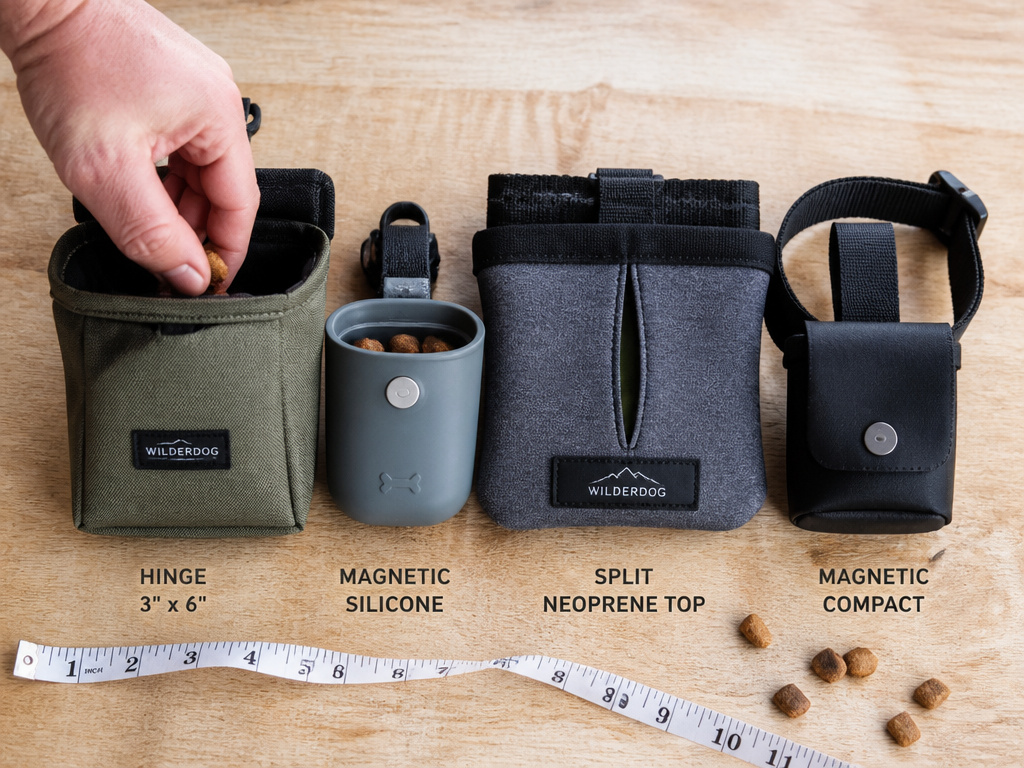
Four pouches, four published size sets, and no two brands agree on what size a treat pouch should be.
| Pouch | Published size | Closure | Wash |
|---|---|---|---|
| Terry Ryan Treat Pouch | 6.5 x 8.5 in; opening 3 x 6 in | Hinge, stays open | Machine washable |
| Leerburg Silicone | 5 x 4.25 x 2.25 in | Magnetic snap | Rinse inside out |
| Orvis 3LAH4200 | 7 x 5.5 x 1 in | Neoprene split top | Hand wash only |
| PupSensei Magnetic | Strap 30 to 52 in | Magnetic | Wipe and air dry |
Read those as a shape, not a ranking. The Terry Ryan pouch is the tallest, with a 3 by 6 inch opening that swallows a whole hand. The Orvis 3LAH4200 is wide, flat, and shallow at 7 by 5.5 by 1 inch. The Leerburg silicone pouch is the smallest of the four at 5 by 4.25 by 2.25 inches.
Orvis builds the 3LAH4200 with Standing Stone Kennels, a Kansas training outfit with more than a decade of experience and thousands of dogs trained. That’s a sourcing note, not a performance claim, but it tells you who designed the split top.
StridePaw lists three red flags worth checking before you buy:
- A floppy opening. It spills treats and slows your reach.
- A weak clip. The pouch swings or drops off mid-session.
- An interior you can’t turn out. Crumbs and odor build where you can’t reach them.
If you want one pouch and you walk a dog twice a day, the Orvis 3LAH4200 covers the most ground: three attachment methods, a built-in waste bag dispenser, and a split top that doesn’t need a second hand. If you train indoors on carpet you care about, the Leerburg Silicone Treat Pouch is the better pick, because the non-porous body rinses clean and the magnet holds through a bend.
The pouch doesn’t make a treat valuable. That decision happens before anything goes in, and the high-value treats you choose do more for the session than any closure design.
Why Does the Pouch Stop Working Mid-Session?
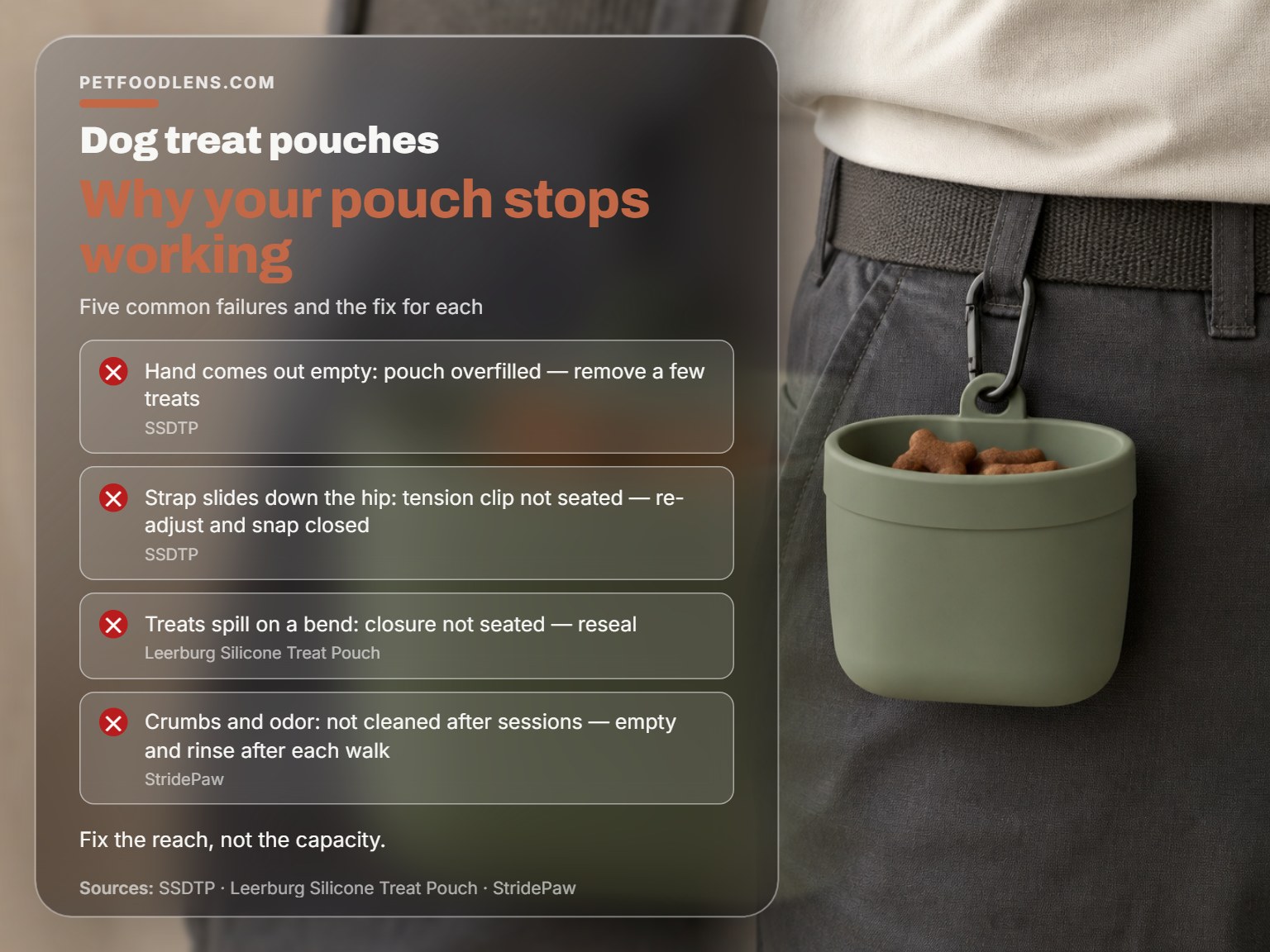
Your hand goes in and comes back with two crumbs and no treat.
The pouch is usually overfilled, not broken. Supeter’s troubleshooting section is explicit about it: if treats are hard to reach, you overfilled it, so remove a few so your hand glides in and out.
| Symptom | Cause | Fix |
|---|---|---|
| Hand comes out empty | Pouch overfilled | Remove a few treats |
| Strap slides down the hip | Tension clip not seated | Re-adjust, snap clip closed |
| Treats spill on a bend | Closure not seated | Level to one layer, reseal |
| Pouch swings and slaps | Loose attachment point | Move to belt loop or waist |
| Crumbs and odor | Not cleaned after sessions | Empty and rinse after each walk |
Where this goes sideways: A strap that slips at the start of a walk keeps slipping, because the clip never fully seats. Re-adjust the length and snap the tension clip closed before you pull out of the driveway, not after the third block.
Every one of these failures costs you seconds, and seconds are the currency in reward timing during training. A reward that lands late teaches the dog something you didn’t plan to teach.
If the pouch runs dry by the second half of a session, the fix is to stretch treats rather than to buy a bigger pouch.
Fix the reach, not the capacity.
Why Your Pouch Smells: Cleaning Rules and the Ones That Conflict
Terry Ryan says machine washable. Orvis says hand wash only.
Both are fabric pouches, and both instructions are correct for the specific product. That’s exactly why generic cleaning advice falls apart here.
| Question | One position | The other |
|---|---|---|
| Treat type | Leerburg: moist, dry, semi-moist all work | StridePaw: dry or semi-moist only |
| Treat dwell time | PupSensei: empty after every session | Leerburg: no stated time limit |
| Fabric washing | Terry Ryan: machine washable | Orvis: hand wash only |
| Silicone cleaning | Leerburg: hot soapy rinse | PupSensei: damp cloth, air dry |
The fabric split comes down to construction. The Terry Ryan pouch has a water-resistant lining and is machine washable. The Orvis pouch is polyester and neoprene and is hand wash only. Follow the label on the pouch you actually own, not the one in the guide.
Silicone is messier still. Leerburg says to remove the belt clip, flip the pouch inside out, and rinse with hot soapy water. PupSensei says to turn it inside out, wipe the interior with a damp cloth, and air dry thoroughly to prevent mold or odor. Supeter adds a rinse-and-wipe routine, warns against abrasive sponges, and says to store the pouch cool and dry.
The Seam Is Where the Smell Lives
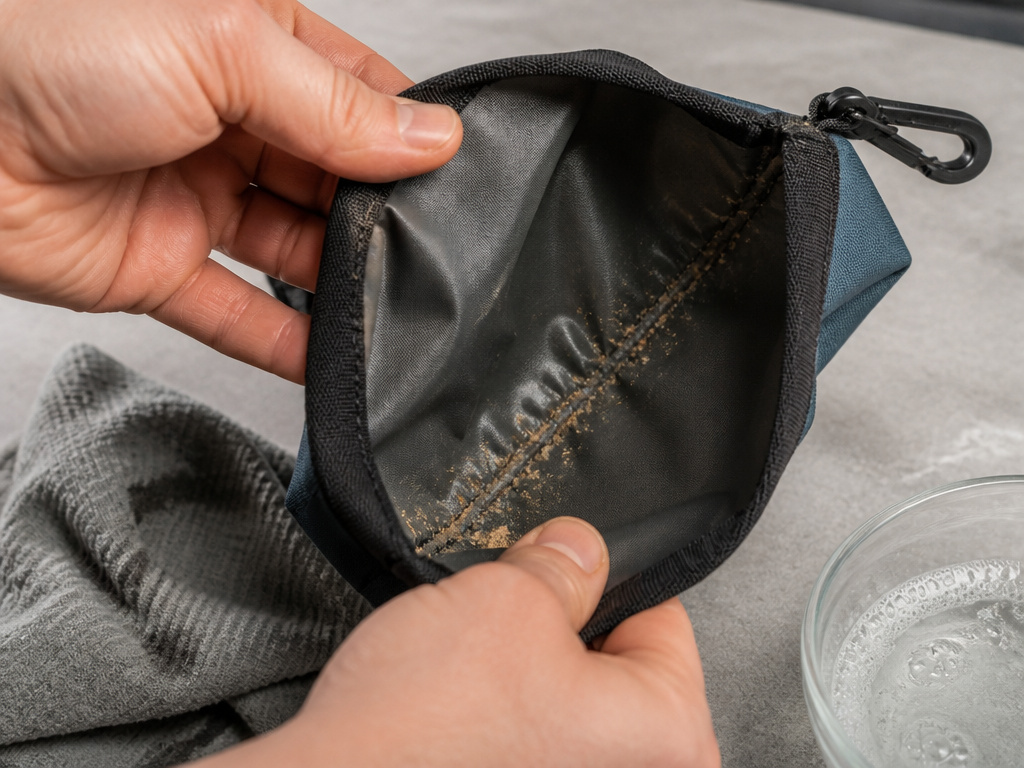
Run a finger around the inside seam of a fabric pouch after a week of daily use and you’ll come back with a grey paste of crushed treat dust. That paste is what you’re smelling.
StridePaw says to clean after each walk to prevent odors. PupSensei says to empty the pouch after every session. Both are cheap habits and both beat scrubbing a crusted seam later.
A pouch you can smell from arm’s length is a pouch you didn’t empty. The rinse takes less time than the reach it costs you.
What Should Actually Go in the Pouch?
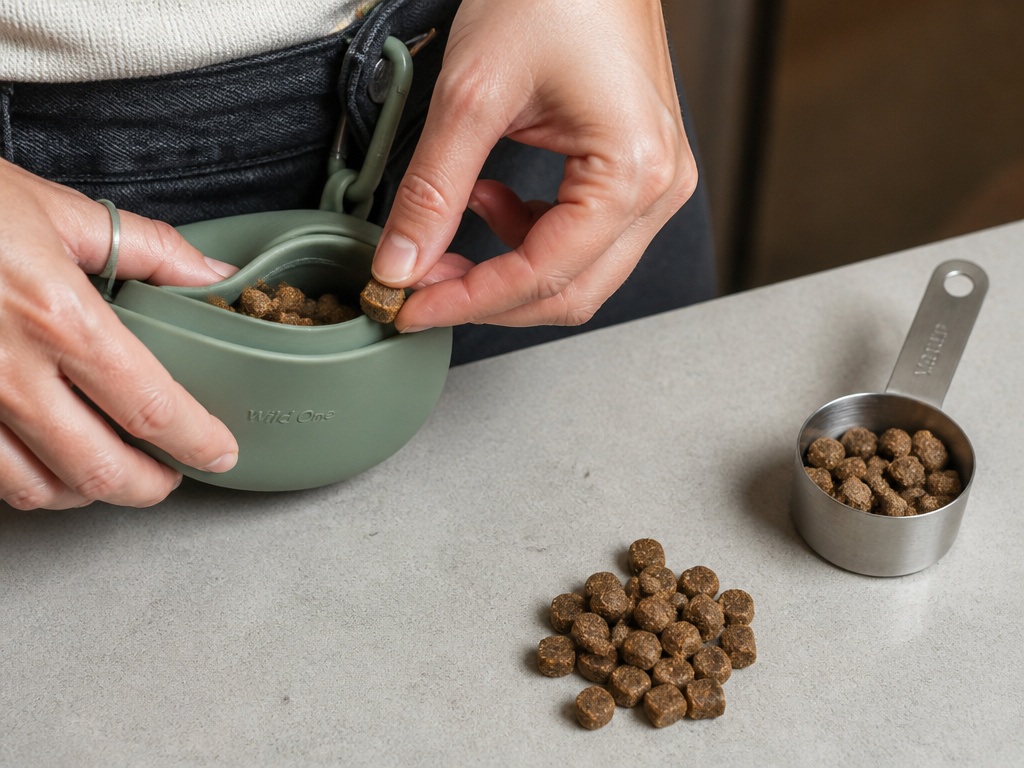
Kibble pulled from the measured meal is the cheapest training reward you own.
The pouch is a delivery system. What you put in it decides whether the session adds weight or just adds repetitions.
My rule is that training rewards come out of the daily calorie budget, not on top of it. Measure the meal, take a portion out, and that portion is the session pay. A dog working for pieces of its own dinner isn’t on a bonus diet.
Treat Size and the Calorie Math
Cut rewards small. Pea-sized treat pieces keep the dog working without filling it up, and they come out of the pouch faster because your fingers close on them in one motion.
Then do the subtraction. If you’re feeding a full measured meal and adding a pouch of commercial treats on top, you’re running a surplus. The treat calories are the ones people forget to count, because they never hit a bowl.
Here’s where the sources genuinely split on what belongs in the pouch. Leerburg says moist, dry, or semi-moist treats all work in the silicone pouch, and a Leerburg reviewer backs that up by using it for raw. StridePaw takes the opposite line and says to use dry or semi-moist treats and avoid sticky or crumbly ones that make the pouch messy.
Both positions are defensible. A non-porous silicone body handles wet food without trapping particles or odor. A fabric pouch with a lining does not.
Common mistake: Loading the pouch with your dog’s best food for a routine sit. You spend your strongest reward on your easiest behavior, and by week three the dog offers sits and nothing else. Save the good stuff for the hard rep, and start fading treats once the behavior holds.
Supeter adds two safety notes worth repeating. The silicone pouch is not a chew toy, and it should stay out of reach of small children to prevent accidental ingestion of dog treats.
Frequently Asked Questions
Can I use a treat pouch for training sessions in very cold weather?
Yes, but expect the closure to stiffen. Magnetic flaps and stiff fabric lose some snap below freezing, so test the seal with gloved hands before you rely on it outdoors. Keep the pouch under your jacket between reps if the treats you use get hard in the cold.
How do I stop treats from crumbling and leaving dust in the bottom of the pouch?
Crumbs come from broken biscuits and from treats rubbing against each other as you reach in. Switch to firmer, single-piece treats for high-rep sessions, and wipe the inside with a damp cloth after emptying rather than waiting for a full wash. A pouch that stays crumb-free also seals better, since grit in the seam keeps the flap from closing flush.
Is a treat pouch safe to wear while running or doing agility work with my dog?
For jogging, tighten the belt or clip so the pouch sits high and flat against your hip, and choose a model with a secure closure rather than an open scoop. For agility, many handlers prefer a smaller pouch or a bait bag clipped at the waistband so it does not swing during turns. Whatever you pick, do a short test run before a class or trial.
How many treats should I actually carry on a walk?
Carry only what you expect to use, plus a small buffer, rather than filling the pouch for the whole day. A single layer is the working limit, so a short training walk needs a small handful, not a full bag. Restocking from a sealed container mid-walk is faster than digging out treats that have gone soft at the bottom.
The Bottom Line
The mechanics of how to use a dog treat pouch are simple. The discipline is in the count.
If your dog is already eating to the top of its daily allowance, every treat in that pouch is surplus, and the pouch makes surplus easy to lose track of. That’s the one number no closure design fixes for you.
None of this applies to a dog that guards food or snaps around hands. A pouch puts food at hip height in a moving environment, and that’s a trainer’s problem rather than a gear problem. Get help before you get a better pouch.
Tonight, measure the meal, take a portion out, and put that portion in the pouch. Test the clip, walk to the end of the street, and reward once for slack leash.
That’s the whole system.
