
How to Use Treats for Dog Training: Step-by-Step
This post contains affiliate links. As an Amazon Associate, we earn from qualifying purchases.
To use treats for dog training, cap them at 10% of the dog’s daily calories; the AKC suggests pea-sized pieces the dog can eat in a second, while VCA controls quantity by calorie budget with no size rule. A dog eating 550 calories a day gets 495 from complete food and 55 from treats. Size, softness, and timing are detail on top of that budget.
That ceiling is a calorie limit, not a size limit, and the gap between the two explains why two credible sources can hand you two different rules and both hold up inside their own frame. It also decides what you buy, how you cut it, and how fast you can get it into the dog’s mouth. This is why how to use treats for dog training comes down to portioning by calories rather than by size.
What follows: the calorie math, the three properties a working treat needs, the kibble argument, the delivery mechanics, and the point where a treat stops helping.
Key Takeaways
- Treats are a 10% line item, not a food group. Measure the day’s allowance once and set it aside so you stay within it.
- The AKC says a pea-sized piece is plenty even for a large dog, while VCA controls quantity by calorie budget with no size rule; soft beats crunchy when you need repetition speed.
- Kibble works indoors and fails in a park. Escalate value with distraction, not with habit.
- Petting is not automatically a reward. The dog decides, so watch the body language before you swap food for praise.
- Food-reactive dogs need caution with food-based training, and AAHA says spreadable treats should not be used with dogs that become reactive or aggressive around food.
Start With the 10% Rule, Not the Treat Aisle
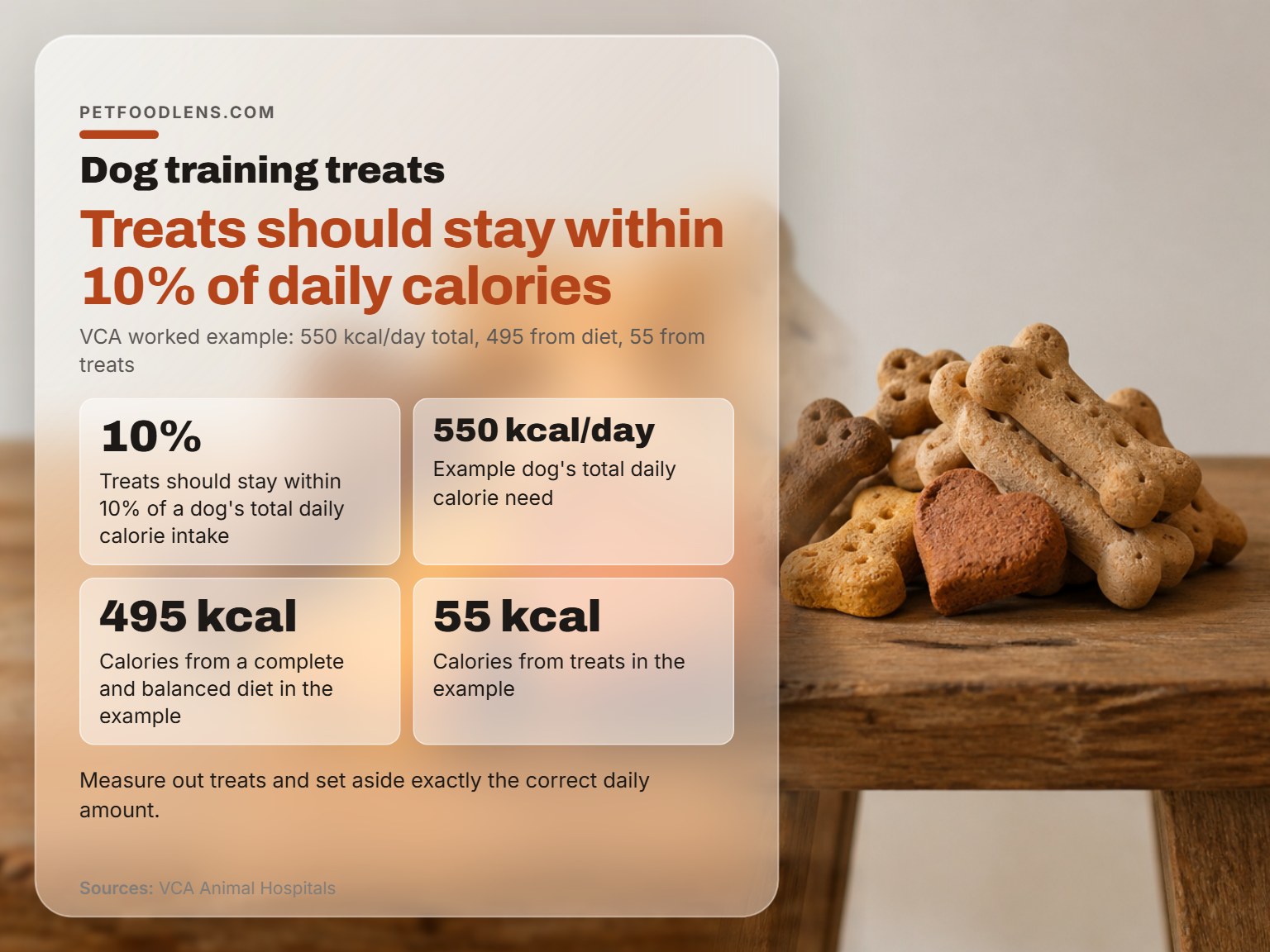
Measure the day’s treats before the session starts, not during it. VCA Animal Hospitals puts the ceiling at 10% of a dog’s total daily calorie intake, and that figure does two jobs: it caps excess calories and it protects the complete diet’s share of vitamins and minerals.
Veterinary guidance sets a treat ceiling at 10% of a dog’s total daily calorie intake. A dog requiring about 550 calories per day takes 495 from a complete and balanced diet and 55 from treats. Measuring the daily allowance in advance is the standard method of staying inside that ceiling.
Run the math on your own dog once, with the bag in front of you. For a dog on 550 calories a day, the treat budget is 55 calories. That is a smaller pile than most people picture when they hear the word treat.
Whole foods need a lookup instead of a label. VCA directs owners to the USDA FoodData Central database for calorie counts on boiled chicken or carrots, and an estimate is fine as long as it lands inside the allowance.
The treat limits that matter are the ones you set in the morning. Measure the pile, put it in a bowl, and the day’s decisions are already made.
I’ve had this conversation across a counter more times than I can count. The dog is on a complete and balanced diet, the owner is careful, and the weight is still creeping up, because the treats never made it into the arithmetic.
What Makes a Training Treat Actually Work?
Three properties decide it, and the AAHA 2015 Canine and Feline Behavior Management Guidelines name all three: palatable, carrying an olfactory component at room temperature, and small enough that a dog can have several without appreciable caloric intake.
That middle one gets skipped, and it’s the one that costs you a session when you learn how to use treats for dog training. A treat without an olfactory component at room temperature may not work as a reward.
- Palatable. The dog takes it without a negotiation.
- Smells like food at room temperature. A treat needs an olfactory component at room temperature to work as a reward.
- Small enough to repeat. Several pieces in a row without touching the calorie ceiling.
- Fast to eat. The AKC’s trainer-written guidance makes this point directly: soft treats are easier and faster to eat than crunchy ones.
Soft over crunchy is the AKC’s call for session work, and biscuits are fine as a one-off reward when you aren’t asking for repetition. The best training treats are the ones the dog eats in a second and remembers.
I go to the calorie statement instead, since the calorie budget is what matters. That habit carries straight over to the treat aisle.
Size vs Calories: Where the AKC and VCA Diverge
Two credible sources give two different answers on how to control the amount, and both hold up inside their own frame.
| Question | AKC position | VCA position |
|---|---|---|
| How to control the amount | Fixed size: pea-sized is plenty, even for large dogs | Calorie budget: 10% of daily intake |
| What breaks first | A pea-sized piece of a dense treat blows the budget | No size rule, so pieces can be too big to eat fast |
| Best fit | Fast sessions with many repetitions | Dogs on a measured diet or a weight plan |
The AKC’s rule is physical: a pea-sized treat is plenty even for a large dog, and small dogs get smaller pieces than that. VCA’s rule is arithmetic, with no size component at all.
Those frames collide the moment a pea-sized cube is calorie-dense. VCA is explicit that high-value treats are high in calories and add up quickly, which is exactly the case where the size rule and the calorie rule point in different directions.
Use the size rule to decide how you cut treats, and the calorie rule to decide how much of the pile you’re allowed to spend. Neither one replaces the other.
There’s a physical difference too. A soft treat torn into small pieces leaves a smear on your thumb and reaches the dog in a second. A biscuit leaves crumbs in the grass and costs you the next repetition.
Kibble as a Reward: Two Sources, Two Answers
VCA endorses kibble as a training reward. The AKC’s guidance says kibble may work in a quiet living room but is insufficient in distracting locations, where stinky high-value treats are needed.
VCA’s reasoning is nutritional: kibble is complete and balanced, so it helps prevent deficiencies on a treat-heavy training day, and how to use treats for dog training with kibble makes it safe to reduce meal size while staying inside the calorie budget.
The AKC’s reasoning is about value. Kibble gets the job done in a quiet living room, and in a more distracting location you need the stinky stuff.
Both are describing the same mechanism from opposite ends. Kibble is complete, which is a nutrition fact. Kibble is also low-value, which is a training fact. The two don’t contradict.
I keep kibble in one pocket and something smellier in the other, and I let the environment decide which hand moves. That’s the whole system.
The workable version: VCA endorses kibble as complete and balanced, while the AKC says kibble works indoors where distraction is low and you should escalate to something smellier when you move outside. That escalation matters most in puppy training, where every new room is a new environment.
VCA adds a line worth keeping: most treats won’t provide the vitamins and minerals a dog needs, so the complete diet has to carry that load. VCA also recommends checking body condition monthly and adjusting.
How Do You Deliver a Treat Fast Enough to Matter?
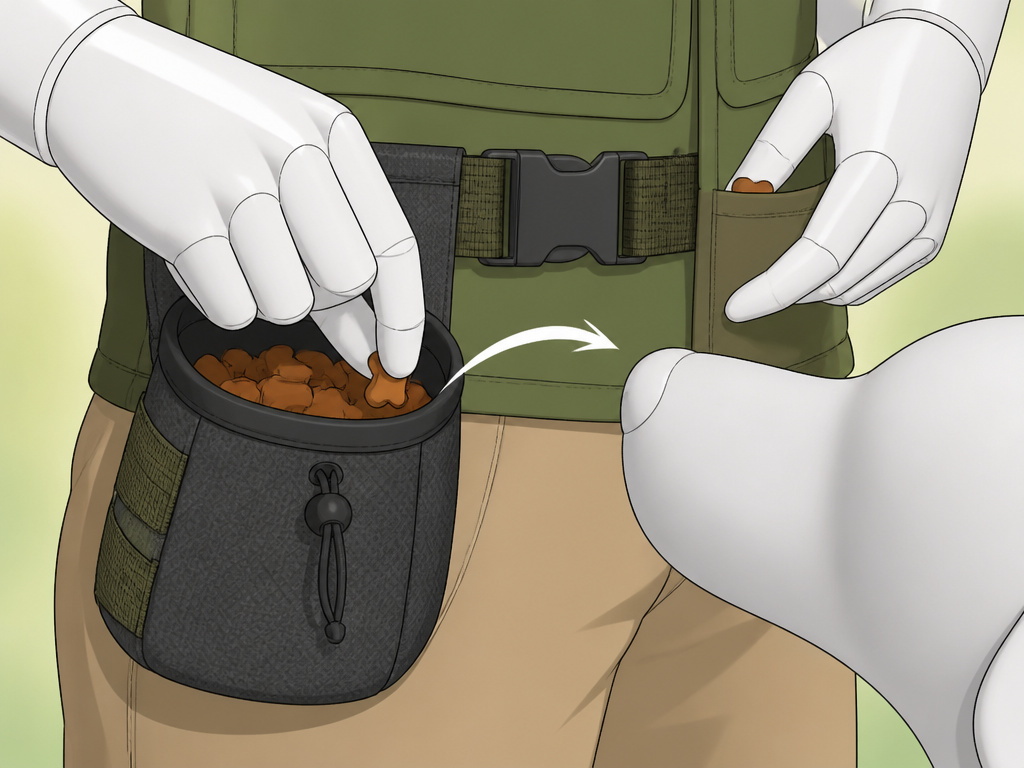
Timing beats selection. The NWRRC’s using treats in training guide puts it flatly: timing is by far the most important element, and a reward that lands late loses its meaning.
Before you start: Check the treat for xylitol before it goes in a pocket, since xylitol is toxic to dogs. Keep food away from a dog that guards it, because AAHA flags food-reactive dogs as a contraindication for hand-fed treats. Cut pieces small enough to swallow, since a dog that stops to chew is a dog missing the next cue.
- Load the pockets before the dog comes out. A bait pouch or a vest with both pockets loaded means either hand can deliver. Fumbling or dropping the reward ruins the effect.
- Practice the draw without the dog. Pull treats out of your pocket in the kitchen until it’s smooth. This is the step everyone skips and the one that shows up first in a session.
- Mark the behavior, release, then pay. The dog doesn’t get the treat until after the release word.
- Deliver at your hip. Reward close to your body so the dog stays near you after release instead of drifting away.
A treat pouch or a loaded pocket keeps treats accessible, unless the pouch itself becomes the distraction. If the dog stares at the pouch instead of you, the NWRRC handout suggests a vest with both pockets loaded so the reward comes from either side without a visible target.
The Release Word Does Two Jobs
Most handlers use “OK”, and the specific word matters less than using it consistently. The release tells the dog the command is finished, and it tells the dog the treat arrives after the release, not before.
The sequence runs: sit, hold, “OK”, then treat. Get that order backwards and the release word stops meaning anything.
More than one release cue is fine. The NWRRC handout uses “OK” plus a sharp hand clap with “YES!” for a stronger marker.
Don’t Ask for More Than the Dog Can Hold
Duration builds in seconds, not minutes. The handout’s advice is to start with a couple of seconds and extend from there, and to accept that the ceiling depends on location, distractions, and how much work has gone into that specific command.
Asking for a long stay on day one isn’t a training plan. It teaches the dog that the cue predicts failure.
The same delivery logic carries into recall training, where a reward that arrives after the dog has already wandered off teaches the wrong thing entirely.
When Treats Backfire: Allergy, Guarding, and the Calorie Trap
Some dogs should not be trained with food in your hand, and AAHA names the cases.
- Food allergies in the dog or the handler. AAHA singles out peanut butter as the example.
- Dogs that become more aggressive in the presence of any food.
- Dogs that guard a treat dispenser, or turn aggressive around one.
Spreadable treats are the specific problem for a reactive dog. AAHA says cream cheese, spray cheese, pâtés, yeast spreads, and some tinned foods should not be used with dogs that become reactive or aggressive around food, even though the same spreadables are useful for delivering a reward at a distance to a calm dog.
Where this goes sideways: VCA’s warning is that high-value treats are high in calories and add up quickly. A day of repetition with cheese can push a dog past the 10% allowance without anyone noticing, and the weight shows up on the scale later.
| What you’re seeing | Likely cause | Fix |
|---|---|---|
| Dog loses interest mid-session | Treat too big or too slow to eat | Cut smaller, switch to soft |
| Weight creeping up | Treats outside the daily allowance | Measure the pile in the morning |
| Dog only works when food is visible | Reward always in your hand | Load pockets, vary the reward |
| Growling near the treat bag | Food guarding | Stop hand-feeding, get a behavior consult |
The last row calls for stopping hand-feeding rather than a better treat. AAHA’s AAHA behavior management guidelines are written for veterinary staff handling anxious patients, and the same caution applies at home once food changes a dog’s posture.
How to Fade Treats Without Losing the Behavior
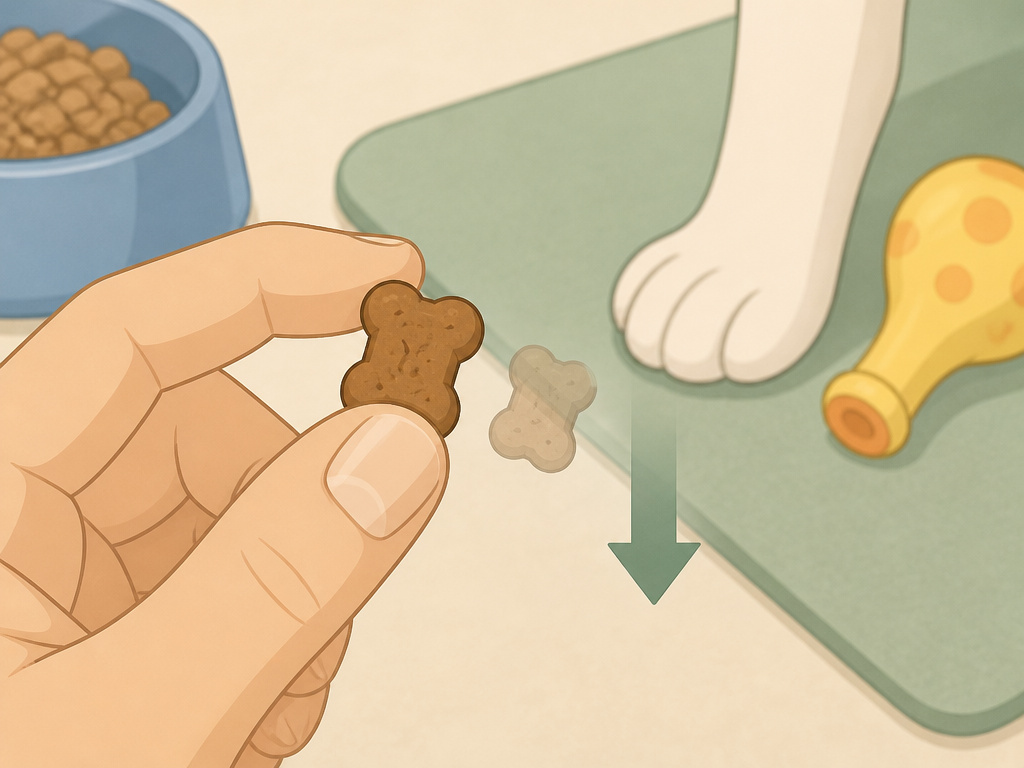
The complaint is always the same: the dog is perfect with treats and useless without them. Two sources answer it in two different ways.
The Weaning Approach
The NWRRC handout’s answer is to back off on how often and when you reward as training progresses. Early on you hand out treats freely, then the schedule thins. Competition rules make the endpoint concrete: outside Conformation, no treats or toys can be with you in the ring at all, not in your hands, your mouth, or your pockets.
The Rotation Approach
VCA’s answer is intermittent reinforcement. Once the dog performs reliably, rotate the reward so one repetition gets the favorite treat, the next gets a belly rub, and the next gets a squeaky toy.
One caution on the rotation. VCA flags petting as a common misunderstanding between people and dogs: owners assume touch reinforces, and the dog decides whether it does. Watch the body language before you count praise as payment.
Both routes end in the same place, and the route matters less than starting. The fade treats question gets easier once the dog has a release word and a clear picture of what earns what.
If the dog works for kibble in the kitchen and nothing in the yard, the reward isn’t the problem. The environment is. Move the training back one step and rebuild there.
The same fading logic applies to leash training, where the reward has to migrate from your hand to the position the dog is holding.
Frequently Asked Questions
How many treats should a dog get in a training session?
Count calories, not pieces. VCA’s ceiling is 10% of daily intake, so a dog on 550 calories a day has 55 calories of treat budget for the whole day, sessions included. Split that pile across every session and don’t refill it.
Can I use my dog’s regular food as a training treat?
Yes, with a caveat straight from the source split. VCA endorses kibble because it’s complete and balanced and protects against deficiencies on a heavy training day. The AKC’s position is that kibble works in a quiet living room and stops working in a distracting location, where you need something smellier.
Is peanut butter a good training treat?
It’s tasty and useful, and VCA puts it in the use-cautiously column because it’s calorie-dense. AAHA adds a harder warning: peanut butter is the named example when cautioning about food allergies in the dog or the handler. Check the label before it goes anywhere near a dog.
Should I use treats for every behavior, forever?
No. The NWRRC handout recommends thinning the reward schedule as training progresses, and VCA recommends rotating treats with affection and toys once the dog performs reliably. Pick one route and start thinning.
What if my dog is gaining weight during training?
Measure the daily treat allowance and check body condition monthly, which is VCA’s recommendation. If the weight is still climbing with the treats measured, check body condition monthly and adjust.
Do treats work for a dog that guards food?
Not by hand. AAHA cautions against food-based work with dogs that become aggressive in the presence of food, and rules out spreadable treats entirely for dogs that turn reactive around food. That case needs caution with food-based training, not a better biscuit.
The Bottom Line
Weigh out tomorrow’s treat allowance before you do anything else. Put it in a bowl, put the bowl on the counter, and let that pile be the day’s entire budget. Everything below runs off that one habit.
One concession, and it matters. This whole approach assumes a healthy dog on a complete diet. If your dog is on a therapeutic or prescription food, the treat budget changes and the math isn’t mine to give you. That’s a veterinarian conversation.
Indoors, a dog can work for part of its dinner instead of a bag of cheese. The dog still gets paid, and the calories stay inside the line.
