
How to Add Water to Cat Food: Step-by-Step
This post contains affiliate links. As an Amazon Associate, we earn from qualifying purchases.
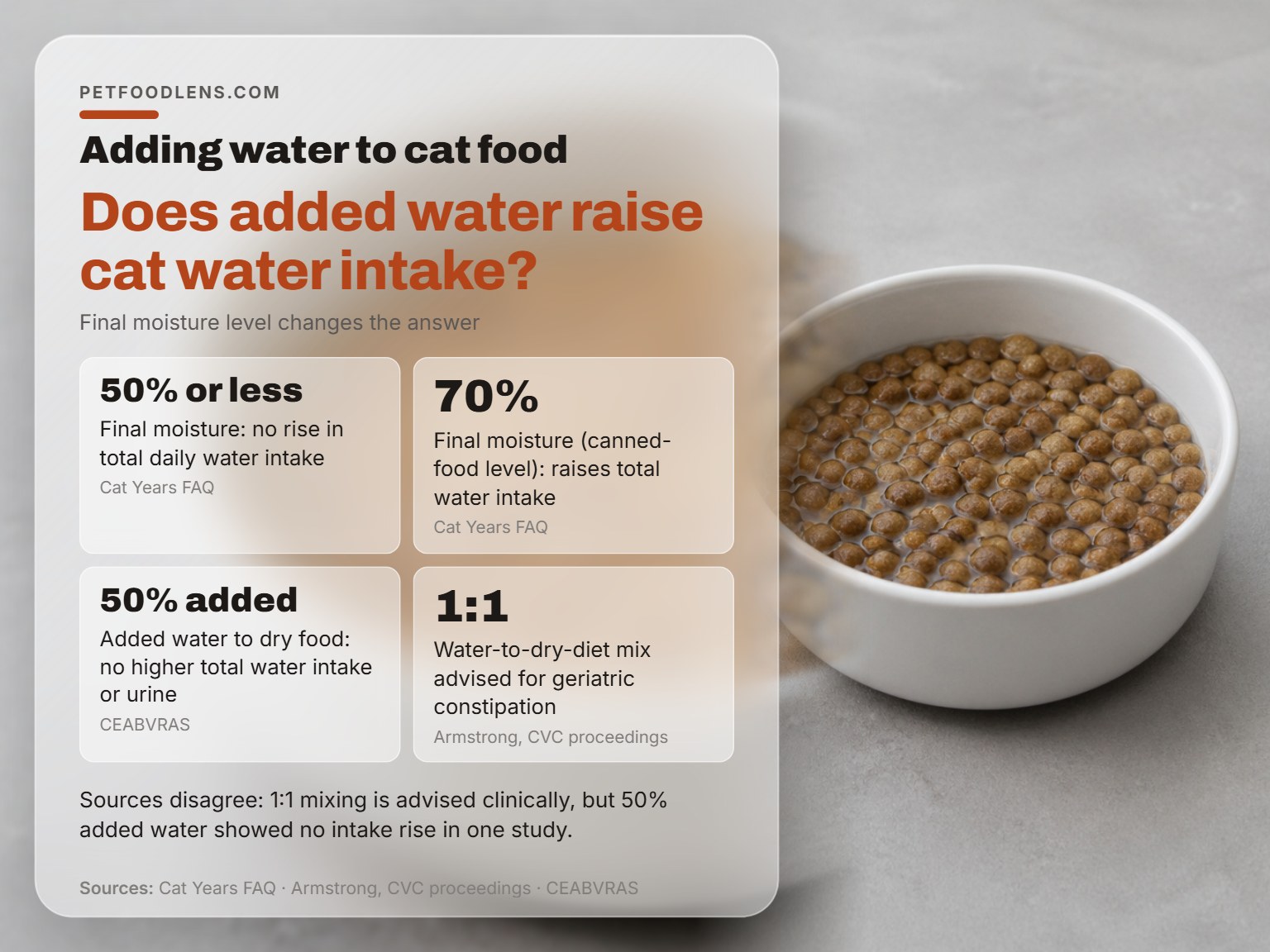
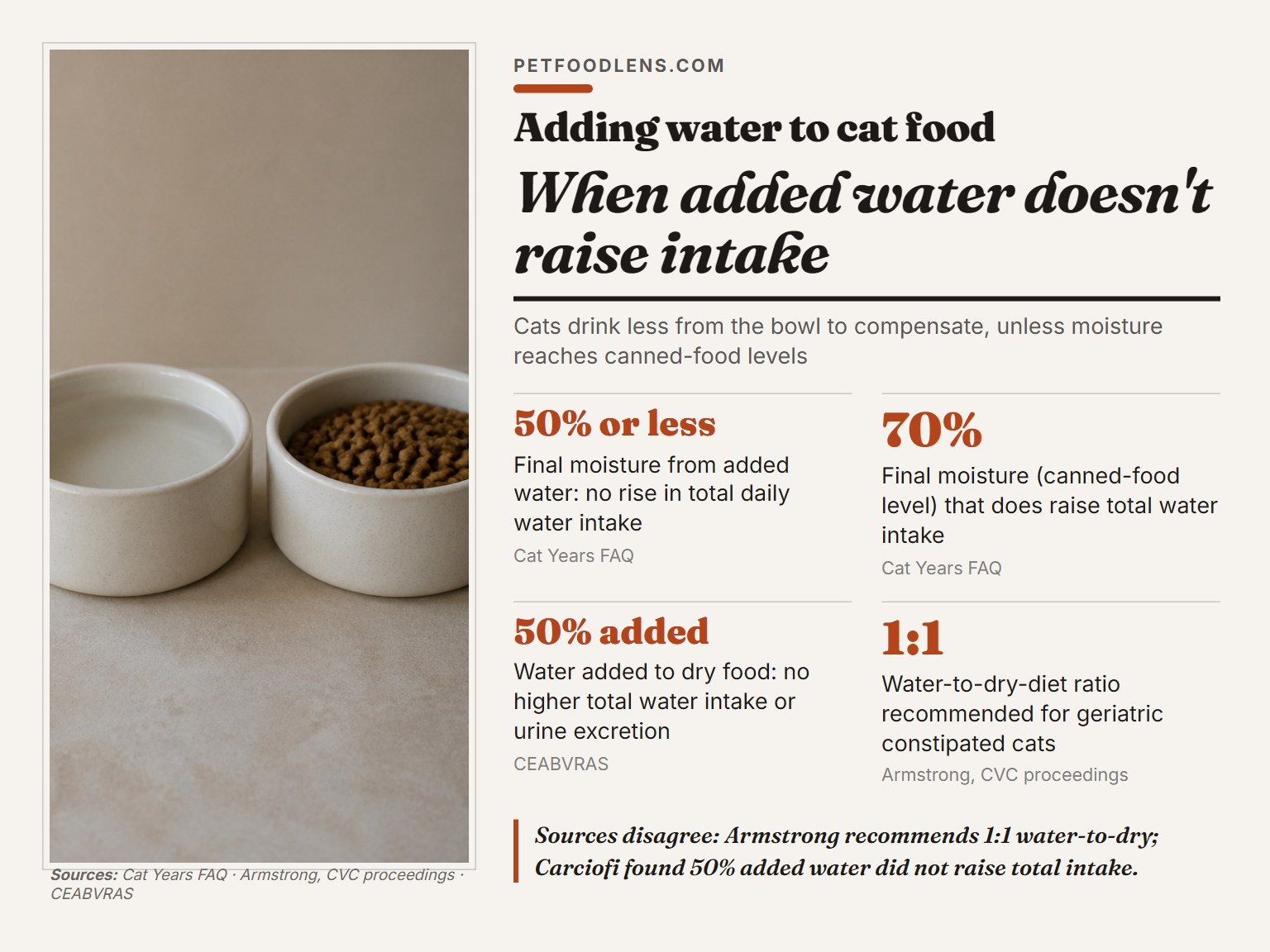
How to add water to cat food: Cat Years FAQ (citing Buckley et al., 2011) says push the food to 70% moisture, the level canned food sits at, because at or below 50% cats drink less from the bowl to compensate and total intake stays flat, while Murphy (Purina) suggests starting with a drop or two and working up to the cat’s tolerance, and Armstrong recommends mixing water with dry diets 1:1 for constipated geriatric cats.
That compensation is where a lot of the how to add water to cat food advice falls apart. Carciofi and colleagues housed ten adult female cats in metabolic cages and fed four diets, one of them a dry food with 50% water added. Total water intake and urine output didn’t budge, because the cats drank less.
What follows is the moisture math, the three places the research genuinely disagrees, and the practical way to reach a number that changes what’s in the bowl.
Key Takeaways
- 70% final moisture is roughly where added water starts raising a cat’s total daily intake. Below that, the cat compensates at the water bowl.
- A dry food with 50% added water produced no change in total water intake or urine output across ten cats in a controlled trial.
- Vets managing constipated geriatric cats still mix water into dry food at 1:1. That’s a clinical tactic aimed at stool, not a proven hydration gain.
- Fiber supplements can worsen constipation in a marginally dehydrated cat until water intake rises first.
Why a Splash of Water in the Bowl Changes Nothing
A tablespoon of water in a bowl of kibble is a rounding error.
Carciofi’s team tested it properly. Ten adult female cats, four diets, a Latin square design with repeats over time. The treatments were low-price dry, low-price dry with 50% added water, super-premium dry, and canned.
Ten adult female cats in metabolic cages received four diets: low-price dry, low-price dry with 50% added water, super-premium dry, and canned. Adding water to the dry food raised the water delivered in the food but not total daily water intake, because voluntary drinking fell to compensate. Canned food produced the highest total intake and the lowest urine density.
Read that middle sentence again. The water went in. The total didn’t move.
The detail I keep coming back to is the urine-to-feces water ratio. Dry foods with high digestibility produced 0.7:1. Low-digestibility dry foods produced 1.6:1. Same species, same cages, more than double the water leaving in the stool on the poorer diet.
That gap comes from residue. A highly digestible food leaves less undigested material behind, so less water rides out with the feces and more is available to pass in urine. Fat intake also correlated positively with urine volume in the same study.
So the food itself shifts the water math before you add a drop to the bowl. If you want the background on how the two formats compare on moisture alone, the breakdown of wet food vs dry food for hydration covers the format question separately from the topping question.
Which is the part that surprised me most when I first read the paper.
How Much Water Do You Actually Need to Add?
Seventy percent is the number, and it’s a bigger number than it sounds.
Here is the math. Take 100 g of dry kibble at 6% moisture, which is close to the 59 g/kg as-is moisture Alexander’s group reported for the Royal Canin Fit 32 test diet. That’s 6 g of water and 94 g of dry matter.
To land at 70% moisture, water divided by total weight has to equal 0.70. Solve it and the bowl needs about 219 g of water in total, so you’re adding roughly 213 g of water to 100 g of kibble. More than twice the kibble’s weight.
At 50% moisture the same 100 g of kibble needs about 94 g of water total, or roughly 88 g added. That’s the level Carciofi tested. It’s also the level that produced no change in total intake.
| Final moisture | What it looks like | What the evidence shows |
|---|---|---|
| 6% | Dry kibble straight from the bag | No meaningful water contribution |
| 40% | Kibble soaked, still firm to the press | No weight or fat gain over 28 days |
| 50% | Kibble with roughly its own weight in water | Total water intake unchanged |
| 70% | Canned-food texture, holds a soft ridge | Raises total daily water intake |
| 80% | Loose and soupy, barely holds shape | Higher activity, no weight gain at excess intake |
The 40% and 80% columns come from a different trial. Alexander and colleagues randomised 69 adult cats into three groups and fed diets hydrated to 6%, 40%, or 80% total moisture content, then offered them at 200% of daily maintenance energy requirements for 28 days. The dry group gained body weight and body fat (P<0.01). The hydrated groups didn’t (P>0.01). Activity in the 80% group ran significantly higher than in the other two (P<0.01).
That’s a weight-management result, and the authors say so. It isn’t a hydration result. The PMC study on water addition to dry cat diet measured energy dilution and activity, not total water intake. Two different outcomes, often quoted as if they were one.
Common mistake: Topping the bowl with a tablespoon and calling it handled. A small splash keeps the food in the low-moisture band, the cat drinks less from the bowl to balance it, and the total doesn’t move. You’ve spent the effort and changed nothing.
If you want the target number for the bowl itself rather than the food, that’s a separate calculation, and how much water cats need works through it.
The Sources Don’t Agree on the Number
Four credible sources, four different answers.
| Source | What they recommend | Moisture level or ratio |
|---|---|---|
| Carciofi et al., 2005 | Dry food with added water, measured | 50% added water, no change in total intake |
| Cat Years FAQ (citing Buckley et al., 2011) | Soaked kibble or canned food | 70% final moisture or higher |
| Murphy (Purina, Univ. Of Tennessee) | Add water gradually to the cat’s tolerance | Start with a drop or two |
| Armstrong (Univ. Of Minnesota, CVC) | Mix water with dry diets for constipated cats | 1:1 water to dry food |
Armstrong’s 1:1 ratio lands close to the 50% band Carciofi found produced nothing. That looks like a straight contradiction. It mostly isn’t.
Armstrong is writing about geriatric cats with chronic constipation, where the outcome being managed is stool, not total water intake. Her proceedings note that inadequate water intake producing dry feces is the most common reason cats become constipated in the first place. A null result for total water intake and a positive result for stool quality can both be true, because they’re measuring different things.
A null result for total water intake isn’t a null result for stool. Those are two different measurements, and the disagreement between Carciofi and Armstrong comes from measuring different things.
Murphy’s advice is the most modest of the four. She suggests starting with “a drop or two” and working up to the highest volume the cat will tolerate, which is a tolerance-building protocol rather than a claim about total intake. She also notes that the optimal level of water intake for a cat isn’t actually known.
The mechanics of getting water into dry food are the same whether the bowl belongs to a cat or a dog, and adding water to dry dog food walks through the soaking side of it. The targets differ; the physics don’t.
How to Add Water to Cat Food Without Making It a Chore
Five steps, and only one of them is about the water itself.
- Weigh the portion. A can of wet food at more than 70% moisture is mostly water by weight. Eyeballing the portion means you don’t know what you’re starting from.
- Add water by weight, not by eye. If you’re soaking kibble to a real target, you need a scale. Two hundred and thirteen grams of water into 100 g of kibble is not a splash, and guessing at it gets you to the 50% band that does nothing.
- Let it sit long enough to actually absorb. Alexander’s team soaked overnight in a sealed tub at room temperature and measured evaporation under 2% of total mass. Press a soaked kibble between two fingers. If there’s still a hard core, the water hasn’t gone in yet.
- Warm it, don’t cook it. Warm water releases aroma, and aroma is most of what gets a hesitant cat to the bowl. Hot water cooks the outside of the food and changes the smell in the wrong direction.
- Watch the bowl, not the clock. If the cat’s drinking from the water bowl drops after you start adding water to food, you’re watching compensation happen in real time.
If measuring kibble by weight sounds like more effort than you’ll sustain, there’s a middle path. Cat food toppers add moisture without requiring you to rehydrate a whole meal, and freeze-dried cat food rehydrates to a moisture level you control with a measured amount of water rather than a guess.
Warm Water, Broth, and the 3 oz Can
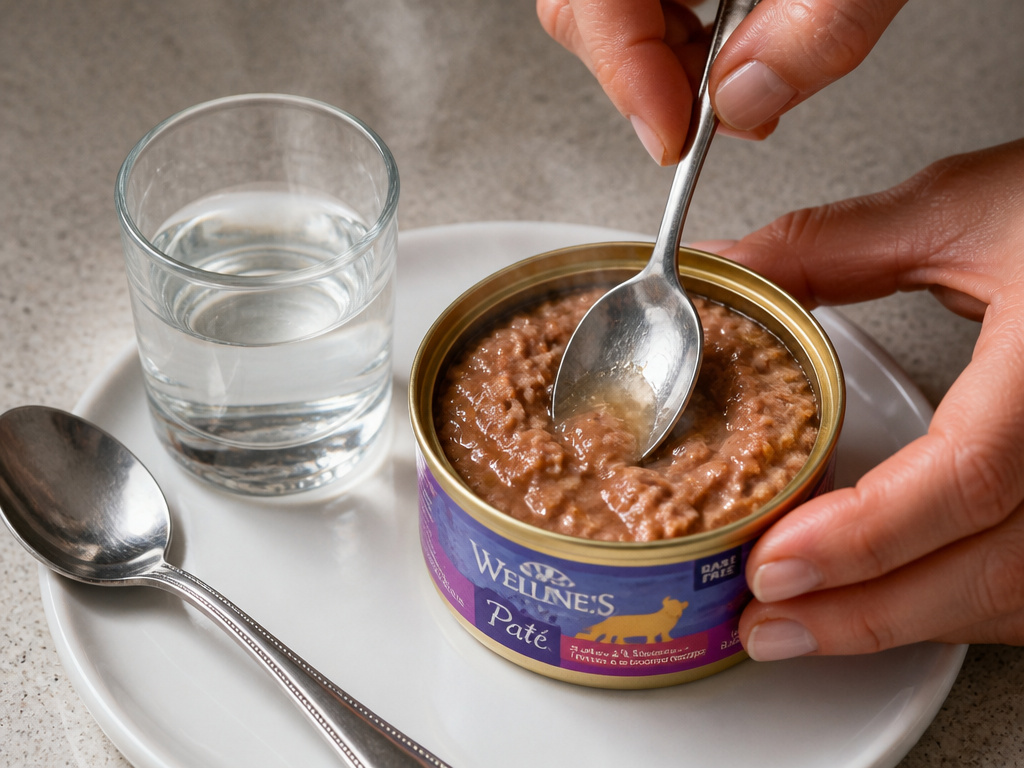
Six in the evening, cat circling your ankles, can opener already out.
Stir a small amount of warm, not hot, water into a can of pate; the warming releases aroma, which may help encourage a hesitant cat to the bowl.
You’ll smell the food open up before the cat gets anywhere near it. That’s the point.
The catch is that this works best with food that is already wet, though Murphy (Purina) and Armstrong both endorse adding water to dry food in some situations. A pate at more than 70% moisture is already past the threshold. Adding a tablespoon to it pushes it further, which is fine, but it isn’t rescuing a dry diet. Adding 50% water to kibble is what Carciofi tested and it produced no change in total intake, though Murphy (Purina) still endorses adding water to dry food starting with a drop or two.
Broth, and the Onion Problem
Plain poached chicken broth is fine. Only if there’s no onion, no garlic, and no salt in it.
I’ve seen homemade broth recipes that would be a hazard for a cat, which is why the ingredient list matters on a kitchen pot the same way it matters on a bag. If you’re making it yourself, the guide to making homemade broth for cat food is worth reading before you start improvising with a stock cube.
Before you start: Warm water, never hot, because a cat’s tongue is more sensitive than yours and a bowl that’s comfortable to your wrist can still be too warm. Broth needs to be free of onion, garlic, and added salt. And soaked food sitting out for hours loses moisture to evaporation, which pulls your final number back below target.
What the Label’s Moisture Percentage Actually Tells You
Guaranteed analysis is where the confusion starts.
“Moisture 78% max” reads like a quality claim. It’s water. That’s the whole entry. The number that tells you something is protein and fat on a dry matter basis, which you calculate by removing the water from the equation first.
Dry Matter Basis in One Paragraph
Take the protein percentage, divide by one minus the moisture percentage, multiply by 100. The wet food wins on protein density, and the front of the can never says so.
Turn a pate out of the can and it holds a soft ridge. That film is usually thickener doing work the meat should be doing.
Wet food often contains more than 70% moisture. Anything under about 70% in a product marketed as a stew or chunks in gravy is worth a second look at the ingredient list, because something is holding that texture together.
I work out dry matter basis on the back of a can about once a week out of habit, and it has never once matched the impression the front of the label was trying to give.
When Adding Water Isn’t the Answer
Some cats need a vet, not a tablespoon.
Armstrong’s constipation protocol starts with hydration but doesn’t stop there. She lists canned food with added water, water bowls in multiple locations, a pet water fountain, mixing water with dry diets at 1:1, flavored water using frozen cubes of meat or fish broth, distilled or filtered water if the tap supply is heavy in minerals or chlorine, keeping food and water bowls away from the litter box, and feeding multiple smaller meals instead of one or two large ones.
If those fail, intermittent subcutaneous fluids may be needed to maintain hydration. That’s a veterinary decision.
When Fiber Backfires
This is the one that catches people out. In a well-hydrated cat with a functional colon, a fiber-enhanced diet works. It increases fecal bulk, stimulates the defecation reflex, and shortens transit time.
In a cat with marginal dehydration, the same diet can make constipation worse. Armstrong is direct about it: either the cat consumes more water for the diet to work, or a different approach is needed. Historically, high-fiber constipation diets ran above 20% fiber on an as-fed basis. Psyllium powder can be mixed with canned food at 1 to 4 tsp once or twice daily, but that’s a conversation to have with your vet, not a label decision.
Where this goes sideways: Adding fiber to a cat that’s already dry. The fiber pulls water into the colon, the stool gets bulkier and harder, and the cat strains more than before. If you’re going to add fiber, raise water intake first before judging whether it helped.
Does a Fountain or a Bigger Bowl Actually Help?
Armstrong’s list of cheap fixes starts with the bowl itself.
Most water bowls sold for cats are too small. Cats dislike their whiskers touching the side of a container, which is why a larger dog bowl often gets more use than a purpose-built cat bowl. Wide and shallow beats tall and narrow.
Bowl placement matters too. The most common setup I see is the water bowl parked directly beside the food dish. Armstrong recommends keeping food and water bowls away from the litter box, and moving the water bowl away from the food dish is free to try.
Free changes worth trying:
- Move the water bowl away from the food dish, ideally into another room.
- Swap a deep plastic bowl for a wide shallow ceramic one. Plastic picks up a film over time that I wouldn’t drink from either.
- Add a second bowl in a different location so the cat doesn’t have to cross the house.
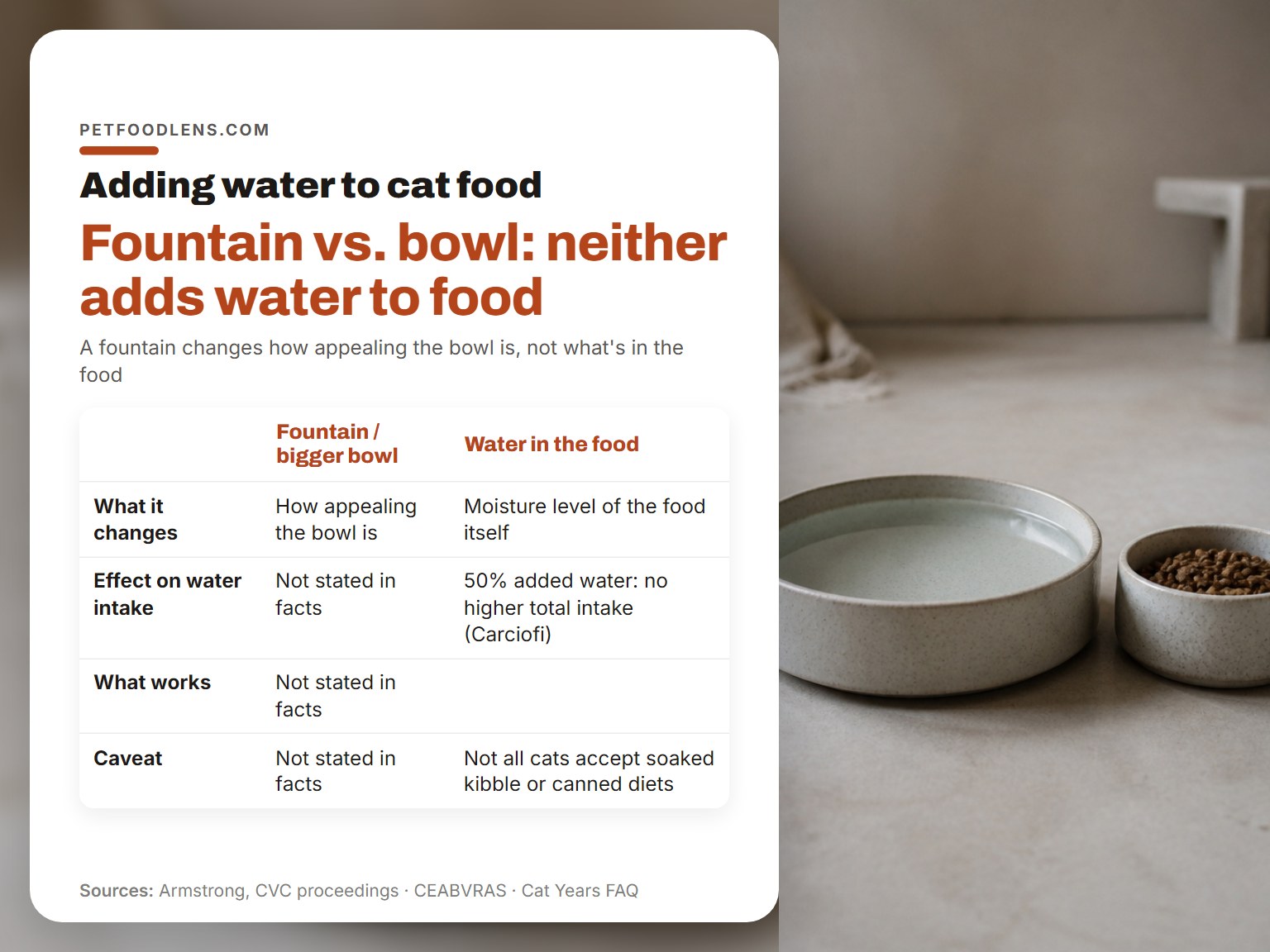
- Try a fountain if your cat shows interest in running water. Armstrong lists a pet water fountain as a reasonable strategy.
Fair warning on the fountain, though. It’s a tool for getting cats to drink, and it’s a weak substitute for moisture in food. Murphy’s point is that cats without adequate water intake have limited reserves to flush out in urine, which shows up as higher urine specific gravity. A fountain changes how appealing the bowl is. It doesn’t change what’s in the food.
Frequently Asked Questions
Does the temperature of the water matter when mixing it into kibble?
Warm water softens kibble faster and releases more aroma, which can help a picky cat accept a wetter bowl. Let it cool to room temperature before serving so the food does not spoil faster, and never microwave the mix, since hot spots can burn a cat’s tongue. Any water left standing with food should be discarded after about 30 minutes.
Can I just leave a second water bowl next to the food instead?
Extra bowls help only if the cat actually uses them, and the compensation research suggests many cats will not drink more just because water is available. Place bowls away from the food and litter box, since cats often prefer water sources that are separate and quiet. A cat fountain can tempt some drinkers, but it is not a substitute for moisture in the food itself.
How quickly should I increase the amount of water?
Go slowly, adding a small amount and holding it for several days before increasing again. Sudden jumps in moisture can cause loose stools or a cat to refuse the bowl entirely. If your cat has kidney disease, diabetes, or another condition, set the target moisture level with your vet rather than working it out alone.
Is adding water to dry food ever a bad idea?
Yes, in a few situations. Dry food left wet for hours at room temperature grows bacteria quickly, so serve it fresh and remove what is not eaten. Cats with dental disease may find softened kibble easier, but those with certain gastrointestinal conditions may do better on a diet formulated for their needs rather than a home-modified one.
The Bottom Line
Here’s the trigger. If you can’t get the food to roughly 70% moisture, don’t bother with the splash at all. A tablespoon in a bowl of kibble sits in the 50% band that Carciofi measured as a null result, and you’ll spend the effort for nothing.
That leaves two options per the Cat Years FAQ: feed a canned or pouched food that’s already at 70% or above, or rehydrate deliberately with a scale and enough water to actually hit the target, though Murphy (Purina) endorses starting with a drop or two and working up to the cat’s tolerance.
One concession. If your cat is a geriatric patient with chronic constipation, Armstrong’s 1:1 mixing is still worth asking your vet about, even though it lands near the moisture level the hydration studies found ineffective. You’re treating stool, not water intake, and those are different goals with different evidence behind them.
I’m not a clinician. Prescription diets for urinary or kidney disease are outside what I can responsibly advise on from a label, and a cat with those diagnoses needs a veterinarian making the call. What I can tell you is that the number on the front of the bag is marketing, the moisture percentage on the guaranteed analysis is water, and the arithmetic in the middle of this article is the part nobody puts on the packaging.
Turn the bag over.
