
How to Get a Cat to Drink More Water: Step-by-Step
This post contains affiliate links. As an Amazon Associate, we earn from qualifying purchases.
To get a cat to drink more water, raise total water in the diet instead of waiting on the bowl: wet food at 70 to 80 percent moisture, extra water mixed into meals, and several wide ceramic bowls placed away from the food dish. Cornell puts a 10-pound cat at about one cup a day.
That cup is a total across food and bowl, which is the first thing to understand about how to get a cat to drink more water. A cat eating canned food pulls most of it out of the meal and may barely touch the water dish, which is why owners of wet-fed cats so often report a cat who never drinks.
What follows is the order I’d work in: the numbers first, then the food swap that does most of the work, then the bowl and fountain details that only matter once the food is right.
Key Takeaways
- Wet food does more for water intake than a fountain. Canned diets run 70 to 80 percent water; kibble runs single digits to low teens.
- A cat can lose 8 percent of its body water before it drinks more, per IVIS. Waiting for thirst means waiting too long.
- Urine specific gravity under 1.030 is the target the University of Minnesota Urolith Center uses for cats.
- One bowl per cat, plus one extra, with at least one on every floor, per iCatCare.
- Never syringe water into a cat’s mouth. iCatCare calls it stressful and a real aspiration risk.
How Much Water Does a Cat Actually Need?
The honest answer is that no one has pinned down a single number. Published figures run from 23 mL/kg a day to 70 mL/kg a day, and the scoping review that collected them says the minimum before a cat is at greater risk remains unknown.
Feline water intake is expressed per kilogram of body weight, and published requirements range from 23 to 70 mL per kilogram per day. The spread reflects different diets, different measurement methods, and a genuine gap in the evidence rather than a disagreement about feline physiology. Cornell’s simpler rule of roughly one cup daily for a ten-pound cat sits inside that range.
| Source | Daily water figure | What it covers |
|---|---|---|
| Cornell Feline Health Center | About 4 oz per 5 lb lean body weight | Total intake, roughly 1 cup for a 10-lb cat |
| IVIS clinical nutrition encyclopedia | 55 to 70 mL/kg | Requirement tied to dry matter intake |
| Scoping review, 32 papers | 23 to 51 mL/kg | Measured intake in healthy cats |
| Scoping review citing NRC 2006 | 50 to 60 mL/kg | Inherited from dog data |
| Nutrient-enriched water trial | 30 mL/kg target | Total fluid goal in a clinical setting |
Cornell’s feline hydration health information gives the version you can do in your head: about 4 ounces of water per 5 pounds of lean body weight, or roughly a cup a day for a 10-pound cat. That lands near 55 mL/kg, in the upper half of the published range.
The IVIS cat water intake chapter ties the requirement to food instead of weight: about 2 mL of water for every gram of dry matter eaten, or 55 to 70 mL/kg a day.
Two things follow from that spread. A cat on a wet diet at 70 to 80 percent moisture can clear the low end without touching the bowl. And the how much water should a cat drink figures scale by lean body weight, so a 15-pound cat needs meaningfully more than a 10-pound one.
IVIS adds a detail that reframes the whole exercise. A cat may not drink additional water until it has lost as much as 8 percent of its body water.
Thirst shows up late in this species.
Why the Bowl Is the Wrong Place to Start
Chasing bowl volume is the slowest route to a better-hydrated cat, and it is the wrong way to think about how to get a cat to drink more water. The water inside the food does more work than the water in the dish, and it does it every meal without asking the cat to change a habit.
I learned that the long way. Early in this work I assumed a meat-first label meant a food was mostly meat, and I built a whole comparison on that assumption. Then I found out how much of fresh meat’s listed weight is water and how much of it cooks off before the kibble is finished. It changed how I read ingredient order, and it’s why I check moisture content before I check anything else on the bag.
Here’s what the numbers actually look like:
- Canned or pouch food: 70 to 80 percent water, per the University of Minnesota Urolith Center.
- Dry kibble: 9 to 12 percent in that same Minnesota comparison, 7 to 8 percent per IVIS, and 3 to 11 percent in the scoping review.
- Whole prey: 65 to 75 percent moisture, which is where the cat’s whole design comes from.
That gap is the argument. A cat on canned food takes in water with every bite. A cat on kibble asks its kidneys to close the difference.
IVIS explains the mechanism: dry food increases fecal water loss but decreases urinary loss, so total water balance shifts less than intake does. Urinary stones track urinary minerals and pH more closely than moisture content. That’s the part the wet-food camp tends to skip.
Higher moisture helps, and it’s the lever I’d pull first. It also isn’t a guarantee against crystals.
The University of Minnesota Urolith Center makes the case from the stone side, and their how to increase water intake in pets guidance is blunt about it: more water means more urine volume, which dilutes the minerals that bind into crystals. Seen that way, the wet vs dry food question is about dilution, not about which bag photographs better.
If moisture is your main selection criterion, the best cat food for hydration comparison settles it fast. Canned wins by a wide margin.
How to Get a Cat to Drink More Water, Step by Step
Six changes, ordered by how much they move the number and how little they cost you.
Before you start: Never syringe water into a cat’s mouth. ICatCare warns it’s highly stressful and can cause illness if water reaches the lungs. Keep onion, garlic and salt out of any broth you make. And if a cat refuses soaked food, back off that day rather than let it skip meals.
- Move the water away from the food. IVIS puts the minimum gap at 50 cm, and a different room works better. A bowl beside the food dish gets ignored by a lot of cats, and you won’t know which cat until you move it.
- Swap part of the ration to canned. Even half a can a day changes the arithmetic, because canned food is 70 to 80 percent water.
- Stir warm water into the pate. Stir a little warm water into the pate. Warm, not hot, because aroma is doing half the work.
- Soak the kibble if canned gets refused. One cup of water per cup of dry food, soaked until it floats, per the University of Minnesota Urolith Center. Skip it if the cat won’t eat soggy food, since a cat that stops eating is worse off than a cat that drinks little.
- Add bowls until you have one per cat plus one. iCatCare’s rule, with at least one on every floor. A cat blocked from the bowl by a housemate is a cat that isn’t drinking.
- Measure something. A bowl with volume markings beats a guess, and urine specific gravity beats both.
Step three is the one I’d defend hardest. A little warm water stirred into the can is a change most cats don’t notice, and it adds water without asking the cat to drink anything.
The mechanics of how to add water to cat food matter more than the volume, since a soupy texture gets refused outright.
The strongest evidence for raising intake on purpose comes from a 2023 prospective study of 13 clinically dehydrated cats. Median voluntary intake of nutrient-enriched water hit 38.9 mL/kg a day against 13.7 mL/kg for plain water (P = 0.005), and every cat cleared a 30 mL/kg total fluid target. That’s a peer-reviewed feline hydration trial, not a blog claim.
Do Water Fountains Actually Work?
The scoping review looked at static versus flowing water and found no effect on intake, while Cornell and IVIS report that some cats drink more from a fountain. Cornell and IVIS both report that some cats drink more from a fountain, and both frame it as individual preference rather than a rule.
That’s a genuine split, and it’s worth naming who holds which side. Cornell’s position is that some cats increase intake with fountains and that preferences vary between cats. IVIS notes some cats prefer fountains that aerate the water. The scoping review found intake wasn’t affected by source type at all. Three sources, two positions.
What the Fountain Research Actually Shows
Nothing in the literature says a fountain hurts. The question is whether it closes a gap, and on this evidence it doesn’t close the big one.
A cat eating kibble at roughly 10 percent moisture is still taking in a fraction of what a canned-fed cat gets. A pump moving water around a bowl doesn’t change what’s in the food.
Where Fountains Fail
The failure mode I see most isn’t the fountain. It’s the maintenance.
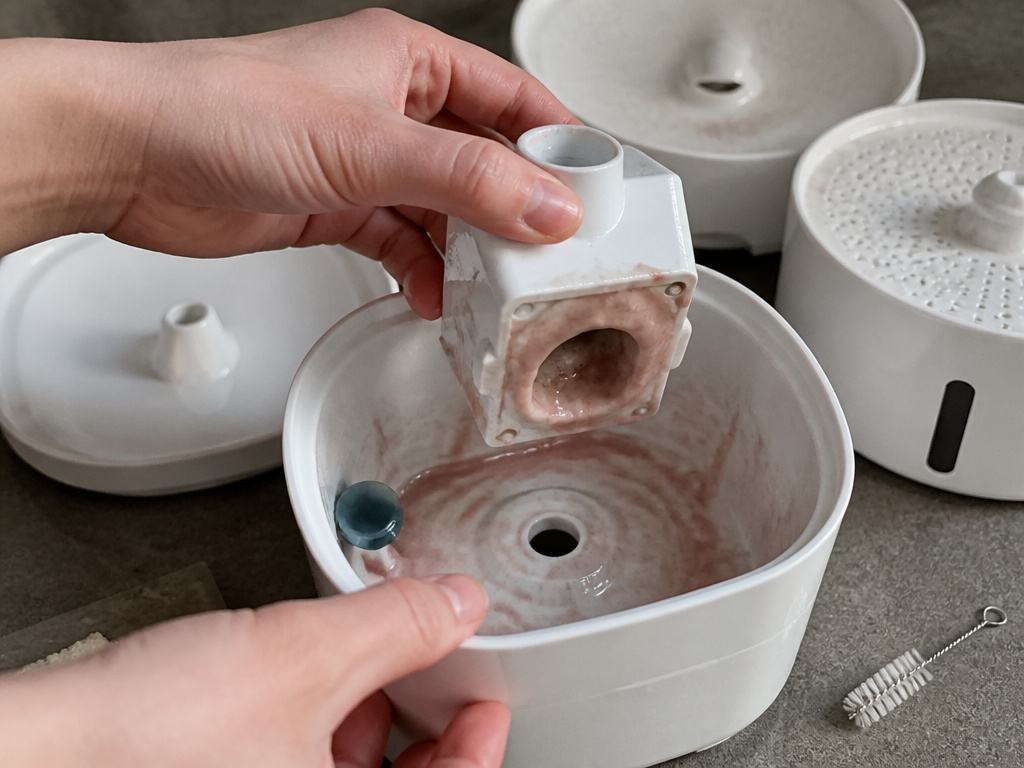
A fountain a week overdue smells like a wet dishcloth, and the pump housing feels slick when you pull it apart. That film is why I tell people to clean the thing weekly or skip it entirely.
Many fountains I’ve seen in homes were overdue for a clean.
I keep a fountain in the house for one reason: some cats genuinely like moving water. I don’t keep one as a urinary-health strategy. A fountain doesn’t change what’s in the food, and the food is where the water is.
If you’re going to run one anyway, weigh the upkeep before you buy. Weigh the upkeep before you buy, because the cat water fountain argument only works if the weekly clean actually happens.
Bowl Material, Placement, and the Multi-Cat Problem
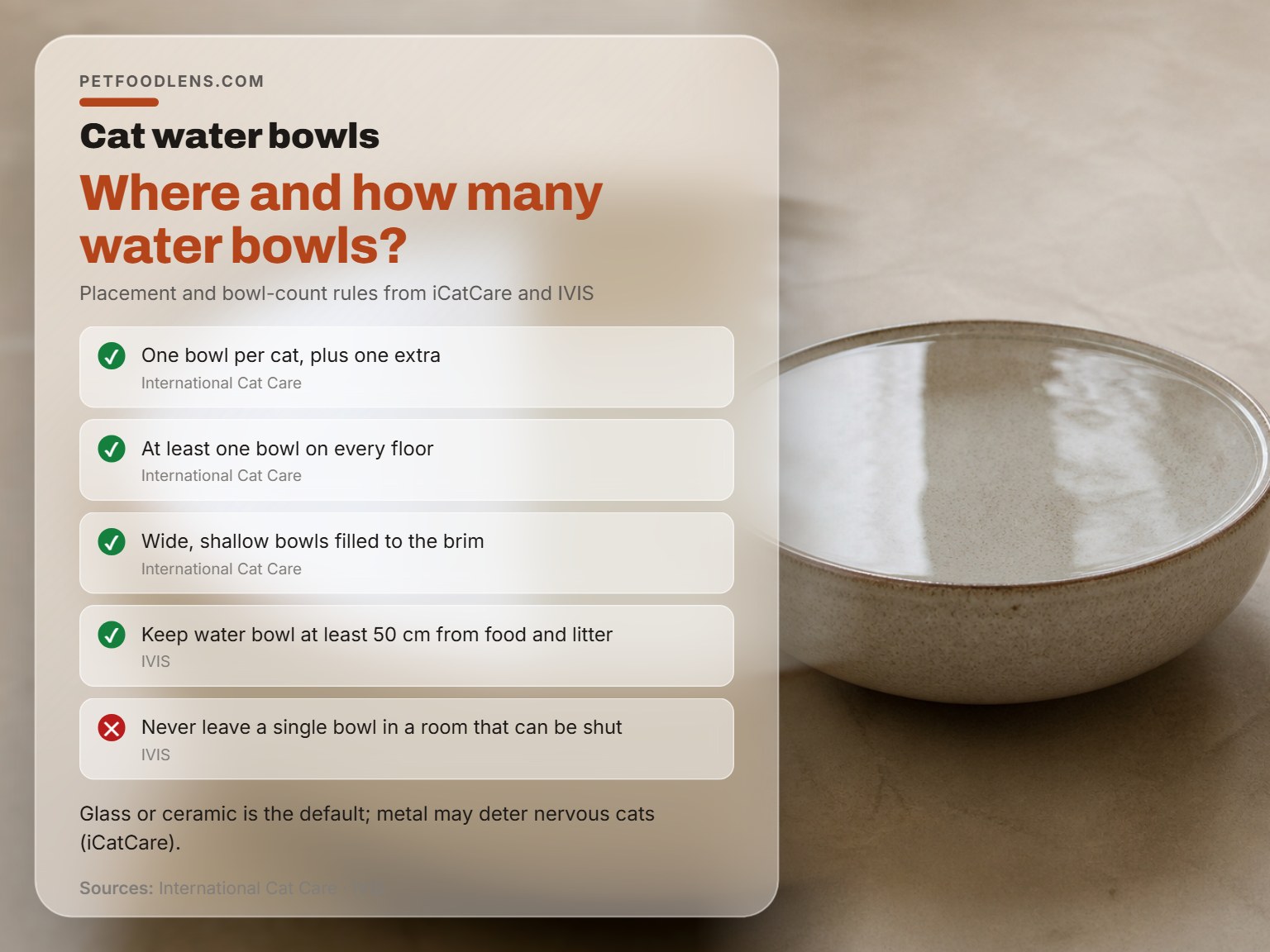
IVIS puts the water bowl at least 50 cm from the food bowl and the litter tray, while iCatCare emphasizes wide, shallow bowls filled to the brim. That gap does more work than the bowl itself.
| Bowl type | What the sources say | Practical call |
|---|---|---|
| Glass or ceramic | Preferred by IVIS and favored by iCatCare | Default choice |
| Metal | IVIS lists it as acceptable; iCatCare warns it’s noisy, cold and reflective | Fine for a bold cat, risky for a nervous one |
| Plastic | IVIS prefers glass, metal or porcelain to plastic | Skip it; it holds a film |
| Fountain | Cornell and IVIS say some cats use them; scoping review found no intake effect | Secondary tool, cleaned weekly |
That material disagreement is a clean example of the two sources talking past each other. IVIS treats metal as acceptable. ICatCare argues metal’s noise, cold surface and reflectivity may put some cats off. Both can be true at once, and the cat in your kitchen is the tiebreaker.
The placement rules are less contested:
- One bowl per cat, plus one extra (iCatCare).
- At least one bowl on every floor, so a closed door never cuts off access.
- Wide and shallow, filled to the brim.
- Not jammed against a wall, where the cat drinks with its back to the room.
- Never in a room that gets shut overnight.
The single most common setup problem I see is the bowl parked right next to the food dish. Move it a few feet, or into another room, and some cats change behavior.
The iCatCare cat carer resource is where the bowl-count rule comes from, and it’s short enough to read in one sitting.
Sort the count first. The water dispensers for cats question only matters once every cat in the house can actually reach a bowl.
What to Add to the Water, and What Never Goes In
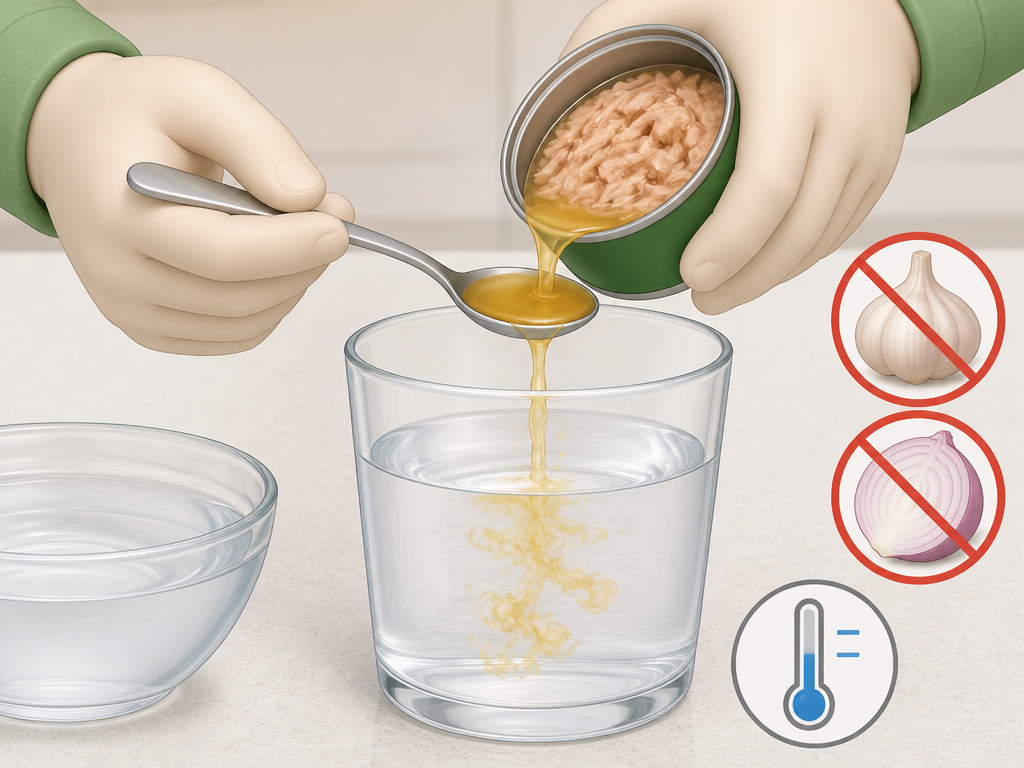
A teaspoon of flavor per cup of water is the ratio the University of Minnesota Urolith Center uses. One teaspoon of meat or vegetable broth, or a spoonful of the cat’s own canned food, stirred into a cup.
Keep plain water available alongside it. The goal is an extra option, not a replacement.
Cornell’s version is a small amount of water from a can of tuna, or low-sodium chicken broth. Both work, and both are cheaper than a case of feline-specific supplement.
The Two-Second Version
Warm water into the pate. That’s the whole recipe.
The cat food toppers approach does the same job with more moving parts, and it’s worth knowing if your cat turns its nose up at plain water.
What Never Goes in the Bowl
Onion, garlic, and added salt have no place in a cat’s bowl. A broth recipe written for human soup will usually carry at least one of them.
Easy to miss: “Homemade broth” covers a lot of ground. Onion, garlic and salt don’t belong in a cat’s bowl, and a recipe built for people will usually include at least one of them. Plain poached chicken, strained, or nothing at all.
If you’re making it yourself, the homemade broth for cats method is three ingredients and a strainer.
Temperature is the other split. IVIS says water shouldn’t be colder than 10°C, while iCatCare says some cats prefer room temperature over cold. ICatCare says some cats prefer room temperature over cold. The scoping review found one study reporting four of eight cats preferred cooled water, then flagged the statistics as inappropriate and the conditions as uncontrolled. I’d offer room temperature and let the cat decide.
When Drinking More Is a Warning Sign
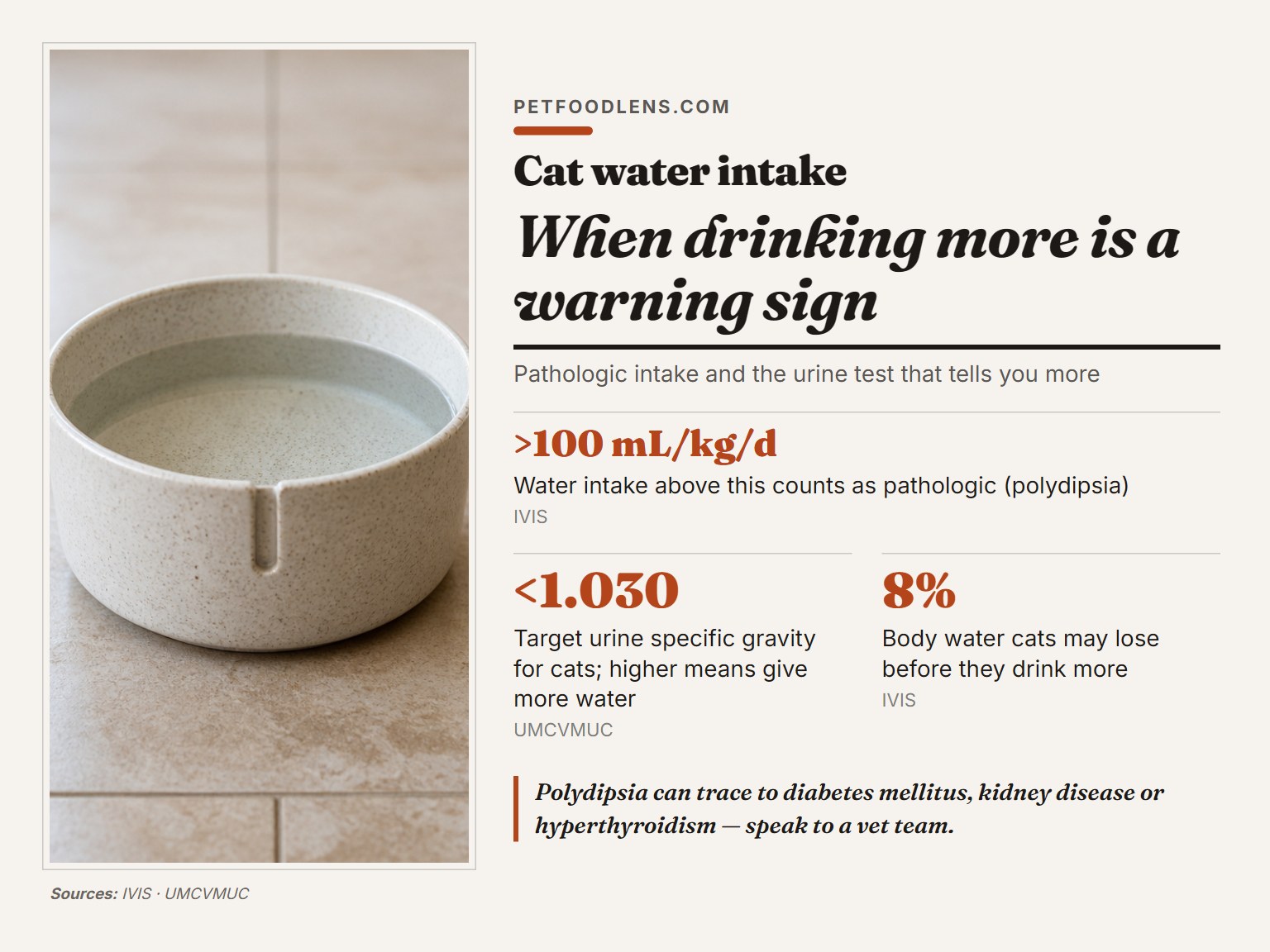
Anything above 100 mL/kg a day counts as pathologic water intake, per IVIS. That’s the number that turns drinking more into a phone call.
Polydipsia at that level usually traces back to something. ICatCare lists diabetes mellitus, kidney disease and hyperthyroidism, and notes there may be other signs alongside it, such as weight loss or increased hunger.
The other direction matters just as much. Cornell’s list of dehydration signs runs:
- Lethargy and weakness
- Poor appetite
- Dry or tacky mucous membranes
- Sunken eyes in severe cases
The skin-tent test over the shoulders should snap back almost immediately in a hydrated cat. Geriatric cats can tent even when they’re fine, so treat that one as a clue rather than a verdict.
The full signs of dehydration list is worth having on the fridge.
Urine specific gravity is the measurement I’d trust over any of that. Under 1.030 is the target for cats per the University of Minnesota Urolith Center, and higher values mean give more water. Measuring urine specific gravity will tell you more in one morning than a month of eyeballing the water line.
I’m not a clinician. Prescription diets for kidney disease and urinary crystals are a veterinary decision, and Prescription diets exist because those cases need more than a bowl moved across the kitchen. My end of this is the food label and the moisture percentage.
Frequently Asked Questions
How much water should a cat drink a day?
Cornell’s rule is about 4 ounces per 5 pounds of lean body weight, which works out to roughly one cup for a 10-pound cat. IVIS puts the requirement at 55 to 70 mL/kg a day, and a scoping review measured healthy cats at 23 to 51 mL/kg. The spread is real, and the minimum before risk rises is still unknown.
Is it normal for a cat to barely drink?
On a canned diet, yes. Wet food at 70 to 80 percent moisture supplies most of the daily requirement, so a cat eating pate may take in very little from the bowl. On dry kibble at 9 to 12 percent moisture, a cat that barely drinks is a cat running a deficit.
Can I add water to dry food?
Yes. The University of Minnesota Urolith Center recommends soaking kibble to the point where it floats, using one cup of water per cup of dry food. Test a small amount first, since some cats refuse the texture change and a cat that stops eating is a bigger problem than a cat that drinks little.
Do cats prefer running water?
The evidence is mixed. Cornell and IVIS both say some cats drink more from fountains and frame it as individual preference. A scoping review found water intake wasn’t affected by whether the source was static or flowing, while Cornell and IVIS report that some cats drink more from fountains.
How do I know if my cat is dehydrated?
Cornell lists lethargy, weakness, poor appetite, dry mucous membranes and, in severe cases, sunken eyes. Gently lift the skin over the shoulders; in a hydrated cat it snaps back almost immediately. Geriatric cats can show reduced skin elasticity even when hydrated, so pair the test with urine specific gravity.
The Bottom Line
If your cat is on dry food and drinking what looks like a normal amount, the number to watch is urine specific gravity, not the water line. Under 1.030 is the target the University of Minnesota Urolith Center uses. Measuring urine specific gravity tells you more in one morning than a month of guessing.
The first thing to do this week: put half a can of pate down and stir in a tablespoon of warm water. If the cat eats it, you’ve moved the needle further than any fountain will.
All of this assumes a well cat. One that’s suddenly drinking more, or one that’s stopped eating, needs a veterinarian and possibly a therapeutic diet I’m not qualified to select. That’s a diagnosis question, and no amount of bowl rearranging answers it.
