
Indoor Cat Food Pros and Cons: What Holds Up
This post contains affiliate links. As an Amazon Associate, we earn from qualifying purchases.
Indoor cat food pros and cons come down to calorie density, moisture, and portion control. An indoor formula trims calories for a less active cat, but it can’t fix free-feeding, and dry kibble adds no water. The food helps. The feeding routine decides the outcome.
That last sentence is where most of the argument actually lives. Two cats can eat from the same bag and end up at different body conditions, because the indoor cat food pros and cons come down to free-choice dry feeding and single-location group feeding as the mechanisms behind overconsumption, not the kibble itself.
What follows walks the label line by line: the guaranteed analysis, the pros and cons that survive scrutiny, the obesity and urinary evidence in both directions, and the point where an indoor formula stops being the right tool.
Key Takeaways
- Indoor formulas cut calories, not water. A dry indoor food still carries single-digit moisture, so a fountain doesn’t close the gap a canned diet would.
- Free-feeding is the bigger variable. Free-choice dry feeding and single-location group feeding are flagged in the veterinary literature as the mechanisms behind overconsumption.
- The obesity evidence is genuinely split. Epidemiological studies linked high-carb dry diets to lower obesity risk than high-fat dry diets, while other work found a mild increase with dry food generally, attributed to calorie density.
- Canned food for urinary signs rests on one study. Ohio State grades the evidence III and argues a grade for no effect may have been more appropriate.
- “Supports urinary health” is not “dissolves stones.” Over-the-counter bags use the first verb. Therapeutic diets earn the second through feeding trials.
What “indoor cat food” actually means on a label
Royal Canin Indoor Adult 27 is the reference point I use, because the name states the whole pitch: indoor cats, aged 1 to 7 years, maintenance only.
Indoor formulas reduce fat and calories for a cat with a smaller territory and lower activity budget. The guaranteed analysis is the only part of the label with enforceable numbers. Protein minimums, fat ranges, and calorie content per cup are printed, verifiable, and comparable across brands. Everything on the front of the bag sits outside that structure.
Flip the bag over and you get five lines that actually mean something.
| Nutrient (guaranteed analysis) | Level |
|---|---|
| Crude protein | 27.0% minimum |
| Crude fat | 11.0% minimum, 15.0% maximum |
| Crude fiber | 5.7% maximum |
| Moisture | 8.0% maximum |
| Energy density | 3,534 kcal ME/kg; 325 kcal ME/cup |
Those five lines are the whole nutritional argument. The bag also states that the food meets AAFCO Cat Food Nutrient Profiles for maintenance, which is the minimum legal bar for a complete cat food in the United States. It is a floor, not a badge of quality.
Reading the guaranteed analysis without getting fooled
Early in this work I lined up a canned food and a dry food by the protein percentage printed on each label and concluded the dry one was far richer. The canned number looked like a third of the dry number. The moisture line made that comparison worthless, because a food that is mostly water can’t be judged against a food that is mostly dry matter.
Here’s the conversion, using the Royal Canin numbers. Take the protein minimum of 27.0% and divide it by the dry matter fraction. Moisture is capped at 8.0%, so dry matter is 92.0%. That gives 27.0 divided by 92.0, or 29.3% protein on a dry matter basis.
Run that same math on any dry cat food and any canned food before you compare them. It’s the only way the numbers mean anything.
The indoor cat food pros and cons that actually matter
Half of what indoor formulas get credit for survives a look at the numbers.
The pros
- Portion math gets easier. At 325 kcal per cup, a measured cup is a real unit you can work with, and the calorie figure is printed rather than guessed.
- Fiber runs higher than a maintenance formula. The 5.7% maximum crude fiber ceiling is there partly for hair movement, which is why indoor formulas and hairball control cat food overlap so heavily.
- The formulation targets a real problem. Indoor cats without outdoor access show behavioural problems more often, and a food built around a lower activity budget at least acknowledges the lifestyle.
- It’s convenient and shelf-stable. That matters more than people admit. A food the owner will actually measure out beats a better food left in the cupboard.
The cons
- Moisture is the weak point. A dry food capped at 8.0% moisture delivers almost no water, and that’s the whole basis of the canned-food argument below.
- “Indoor” is a marketing category as much as a nutritional one. The calorie reduction is real. The rest of the positioning is mostly copy.
- It doesn’t fix the bowl. An indoor formula free-fed from a hopper produces the same overconsumption as any other formula.
- Weight gain still happens. If your cat is already heavy, an indoor maintenance formula is the wrong starting point and a weight management cat food is where the conversation starts.
Common mistake: Buying an indoor formula and free-feeding it from a hopper. Calorie density drops, intake rises to compensate, and the cat lands at the same body condition later with a lighter wallet.
If you want a single recommendation rather than a category, the honest answer for a healthy indoor cat aged 1 to 7 is a measured indoor maintenance formula, and the best indoor cat food shortlist is where I’d start comparing specific bags.
Does dry food cause obesity in indoor cats?
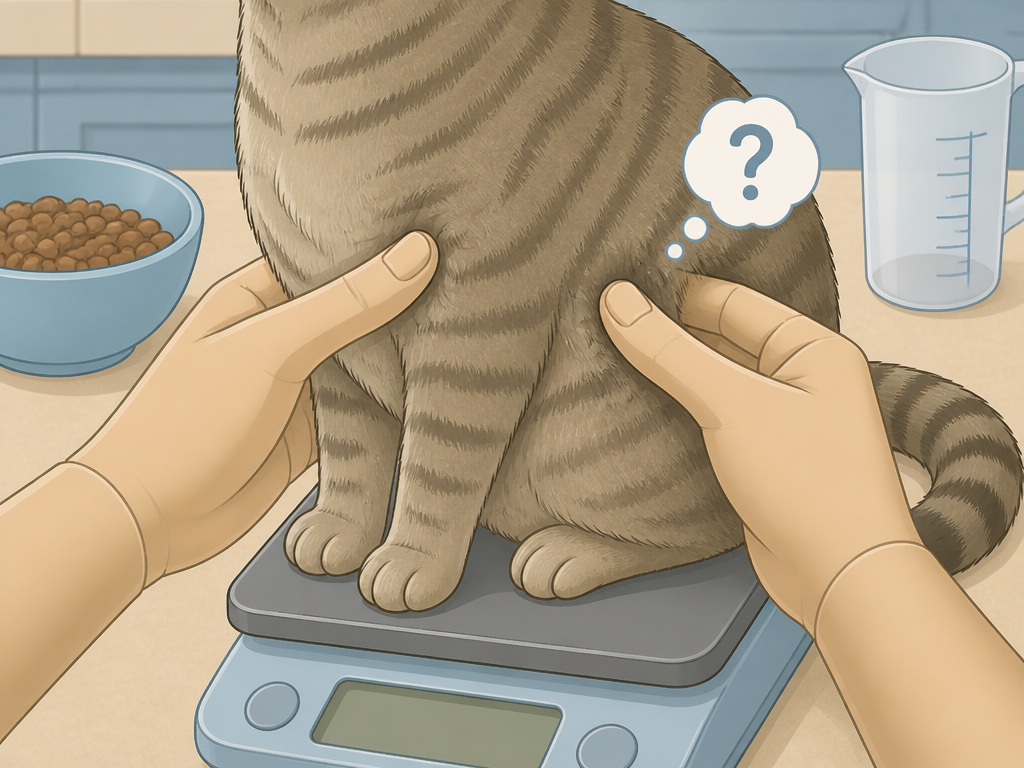
The evidence is more divided than either camp admits, and the division is worth understanding before you change anything.
The JAVMA review on carbohydrates in feline diets evidence found no evidence that high-carbohydrate diets cause diabetes in cats. It also notes that epidemiological studies associated high-carbohydrate dry diets with lower obesity risk compared with high-fat dry diets. That runs straight against the low-carb position most owners have absorbed.
Then the same review qualifies itself twice. Low-carbohydrate, high-fat diets are noted to increase obesity risk. And other studies document a mild increased obesity risk with dry food generally, attributed to calorie density and ad-libitum feeding, independent of carbohydrate.
Where the studies actually disagree
| Question | Position one | Position two |
|---|---|---|
| Dry food and obesity | High-carb dry diets linked to lower obesity risk than high-fat dry diets | Some studies find a mild increase with dry food, tied to calorie density |
| Carbohydrate and diabetes | No evidence high-carb diets cause diabetes in cats | Low-carb at 26% of ME or less may aid diabetic remission |
| Canned food for urinary signs | One study, P = 0.04, recurrence lower on the canned diet | Grade III evidence; a grade for no effect may fit better |
Read that table slowly, because it kills both slogans. Carbs aren’t the villain the low-carb aisle says they are. Dry food isn’t neutral either, and the reason has more to do with the bowl than the kibble.
A separate feline dry food health review covers the disease-risk side if you want to go deeper than a blog summary.
There’s a physical check that beats any of this. Run your hand along the cat’s ribs. If you have to press to find them, the feeding routine is already winning and the formula debate is secondary.
Is wet food protective for urinary health?
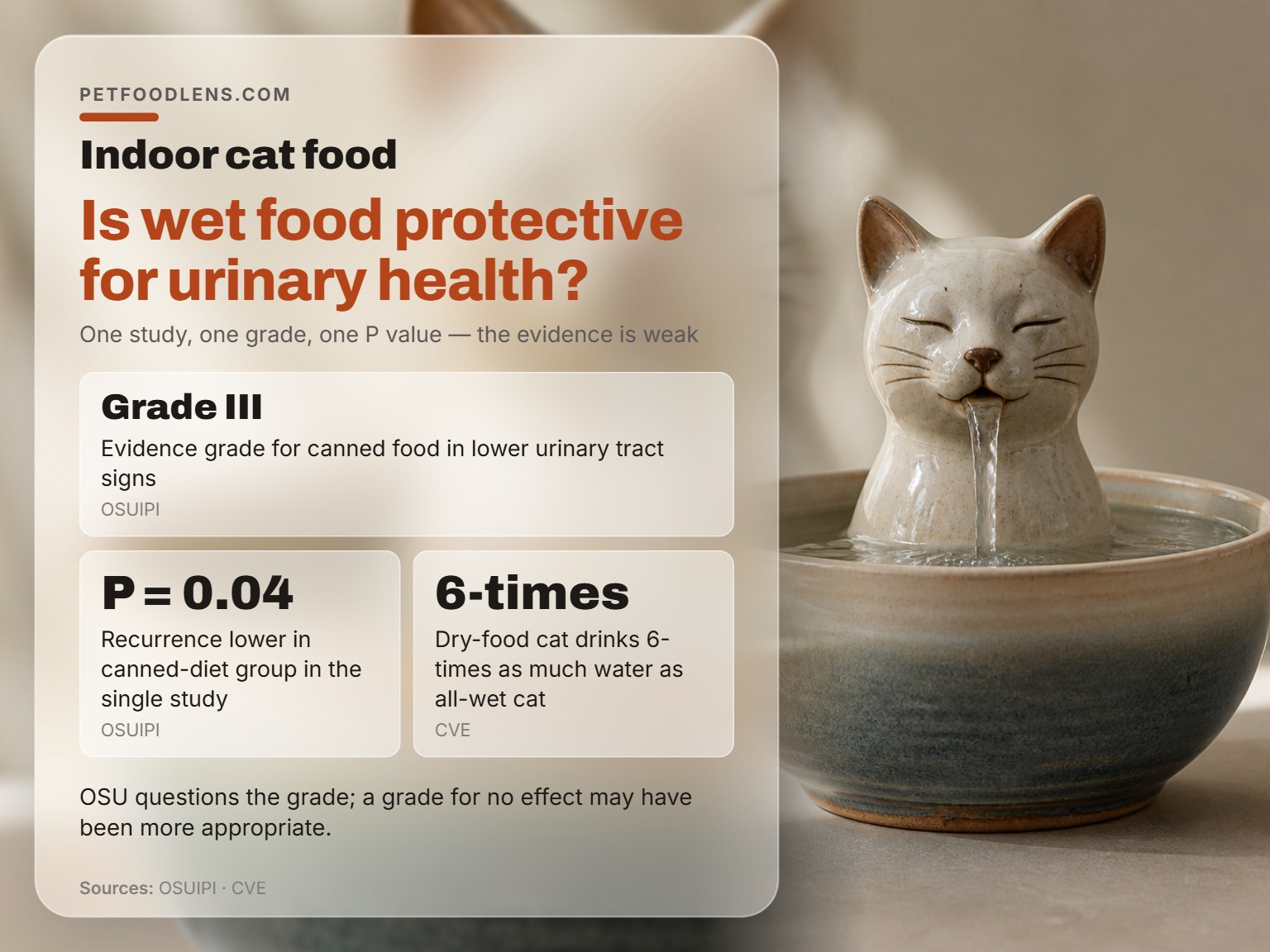
One study, one grade, one P value. That is what the canned-food recommendation for cats with lower urinary tract signs rests on.
The Ohio State Indoor Pet Initiative is blunt about it. The evidence supporting canned food for cats with lower urinary tract signs is weak, graded III, and based on a single study. In that study, recurrence of clinical signs was significantly lower in the canned-diet group than the dry-diet group at P = 0.04. OSU then argues that a similar grade for no effect may have been more appropriate.
That’s an unusual thing for a university clinical guide to write, and it matters. A single study with a borderline P value is a hypothesis, not a settled rule.
Against that sits a hydration argument from the Centre for Veterinary Education at the University of Sydney: a cat on dry food drinks six times as much water as the same cat on all-wet food, though OSU questions how strong the canned-food evidence really is. If that compensation is real, the moisture gap partly closes on its own.
I keep a fountain in my own house and I still call it a comfort item, not a urinary treatment. If your cat has already had an episode, the fountain is not the plan. The vet’s diet is the plan.
So where does that leave wet cat food? It’s a legitimate way to raise water intake, and it’s the form most urinary cat food is built around. Treat it as a reasonable default for a cat with a history, not as proven prophylaxis.
The carbohydrate number that decides most arguments
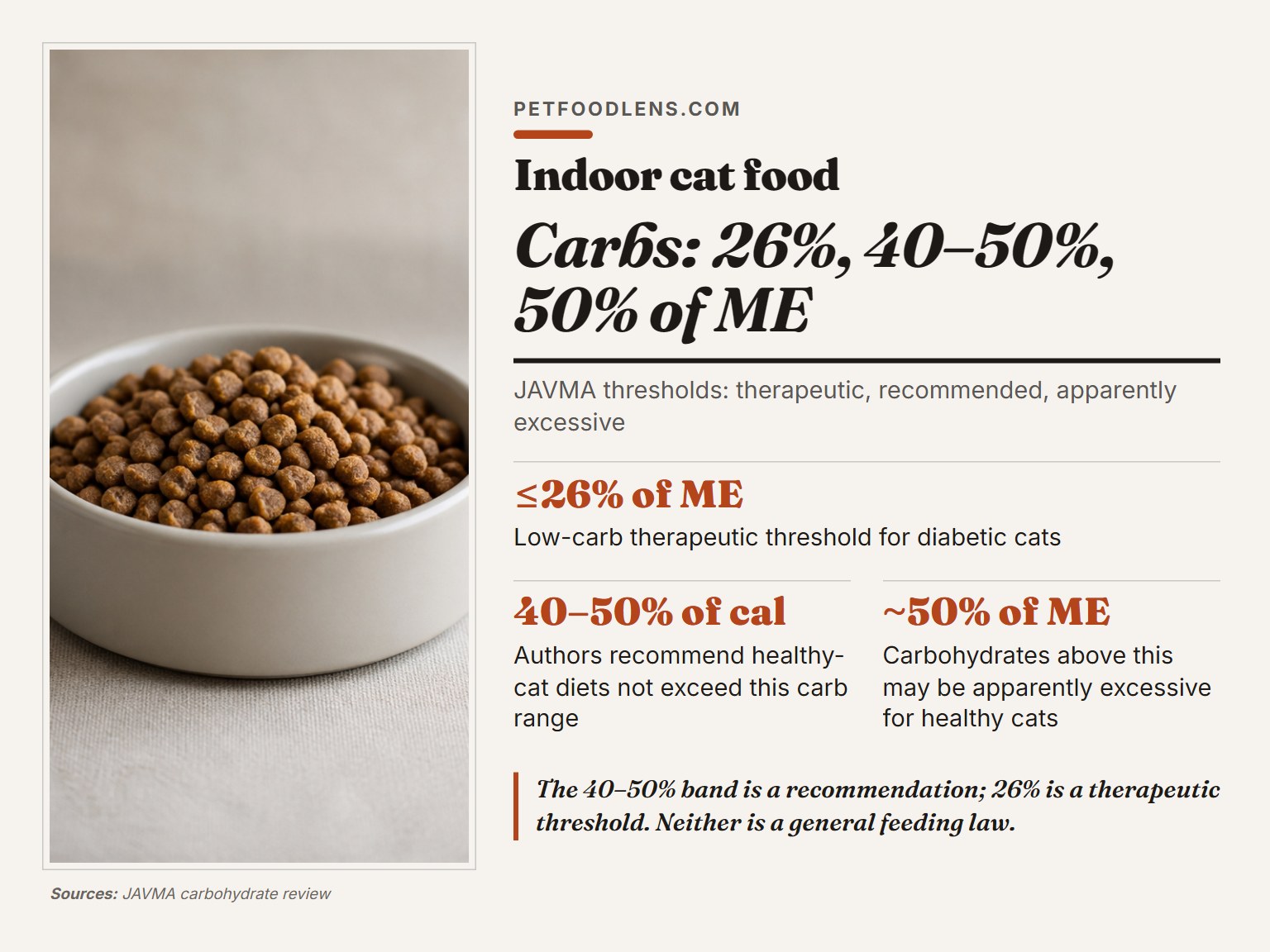
The JAVMA review gives three thresholds, and almost nobody quotes the middle one.
Carbohydrates in excess of approximately 50% of metabolizable energy may be defined as apparently excessive for healthy cats. The authors recommend healthy-cat diets not exceed 40% to 50% of calories from carbohydrate. The low-carbohydrate therapeutic threshold for diabetic cats is defined as 26% of metabolizable energy or less.
If a bag’s carbohydrate load lands above 50% of metabolizable energy, the JAVMA review calls that apparently excessive for a healthy cat. At 26% of metabolizable energy or below, you’re in therapeutic territory for a diabetic cat. Everything between those two numbers is a judgment call, not a rule.
Note what that means. The 40% to 50% band is a recommendation from the review authors, and the 26% figure is a therapeutic threshold for a specific diagnosis. Neither one is a general feeding law.
Why grain-free rarely changes the load
Here is the part the front label skips. Grain-free dry foods often swap corn for peas, potato, or tapioca, so the carbohydrate load barely moves. A bag with a wolf on the front and a starch-heavy ingredient list is still a starch-heavy bag.
Ingredient splitting makes this harder to spot. When a label lists peas, pea protein, and pea fiber as three separate entries, each one weighs in lower on the list than the combined total would. That’s a deliberate formatting choice and it should raise your eyebrow every time.
If you want to compare the actual category, the grain-free cat food breakdown does the arithmetic. Bring the guaranteed analysis with you.
Feeding management beats food form
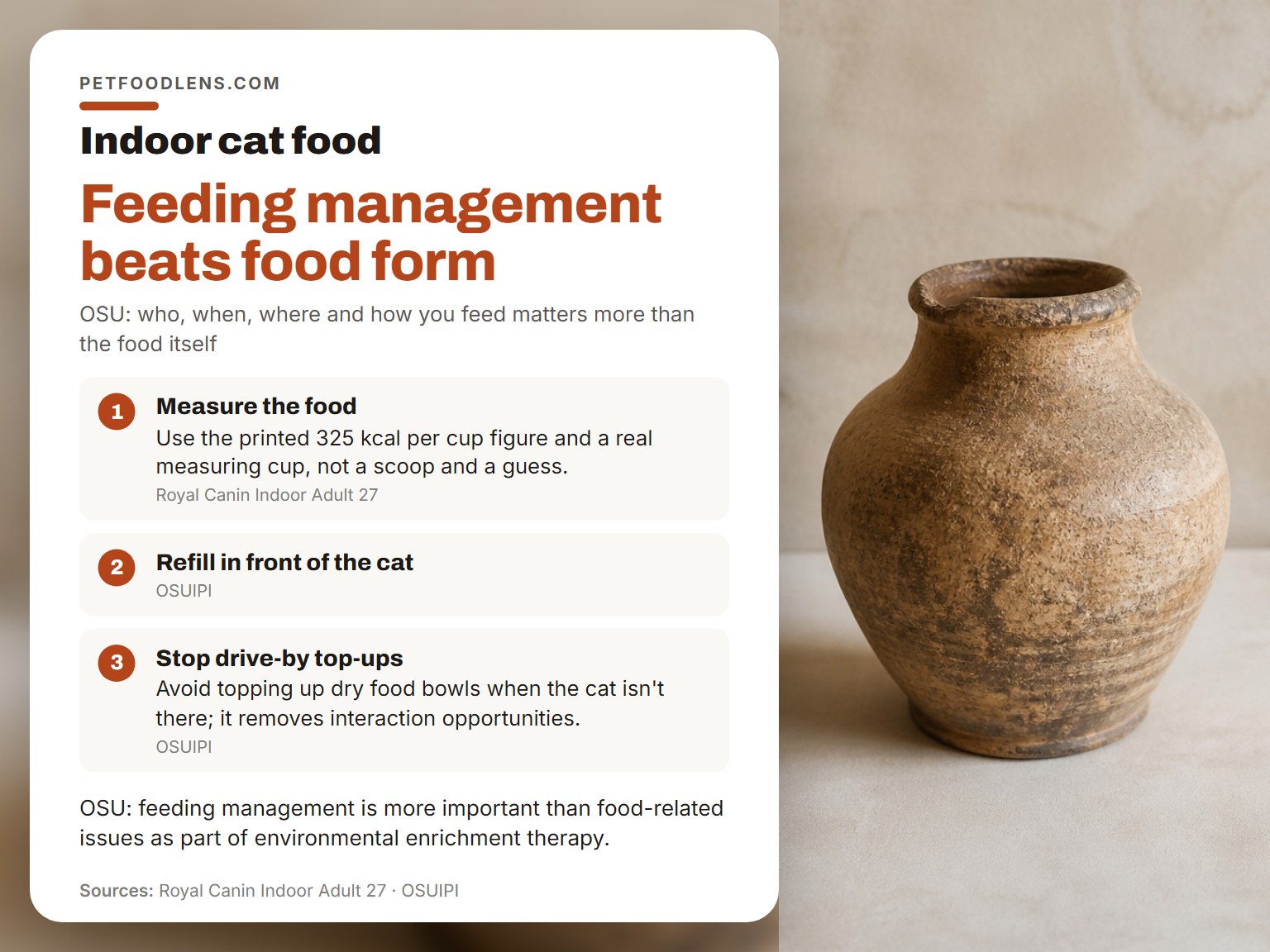
You can feed a carefully chosen indoor formula and still end up with a fat cat, because the bowl is doing the work.
OSU’s clinical guidance is direct on this: feeding management, meaning who feeds the cat, when, where, and how, is more important than the food-related issues as part of environmental enrichment therapy. The feline feeding program guidelines reach the same place from the behavioural side.
Here’s the routine I’d set up, in order.
- Measure the food. Use the printed 325 kcal per cup figure and a real measuring cup, not a scoop and a guess. Skip this and the rest of the list is decoration.
- If you leave food out, leave only enough to require a refill once or twice a day. OSU recommends doing that refill in the presence of the cat, which turns a chore into an interaction.
- Stop the drive-by top-up. Topping up the bowl when the cat isn’t there removes the interaction opportunity entirely, and it hides how much is actually going in.
- Split the day into at least two feeding events. Two smaller meals give you two chances to notice appetite changes, which is often the first sign of a problem.
- Set multi-cat bowls apart. Feeding the group in one place is flagged as a mechanism behind overconsumption, and it also lets a shy cat get pushed off the bowl.
The 2021 AAHA nutrition guidelines treat body condition scoring as a routine vital sign, which is the right frame. Weigh the food, then weigh the cat.
Fountains fit here as a secondary tool, and only that. A fountain helps a cat who likes moving water. It fails when the filter and pump housing don’t get cleaned regularly, and many of the ones I’ve seen in homes were overdue. Lift the lid on an overdue fountain and it smells faintly of pond water. That smell is a biofilm, and your cat is drinking from it.
If you want the behavioural case for all of this, the behavioral aspects of cat feeding review covers why the how matters as much as the what.
When an indoor formula is the wrong tool
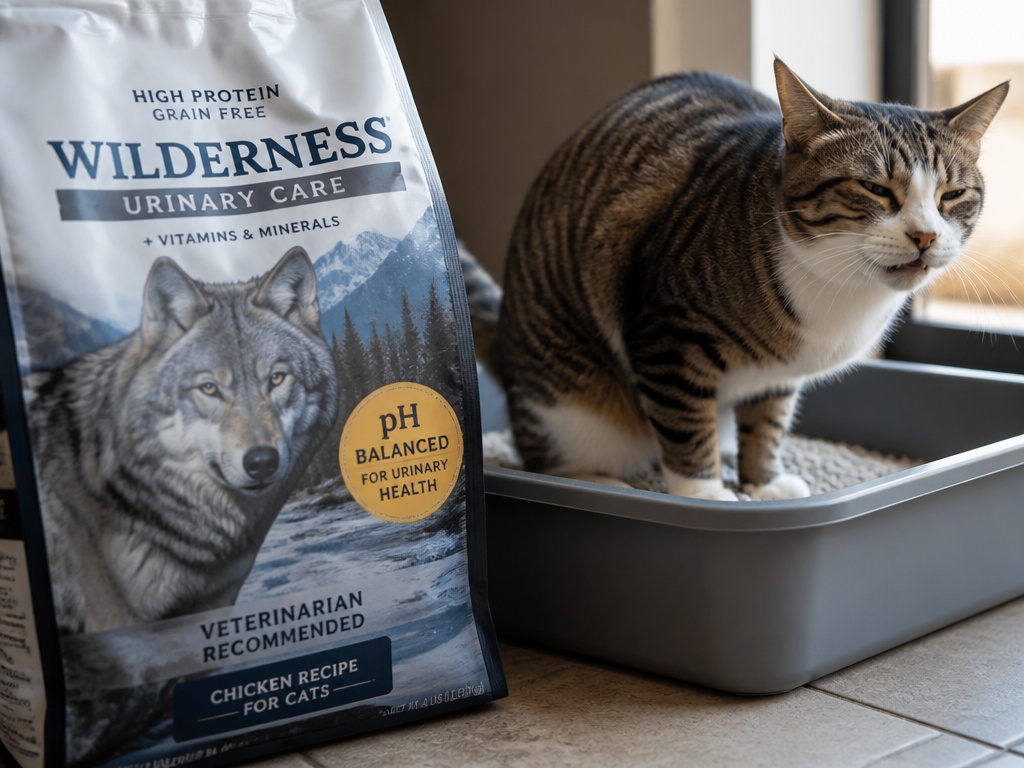
A large bag with a wolf on the front, a sticker that says pH balanced, and a cat that has been straining in the litter box.
That cat does not need an indoor formula. That cat needs a vet and probably a urinalysis.
I read the fronts of several over-the-counter urinary bags once. Nearly all of them said “supports” or “promotes.” Not one said “dissolves.” That single verb is the difference between a marketing claim and a tested diet.
Over-the-counter urinary formulas versus therapeutic diets
Hill’s Prescription Diet c/d and Royal Canin Urinary SO are the kind of products where the dissolution claim comes from feeding trials in cats that actually had the condition. A bag with a pH-balanced sticker on it has not been through that exam. Neither has a “sensitive stomach” formula standing in for a GI diagnosis.
The part nobody mentions: An over-the-counter urinary bag that says “supports” has not been through a dissolution trial. A cat with struvite stones can stay on it while the stones keep growing.
Purina Pro Plan Veterinary Diets belongs in the same tested bucket as the other two. All three are formulated for a diagnosed condition, which is why the label language is different and why the price is different.
Marketing is not nutrition, and this is the clearest place it shows.
Here’s my honest limit. I’m not a clinical specialist. Therapeutic diets for cats with kidney disease or diabetes are where I hand the conversation to a veterinarian, because those cats need monitoring and bloodwork, not a comparison chart. I also work from labels and published formulations, so I can’t verify manufacturing quality, ingredient sourcing, or batch consistency. A clean guaranteed analysis can still sit on top of a problem I have no way to detect.
For a healthy indoor cat, none of this applies. The best dry food for indoor cats and the best wet cat food for indoor cats comparisons are the right starting points, and the choice between them is mostly a moisture decision.
Frequently Asked Questions
Is indoor cat food actually different from regular cat food?
Sometimes, and the difference is measurable when it exists. Royal Canin Indoor Adult 27 is formulated for indoor cats aged 1 to 7 years, and the calorie density reflects a lower activity budget. Many “indoor” bags differ mainly in fiber level and marketing. Check the guaranteed analysis and the kcal per cup before assuming.
Do indoor cats need less food than outdoor cats?
They usually need fewer calories, but the honest answer is that the individual cat decides. Body condition is the measure that matters. Run your hand along the ribs regularly, and adjust the measured amount rather than switching formulas blindly.
Is wet food better for indoor cats?
It’s wetter, which is the one thing you can say with certainty. Whether that prevents urinary disease is less settled. Ohio State grades the canned-food evidence for lower urinary tract signs as weak, based on a single study with P = 0.04. A cat on dry food also drinks about six times as much water, per the University of Sydney’s continuing education arm, though OSU questions how strong the canned-food evidence really is.
Should I feed grain-free food to an indoor cat?
Grain-free is a marketing category, not a nutritional upgrade. Swapping corn for peas, potato, or tapioca often leaves the carbohydrate load roughly where it started. If carbohydrate content is what concerns you, calculate it from the guaranteed analysis rather than reading the front of the bag.
Can an indoor cat live on dry food only?
Yes, and many do. The trade-off is water intake. A dry food capped at 8.0% moisture contributes almost nothing to hydration, so a dry-only cat depends on drinking. If your cat is a poor drinker, that’s the argument for adding some canned food, not a guarantee of anything.
How much should I feed an indoor cat?
Start with the calorie figure on the bag and the body condition in front of you. Royal Canin Indoor Adult 27 lists 325 kcal per cup as-fed. Measure that, feed it in at least two sittings, and recheck the ribs periodically. Adjust the amount, not the formula.
The Bottom Line
Here’s the trigger I’d give a friend. If your indoor cat eats from a bowl that gets topped up during the day, fix that before you change the food. The JAVMA review points at free-choice feeding and single-location group feeding as the mechanisms behind overconsumption, and no formula on the shelf outruns a bottomless bowl.
If your cat has already had a urinary episode, a stone, or a diabetes diagnosis, the calculus changes. That’s the one place where I’d stop comparing labels and hand the decision to your vet, because the therapeutic diets are the products in this category with feeding trials behind them.
And the limit worth stating plainly: I read labels and published formulations. I can’t audit a plant, verify a supplier, or test a batch. A clean guaranteed analysis is the start of the conversation, not the end of it.
