
How to Feed a Pregnant Cat: Amounts and Timing
This post contains affiliate links. As an Amazon Associate, we earn from qualifying purchases.
To feed a pregnant cat, raise her daily calories about 10% a week from early pregnancy per Fontaine (Kim & Wakshlag advise increasing intake from the second week) until she eats 25 to 50% above maintenance in the final week, on a diet built for gestation. She should finish 40 to 50% heavier than her mating weight per the National Research Council, or up to 38% per Fontaine. For guidance on how to feed a pregnant cat, follow these calorie and weight targets.
That spread is where the how to feed a pregnant cat question splits the two best-known feline nutrition references. The National Research Council sets the target at 40 to 50% of mating weight, while a peer-reviewed review of food intake in the pregnant queen puts typical gain at up to 38%. Both describe steady, linear gain from the moment pregnancy is established, and that agreement is the part that changes how you fill the bowl.
What follows is the feeding schedule, the label checks that decide which food goes in the bowl, and the two litter-size cases where the standard plan inverts.
Key Takeaways
- Weigh the portions, don’t free-pour. VCA Animal Hospitals names meal feeding as the best way to control body condition and weight gain in pregnancy.
- Calories climb roughly 10% a week from the start of pregnancy per Fontaine, while Kim & Wakshlag advise increasing intake from the second week, landing 25 to 50% above maintenance by the last week of gestation.
- The AAFCO gestation floor for cats is 30% protein, 9% fat, 1% calcium, 0.8% phosphorus on a dry matter basis, though Kim & Wakshlag recommend above 32% DM protein.
- Free-choice feeding during lactation is advised by the NRC for lactating cats generally, but VCA warns against it for one or two kittens, where mastitis risk rises.
- Dietary taurine between 0.02% and 0.05% causes early embryonic loss before day 25 of gestation.
How Much Should a Pregnant Cat Gain, and When?
Two credible sources give two different numbers for pregnancy weight gain, and the gap is worth knowing before you pick a food.
Feline gestation runs 63 to 65 days in most queens, with a documented range of 58 to 70 days. Weight gain begins as soon as pregnancy is established and proceeds in a linear fashion, driven by fat laid down in the first month that later funds the energy cost of lactation.
VCA Animal Hospitals puts typical gestation at 63 to 65 days, with a documented range of 58 to 70 days. A peer-reviewed review of food intake in the dam counts 65 days plus or minus one when dated from ovulation, which is the more precise way to age a litter.
The weight number is messier. The Your Cat’s Nutritional Needs PDF from the National Research Council tells owners to feed for a 40 to 50% increase over mating weight by the end of pregnancy. Fontaine’s Food Intake During Feline Pregnancy and Lactation reports typical gain of up to 38% of pre-pregnancy weight. Same curve, different ceiling.
| Question | Position A | Position B |
|---|---|---|
| Weight gain by term | NRC: 40-50% of mating weight | Fontaine: up to 38% of pre-pregnancy weight |
| Diet energy density | Fontaine: at least 4000 kcal ME/kg DM | Kim & Wakshlag: above 4500 kcal/kg DM |
| Protein floor | AAFCO via Fontaine: 30% DM | Kim & Wakshlag: above 32% DM |
| When intake rises | Fontaine: from the start, about 10% a week | Kim & Wakshlag: from the second week |
| When to switch food | VCA: before breeding | Kim & Wakshlag: about halfway through |
Here’s the practical read. Chase steady gain, not a percentage. Weigh her weekly on a kitchen scale and write the number down, because your hands are a poor judge of a two-pound change spread across nine weeks.
Right after birth she stays 19 to 26% above her pre-breeding weight, per Fontaine. That cushion is deliberate. It’s fat she banked in the first month specifically to spend on milk, and spend it she will.
The Food Switch: Before Breeding, Mid-Pregnancy, or Never
The two most-quoted how to feed a pregnant cat instructions contradict each other on the calendar.
VCA advises changing to kitten food before breeding, on the reasoning that a food change during pregnancy adds stress. Nutrition and Theriogenology breeding guide authors Kim & Wakshlag advise switching about halfway into gestation. Both positions are defensible, and neither one is printed on a bag.
What actually decides the question is the adequacy statement, not the calendar. Flip the bag over and find the line that says the food is formulated for gestation and lactation, or for growth and reproduction. That line is the food’s legal claim about what it can support.
If you’re moving her onto a new food, do it in stages. A queen who refuses the bowl for a day is a queen losing condition she can’t spare.
- Mix a small amount of the new food into the old. A full swap in one sitting gets refused, and a refused bowl during pregnancy costs you a day of gain you won’t get back.
- Hold that ratio for several days before increasing it. Cats build a food preference from texture and smell, and rushing the ratio teaches her to distrust the bowl.
- Watch the litter box, not the bowl. Loose stool means you moved too fast. Back the ratio down and hold it there an extra few days.
- Finish the swap before she’s carrying enough weight to make big meals uncomfortable. By late gestation the uterus crowds the stomach, and a food she’s still unsure about is the one she’ll skip.
The transition itself is the same one you’d run with any cat, and the mechanics of switching cat food don’t change because she’s pregnant. What changes is the cost of a bad week.
If you’d rather not run a transition at all, pick the best cat food for pregnant cats before she’s bred and be done with it. That removes the whole scheduling problem.
What the Label Has to Say: Protein, Fat, and Taurine
The AAFCO nutritional adequacy statement is the only line on a cat food package that tells you whether the food is built for gestation and lactation.
AAFCO’s minimums for cats in gestation and lactation, as reported by Fontaine, are 30% protein, 9% fat, 1% calcium, and 0.8% phosphorus on a dry matter basis. Kim & Wakshlag push the protein figure above 32% on a dry matter basis and specify animal-sourced protein. That gap matters more than it looks, because “30% protein” on a wet food label is measured with the water still in it.
Dry matter basis strips the water out so you can compare a pate against a kibble honestly. A canned food’s protein percentage is measured with the water still in it, so it must be converted to a dry matter basis before comparing it with a kibble. Run the numbers before you conclude anything about which food is richer.
What to check, in order:
- The adequacy statement first. It should name gestation, lactation, or growth and reproduction. A food labeled for adult maintenance only is the wrong food, no matter what the front of the bag says.
- Protein source and amount. Named animal meals such as chicken meal are often denser in protein than fresh chicken, because fresh chicken is mostly water weight.
- Calcium and phosphorus together. 1% calcium against 0.8% phosphorus is the ratio AAFCO sets, and the pair matters more than either number alone.
- Taurine. See below. This one is not optional for cats.
- Energy density. Fontaine recommends at least 4000 kcal metabolizable energy per kilogram of dry matter for the whole of feline gestation.
Why Taurine Is a Cat Problem, Not a Dog Problem
Cats can’t make enough taurine to cover their own needs, so it has to come from the diet. In a pregnant queen, a secondary taurine deficiency causes early embryonic resorption before day 25 of gestation. Fontaine puts the danger band at dietary taurine levels between 0.02% and 0.05%; higher levels allow normal reproduction.
Commercial cat foods are formulated to clear that bar comfortably. Home-made diets are the risk case. If a queen on a home-made diet has a history of reproductive problems, Fontaine’s guidance is to evaluate taurine levels in every case.
For the queen-and-litter window specifically, choose a food whose adequacy statement names gestation, lactation, or growth and reproduction. Check the protein requirements for cats if you want the dry-matter math worked through in full.
Why Meal Feeding Beats a Bottomless Bowl in Pregnancy
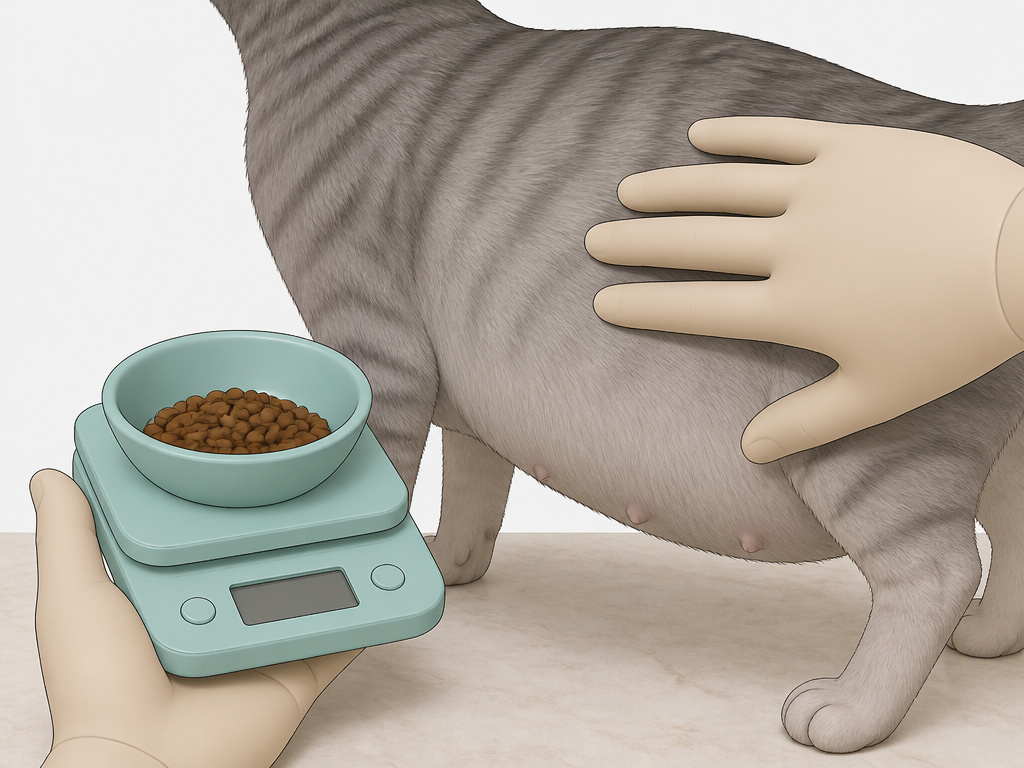
The question I get most often about pregnant queens is whether the bowl can just stay full. I’ve watched that go wrong often enough to stop recommending it. In homes where free-feeding ran the house, the queen was carrying extra condition within a few weeks of conception, and the owner had no way to say how much she was actually eating.
VCA names meal feeding as the best way to control body condition and weight gain during pregnancy. The reason is mechanical. A pregnant queen’s energy requirement climbs roughly 10% a week, so a bowl that stays at a fixed level underfeeds her early and overfeeds her late. You can’t adjust a number you never measured.
I won’t free-feed a pregnant queen, and the reason is simple arithmetic. If you don’t know what she ate yesterday, you can’t tell whether today’s portion is right. Two minutes with a scale beats nine weeks of guessing.
Portion control also gives you something free-feeding never will: an early warning. A queen who suddenly leaves half her measured meal is telling you something, and you’ll only hear it if the meal had a size to begin with.
Run a flat hand along her ribs once a week. On a queen in good condition you feel ribs under a thin cushion, the way a leather sofa feels under its padding. When she’s gaining too fast, the ribs disappear under a smooth roll and the waistline behind the last rib fills in flush.
Fontaine recommends several meals daily rather than one large one, because the gravid uterus distends the abdomen and limits how much she can take at a sitting. Split the daily total into three or four smaller meals and she’ll finish them.
Common mistake: Free-feeding through pregnancy because she “looks fine.” VCA calls obesity the most common nutrition-related problem in pregnant cats, and ties it to fewer eggs released at ovulation and lower milk production later.
If you want a structure to hang the portions on, this cat feeding schedule by age gives you the meal timings to build from.
How Many Calories Does a Nursing Cat Actually Need?
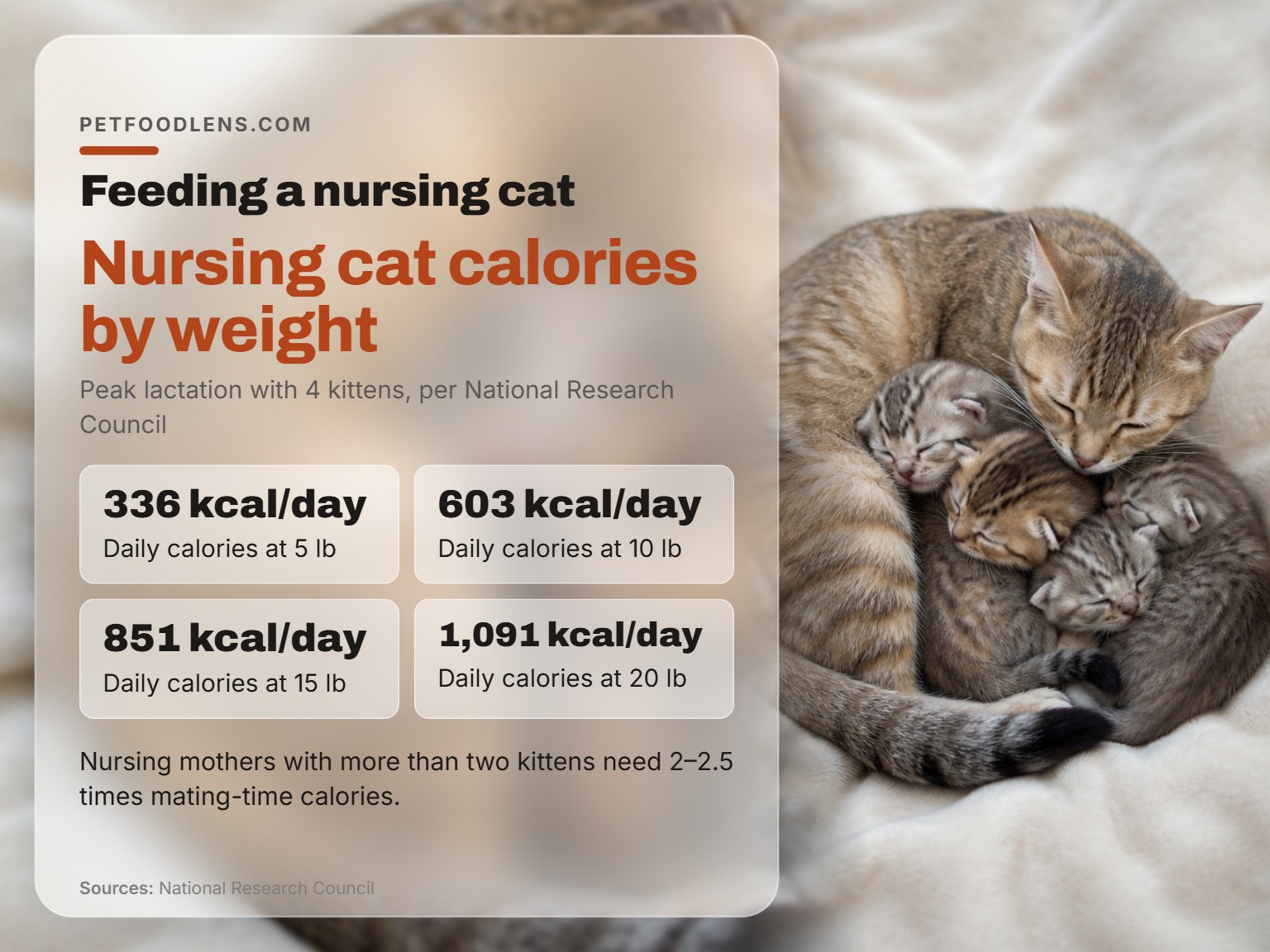
336 calories a day at 5 lb. 1,091 calories a day at 20 lb. Same cat, same job, four kittens at peak lactation.
| Queen’s weight | Daily calories at peak lactation (4 kittens) |
|---|---|
| 5 lb | 336 kcal |
| 10 lb | 603 kcal |
| 15 lb | 851 kcal |
| 20 lb | 1,091 kcal |
Those figures come from the National Research Council’s guide for cat owners, and the jump to 603 kcal at 10 lb tells you most of what you need to know about lactation. She’s doing roughly twice the work.
The NRC rule of thumb: nursing mothers with more than two kittens need between 2 and 2.5 times the calories they needed at mating. Energy needs rise with litter size and keep climbing through the fourth week of nursing. The NRC also advises free access to a highly palatable, high-calorie food for lactating cats, though VCA cautions against free-choice feeding for mothers nursing only one or two kittens.
VCA adds one exception that the general advice leaves out. Free-choice feeding during the first 3 to 4 weeks of lactation works well for a big litter, because the queen eats on her own schedule and the kittens start sampling solid food around 3 weeks of age. It is not advised for a mother nursing only one or two kittens, because she’ll make more milk than the litter needs and set herself up for mastitis.
VCA advises measuring the bowl for two kittens or fewer and leaving it down for larger litters, while the NRC advises free access to high-calorie food for lactating cats generally.
Expect her to lose weight while nursing no matter what you feed. The NRC states this plainly: new mothers typically suckle for 7 to 9 weeks and drop condition during that stretch regardless of intake. The fat she laid down in early pregnancy is the plan working, not the plan failing.
A nursing queen empties a water bowl faster than you’d believe. Keep it full and rinse it daily, because a bowl that sits develops a slick film you can feel with a fingertip and she’ll drink around it. Both VCA and the NRC call for clean, fresh water at all times.
The full picture on feeding a nursing cat runs past weaning into the recovery weeks. For the food side, this nursing cat food breakdown covers energy density without the front-of-bag noise.
Where this goes sideways: Leaving the bowl down for a queen with a single kitten. VCA specifically warns against it, because the overproduction of milk that follows predisposes her to mastitis.
Weaning: The 25% Rule and the 4-5 Day Ramp
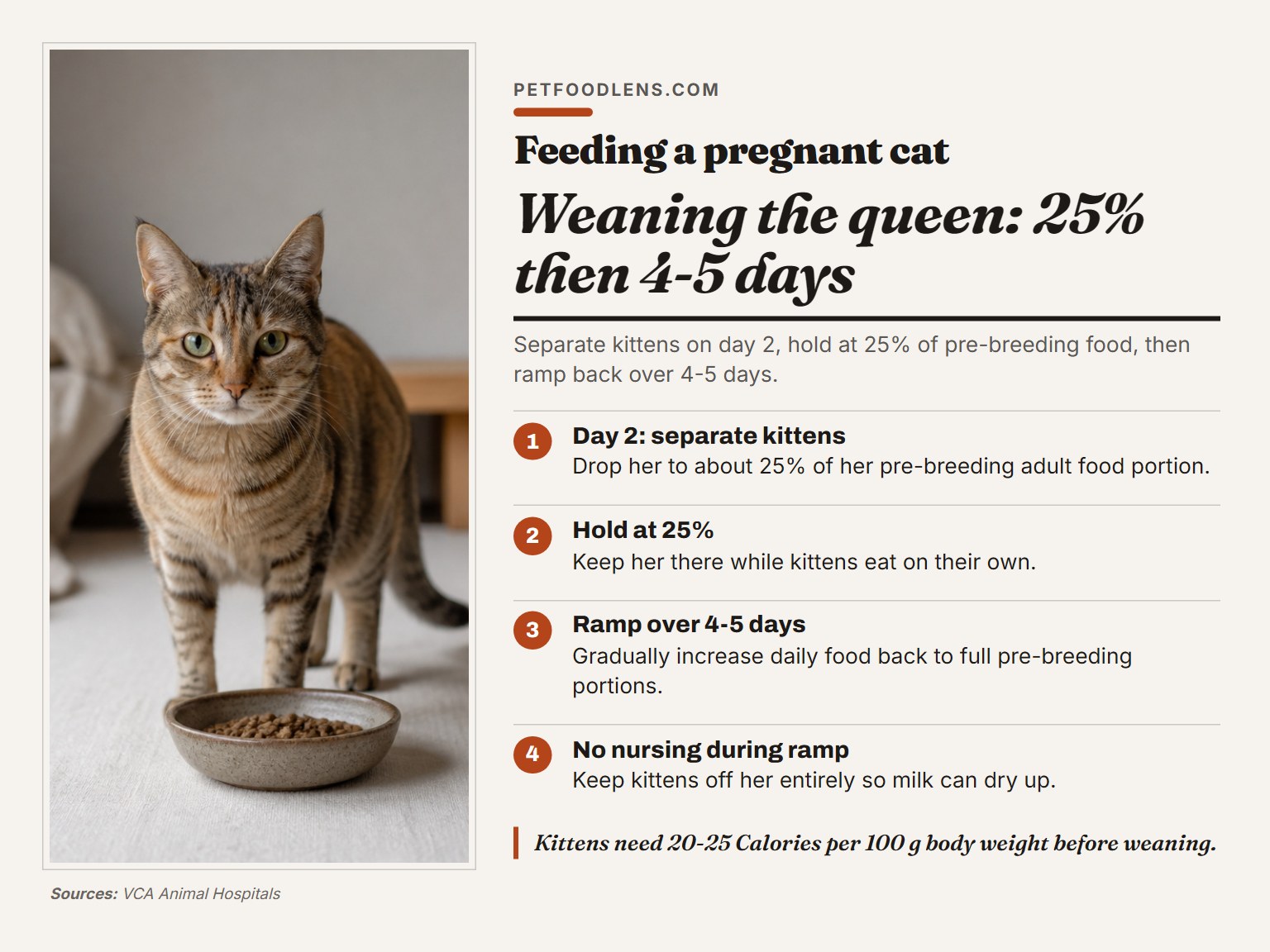
Weaning starts on the kitten side before it starts on the queen’s side.
Around the third week the noise in the box changes. The demands get sharper and more frequent, and that shift lines up with the point where milk alone stops covering what the kittens need. VCA notes kittens begin sampling solid food at about 3 weeks of age. The NRC puts the start of supplemental feeding at 2.5 to 4 weeks after birth, for the same reason.
Before weaning, kittens need 20 to 25 Calories for every 100 grams of body weight. That’s the number to check against if you’re supplementing by hand.
The queen’s side is a scheduled ramp, and it runs on a clock:
- Day two of weaning, separate the kittens from her and drop her to about 25% of the pre-breeding portion of adult food she ate before late gestation. Skipping the separation lets the kittens keep nursing, and milk production never shuts down.
- Hold her at that 25% while the kittens eat on their own. She’ll be uncomfortable and vocal about it. That’s normal and it passes.
- Over the next 4 or 5 days, increase her daily food gradually back to full pre-breeding portions. Jumping straight back to full rations risks a gut upset at the exact moment she’s recovering.
- Keep the kittens off her entirely during the ramp. Any nursing at all delays drying up, which is the whole point of the exercise.
Kitten portions are their own calculation, and this guide to kitten feeding amounts covers the growth curve from weaning onward.
When the Standard Plan Fails: Big Litters, Fat Queens, and Flat Appetites
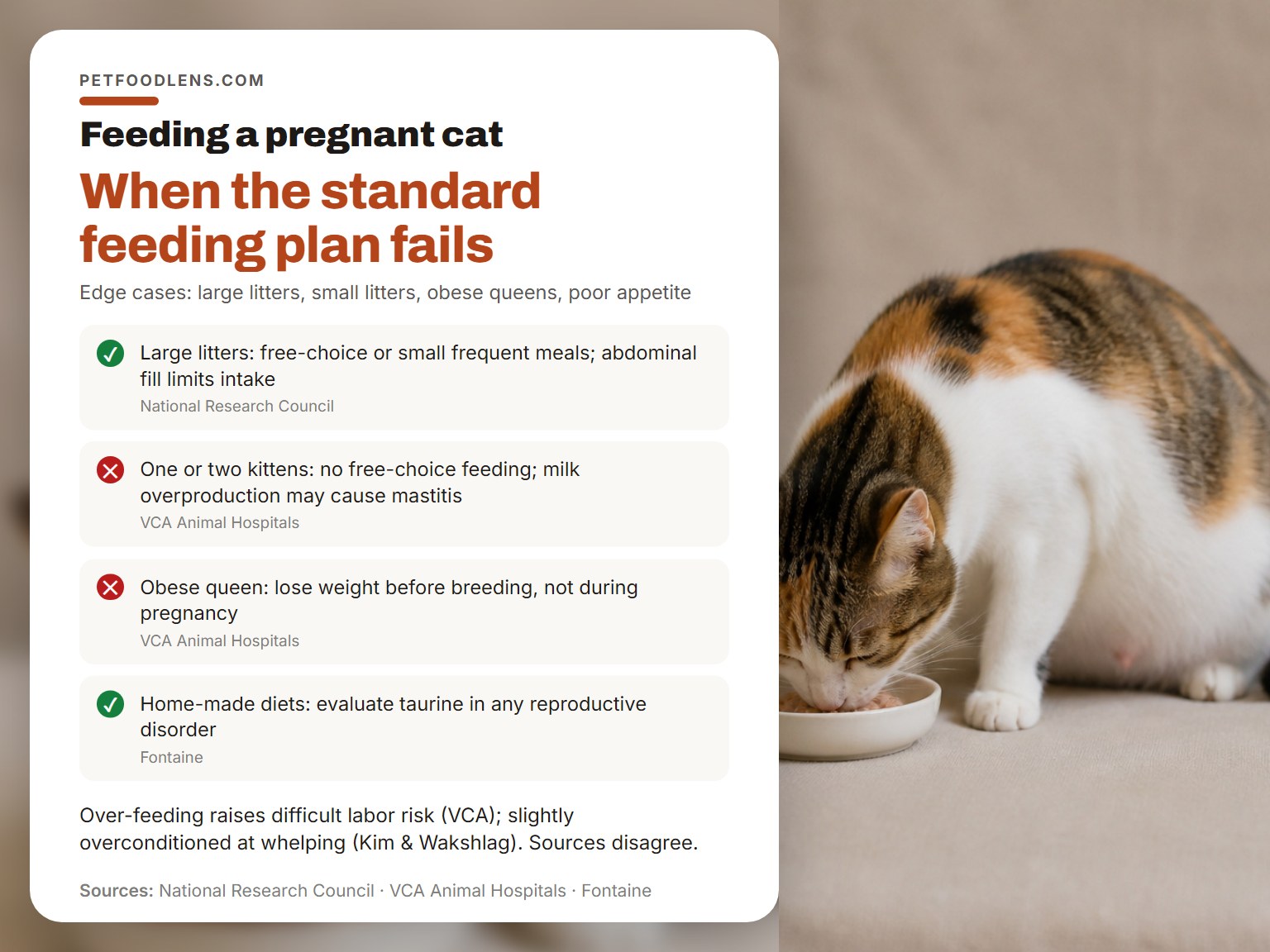
Large litters break the meal-feeding rule. Tiny litters break the free-feeding rule.
The edge cases are where most feeding charts fall apart:
- Large litters. Kim & Wakshlag recommend free-choice feeding or small frequent meals, because abdominal fill physically limits how much the queen can take in at one sitting. The standard meal plan fails here.
- One or two kittens. The opposite problem. VCA rules out free-choice feeding because of mastitis risk from milk overproduction.
- An obese queen before breeding. VCA is direct: obesity reduces the number of eggs released at ovulation, which means smaller litters, and it depresses milk production during lactation. The weight comes off before breeding, not during pregnancy.
- A queen who won’t eat. Abdominal distension from the gravid uterus is the usual cause. Smaller meals, more often, warmer food.
- Home-made diets. Taurine adequacy gets evaluated in any queen with a reproductive disorder, per Fontaine.
The part nobody mentions: VCA warns that over-feeding raises the risk of difficult, prolonged labor, while Kim & Wakshlag argue for queens that are slightly overconditioned at whelping. Those two positions point in opposite directions, and no feeding chart resolves them for you.
One more flag worth carrying to your vet. That makes calcium supplementation a decision for a veterinarian who has seen the queen, not something to add because a forum said so.
Breeders who want the underlying literature can start with a review of pregnant queen nutrition and the Nutrition and Management of Reproduction in the Cat overview, both of which cover cattery-scale management beyond a single queen.
Frequently Asked Questions
How long is a cat pregnant?
63 to 65 days is typical, with a documented range of 58 to 70 days according to VCA Animal Hospitals. Counted from ovulation, the figure is 65 days plus or minus one. Dating from a single mating is less reliable than dating from ovulation, which is why the range is wider than most people expect.
Should I switch my pregnant cat to kitten food?
The sources disagree on timing. VCA recommends switching before breeding to avoid the stress of a change during pregnancy. Kim & Wakshlag recommend switching about halfway into gestation. Either way, confirm the bag carries an AAFCO statement for gestation and lactation or growth and reproduction.
How much more should I feed a nursing cat?
Queens with more than two kittens need 2 to 2.5 times the calories they needed at mating, per the National Research Council. At peak lactation with four kittens, that works out to 603 kcal a day for a 10 lb queen. Energy needs rise with litter size and through the fourth week of nursing.
Can I free-feed a pregnant cat?
VCA recommends meal feeding during pregnancy as the best way to control body condition and weight gain. VCA reserves free-choice feeding for the first 3 to 4 weeks of lactation and only for litters larger than two kittens, while the NRC advises free access to high-calorie food for lactating cats generally.
Do pregnant cats need supplements?
Commercial balanced diet needs no supplementation, according to Fontaine. EPA and DHA supplementation during gestation and lactation has shown benefits for learning ability, memory, and vision in kittens. Home-made diets are the exception, where taurine levels should be evaluated.
When do kittens start eating solid food?
Around 3 weeks of age, per VCA, which is also when the National Research Council recommends starting supplemental feedings because the mother’s milk is no longer sufficient. Before weaning, kittens need 20 to 25 Calories per 100 grams of body weight.
The Bottom Line
If your queen is overweight before breeding, fix that first and don’t wait for the pregnancy. VCA is blunt about it: obesity cuts the number of eggs released at ovulation and drops milk production during lactation, and the weight has to come off before breeding, not during.
That’s the one trigger worth acting on today. Put her on a scale, compare the number against her mating weight, and write it down where you’ll see it.
Everything above assumes a queen who starts pregnancy in healthy body condition. If she doesn’t, these targets are the wrong targets for her, and a veterinarian should set the plan instead of a feeding chart.
One concession, since the sources split on it. I’d rather see a queen finish gestation a little under the 40% mark than see her carrying extra fat into labor, because VCA links over-feeding to difficult and prolonged labor. Kim & Wakshlag argue the other way, favoring a slightly overconditioned queen at whelping. When those two positions collide, I’ll take the leaner error every time.
