
Vegetarian Cat Food Pros and Cons: What Labels Hide
This post contains affiliate links. As an Amazon Associate, we earn from qualifying purchases.
Vegetarian cat food pros and cons rest on more than one document: the AAFCO nutritional adequacy statement on the back of the can, the lab analyses of nutrient content, and the owner surveys of cat health. In a 2015 JAVMA analysis of 24 commercial vegetarian diets, 6 failed AAFCO amino-acid minimums and only 3 met full labeling rules. Owner surveys point the other way. The label tells you more than the philosophy.
Those surveys are real data. A 2023 PLOS ONE study of 1,369 cats found 37% of vegan-fed cats had at least one disorder against 42% of meat-fed cats, and not one of the differences reached statistical significance. So the lab work says the diets fall short and the owners say the cats look fine. Both can be true at once, and that gap is where most of the arguing happens.
What follows walks the evidence in order: what the AAFCO statement certifies, what the lab analyses found, what the owner surveys found, and the four label checks that decide whether a specific can is worth your money.
Key Takeaways
- The AAFCO statement outranks every claim on the front of the bag. A feeding-trial statement means the product was tested on animals; a formulation statement means it was calculated on paper.
- 6 of 24 commercial vegetarian diets failed AAFCO amino-acid minimums in the 2015 JAVMA analysis, and only 3 of 24 met full labeling rules including the calorie statement.
- Kanakubo’s team recommended taurine monitoring outright, and it applies hardest to canned vegetarian diets, though Dodd 2023 makes no taurine-specific monitoring recommendation.
- Vitamin D is the weak point for plant-based formulas in Zafalon’s Canadian analysis, where no commercial plant-based diet met AAFCO or FEDIAF recommendations for maintenance or growth, though Kanakubo 2015 and Dodd 2023 reach different conclusions on overall adequacy.
- Owner surveys and lab analyses disagree, and neither has settled the question. Treat both as evidence, not proof.
What the AAFCO Statement on a Vegetarian Cat Food Actually Certifies
Flip a can over and look for a sentence beginning “Animal feeding tests using AAFCO procedures” or “formulated to meet the nutritional levels established by the AAFCO Cat Food Nutrient Profiles.”
On a compliant can, that statement appears under the guaranteed analysis. On a can that’s fudging it, the line is missing or vague enough to be useless.
The AAFCO nutritional adequacy statement identifies the life stage a diet is intended for and the method used to substantiate it. A feeding-trial statement means the product was tested on animals. A formulation statement means the recipe was calculated to meet published nutrient profiles without a feeding trial.
Here’s what that means in practice. A formulation statement is a math exercise. A feeding trial is an experiment. Kanakubo’s team found exactly one diet in the entire set carrying a statement that it had passed AAFCO feeding trials for the specified life stages.
One. Out of 24.
That single detail explains why so many vegetarian cat foods look fine on paper and still miss. The paper is the whole submission.
6 of 24 Commercial Vegetarian Diets Missed AAFCO Amino Acid Minimums
The failures clustered around methionine, taurine, and lysine. One diet came in under the minimum for four amino acids at once: leucine, methionine, methionine-cystine, and taurine.
| Nutrient | What the analysis found | Why it matters |
|---|---|---|
| Methionine and methionine-cystine | Below AAFCO minimum in 3 of the 6 failing diets | Among the four nutrients UK Pet Food flags for cats |
| Taurine | Below minimum in 3 of the 6 failing diets | The one nutrient Kanakubo recommends monitoring |
| Lysine | Below minimum in 2 cat diets | Commonly the limiting amino acid in cereals |
| Crude protein, dry matter | 19.2% to 40.3%, median 29.8% | A high percentage doesn’t guarantee amino acid balance |
The question of protein adequacy of vegetarian cat food is really an amino acid question, and the total protein number obscures it.
The Lysine Problem
Lysine deserves its own paragraph because the measurement itself is unreliable.
Acid hydrolysis is required to measure amino acids in food, and that process reverts damaged lysine back into a form the lab can detect. In one study cited by Kanakubo’s team, measuring total lysine overestimated bioavailable lysine by 87% across 20 cat diets, 10 dry and 10 canned.
So a label can clear the lysine minimum and still deliver less than the cat can use. Two cat diets in the set fell below the minimum outright, and a third sat just 1% above it. Kanakubo’s team noted those values were within the analytic variation AAFCO allows, which is a polite way of saying the margin was thin enough to disappear.
A protein percentage on a guaranteed analysis tells you how much nitrogen the lab recovered. It tells you nothing about whether the amino acids inside are in usable proportions.
Do Vegetarian Cat Diets Meet a Cat’s Protein Requirements?
The range in that study ran from 19.2% to 40.3% crude protein on a dry matter basis. That spread is wide enough that “high protein” and “vegetarian” describe two entirely different products.
The protein requirements for cats that actually matter here are amino acid requirements in disguise, as Kanakubo 2015 documented. A cat needs methionine and cystine to work with, taurine already formed or synthesizable, and enough lysine to go around. The percentage on the bag is a crude proxy for all of it.
Lysine is commonly the limiting amino acid in cereals, which is exactly what plant-based cat foods lean on. Processing makes it worse. That’s the mechanism behind the failures, and it’s why a recipe can hit its protein target and still miss an amino acid floor.
Soy is one of the plant proteins formulators reach for, and the soy in pet food question usually comes down to how much of the recipe it carries and what else is competing with it, which the label does not reveal.
What most people get wrong: Treating the crude protein number as the whole answer. The 2015 failures were amino acid failures, and crude protein is a total, not a balance.
What the Owner Surveys Found That the Lab Work Didn’t
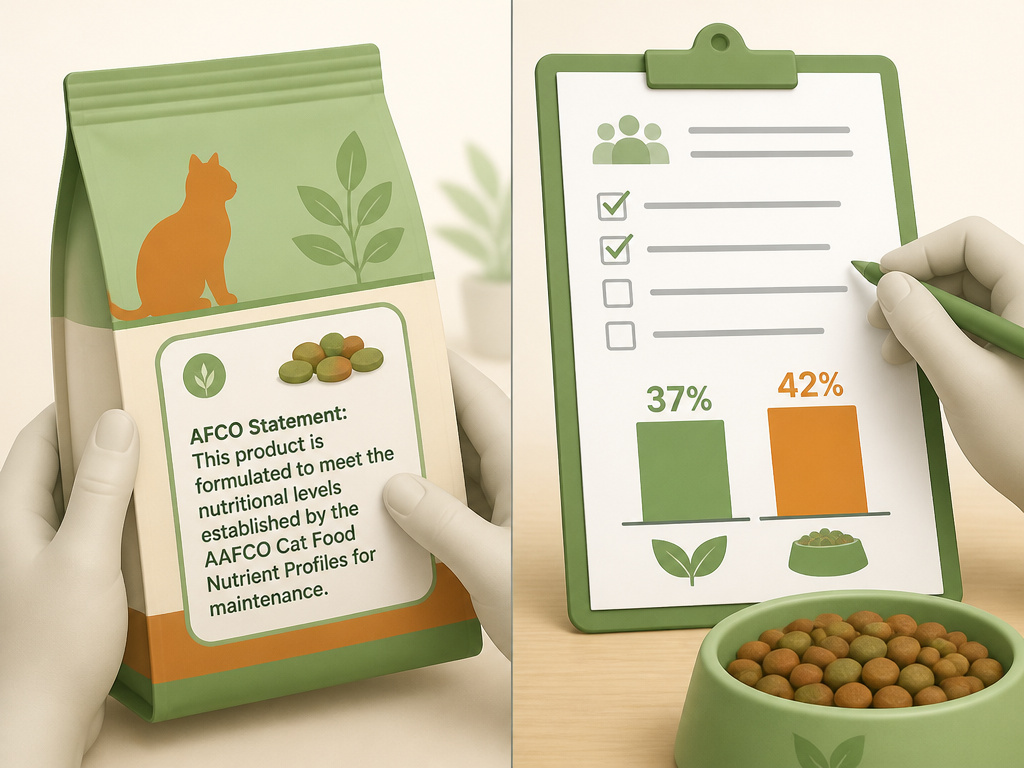
The largest owner survey in this literature found the opposite of what the lab work implies, and it did it with 1,369 cats.
| Question | Lab analysis (2015, 2021) | Owner surveys (2021, 2023) |
|---|---|---|
| What was measured | Nutrient concentrations in the food | Guardian-reported health outcomes |
| Sample | 24 diets, one batch each | 1,369 cats in 2023; 1,325 in 2021 |
| Headline finding | 6 of 24 missed amino acid minimums | 37% vs 42% with at least one disorder |
| Statistical strength | Direct measurement, single time point | No significant differences |
What the 42% vs 37% Number Actually Says
Of 22 disorders examined, 15 were more common in meat-fed cats and 7 in vegan-fed cats. Exactly one difference was statistically significant.
The reported risk reductions for vegan-fed cats were all non-significant: vet visits down 7.3%, medication down 14.9%, therapeutic diet down 54.7%, severe illness down 7.6% by vet assessment and 22.8% by guardian assessment, disorders per unwell cat down 15.5%.
Dodd’s team called the trend clear and consistent. Semp’s systematic review of 16 studies reached a different tone from the same weak evidence base, rating certainty low or very low for most outcomes and recommending caution.
I’d rather see an owner read the AAFCO statement than read a survey abstract. Surveys measure what people notice. The statement measures what the manufacturer tested. Both are worth something, but only one of them is about the food.
Is Vegetarian Cat Food Safe for Kittens?
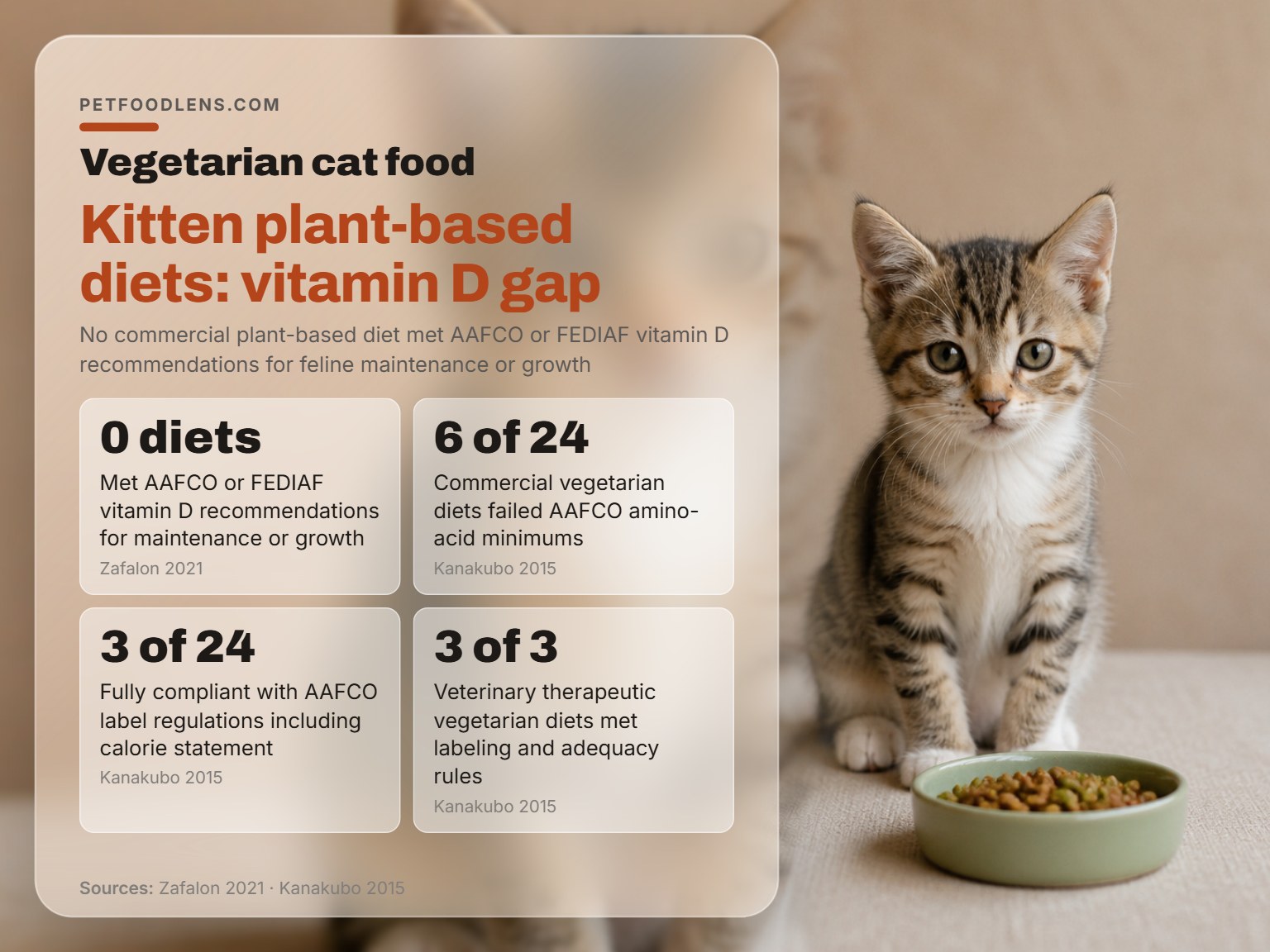
Zafalon’s team analyzed plant-based pet foods sold in Canada and found that no commercial diet met AAFCO or FEDIAF recommendations for vitamin D, for feline maintenance or for growth, while Dodd 2023 reports owner-assessed health with no growth-specific finding.
That’s one nutrient, and it’s the nutrient that analysis singled out. Growth formulas are the case where a shortfall has the least room to be absorbed.
The dog side of this reads more permissively, and vegetarian dog food is treated as lower-risk by UK Pet Food and Semp. A kitten is not a puppy, and UK Pet Food and Semp both treat cats as the higher-risk species for exactly this reason, while Knight & Leitsberger 2016 do not frame cats as a higher-risk case.
The Taurine Question, and Why Canned Diets Get Flagged
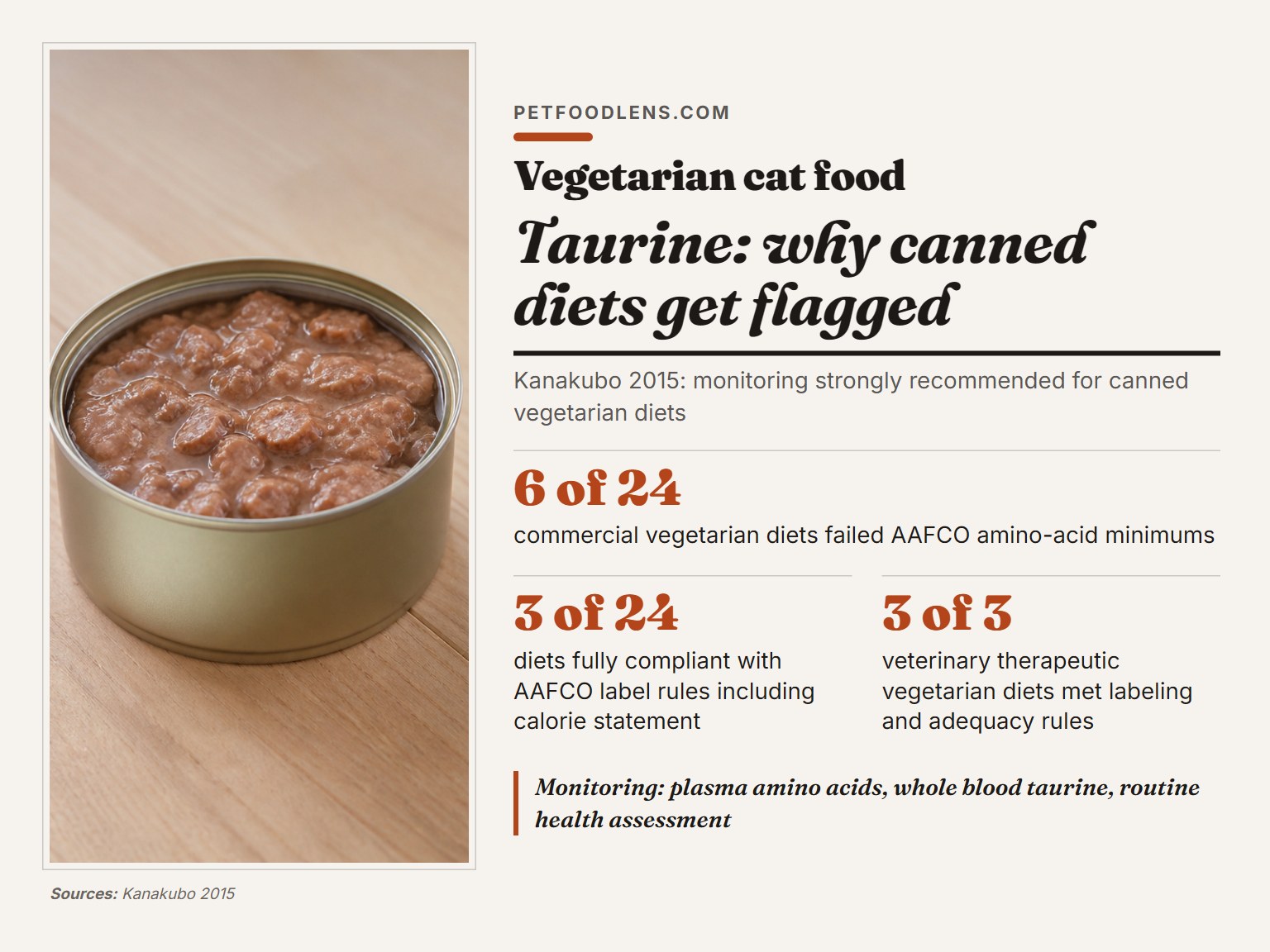
Taurine is the one nutrient Kanakubo’s team named in a direct recommendation: regular monitoring of taurine status is strongly recommended for dogs and cats eating canned vegetarian diets.
Notice the qualifier. Canned, specifically. The recommendation was stronger there than for dry.
If you’re set on the canned route, the vegan wet cat food options are limited, and the label checks matter more there than anywhere else on the shelf.
Easy to miss: A taurine minimum on the guaranteed analysis. That’s a label figure. It isn’t the same thing as a blood taurine level, which is what the researchers actually recommended measuring.
The monitoring package Kanakubo’s team suggested:
- Plasma amino acid concentrations, which show whether the diet is delivering what the label claims
- Whole blood taurine, the measurement that catches a shortfall the food label can’t
- Routine general health assessment, the boring part that catches everything else
- All of it sooner rather than later for a cat on a canned vegetarian diet
How to Read a Vegetarian Cat Food Label in Four Steps
Four checks, in this order. Each one eliminates a category of product before you spend anything.
Before you start: Two hazards worth naming. A kitten on a plant-based formula is the thinnest margin in this whole literature, because the Canadian analysis found no diet meeting vitamin D recommendations for growth, so a veterinarian should be setting that diet. And a cat with a diagnosed kidney, heart, or urinary condition needs the diet chosen against the diagnosis, which is a different exercise from the one below.
- Find the AAFCO statement and read the method. If it says “formulated to meet,” the recipe was calculated, not tested. Skipping this check means you’re trusting the front of the package, and the front of the package is marketing.
- Confirm the life stage matches your cat. A maintenance statement on a food you’re feeding a kitten is a mismatch the manufacturer never claimed was safe.
- Read the first five ingredients for where the protein comes from. Named protein sources near the top tell you more than a protein percentage, because the percentage is a total and the order is a hint at the balance.
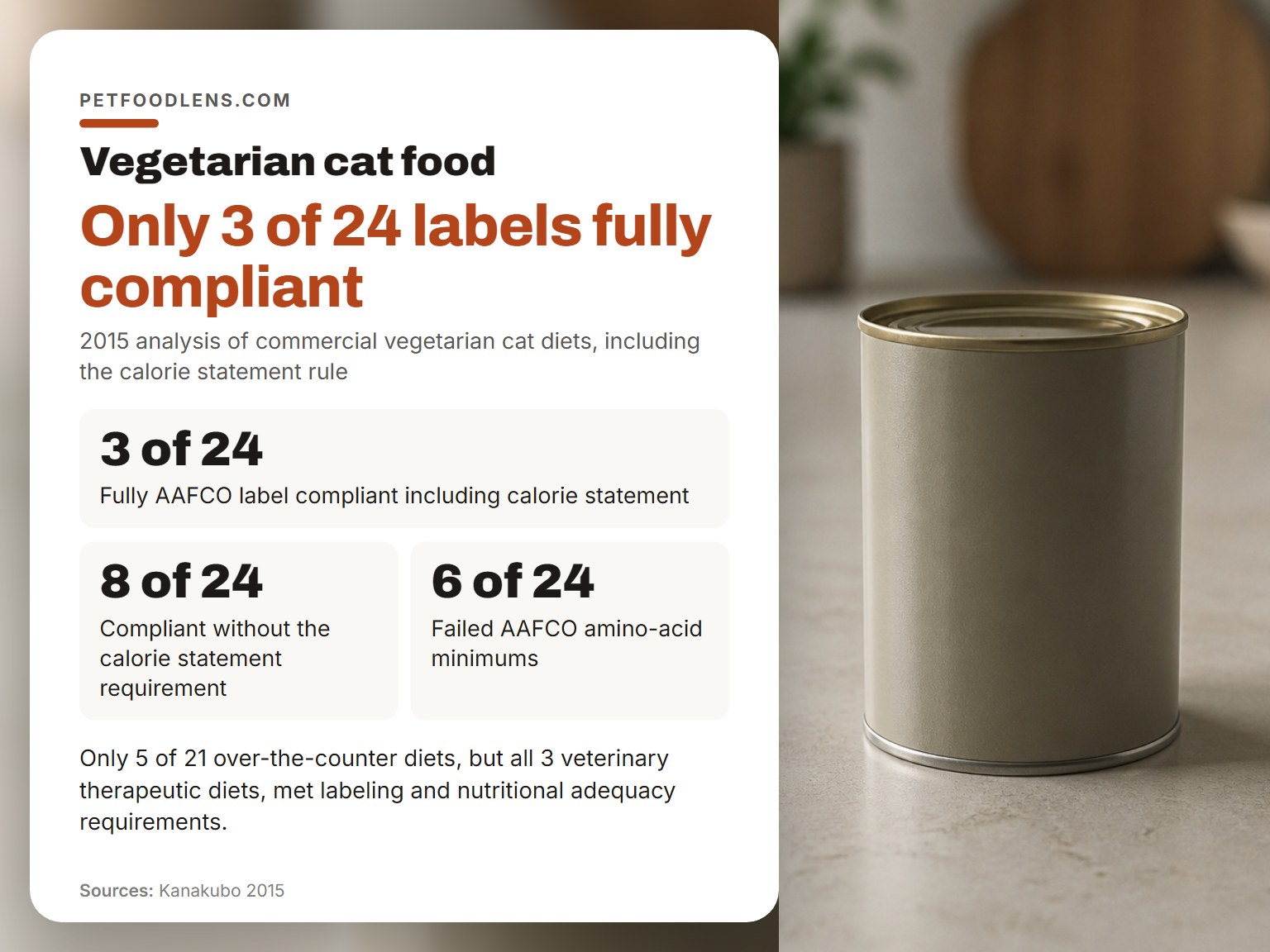
- Look for the calorie statement. Only 3 of 24 diets in the 2015 analysis were fully compliant with AAFCO labeling rules once the calorie statement was included. Eight of 24 made it without that requirement. Skipping this one means you can’t calculate how much to feed, and portion drift is its own problem.
If you’d rather not hunt shelf to shelf, plant-based pet food subscriptions at least put the same label in front of you on a repeatable schedule, though the label checks still apply.
Vegetarian Cat Food Pros and Cons: Where the Research Disagrees
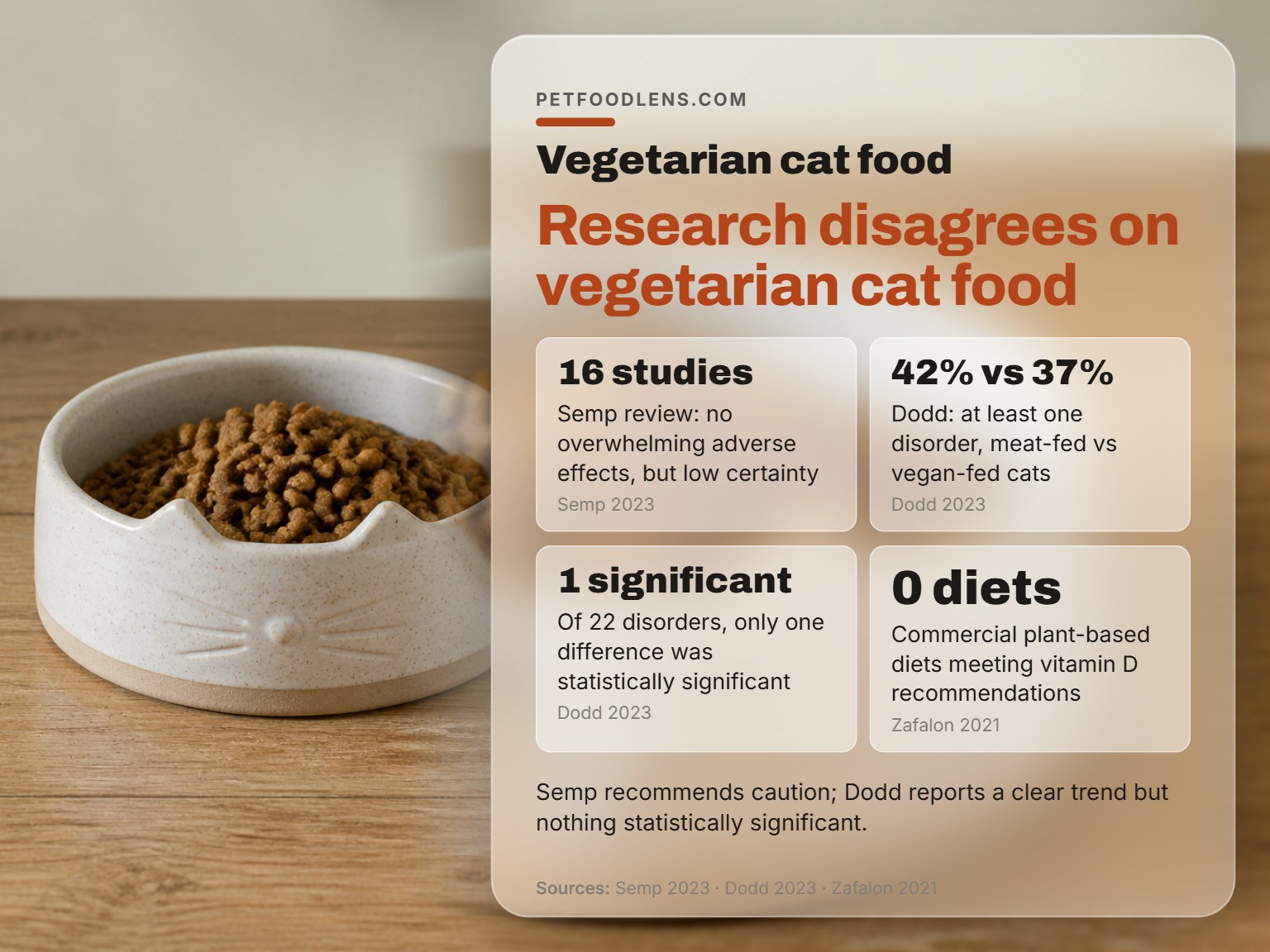
Two papers, published in the same year, describe overlapping evidence and reach opposite headlines.
Semp’s review found no overwhelming evidence of adverse effects across 16 studies, then rated certainty low or very low for most outcomes and recommended caution. Dodd’s study found vegan-fed cats tended to be healthier on a clear and consistent trend, with nothing reaching statistical significance.
The UK Position and the Rebuttal
UK Pet Food’s January 2023 factsheet advises against home-made vegetarian and vegan diets for cats and urges owners to think very carefully before feeding vegan to a cat at all. It frames cats as obligate carnivores that cannot obtain all the nutrients they need from the plant kingdom, and it names taurine, methionine, vitamin D, and arachidonic acid as the pressure points.
A 2024 rebuttal from Daina and colleagues calls sweeping claims of nutritional unsoundness in vegan pet diets inconsistent with the field and incorrect. The rebuttal’s open-access fee was paid by Representing Animals, which the authors state played no role in design, analysis, or publication decisions, and the authors declare no commercial conflicts.
That’s a vegetarian versus meat-based companion animal diets argument you can read in full, and it hasn’t resolved.
Owners often arrive from the vegan dog food side, where the species risk profile is different and the stakes are lower, per UK Pet Food and Semp. The health risks of vegan cat food deserve their own reading before you apply dog logic to a cat, given the nutrient shortfalls Kanakubo 2015 and Zafalon 2021 documented.
Where the sources actually line up:
- The failures in Kanakubo’s study were all in commercial products, which undercuts the assumption that buying a finished diet is automatically safer than cooking, though UK Pet Food advises that home-made vegetarian/vegan diets are the highest-risk category and urges owners to buy commercial.
- Cats carry more nutrient risk than dogs, per both UK Pet Food and Semp, and the four flagged nutrients are the reason, while Knight & Leitsberger 2016 do not frame cats as a higher-risk case.
- Nobody has run a long-term controlled trial. Semp’s systematic review of vegan pet diets rated certainty low or very low, and a 2026 exploratory survey of 1,305 cats carries less weight than a randomized trial would.
Zafalon’s essential nutrients in plant-based pet foods analysis is the one to read if vitamin D is your concern, and Dodd’s guardian-reported health outcomes in vegan cats is the one to read if you want the survey side in full.
Frequently Asked Questions
Is vegetarian cat food AAFCO approved?
There’s no approval process. AAFCO publishes nutrient profiles, and a manufacturer states whether its diet meets them by formulation or by feeding trial. In the 2015 analysis of 24 commercial vegetarian diets, 6 failed amino acid minimums and only 1 carried a feeding-trial statement.
Can a cat live on a vegetarian diet long term?
The evidence is thinner than either side claims. Owner surveys found no lifespan difference and no statistically significant health difference between plant-based and meat-based fed cats. Lab analyses found frequent nutrient shortfalls in the foods themselves. Long-term controlled feeding data doesn’t exist for cats.
What nutrients are missing from vegetarian cat food?
The documented failures are methionine, methionine-cystine, taurine, lysine, and tryptophan. Vitamin D was the nutrient that failed across the board in the Canadian analysis, for both maintenance and growth formulas. UK Pet Food also flags arachidonic acid.
Is vegan cat food safer than vegetarian cat food?
Nothing in the literature separates them. Both categories lean on plant proteins, and both showed the same amino acid and vitamin D problems in testing. The useful distinction is the label, not the word on the front, though the sources disagree on whether commercial vegetarian diets are adequate at all.
How often should a vegetarian-fed cat be checked?
Kanakubo’s team recommended regular monitoring of taurine status, with plasma amino acid and whole blood taurine measurements plus routine general health assessment. They flagged canned vegetarian diets as the case where that matters most. Your veterinarian sets the interval.
The Bottom Line
Here’s the trigger I’d give any owner. If the can in your hand doesn’t carry an AAFCO statement for the correct life stage, put it back and pick a different one. That single check removes most of the risk documented in the 2015 analysis before you reach any of the harder questions.
Everything above assumes a healthy adult cat. A kitten, a cat with kidney disease, a cat with a diagnosed heart condition: those are veterinary conversations, and I’m not the person to have them with you.
Weigh the vegetarian cat food pros and cons against the label in your hand, not against the philosophy. A commercial diet with a feeding-trial statement and a taurine monitoring plan is the closest thing to a defensible middle. A home-made lentil-and-rice recipe, which UK Pet Food advises against outright, is not.
