
How to Feed an Underweight Cat: Step-by-Step
This post contains affiliate links. As an Amazon Associate, we earn from qualifying purchases.
The short answer to how to feed an underweight cat: calculate calories from current body weight, feed small weighed meals of an energy-dense diet, and find out why the cat stopped eating. Once intake sits at one-third of resting energy requirement or less for 72 hours, AAHA strongly recommends a feeding tube rather than more coaxing.
That second sentence is the one owners skip. A cat that stops eating has a reason, and the reason is medical until proven otherwise. Dental pain, kidney disease, hyperthyroidism, and inflammatory bowel disease all announce themselves at the bowl first, which is why the calorie math comes after the vet visit, not instead of it.
What follows is the order I’d work in: score the cat, run the numbers, decide what goes in the bowl, then work through the coaxing, the schedule, and the point where coaxing stops being enough.
Key Takeaways
- Score muscle, not just fat. Body condition score and muscle condition score are recorded separately in thin cats, because they lose both at once.
- Feed to current weight if the cat is genuinely underweight. Switch to ideal body weight only when the cat is overweight and losing.
- Weigh the food. AAFCO doesn’t standardize the feeding directions on the bag, so the label is a starting guess and nothing more.
- 72 hours at one-third of RER or less is the AAHA trigger for tube feeding, and that clock includes the days before hospitalization.
- Skip the syringe. AAHA no longer recommends oral syringe feeding because of food aversion and aspiration risk.
Start With the Scale, Not the Bowl
Muscle condition score is the number owners never hear about, and it’s the one that matters most on a thin cat.
Run your hands down the spine and over the hips. A cat holding muscle feels like a padded ridge under the skin. A cat losing it feels like a row of knuckles with a loose cover stretched over them. That difference is the muscle condition score, and it tells you whether the cat is burning protein or simply carrying less fat.
The 2021 AAHA nutrition guidelines are blunt about this: body condition score and muscle condition score get scored separately in underweight patients, because those cats lose fat and muscle at the same time. Score one and you’ve described half the cat.
Nutritional status is recommended as a fifth vital assessment in feline patients, recorded alongside temperature, pulse, respiration and pain. Body condition score and muscle condition score are recorded separately, because such cats often lose both fat and muscle mass, and a single score cannot describe both. The assessment is repeated at every visit and daily in a hospitalised patient.
That’s why current feline nutritional assessment recommendations treat nutrition as a vital sign rather than a side note. It gets checked the same way you’d check a temperature.
Weigh the cat weekly on a baby scale. Body condition scoring is a hands-on judgment, and judgment drifts when you’re the one doing the feeding. A scale doesn’t drift.
What to write down each week:
- Weight to the tenth of a pound. One reading is noise. Three readings in a row is a trend.
- Body condition score, using the same hands and the same lighting every time.
- Muscle condition score, felt along the spine and the flat of the hips.
- How much the cat actually ate, not how much you put down. Those are different numbers more often than anyone likes to admit.
A cat that has always been thin and is holding steady is a different animal from a cat that dropped weight in six weeks. Fast loss moves the vet visit from “soon” to “today.”
How Many Calories Does an Underweight Cat Need?
Two numbers decide the whole plan: the resting energy requirement, and the weight you calculate it from.
Resting energy requirement (RER) is the calories a cat burns doing nothing at all. Maintenance energy requirement (MER) is that number multiplied by a factor for life stage and activity. AAHA’s guidance is to run those calculations yourself rather than following the bag, because AAFCO does not standardize how manufacturers produce those feeding directions. Two bags with identical calorie counts can print wildly different daily amounts.
Here’s the part that trips people up. AAHA says to base the calculation on current weight if the cat is ideal or underweight, and on ideal body weight if the cat is overweight or obese. The point is to supply energy to the lean mass the cat still has, not to the fat it’s carrying.
| Cat’s situation | Weight to calculate from | Why |
|---|---|---|
| Thin, no reserves left | Current weight | Feeds the lean mass that remains |
| Overweight but losing | Ideal body weight | Avoids feeding the fat mass |
| Chronic illness with wasting | Current weight, rescored weekly | Muscle loss shifts the target fast |
Current Weight or Ideal Weight?
The two positions aren’t as far apart as they look. AAHA ties the choice to body condition. The nutritional assessment review tabulates estimated energy needs against ideal weight, which lands in the same place for an overweight cat and a different place for a thin one.
For a genuinely underweight cat, current weight wins. Feed a thin cat to its ideal weight and you’re feeding a cat that doesn’t exist yet.
Once you have the number, how much to feed becomes a weighing job rather than a scooping job. That’s the whole shift.
The 72-Hour Rule and the 3-to-5-Day Rule Don’t Agree
Three respected sources give three different answers to the same question: when does coaxing stop and assisted feeding start?
This matters because the answer decides whether you’re still trying techniques at home or sitting in a clinic. Here’s each position, stated as its own authors stated it.
| Source | Trigger for assisted feeding | What it actually measures |
|---|---|---|
| 2021 AAHA guidelines | 72 hours of eating 1/3 of RER or less | Intake fraction, not calendar days |
| Feline anorexia review | 3 to 5 days with no food | Calendar days |
| Inappetent cat review | Anorexia beyond 3 days | Malnutrition risk |
The AAHA trigger is the most sensitive of the three, and it’s the one owners never hear. It counts backwards from the moment intake dropped below a third of RER, including the days before the cat was hospitalized. A cat that has been picking at food for four days has already blown through it.
The management of anorexia in cats review frames the same decision in calendar days: 3 to 5 days of no food, sooner if the cat is severely malnourished or showing signs consistent with hepatic lipidosis. The inappetent-cat review splits the difference by calling anorexia beyond 3 days a malnutrition risk factor.
Read together, the practical rule is this. Judge by intake fraction if you can measure it, use 3 days as the outside calendar limit, and treat severe malnutrition or suspected hepatic lipidosis as an immediate call rather than a countdown.
Where this goes sideways: Waiting for day five because the cat is still eating a little. Picking at food can still land under a third of RER, and that’s the number AAHA is actually counting.
How to Feed an Underweight Cat: What Actually Goes in the Bowl
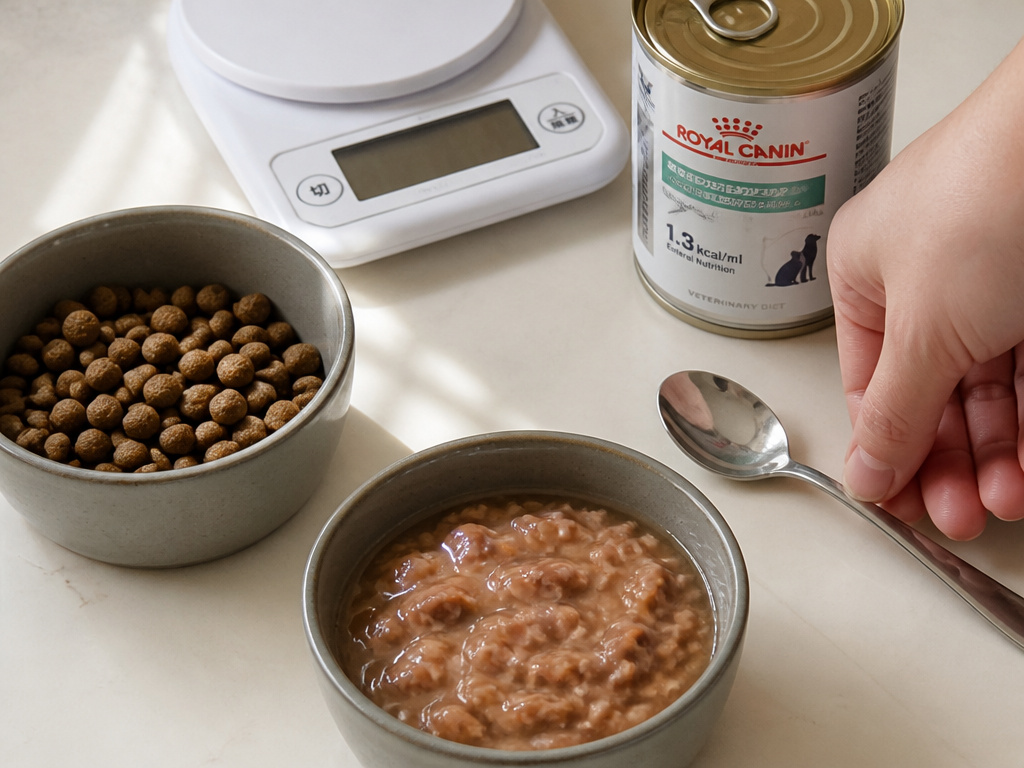
Calorie density is the lever, and it’s the one most owners never touch.
AAHA notes that high-fat diets tend to carry more calories per unit of volume, which shrinks the amount of food a cat has to eat to hit its energy target. For a cat with a small appetite, that’s the entire game. You’re trying to fit a calorie target into a stomach that quits early.
The inappetent-cat review goes further for sick cats, calling an energy-dense, high-protein, high-fat commercial feline diet the preferred choice for most critically ill patients. The anorexia review takes a different position for the short term: any food is fair game for 2 to 3 weeks, including meat-based baby foods and palatable table foods, because calories are what matter most in that window.
Both are right, and the split is about time. Short term, calories win. Once the cat is eating reliably, balance comes back into the picture.
Before you start: Three things in this section can hurt the cat. Baby food containing onion powder has been shown to cause Heinz body anaemia in cats, so read the jar before you open it. A severely malnourished cat fed too fast can develop refeeding syndrome, where severe hypophosphataemia causes muscle weakness and haemolysis. And food pushed into a cat’s mouth by syringe can end up in the airway. Read the jar, start slow, and skip the syringe.
For a cat that needs maximum calories in minimum volume, the recovery diets exist for exactly this job. Energy-dense, high-protein, high-fat commercial feline recovery diets are built for exactly this job, and they’re what a lot of clinics reach for when a cat needs to eat and won’t. If you want a wider shortlist of calorie-dense cat food, compare the kcal per can rather than the protein percentage on the front.
Wet Food vs Dry When the Goal Is Weight Gain
For a cat that’s still eating willingly, dry food is the easier route to a calorie target. It packs more calories per gram, so a small volume goes further, and you can leave it down without it drying into a crust.
For a cat that’s turning its nose up, wet wins. Smell drives feline appetite, and a warm wet food carries that smell across the room in a way kibble never will.
So the answer flips on willingness. Willing eater, dry for density. Reluctant eater, wet for aroma. If you’re shopping the wet side, wet cat food for weight gain is worth comparing on kcal per can, and food for underweight cats covers the tinned and pouch options side by side.
How Do You Get a Nose-Down Cat to Eat?
The bowl is full, the cat is sitting three feet away with its back to it, and the clock is running.
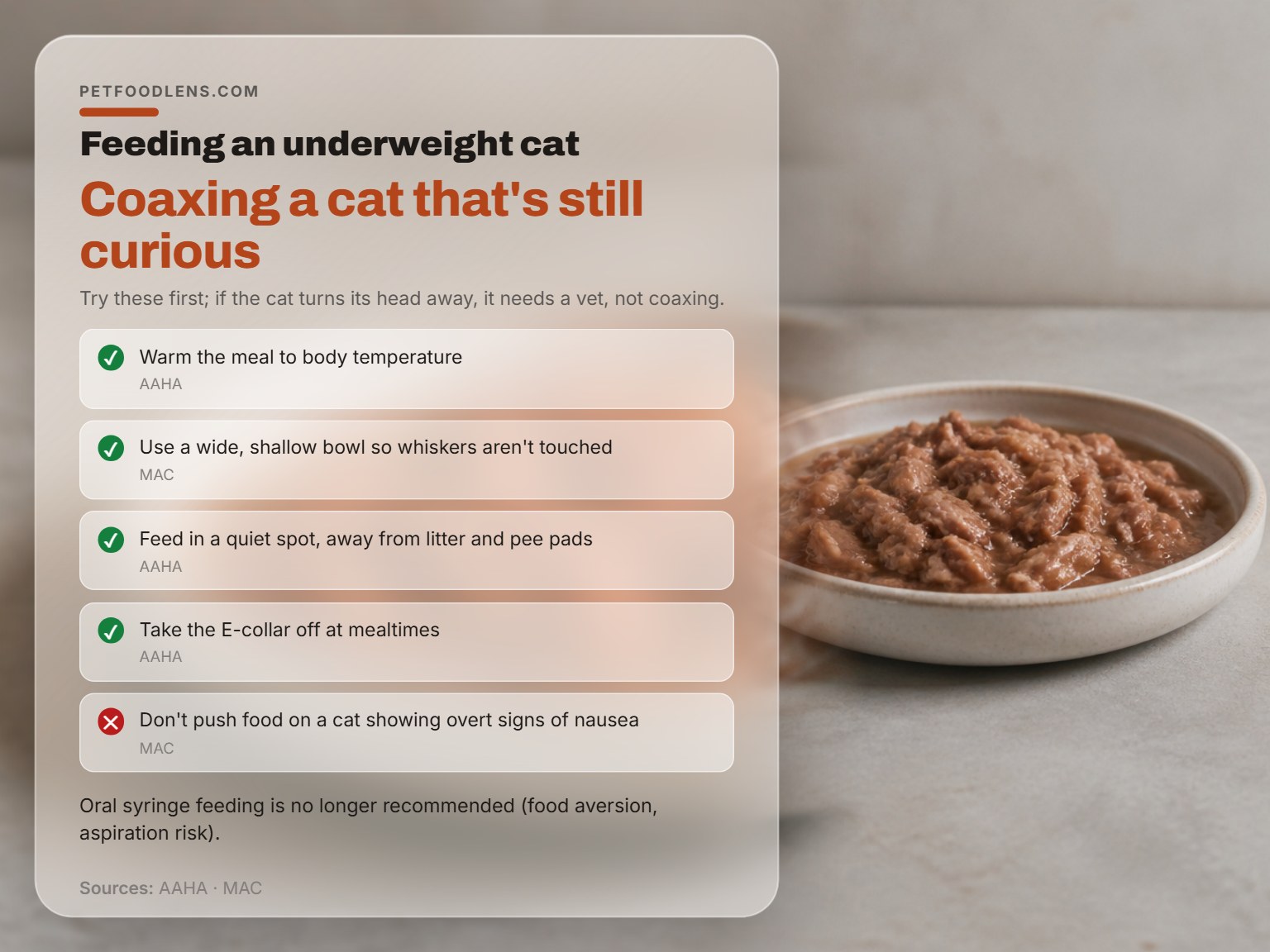
The first thing to understand is that pushing food at a cat showing overt signs of nausea makes things worse. The anorexia review is direct about this: cats that drool at the sight of food, turn their heads away, or spit food out should be left alone, because pushing risks a learned food aversion that can outlast the illness itself.
For a cat that’s still curious, the toolkit is bigger than most owners realise. Work through it in this order.
- Warm the food to body temperature. Heating a meal is one of the specific techniques AAHA lists for anorexic and hyporexic patients, and it costs nothing to try.
- Change the bowl. Some cats will not eat from a dish that touches their whiskers, and plastic bowls can hold onto unpleasant odours. Switch to a wide, shallow ceramic saucer. Skip this and you’ll spend a week blaming the food.
- Move the bowl somewhere quiet, away from the litter box, the pee pads, and the water dish. AAHA lists separating food from litter boxes and pee pads as a standard technique for a reason.
- Take the E-collar off at mealtimes. A cone catches the bowl edge and most cats give up rather than work around it.
- Separate feeding from treatment. Don’t pill a cat and then put food down. The JAVMA reduced food intake study recommends scheduling medications at other times, by other people if possible.
- Try a novel food, but expect it to fail if the cat is still unwell. The aversion can transfer to the new food, so this is a one-shot attempt, not a rotation.
I’ve stopped telling owners to try harder with a cat that’s turning its head away from the bowl. A nauseous cat doesn’t need encouragement, it needs an antiemetic and a diagnosis. The coaxing tricks work on the cat that’s still curious, and that’s a different animal.
There’s one genuine disagreement in this territory, and it’s worth naming. AAHA states plainly that oral syringe feeding is no longer recommended, because of food aversion and aspiration risk. The anorexia review still describes placing a small amount of food in the mouth, on the lips, or on the paws, plus stroking and talking to the cat with food nearby, as a way to stimulate interest.
Those aren’t the same act. A dab of food on the lips is a nudge. A syringe loaded into the back of the mouth is a delivery method, and that’s the one AAHA pulled. If your cat is genuinely refusing everything, the syringe isn’t the answer; the vet is.
If your cat is simply picky by temperament rather than nauseous by illness, the same tools apply but the urgency doesn’t.
Small Meals, Weighed, on a Schedule
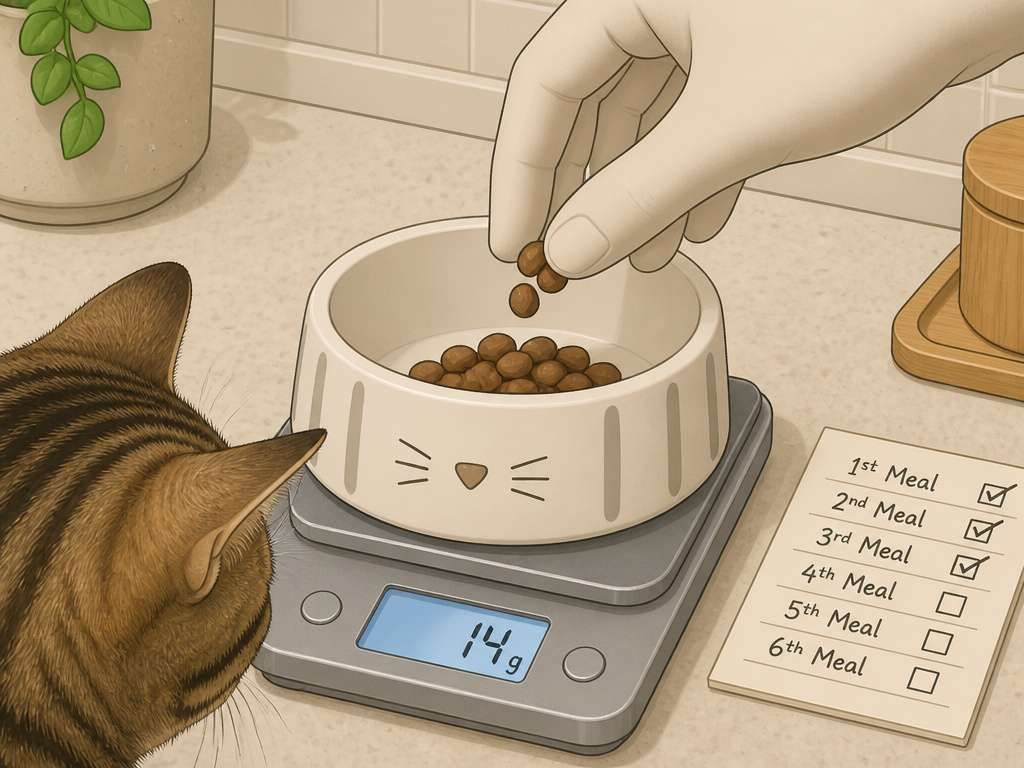
Three changes do most of the work here: smaller meals, more of them, and a number on the bowl instead of a scoop.
Early satiety is common in anorectic cats, which means the meal ends before the calories land. The anorexia review’s answer is to divide the day’s food into as many small, fresh meals as you can manage. A cat that quits after four bites will eat six times a day if you let it.
You’ll hear the difference before you see it. A bowl licked clean has a dry, ringing scrape to it. A bowl the cat walked away from sits there silent and full, and that silence is your real feedback loop.
Weigh the food. AAFCO now requires calorie content on cat food labels, and most manufacturers publish it on their websites, so the kcal per gram is available to you. From there, measuring cat food portions with a kitchen scale to the gram beats any measuring cup, because cup volume changes with kibble size and how settled the bag is.
Meal spacing is its own decision. Meal frequency matters more for a thin cat than a fat one, because you’re trying to fit a calorie target into a stomach that quits early.
Here’s where the household setup comes in. In multi-cat homes, one cat is often eating the other’s food, and the thin one is thin because it’s being outsized at the bowl. The fix is separate feeding spots in separate rooms, or timed meals where every bowl comes up after twenty minutes. I ask about the household setup early now, because no calorie plan survives a cat that never gets to the bowl.
Common mistake: Feeding a cat with kidney disease a high-protein weight-gain diet. Uraemic cats may not tolerate high protein, so the weight-gain plan has to be built around the diagnosis rather than bolted on top of it.
When Coaxing Fails: Tubes, Drugs, and Refeeding Risk
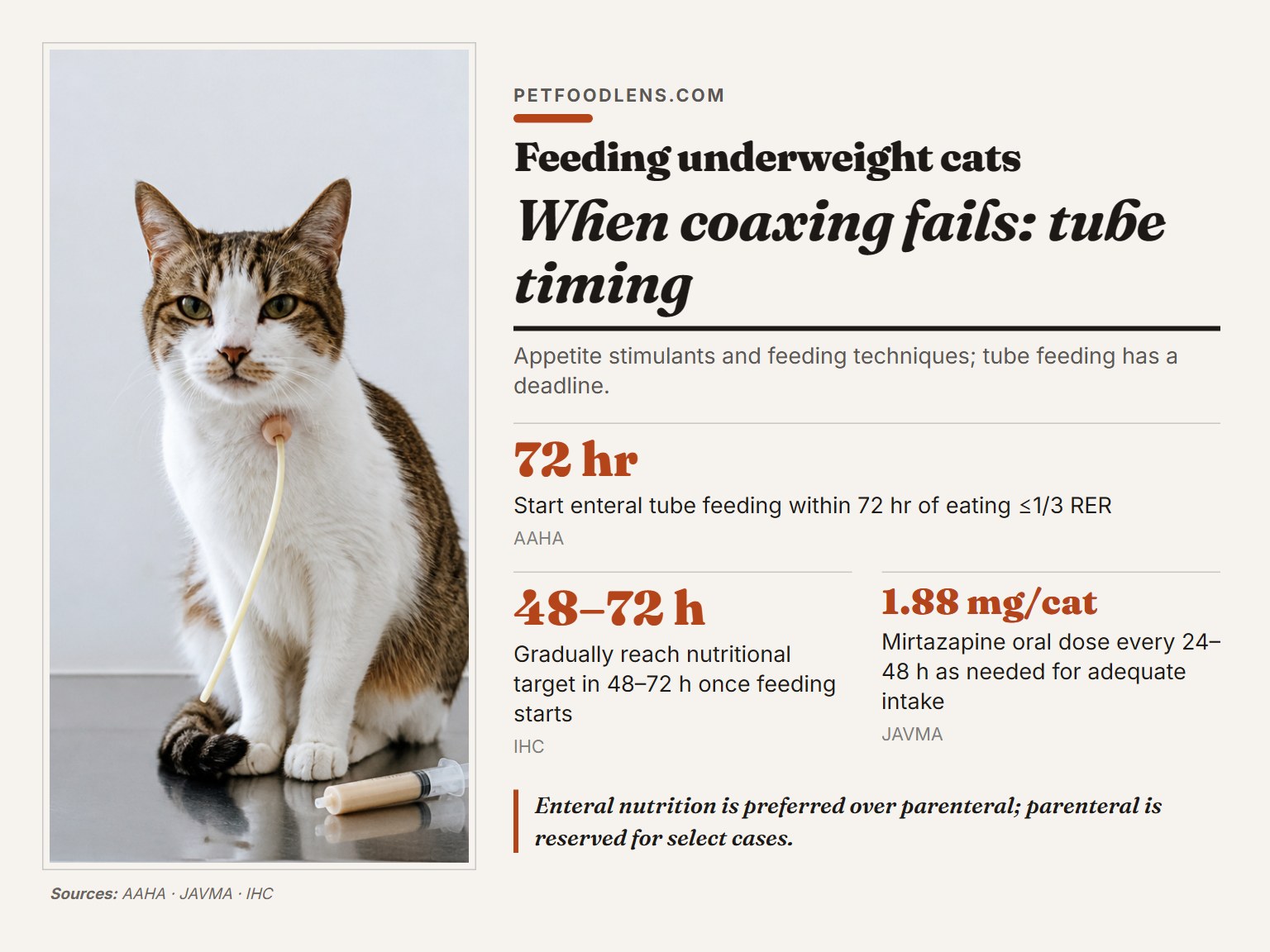
Coaxing has an expiry date.
Appetite stimulants are the middle step, and they’re more limited than the internet suggests. The JAVMA review notes that efficacy is unpredictable and may prove inadequate to get a hyporexic cat to its energy target. Worse, leaning on them delays the intervention that would have worked.
Appetite Stimulants: Dose, Delay, and Contraindications
The two drugs that come up most are mirtazapine and cyproheptadine, and both have real numbers attached.
Mirtazapine is dosed orally at 1.88 mg per cat every 24 to 48 hours, as needed, to reach adequate intake. Cyproheptadine is dosed at 1 to 2 mg every 12 to 24 hours, and because of variable bioavailability and a mean half-life of 12 hours, it may take 2.5 days or more to reach steady-state concentrations. Neither is a same-day fix.
Both are metabolised in the liver and cleared by the kidneys, so dosing frequency should be reduced in cats with hepatic or renal disease. Cyproheptadine is not recommended at all in cats with hepatic lipidosis, because of reports of idiosyncratic hepatotoxicosis and hepatic failure.
The part nobody mentions: An appetite stimulant buys you a few days, not a plan. Over-reliance on one delays the tube, and those are days the cat spends losing more weight it didn’t have to lose.
When drugs aren’t enough, the route decision takes over. AAHA’s position is that enteral nutrition should be promoted over parenteral, with parenteral nutrition reserved for select cases, generally in referral facilities with 24-hour care. The inappetent-cat review is less restrictive, calling for parenteral nutrition whenever enteral feeding isn’t feasible or isn’t tolerated.
The clinical signs decide which tube, if any:
- Protracted vomiting rules out oral and oesophageal feeding entirely.
- Oral or pharyngeal disease points toward a gastric tube instead.
- Severe inflammatory bowel disease or intestinal lymphoma may mean the gut can’t use the nutrients at all, which is where parenteral nutrition comes in.
- Cardiovascular instability has to be corrected before enteral feeding starts, because enteric vasodilation can drop blood pressure further.
Once feeding starts, it ramps. The inappetent-cat review puts the target at 48 to 72 hours, with gradual introduction rather than a full ration on day one. For a chronically debilitated or severely malnourished cat, the ramp gets slower and the carbohydrate load gets very low, specifically to reduce refeeding syndrome risk.
The exit is equally specific. Nutritional support is discontinued only when the cat can eat roughly its RER without much coaxing. Not when the bloodwork looks better, and not when the cat eats one good meal.
What Not to Feed a Thin Cat
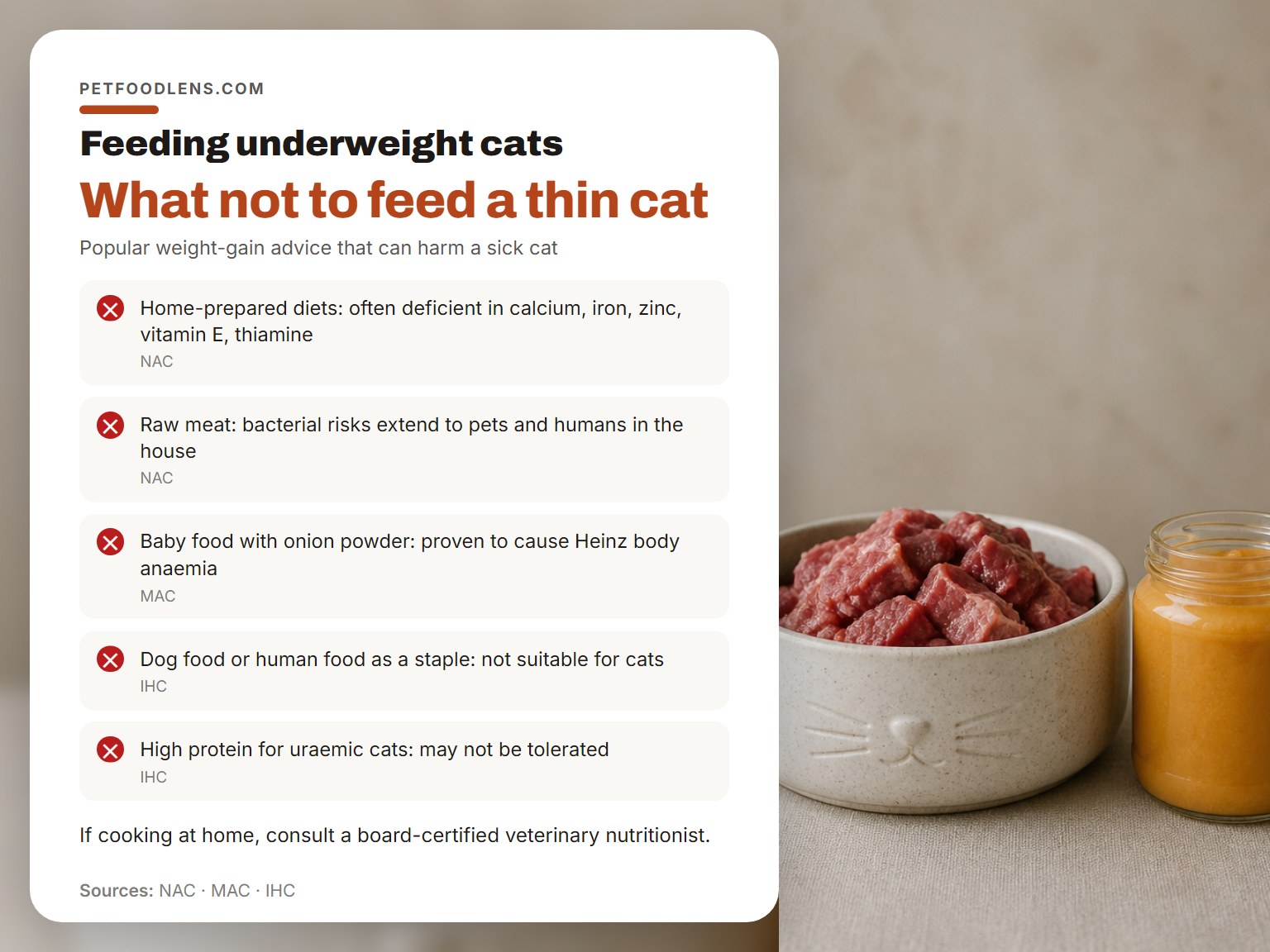
Some of the most popular weight-gain advice actively works against a cat that’s already sick.
Home-prepared diets are the biggest one. The nutritional assessment review found that home-prepared cat diets are often deficient in calcium, iron, zinc, vitamin E, and thiamine, which can produce bone fractures and deformities, anaemia, skin disorders, and neurologic disease respectively. If an owner insists on cooking, the recommendation is a consult with a board-certified veterinary nutritionist, and that’s not a formality.
Raw meat is the second. The documented benefits do not justify the health risks, and the bacterial risk extends to the humans in the house, not just the cat. High-pressure pasteurisation may offer a route for owners who want raw-style feeding, but dehydration and freeze-drying do not reliably kill many forms of pathogenic bacteria.
Baby food deserves its own warning. It’s a legitimate short-term calorie source in the anorexia review, and it’s also the fastest way to poison a cat if the jar contains onion powder.
Two more rules that get broken constantly. Don’t feed a cat dog food or human food as a staple, because diets designed for other species don’t meet feline requirements. And don’t assume high protein is always right, because cats with uraemia may not tolerate it.
Easy to miss: Stopping the plan the moment the cat looks better. Weight gain in a thin cat is slow, and a cat that’s eating again is a cat that’s still recovering, not a cat that’s finished.
Frequently Asked Questions
How long can a cat go without eating before it’s dangerous?
Anorexia lasting longer than 3 days is a recognised malnutrition risk factor. The anorexia review puts the typical window for starting assisted feeding at 3 to 5 days, sooner if the cat is severely malnourished or showing signs of hepatic lipidosis. AAHA’s trigger is different and earlier: 72 hours of eating one-third of RER or less.
Should I syringe-feed my cat?
AAHA no longer recommends oral syringe feeding, citing food aversion and aspiration risk. The anorexia review still describes placing a small amount of food on the lips or paws as a way to spark interest, which is a nudge rather than a syringe load. If the cat is refusing everything, that’s a vet call, not a syringe call.
Is wet food better than dry for weight gain?
It depends on whether the cat is eating. Dry food carries more calories per gram, so a small volume goes further for a willing eater. Wet food wins on aroma, and smell is what pulls a reluctant cat back to the bowl. Compare kcal per can or per gram, not the protein percentage on the front.
How much should I feed an underweight cat?
Calculate resting energy requirement from current body weight, then apply a maintenance factor for life stage and activity. AAHA advises running that calculation rather than following the bag, because AAFCO doesn’t standardize feeding directions. Weigh the food to the gram and reassess weekly.
Why is my cat losing weight when it’s still eating?
Malabsorption is one route. In roughly 30 percent of cats over 12 years old, fat absorption is decreased, and in 20 percent protein digestibility drops. Dental pain, kidney disease, hyperthyroidism, and intestinal disease are the other common explanations. A cat with hyperthyroidism often eats well and still loses weight.
Can I just feed more of the cat’s regular food?
You can, and for 2 to 3 weeks calories matter more than completeness. The limit is volume. A cat with early satiety quits before it hits the target, which is why energy-dense food does more work than a bigger scoop of the same food.
The Bottom Line
If you take one number away from this, take the 72-hour one. A cat that has eaten a third of its resting energy requirement or less for three days needs a vet visit today, not a new brand of food. That clock includes the days you spent coaxing at home, which is why it catches people out.
Tonight, weigh the cat on a baby scale and write the number somewhere you’ll see it. That single figure turns every later decision, from calorie math to whether the plan is working, into something you can check instead of guess.
And one concession, because it matters. If your cat is severely malnourished or showing signs consistent with hepatic lipidosis, none of the home feeding advice above applies. That cat needs a clinic, a slow ramp, and a very low carbohydrate plan, and the fastest way to help is to stop reading and make the call. That’s how to feed an underweight cat when the cat is genuinely sick: you don’t, not alone.
