
How to Feed a Dog During Travel: 12-Hour Water Rule
This post contains affiliate links. As an Amazon Associate, we earn from qualifying purchases.
To feed a dog during travel, keep two clocks: food offered at least every 24 hours (every 12 hours for puppies under 16 weeks) and potable water at least every 12 hours. Weigh each meal in advance and keep dry food below 80 degrees Fahrenheit. Knowing how to feed a dog during travel means planning ahead for both meals and water.
Those two clocks are written for dogs moving in commerce. They’re still the only published numbers anyone has, which makes them the benchmark a family can borrow. A 12-hour water gap on a July drive is a planning failure, and it is exactly the how to feed a dog during travel question that goes wrong fastest for a puppy pushed past 12 hours without a food offer.
What follows is the practical version: the intervals, the withhold-or-feed argument, water on the road, portioning, and the storage temperatures that decide whether the food is still food by day two.
Key Takeaways
- Water every 12 hours is the floor, and it does not loosen with age the way the food interval does.
- Puppies under 16 weeks halve the food clock to 12 hours, which is the number most travel plans blow through.
- 80 degrees Fahrenheit is FDA’s storage ceiling for dry food, and a closed trunk on a summer afternoon passes it without trying.
- Keep the whole bag, not just the kibble, so the UPC and lot number survive into a complaint.
- Fresh diets need a cold chain that a long drive, a hike, or an evacuation may not be able to supply.
What the 12- and 24-Hour Rules Actually Require
9 CFR 3.17 is the federal rule that sets feeding and watering intervals for dogs in transport, and it reads faster than most product labels.
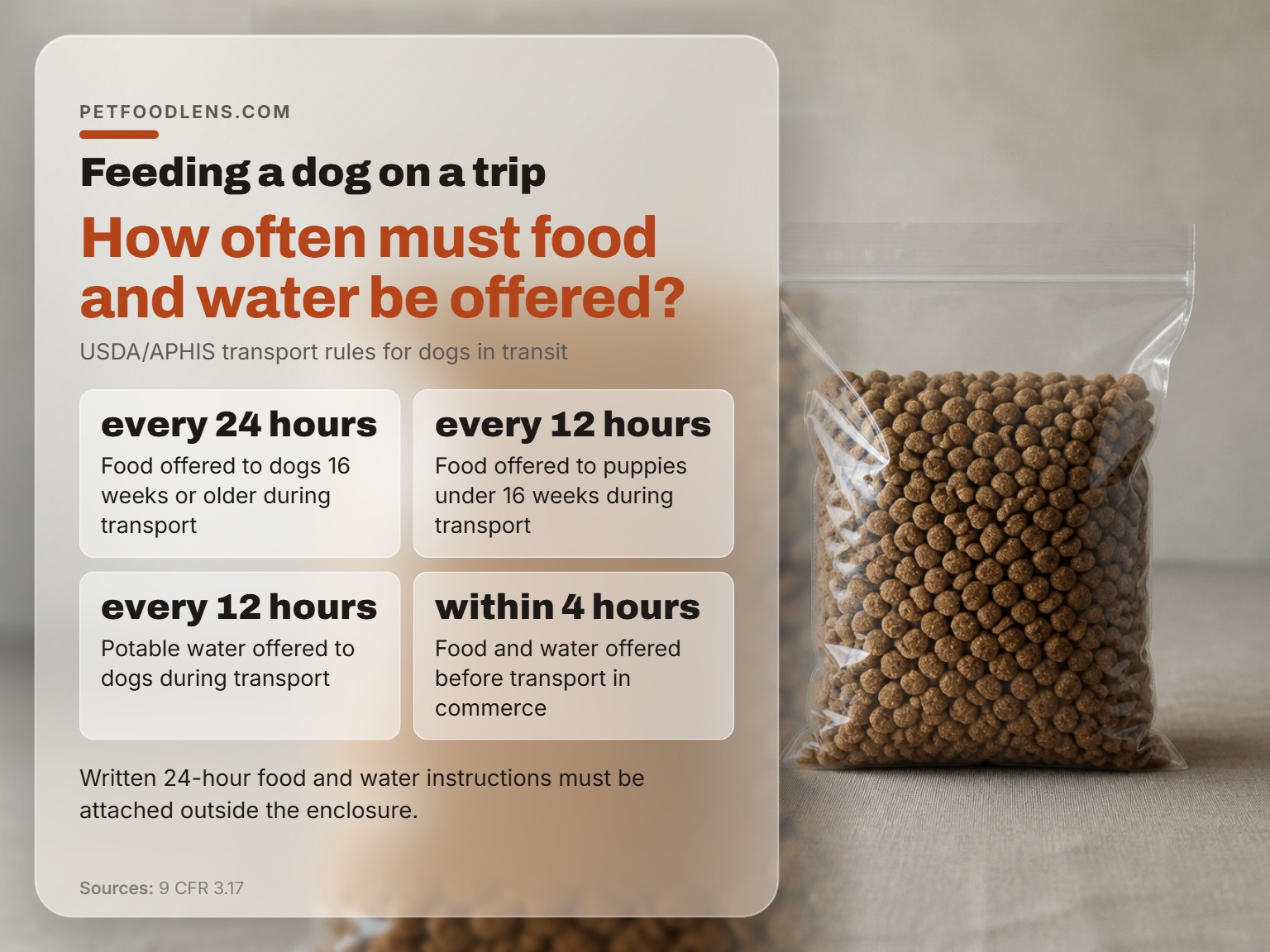
Federal transport rules set two clocks. Dogs 16 weeks and older must be offered food at least once every 24 hours, puppies under 16 weeks at least once every 12 hours, and every dog must be offered potable water at least once every 12 hours. Commercial consignors must also certify the date and time of the last offer.
Those intervals bind dealers, exhibitors, research facilities, and the carriers and handlers in between. They are a floor, not a target.
Two design details in the same clause are worth stealing for a crate. Receptacles must be fillable from outside the enclosure without opening the door, and they must be built so the dog can’t slip out through the food opening. Anyone who has wrestled a bowl through a crate door at a rest stop understands both.
| Dog | Food offered | Water offered |
|---|---|---|
| 16 weeks or older | At least every 24 hours | At least every 12 hours |
| Under 16 weeks | At least every 12 hours | At least every 12 hours |
| Before transport in commerce | Within 4 hours of pickup | Within 4 hours of pickup |
| Air cargo, accessible area | Observed at least every 4 hours | Observed at least every 4 hours |
The rule also requires written in-transit food and water instructions for a 24-hour period, attached to the outside of the enclosure where they can be seen and read. Tape a card to your crate with feeding times, amounts, and your phone number. A handler who has never met your dog can follow it.
Where the rule applies, and where it doesn’t
Your own car is not covered by the Animal Welfare Act. That’s the honest version, and it matters because owners cite the 24-hour number as if a state trooper will check it.
The 9 CFR 3.17 food and water requirements still earn their place as a benchmark, because they’re the only published intervals in existence. The USDA pets on planes guidance repeats the same numbers for airline handlers, and that page was last modified January 25, 2026, so it reflects the live federal position rather than an archived one.
If your dog flies cargo, the air rules go further. No more than one dog 6 months or older per kennel, and no more than two puppies between 8 weeks and 6 months if they’re of comparable size and weigh 20 pounds or less each. Kennels get cleaned if the transit runs past 24 hours.
Should You Withhold Food Before a Long Drive?
Two credible sources give opposite answers here, and both are defensible.
VCA Animal Hospitals advises withholding breakfast on travel day, because an empty stomach lowers the risk of nausea and vomiting, then feeding a small meal at the evening destination. The regulation sets a hard maximum interval instead: food at least every 24 hours, and every 12 hours for puppies under 16 weeks.
| Approach | Who says it | What it means on a 10-hour drive |
|---|---|---|
| Withhold breakfast, small meal on arrival | VCA Animal Hospitals | Dog may go 12 to 18 hours without food |
| Food offered at least every 24 hours | 9 CFR 3.17 | Adult dogs stay inside the federal ceiling |
| Food offered at least every 12 hours | 9 CFR 3.17 | Puppies under 16 weeks need a mid-trip offer |
The two regimes answer different questions. VCA is describing a healthy adult dog on a road trip. The regulation is describing dogs moving in commerce, where nobody is watching for nausea.
Age is where the argument resolves. A 14-week-old puppy carries a 12-hour food clock, and a drive that starts at 6 a.m. And ends at 8 p.m. Runs straight through it.
I won’t skip a meal for a puppy under 16 weeks on a long drive. The nausea argument holds up for adult dogs. A 12-week-old has a 12-hour ceiling for a reason, and I’d rather deal with a messy crate than push a puppy past that window.
For an adult dog on a four-hour drive, the VCA approach is fine and I use it. For a puppy, offer food before you leave and again at the 12-hour mark, because the interval is the harder constraint.
Some owners reach for calming treats for dogs before a long drive, which is a separate decision from the food clock. Test any new treat at home first, the same way VCA suggests a dry run with a prescribed anxiety medication. Trazodone, gabapentin, and alprazolam are the three VCA names as sometimes-used options, and all three are prescriptions.
Where this goes sideways: Withholding breakfast from a puppy under 16 weeks and then driving eight hours. That stacks a 12-hour overnight gap on top of an eight-hour drive, against a 12-hour ceiling.
How Often Does a Dog Need Water on the Road?
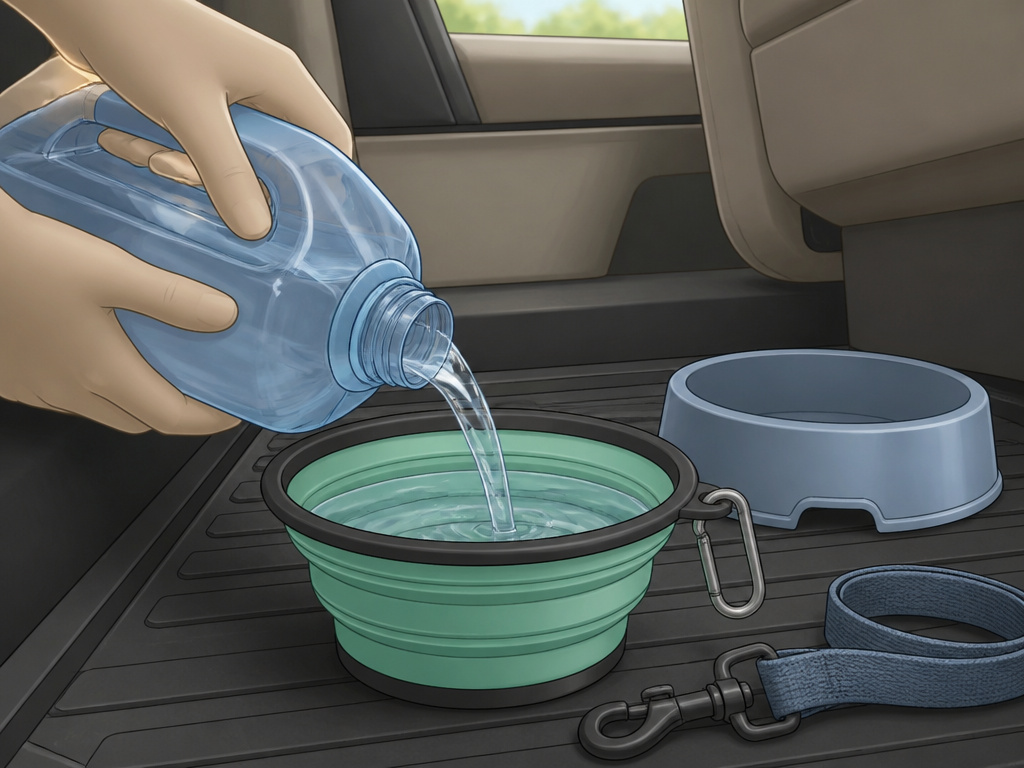
Twelve hours is the longest a dog should go without a potable water offer, and that number doesn’t loosen with age the way the food interval does.
VCA’s road-trip version is simpler than the regulation: offer water at every rest stop you make. On a normal driving day, that clears the 12-hour floor without any math.
The water itself is the part that gets skipped. VCA notes that water in different regions carries different minerals and can contribute to stomach upset or loose stool. Fill a jug from your own tap before you leave.
A dehydrated dog rarely refuses water dramatically. He sniffs the bowl, takes two laps, and walks away, and the bowl comes back nearly as full as it went out.
Carry water from home, and here’s why
Mineral content varies by source, and a dog with a sensitive gut will show you within a day. VCA’s fix is the cheap one: bring water from home and use the dog’s own familiar dishes, which should be unbreakable.
For the car, a collapsible bowl earns its space: it packs flat, holds enough for a rest stop, and doesn’t rattle around the footwell. At the destination, a gravity waterer keeps water available between your scheduled offers, which is what a portable feeding station is for.
Portioning: Weigh It, Bag It, Label It
A scoop of kibble in a zip-lock bag, a bowl sliding around the passenger footwell, and a dog who has drunk nothing since the driveway.
VCA’s guidance on how to feed a dog during travel is to take the dog’s regular food and package meals in individual containers for ease of feeding. That’s it. No travel formula, no special bag. The same food, pre-measured.
In my experience with weight problems, unmeasured bowls lead to overfeeding within a few weeks. Travel makes that habit worse, because the scoop at a truck stop is always bigger than the scoop at home. Weigh the meals. It takes four minutes the night before.
Here’s what goes in the food bag, and it’s shorter than most people expect:
- Vaccination certificates, recent lab work, the rabies tag, and any medications. VCA lists all four, and a vet who has never seen your dog will want them.
- The regular food, portioned into individual containers, one per meal.
- The dog’s own dishes, unbreakable, because a strange bowl at a strange stop is one more variable.
- Zip-lock bags, paper towels, and disposable gloves for a stool or urine accident in the vehicle.
- Waste bags. Obvious, and the item everyone forgets.
If the trip ends somewhere the dog stays behind while you go out, a timed pet feeder holds the schedule you built. That matters more than the feeder’s feature list. A dog feeding routine that stays the same across locations lets you spot a real appetite change instead of blaming the trip.
Heat Is What Turns Good Kibble Into a Bad Bag
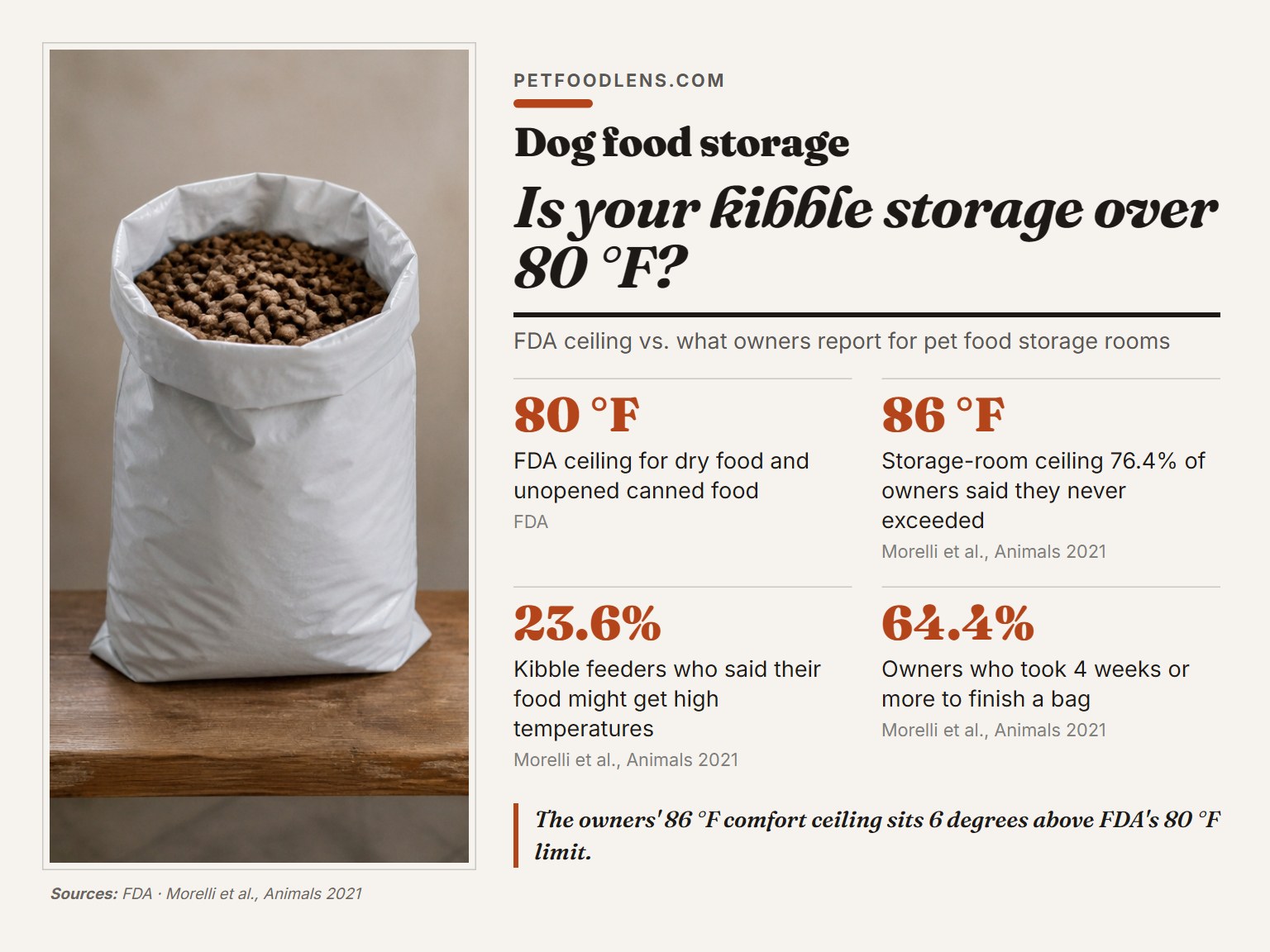
Eighty degrees Fahrenheit is the ceiling FDA publishes for dry food and unopened canned food, and a refrigerator for anything opened should sit at 40 degrees or below.
Now compare that to what owners report. In a survey of 1,545 dog and cat owners published in Animals, 76.4 percent said their pet food storage room never exceeded 30 C, which is 86 F. That comfort ceiling sits 6 degrees above FDA’s limit, so a slice of owners who believe they’re compliant are running over the line.
The same survey found 23.6 percent of kibble feeders said their food might be exposed to high temperatures, and 64.4 percent took four weeks or more to finish a bag. A month of exposure is a month of chances to cross 80 F.
Kibble that has been cooked in a car smells like old cooking oil, with a pencil-shaving edge underneath. You’ll catch it on the first open.
The whole bag goes in the container
FDA is specific about this one. Put the entire bag into the storage container rather than pouring kibble in, so the UPC, the lot number, and the best-by date stay with the food.
Owners do the opposite. In the same survey, 43.5 percent decanted kibble into a container, and 79.5 percent of those used plastic bins. That’s a direct contradiction of the regulator’s instruction, and it’s exactly how lot numbers go missing.
What most people get wrong: Pouring kibble straight into a plastic bin. The bag carries the UPC, the lot number, and the best-by date, and all three vanish the moment the bag hits the trash.
If you can’t read the lot number, nobody can trace the bag. Keep the packaging, not just the food.
FDA’s list of problem signs is short and worth memorizing: a foul odor, a can or pouch that’s swollen or leaking, a foreign object in the product, or a pet that gets sick after eating it. If any of those show up, stop feeding the product and call your veterinarian. FDA also asks owners to report the complaint to both the agency and the manufacturer.
The FDA pet food storage guidance adds one more habit that costs nothing: wash food bowls after each use and water bowls daily. On the road, that’s a rest-stop rinse.
For the longer version of this, including container types and how long an opened bag actually holds, see how to store dry dog food. The peer-reviewed pet food storage research behind the survey numbers is worth reading in full if you want the method.
Can You Travel With a Fresh or Raw Diet?
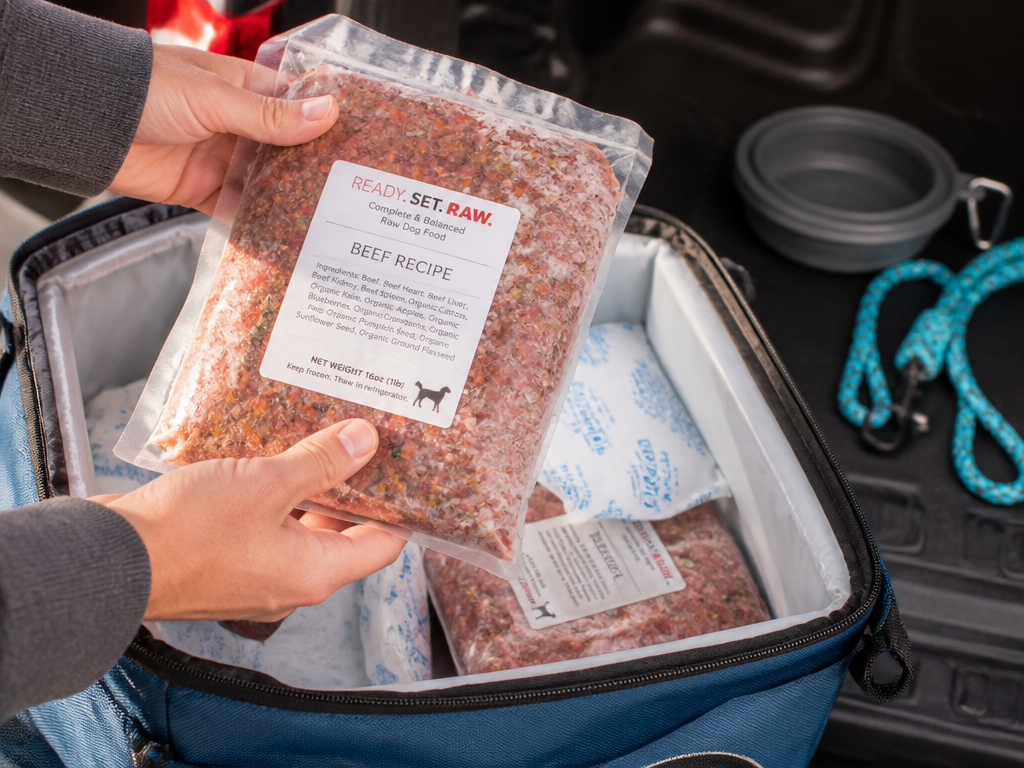
A fresh diet is the one format that genuinely can’t improvise on a long drive.
Cailin Heinze, a veterinary nutritionist, lays out the constraint plainly. Fresh diets arrive refrigerated or frozen on a subscription schedule and require refrigeration or freezing at every step. Access to a cooler with ice or cold packs, or a refrigerator, may not be convenient or possible on a long road trip, a hike, a camping trip, or an evacuation.
A disruption in power or refrigeration creates food safety concerns and costs you food you already paid for. Owners also need to be present at delivery in summer or warm climates, because the food has to stay cold from the truck to the fridge.
A cold-chain break turns fresh food into a safety question rather than a quality question. Heinze’s warning is specific: a power or refrigeration disruption creates food safety concerns and costs you food you already paid for.
Heinze also notes there are scant data supporting health benefits of fresh diets over more traditional ones, even though 95 percent of US owners in a recent survey were aware of them. Awareness and evidence are two different things.
I’m not a clinical specialist. If your dog is on a therapeutic diet for kidney disease or diabetes, that decision belongs to your veterinarian, not to a label comparison. What I can tell you is that choosing a dog food format for a trip should start with the cold chain, not the ingredient panel. Dry food travels. Fresh food travels with a cooler and a plan.
The First 24 Hours, in Order
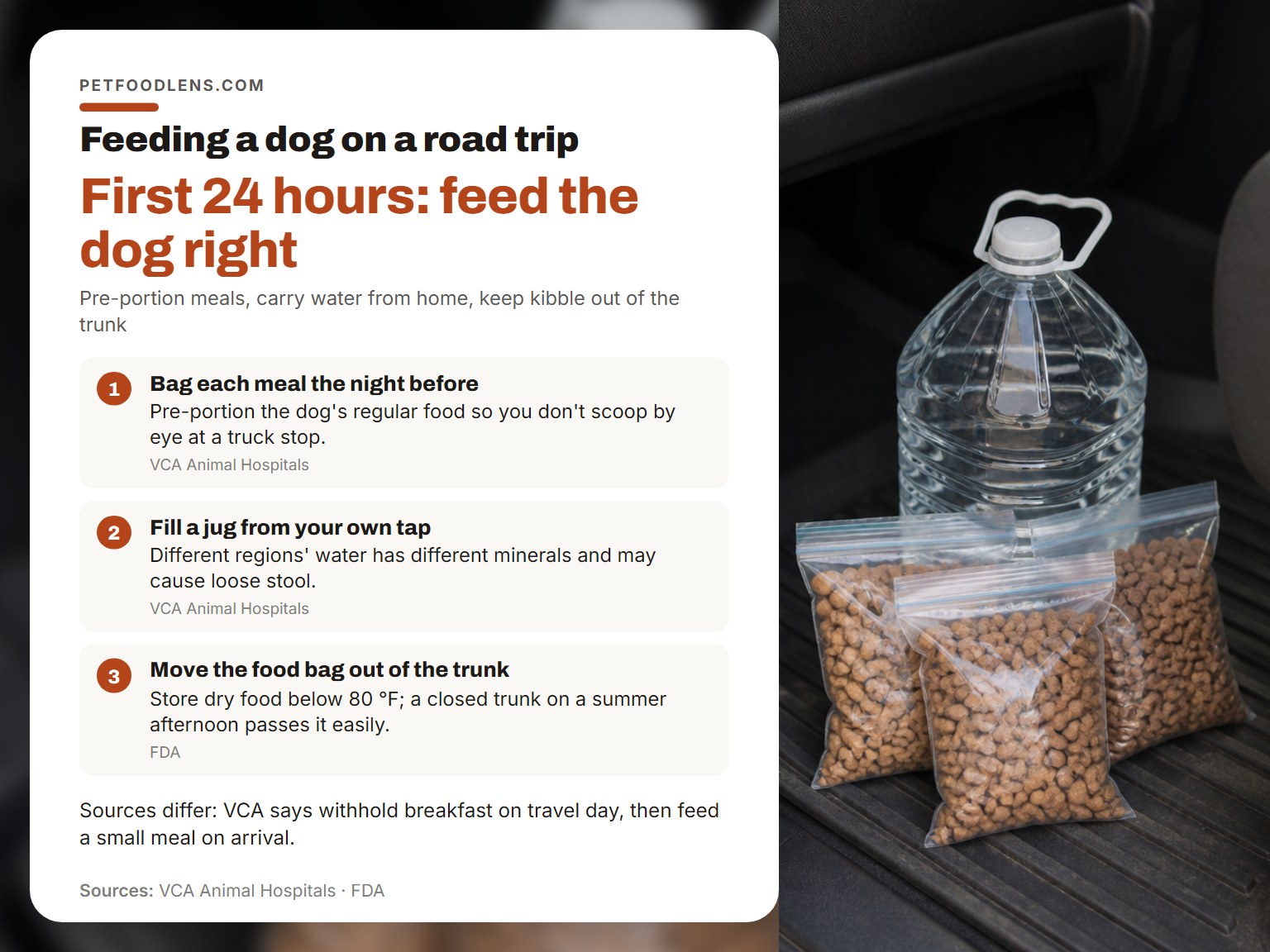
The first hour of a long drive sets up everything that follows, and almost none of it happens in the car.
Before you start: A parked car’s interior can reach a dangerous temperature in a very short time and cause heat stroke, so the dog never stays in the vehicle alone, not for a five-minute stop. Dry food stored above 80 degrees Fahrenheit is a separate problem, and a trunk on a summer afternoon gets there fast. Unfamiliar water can trigger loose stool, so carry your own from home.
- Bag each meal the night before. Skip it and you’ll scoop by eye at a truck stop, and the truck-stop scoop is bigger than the one at home.
- Fill a jug from your own tap. Regional water differs in minerals, and a dog with a sensitive gut will show you within a day.
- Move the food bag out of the trunk. FDA’s ceiling is 80 degrees Fahrenheit, and a closed trunk on a summer afternoon passes it easily. The cabin floor in shade is better.
- Set a reminder for the 12-hour water mark. Rest stops cover it on a normal day. A delayed ferry or a closed exit does not.
- Feed the evening meal at the destination, not at a rest stop. A full stomach plus motion is the combination VCA is trying to avoid.
- Check the bag against FDA’s problem list before the first meal. Foul odor, a swollen or leaking container, or a foreign object means the food doesn’t get fed.
- Keep the whole bag. The UPC, lot number, and best-by date are what make a complaint traceable to a batch.
Frequently Asked Questions
Can I feed my dog right before a car ride?
For an adult dog, VCA advises withholding breakfast on travel day and feeding a small meal at the destination, because an empty stomach lowers the risk of nausea and vomiting. For a puppy under 16 weeks, the 12-hour federal interval is the harder limit, so an offer before you leave is the safer call.
How often should I offer water during a long drive?
At least every 12 hours is the federal floor for dogs in transport. VCA’s practical version is simpler: offer water at every rest stop. Carry water from home so a mineral change doesn’t upset the gut mid-trip.
What if my dog won’t eat while traveling?
Offer the regular food, in a familiar dish, in a quiet spot away from traffic. A dog that refuses food for a full 24-hour window has passed the federal interval, and that’s worth a call to your veterinarian rather than another rest stop.
Is it safe to leave dry food in the car?
No. FDA puts the storage ceiling at 80 degrees Fahrenheit for dry food and unopened cans, and a parked car passes that quickly. Keep the bag in the cabin with you, or in a cooler with cold packs.
Do the federal feeding rules apply to my own dog?
Not legally. 9 CFR 3.17 covers dealers, exhibitors, research facilities, and the carriers and handlers who move dogs in commerce. The intervals are still the best published benchmark for a family trip, which is why they’re worth planning around.
Can I switch my dog’s food during a trip?
VCA’s guidance is to take the dog’s regular food, and that’s the simplest answer. A new food mid-trip adds a variable you can’t separate from travel stress. If a switch is happening anyway, do it at home, not at a rest stop.
The Bottom Line
The number that changes the plan is 24 hours. Under a day, you’re managing intervals and a cooler. Past 24 hours, APHIS requires kennels to be cleaned, and the trip becomes a series of feeding events instead of one bag in the back.
If your dog eats a fresh or raw diet, this whole plan gets harder, and I’d rather say that plainly than pretend a cooler solves it. Heinze’s cold-chain warning is the reason.
Weigh tomorrow’s meals tonight. That’s the entire first step, and it’s the one that makes the rest of the plan work.
A boring, familiar kibble fed on a predictable clock beats an exciting new food every time you pull out of the driveway.
