
How to Feed a Cat With No Teeth: What Actually Works
This post contains affiliate links. As an Amazon Associate, we earn from qualifying purchases.
To feed a cat with no teeth, match the texture to what the mouth can handle: pate-style wet food or mousse in the first days after extractions, then whatever the cat eats comfortably. Most toothless cats swallow chunks whole and manage regular food fine. Pain is what stops a cat eating, and a toothless cat can still have pain. Knowing how to feed a cat with no teeth means watching for that pain.
That pain thread runs through every decision below, from the first meal after surgery to the tube-fed cat who still won’t eat. A cat with no teeth and a sore mouth behaves exactly like a cat with teeth and a sore mouth. Owners often stop offering variety too early, assuming the how to feed a cat with no teeth question is the whole story.
What follows covers texture choices, the kibble argument, the tube-feeding numbers, and the signs that mean a phone call rather than a food swap.
Key Takeaways
- Pate or mousse first. Soft textures are the easiest default in the first days after extractions, and no source here argues otherwise.
- Dry kibble usually works, but nobody endorses it after surgery. Most toothless cats swallow chunks whole; the consensus dental guidelines stay cautious and push pain control instead.
- Warm food to body temperature and test it on the back of your hand. A microwaved meal needs stirring first, or the cat gets a hot pocket and a cold edge.
- Tube feeding runs at about 1 mL per second with 5 mL flushes before and after. Faster delivery causes vomiting.
- Offer food by mouth at least twice weekly while a tube is in place, so you can watch the appetite come back.
What Can a Cat With No Teeth Actually Eat?
Soft, pate-style wet food is the easiest default after extractions or for a cat with a sore mouth. That much is uncontroversial across every source on this topic.
Blended tube food passes through a kitchen strainer before the syringe gets filled. Chunks and clumps that survive high-speed blending lodge in the tube lumen, and a partial clog turns a routine feed into a clinic visit. Straining takes seconds and removes the most common mechanical failure in home tube feeding.
The texture that works varies by cat. There is no rule that says a toothless cat must eat mush, and a cat that swallows chunks whole often handles the same food it ate before surgery. Watch how the cat eats rather than deciding the how to feed a cat with no teeth answer in advance.
| Food Form | Safe? | Notes |
|---|---|---|
| Pate wet food | Yes | Easiest texture; warm slightly or thin with water |
| Mousse or puree | Yes | Best for the first days after extractions |
| Flaked or shredded wet | Usually | Check chunk size; break up large pieces |
| Dry kibble | Usually | Many toothless cats manage it; watch for pain signs |
| Moistened kibble | Short term | Spoils faster; do not leave it out long |
| Hard treats and bones | No | Can injure healing gums or remaining teeth |
Texture is only half the equation. A cat with a reduced sense of smell decides whether to eat based on aroma, so slightly warmed pate beats a cold scoop that smells like nothing at all.
Three things to keep off the menu until the veterinarian clears the mouth:
- Hard treats and bones. They can injure healing gums or whatever teeth are left, and healing gums are soft tissue, not armor.
- Anything sharp. Same reason, less explanation needed.
- Human table food, unless you have actually checked it. Plenty of it is unsafe for cats for reasons that have nothing to do with teeth.
There is no single best food for cats with no teeth, because the answer depends on how far out from surgery you are and whether the cat has other conditions running in the background.
Dry Kibble for a Toothless Cat: Where the Advice Splits
Owners ask me constantly whether they can just leave a bowl down and skip the measuring. In homes where a cat is already carrying extra weight, an unmeasured bowl can lead to overfeeding, and weighed portions take only a moment longer.
That matters here because dry food is the one form you can leave out. Dry food does not dry out, so free-choice feeding works logistically. The tradeoff is that it may be less palatable and, depending on ingredients, less digestible than moist food.
The sources part company on kibble. A practitioner article from Dr. Zubair Khalid argues most toothless cats manage kibble fine, because cats swallow chunks whole and kibble softens quickly with saliva. They emphasize pain control, appetite stimulants, and tube placement instead.
Why the Kibble Question Splits Vets
The two positions are not measuring the same thing. One describes capability: can the cat physically get the food down. The other describes a post-surgical clinical pathway, where a cat that can chew is not necessarily a cat that should be pushed to.
That distinction matters most in full-mouth extraction cases, where the guidelines flag inappetence as a pain problem first and a food problem second. If your cat is dropping food or eating on one side, the food is not the variable to change.
I won’t free-feed a cat recovering from dental work. Not because the kibble is dangerous, but because a full bowl hides the one signal I actually need, which is whether the cat is eating at all.
If you do go the softened route, softened kibble spoils faster than dry and should not sit out for long stretches. Make a fresh small batch instead of soaking a day’s worth at once.
Where this goes sideways: Soaking a big bowl of kibble in the morning and leaving it down all day. Bacteria move in fast on a wet starch surface, and you get a cat with an upset gut on top of a healing mouth.
How to Feed a Cat After Tooth Extraction
Mousse and puree textures belong in the first days after tooth extraction, and the reason is mechanical rather than nutritional. The food has to move past a surgical site without dragging across it.
Flaked and shredded wet foods are usually safe once you check chunk size and break up the big pieces. Pate can be thinned with a splash of water if the cat is lapping rather than licking.
Dish geometry gets ignored and shouldn’t. Deep bowls press against sore gums, so a shallow, wide dish lets the cat take food without the rim digging in. Small amounts offered more often beat one large portion.
Timing of the first meal is where guidance thins out. Some veterinarians recommend skipping food for the first several hours after anesthesia. No source gives a fixed hour figure, so follow the discharge instructions instead of a number you found online.
Soft food is a bridge for pain from bad teeth, and it does not fix the underlying disease. If diseased teeth are still in place, texture changes buy comfort while you wait for treatment, nothing more.
Easy to miss: A deep ceramic bowl that worked fine for years. After extractions the rim lands right on the gum line, and the cat starts taking two bites and walking away.
Older cats with bad teeth often arrive with two problems at once, a sore mouth and a reduced appetite that predates it. That combination needs a weight check, not just a softer food.
The first days after tooth extraction are about comfort. By the time the mouth has settled, you should be testing whether the cat will take its old food back, because a cat that stays on mousse indefinitely is a cat nobody rechecked.
Tube Feeding a Cat With No Teeth: The Numbers That Matter
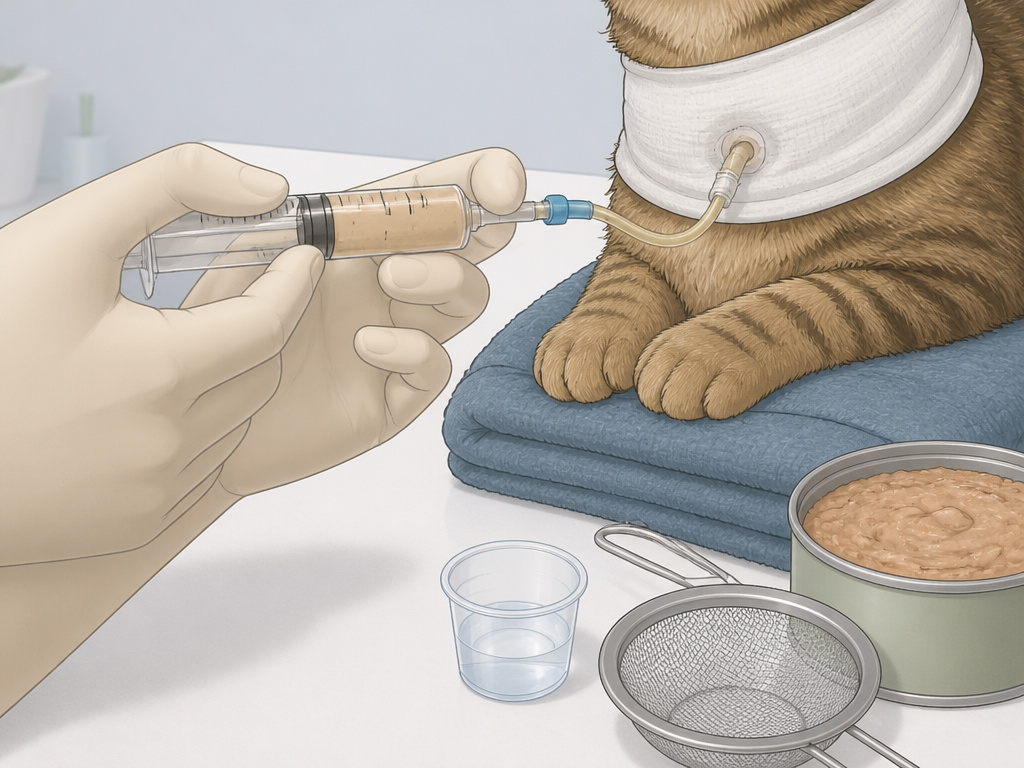
Five milliliters of lukewarm water goes in before every feed, and five more goes in after.
An esophagostomy tube is a small rubber tube surgically inserted into the esophagus through the skin of the neck. It delivers food past the mouth and pharynx, and it is not placed directly into the stomach. VCA Animal Hospitals publishes the full home protocol, and the numbers are worth writing down.
Before you start: Stop and call the clinic if the cat coughs or gags during the pre-feed flush, because that points to a tube-position problem rather than a food problem. Keep the tube capped when it is not in use. Never remove the tube yourself, even though removal is simple and needs no anesthesia.
The sequence, with what goes wrong when you skip a step:
- Blend the canned diet with the recommended amount of water at high speed until the mixture is uniform. Under-blending leaves clumps that block the tube.
- Pour it through a kitchen strainer. Chunks that survived the blender are the usual cause of a clogged tube.
- Flush with 5 mL of lukewarm water first. This confirms the tube is open before you commit a whole meal to it.
- Inject the food slowly, about 1 mL per second, with the cat’s front feet elevated so food moves easily into the stomach. Too fast and the cat vomits the meal back up.
- Flush with 5 mL of lukewarm tap water and recap. Food left sitting in the lumen sours between feeds.
- Refrigerate the leftovers and warm them to body temperature before the next feed. Stir after microwaving, then test on the back of your hand; it should feel slightly warm.
Frequency is the one number the sources do not agree on. VCA says feed two to five times per day. Those are different schedules, and neither source reconciles them. Ask your own clinic which one they want followed.
You will know the tube is patent by feel. A clear tube takes the plunger with a smooth, even push. A partial clog gives a gritty drag and then a sudden give, and that is your cue to stop rather than force it.
Some cats need several weeks of feeding before healing happens or appetite returns. Clean the stoma daily with whatever cleanser the veterinarian recommends, and change the neck wrap on their schedule. Medications can go through the tube too, followed with water.
A cat that stops eating is a phone call, not a food experiment.
How Do You Get a Toothless Cat to Eat When It Won’t?
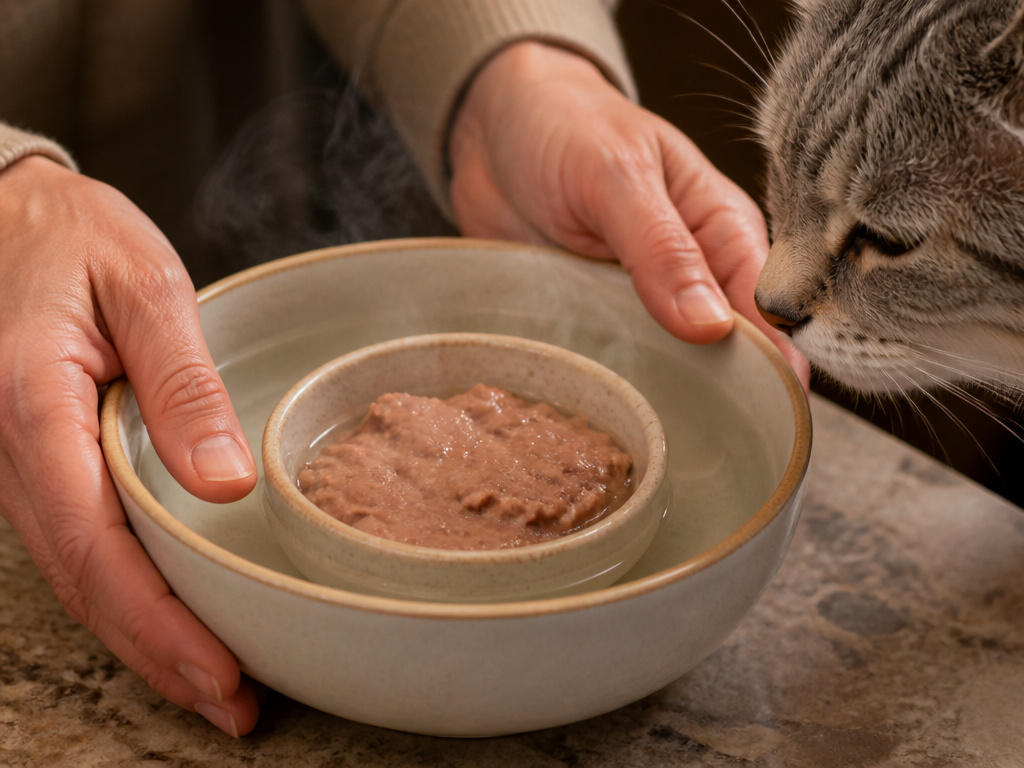
A cat that won’t eat is in pain or off its food for a reason, and the reason is usually upstream of the bowl.
Aroma does more work than texture for a cat with a reduced sense of smell. Warming food to room temperature or slightly above releases the volatile compounds that trigger interest, which is why a warmed pate often gets eaten while the cold version sits.
Rotating food textures is worth trying once the mouth has settled, since a cat that refuses pate may take shreds. Feeding a picky cat is a different problem from feeding a sore one, and the tactics overlap only partly.
Force-feeding is where the guidance gets blunt. Owner-community advice routinely recommends syringe-feeding pate to post-surgical cats. Those positions conflict directly, and the guideline is the one with a consensus panel behind it.
There is a harder edge to this. A cat that has gone a long stretch without eating needs veterinary supervision rather than a bigger bowl.
An underweight cat needs calories, and a sore mouth is the fastest way to lose them. That is the argument for early tube placement rather than a wait-and-see approach.
While a tube is in place, offer a small amount of the cat’s favorite food by mouth at least twice weekly. The tube does not hinder chewing or swallowing, so that offer is a genuine test of appetite rather than a courtesy.
The Signs That Mean Stop and Call the Vet
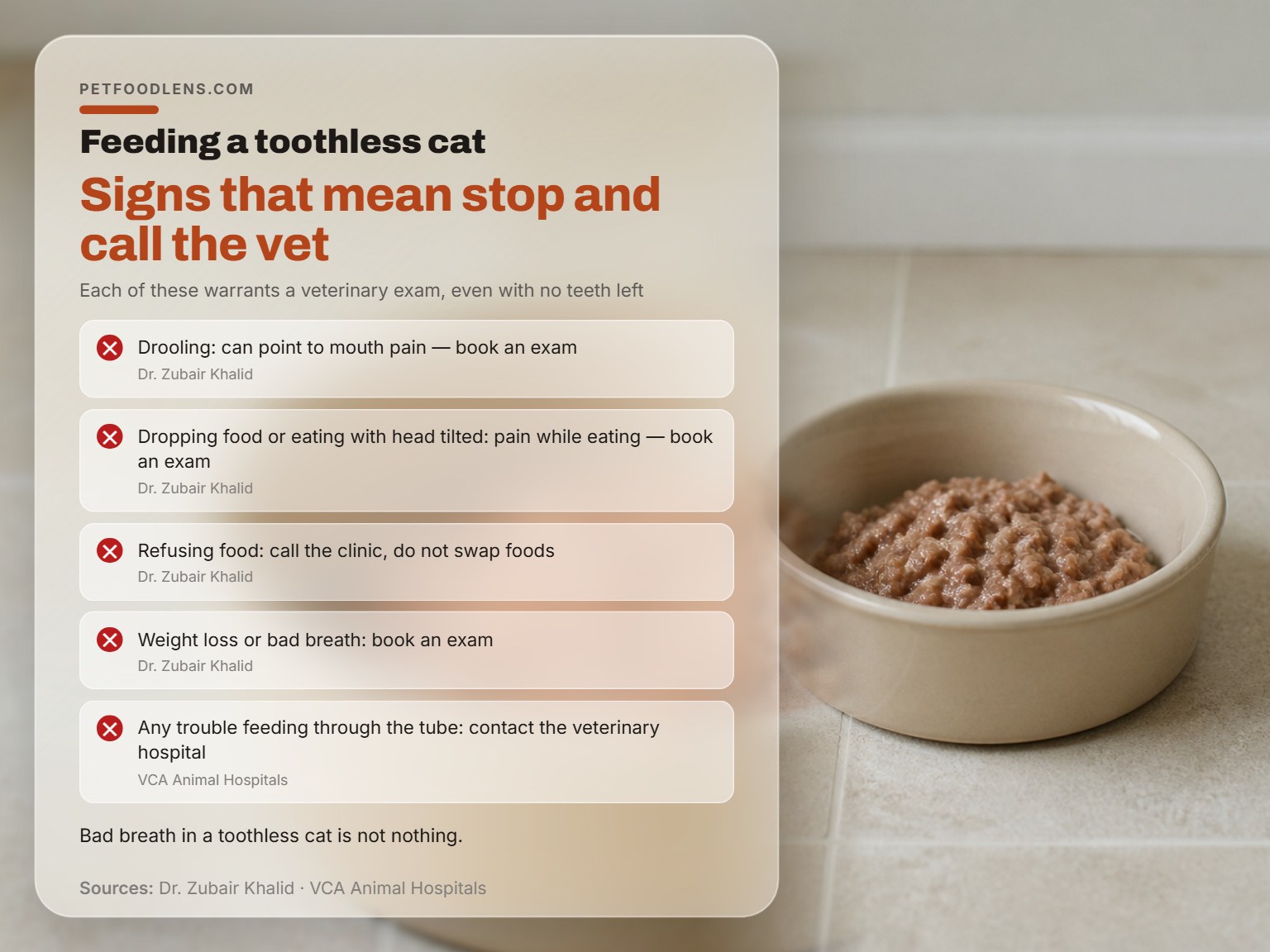
Drooling is the sign owners notice first.
| Sign | What It Can Point To | What To Do |
|---|---|---|
| Drooling | Mouth pain | Book an exam |
| Dropping food | Pain while eating | Book an exam |
| Eating with head tilted | One-sided pain | Book an exam |
| Refusing food | Inappetence | Call the clinic, do not swap foods |
| Weight loss | Intake falling short | Book an exam |
| Bad breath | Dental or other disease | Book an exam |
Every one of those signs warrants a veterinary exam even if the cat has no teeth left, and even if the mouth looks healed to you. Bad breath in a toothless cat is not nothing.
Difficulty with the tube itself is its own trigger. VCA is direct about it: contact the veterinary hospital if you have any trouble feeding through the tube, rather than improvising a workaround at home.
I would rather take a call about drooling than a call about weight loss. The first one is a cat telling you something. The second one is a cat that stopped telling you weeks ago.
Frequently Asked Questions
Can a cat with no teeth eat dry food?
Most can. Cats tear and shear food rather than grinding it, so a cat that swallows kibble whole usually manages fine, and kibble softens quickly with saliva.
How long does a cat need soft food after extractions?
There is no single published number. Mousse and puree textures are the standard choice for the first days after surgery, and after that the answer depends on the individual mouth and how the cat is eating. Ask the discharging veterinarian for a specific checkpoint rather than guessing.
What if my cat refuses to eat after dental surgery?
Refusing food is a pain signal as often as a food problem. Call the clinic rather than cycling through textures at home, especially if the cat is also drooling, dropping food, or eating with its head tilted. Do not syringe-feed without instruction.
How often should I feed through an esophagostomy tube?
VCA Animal Hospitals gives two to five times per day. The two schedules differ, so follow the one your own clinic wrote on the discharge sheet.
Can I syringe-feed my cat if it won’t eat?
Not without veterinary direction. A chronically inappetent cat needs veterinary supervision rather than a syringe at the kitchen counter.
How do I know when the feeding tube can come out?
VCA’s trigger is appetite, not a calendar. Book a re-check examination and possible tube removal after the cat has been eating well consistently for at least a week. Removal is simple and needs no anesthesia, but do not attempt it yourself.
The Bottom Line
Here is the trigger worth writing on the discharge sheet: once your cat has eaten well on its own for a full week, book the recheck and ask about pulling the tube. That is VCA’s threshold, and it beats guessing by how the cat looks.
The first thing to do this week is unglamorous. Weigh the portion, warm it to body temperature, and serve it in a shallow dish.
One concession, and it matters. I read labels and compare formulations for a living, and that is not the same as examining a mouth. A cat with kidney disease, diabetes, or a healing extraction site needs a veterinarian making the diet call. When a clinic hands you a therapeutic diet, ask which condition it targets and why that one, then follow it. When a clinic hands you a therapeutic diet, ask which condition it targets and why that one, then follow it.
A toothless cat is not a broken cat. Feed the mouth in front of you, and stop feeding the one on the bag.
