
Fish Oil for Dogs Dosage Guide: EPA and DHA by Weight
This post contains affiliate links. As an Amazon Associate, we earn from qualifying purchases.
For a fish oil for dogs dosage guide, the number that matters is combined EPA and DHA, not total fish oil weight.
That gap between the figure on the front of the bottle and the figure that actually drives the dose is where most of the fish oil for dogs dosage guide goes wrong. The dose is whatever EPA and DHA it happens to carry inside it.
What follows walks the published condition table, the metabolic-weight math that makes it work, and the two places where clinical sources genuinely disagree with each other. By the end you’ll be able to read any label and know what your dog’s daily target looks like in milligrams.
Key Takeaways
- Dose on combined EPA and DHA, never on total fish oil weight or capsule count.
- A 20 kg dog needs 2,932 mg EPA+DHA daily for osteoarthritis and 1,135 mg for high blood lipids, per a 2020 veterinary review.
- Dosing scales to kg^0.75, so flat mg/kg math over-doses small dogs and under-doses large ones.
- Check the bowl first.
- Start under target and watch the stool. Mild GI upset is the most common side effect at therapeutic doses.
Why Combined EPA and DHA Beats the Number on the Front of the Bottle
The first thing I check on any fish oil bottle, per the fish oil for dogs dosage guide, is the combined EPA and DHA per serving, not the “1,000 mg fish oil” printed across the front. That’s a factor of three between what the front implies and what the dose actually is.
Therapeutic fish oil dosing in dogs is calculated on combined eicosapentaenoic acid (EPA) and docosahexaenoic acid (DHA), expressed per kilogram of metabolic body weight. Total fish oil weight, capsule count, and teaspoon volume are not dose units. A product’s EPA and DHA content per serving, not its total oil weight, determines how much of the supplement a dog receives.
Rancid oil announces itself before you ever get it into a bowl. Cut a capsule open and an oxidized oil smells sharp and unpleasant rather than marine. Fresh oil smells like the sea and nothing else.
That smell test matters because oxidized oil is the safety issue most sources keep circling back to. More on that below.
The Dose Table: What a 20 kg Dog Actually Needs
A 2020 review in Today’s Veterinary Practice lays out condition-specific targets on a mg/kg^0.75 basis, and the spread between them is wider than most owners expect. Here is what the numbers actually say.
| Condition | mg/kg^0.75 | mg/kg/day | EPA+DHA for a 20 kg dog |
|---|---|---|---|
| Osteoarthritis | 310 | 147 | 2,932 mg |
| Kidney disease | 140 | 66 | 1,324 mg |
| Atopy or IBD | 125 | 59 | 1,182 mg |
| Idiopathic hyperlipidemia | 120 | 57 | 1,135 mg |
| Cardiovascular disorders | 115 | 54 | 1,088 mg |
| NRC safe upper limit | 370 | 175 | 3,499 mg |
Osteoarthritis sits at the top of that table by a wide margin. The cardiovascular figure is the lowest of the therapeutic rows, which is one of the places sources later part company.
For context, the NRC recommended allowance is 30 mg/kg^0.75, or 284 mg for a 20 kg dog. That’s a maintenance figure for a healthy animal, not a treatment target. Don’t confuse the two.
A systematic review of EPA DHA supplementation found the evidence base uneven across conditions. Some indications have solid trial support. Others are extrapolated from the mechanism.
If you’re stacking joint support, the glucosamine dosage side of that stack has its own weight-based math and its own ceiling.
How Do You Convert Pounds to kg^0.75 Without Undershooting?
Divide the weight in pounds by 2.2 and you have kilograms. Raise that figure to the 0.75 power and you have the number the dose table actually wants.
Linear mg/kg math is what most label directions use, and it fails at both ends of the size range. A 5 kg dog dosed linearly gets far more drug per unit of metabolic tissue than a 40 kg dog does. The 0.75 exponent corrects for that, which is why the veterinary table uses it.
Here’s the sequence I use:
- Weigh the dog and divide by 2.2. Skipping this and estimating from the last vet visit is how a dog gets dosed at the wrong weight.
- Raise the kilogram figure to the 0.75 power. A basic calculator handles it; do this before you look at any bottle.
- Multiply by the condition factor from the table. Using the osteoarthritis factor for a dog with skin issues raises the target for no reason.
- Divide by the EPA+DHA per capsule, not the capsule weight. This is the step where a 1,000 mg softgel with only 300 mg of actives turns a small capsule count into a much larger one.
Write the daily milligram target on the lid in marker before you open the bottle. Owners who dose by eye can drift upward, and that drift is where many of the loose-stool complaints come from.
The Linear Math Error in Plain Numbers
Take a 10 kg dog and a 40 kg dog on the same linear mg/kg rate. The small dog ends up with a higher dose per unit of metabolic weight than the large dog gets. That’s the whole argument for the exponent in one sentence.
Weight-Band Dosing vs Condition-Specific Dosing: Where the Two Camps Split
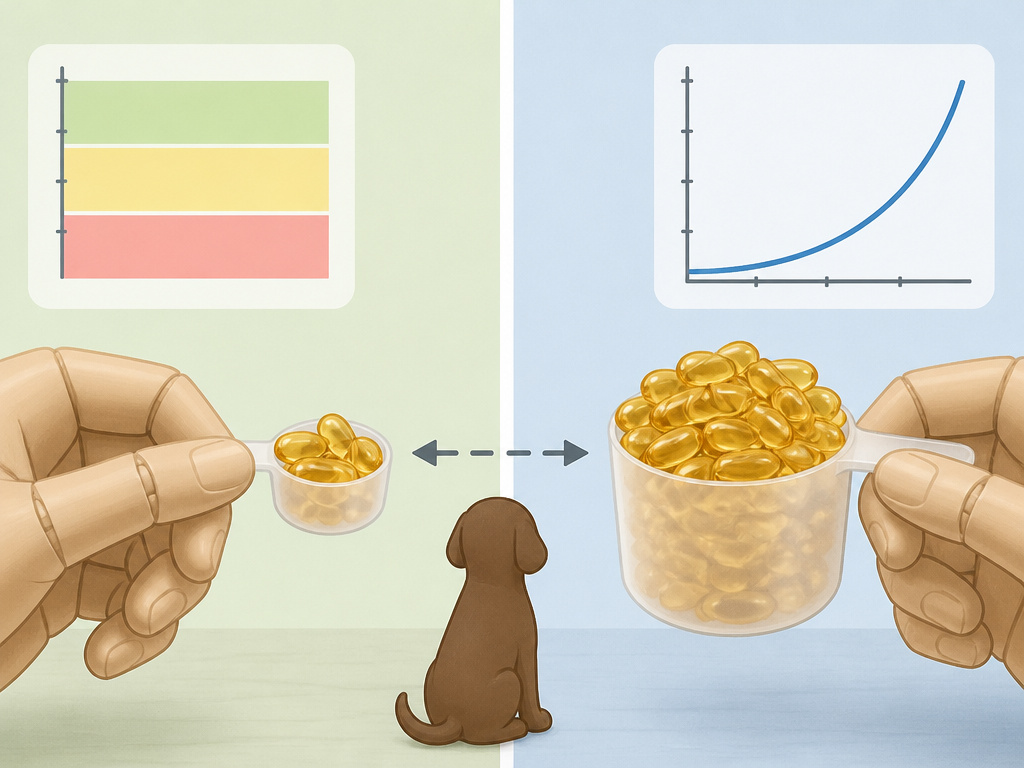
Two published frameworks give wildly different numbers for the same dog, and both are in circulation.
| Framework | Basis | 20 kg dog, joint support | Best for |
|---|---|---|---|
| Condition-specific table | mg/kg^0.75 by diagnosis | 2,932 mg EPA+DHA | Diagnosed OA, vet-guided |
| Consumer weight bands | Flat mg/day by size | 500 to 1,200 mg | A general starting point |
| Linear clinic math | 40 mg/kg EPA + 25-30 mg/kg DHA | Split components | Quick in-clinic estimates |
That’s a reasonable on-ramp for a healthy dog. It is not a treatment dose for a dog with a diagnosis.
Where this goes sideways: Using a weight-band chart for a dog with diagnosed osteoarthritis. The band tops out well below the studied figure, the dog gets a fraction of the therapeutic dose, and eight weeks later the owner concludes fish oil doesn’t work for joints.
If you’re choosing between oil types rather than doses, the best oil for dogs comparison covers which fats actually carry EPA and DHA and which are just expensive flavor.
Is the Fish Oil in the Bottle What the Label Claims?
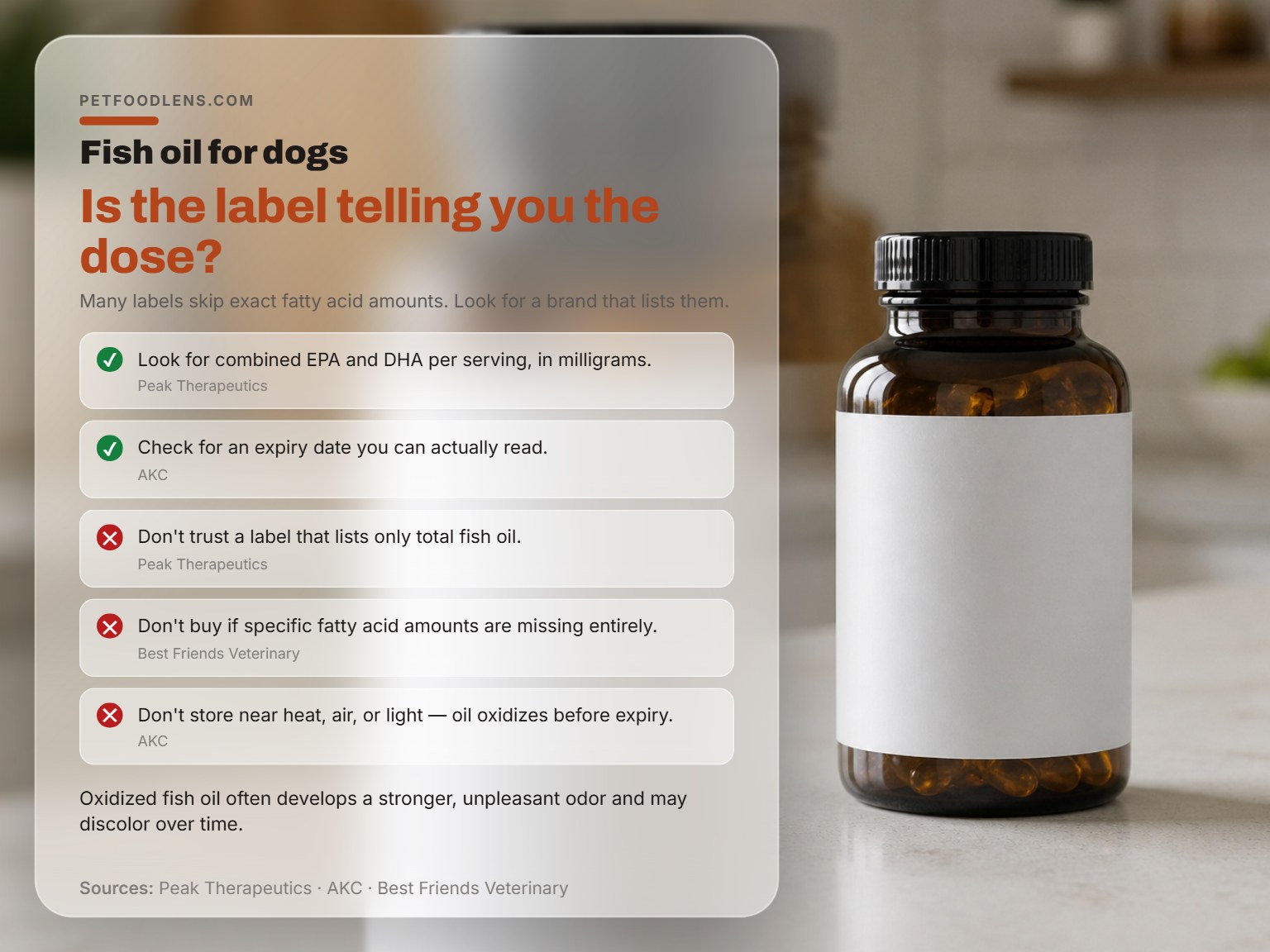
Many supplement labels do not list the exact amounts of specific fatty acids, so owners should look for a brand that lists the exact amounts of specific fatty acids. That’s the number that should reset your trust in the back panel.
The AKC fish oil for dogs guide makes the structural point plainly: fish oil supplements are not regulated in the same way as food or medications. Nobody is verifying the milligram claim before the bottle reaches the shelf.
Three Things to Check Before You Buy
- Combined EPA and DHA per serving, in milligrams. If the label only lists total fish oil, the product can’t be dosed accurately.
- An expiry date you can actually read. Heat, air, and light oxidize oil before that date, so a bottle stored near a stove is already behind.
- Whether specific fatty acid amounts appear at all. Many labels skip them entirely, and a brand that won’t list them is telling you something.
Fresh fish oil smells like the sea; oxidized oil often develops a stronger, unpleasant odor and may discolor over time.
One product worth flagging by name: the OM 3 capsules for cats sold by 1-800-PetMeds have been reported to contain dioxin-like PCBs. That’s a cat product, but it’s the reason I read the manufacturer before I read the marketing.
What the Bowl Already Delivers Before You Open a Capsule
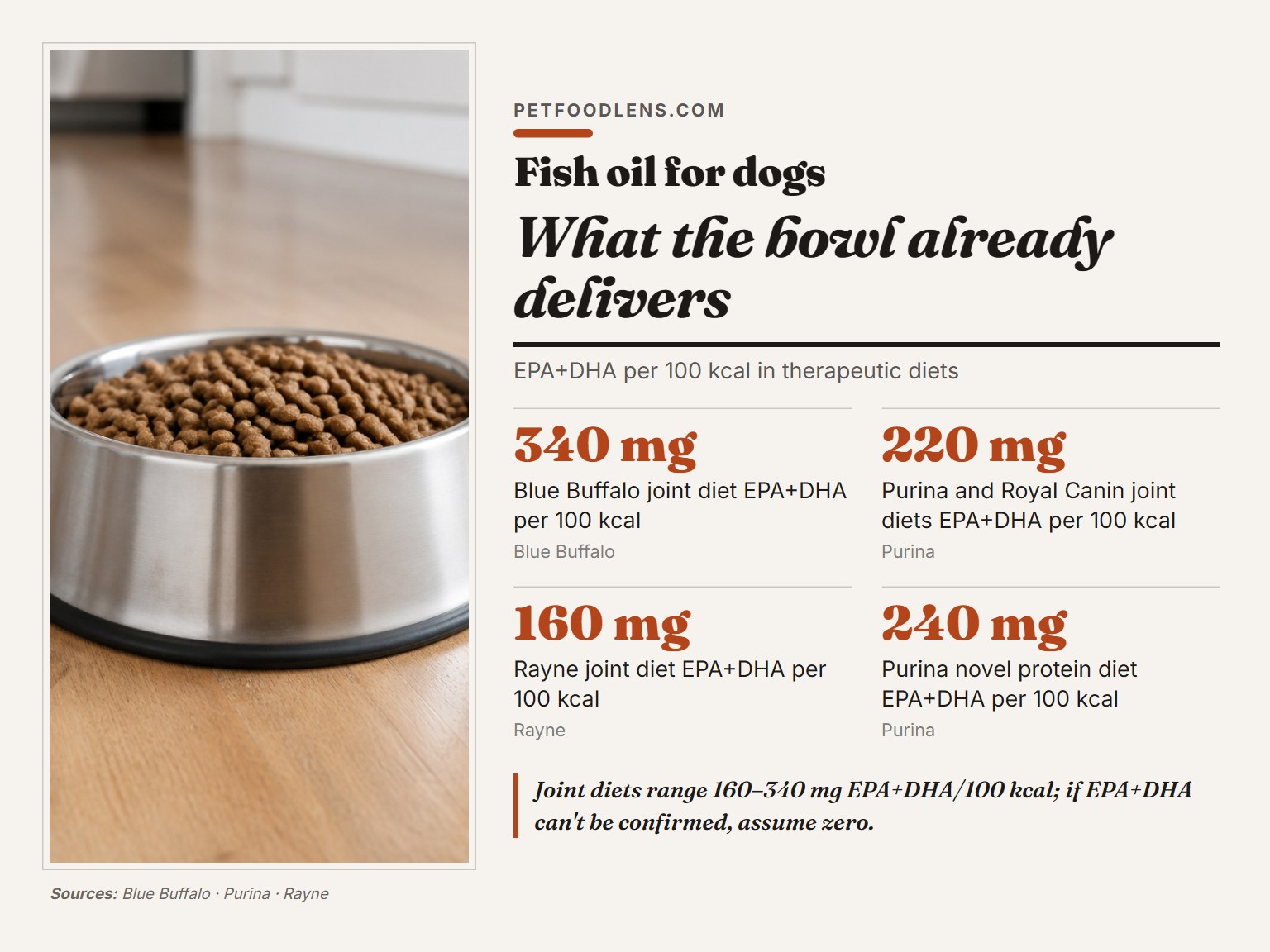
Three cups of the right therapeutic diet can make the capsule unnecessary, and most owners never run that math.
Adding a capsule on top of that is guesswork.
Blue Buffalo’s joint formula sits at 340, Purina and Royal Canin both at 220, and Rayne at 160. Outside the joint category, Purina’s novel protein diet carries 240 and Blue Buffalo’s renal formula 190.
If you can’t confirm the EPA and DHA content of a food, assume it’s zero and dose accordingly. That’s the conservative call, and it’s the one that keeps you from double-counting.
The omega-6 to omega-3 ratio in the base diet matters here too. Loading EPA into a bowl that’s heavy on omega-6 is pushing against the current.
Cats are a different calculation entirely. The suggested dose for feline chronic kidney disease is roughly 112 mg of combined EPA+DHA per kilogram, and about 120 mg/kg for feline osteoarthritis. The fish oil for cats figures are worth keeping separate, because a 4 kg cat is a small number and a pump of the wrong oil overshoots fast.
Where the Sources Disagree on Dose
Published sources do not agree with each other, and pretending otherwise would be dishonest. Three splits matter for a dog owner.
Human Fish Oil vs Dog-Specific Products
The AKC position is that human fish oil products may contain ingredients unsafe for dogs and are dosed for people, so you should choose a supplement formulated for dogs, while a veterinary clinic handout takes the opposite working position and gives capsule counts for specific human brands. A veterinary clinic handout takes the opposite working position, naming Nature’s Bounty at 390 mg per capsule and a Costco fatty acid supplement at 700 mg of EPA, and giving capsule counts for dogs on both.
Both are describing real practice. The difference is who is doing the arithmetic. If a vet has calculated the EPA target and told you which human capsule to use, that’s one thing. Buying a bottle off the shelf and guessing is another.
Flaxseed: Three Positions, One Direction
A clinic handout states that dogs and cats can’t digest flax seed to release the oils, so for pets it isn’t beneficial at all, while a supplement vendor says dogs convert ALA to EPA and DHA at single-digit rates and the AKC notes fish oil is more useful than plant-based ALA for inflammatory conditions. A supplement vendor puts it more precisely: dogs convert ALA to EPA and DHA at single-digit rates, so plant sources alone can’t reach clinical levels. The AKC lands in the same place from a third angle, noting fish oil supplies DHA and EPA directly and is more useful than plant-based ALA for inflammatory conditions.
The fish krill flaxseed omega-3 dog study tested the substitution directly rather than arguing from mechanism. The direction is the same either way: flax is not a fish oil substitute.
The Cardiovascular Number Doesn’t Match
The clinic handout gives 40 mg/kg of EPA plus 25 to 30 mg/kg of DHA daily, which is a split-component framing with a different total. These are not the same instruction and shouldn’t be merged into one number.
When two credible sources give you different totals for the same condition, the tiebreaker is your veterinarian reading your dog’s actual labs. Not a blog, and not me.
Giving Fish Oil Without the Loose Stool Surprise
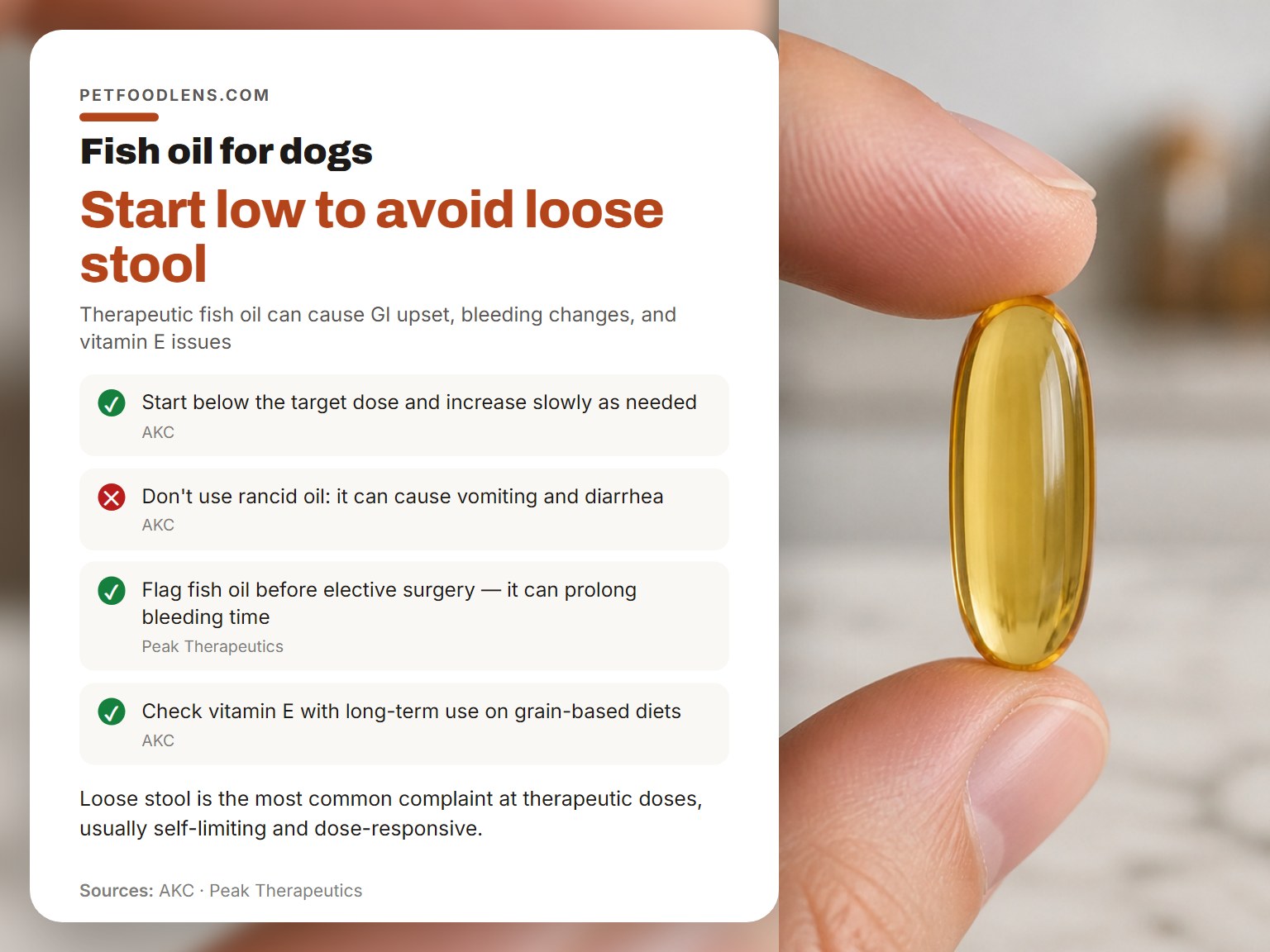
Before you start: Fish oil at therapeutic doses can prolong bleeding time, so flag it before any elective surgery. It can also cause GI upset and, on grain-based diets, may deplete vitamin E stores over the long term. And rancid oil causes vomiting and diarrhea on its own, so smell the bottle before the first dose.
The documented adverse effects list from the 2020 review is longer than most labels admit: altered platelet function, gastrointestinal disturbances, impaired wound healing, nutrient excess and weight gain, altered immune function, and effects on insulin sensitivity.
- Loose stool is the most common complaint at therapeutic doses, usually self-limiting and dose-responsive.
- Bleeding time can shift mildly at very high doses, rarely clinically significant but relevant around surgery.
- Vitamin E may need attention with long-term use alongside grain-based diets.
- Weight gain is a real risk when you’re adding oil on top of a complete diet.
Start below the target and increase slowly as needed following veterinary instructions. A dog that goes straight to a full therapeutic dose often gets soft stool and then the owner quits.
For a dog that won’t take oil on kibble, adding fish oil to dog food covers the mix-in approaches that don’t end up on the floor.
Easy to miss: A dog on a therapeutic joint diet may already be at target. Check the food’s EPA+DHA per 100 kcal before you buy a bottle, or you’re paying twice for the same milligrams.
For a dog already on a prescription joint diet, the answer is usually no bottle at all.
Frequently Asked Questions
How much fish oil should I give my dog daily?
It depends on the condition being treated, not just the weight. A 20 kg dog needs 1,135 mg of combined EPA+DHA for idiopathic hyperlipidemia and 2,932 mg for osteoarthritis, per the 2020 veterinary dose table. Ask your vet which row applies before you calculate anything.
Is 1,000 mg of fish oil a day enough for a dog?
Usually not, because 1,000 mg refers to the oil, not the actives. A standard 1,000 mg capsule carries only about 180 mg of EPA and 120 mg of DHA. Hitting a 1,000 mg EPA target on those capsules takes roughly seven a day for a 60 lb dog.
Can I give my dog human fish oil capsules?
Sources split on this. The AKC advises against it, warning that human products may contain ingredients unsafe for dogs and are dosed for people. A veterinary clinic handout gives capsule counts for specific human brands, so some practices do it under supervision. Either way, the EPA and DHA math has to be done by someone.
Does fish oil help dogs with kidney disease?
The 2020 review lists a kidney disease target of 140 mg/kg^0.75, which works out to 1,324 mg of combined EPA+DHA for a 20 kg dog. That’s a dose figure, not a promise of benefit, and kidney disease is a condition where the diet usually does more work than the capsule.
What happens if I give too much fish oil?
The NRC safe upper limit is 370 mg/kg^0.75, or 3,499 mg for a 20 kg dog. Above therapeutic doses the reported effects are mild bleeding-time prolongation and GI upset. The bigger practical risk is oxidized oil, which causes vomiting and diarrhea regardless of dose.
The Bottom Line
If your dog is already eating a therapeutic joint diet at 340 mg EPA+DHA per 100 kcal, do the food math before you buy anything. The capsule may be solving a problem the bowl already solved.
Two thresholds worth carrying out of here. If your dog is heading into elective surgery, tell the surgeon about the fish oil, because bleeding time is the one adverse effect with a real clinical consequence. And if the bottle smells sharp rather than marine, throw it out. Oxidation is a bigger real-world safety issue than dose.
One honest limit: I work mostly in commercial cat food, so for dogs I lean on the published veterinary dose tables rather than my own clinical caseload. That’s exactly why every number above traces to a named source. Your vet has the labs I don’t.
