
Diabetic Cat Food Guide: What the Label Won’t Tell You
This post contains affiliate links. As an Amazon Associate, we earn from qualifying purchases.
A diabetic cat food guide points to the same starting point: a complete diet low in carbohydrate, high in protein, fed in a consistent daily pattern. AAHA’s 2026 guidelines put obese cats with a body condition score above 7/9 at 15 to 25 percent of metabolizable energy from carbohydrate. Reported remission on a high-protein, low-carb diet plus insulin ranges from 15 to 100 percent.
Consistency is the part owners drop first. Insulin peaks on a schedule whether or not food shows up to meet it, so a skipped meal lands the cat in a low it can’t correct on its own. That’s why the feeding plan and the insulin dose get adjusted together, never separately.
What follows is the label math, the three carbohydrate targets that don’t agree, the wet-versus-dry split between AAHA and Royal Canin, and the two numbers that decide how fast an obese cat should lose weight.
Key Takeaways
- Carbohydrate is missing from most guaranteed analyses. Subtract protein, fat, fiber, moisture, and ash from 100, then convert the result to calories.
- AAHA’s 2026 guidelines set 15 to 25 percent of metabolizable energy from carbohydrate for obese cats with a body condition score above 7/9.
- Canned food is AAHA’s stated preference, not a universal rule. Royal Canin argues that consistent, predictable intake matters more, and dry food sometimes delivers it.
- Weigh the cat once or twice a month on the same scale. AAHA puts healthy loss at 0.5 to 2 percent of body weight per week.
- Diet complements insulin or an SGLT2 inhibitor. Remission happens. Expecting it doesn’t.
The Carbohydrate Number a Diabetic Cat Food Guide Skips
The guaranteed analysis on the back of a can lists protein, fat, fiber, moisture, and ash. It does not list carbohydrate.
Guaranteed analyses report protein, fat, fiber, moisture, and ash as maximums or minimums. Carbohydrate is calculated by subtraction: 100 minus the listed percentages. Where ash is missing, AAHA suggests estimating 2 to 3 percent for canned diets and 5 to 8 percent for dry diets before converting the result to metabolizable energy.
Turn the bag over. The American Association of Feed Control Officials now requires carbohydrate disclosure under its Pet Food Label Modernization rules, but plenty of labels in circulation still predate that change. AAHA notes the gap directly, and it’s the reason so many owners end up guessing.
The Subtraction Method, Step by Step
- Find the guaranteed analysis. It’s the small grid under the ingredient list, and it’s the only part of the label with numbers you can check.
- Subtract protein, fat, fiber, and moisture from 100. What remains is nitrogen-free extract plus ash. Skip this step and you’re guessing at the one nutrient that drives post-meal glucose.
- Estimate ash at 2 to 3 percent for canned and 5 to 8 percent for dry. AAHA gives those ranges for labels that omit it. Use the top of the dry range and you won’t undershoot.
- Convert the percentage to calories. A percentage of weight and a percentage of calories are different numbers. Balance.it runs a free guaranteed-analysis converter, and Tufts publishes one through its Petfoodology site.
I run this calculation on the back of a can about once a week out of habit, and the number that surprises owners most is dry food. A grain-free kibble can land well above a canned pate once you finish the subtraction. Grain-free is a marketing category. It says nothing about the carbohydrate load.
The other thing the label hides is moisture.
If you’d rather skip the arithmetic, a list of low-carb cat food built on calculated values saves the step. Just check whether the numbers were converted to calories or left as percentages of weight. The two aren’t interchangeable.
How Many Carbs Should a Diabetic Cat Eat?
Three published targets for the same question don’t agree, and the spread is wide enough to change what you buy.
- AAHA’s 2026 guidelines: 15 to 25 percent of metabolizable energy for obese cats with a body condition score above 7/9, paired with lower calories.
- The 2025 iCatCare consensus: under 25 percent on a dry matter basis, under 15 percent of metabolizable energy, or under 5 grams per 100 kilocalories. Three ways of expressing one target, and they don’t line up neatly.
That’s the honest state of the field. Anyone who hands you a single carbohydrate ceiling as settled fact is quoting one body and ignoring the others. A diabetic cat food list worth using will tell you which standard it applied.
For context on how much this matters, Royal Canin reports that type 2 diabetes accounts for up to 95 percent of diagnosed feline diabetes cases. The diet is aimed squarely at that population.
Where this goes sideways: Chasing the lowest carbohydrate number on the shelf and ignoring calorie density. AAHA notes that commercial therapeutic diets built for diabetic cats are often calorie dense, so an overweight cat can gain on a formula marketed for diabetes.
Fiber is the other place the sources part company. AAHA states plainly that high-fiber diets are not typically recommended for cats with diabetes, while Royal Canin describes a weight-loss diet for diabetic cats as typically high in fiber. Royal Canin describes a weight-loss diet for diabetic cats as typically high in fiber, with insoluble fiber supporting satiety and soluble fiber slowing nutrient uptake to blunt the glycemic load.
Both are describing a weight-loss formula. AAHA is warning against fiber as a diabetes strategy. Royal Canin is using it as a satiety tool. Read them together and the fiber question becomes a weight question, not a glucose question.
Wet Food vs Dry Food for a Diabetic Cat: Where the Sources Split
AAHA prefers canned food. Royal Canin says a dry diet can be the right call, and both positions come with a reason.
| Factor | Canned | Dry |
|---|---|---|
| Caloric density | Lower, so a bigger bowl for the same calories | Higher, so a smaller bowl for the same calories |
| Satiety | Better in most cats, per Royal Canin | Weaker unless moistened |
| Urinary health | Moisture supports it directly | Needs water added or a fountain alongside |
| Intake consistency | Must be fed fresh, on your schedule | Holds in a feeder all day |
| AAHA position | Preferred | Acceptable if intake stays reliable |
AAHA’s reasoning is caloric density. Canned food lets a cat eat a higher volume for the same caloric intake, which matters when the cat is hungry and the calorie budget is fixed. Royal Canin’s reasoning is different: the most important thing is a consistent, predictable food intake, and for some cats that’s only achievable with dry food.
The wet food for diabetic cats question usually resolves on the cat’s habits before diagnosis. Royal Canin says the dry-versus-wet choice should be made with the owner and account for what the cat already likes. A food the cat refuses is a worse plan than a food it eats every day, no matter what the carbohydrate number says.
I won’t tell an owner to force wet food on a cat that refuses it. A dry diet the cat actually eats beats a pate it walks away from, and Royal Canin’s point about predictable intake decides most of these cases.
That doesn’t make dry food for diabetic cats a free pass. If you go dry, pick on calculated carbohydrate per calorie, not on the front-of-bag claim, and add water where you can.
What to Do If Your Cat Won’t Touch Wet Food
Royal Canin suggests moisturizing kibble as a middle path, and it works better than most owners expect. Stirring warm water into a can of pate costs nothing and may help, since Royal Canin notes that moisturizing kibble can be an option if a cat does not like pouches or pates. Warming releases aroma, which is probably half of why it works. The water itself is the other half.
Keep the water warm, not hot. A cat’s nose is the gatekeeper here, and steam carries the smell across the kitchen before the bowl is even down.
How Fast Should an Obese Diabetic Cat Lose Weight?
The 2025 iCatCare consensus caps it at 0.5 to 1 percent, targeting a body condition score of 5/9.
That’s a real disagreement, and it isn’t academic. The upper bound of one guideline is double the upper bound of the other. If your vet quotes a target, ask which guideline it came from.
Pick the slow end of the range and stay there. A cat dropping 2 percent of body weight a week is losing fast enough that muscle goes along with the fat, and Royal Canin’s point about high protein during caloric restriction only partly covers that.
Weighing is the part that gets skipped. AAHA recommends checking body weight at least once or twice monthly as dietary therapy starts, using the same scale each time. A cheap baby scale beats a bathroom scale you’re holding the cat on.
The evidence for pairing weight loss with diet is stronger than the evidence for diet alone.
If weight is the actual problem, a weight management cat food built around calorie restriction is the lever. The published review on managing the obese diabetic cat covers the physiology behind that link in more depth than a label ever will.
The Transition Pace Nobody Budgets For
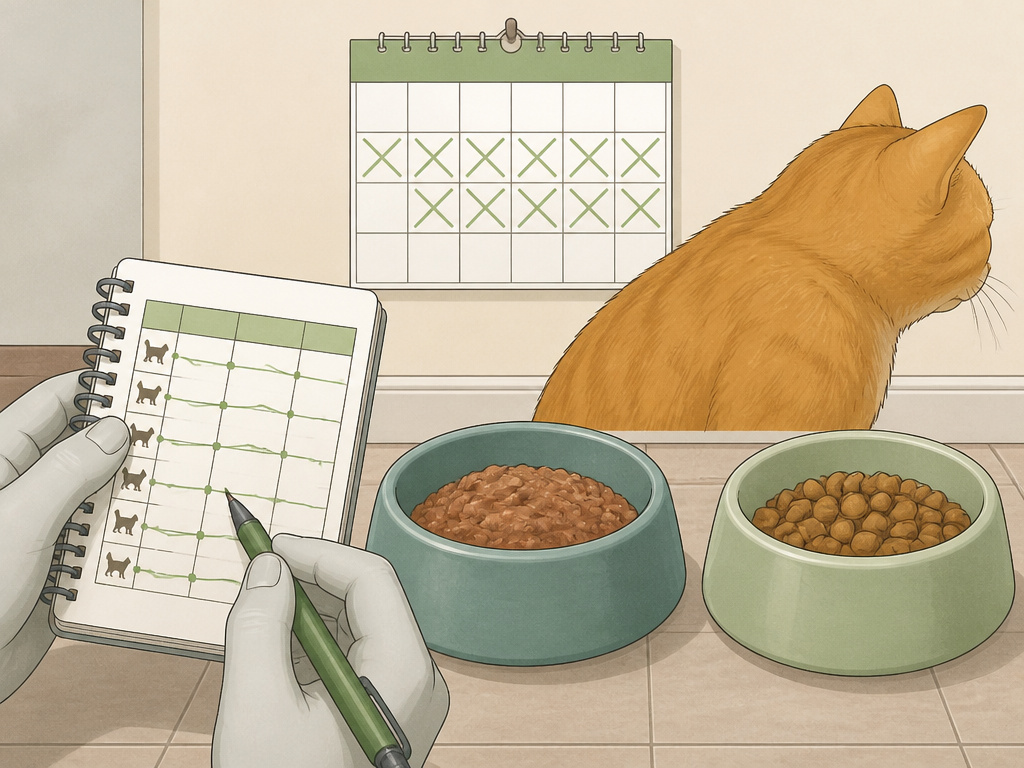
Day four of a food switch, the cat eats half the bowl and walks away. Day five, none of it.
Pushing the schedule would have put him off the food entirely, so I let the cat set the pace and checked weight weekly instead of daily. A plan someone follows beats a perfect plan they abandon.
Before you start: A diabetic cat that stops eating while on insulin is at risk of hypoglycemia, because the insulin doesn’t know the meal was skipped. Call your vet before you change the diet, not after.
A Transition Schedule That Actually Holds
- Skip the slow start and you get a cat refusing both bowls by day five.
- Watch the litter box. Loose stool here means you moved too fast, so hold at half for another three days.
- Most cats settle at this ratio.
- If yours is one, stay at whatever ratio he’ll eat and let the calendar stretch.
The food for feline diabetes that works is the one the cat finishes. That sounds soft. It’s the single most consistent point across both AAHA and Royal Canin, and it’s the one owners override most often in pursuit of a better number.
When Another Disease Outranks the Diabetes
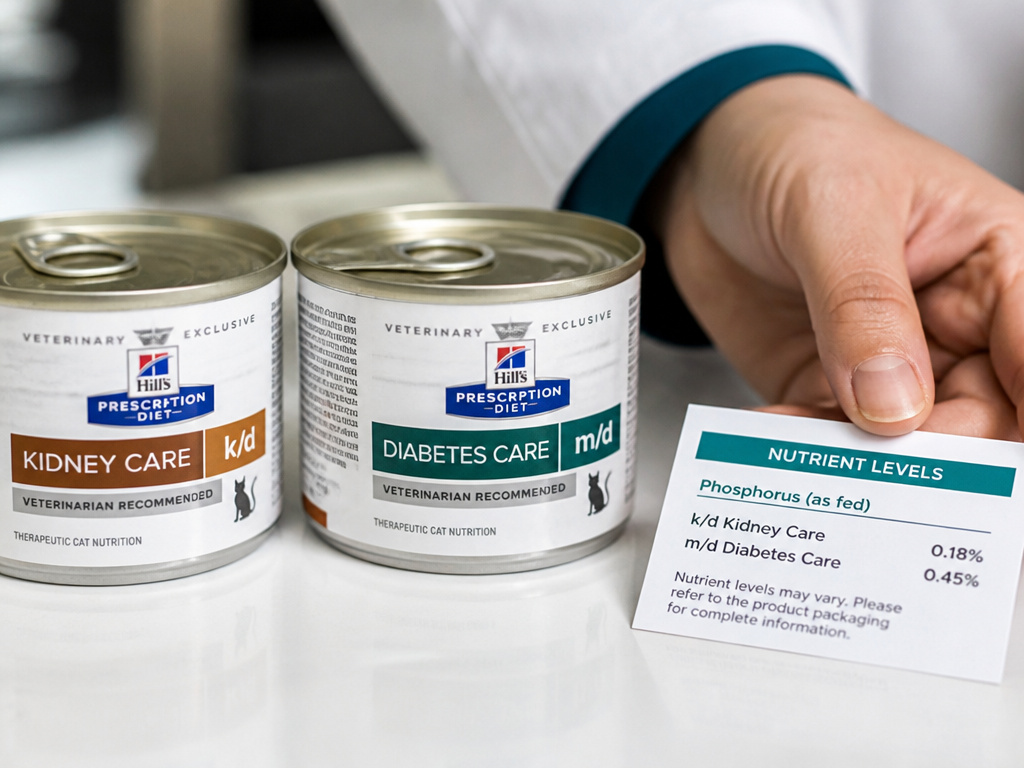
Kidney disease outranks diabetes.
AAHA’s task force is direct about this: when a cat has diabetes plus a comorbidity, pick the diet based on which disease is most likely to affect survival. Their example is a cat with diabetes and advanced proteinuric renal disease, where a renal diet beats a diabetic diet.
That breaks the low-carb rule, and it should. A diet that manages glucose while letting phosphorus run unmanaged isn’t a win. This is where named therapeutic products earn their place, because the target nutrient is printed on the can and verified: Hill’s Prescription Diet k/d and Royal Canin Veterinary Diet Renal Support are both built around phosphorus restriction, not around carbohydrate percentage.
AAHA also recommends a veterinary nutritionist consult when a plan has to cover multiple conditions at once. That’s not a hedge. Formulating for renal and diabetic targets simultaneously is genuinely a two-disease problem, and the veterinary diets that exist for it are the most rigorously tested foods on the shelf.
Easy to miss: Dropping the prescription diet once the bloodwork improves. The bloodwork improved because of the diet, so stopping it removes the thing that was working.
Feeding Schedule, Treats, and the Warm Water Trick
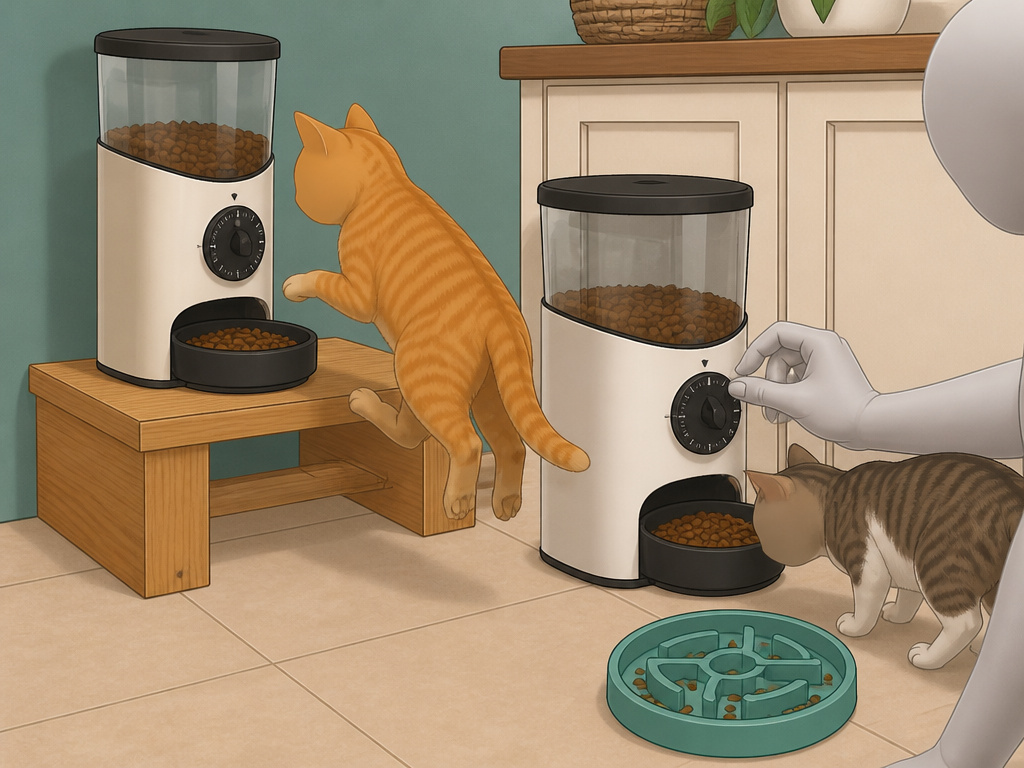
Three things control the feeding side: timing, volume, and how hard the cat has to work for the food.
On timing, AAHA is looser than most clinic handouts suggest. Meal feeding is ideal with intermediate-acting insulins that peak within a few hours of injection, but it isn’t essential in cats, and graze eating over the day is acceptable. With glargine U-300, strict meal feeding isn’t required at all, because injection frequency may be reduced and the hypoglycemia risk from a missed meal is low.
On volume and effort, Royal Canin has practical suggestions that cost little:
- Split the daily ration into several small meals using automatic feeders, which mimics natural feeding behavior.
- Run more than one feeder and change the schedule daily, so the cat can’t camp in front of the one that opens next.
- Put food on a raised surface so the cat has to jump to reach it.
- Use feeding toys so the cat spends energy getting the food and gets mental stimulation doing it.
Automatic Feeders and the Rotation Trick
The rotation detail is the one people skip. With two feeders on a shifting schedule, the cat has to move to find out, and that movement is the point.
Treats count against the daily calorie budget, not alongside it. If you’re using them for training or for pill pockets, a treats for diabetic cats option with a calculated carbohydrate value is easier to budget than a piece of whatever’s in the drawer.
The part nobody mentions: Homemade broth. Onion, garlic, and salt have no place in a cat’s bowl, and a plain poached chicken broth is only safe if all three stay out of the pot. Read the ingredient list even when you made it yourself.
Frequently Asked Questions
What is the best food for a diabetic cat?
There’s no single answer, because AAHA and the 2025 iCatCare consensus publish different carbohydrate ceilings. The practical starting point is a complete diet low in carbohydrate and high in protein, with the carbohydrate calculated from the guaranteed analysis rather than read off the front of the bag. Your vet sets the target based on your cat’s weight and insulin.
Can a diabetic cat eat dry food?
Yes, if the cat actually eats it consistently. AAHA prefers canned food because its lower caloric density lets a cat eat more volume for the same calories. Royal Canin counters that consistent, predictable intake matters most, and for some cats that’s only achievable with dry food. Calculate the carbohydrate per calorie either way.
How do I calculate carbs in cat food?
Subtract the listed protein, fat, fiber, and moisture percentages from 100. If ash isn’t listed, estimate 2 to 3 percent for canned food or 5 to 8 percent for dry, per AAHA. Then convert the result to metabolizable energy using a converter such as Balance.it or the Tufts nutrient converter, because a percentage of weight and a percentage of calories are different numbers.
Will my diabetic cat go into remission?
Some do. AAHA reports remission rates between 15 and 100 percent on a high-protein, low-carbohydrate diet combined with insulin, which is a wide enough spread to be honest about rather than reassuring. Diet is typically a complement to insulin or an SGLT2 inhibitor, and remission on diet alone is possible but not something to plan around.
Should I feed my diabetic cat before or after insulin?
That depends on the insulin. AAHA says meal feeding suits intermediate-acting insulins that peak within a few hours of injection, but it isn’t essential in cats, and graze feeding is acceptable. With glargine U-300, strict meal feeding isn’t required because injection frequency may be reduced and the risk from a missed meal is low.
Are grain-free foods low in carbohydrate?
Not necessarily. Grain-free describes which ingredients are absent, not how much carbohydrate the formula delivers. Legumes, peas, and potato can carry as much carbohydrate as the grain they replaced. Run the subtraction on the guaranteed analysis and convert to calories before you trust the claim.
The Bottom Line
One number to act on this week: calculate the carbohydrate calories in whatever is in the bowl right now. If it lands above 25 percent of metabolizable energy and your cat is carrying extra weight, that’s a conversation for your vet at the next check, not a reason to switch bags on your own.
A diabetic cat food guide is only as good as the number on the back of the bag, and that number usually isn’t printed. Do the subtraction once and you’ll never read a front label the same way again.
Here’s the concession. None of this replaces the insulin schedule. AAHA is clear that dietary therapy is a complement to insulin or an SGLT2 inhibitor, and the occasional cat that remits on diet alone is the exception rather than the plan. Get the food right, then let your vet handle the dose.
