
Coconut Oil for Dogs Pros and Cons: What the Evidence Says
This post contains affiliate links. As an Amazon Associate, we earn from qualifying purchases.
The coconut oil for dogs pros and cons split cleanly: it is at least 90% saturated fat, mostly MCTs, and it can add shine and short-term moisture to skin. It cannot meet a dog’s fat needs, and too much brings diarrhea, weight gain, or pancreatitis.
The gap is the fatty acid profile. Coconut oil’s MCTs are mostly lauric acid, a 12-carbon chain that does none of the work omega-3 and omega-6 do for skin and coat. That one fact explains most of the coconut oil for dogs pros and cons, including why a spoonful of the stuff adds calories without adding much else.
What follows walks it in order: what is in the jar, where it helps, where it hurts, what the trials actually measured, and the dose question that four sources answer four different ways.
Key Takeaways
- At least 90% of coconut oil is saturated fat, and its main MCT is lauric acid, not the caprylic and capric acids used in the canine seizure trial.
- A tablespoon carries about 120 calories, which is a significant share of a small dog’s day.
- Treats and supplements together should stay under 10% of daily calories. The other 90% comes from a complete diet.
- Topical use is the safer lane: once a week, rinsed off after about five minutes.
- Skip it entirely for dogs with pancreatitis or high triglycerides.
What Is Actually in the Jar: 90% Saturated Fat and One MCT That Matters
The composition is short enough to memorize. Coconut oil runs at least 90% saturated fat, and most of that arrives as medium-chain triglycerides, usually written MCTs. It sits solid in the jar at room temperature and turns liquid on contact with skin.
Lauric acid is the primary medium-chain triglyceride in coconut oil, a 12-carbon chain. Capric and caprylic acids appear in smaller amounts. Lauric acid shows antimicrobial, antifungal, and antiviral activity in laboratory testing. No canine study has established a protective dose in living animals, and coconut oil supplies very little omega-6 or omega-3.
Lauric acid is the one quoted in marketing copy. It does kill germs in a lab dish. Whether it reaches a useful concentration in a living dog is a separate question, and the AKC coconut oil for dogs guide puts it plainly: there is no clear evidence it can be used in sufficient quantities to offer dogs much protection.
The omega numbers matter just as much. A dog’s skin and coat use omega-6 and omega-3 fatty acids, and coconut oil carries very small amounts of either. The AKC and Rollins say it cannot meet a dog’s fat needs because it lacks essential omega-3 and omega-6, while Dublin Vet Clinic frames it as a supplement, not a replacement for balanced nutrition.
Coconut Oil for Dogs Pros and Cons: The Case For It
Two uses survive a hard look.
The first is topical. PetMD says coconut oil can be safely used topically on chapped paw pads and on the coat for shine, though Simpson notes its very small omega-6 content makes it a poor choice for managing skin conditions or improving coat health. The effect is moisture sitting on the surface, not nutrition arriving from inside.
The second is mechanical. A dab of solid coconut oil is a tidy way to get a tablet down a dog that has learned to eat around pills, though PetMD notes it is likely safe in very small quantities only unless the dog is prone to GI issues or pancreatic disease.
Here is the honest list:
- Chapped paw pads and dry skin: temporary moisture, nothing more. It does not treat allergies, bacterial infections, or yeast.
- Coat shine: real but modest, and most of it comes from fat sitting on the hair shaft.
- Pill lubricant: the lowest-risk use on this list, in very small amounts.
- A weekly topical routine for a dog that tolerates being handled.
Notice what is missing. Allergies, hot spots, infections, and anything a veterinarian would call a diagnosis.
I once read the fronts of about 15 over-the-counter urinary bags looking for one verb. All of them said “supports” or “promotes.” Not one said “dissolves.” Coconut oil packaging runs the same play. You will see “soothes” and “nourishes.” You will not see “treats.”
The Cons: 120 Calories a Tablespoon and a Pancreatitis Risk
One tablespoon of coconut oil holds about 120 calories. On a small dog, that is a significant slice of the day for something with no vitamins attached.
Coconut oil is nearly 100% fat, and fat runs about 9 kcal of metabolizable energy per gram according to WSAVA congress proceedings. The short-term cost shows up fast. The stool goes slick and greasy, then loose, then frankly diarrheal.
Common mistake: Adding a daily spoonful on top of a full bowl of kibble without counting it. That pushes total calories past the 10% ceiling for treats and supplements, and the weight gain shows up on the scale before it shows up in the coat.
Long-term feeding carries the heavier risk. The AKC’s veterinary sources link prolonged coconut oil feeding to obesity and to pancreatitis, a painful and sometimes life-threatening inflammation of the pancreas. Dogs with a history of pancreatitis or high triglycerides should avoid added fats unless a veterinarian directs otherwise.
The same arithmetic applies to any high-fat diet for dogs. The fat is the whole point of the diet, and the calories still count.
Four groups should skip coconut oil entirely:
- Dogs with a pancreatitis or high-triglyceride history.
- Overweight dogs, or any dog on a fat-restricted diet.
- Dogs with kidney disease or an electrolyte disturbance, since coconut is high in potassium.
- Dogs with ongoing gastrointestinal trouble.
Do the Studies Back Any of This?
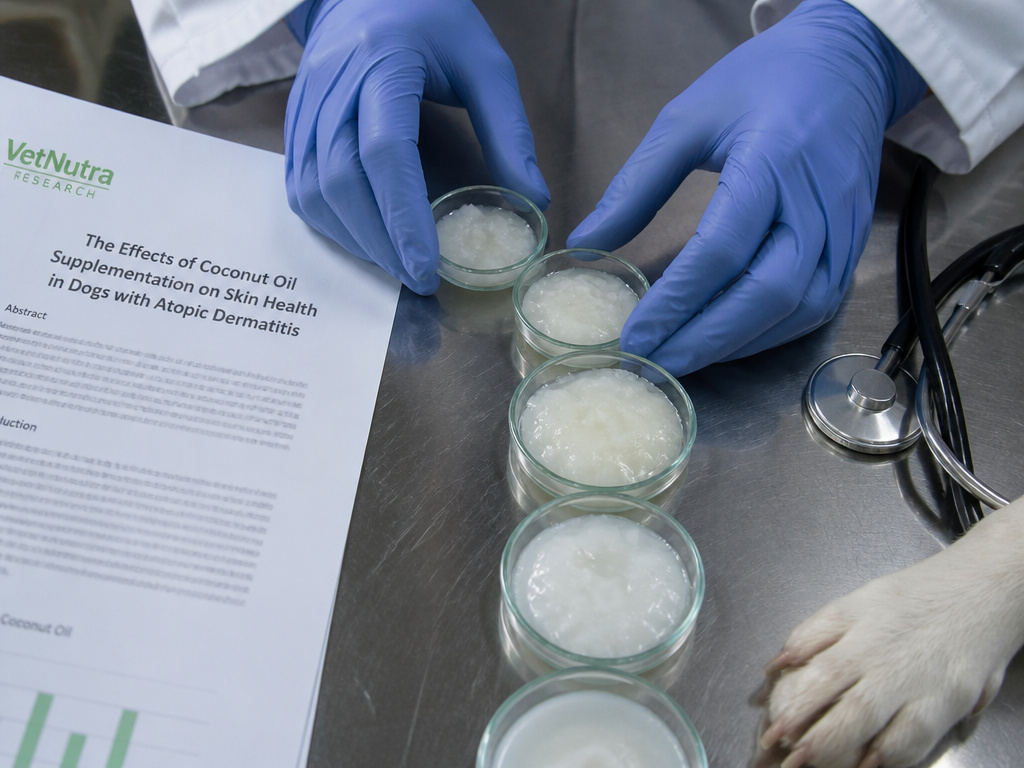
The dermatology case for coconut oil rests on a very thin stack of papers.
Andrew Simpson, a board-certified veterinary dermatologist, told the 2025 AVMA Convention that there are no known placebo-controlled, randomized, double-blinded studies evaluating coconut oil’s clinical efficacy or its potential adverse events in dogs. That is the entire evidence base for the skin claims, stated without decoration.
What does exist runs in the other direction. A 2019 in vitro study by Boyd and colleagues in Veterinary Dermatology exposed canine epidermal keratinocytes to organic virgin coconut oil and found increased disruption of plasma membrane integrity compared with the control group. There was no sign of oxidative stress measured by nitrite production. A dish is not a dog, but the finding is not the one the marketing implies.
There is also a cross-species gap worth naming. Coconut oil has shown benefit for dry skin and atopic dermatitis in human medicine, per a 2024 study cited in the same lecture. Veterinary literature has not caught up, and the transfer is not free.
The same question is worth asking of anything in the supplement aisle, turmeric for dogs included: what trial, in what species, at what dose?
The question I ask about any supplement is the one I ask about a urinary formula: what did the trial measure, in what species, at what dose? Coconut oil fails that question in dogs. The human skin data is real, and it does not transfer for free.
The Seizure Claim Uses a Different Oil
This is where the internet and the literature part company. A six-month randomized, double-blinded trial of 21 dogs with idiopathic epilepsy found significantly lower seizure frequency and seizure-day frequency on a medium-chain triglyceride diet versus placebo.
The catch is the fat. That trial used caprylic and capric acid. Coconut oil’s primary MCT is lauric acid, a different molecule. You cannot assume the result carries over, and a board-certified nutritionist has said exactly that.
The older lipid work is worth knowing too. A 1974 Journal of Nutrition feeding trial gave coconut oil at 10, 20, and 40% of calories to 12 dogs over two weeks and saw serum cholesterol and phospholipids rise at every level, dose-dependent but not proportional to calories, per peer-reviewed canine lipid research. A related trial in thyroidectomized dogs found significantly greater cholesterol and triglyceride elevations at 40% of calories, per the canine thyroid and coconut oil trial04885-X/abstract).
Those doses are therapeutic-diet territory. Nobody is putting 40% of a dog’s calories on a teaspoon.
How Much Coconut Oil Can You Give a Dog? The Sources Do Not Agree
Four sources, four answers, and not one of them from a controlled trial.
| Source | Suggested amount | Caveat attached |
|---|---|---|
| Dublin Vet Clinic | 1/4 teaspoon for small dogs, then increase | Titrate by size and tolerance |
| Dr. Angela Rollins (dvm360) | 1 teaspoon a day | Only if it does not trigger pancreatitis |
| Dr. Jolee Stegemoller (AKC) | Up to about 1 teaspoon, large dogs | Large amounts cause diarrhea |
| PetMD | Very small amounts, such as a pill lubricant | Be conservative; excess causes diarrhea |
Read that column again. The gap between a quarter teaspoon and a full teaspoon is a fourfold difference in fat, and no trial settles it.
Why the Numbers Do Not Line Up
Because none of them is a clinical dose. They are starting points drawn from practice, sized to a dog’s weight and tolerance rather than to a measured threshold. Rollins attaches the honest condition: a teaspoon a day is fine as long as it does not induce pancreatitis.
The ceiling that actually has consensus behind it is the calorie rule. Treats and supplements of all kinds, coconut included, should supply no more than 10% of a dog’s total daily caloric intake. That figure appears in PetMD, in the AKC’s guidance, and in WSAVA congress proceedings.
Before you start: A tablespoon of coconut oil is about 120 calories, so measure it rather than eyeballing a spoon. Dogs with a pancreatitis or high-triglyceride history should not get added fat without a veterinarian’s sign-off. Check any flavored or sweetened coconut product for xylitol, which is toxic to dogs.
If you decide to try it, do it in this order:
- Clear it with your vet first if the dog has any history of pancreatitis, high triglycerides, kidney disease, or GI trouble. Skipping this is how a gentle supplement becomes a flare.
- Start at a quarter teaspoon for a small dog and scale up by weight. Starting at a full teaspoon invites diarrhea within a day or two.
- Count the calories against the 10% ceiling before you add anything else to the bowl. Doubling up on treats and oil blows past it quietly.
- Hold the dose for a week and watch the stool. Greasy or loose stool means you went too high, too fast.
- Stop and call the vet if the stool stays loose past a couple of days or the dog starts vomiting.
Coconut Milk, Water, Flesh, and Husk: Four Different Answers
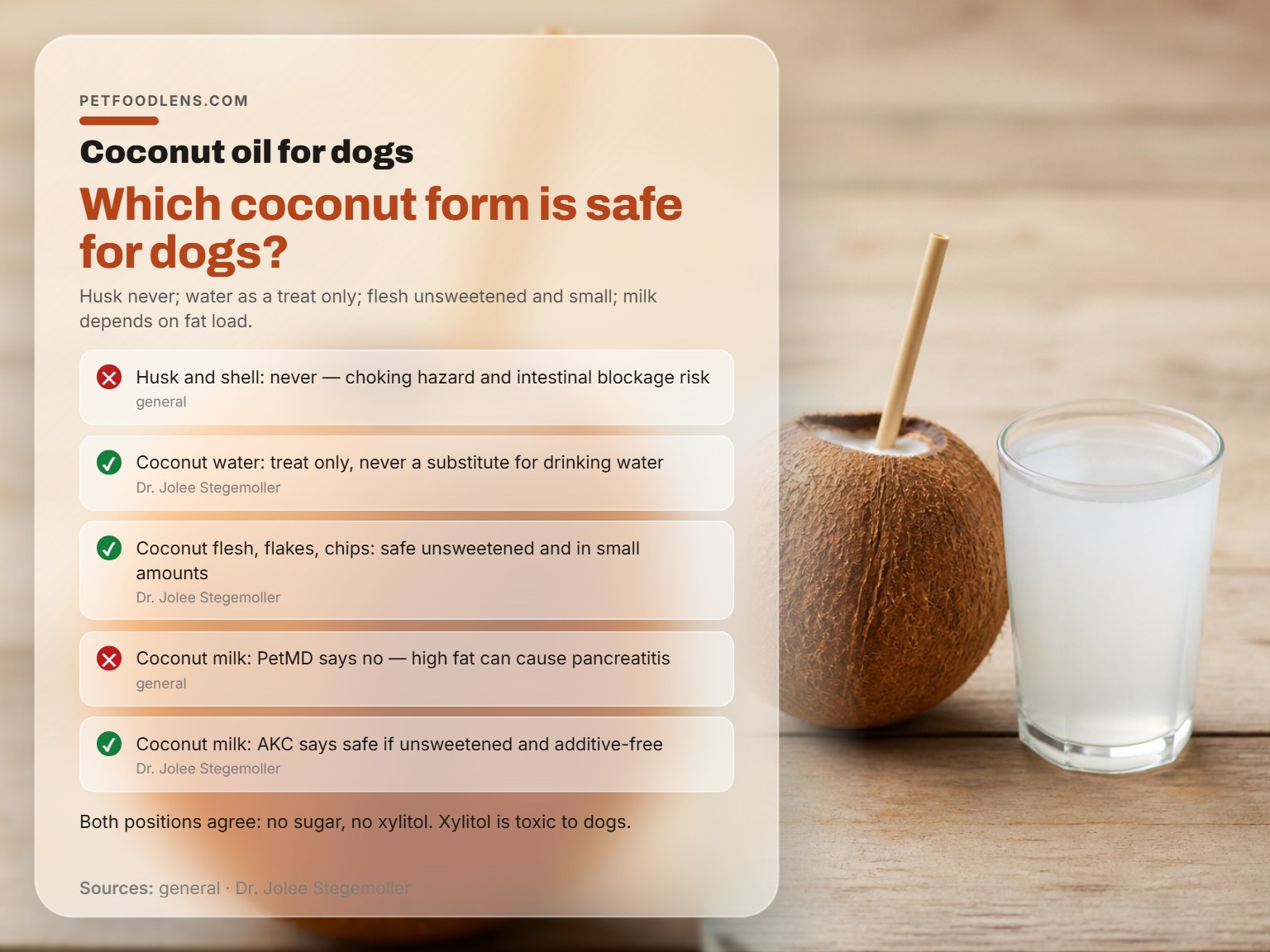
Which form is on the counter right now? Because the answer changes with it.
- Husk and shell: never. Choking hazard and intestinal blockage risk, and no upside.
- Coconut water: a treat only, never a substitute for drinking water. Check the label for xylitol.
- Coconut flesh, flakes, and chips: safe unsweetened and in small amounts, treated as a treat.
Coconut Milk: Two Vets, Two Answers
PetMD says no. Coconut milk is naturally high in fat, and high-fat foods can cause pancreatitis. That is a defensible position for a dog with any pancreatic history.
The AKC can dogs eat coconut guidance, from Dr. Jolee Stegemoller, says coconut milk is safe if it is unsweetened and free of additives. Both positions agree on the two conditions that matter: no sugar, no xylitol.
The disagreement is really about fat load and dose, not about the food itself. A splash of unsweetened coconut milk in a bowl is a different event from a bowl of it.
Where this goes sideways: Sweetened coconut milk, flavored coconut water, and “tropical blend” drinks can carry xylitol or added sugar. Xylitol is toxic to dogs, and the label is the only place it shows up.
Topical Use: Chapped Pads, Dry Skin, and the Open-Wound Rule
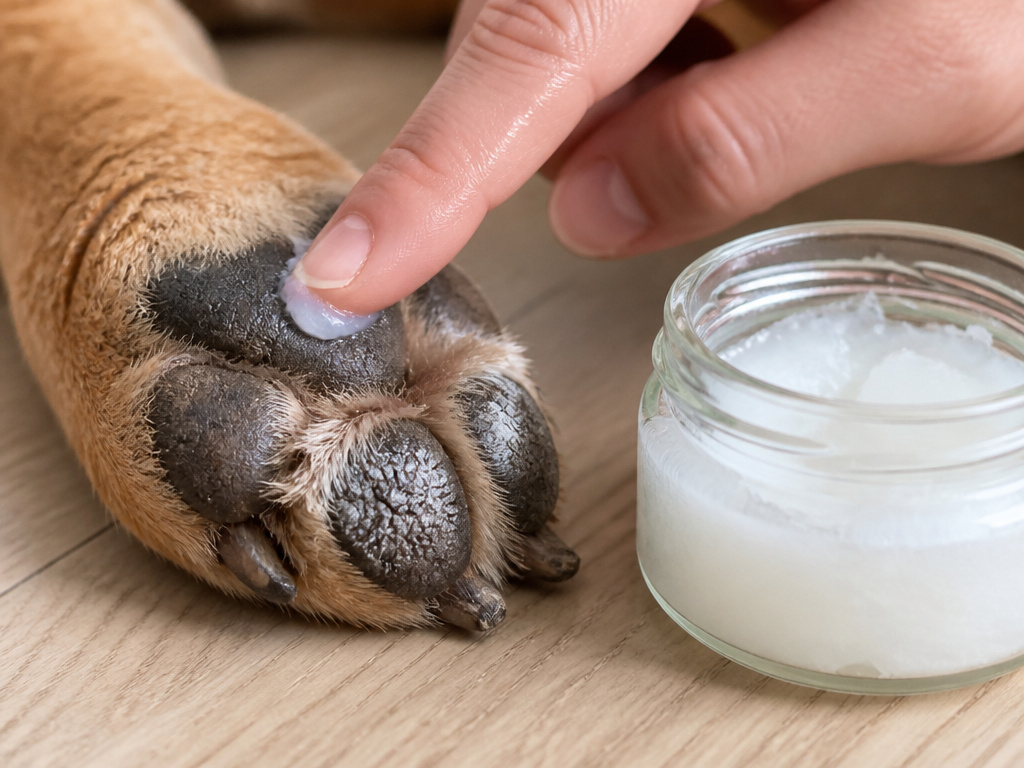
A dog comes in from a January walk lifting one paw at the door. The pad is split and dry. That is the case coconut oil was made for, and the routine is short.
Apply it to the skin about once a week and let it absorb for a few minutes. After roughly five minutes, rinse the dog off. If the coat still feels greasy, follow with a light shampoo and rinse again. The oil goes on glossy and soaks in fast, and the hair around the pad clumps if you skip the rinse.
That is the whole protocol. Once a week, not once a day.
Where Topical Use Is Off the Table
Hepper advises never applying coconut oil to raw, moist, or infected skin, while PetMD and the AKC describe topical use on chapped paw pads and the coat; a weeping hot spot or an open scrape needs a veterinarian.
The 2019 keratinocyte finding is worth keeping in mind here. If coconut oil disrupts cell membranes in a lab culture of dog skin cells, slathering it on broken skin is not the moment to test the theory.
Coconut Oil vs Fish Oil for Skin and Coat
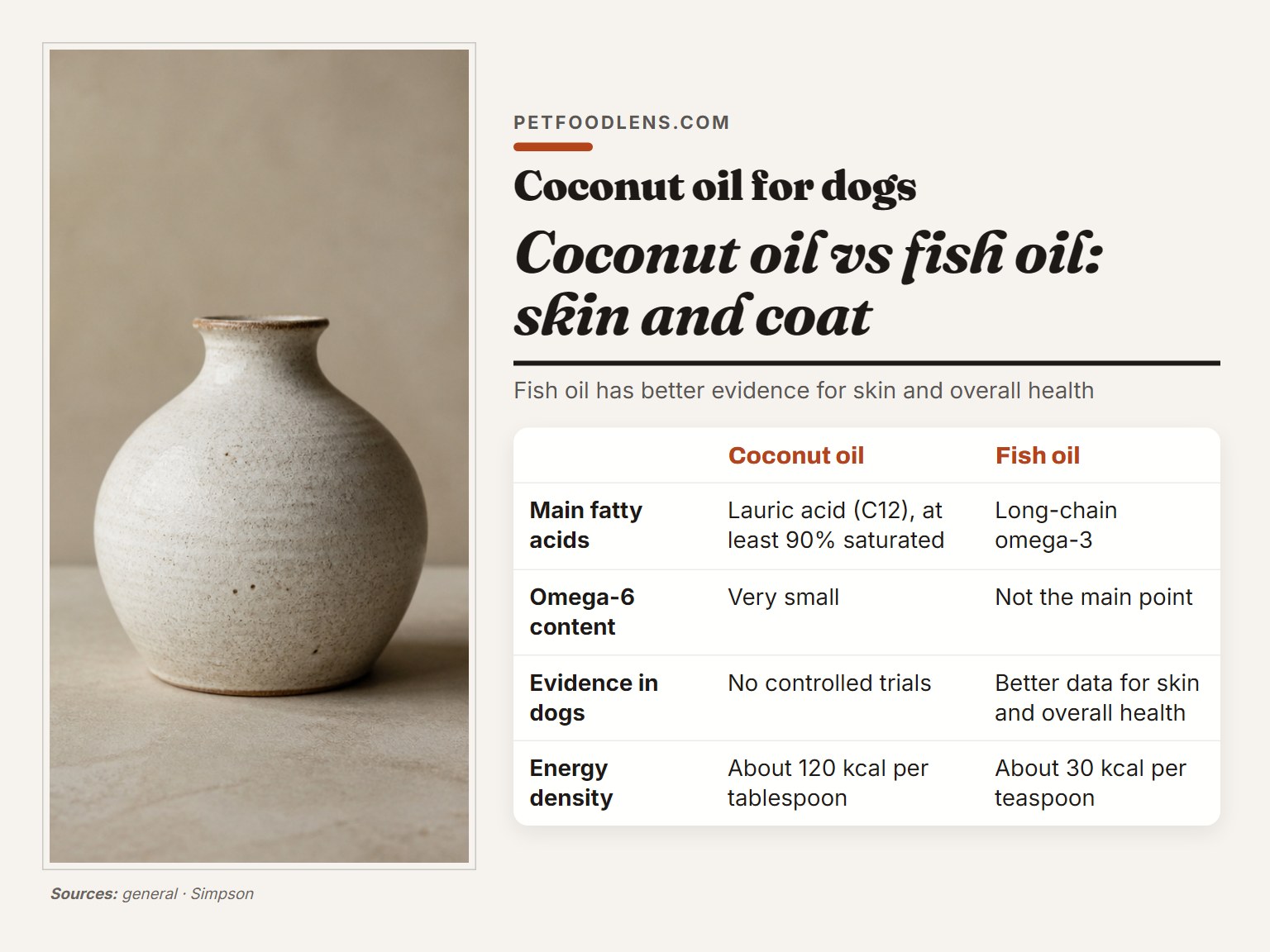
Fish oil wins this one, and it is not close on the evidence.
| Attribute | Coconut oil | Fish oil |
|---|---|---|
| Main fatty acids | Lauric acid (C12), at least 90% saturated | Long-chain omega-3 |
| Omega-6 content | Very small | Not the main point |
| Evidence in dogs | No controlled trials | Better data for skin and overall health |
| Energy density | About 120 kcal per tablespoon | About 30 kcal per teaspoon |
The AKC’s nutrition guidance states directly that there is better data for omega fatty acids like fish oil for skin and overall health than for coconut. That is the comparison in one sentence.
Watch the units in that last row. A teaspoon of fish oil at roughly 30 kcal and a tablespoon of coconut oil at roughly 120 kcal are not the same measure, so do not read the numbers as a fourfold difference per spoon.
If the goal is coat condition, the best food for dog coat health does more than any topper. If you want a supplement, omega-3 for dogs has the evidence behind it. For a straight comparison of what goes in the bowl, this breakdown of the best oil for dog food covers the options.
Unsweetened and additive-free are the only two words that matter on a coconut product label. Everything after that is calories you have to count.
Frequently Asked Questions
Is coconut oil good for dogs with itchy skin?
It can temporarily moisturize dry skin, and that is the limit. It does not treat allergies, bacterial infections, or fungal conditions. A dog that is itching constantly needs a diagnosis, not a jar of oil.
Can coconut oil help a dog with seizures?
Probably not, and the reasoning matters. The trial that showed fewer seizures used caprylic and capric acid, while coconut oil’s main MCT is lauric acid; Rollins says the claim stays unproven, while the AKC says coconuts offer potential benefits for MCTs, particularly for dogs with seizure disorders.
How much coconut oil is too much for a dog?
There is no fixed threshold, but the calorie ceiling is the practical limit. Treats and supplements together should stay under 10% of daily calories. Greasy or loose stool is the signal that you crossed the line.
Can I put coconut oil on my dog’s paws?
Yes, on dry or chapped pads, about once a week. Rinse after roughly five minutes and follow with a light shampoo if the coat stays greasy. Never apply it to raw, moist, or infected skin.
Is coconut oil a substitute for fish oil?
No. Coconut oil carries very small amounts of omega-6 and lacks the omega-3 that skin and coat actually use. Fish oil has the better evidence for both skin and overall health.
The Bottom Line
Here is the trigger that settles it. If your dog has ever had a pancreatitis episode or a high-triglyceride reading on bloodwork, coconut oil is off the list, full stop, and the teaspoon advice you read online does not apply.
For a healthy dog, Dublin Vet Clinic suggests starting at a quarter teaspoon for a small dog and increasing gradually, while Rollins suggests a teaspoon a day and Stegemoller says up to about a teaspoon for a large dog is okay, all only if the calories fit inside that 10% allowance. Weigh it. A heaped spoon of firm oil and a level one are different amounts, and the scale ends the argument faster than any label will.
One concession worth stating plainly: I know commercial cat food far better than I know dogs, and the clinical nutrition questions here are ones a veterinarian should answer for your animal, not a label reader. What I can tell you is how to read the claim. “Supports” and “soothes” are not “treats,” and the studies behind the dog claims do not exist yet.
