
10 Best Soft Cat Food For Kittens in 2026
This post contains affiliate links. As an Amazon Associate, we earn from qualifying purchases.
The best soft cat food for kittens needs to deliver complete nutrition in a texture tiny mouths can manage. Blue Buffalo Wilderness Kitten Paté Wet Food takes the Best Overall spot because it leads with real chicken or salmon. It packs high protein for growth and includes DHA from salmon oil for cognitive development. The Tiki Cat Baby Shreds Kitten Food wins Best Variety Pack, while the Royal Canin Mother and Babycat Kitten Wet Food is our pick for weaning kittens.
A kitten’s digestive system is still developing, so the wrong food can cause upset or miss critical nutrients. Texture matters as much as ingredients, too firm and a kitten may struggle; too loose and it may not get enough calories. DHA for brain development, balanced calcium and phosphorus for bones, and high-quality protein are non-negotiable during the first year.
We built this guide by combing through manufacturer specifications, ingredient lists, and guaranteed analyses, then cross-referencing patterns in owner feedback and expert round-ups. The result is a research-based look at ten of the best soft food options for kittens, each chosen for a specific need, whether you are weaning, managing a picky eater, or sticking to a budget.
Top 10 Soft Cat Foods For Kittens in the Market
Certain content that appears on this site comes from Amazon. This content is provided "as is" and is subject to change or removal at any time.
The Best Soft Cat Foods For Kittens, Reviewed
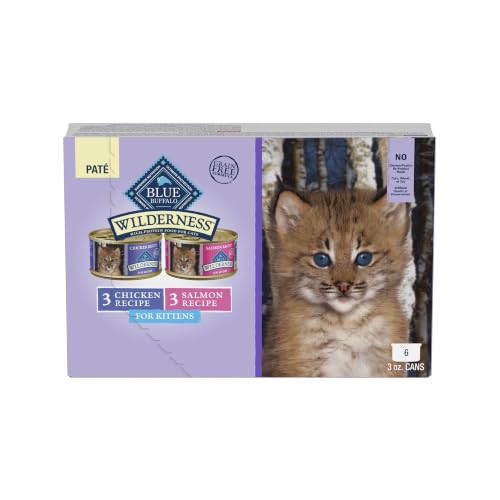
Blue Buffalo Wilderness Kitten Paté Wet Food
What We Like
- Real chicken or salmon as first ingredient
- High protein and grain-free formula
- DHA from salmon oil for cognitive development
- Smooth pâté texture easy for kittens to eat
Trade-offs
- Variety pack limits single-recipe feeding
- Not suitable for kittens needing a grain-inclusive diet
Real chicken or salmon listed as the first ingredient means this recipe is built around whole meat rather than fillers or by-products. That matters for a growing kitten that needs dense protein for muscle and organ development. The smooth pâté texture makes it easy for young kittens to lap up without struggling with chunks, while the grain-free formula avoids common carbohydrate fillers that offer little nutritional value. DHA from salmon oil supports cognitive development during the critical early months, and added taurine helps maintain healthy eyes and heart function. This is a well-rounded wet food that covers the key developmental bases without relying on artificial ingredients or cheap protein sources.
Each 3 oz can is appropriate for small kittens, but as your cat grows, you may need to open multiple cans per feeding, which adds to daily prep. Compared to the Tiki Cat Baby Pate, which also offers a smooth texture and DHA, Blue Buffalo Wilderness includes a wider variety of protein sources across the pack, chicken and salmon, which can help prevent flavor fatigue. If your kitten is already a hearty eater, you might find yourself reaching for larger cans from other brands. But for the first few months of life, this recipe provides the nutritional foundation that supports steady growth and energy.
Tiki Cat Baby Shreds Kitten Food

What We Like
- Four-recipe variety pack
- DHA for brain and vision development
- Added taurine and balanced calcium/phosphorus
- Prebiotics aid digestion
Trade-offs
- Only 2.4 oz per can
A dozen 2.4-ounce cans split across four different recipes mean you can rotate flavors without committing to a single protein source. That variety is the main draw here: Chicken & Salmon, Chicken Tuna & Chicken Liver, Chicken Duck & Duck Liver, and Chicken & Egg each bring slightly different fat and mineral profiles. That can help keep a growing kitten interested at mealtime. The inclusion of DHA for brain and vision development, along with added taurine and balanced calcium and phosphorus, covers the key nutritional bases for kittens eight weeks and older. Prebiotics are a nice touch for gentle digestion, and the grain-free, no-filler ingredient list aligns with what I look for in a wet food.
Can size is the trade-off. At 2.4 ounces, these are smaller than the 3-ounce cans you get with something like Blue Buffalo Wilderness Kitten Paté Wet Food, so a hungry kitten may need two cans per feeding, which eats into the per-meal value. For owners who want to offer multiple proteins in a clean, high-protein formula and don’t mind the smaller cans, this variety pack is a practical way to do it.
Royal Canin Mother and Babycat Kitten Wet Food

What We Like
- Ultra-soft mousse eases milk-to-food transition
- DHA supports brain development from womb onward
- Prebiotics and digestible proteins aid digestion
- Formulated for both queen and young kittens
Trade-offs
- Only suitable for kittens up to 4 months old
The ultra-soft mousse texture is the key feature here: it’s designed specifically for kittens transitioning from milk to solid food, so you don’t have to worry about tiny teeth struggling with chunks. Royal Canin packs in DHA for brain development starting in the womb, plus antioxidants and prebiotics to support growth and digestion. This makes it a solid fit for breeders or anyone with a litter of very young kittens (1-4 months) who need gentle nutrition that won’t upset their systems.
The trade-off is that this formula is narrowly targeted; once your kitten passes four months, you’ll need to switch to a different food. Compared to the Blue Buffalo Wilderness Kitten Pate, which is also a wet food for kittens, the Royal Canin is more of a short-term tool for the weaning stage. But for those first critical months, the mousse texture and queen-friendly formulation make the weaning process noticeably smoother.
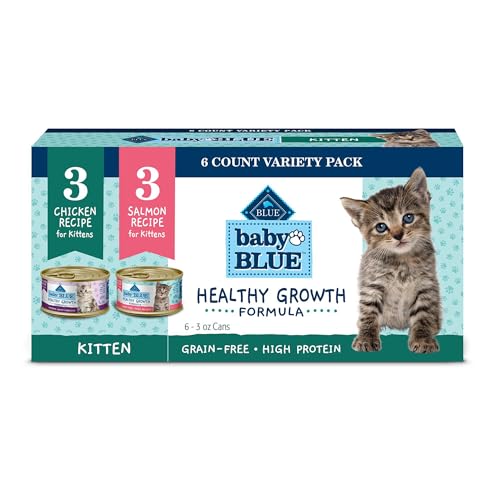
Blue Buffalo Baby Blue Kitten Wet Food Variety Pack
What We Like
- Real meat as first ingredient
- Grain-free and high-protein formula
- DHA supports cognitive development
- Two savory recipes in one pack
Trade-offs
- No poultry by-product meals, but some owners prefer single-protein
- Contains two recipes, not single-protein options
Real meat as the first ingredient means this kitten food puts protein quality front and center, something I always look for when scanning a label. The grain-free, high-protein recipe is paired with DHA for cognitive development, which is a solid combination for growing kittens. If you’re focused on giving your kitten a protein-rich start without fillers like corn, wheat, or soy, this variety pack delivers that in two palatable recipes (chicken and salmon). It’s a straightforward, no-nonsense formula that prioritizes what matters for early development.
With only six 3-oz cans, this pack is smaller than the Royal Canin Mother and Babycat 24-pack, so you will reorder sooner if you have multiple kittens or a hearty eater. The ingredient list is cleaner than many alternatives, with no poultry by-product meals and a clear emphasis on meat-based protein. For someone who reads labels first and wants a high-protein, grain-free option without the marketing fluff, this pack earns its place as a top high-protein pick.
Tiki Cat Baby Pate Kitten Wet Food

What We Like
- Smooth pate for tiny mouths
- Contains DHA for brain development
- Grain and potato free
- High protein for growth
Trade-offs
- Only 2.4 oz per can
- Smaller can size than some competitors at 2.4 oz
A 2.4-ounce can of smooth pate means this food is designed for kittens just starting solid food, with a texture that’s easy on tiny mouths and tummies. The inclusion of DHA, taurine, and prebiotics supports brain and nervous system development during a critical growth window, while real minced chicken, duck, salmon, tuna, and organ meats provide high protein without grains or fillers. For a kitten transitioning from milk to solids, this recipe focuses on gentle nutrition and hydration in a format that’s hard to mess up.
The trade-off is portion size: at 2.4 ounces per can, it’s smaller than Royal Canin Mother and Babycat’s 3-ounce cans, which means more frequent openings if you’re feeding a growing kitten. The variety pack also means you’ll get different proteins in each can, which is fine for exploration but could be a drawback if your kitten develops a preference for just one recipe. Still, for a pate that prioritizes ingredient transparency and developmental support, this is a focused option.
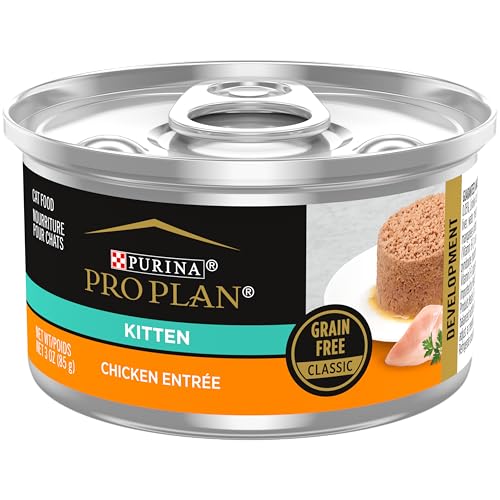
Purina Pro Plan Grain Free Kitten Pate
What We Like
- Grain-free formula with real chicken
- DHA for brain and vision development
- Highly digestible for optimal nutrient delivery
- Includes 25 essential vitamins and minerals
Trade-offs
- Single protein recipe limits variety for picky eaters
- Only available in one texture option
A 3-ounce can of grain-free pate with DHA and taurine means this kitten food targets brain and vision development from the start. The highly digestible formula helps ensure those nutrients actually get absorbed. For a kitten in its first year, that combination of digestibility and developmental support is what makes this a strong pick for owners who want a straightforward, nutritionally complete grain-free option without a lot of extras. The real chicken base gives it a protein profile that matches what a growing kitten needs, and the 25 essential vitamins and minerals round out the package.
Texture is the key here: this is a classic pate, so if your kitten prefers shreds or chunks, you might get a turned-up nose. Compared to Tiki Cat Baby Shreds, which offers a different texture, Purina Pro Plan sticks with a uniform pate that some kittens love and others ignore.
Product photos
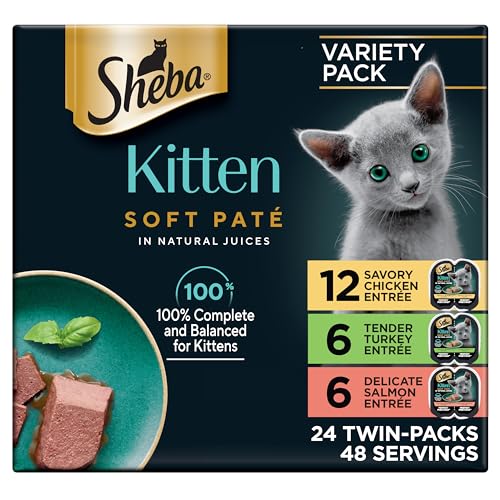
Sheba Perfect Portions Kitten Pate
What We Like
- Pre-portioned twin packs reduce waste
- DHA supports brain development
- Vitamin E for immune support
Trade-offs
- Not suitable for adult cats or senior diets
- Only for kittens, not for adult cats
Forty-eight individually sealed servings in one box mean you never guess how much to scoop or worry about leftover half-cans drying in the fridge. Each 2.6-ounce twin pack splits neatly into two meals, which is exactly the kind of precision that matters when a four-pound kitten’s appetite changes week to week. The pate is soft enough for tiny mouths transitioning from milk, and the formula includes DHA for brain development and Vitamin E for immunity, both backed by the ingredient list, not just the front of the package. This is a solid fit for anyone who wants measured portions without measuring cups or guesswork.
The trade-off for that convenience is portion size: at 2.6 ounces per tray, a growing kitten may need two servings a day as it approaches six months, which means opening more packages than you would with a 3-ounce can like Royal Canin Mother and Babycat. The pate texture is designed for small mouths transitioning from milk, as stated in the product description. For owners who prioritize portion control and a clean, no-waste routine, this Sheba multipack delivers exactly what the label promises.
Product photos
Weruva Kitten Can Jam Variety Pack
What We Like
- No grains, gluten, or carrageenan
- Made in human food facilities
- Family-owned company
- Complete & balanced for growth
Trade-offs
- Only 3 oz cans, small portions
- No DHA mentioned for brain development
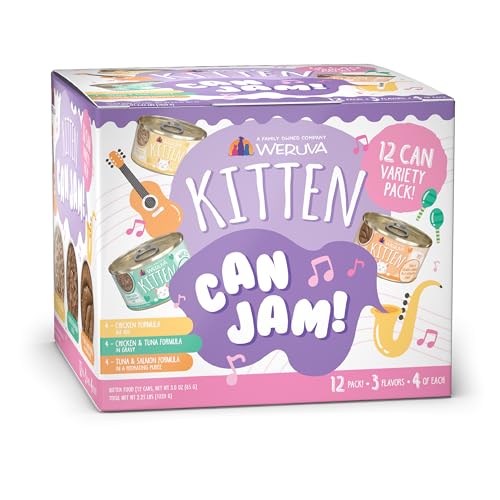
A 12-can variety pack with no grains, gluten, carrageenan, by-products, corn, soy, or artificial anything means you’re looking at a label that reads like a whole-food list. Weruva makes this in human food facilities under B.R.C. Global Standards, so the ingredient transparency is about as strict as it gets for a kitten wet food. That’s the kind of detail that matters when you’re feeding a growing cat and want to avoid the fillers and gums that show up in cheaper cans. If you’re the sort of person who flips the can over before you buy, this one passes the test without needing a magnifying glass.
Each can is only 3 ounces, so a hungry kitten might need more than one per meal, and the variety pack gives you 12 cans total, not a huge stockpile. Compared to Tiki Cat Baby Shreds, which also avoids grains and includes DHA for brain development, Weruva doesn’t list DHA on its spec sheet. If that’s a priority, you might want to check the recipe details. Still, for a family-owned brand that puts real ingredients first and skips the thickeners, this is a straightforward pick for label-readers who value what’s left out over what’s added in.
Product photos
INABA Churu Entree Bisque Kitten Food
What We Like
- 90% moisture for hydration support
- Inulin prebiotic for digestion and immunity
- Grain-free, no preservatives or fillers
Trade-offs
- Only 6 pouches per pack, fewer servings
- Single-serve pouches create more waste
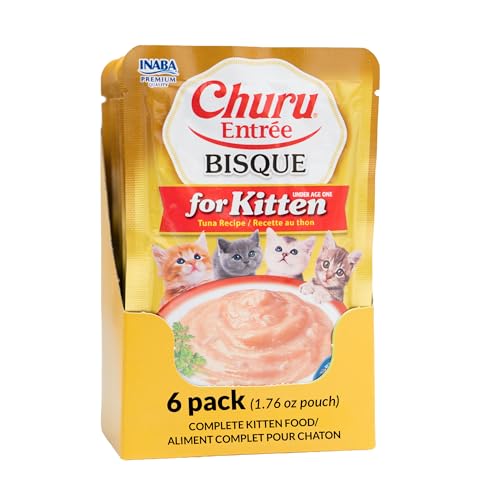
At 90% moisture, this bisque is essentially a hydration delivery system disguised as a meal, useful for kittens that don’t drink enough water on their own. It’s a smart pick for owners who want to support hydration and gut health in one spoonful, especially for picky kittens who turn their nose up at plain water bowls.
Six pouches go fast, especially if you’re feeding multiple kittens or a growing appetite. Compared to the Blue Buffalo Wilderness Kitten Paté, which comes in a 6-count pack of 3-ounce cans, the Inaba pouches offer a similar count but a different texture that some kittens may lap up more readily. For hydration-focused feeding, this bisque does its job without fuss.
Product photos
Purina Pro Plan Development Kitten Variety Pack
What We Like
- DHA for brain and vision development
- 25 essential vitamins and minerals
- Manufactured in Purina-owned U.S. facilities
Trade-offs
- Contains multiple protein sources, not single-protein
- Not suitable for kittens with grain sensitivities
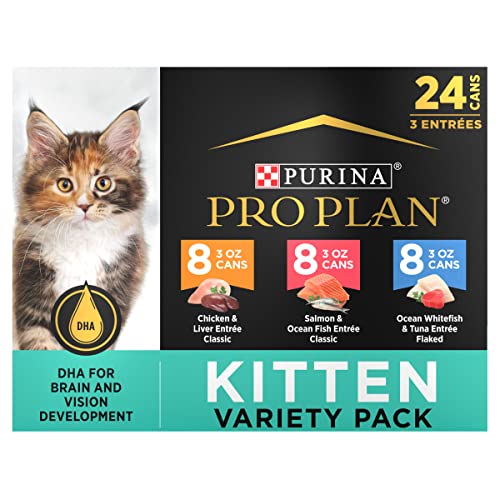
Twenty-four 3-ounce cans of wet kitten food with DHA for brain and vision development make this a practical starter pack for the first year. It’s a straightforward, no-nonsense option for budget-conscious kitten owners who want complete nutrition without paying for trendy ingredients or fancy packaging.
The trade-off is that you get a mix of protein sources, chicken, liver, salmon, ocean fish, whitefish, and tuna, so it’s not a choice for owners who need a single-protein diet. If your kitten has no sensitivities and you want reliable nutrition at a lower cost per can, this pack delivers exactly what the label says.
Product photos
How We Evaluated Soft Cat Foods For Kittens
We started with the label, the ingredient list, guaranteed analysis, and nutritional adequacy statement. Every food here meets AAFCO growth standards. We dug deeper into the source and quality of protein, the presence of DHA for brain and vision development, and whether the texture matched the age and tooth development of the intended kitten. Our research drew on manufacturer documentation, veterinary nutrition resources, and patterns in owner-reported feeding experiences.
Four criteria carried the most weight. First, protein source and content, real meat or fish as the first ingredient signals higher biological value for growing kittens. Second, DHA inclusion, since this omega-3 fatty acid is critical during the rapid brain growth of the first year. Third, texture and mouthfeel, because a kitten that cannot easily lap or chew its food will not eat enough. Fourth, life-stage appropriateness, with special attention to foods formulated for weaning (1-4 months) versus general growth (up to 12 months).
A research-led evaluation has limits: palatability is not tested in a lab, and individual kitten preferences vary widely. We also cannot verify every manufacturing claim without visiting facilities. What we can do is read the fine print, the ingredient deck, the guaranteed analysis, and the feeding directions, and flag what matters for your kitten’s specific stage and health profile.
What To Look For In Soft Cat Foods For Kittens
Choosing a soft food for your kitten comes down to matching the texture, nutrient profile, and ingredient quality to your kitten’s age, health, and preferences. Here is what to check on the label and in the bowl.
Look for a food that lists a named meat or fish as the first ingredient. It should include DHA from a named source, like fish oil or salmon oil, and be labeled “complete and balanced” for growth by AAFCO. The texture should match your kitten’s age: ultra-soft mousse for weaning, pate or shreds for older kittens.
Protein Quality and Source
Kittens need roughly twice the protein per pound of body weight as adult cats. The first ingredient should be a named animal protein, chicken, turkey, salmon, or tuna, not a vague “meat meal” or “poultry by-product.” Whole meat provides amino acids like taurine that kittens cannot synthesize on their own. Some of the best soft kitten food options, like the Blue Buffalo Wilderness line, lead with deboned chicken or salmon. They skip grain fillers that dilute protein density.
DHA for Brain and Vision Development
Docosahexaenoic acid (DHA) is an omega-3 fatty acid that accumulates in the kitten’s brain and retina during the first months of life. Foods that specify DHA from salmon oil or fish oil are preferable to those that only list “fish oil” without the DHA claim. The top-rated wet kitten foods in our guide, including the Tiki Cat Baby line and both Purina Pro Plan options, explicitly call out DHA on the label, which gives you confidence the levels are meaningful.
Texture and Age Appropriateness
Not all soft foods are the same consistency. A young kitten just starting weaning onto solid food needs an ultra-soft mousse or bisque that mimics the moisture of milk. By a few weeks later, most kittens can handle a smooth pate or finely shredded meat. The guide to soft kitten food we built includes specific texture notes for each pick so you can match the mouthfeel to your kitten’s developmental stage.
- Check the feeding guidelines on the can: some foods are designed only for kittens up to four months, others for the full growth period.
- Feel the texture yourself: if you can squish a pea-sized amount between your fingers easily, it’s likely soft enough for a young kitten.
- Look for added prebiotics or probiotics if your kitten has a sensitive stomach during transitions.
- Avoid foods with carrageenan, artificial colors, or unspecified “animal digest” if you prioritize clean ingredients.
- For hydration support, choose a gravy-style or bisque formula with moisture content above a high percentage.
A good rule of thumb: if the texture is too firm for you to mash with a fork, it is probably too firm for a kitten under a few weeks old.
Soft Cat Foods For Kittens Compared
The table below compares all ten soft kitten foods side by side, highlighting the key specs and best-use scenarios for each pick.
| Product | Texture | Key Nutrients | Protein Source |
|---|---|---|---|
| Blue Buffalo Wilderness Kitten Paté Wet Food | Smooth pâté | DHA, taurine | Chicken or salmon first |
| Tiki Cat Baby Shreds Kitten Food | N/A | DHA, taurine, prebiotics | N/A |
| Royal Canin Mother and Babycat Kitten Wet Food | Ultra-soft mousse in sauce | DHA, antioxidants, prebiotics | Highly digestible proteins |
| Blue Buffalo Baby Blue Kitten Wet Food Variety Pack | N/A | DHA for cognitive development | Real meat first |
| Tiki Cat Baby Pate Kitten Wet Food | Smooth pate | DHA, taurine, prebiotics | Chicken, duck, salmon, tuna, organ meats |
| Purina Pro Plan Grain Free Kitten Pate | Classic pate | DHA, taurine, vitamin A | Real Chicken |
| Sheba Perfect Portions Kitten Pate | Pate | DHA, Vitamin E | Chicken, Turkey, Salmon |
| Weruva Kitten Can Jam Variety Pack | N/A | N/A | N/A |
| INABA Churu Entree Bisque Kitten Food | Silky-smooth bisque | Inulin prebiotic fiber | N/A |
| Purina Pro Plan Development Kitten Variety Pack | N/A | DHA for brain and vision development | real poultry or fish |
Frequently Asked Questions
How do I choose the best soft cat food for my kitten?
Look for a food labeled “complete and balanced for growth” by AAFCO. The first ingredient should be a named meat or fish, and the formula should include DHA for brain development. Match the texture to your kitten’s age, mousse or bisque for weaning, pate or shreds for older kittens.
When should I switch my kitten from soft food to dry food?
Most kittens can start eating a mix of soft and dry food around four to six months, but there is no rush. Many owners keep soft food in the rotation for hydration and variety. Transition gradually over several days by mixing increasing amounts of dry into the wet food.
How much soft food should I feed my kitten each day?
Follow the feeding chart on the can, which is based on your kitten’s weight and age. A typical 8-week-old kitten eats about one 3-ounce can per day split into 3-4 meals. Adjust based on your kitten’s body condition, you should be able to feel the ribs without seeing them.
Can I mix different brands of soft kitten food?
Yes, mixing brands is fine as long as each food is complete and balanced for growth. Variety can prevent pickiness and expose your kitten to different protein sources. Just transition slowly over a few days to avoid digestive upset.
What ingredients should I avoid in kitten food?
Avoid artificial colors, flavors, and preservatives like BHA, BHT, and ethoxyquin. Carrageenan is a controversial thickener some owners prefer to skip. If your kitten has allergies, avoid foods with unnamed “meat meal” or “animal digest” that could contain multiple protein sources.
The Bottom Line
For most kitten owners, the Blue Buffalo Wilderness Kitten Paté Wet Food is the best overall choice. It combines real meat as the first ingredient, high protein for growth, and DHA from salmon oil in a smooth pate that kittens eat readily. It suits kittens from weaning age through the first year and works well for both single-kitten and multi-kitten households.
If you need something specific, a variety pack to prevent boredom, a weaning mousse for newborns, or a budget-friendly option that still includes DHA, the guide above has a pick for you. The Purina Pro Plan Development Kitten Variety Pack is our Best Budget Pick and delivers complete nutrition without the premium price tag.
The single most important factor is reading the ingredient list and guaranteed analysis on the can, not the marketing claims on the front. A kitten’s first year sets the foundation for a lifetime of health, and the food you choose matters more than the brand name or the picture on the label.
