
10 Best Puppy Food For Labs in 2026
This post contains affiliate links. As an Amazon Associate, we earn from qualifying purchases.
For a Labrador Retriever puppy, the best start comes from breed-specific nutrition. Our Best Overall pick, Royal Canin Labrador Retriever Puppy Dry Dog Food, wins because its kibble shape discourages gulping and its calcium-to-phosphorus ratio supports rapid bone development in purebred Labs. We also recommend Purina Pro Plan Large Breed Puppy Food for joint development and Fromm Large Breed Puppy Gold for a family-owned brand option.
A Labrador puppy grows faster than many breeds, making balanced calcium, phosphorus, and DHA critical during the first 15 months. Getting the formula wrong can stress developing joints and bones, which is why breed and size-specific recipes matter more here than for many other puppies.
This guide is based on research into manufacturer specifications, veterinary nutrition guidelines, and patterns in owner feedback. We cover what to look for in a Lab puppy food and highlight top-rated formulas for different needs.
Top 10 Puppy Foods For Labs in the Market
Certain content that appears on this site comes from Amazon. This content is provided "as is" and is subject to change or removal at any time.
The Best Puppy Foods For Labs, Reviewed
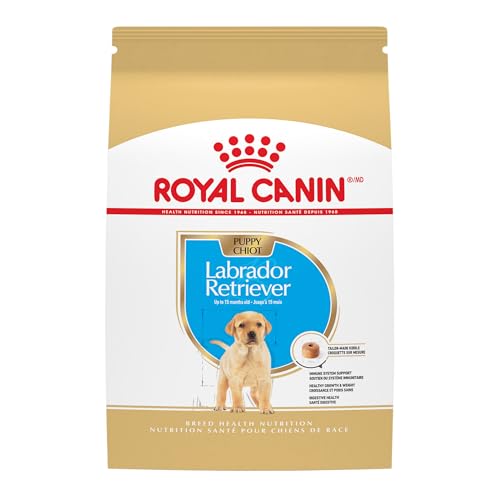
Royal Canin Labrador Retriever Puppy Dry Dog Food
What We Like
- Calcium and phosphorus support bone and joint development
- Antioxidants and vitamin E support immune system
- High-quality proteins and prebiotics promote stool quality
Trade-offs
- Formulated only for purebred Labrador Retrievers
- Not suitable for puppies outside the 8-week to 15-month range
The calcium and phosphorus levels are tailored to support bone and joint development during the rapid growth phase, while antioxidants and vitamin E back up the developing immune system. For owners of purebred Labs who want a formula built around their breed’s unique needs, this is the most targeted option available.
This formula is designed for purebred Labrador Retrievers, so it won’t suit mixed-breed puppies or other large breeds. In contrast, Royal Canin Large Puppy Dry Dog Food is formulated for any large breed puppy weighing 56 to 100 pounds. If you have a purebred Lab puppy, the donut-shaped kibble and joint-supporting minerals are tailored to the breed.
Purina Pro Plan Large Breed Puppy Food

What We Like
- Glucosamine for joint and cartilage support
- DHA from fish oil for brain and vision
- Real chicken as first ingredient
- Vitamin A and omega-6 for skin and coat
Trade-offs
- 34 lb bag is heavy for some owners to handle
- Chicken recipe excludes puppies needing lamb or fish protein
Glucosamine in the formula directly targets developing joints and cartilage, which matters for a large breed puppy whose rapid growth can put stress on those structures. That makes this bag a practical pick for owners who want to prioritize skeletal support during the first year. The DHA from fish oil also covers brain and vision development, while vitamin A and omega-6 fatty acids handle skin and coat. It’s a straightforward, ingredient-focused option that leans into structural health without extra frills.
For large breed puppies, joint support is a key concern, and this formula includes glucosamine to help developing joints and cartilage, which is a direct benefit for owners focused on that aspect of growth. While the Royal Canin Labrador Retriever Puppy formula offers breed-specific immune support and a specialized kibble shape, Purina Pro Plan takes a more general large-breed approach with joint health as a highlighted feature. If you want a clear emphasis on joint development without breed-specific extras, this is a straightforward choice.
Purina ONE Plus Large Breed Puppy Food

What We Like
- Real chicken as first ingredient
- DHA for vision and brain development
- Glucosamine for joint health
- No artificial flavors or preservatives
Trade-offs
- Only one protein source (chicken)
- Large breed formula not for small breeds
Real chicken is the number one ingredient in this dry puppy food, providing the protein needed for strong, growing muscles including a healthy heart. DHA, a nutrient found in mother’s milk, supports vision and brain development, while glucosamine supports joint health as the puppy grows. The formula includes four antioxidant sources for immune support and a SmartBlend of omega-6 fatty acids, vitamins, and minerals to support a shiny, healthy skin and coat. The crunchy bites and tender meaty morsels deliver great taste with no artificial flavors or preservatives.
This large breed formula is designed to support appropriate growth rate and joint health, making it a straightforward choice for owners who want a clear ingredient list. Compared to the Royal Canin Labrador Retriever Puppy formula, which features a specialized donut kibble, Purina ONE takes a more general large-breed approach. The 31.1 lb bag provides a practical amount for a growing puppy, though the recipe focuses on chicken as the primary protein source.
Royal Canin Large Puppy Dry Dog Food

What We Like
- Antioxidants support immune system
- Prebiotics and proteins promote gut health
- Supports brain development during growth
- Developed by veterinarians
Trade-offs
- Only for puppies 56-100 lbs adult weight
- Not suitable for puppies under 56 lbs adult weight
A 30-pound bag of kibble formulated for puppies with an expected adult weight of 56 to 100 pounds means this food is built for the growth phase of larger breeds. The inclusion of antioxidants, prebiotics, and proteins directly supports immune function and digestive health, two areas that matter a lot when a puppy’s system is still developing. If you’re raising a large-breed puppy that will land in that weight range, this formula gives you a targeted nutritional foundation without guesswork.
The most important thing to know is that this food is formulated for puppies expected to weigh between 56 and 100 pounds as adults. So if your pup is outside that range, you’ll need a different formula. The crunchy kibble is designed to be simple to serve and pairs well with the brand’s wet food for mixed feeding, giving you flexibility at mealtime. It supports brain development and energy needs during growth, while antioxidants and prebiotics work to bolster the immune system and promote gut health.
Fromm Large Breed Puppy Gold Dry Dog Food

What We Like
- Family-owned since 1904
- Three animal protein sources
- Whole grains for fiber and energy
- Formulated for large breed puppies
Trade-offs
- Not suitable for small or medium breed puppies
- Contains whole grains, which some owners avoid
Three named animal proteins, chicken, duck, and lamb, give this kibble a broader amino acid profile than most single-protein puppy foods. That matters for large breed puppies whose muscles, joints, and metabolic systems are developing fast. Fromm doesn’t rely on a single protein source or a vague ‘meat meal’ label; each ingredient is listed, and the whole grains add a vitamin and mineral variety that many grain-inclusive formulas skip. This is a food built on ingredient transparency, not marketing fluff.
The 30-pound bag is a practical size for large-breed puppies, but it means you’ll be reordering more often than with some bigger bags on the market. That’s a minor trade-off for a formula that clearly lists its protein sources and comes from a fifth-generation family company rather than a conglomerate. If you want straightforward ingredients and multiple animal proteins without fillers, this is the one to grab.
Eukanuba Puppy Large Breed Dry Dog Food
What We Like
- Real chicken as first ingredient
- Clinically proven DHA for brain development
- Optimized calcium and phosphorus for bones
- Concentrated energy for healthy growth
Trade-offs
- Only for puppies up to 15 months old
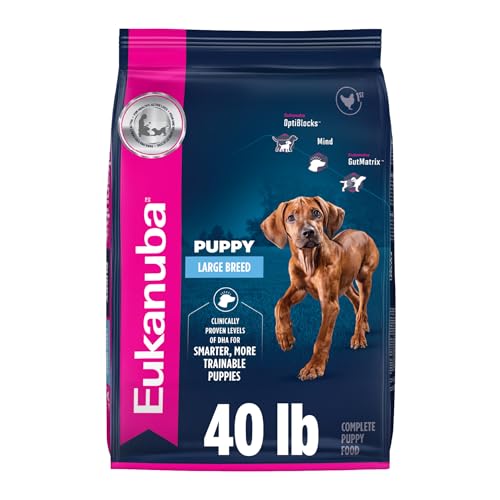
A 40-pound bag of Eukanuba Large Breed Puppy food is built around clinically proven levels of DHA, the fatty acid directly tied to healthy brain development in growing puppies. For an owner who wants a pup that picks up training quickly, that single spec matters more than most. Real chicken comes first in the ingredient list, providing the high-quality animal protein needed to support lean muscle growth during those rapid early months. The calcium and phosphorus levels are dialed in specifically for large-breed puppies expected to hit over 55 pounds as adults, helping ensure bone development keeps pace with their frame without outpacing it. This is a formula that puts nutritional science ahead of marketing fluff, exactly what a skeptical label-reader wants to see.
The most decisive fact here is that this food is formulated for large breed puppies up to 15 months old, so you’ll need to switch to an adult formula once they hit that age. That’s a step some owners would rather skip, but for those who want a diet tailored to a puppy’s rapid growth phase, it’s a focused choice. The DHA content supports healthy brain development, which reviewers note helps with early training and learning. If you’re looking for a food that provides complete and balanced nutrition specifically for large breed puppies, this bag delivers.
Product photos
Diamond Naturals Large Breed Puppy Dog Food
What We Like
- Real pasture-raised lamb is first ingredient
- Formulated for large breed puppy needs
- Includes DHA for brain development
- Suitable for puppy, adult, and senior dogs
Trade-offs
- Not breed-specific like some competitors
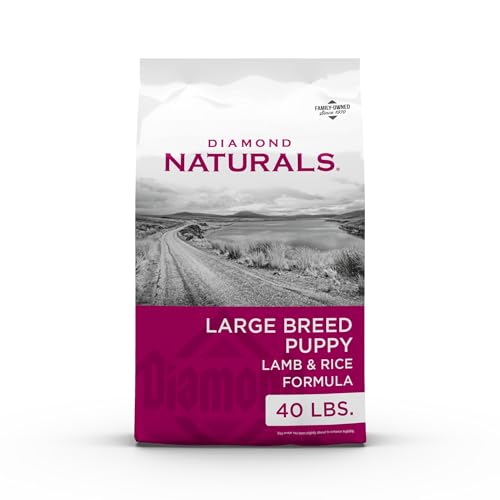
Real pasture-raised lamb is the first ingredient here, which is a clear signal that protein quality was a priority over cheap fillers. That matters for a growing large breed dog whose growth needs careful support, too much or too little of certain minerals can throw off bone development. Diamond Naturals adjusts the protein and mineral levels specifically for larger frames, so you’re not guessing whether a generic puppy food is appropriate. The 40-pound bag also covers more ground between refills, which is convenient if you’re feeding a growing Labrador that will eat through smaller bags quickly.
The trade-off is that this is a general large breed formula, not one tailored to a specific breed like Royal Canin’s Labrador Retriever Puppy option. That means you won’t get breed-specific kibble shape or a formula built around a Lab’s known tendencies, but you do get a straightforward ingredient list with lamb as the headline. If you prefer a food built around a single named protein source and don’t need breed-specific extras, this is a practical pick. For someone who wants a formula designed for a specific breed’s quirks, the Royal Canin Labrador version is the alternative.
Product photos
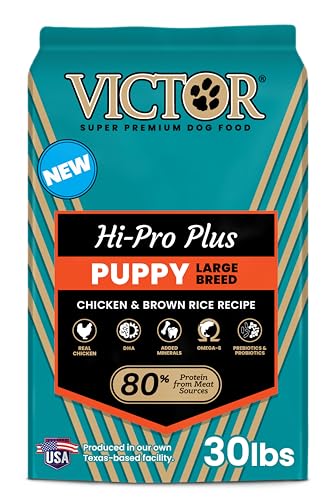
Victor Hi-Pro Plus Large Breed Puppy Food
What We Like
- Real chicken is first ingredient for lean muscle
- Fortified with DHA for brain and vision development
- Prebiotics and probiotics support digestive health
- No corn, wheat, soy, or artificial additives
Trade-offs
- Includes grains, not suitable for grain-free diets
- Kibble shape not specialized for large breed jaws
Real chicken is the first ingredient, which gives this formula a clear protein advantage for growing large breed puppies that need lean muscle development. Combined with DHA for brain and vision support and appropriate calcium and phosphorus levels for strong bones and teeth, this Victor formula is built around the nutritional demands of an active, growing lab puppy. The inclusion of prebiotics and probiotics also helps establish a healthy gut, which is often a concern with high-protein diets. This makes it a strong candidate for owners who want to prioritize muscle growth without sacrificing digestive health or overall development.
Real chicken is the first ingredient in this large breed puppy food, providing high-quality protein to support lean muscle growth during a puppy’s rapid development. The formula includes DHA for brain and vision development, plus appropriate calcium and phosphorus levels to help build strong bones and teeth. Prebiotics and probiotics work together to establish a healthy gut in growing puppies, and the recipe contains no corn, wheat, soy, or artificial flavors or colors. Compared to Purina Pro Plan Large Breed Puppy Food, which also includes DHA and calcium, Victor’s use of gluten-free ancient grains is a less common ingredient choice. For puppies that do well with grains, this is a well-formulated option; for those strictly avoiding grains, other choices would be better.
Product photos
Hill's Science Diet Puppy Large Breed Dog Food

What We Like
- Balanced minerals for growing bones and teeth
- DHA and Fish Oil for brain and eye development
- Antioxidant blend supports developing immune system
- High quality proteins fuel growing muscles
Trade-offs
- 27.5 lb bag is smaller than some large breed options
- Chicken-based recipe not suitable for all protein sensitivities
The DHA and Fish Oil content directly supports healthy brain and eye development in large breed puppies, a critical window for labs who need both mental and physical grounding. The balanced minerals target growing bones and teeth, while the antioxidant blend bolsters the developing immune system. This formula is built around the nutritional priorities a large breed puppy faces, using natural ingredients and high-quality proteins to fuel muscle growth without unnecessary fillers. It suits owners who want a veterinarian-backed foundation for their lab’s first year, backed by a brand that US veterinarians recommend more than any other.
Bag size is the trade-off: at 27.5 pounds, you’ll restock sooner than with Purina Pro Plan’s 34-pound bag, which also offers DHA but uses a different calcium-to-phosphorus ratio. For a large breed lab puppy eating several cups a day, that difference means more frequent trips to the store. The chicken and brown rice recipe is straightforward, but if your pup has a known poultry sensitivity, you’ll need to look elsewhere. For most lab owners, though, this is a reliable, veterinarian-recommended starting point that prioritizes the specific developmental needs of a growing large breed dog.
Product photos
IAMS Proactive Health Large Breed Puppy Dry Dog Food
What We Like
- Real chicken as first ingredient
- Omega-3 DHA for brain development
- Optimal calcium for bones and joints
- Vitamin E and selenium for immunity
Trade-offs
- Only one protein source listed
- Not suitable for small or medium breed puppies
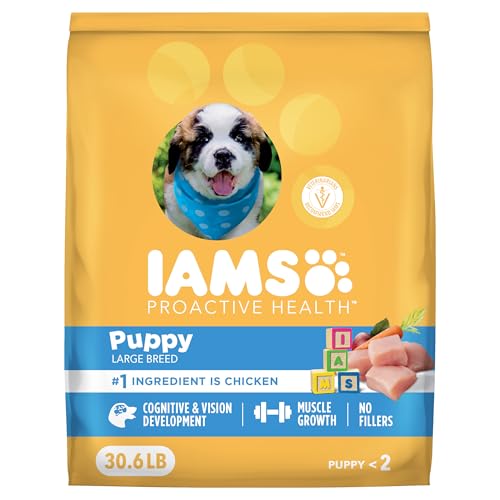
The Omega-3 DHA content in this formula is the standout feature, it directly supports cognitive and vision development in large breed puppies, which matters when you’re raising a breed prone to joint and neurological issues. Real chicken is the first ingredient, and the addition of optimal calcium levels targets bone and joint health without overdoing it. Vitamin E and selenium round out the immune support. This is a straightforward, nutritionally focused recipe that doesn’t rely on gimmicks, and it’s backed by veterinary recommendation. For a puppy food that prioritizes brain development from day one, this is a strong choice.
The nutritional profile here is solid, making it a practical choice for owners who want targeted cognitive support without the premium cost of breed-specific lines. The trade-off is that the formula sticks to chicken as the sole protein source, so if your lab puppy has sensitivities or you prefer variety, you’ll need to look elsewhere.
Product photos
How We Evaluated Puppy Foods For Labs
We evaluated these puppy foods by reviewing manufacturer nutritional data, ingredient lists, and feeding guidelines. Our research also drew on veterinary nutrition resources and patterns from thousands of owner experiences to understand what works for Labrador puppies in real homes.
The four criteria that mattered most were appropriate calcium and phosphorus levels for large-breed bone development, DHA content for brain and vision development, protein source quality and digestibility, and kibble shape or size that encourages chewing rather than gulping. Labs are notorious fast eaters, so kibble design matters more than many owners realize.
A research-led evaluation has limits. We did not feed these foods to puppies in a controlled setting, and individual results vary with each dog’s metabolism, activity level, and health history. Always transition a new food gradually over several days and consult your veterinarian before making a switch, especially for a growing large-breed puppy.
What To Look For In Puppy Foods For Labs
Choosing a puppy food for a Labrador means looking past the front of the bag to the guaranteed analysis and ingredient list. The right formula supports steady, controlled growth without stressing joints or digestion.
Look for a food with balanced calcium (1.0% dry matter), DHA from fish oil, a named animal protein as the first ingredient, and a kibble size or shape that slows down fast eaters.
Calcium and Phosphorus Balance
Large-breed puppies like Labs need carefully controlled calcium levels to avoid skeletal abnormalities. The Association of American Feed Control Officials (AAFCO) recommends 1.0% calcium on a dry matter basis for large-breed growth formulas. Too much calcium can be as problematic as too little, so avoid “all life stages” foods that may overshoot this range for a growing Lab. Phosphorus should appear in a ratio close to 1:1 with calcium for proper bone mineralization.
DHA for Brain and Vision Development
Docosahexaenoic acid (DHA) is an omega-3 fatty acid that supports cognitive development and retinal health in puppies. The best formulas for Labs include DHA from fish oil rather than algal oil, as the marine source is more bioavailable. Look for DHA listed in the guaranteed analysis or as a named ingredient like “fish oil” or “menhaden fish meal.” This is especially relevant when you are choosing food for a Lab puppy during the critical socialization and training window from 8 weeks to 6 months.
Protein Source and Kibble Shape
Labrador puppies need a high-quality animal protein as the first ingredient to support lean muscle growth without excessive calories. Chicken, lamb, and fish are common first ingredients in the formulas we evaluated. Kibble shape is an underrated factor: Labs tend to inhale food, and a large or uniquely shaped kibble encourages chewing and slows eating, which can reduce bloating risk. The best dry food for Lab puppies often features a larger kibble than standard puppy formulas for this reason.
- Check the guaranteed analysis for calcium between 1.0% and 1.5% on a dry matter basis.
- Confirm DHA is listed in the guaranteed analysis or as a named ingredient.
- Ensure a named animal protein (chicken, lamb, fish) is the first ingredient.
- Look for a kibble size or shape designed for medium-to-large breed puppies.
A good rule of thumb: if the kibble fits through a standard soda bottle opening, it is probably too small for a Labrador puppy.
Puppy Foods For Labs Compared
The table below compares all formulas side by side, covering protein source, key nutritional features, and best-use scenarios for each.
| Product | Protein Source | Key Nutrients | Bag Weight |
|---|---|---|---|
| Royal Canin Labrador Retriever Puppy Dry Dog Food | N/A | Antioxidants, vitamin E, calcium, phosphorus | 30 lb |
| Purina Pro Plan Large Breed Puppy Food | Chicken, first ingredient | Glucosamine, DHA, Vitamin A & omega-6 | 34 lb |
| Purina ONE Plus Large Breed Puppy Food | Real chicken #1 | DHA, glucosamine | 31.1 lb |
| Royal Canin Large Puppy Dry Dog Food | N/A | Antioxidants, prebiotics, proteins | 30 lb |
| Fromm Large Breed Puppy Gold Dry Dog Food | Chicken, duck, lamb | N/A | 30 lb |
| Eukanuba Puppy Large Breed Dry Dog Food | Real Chicken First | DHA, calcium, phosphorus | 40 lb |
| Diamond Naturals Large Breed Puppy Dog Food | Pasture-raised lamb | DHA | 40 lb |
| Victor Hi-Pro Plus Large Breed Puppy Food | Real Chicken | DHA, Omega 3 & 6, Prebiotics & Probiotics | 30lb |
| Hill's Science Diet Puppy Large Breed Dog Food | Chicken & Brown Rice | DHA and Fish Oil | 27.5 lb |
| IAMS Proactive Health Large Breed Puppy Dry Dog Food | Real chicken #1 | Omega-3 DHA, calcium, Vitamin E | 30.6 lb |
Frequently Asked Questions
When should I switch my Lab puppy from puppy food to adult food?
Most Labrador puppies should transition to adult food between 12 and 15 months of age. Large-breed puppies mature more slowly than smaller breeds, so feeding a large-breed puppy formula until the growth plates close helps protect joints. Your veterinarian can confirm when your individual dog is ready based on weight and skeletal maturity.
How much should I feed my Labrador puppy?
Feeding amounts vary by formula, age, and activity level. Most puppy food bags provide a weight-based feeding chart that starts at about 1 cup per day for an 8-week-old puppy and increases as the puppy grows. Divide the daily amount into three meals until 6 months, then two meals thereafter. Monitor your puppy’s body condition and adjust portions rather than relying solely on the bag’s recommendation.
What ingredients should I avoid in Lab puppy food?
Avoid formulas with unnamed animal by-products, artificial colors, flavors, or preservatives like BHA, BHT, and ethoxyquin. For large-breed puppies, also avoid “all life stages” foods that may contain excessive calcium or phosphorus. Some owners prefer to avoid corn, wheat, and soy, though these ingredients are not inherently harmful unless your puppy has a specific sensitivity.
Can I feed my Lab puppy a grain-free diet?
Grain-free diets are not recommended for large-breed puppies unless prescribed by a veterinarian. Research has linked grain-free formulas to dilated cardiomyopathy (DCM) in some dogs, and most veterinary nutritionists advise against them for growing large breeds. The large breed puppy food options we evaluated include wholesome grains that provide fiber and energy for active Labs.
What makes Labrador puppy nutrition different from other breeds?
Labrador Retrievers are prone to hip and elbow dysplasia, obesity, and rapid growth, so their puppy food must support controlled skeletal development without excess calories. Breed-specific formulas like the Royal Canin Labrador Retriever Puppy include tailored calcium levels and a unique kibble shape that discourages gulping. General large-breed puppy foods also work well, but the most targeted Labrador puppy nutrition comes from formulas designed specifically for the breed’s growth patterns.
The Bottom Line
The Royal Canin Labrador Retriever Puppy Dry Dog Food is our Best Overall pick for purebred Lab puppies from 8 weeks to 15 months. Its breed-specific kibble shape slows down fast eaters, and its calcium and phosphorus levels are calibrated for the breed’s rapid bone development. If you have a mixed-breed puppy or a Lab outside that age range, a large-breed formula like Purina Pro Plan Large Breed Puppy Food is a strong alternative.
For owners focused on joint health, the Purina Pro Plan formula includes glucosamine and DHA from fish oil. Budget-conscious buyers should consider Purina ONE Plus Large Breed Puppy Food, which offers real chicken as the first ingredient and glucosamine at a more accessible price point. Those who prefer a family-owned brand will appreciate Fromm Large Breed Puppy Gold, with three animal protein sources and whole grains.
The single most important factor in choosing a puppy food for your Lab is appropriate calcium and phosphorus levels for large-breed growth. Everything else, protein source, DHA content, kibble shape, supports that foundation. Check the guaranteed analysis before you buy, and transition any new food slowly over a week to keep your puppy’s digestion on track.
