
10 Best Dry Food For Constipated Cat in 2026
This post contains affiliate links. As an Amazon Associate, we earn from qualifying purchases.
The best overall dry food for a constipated cat is Hill’s Prescription Diet GI Biome Stress Digestive/Fiber Care Dry Cat Food. It promotes regular stool in 24 hours while reducing stress with hydrolyzed casein. For cats that don’t need a prescription, the Hill’s Science Diet Adult Urinary & Hairball Control Dry Cat Food is the best for hairball and digestion, while the Royal Canin Digestive Care Adult Cat Dry Cat Food is the best for sensitive stomachs.
Constipation in cats often comes down to insufficient fiber, low moisture intake, or stress that slows gut motility. The right dry food needs to provide the right balance of prebiotic fibers, moisture from other sources, and digestible protein, not just more filler.
We evaluated these formulas by analyzing ingredient lists, fiber sources, manufacturer research, and patterns in owner feedback. This guide breaks down what to look for on the label and which foods match your cat’s specific needs.
Top 10 Dry Foods For Constipated Cats in the Market

Certain content that appears on this site comes from Amazon. This content is provided "as is" and is subject to change or removal at any time.
The Best Dry Foods For Constipated Cats, Reviewed
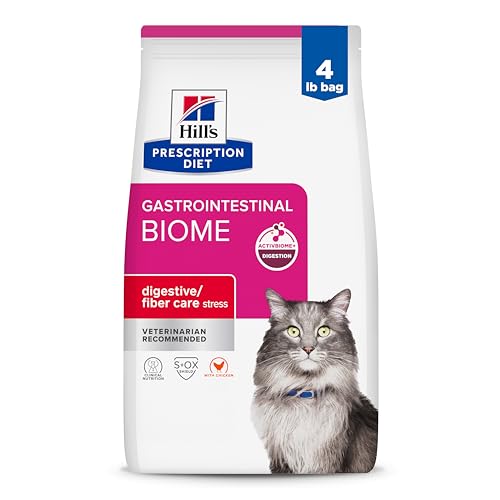
Hill's Prescription Diet GI Biome Stress Digestive/Fiber Care Dry Cat Food
What We Like
- Promotes regular stool in 24 hours
- Reduces stress with hydrolyzed casein
- ActivBiome+ supports gut microbiome
- Prebiotic fibers balance digestion
Trade-offs
- Requires veterinary consultation to purchase
- Not suitable for cats without digestive issues
- Limited to prescription diet access
The ActivBiome+ ingredient technology in this formula is designed to rapidly activate beneficial gut bacteria and support a healthy GI microbiome balance, which can help a constipated cat. Clinical nutrition from Hill’s aims to help promote regular healthy stool in as little as 24 hours, making this a targeted option for cats with digestive stress. It combines fiber management with stress reduction via hydrolyzed casein and L-tryptophan, addressing two common triggers for constipation in one formula. High levels of omega-3 fatty acids (DHA & EPA) round out a prescription diet that’s backed by the #1 US Vet Recommended therapeutic pet food brand.
The trade-off is that this is a prescription diet, so you’ll need a vet’s okay to buy it, which adds a step compared to over-the-counter options. That said, for a cat with chronic constipation or stress-related digestive issues, the targeted clinical formulation justifies the extra effort. Compared to the Royal Canin Digestive Care Adult Cat Dry Food, which offers general digestive support, Hill’s Prescription Diet goes a step further by addressing the behavioral side of gut health. If your cat’s constipation is tied to stress, this dual-action approach makes it worth consulting your vet about.
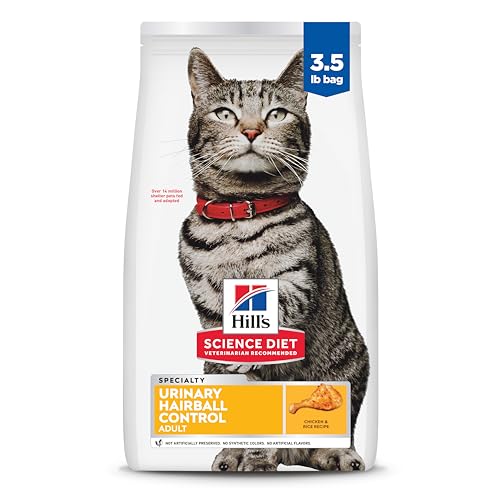
Hill's Science Diet Adult Urinary & Hairball Control Dry Cat Food
What We Like
- Clinically shown to support urinary health
- Natural fiber helps reduce hairballs
- Made with natural ingredients plus added vitamins
- Made in the USA with global ingredients
Trade-offs
- Not formulated for cats with sensitive stomachs or skin issues.
The #1 Veterinarian Recommended claim carries real weight in a crowded category, especially when you’re trying to manage both urinary issues and hairballs. This formula uses natural fiber to help reduce hairballs while supporting healthy digestion, and the clinically shown urinary health support means you’re not trading one problem for another. It’s a solid fit for a constipated cat that also tends to hack up hairballs, because the fiber addresses both issues without relying on laxatives or artificial additives. The ingredient list is straightforward, natural ingredients with added vitamins, minerals, and amino acids, and the US manufacturing gives you a baseline of quality control.
The #1 Veterinarian Recommended brand backs this formula, which is clinically shown to promote urinary health by supporting a healthy mineral content in the urine. Natural fiber helps reduce hairballs and supports healthy digestion, making it a targeted option for cats with both urinary and hairball concerns. Made with natural ingredients plus added vitamins, minerals, and amino acids, and produced in the USA with global ingredients you can trust.
Royal Canin Digestive Care Adult Cat Dry Cat Food

What We Like
- Ring-shaped kibble slows eating
- Prebiotics and fiber for digestion
- Proven 95% healthy stool quality
- Pairs with wet food formulas
Trade-offs
- Only 3 lb bag, frequent repurchasing
- Not a prescription diet for severe cases
A 95% healthy stool quality after 10 days is the kind of concrete result you want when your cat’s digestion is off. That internal study gives this formula real credibility for sensitive stomachs. The ring-shaped kibble is a thoughtful touch, slower eating means less gulping and better breakdown in the gut. Prebiotics and dietary fiber do the heavy lifting here, supporting healthy digestion without relying on exotic ingredients or marketing fluff. It’s a straightforward, vet-developed option for adult cats whose stomachs need a little extra help staying on track.
At just 3 pounds, this bag means you’ll be reordering more often than with a 3.5-pound option like Hill’s Science Diet Sensitive Stomach & Skin. That’s a small trade-off if your cat’s stomach is sensitive enough to benefit from the prebiotics and dietary fiber in this formula. For cats with severe digestive issues requiring a therapeutic diet, this is a maintenance food, not a prescription intervention. But for everyday digestive care in a cat with a touchy stomach, the stool quality results from an internal study, over 95% healthy stool after 10 days, and the slow-eating kibble make it a practical, no-nonsense pick.
Blue Buffalo True Solutions Digestive Care Chicken Dry Cat Food
What We Like
- Clinically proven prebiotic fiber for stool quality
- Real chicken is the #1 ingredient
- No chicken by-product meals, corn, wheat, or soy
Trade-offs
- Not suitable for cats needing a grain-free diet
- Contains no probiotics for additional gut support
A clinically proven prebiotic fiber formula means this food directly targets stool quality and digestive health, exactly what a constipated cat needs. Real chicken leads the ingredient list, and the recipe skips chicken by-product meals, corn, wheat, and soy, so you’re getting a cleaner protein source with fewer fillers. Made in the USA and recommended by veterinarians, it’s a straightforward, evidence-based option for owners who want to address constipation without guesswork.
The bag size is 11 pounds, which is a standard volume for this type of food. If your cat is a picky eater or you prefer rotating proteins, you might want to start with a smaller bag from another brand. This Blue Buffalo option offers more volume per purchase, which can be convenient for households with multiple cats or for owners who want to stock up.
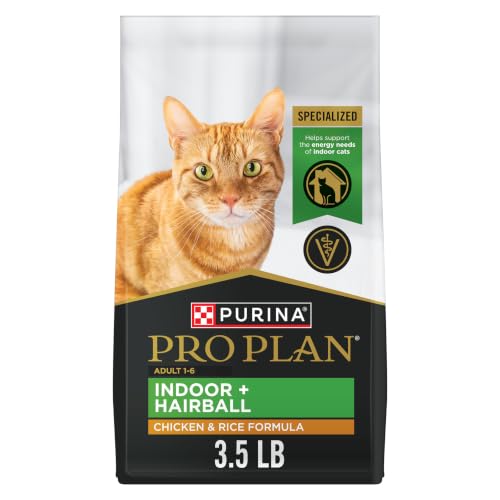
Purina Pro Plan Adult Indoor High Protein Cat Food
What We Like
- Real chicken as first ingredient
- Fiber-rich for hairball control
- Supports lean muscle maintenance
- Formulated for indoor cats' needs
Trade-offs
- Not a therapeutic diet for digestive disorders
- Lacks a grain-free option for sensitive cats
A fiber-rich formula with real chicken as the first ingredient means this food targets the two biggest indoor cat complaints: hairballs and weight management. The protein supports lean muscle for cats that spend most of their day on the couch, while the fiber helps move hair through the digestive system rather than letting it accumulate. It’s a sensible everyday option for a cat that’s generally healthy but needs a little help with hairball passage and staying trim indoors.
This formula is designed for everyday wellness, not for treating medical conditions. The fiber content supports hairball control, but if your cat has ongoing digestive problems, a veterinarian-prescribed diet like Hill’s Prescription Diet GI Biome Stress Digestive/Fiber Care may be more appropriate. For a generally healthy indoor cat that occasionally deals with hairballs, this Purina Pro Plan option provides balanced nutrition at a practical price.
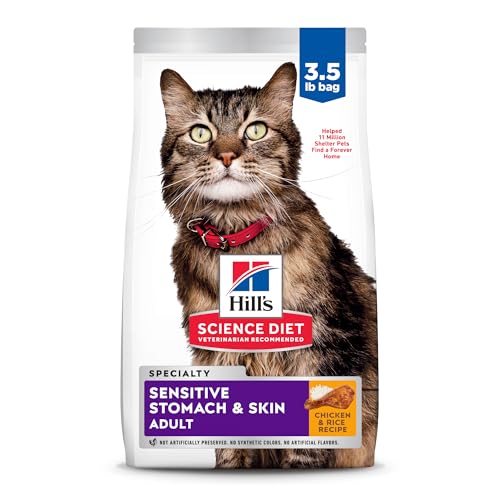
Hill's Science Diet Sensitive Stomach & Skin Dry Cat Food
What We Like
- Prebiotic fiber for gentle digestion
- Omega-3 & 6 for skin and coat
- Vitamin E and C+E for immunity
- Chicken is the #1 ingredient
Trade-offs
- Not a specialized prescription diet for chronic conditions
- Contains chicken, not suitable for poultry allergies
With prebiotic fiber as a key feature, this formula is designed to be gentle on the stomach and support regular digestion, important for cats with sensitive systems. The inclusion of omega-3 and 6 fatty acids, along with vitamin E, also targets skin and coat health, making it a multi-benefit option. It suits owners who want a balanced, veterinarian-recommended diet that prioritizes digestive comfort without sacrificing overall nutrition.
The #1 veterinarian-recommended brand offers a highly digestible formula with prebiotic fiber that is gentle on the stomach, so it helps adult cats with occasional sensitivity absorb nutrients without upset. The 3.5-pound bag is light enough to try out, though larger households may need to buy multiple bags.
Product photos
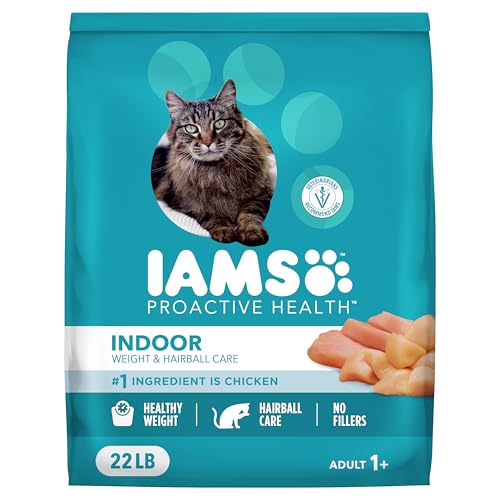
IAMS Proactive Health Indoor Dry Cat Food
What We Like
- Real chicken is #1 ingredient
- Proprietary fiber blend for hairball control
- L-carnitine supports healthy weight
- 22 lb bag offers extended supply
Trade-offs
- Contains grains, not grain-free
- Fiber blend targets hairballs, not constipation specifically
This formula puts real chicken and turkey as the first ingredient, backed by a proprietary fiber blend that includes beet pulp to help reduce hairballs before they form. The addition of L-carnitine is a practical touch for indoor cats that tend to gain weight, it supports fat burning for energy rather than just storing it. The 22-pound bag provides an extended supply for households with one or more cats.
The proprietary fiber blend with beet pulp is formulated to help reduce hairballs before they start, so if your cat tends to hack up fur clumps, this food addresses that directly. The same fiber also provides prebiotics for healthy digestion, supporting regularity as part of its overall design. For an indoor cat that needs hairball control along with good digestive support, this recipe covers both without overcomplicating things.
Product photos
Purina ONE Natural Hairball Control Dry Cat Food

What We Like
- Real chicken is first ingredient
- Natural fiber-rich blend for hairballs
- Contains four antioxidant sources
- No artificial flavors or preservatives
Trade-offs
- Not a prescription diet for severe cases
- Not suitable for kittens or senior cats
Real chicken is the first ingredient, which gives this formula a solid protein base while the natural fiber-rich blend targets hairball formation. The SmartBlend includes four antioxidant sources to support immune health, and the added calcium helps support strong teeth and healthy gums. It’s a straightforward, no-nonsense option for a cat that tends to hack up hairballs but doesn’t need a veterinary prescription diet.
This is a general hairball control food, not a specialized digestive or urinary formula like Hill’s Science Diet Adult Urinary & Hairball Control. For a cat that just needs regular hairball management without added medical intervention, this is a clean, well-built choice.
Product photos
Solid Gold Indoor Salmon Dry Cat Food

What We Like
- High fiber from pumpkin and broccoli
- Live probiotics for gut health
- Salmon protein for picky cats
- Includes antioxidants and omega fatty acids
Trade-offs
- 3 lb bag is a small trial size
- No specified fiber percentage on label
The fiber here comes from lentils, pumpkin, and broccoli, three whole-food sources that work together to support digestion and help move things along. For a constipated cat, that mix of soluble and insoluble fiber can make a real difference in stool consistency and regularity. Add in live probiotics and prebiotics to support gut flora, and you’ve got a formula that targets the digestive tract from multiple angles. This is a good fit for owners who prefer grain-free recipes and want recognizable ingredients like salmon over a long list of supplements.
The bag size is a factor: at 3 pounds, you’re getting a trial-size amount, not a bulk buy. That’s fine for testing whether your cat accepts the salmon flavor or tolerates the grain-free formula, but if you have multiple cats or a cat with a big appetite, you’ll be reordering often. Compared to Royal Canin Digestive Care, which also targets sensitive stomachs, this Solid Gold recipe leans on grain-free fiber sources. It is a reasonable choice for cats who need extra fiber and do well without grains.
Product photos
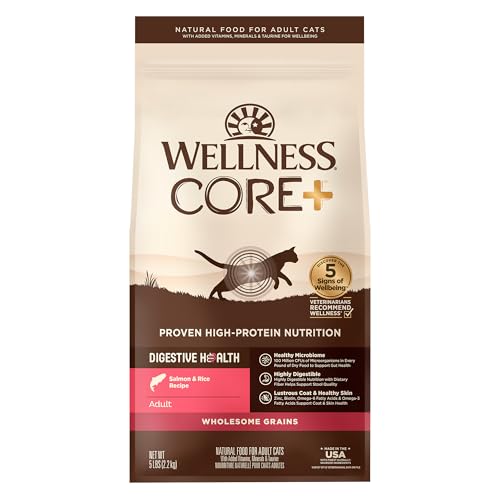
Wellness CORE+ Digestive Health Adult Dry Cat Food
What We Like
- Probiotic coated kibble supports digestion
- Includes prebiotic fibers and digestive enzymes
- Natural ingredients with superfoods
Trade-offs
- Only available in 5 lb bag size
- Not formulated for kittens or seniors
A 5-pound bag of probiotic-coated kibble means each piece carries live gut-supporting bacteria, not just a dusting that wears off. That coating, paired with prebiotic fibers and digestive enzymes, targets the root of digestive issues by feeding the good bacteria already in your cat’s gut. This is the kind of formulation that makes sense for a cat who needs gentle, daily digestive support rather than a one-time fix. It’s designed for adult cats, so it works for cats in their prime, and the salmon and rice recipe keeps the ingredient list straightforward without unnecessary fillers.
The probiotic coating on this kibble is a real differentiator: most dry foods lose probiotic viability during processing, but coating after baking preserves the bacteria. At 5 pounds, the bag is compact and easy to store, though it’s smaller than some competitors like Blue Buffalo True Solutions Digestive Care (11 lb) or IAMS Proactive Health Indoor (22 lb). For a single adult cat needing daily digestive support, this targeted approach often justifies the smaller size.
Product photos
How We Evaluated Dry Foods For Constipated Cats
We built this guide from manufacturer-published nutritional data, ingredient specifications, and patterns reported by cat owners and veterinary nutrition experts. Every food was assessed for its fiber type and content, protein source quality, and any clinical research behind its digestive claims.
The three criteria that mattered most were fiber profile (soluble vs. Insoluble and total percentage), ingredient transparency (named proteins, no vague by-products), and whether the formula was designed specifically for digestive health. It had to be designed for that purpose, not merely marketed as such. Prescription diets were evaluated separately because they require a veterinarian’s approval and target diagnosed conditions.
A research-led evaluation has limits: we cannot claim to have tested these foods on actual cats, and individual results depend on your cat’s specific health status, age, and hydration habits. Always consult your veterinarian before switching foods for a medical issue like constipation.
What To Look For In Dry Foods For Constipated Cats
Choosing the right kibble means reading past the marketing claims and checking the fiber source, protein digestibility, and whether the food is formulated for your cat’s specific life stage and health status.
Look for a named animal protein as the first ingredient, a blend of soluble and insoluble fiber sources (like psyllium, beet pulp, or pumpkin), and avoid vague “by-product” meals. Prescription diets offer targeted fiber levels but require a vet’s approval.
Fiber Type and Content
Not all fiber helps constipation the same way. Soluble fiber (from psyllium, beet pulp, or inulin) absorbs water and forms a gel that softens stool, while insoluble fiber (from cellulose or grain hulls) adds bulk. The best dry foods for constipation use a combination of both. The best high-fiber dry cat food options typically list a specific fiber percentage around several percent crude fiber, but the type matters more than the number.
Protein Quality and Digestibility
A highly digestible protein puts less strain on the digestive tract. Look for named sources like chicken, salmon, or turkey as the first ingredient. Foods with chicken by-product meal or unnamed meat meals are harder for some cats to break down and can contribute to irregular stool. The best food for digestive issues will have a single, named animal protein and minimal filler ingredients.
Prescription vs. Over-the-Counter
Prescription diets like Hill’s GI Biome contain targeted fiber blends and hydrolyzed proteins that aren’t available in standard pet store formulas. They require a vet’s authorization and are designed for diagnosed conditions. For milder or occasional constipation, non-prescription cat food with prebiotic fiber and probiotics can be effective. Know which category your cat needs before shopping.
Kibble Shape and Size
Some cats eat too fast, gulping air that leads to gas and irregular digestion. Ring-shaped or large-diameter kibble slows eating and encourages chewing. The feeding tips for constipation often include switching to a slow-eating kibble design or using puzzle feeders.
- Check the crude fiber percentage on the guaranteed analysis label
- Look for at least one named soluble fiber source (psyllium, inulin, beet pulp)
- Verify the protein source is a named meat, not a by-product meal
- Consider kibble shape if your cat eats too quickly
- Confirm the food is formulated for your cat’s life stage (adult, senior)
A good rule of thumb: the first three ingredients should be a named protein, a named fiber source, and a whole grain or legume, not a “meal” or “by-product.”
Dry Foods For Constipated Cats Compared
The table below compares all ten dry foods across fiber type, protein source, and key digestive features so you can see the differences at a glance.
| Product | Primary Benefit | Key Ingredient Technology | Weight | Fiber Type |
|---|---|---|---|---|
| Hill's Prescription Diet GI Biome Stress Digestive/Fiber Care Dry Cat Food | Digestive health & stress reduction | ActivBiome+ | 4.0 pounds | Prebiotic fibers |
| Hill's Science Diet Adult Urinary & Hairball Control Dry Cat Food | Urinary & Hairball Control | Natural fiber | 3.5 pounds | Natural fiber |
| Royal Canin Digestive Care Adult Cat Dry Cat Food | Digestive Support | Prebiotics, dietary fiber | 3.0 pounds | Prebiotics, dietary fiber |
| Blue Buffalo True Solutions Digestive Care Chicken Dry Cat Food | Digestive Care | Clinically Proven Prebiotic Fiber | 11.1 pounds | Clinically Proven Prebiotic Fiber |
| Purina Pro Plan Adult Indoor High Protein Cat Food | Indoor High Protein | Fiber-rich formula | 3.5 pounds | Fiber-rich |
| Hill's Science Diet Sensitive Stomach & Skin Dry Cat Food | Sensitive Stomach & Skin | Prebiotic fiber | 3.5 pounds | Prebiotic fiber |
| IAMS Proactive Health Indoor Dry Cat Food | Indoor Health | Proprietary Fiber Blend | 22.0 pounds | Proprietary Fiber Blend |
| Purina ONE Natural Hairball Control Dry Cat Food | Hairball Control | Natural fiber-rich blend | 7.0 pounds | Natural fiber-rich blend |
| Solid Gold Indoor Salmon Dry Cat Food | Indoor Salmon | Probiotics & prebiotics | 3.0 pounds | Lentils, pumpkin, broccoli |
| Wellness CORE+ Digestive Health Adult Dry Cat Food | Digestive Health | Probiotic Coated | 5.0 pounds | Prebiotic fibers |
Frequently Asked Questions
What is the best dry food for a constipated cat?
The best overall is Hill’s Prescription Diet GI Biome Stress Digestive/Fiber Care Dry Cat Food, which uses prebiotic fibers and hydrolyzed casein to promote regular stool within 24 hours. It requires a veterinarian’s approval. For non-prescription options, look for dry cat food for constipation with named fiber sources like beet pulp or psyllium.
Can dry food help with cat constipation?
Yes, but only if the formula contains the right balance of soluble and insoluble fiber and the cat is drinking enough water. Dry food alone lacks the moisture of wet food, so moisture-rich wet food can be fed alongside kibble to increase hydration. Always ensure fresh water is available.
How much fiber does a constipated cat need?
Most adult cats benefit from a crude fiber content between a few percent and several percent on a dry matter basis, but the fiber type matters more than the percentage. Soluble fibers like psyllium and inulin soften stool, while insoluble fibers add bulk. A psyllium husk supplement can be added under veterinary guidance if the food’s fiber profile isn’t enough.
What ingredients should I avoid in cat food for constipation?
Avoid foods with unnamed meat by-products, artificial colors, and excessive grain fillers like corn gluten meal. These can be harder to digest and may worsen constipation. Stick to foods for stool consistency that list a named protein and at least one named fiber source.
When should I take my constipated cat to the vet?
If your cat hasn’t produced a stool in more than two days, is straining without results, vomiting, or showing signs of pain, see a veterinarian immediately. Chronic constipation can lead to megacolon. A vet can recommend the right foods for feline constipation and rule out underlying medical issues.
The Bottom Line
For cat owners willing to work with a veterinarian, the Hill’s Prescription Diet GI Biome Stress Digestive/Fiber Care Dry Cat Food is the most effective option for constipation that’s tied to stress or gut microbiome imbalance. Its ActivBiome+ technology and hydrolyzed casein target both stool regularity and anxiety. No over-the-counter food can match that combination.
If you prefer a non-prescription route, the Hill’s Science Diet Adult Urinary & Hairball Control Dry Cat Food offers excellent fiber support for hairball and digestion issues. The Royal Canin Digestive Care Adult Cat Dry Cat Food is the top choice for cats with sensitive stomachs who need slow-eating kibble. Budget-conscious owners will find solid value in the IAMS Proactive Health Indoor Dry Cat Food‘s large bag.
The single most important factor is matching the fiber type and protein digestibility to your cat’s specific condition. Don’t just pick any food labeled “digestive health.” Read the ingredient list, check the fiber source, and consult your vet before making a switch.
