
10 Best Dog Food For Puppies Large Breed in 2026
This post contains affiliate links. As an Amazon Associate, we earn from qualifying purchases.
The Purina Pro Plan Large Breed Puppy Food wins as best overall because it leads with real chicken, includes DHA for brain development, and adds glucosamine for growing joints. All of that comes in a formula designed for large-breed growth rates. For a high-protein option, the Victor Hi-Pro Plus Large Breed Puppy Food is a strong choice, while the Hill’s Science Diet Large Breed Puppy Food earns our veterinarian-recommended pick.
A large breed puppy grows fast, too fast, if the diet isn’t right. Too much calcium or the wrong calorie balance can stress developing bones and joints. That is why large-breed-specific formulas exist: they manage growth rate, calcium levels, and calorie density to support a healthy frame without pushing rapid weight gain.
This guide is research-based. We compared ingredient lists, guaranteed analyses, and manufacturer feeding guidelines across ten formulas. We also looked at patterns in owner feedback and expert recommendations to find what actually works for large breed puppies. The result is a clear, practical breakdown of what to feed your growing dog and why.
Top 10 Dog Foods For Puppies Large Breed in the Market
Certain content that appears on this site comes from Amazon. This content is provided "as is" and is subject to change or removal at any time.
The Best Dog Foods For Puppies Large Breed, Reviewed
Purina Pro Plan Large Breed Puppy Food

What We Like
- Real chicken as first ingredient
- DHA for brain and vision development
- Glucosamine for joints and cartilage
- Calcium for strong bones and teeth
Trade-offs
- Contains grains, not grain-free
- Not suitable for small breed puppies
A 34-pound bag of dry kibble with real chicken listed first and DHA from fish oil for brain and vision development makes this a straightforward nutritional package for a large breed puppy. The formula also includes glucosamine to support developing joints and cartilage, plus calcium for strong bones and teeth, exactly the kind of targeted support a growing large breed needs. If you’re looking for a food that covers the basics without a lot of marketing fluff, this is the one to grab.
The main trade-off is the bag size: at 34 pounds, it’s not the easiest to pour from if you have limited upper body strength or storage space. Compared to the 30-pound bag from Wellness Complete Health, this one is heavier, so consider your handling situation. Also, this is a grain-inclusive formula, which rules it out if you’re set on a grain-free diet. For anyone who wants a solid large breed puppy food with real meat and joint support, this fits the bill.
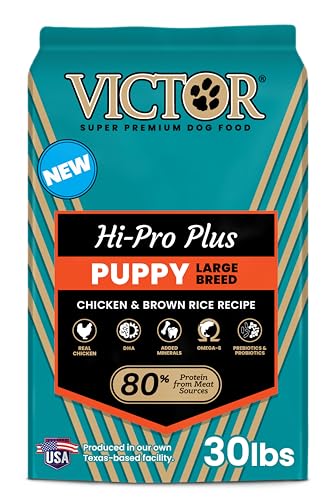
Victor Hi-Pro Plus Large Breed Puppy Food
What We Like
- Real chicken is first ingredient
- DHA for brain and vision development
- Prebiotics and probiotics for gut health
- No corn, wheat, or soy
Trade-offs
- Gluten-free grains still include grains
- Large breed puppy only, not for small breeds
Real chicken as the first ingredient means this formula puts a high-quality protein source front and center, which supports lean muscle growth in a growing large-breed puppy. That protein punch is backed by DHA for brain and vision development, plus appropriate calcium and phosphorus levels for strong bones and teeth. The VPRO Blend, a mix of five researched ingredients, aims to maximize genetic potential regardless of breed or activity level. That makes it a solid fit for owners who want a protein-forward diet without artificial flavors or colors.
Real chicken is the first ingredient, so your large breed puppy gets high-quality protein for lean muscle growth rather than fillers like corn, wheat, or soy. The formula includes gluten-free ancient grains, which means it’s not grain-free, something to keep in mind if you strictly avoid grains. It also provides DHA for brain and vision development, plus prebiotics and probiotics to help establish a healthy gut.
Hill's Science Diet Large Breed Puppy Food

What We Like
- Balanced minerals for growing bones and teeth
- DHA and Fish Oil for brain and eye development
- Antioxidant blend supports developing immune system
- High quality proteins fuel growing muscles
Trade-offs
- Contains grains, which some owners avoid
- Not suitable for small or toy breed puppies
The #1 veterinarian recommended brand claim carries weight when you look at the formulation. It includes balanced minerals for growing bones and teeth, DHA and fish oil for brain and eye development, and an antioxidant blend for the developing immune system. This is a food built around the specific needs of a large breed puppy, not a generic kibble with a big-dog label slapped on. For anyone who wants a nutritionally complete, science-backed option from a brand vets trust most, this is the straightforward choice.
The trade-off is that it’s not a grain-free recipe, which some owners prefer for digestive or allergy reasons. Compared to the Purina Pro Plan Large Breed Puppy Food, which also offers DHA and calcium but in a 34 lb bag, Hill’s comes in a slightly smaller 27.5 lb package. That difference matters if you’re feeding a growing giant breed that plows through food quickly, but the ingredient transparency and veterinarian recommendation make this a strong pick for buyers who prioritize formulation over bag size.
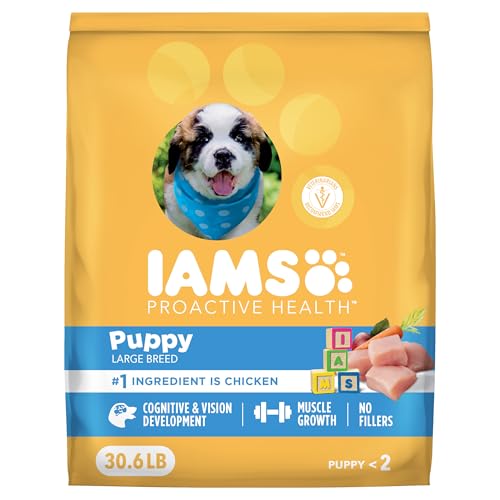
IAMS Proactive Health Large Breed Puppy Food
What We Like
- Real chicken is first ingredient
- Omega-3 DHA for cognitive development
- Optimal calcium for large breed joints
- Antioxidants Vitamin E and Selenium
Trade-offs
- Contains grains, not grain-free
- Bag shape is long and flat, awkward for storage
A 30.6-pound bag with real chicken as the number one ingredient means this recipe puts protein first, not fillers. The Omega-3 DHA supports brain and vision development during those critical early months, while the carefully calibrated calcium level targets the bone and joint health that large breed puppies need. This formula delivers the essentials for large breed puppy development.
This is a grain-inclusive kibble, so if you prefer a grain-free diet for your puppy, you’ll want to look at something like Orijen Grain Free Large Breed Puppy Food instead. But for most large breed puppy owners, the combination of real chicken, DHA, and joint-supporting calcium makes this a straightforward, no-nonsense option that covers the basics well.
Purina ONE Plus Large Breed Puppy Food

What We Like
- Real chicken as first ingredient
- DHA for vision and brain development
- Glucosamine supports joint health
- No artificial flavors or preservatives
Trade-offs
- Not suitable for puppies that need a grain-free diet
- Contains chicken, not for pups with poultry allergies
Real chicken leads the ingredient list in this dry puppy food, providing the protein needed for strong, growing muscles, including a healthy heart. DHA, a nutrient found in mothers’ milk, supports vision and brain development, while glucosamine helps maintain joint health for large breed puppies. This formula also includes four antioxidant sources for immune support and is made with no artificial flavors or preservatives, offering a straightforward recipe focused on the needs of growing large breed puppies.
You get a fairly large bag, 31.1 pounds, which is fine if you have a big pup eating a lot. It’s less convenient if you prefer smaller bags or have limited storage. Compared to the Purina Pro Plan Large Breed option, which also includes DHA and calcium for bone strength, this one adds glucosamine specifically for joint support. If your main concern is helping your puppy’s joints develop well during that rapid growth phase, this formula delivers on that promise without extra frills.
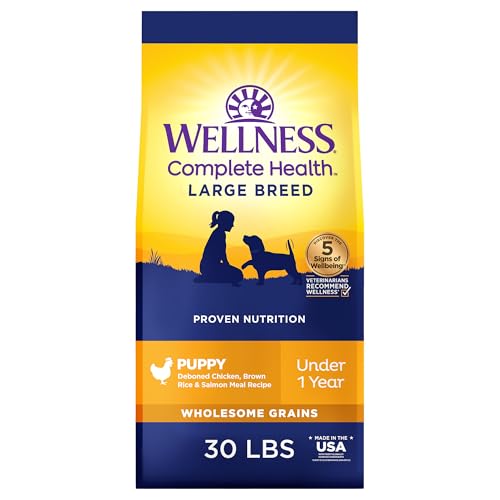
Wellness Complete Health Large Breed Puppy Food
What We Like
- DHA from salmon oil supports brain development
- No corn, wheat, or soy ingredients
- Antioxidants for immune system support
- Omega fatty acids for healthy skin and coat
Trade-offs
- Contains grains, not suitable for grain-free diets
- Not suitable for puppies needing a grain-free diet
The DHA from salmon oil is the standout feature here, it directly supports brain and vision development in large breed puppies, a critical window for growth. This recipe skips corn, wheat, and soy, which some dogs handle poorly, and instead leans on chicken and salmon meal for protein. The antioxidants and omega fatty acids round out a formula that prioritizes whole-body health without relying on artificial additives. It’s a strong pick for anyone who reads the ingredient list first and wants a natural foundation for a growing large breed pup.
This formula includes grains, so if you prefer a grain-free approach, you’d need to look elsewhere, like Orijen’s grain-free large breed puppy line. Compared to Purina Pro Plan’s large breed puppy food, Wellness offers a cleaner ingredient panel with no corn, wheat, or soy, but both deliver DHA for development. The 30-pound bag is standard for the category, but some competitors offer larger bags for multi-dog households. For someone who values natural ingredients and transparent sourcing, this is a straightforward, no-nonsense formula.
Product photos
Royal Canin Large Puppy Dry Dog Food

What We Like
- Antioxidants support immune system
- Prebiotics and proteins promote gut health
- Formulated for large breed puppies
- Crunchy kibble for mixed feeding
Trade-offs
- Only for puppies up to 15 months old
- Only suitable for puppies 56-100 lbs adult weight
Royal Canin targets digestive health specifically, with prebiotics and proteins aimed at gut health and antioxidants for immune support, which is a practical focus for a growing puppy whose system is still developing. It’s designed for puppies with an expected adult weight between 56 and 100 pounds, covering the middle of the large breed range, and the crunchy kibble texture pairs with their wet food if you want to mix things up.
Product photos
Orijen Grain Free Large Breed Puppy Food

What We Like
- 85% animal ingredients for high protein
Trade-offs
- Grain free diet not for every owner preference
This is a high-protein, grain-free formula, which isn’t every puppy’s ideal starting point. Some large breed owners prefer a more moderate protein level or a grain-inclusive recipe for digestive comfort. Compared to the Purina Pro Plan Large Breed Puppy Food, which includes grains and is formulated with DHA and calcium, this Orijen is a higher-protein choice. If your puppy thrives on a grain-free, meat-heavy diet, this is a strong option, but it’s not a one-size-fits-all solution.
Product photos
Fromm Large Breed Puppy Gold Dog Food

What We Like
- Three animal protein sources (chicken, duck, lamb)
- Whole grains for fiber and energy
- Family-owned company since 1904
- Formulated for large breed puppy growth
Trade-offs
- Contains whole grains, not grain-free
- Does not include added DHA supplement
Fromm Large Breed Puppy Gold uses three animal proteins, chicken, duck, and lamb, instead of the single-source protein common in many large-breed puppy foods. That variety provides a broader amino acid profile for muscle development and tissue repair, which matters when a puppy is doubling its weight in months. The whole grains add fiber and complex carbs for steady energy, not the quick spike you get from some high-starch kibbles. This recipe comes from a family-owned company that has been making pet food since 1904, and it is formulated to meet AAFCO nutrient profiles for growth and gestation/lactation.
A 30-pound bag of this large-breed puppy food is a practical size for a single growing dog, though owners with multiple puppies may find it less convenient for portioning or keeping batches fresh. The recipe features chicken, duck, and lamb as protein sources, providing amino acids for muscle maintenance and tissue repair. For those who prioritize a family-owned company with a history since 1904, this food delivers that tradition. Owners seeking grain-free options should look at other products in this category.
Product photos
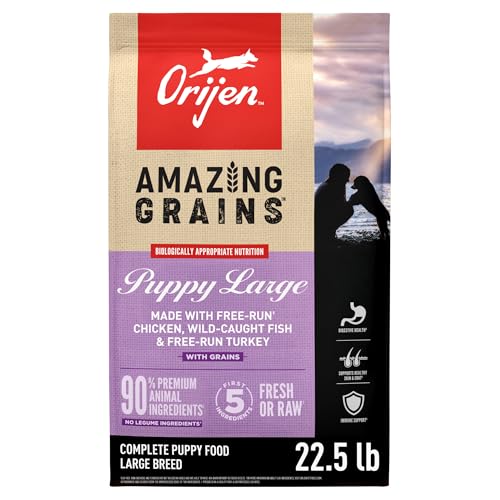
Orijen Amazing Grains Large Breed Puppy Food
What We Like
- 90% poultry and fish ingredients
- WholePrey organs and meat mimic ancestral diet
- Freeze-dried coating for raw flavor
Trade-offs
- Heavier bag at 22.5 lb for small households
- Large breed formula only
The 22.5-pound bag is a substantial commitment, so it’s less convenient for households that want to try a small batch first or have limited storage. This formula includes grains, so if you want a grain-free diet, you might consider Orijen’s Grain Free Large Breed Puppy Food instead. The whole-prey ingredient list is straightforward, but it typically comes at a higher price per pound than many grain-inclusive options. For owners who prioritize a high meat inclusion rate and transparent sourcing, this delivers on both fronts without over-the-top marketing.
Product photos
How We Evaluated Dog Foods For Puppies Large Breed
We started by reading ingredient panels and guaranteed analyses for every formula on our list. Large breed puppy food has specific nutritional targets, controlled calcium, a moderate fat-to-protein ratio, and DHA for cognitive development. We checked each product against those benchmarks using manufacturer-published data.
Next we looked at expert round-ups from veterinary nutrition sources and patterns in long-term owner feedback. The most common praise we saw was for formulas that kept puppies at a healthy, steady weight without loose stools or picky eating. The most common complaints involved bags that didn’t match the description on the label or formulas that caused gas or soft stool during transitions.
The honest limit of a research-led evaluation is that we don’t test these foods in a lab or feed them to our own dogs. We rely on the same information you can find on a bag, ingredients, guaranteed analysis, feeding directions, and cross-reference it with what hundreds of owners report over time. That approach gives you a reliable starting point, not a guarantee.
What To Look For In Dog Foods For Puppies Large Breed
The right large breed puppy food balances controlled growth with complete nutrition. Here is what matters most when you read the label.
Look for a formula labeled “large breed puppy” with controlled calcium, DHA from a named source like fish oil, and a named animal protein as the first ingredient. Avoid all-life-stages foods and generic puppy formulas.
Calcium and Phosphorus Levels
Large breed puppies need less calcium per calorie than small breeds. Too much calcium can disrupt bone remodeling and contribute to skeletal issues like hip dysplasia. The target range is roughly 1.0-1.5% calcium on a dry matter basis, with phosphorus around 0.8-1.2%. Every formula on our list meets this standard, but not every “puppy” food does, always check the guaranteed analysis on the bag.
Calorie Density and Growth Rate
A large breed puppy should grow slowly and steadily. Foods with too many calories per cup push rapid weight gain, which stresses developing joints. Look for a calorie density around 350-400 kcal per cup for most large breed formulas. The feeding guidelines on the bag are a starting point, but every puppy is different. Adjust portions based on body condition, not just the chart.
DHA and Joint Support
DHA (docosahexaenoic acid) supports brain and vision development in puppies. It is most effective when it comes from a named source like fish oil or salmon oil rather than a generic “marine oil.” For joints, glucosamine and chondroitin are common additions in large breed formulas. They are not a substitute for controlled growth, but they can support cartilage health as the puppy matures.
- Confirm the food is labeled “large breed puppy”, not “all life stages” or “small breed puppy.”
- Check the first ingredient: a named animal protein (chicken, lamb, fish) is a good sign.
- Look for DHA from a named source like salmon oil or fish oil.
- Read the guaranteed analysis for calcium and phosphorus.
- Start with the feeding guideline on the bag, then adjust based on your puppy’s body condition.
A large breed puppy should feel lean, you should be able to feel its ribs without pressing hard.
Dog Foods For Puppies Large Breed Compared
The table below compares the ten large breed puppy foods side by side, covering protein source, key nutrients, and what each formula is best for.
| Product | First Ingredient | Key Nutrients | Weight |
|---|---|---|---|
| Purina Pro Plan Large Breed Puppy Food | Real Chicken | DHA, Glucosamine | 34 lb |
| Victor Hi-Pro Plus Large Breed Puppy Food | Real Chicken | DHA, Omega 3 & 6 | 30lb |
| Hill's Science Diet Large Breed Puppy Food | Chicken & Brown Rice | DHA, Fish Oil, Antioxidants | 27.5 lb |
| IAMS Proactive Health Large Breed Puppy Food | Real chicken #1 | Omega-3 DHA, Vitamin E, Selenium | 30.6 lb |
| Purina ONE Plus Large Breed Puppy Food | Real Chicken | DHA, Glucosamine | 31.1 lb |
| Wellness Complete Health Large Breed Puppy Food | Chicken and Salmon | DHA from Salmon Oil | 30 lb |
| Royal Canin Large Puppy Dry Dog Food | N/A | Antioxidants, prebiotics, proteins | 4 lb |
| Orijen Grain Free Large Breed Puppy Food | Fresh or raw poultry or fish | N/A | 23.5 lb |
| Fromm Large Breed Puppy Gold Dog Food | Chicken, duck, lamb | N/A | 30 lb |
| Orijen Amazing Grains Large Breed Puppy Food | Chicken, whole herring, whole whiting, chicken liver, salmon | Pollock oil for immune support | 22.5 lb |
Frequently Asked Questions
When should I switch my large breed puppy to adult dog food?
Most large breed puppies can transition to adult food between 12 and 18 months, depending on their breed. Giant breeds like Great Danes may need puppy food until 24 months. The key sign is when your dog reaches about 90% of its expected adult weight. Check with your veterinarian for a timeline specific to your breed.
What is the difference between large breed puppy food and regular puppy food?
Large breed puppy food has controlled calcium and phosphorus levels to support slow, steady bone growth. Regular puppy food often has higher calcium and calories, which can cause large breed puppies to grow too fast and stress their developing joints. Large breed formulas also tend to have a lower calorie density per cup.
How much should I feed a large breed puppy?
Feeding amounts vary by brand, formula, and your puppy’s age and weight. Start with the feeding guidelines on the bag, then adjust based on body condition. A general rule: a 10-week-old large breed puppy may eat 2-3 cups per day split into three meals, while a 6-month-old may eat 3-4 cups split into two meals. Always measure by weight, not volume.
Should I add wet food to my large breed puppy’s diet?
Adding wet puppy food can increase moisture intake and make meals more appealing for picky eaters. It is not necessary for nutrition if you are feeding a complete and balanced dry food. If you do mix, adjust the dry portion to avoid overfeeding. Wet food should not replace dry kibble as the primary calorie source.
What are the pros and cons of large breed puppy food?
The pros and cons of large breed puppy food come down to growth control. The main benefit is that it helps prevent skeletal issues by managing calcium and calorie intake. The drawback is that it costs more than generic puppy food and may not be necessary for breeds that stay under 50 pounds as adults. It also limits your options if your puppy has allergies or prefers grain-free diets.
The Bottom Line
The Purina Pro Plan Large Breed Puppy Food is our best overall pick for most large breed puppy owners. It combines real chicken, DHA, and glucosamine in a formula that supports steady growth and joint health. If you want a higher-protein option, the Victor Hi-Pro Plus Large Breed Puppy Food delivers with added probiotics and no corn, wheat, or soy.
For budget-conscious buyers, the IAMS Proactive Health Large Breed Puppy Food offers solid nutrition with real chicken and DHA at a lower cost. If your puppy has a sensitive stomach, the Royal Canin Large Puppy Dry Dog Food focuses on digestive health with prebiotics and highly digestible proteins. And if you prefer a grain-free diet, the Orijen Grain Free Large Breed Puppy Food provides 85% animal ingredients in a high-protein, low-carb formula.
The single most important factor in choosing a large breed puppy food is controlled growth. Pick a formula that manages calcium, calories, and protein for your puppy’s expected adult size, and adjust portions based on body condition, not the bag chart. That approach gives your growing dog the best chance at healthy bones and joints for life.
