
BARF Diet for Dogs Explained: What the Research Says
This post contains affiliate links. As an Amazon Associate, we earn from qualifying purchases.
The BARF diet for dogs is a home-prepared raw feeding regimen built on raw meaty bones, muscle meat, organs, and some plant matter, and the evidence on it is genuinely split. Formal studies document an altered gut microbiome and better stool quality, but the same literature flags recurring calcium, zinc, iodine, and vitamin D gaps plus measurable pathogen risk.
The split traces to what is actually being tested. A frozen commercial raw product and a home-mixed BARF bowl are different exposures entirely, and the studies that examine one do not automatically apply to the other. The BARF diet for dogs explained here is a home-mixed bowl, not a frozen commercial product.
What follows walks through the definition drift on the name itself, the commercial-versus-home-prepared split, the specific nutrients that keep failing in formulation studies, and the handling rules the BSAVA publishes for anyone feeding raw at home. The last section covers who should not do this at all.
Key Takeaways
- BARF originally stood for “Bones And Raw Food.” The “Biologically Appropriate” version is a rebrand, not a new formulation standard, and no certifying body backs it.
- Commercial raw diets may carry the phrase “intermittent or supplemental feeding only.” That label means the product is not complete and balanced for the species and life stage.
- The recurring nutrient gaps are specific: calcium, copper, zinc, iodine, vitamins A and D, and the calcium-to-phosphorus ratio.
- Uneaten raw food comes up after 30 minutes and never goes back down, per the BSAVA raw feeding chapter.
- Households with small children, elderly members, or immunocompromised people carry elevated risk that has nothing to do with the dog’s health.
What Does BARF Actually Stand For?
The letters have meant two different things, and the swap happened quietly. A 2025 mini-review in Frontiers in Veterinary Science traced the change: BARF started as “Bones And Raw Food” and was rebranded “Biologically Appropriate Raw Food” without any change to what the diet actually contains.
The commercial raw category splits into fresh, frozen, and freeze-dried formats, often sold with a separate carbohydrate premix. Home-prepared diets split further into named programs: BARF, the Ultimate Diet, and the Volhard Diet. A study of one format does not describe the others, and the pathogen data below attaches to specific formats.
The rebranding matters because “biologically appropriate” sounds like a nutritional standard. It is not one. There is no certifying body that grants the label, no feeding trial that validates it, and no agreed definition of what “appropriate” means for a dog versus a wolf versus a cat. The Frontiers review described the shift as a euphemistic drift, and that is the right word.
The other named raw format, the prey model raw approach, drops plant matter entirely and feeds whole-prey proportions. That is a different diet with a different nutrient profile, and the two get conflated constantly in owner forums.
The bone question gets its own treatment in any honest discussion of raw bones for dogs. The short version: bone is the calcium source in a BARF recipe, and the ratio of bone to meat is where most home formulations go wrong.
Commercial Raw vs Home-Prepared BARF: The Split That Matters
The two halves of the raw category carry different risks, and the label tells you which half you are holding. The 2013 JAVMA review by Freeman and colleagues drew the commercial-versus-home-prepared line, and the label language is where the practical difference shows up.
Here is where I would start with any bag or tub of commercial raw: the nutritional adequacy statement. That single line still tells me within seconds whether a product is a complete diet or a supplement dressed up as one.
The AVMA review notes that commercial raw diets may carry the phrase “intermittent or supplemental feeding only” on the label. That phrase carries real weight. It is the manufacturer telling you, in the language the labeling rules require, that the product has not been formulated to meet AAFCO nutrient profiles for the species and life stage. Feeding it as the sole diet means feeding an incomplete ration.
| Feature | Commercial Raw | Home-Prepared BARF |
|---|---|---|
| Format | Fresh, frozen, or freeze-dried | Raw ingredients mixed at home |
| Premix | Often sold separately | None; owner formulates |
| Adequacy label | May read “intermittent or supplemental” | No label at all |
| Formulation oversight | Manufacturer, sometimes a vet nutritionist | Owner, unless a professional is hired |
| Pathogen control | Variable; depends on supplier | Depends entirely on kitchen practice |
Commercial Raw Diets
The commercial side has one advantage the home-prepared side cannot match: consistency. A frozen raw product from a supplier that runs its formulation through an ACVN or ECVN Diplomate has had its formulation reviewed by a qualified nutritionist, which is the BARF diet for dogs explained in its most reliable form. The owner does not have to weigh liver against kidney at 11pm.
The commercial raw food market has expanded enough that most chain pet stores now stock at least one freezer case of it. The label is the only thing standing between you and an incomplete diet, so read it before you buy.
Home-Prepared BARF
The home-prepared side is where the nutrient data gets ugly. A BARF recipe built from a blog post has no formulation review, no feeding trial, and no guarantee that the calcium-to-phosphorus ratio lands anywhere near the target. The German review that catalogued recurring imbalances in raw diets found the same set of failures over and over.
Portion size is a separate problem. Raw food portions depend on the dog’s weight, age, and activity, and the common shortcut of scaling from body weight is a starting point, not a formula.
The BSAVA raw feeding chapter is blunt about who should design a home recipe: a Diplomate of the American College of Veterinary Nutrition (ACVN) or the European College of Veterinary Nutrition (ECVN), or someone holding a PhD in animal nutrition. A blog post does not qualify, and neither does a pet store employee.
If the goal is a complete diet with a published adequacy statement, choose a product that carries an AAFCO-compliant adequacy statement. That is not a raw recommendation. It is the baseline the raw side has to beat.
What the Evidence Actually Supports
One claimed benefit has formal evidence behind it, and the rest do not. That is the honest summary of the raw feeding literature, and it comes from a review that is otherwise critical of the practice.
The review of microbiological hazards in raw diets conceded that “formal evidence does exist” for an altered intestinal microbiome and subjectively improved stool quality in dogs fed raw. That is a real finding, and it is the strongest argument raw feeders have.
The same review found “neither robust evidence nor identified plausible mechanisms” for the other claims that get repeated in raw feeding circles: better coat, cleaner teeth, fewer allergies, improved immunity. Those claims may turn out to be true, but the current evidence does not support them, and the mechanisms proposed for them do not hold up to scrutiny.
The full accounting of raw dog food pros and cons is longer than one section can hold, but the split is clear: microbiome and stool have evidence, everything else is anecdote.
A separate critical review of raw food diets applied evidence-based medicine grading to the same claims and came out more skeptical overall. The two papers do not contradict each other on the microbiome finding. They disagree on how much weight to give the rest of the raw feeding case, and that disagreement is worth sitting with rather than resolving.
A paper framed the whole debate as a raw meat diets nutritional controversy rather than a settled question, which is the most accurate framing I have seen in print.
The Nutrient Gaps That Keep Showing Up
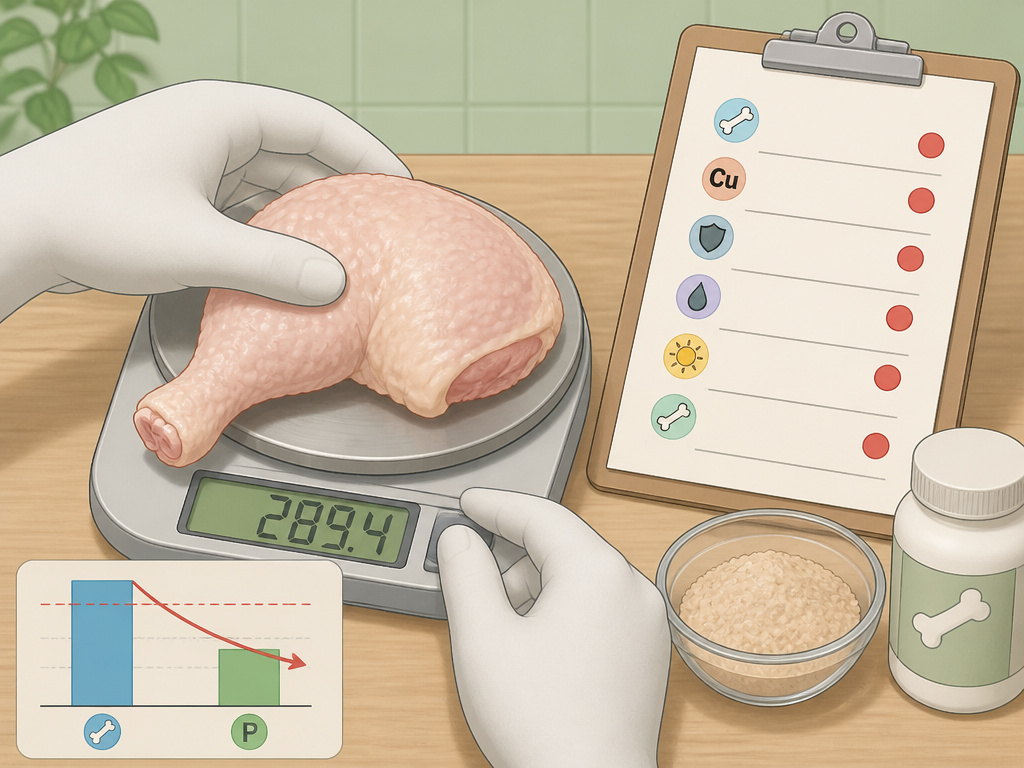
Calcium is where most home BARF recipes fail first, and the rest of the failures tend to cascade from it. The German review of raw meat-based diets catalogued the recurring imbalances across multiple studies, and the list is consistent: calcium, copper, zinc, iodine, vitamins A and D, and the calcium-to-phosphorus ratio.
Calcium fails first because bone is the calcium source in a BARF recipe, and bone content varies wildly by cut. Bone content varies by cut, and the BARF diet for dogs explained here produces a different ratio every time it is mixed if the cut is not specified.
| Nutrient | What Goes Wrong | Why It Matters |
|---|---|---|
| Calcium | Too little or too much, depending on bone content | Puppies develop bone deformities |
| Copper | Under-supplied in muscle-heavy recipes | Anemia and faded coat |
| Zinc | Under-supplied without organ or shell matter | Skin lesions, slow healing |
| Iodine | Under-supplied without thyroid or iodized salt | Thyroid dysfunction |
| Vitamin A | Over-supplied when liver is fed heavily | Bone pain, joint stiffness |
| Vitamin D | Under-supplied without fatty fish or a supplement | Calcium absorption fails |
Getting all six right is what a balanced raw diet is actually about, and it is the part most recipes skip. The recipe has to specify the cut, the organ, and the supplement, not just “chicken and vegetables.”
I have watched clients try to fix a BARF recipe by adding more of whatever nutrient they read about last. That usually dilutes something else, and the diet gets further from balance, not closer.
Where this goes sideways: Eyeballing bone content instead of weighing it. A recipe that calls for “a chicken quarter” produces a different calcium load every time, and the Ca:P ratio drifts with it.
How Do You Handle Raw Food Safely at Home?
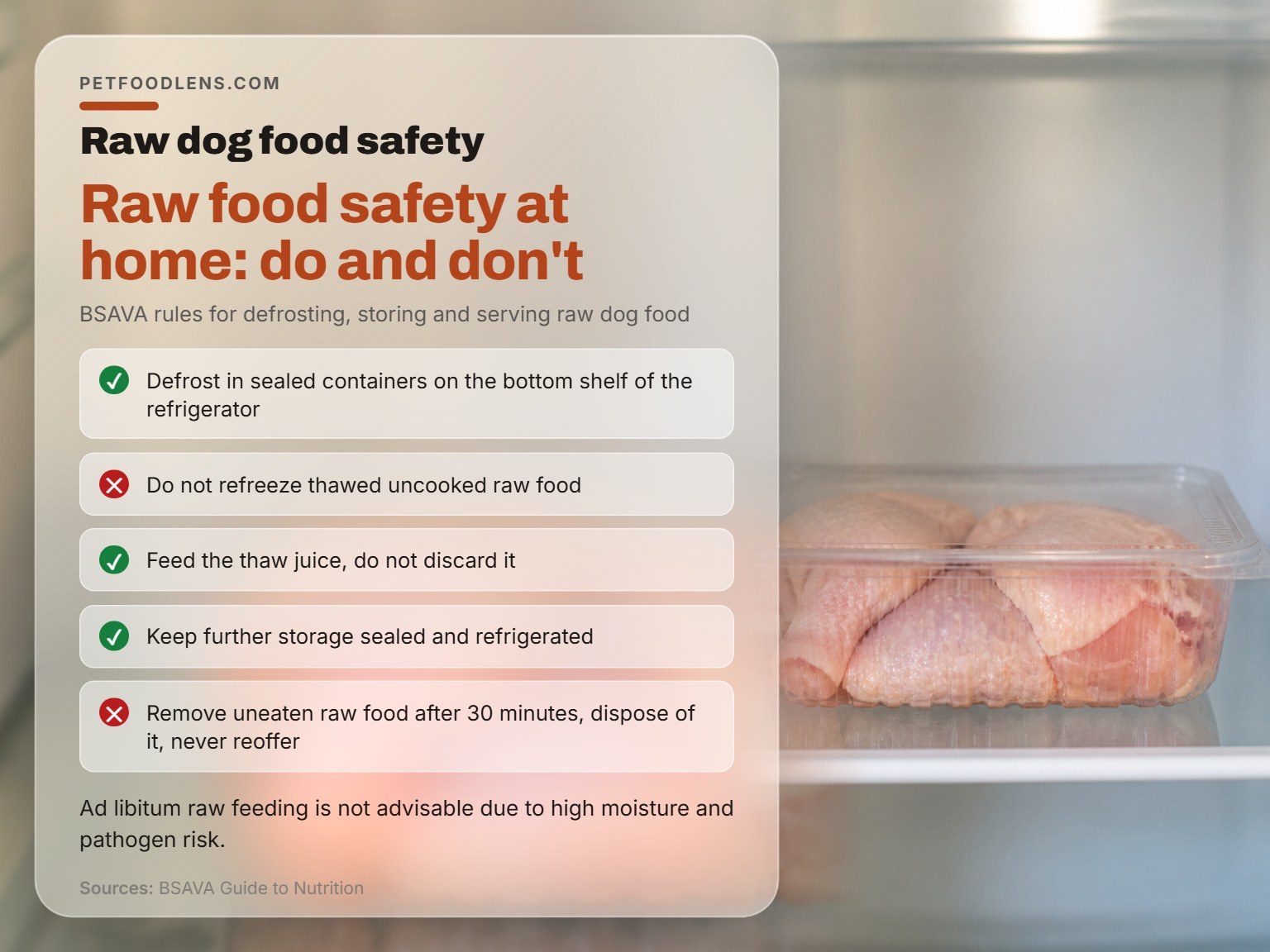
Picture a kitchen counter at 6pm: a tub of frozen raw chicken portions on the cutting board, a dog watching from three feet away, and a toddler in a high chair. The BSAVA raw feeding chapter has specific rules for that kitchen, and most of them are about the counter, not the dog.
Before you start: Raw pet food carries Salmonella, Campylobacter, and Yersinia risk to the humans in the household, not just the dog. Defrost in sealed containers on the bottom shelf of the refrigerator, never on the counter, and never refreeze thawed uncooked food. The thaw juice gets fed, not poured down the sink.
The BSAVA protocol is short and specific:
- Defrost in sealed containers on the bottom shelf of the refrigerator. Not on the counter, not in the sink.
- Do not refreeze thawed uncooked food. The freeze-thaw cycle damages cell structure and releases more liquid, and the bacterial growth window between thaws is the problem.
- Feed the thaw juice, do not discard it. Water-soluble vitamins and minerals leach into the liquid, and pouring it out pours out nutrition.
- Keep any further storage sealed and refrigerated. An open tub in the fridge is a cross-contamination source for everything else on the shelf.
- Remove uneaten raw food after 30 minutes. Dispose of it, and never reoffer it.
The BSAVA chapter also rules out ad libitum raw feeding entirely. The combination of high moisture and pathogen contamination risk means a bowl of raw food sitting out all day is a bacterial culture, not a meal service.
The thaw juice is the giveaway. It pools pink and watery in the bottom of the container, and if you have ever opened a fridge with a leaking raw tub in it, you know the smell before you see the mess.
Here is the order of operations I would follow:
- Move the portion from the freezer to the refrigerator the night before.
- Defrost it in a sealed container on the bottom shelf, not on a plate.
- Feed the thaw juice with the meat, not down the sink.
- Remove uneaten food after 30 minutes and dispose of it.
- Wash the bowl, the counter, and your hands before anything else touches them.
The full raw feeding safety picture includes equipment cleaning, freezer organization, and what to do when the dog licks the counter. It is worth reading before the first defrost, not after.
If you are moving a dog off kibble, the transition to raw food is a separate process from the safety protocol, and doing both at once makes it hard to tell which change caused a problem.
Where the Sources Disagree on Contamination
Two peer-reviewed studies looked at pathogen prevalence in retail raw dog food and reached opposite conclusions. Neither one is wrong, and the reason they disagree is the most useful point here.
The Finnish study tested frozen retail raw meat-based diets for Campylobacter, Salmonella, and Yersinia. PCR detected all three only sporadically, and every sample was culture-negative. That is a strong finding for frozen commercial product specifically.
The UK review, working from European and North American surveys, found Salmonella species “consistently” in a proportion of samples, “typically of fresh-frozen commercial diets.” That is a strong finding too, and it points at a different product category.
The two findings do not actually conflict once you separate frozen from fresh-frozen and separate PCR detection from culture. Frozen storage reduces viable pathogen counts. Fresh-frozen product, which is frozen once and shipped cold but not held at deep-freeze temperatures for long, does not get the same reduction. The lesson for a buyer is that “frozen” on the label is not a pathogen guarantee.
The Finnish raw meat diets in dogs and cats study is the one to read if you want the frozen-product data in full.
The raw diets microbiological hazards review is the one to read for the fresh-frozen data and the Enterobacteriaceae finding.
One finding from the UK review deserves its own paragraph. Raw pet food commonly exceeds hygiene thresholds for Enterobacteriaceae counts, and the isolates often carry resistance to extended-spectrum cephalosporins. That is a One Health problem, not just a dog problem, because the resistance genes do not stay in the dog’s gut.
The same review identified Brucella suis in raw pet meat imported into the EU and UK from Argentina. That is a livestock pathogen that had not been on the radar for pet food before, and it is the kind of thing that shows up when sourcing is opaque.
If a raw manufacturer cannot tell you which country the meat came from and which pathogen controls were run on the batch, the freezer case is doing the marketing, not the supplier.
The BSAVA chapter recommends a separate refrigerator for raw pet food, then cites a recent study finding that a separate fridge does not appear to be a contributing factor to infection incidence. The recommendation and the evidence point in different directions, and the chapter says so out loud. That is rare in this literature.
Who Should Not Feed Raw
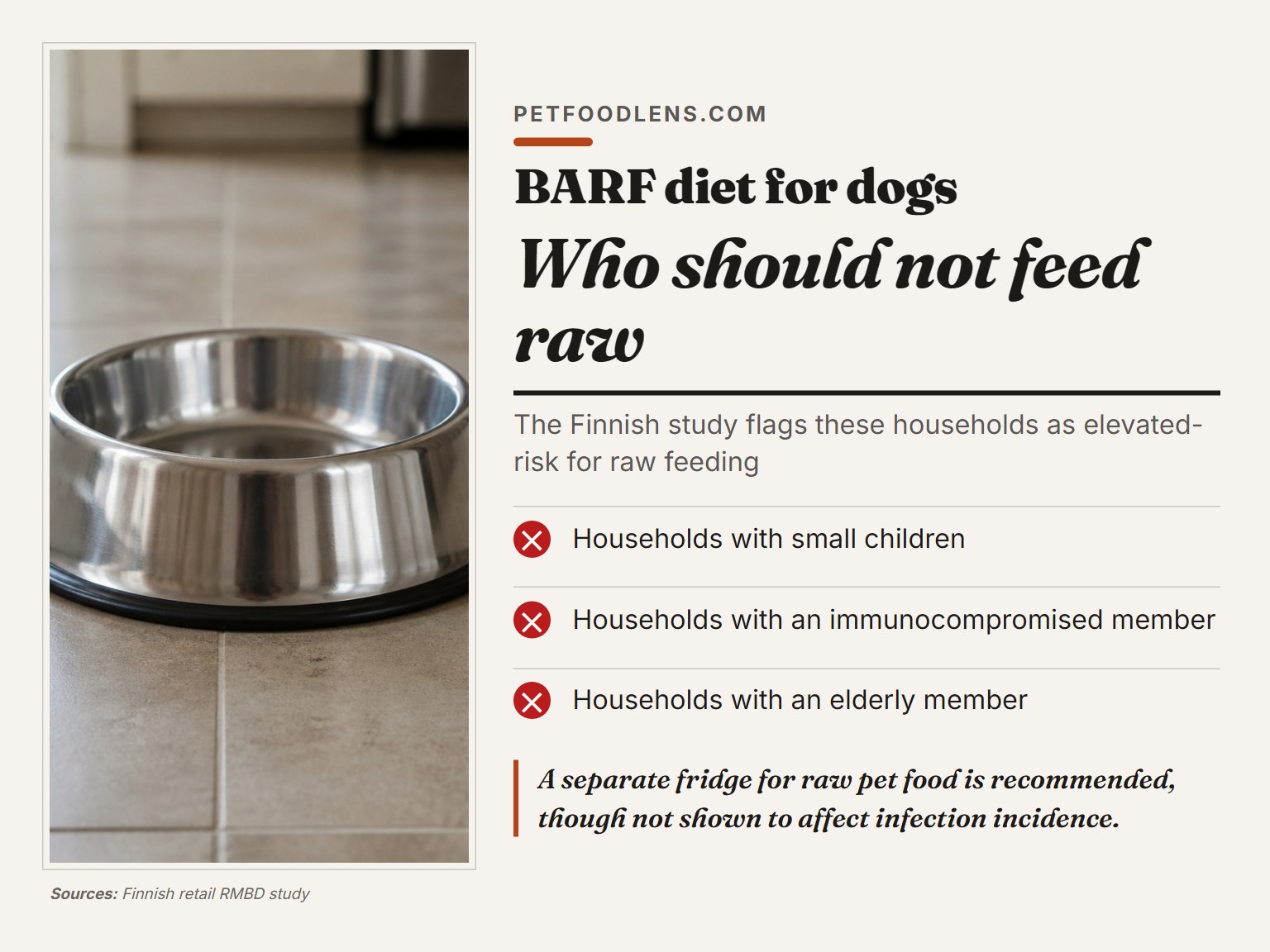
A household with a toddler, a dog on raw food, and a grandmother recovering from chemotherapy is a different risk calculation than a single adult with a healthy dog. The diet is the same. The exposure is not.
The Finnish study flagged immunocompromised households specifically: small children, elderly members, and anyone with a suppressed immune system. Those groups carry elevated risk from raw pet food regardless of how carefully the dog is fed.
- Households with children under five. Toddlers put everything in their mouths, including the dog’s bowl and the floor around it.
- Households with an immunocompromised member. Chemotherapy, transplant medication, and some autoimmune conditions change the risk calculation entirely.
- Households with an elderly member. Age-related immune decline is real, and the exposure pathway is the same kitchen.
- Dogs on immunosuppressive medication. The dog’s own risk goes up, not just the humans’.
- Puppies on a home-prepared recipe. Growing dogs are the most exposed to the calcium and Ca:P ratio gaps, because skeletal development is the process those nutrients drive.
Households With Small Children or Immunocompromised Members
The Finnish study’s household-composition finding is the one most owners skip past. It is not about the dog’s health. It is about the humans sharing the kitchen, and the risk is highest in exactly the households where raw feeding is often promoted as a fix for allergies or picky eating.
Most raw feeding for beginners material focuses on the dog and skips the household. The household is where the risk actually lives.
If you are going to feed raw in a household with an immunocompromised member, the BSAVA’s separate-fridge recommendation is worth following even though the evidence behind it is thin. The recommendation costs nothing to follow and removes one variable.
Frequently Asked Questions
Is BARF the same as raw feeding?
No. Raw feeding is the broad category; BARF is one specific format inside it, alongside the prey model and the named programs (Ultimate Diet, Volhard Diet). A frozen commercial raw product is raw feeding but not BARF in the original sense.
What does BARF stand for now?
“Bones And Raw Food” was the original expansion. The rebrand to “Biologically Appropriate Raw Food” is a marketing shift, not a formulation standard. There is no certifying body behind the new name.
Is BARF safe for dogs?
It depends on the formulation and the household. The microbiome and stool benefits have formal evidence. The nutrient gaps and pathogen risk are real, and the BSAVA publishes specific handling rules because of them.
Can I feed BARF to a puppy?
The nutrient gaps in home-prepared BARF hit growing dogs hardest, especially calcium and the calcium-to-phosphorus ratio. If you feed raw to a puppy, the recipe needs a formulation review by an ACVN or ECVN Diplomate, not a blog post.
Do I need a separate fridge for raw dog food?
The BSAVA recommends one, then cites a study finding it does not appear to affect infection incidence. The recommendation is cheap to follow and removes a variable, but the evidence behind it is thin.
What is the 30-minute rule?
Uneaten raw food comes up after 30 minutes, gets disposed of, and never goes back down. That is the BSAVA rule, and it exists because raw food at room temperature is a bacterial culture.
The Bottom Line
The threshold I would give any owner considering BARF is simple: if you cannot name the person who formulated the recipe and the credential they hold, the diet is a guess. That is true for a blog recipe, a Facebook group template, and a boutique brand that will not disclose its formulator.
That does not mean commercial raw is automatically better. A “complete and balanced” label on a raw product is a claim about formulation, not a guarantee about pathogen control, and the two get conflated constantly.
I will be straight about my own limits here. My background is commercial cat food formulation, and dogs are a step outside my strongest ground. The nutrient data and the pathogen data I have cited are species-general enough to apply, but a dog with a medical condition needs a veterinary nutritionist, not a label-skeptic with a blog.
Here is the practical takeaway. If you want to feed raw, do it with a formulation review and a handling protocol, not a philosophy. If you want a diet that does not require either, choose an AAFCO-compliant commercial product that publishes an adequacy statement. Neither path is free of trade-offs. Pick the one whose trade-offs you can actually manage.
