
Types of Dog Food Toppers: Wet vs Dry Explained
This post contains affiliate links. As an Amazon Associate, we earn from qualifying purchases.
The main types of dog food toppers are wet (canned food, gravy, broth), dry (powder, air-dried, freeze-dried), fresh or gently cooked, raw, and homemade. VCA Animal Hospitals caps toppers and treats together at no more than 10% of a dog’s daily calories, so every form you pick spends from one shared budget.
That shared budget is where the types of dog food toppers question starts to bite. A splash of broth and a scoop of freeze-dried meat both count against the same 10%, and the two forms can differ widely in calorie density. Pick the form around what your dog actually needs, then do the arithmetic on the portion.
What follows walks all eight forms, shows which one fits which problem, and lays out where VCA, the AKC, and Chewy disagree on whether a portion ceiling even exists. By the end you’ll be able to read a topper label and know what it costs your dog’s daily allowance in about ten seconds.
Key Takeaways
- Cap toppers and treats at 10% of daily calories. VCA’s worked example gives a dog on 1,000 calories a day 100 calories from toppers and treats, with 900 from complete food.
- Wet and freeze-dried toppers aren’t interchangeable by volume. Moisture content differs sharply between the two forms, so the same scoop delivers wildly different calories.
- Raw is the form vets are most cautious about. Chewy’s vet-authored guide lists raw toppers as not recommended, while Dogster flags the pathogen risk but notes raw meat can add nutritional value and advises talking to a vet first.
- A topper is a supplement, not a diet. The AKC warns that many are approved only as nutritional supplements and shouldn’t replace the main meal.
- Introduce any new topper gradually. Chewy flags stomach upset as the first risk of adding anything unfamiliar.
The 8 Types of Dog Food Toppers, Compared
Eight forms show up on shelves, and they split into wet and dry families before you get to anything more interesting.
Toppers divide into wet forms, which run from gravies and sauces to broths and canned food, and dry forms, which include powders, air-dried pieces, freeze-dried pieces, and dehydrated solids. Moisture content separates the two families more reliably than the front of the package does, and it drives the calorie density that decides the portion.
Here’s the full set, with what each one is actually for.
- Wet or canned. Ranges from thin gravies and broths up to full canned food, and canned food can carry complete and balanced nutrition.
- Broth-based. A hydrating pour-over that softens hard kibble. Watch the sodium.
- Freeze-dried. Shelf-stable and often raw, which matters a lot in the safety section below.
- Air-dried. Gently dried at moderate temperatures, chewy in texture, and shelf-stable.
- Fresh or gently cooked. Cooked meat and vegetables, usually sold refrigerated or through a subscription.
- Powder. Dusted over kibble for flavor and often protein, and the easiest form to measure precisely.
- Raw. Uncooked meat pieces. Chewy’s vet-authored guide discourages raw toppers, while Dogster flags the pathogen risk but notes raw meat can add nutritional value.
- Homemade. Workable in principle, but get the recipe, serving size, and feeding schedule from a vet first.
The category map above is the easy part. The dog food topper guide covers how individual products get positioned against each other, which is where the marketing gets loud.
Wet Toppers vs Dry Toppers: Where the Moisture Number Decides
The moisture line on the guaranteed analysis tells you more about a topper than the flavor name does.
Start with what the two sources mean by “wet.” The AKC describes wet toppers as running the spectrum from gravies to sauces to broths, sometimes with small chunks of meat and vegetables. Chewy describes canned dog food as a topper that provides complete and balanced nutrition. Both are correct, and they’re describing different products under one word.
That definitional split matters when you’re comparing wet dog food toppers against a dry alternative, because a complete canned food and a thin gravy behave nothing alike in the bowl or on the calorie sheet.
| Topper form | Moisture (label max) | Calorie density | What it’s built for |
|---|---|---|---|
Read that table twice if you’re feeding a small dog. The scoop you’re used to from one form is the wrong scoop for the other.
The practical rule: measure freeze-dried toppers by weight or by the manufacturer’s stated tablespoon, and measure wet toppers by the pouch. Don’t eyeball either.
Which Topper Form Fits Which Problem?
The bowl sits there half full, the dog walks off, and you’re already reaching for something to sprinkle on it. Match the form to the problem you actually have, not the problem the package photographs.
| The problem | Form to try | Why it fits |
|---|---|---|
| Dog walks away from the bowl | Strong-odor wet or fresh | Chewy notes strong-smelling wet and fresh toppers work for picky dogs |
| Dog drinks very little | Low-sodium broth | Dogster: broth adds water and softens hard kibble |
| Needs more protein per bite | Freeze-dried | Chewy: shelf-stable and often raw |
| Struggles to chew hard kibble | Wet or broth | Softens the kibble without changing the base diet |
| Itchy skin, environmental allergies | Omega-oil or antioxidant topper | The AKC notes these may benefit dogs with environmental allergies |
Picky eaters are the loudest use case, and the fix is usually odor rather than flavor variety. Chewy’s guidance is to mix a strong-smelling wet or fresh topper thoroughly into the regular food so the dog gets both, rather than leaving a puddle on top that gets licked off and abandoned.
If you’re working that specific problem, the roundup of toppers for picky dogs is a better starting point than guessing at the shelf.
Sensitive stomachs need a different approach entirely, and it’s slower. Chewy is explicit that adding anything new to a dog’s diet can cause an upset stomach and that gradual introduction is the mitigation. There’s a set of toppers for sensitive stomachs built around that constraint.
One more option worth naming: plain sardines packed in water make a single-ingredient topper with no label to decode, and sardines as a topper covers the portion and frequency question. Fair warning, they smell like exactly what they are.
Where this goes sideways: Adding a topper to a dog with an undiagnosed food allergy. The AKC’s Dr. Gavin Casper notes that toppers make identifying and controlling allergies harder, because you’ve just added a variable to a diet you were trying to keep clean.
The 10% Rule: Where VCA, the AKC, and Chewy Disagree
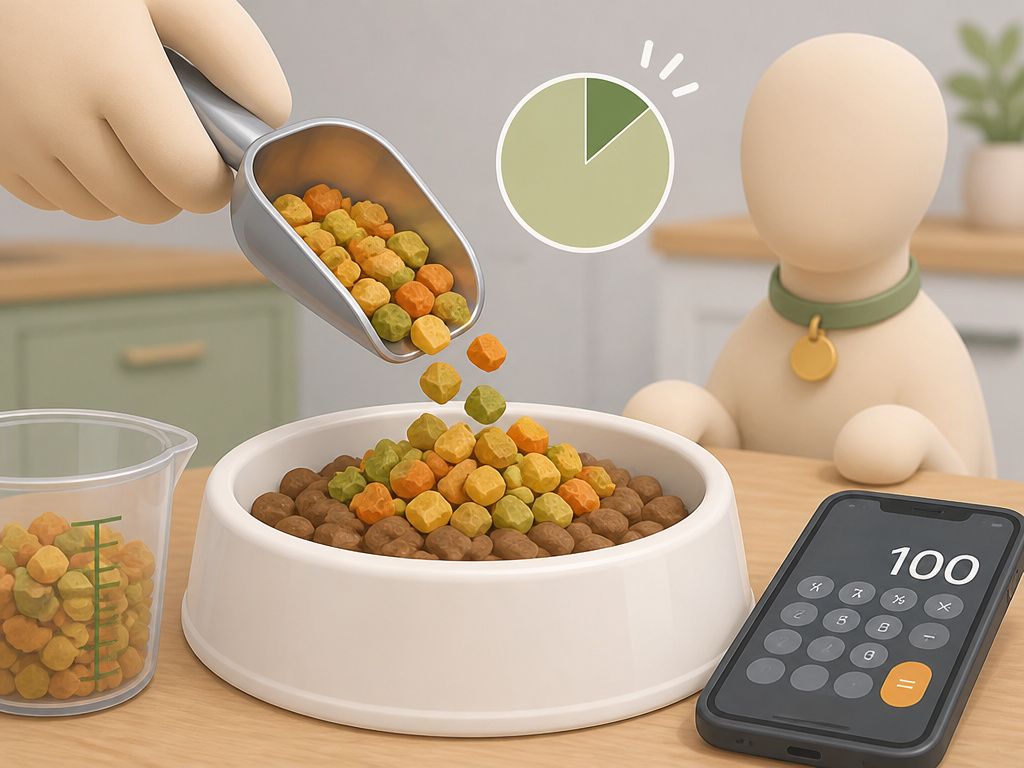
VCA Animal Hospitals states the ceiling plainly: toppers and treats together should make up no more than 10% of a dog’s or cat’s daily calorie intake.
Their worked example is the clearest version of the math. A dog that needs 1,000 calories a day to hold steady weight should get no more than 100 calories from toppers and treats, with the other 900 coming from complete and balanced food. VCA adds that feeding more than 10% as toppers or treats can unbalance the diet and could lead to obesity.
The AKC lands on the same number through Dr. Casper, who puts treats including toppers at 10% of daily caloric intake. Chewy, through Dr. Jennifer Coates, gives no numeric cap at all and points owners to the label directions and their vet instead.
| Source | Portion guidance | Gives a number? |
|---|---|---|
| VCA Animal Hospitals | Toppers plus treats at 10% of daily calories or less | Yes, with a 100-of-1,000 kcal example |
| AKC (Dr. Gavin Casper) | Treats including toppers at 10% of daily calories | Yes, 10% |
| Chewy (Dr. Jennifer Coates) | No numeric cap; follow label and vet guidance | No |
Worth knowing why the three don’t line up. Petfood Industry, writing through George Collings, Ph.D., frames toppers and mixers as used three ways: as treats, as supplementation to the main feeding, and in some cases as meals themselves when they’re marketed that way. Once a product is legally a meal, a treat ceiling doesn’t apply to it in the same way.
So the 10% figure is clinical convention, not regulation. VCA and the AKC both hold it. Chewy doesn’t contradict it so much as decline to state it.
Common mistake: Treating the 10% as 10% of the bowl rather than 10% of the calories. A single high-calorie pouch can consume most of the 100-calorie allowance from VCA’s example, and a smaller dog on fewer daily calories will blow the entire allowance on that single pouch.
That’s the number most topper labels never put in front of you. Run the numbers on your own dog’s daily calories before you decide the pouch is one serving.
How Do You Introduce a New Topper Without an Upset Stomach?
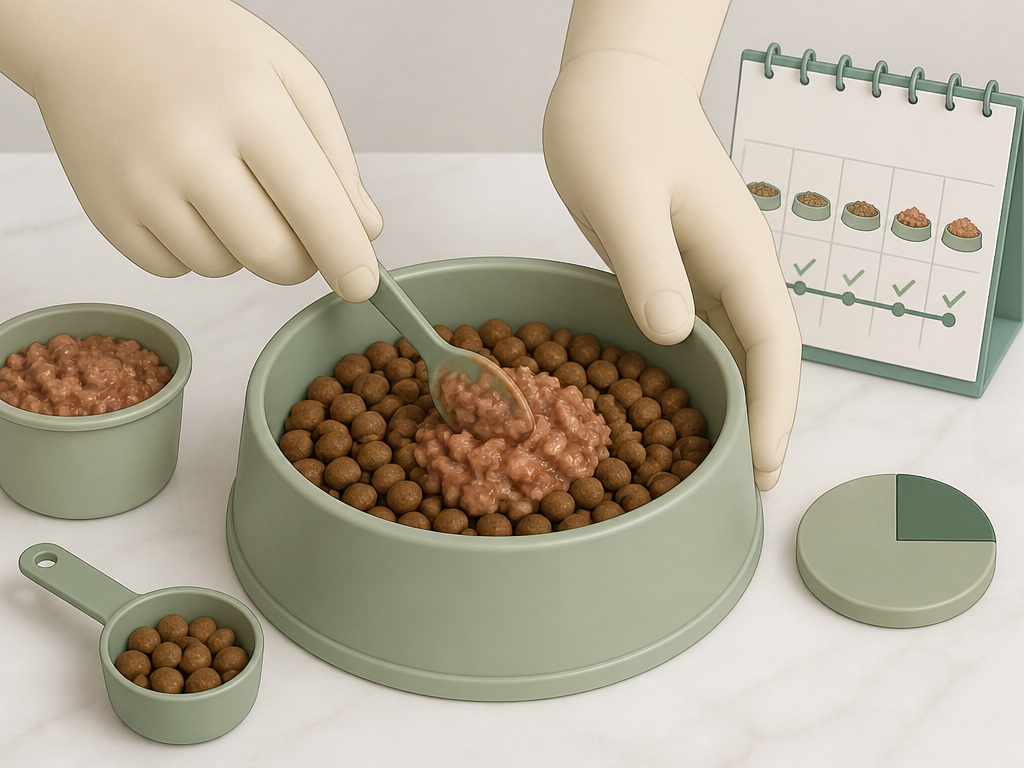
Slow is the whole method here.
Owners ask constantly whether they can just swap or add something overnight and skip the ramp. I’ve watched enough pets refuse food outright or come down with loose stools after an abrupt change that I stopped recommending it. A gradual mix costs you nothing but patience, and Chewy’s guidance points the same direction.
Here’s the sequence that works.
- Start at a quarter of the intended amount. Skipping this is how you get a dog with an upset stomach and no idea which ingredient caused it.
- Mix it through the base food rather than spooning it on top. A topper left in a puddle gets licked off and the kibble goes uneaten, so the dog gets none of the base diet.
- Hold that amount before increasing. Jumping straight to full portion removes your ability to tell a mild reaction from a severe one.
- Increase in small steps until you hit the calorie ceiling. Going past 10% of daily calories unbalances the diet, which is the whole thing you were trying to avoid.
- Stop and call your vet if the stool changes or the dog goes off food. Chewy’s warning about stomach upset is the common outcome, and it’s also the early signal of something that needs a professional look.
Notice that step five isn’t optional. A topper that causes diarrhea for a week has cost you more than the meal variety was worth.
Raw and Freeze-Dried Toppers: The Safety Split
Freeze-dried and raw get filed together on the shelf and split hard on risk.
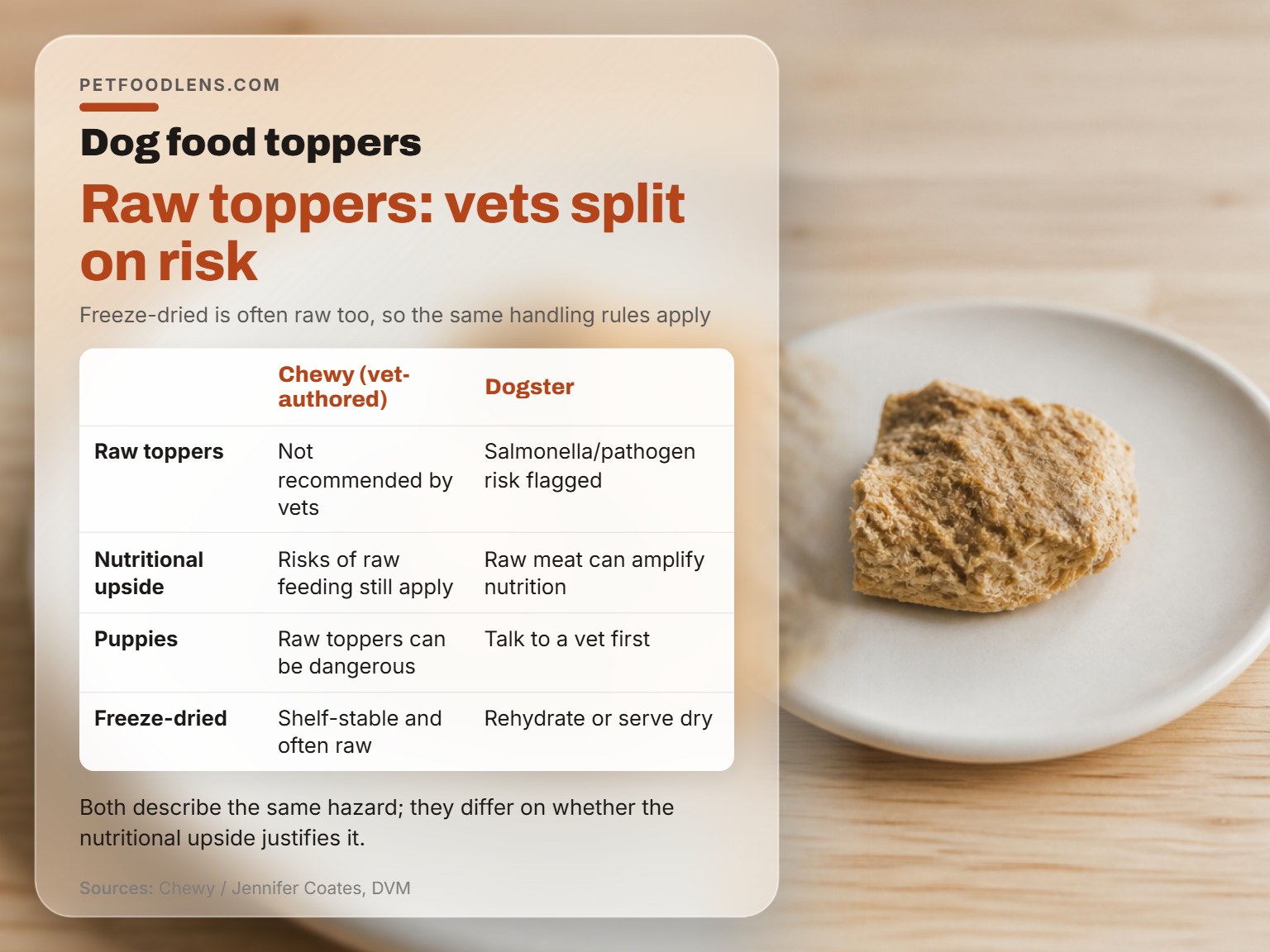
Chewy’s vet-authored guide lists raw dog food toppers as not recommended by vets, and notes that the risks of feeding raw dog food still apply. Dogster takes a different position: it flags the Salmonella and foodborne pathogen risk plainly, then notes that raw pieces of meat can amplify a meal’s nutritional content, and advises talking to a vet first.
Both are describing the same hazard. They differ on whether the nutritional upside justifies it.
Before you start: Raw toppers can carry Salmonella and other foodborne pathogens that transfer to bowls, counters, and hands, so use a dedicated bowl and wash it with hot soapy water after every meal. Puppies and dogs with weakened immune systems face the highest risk, and Chewy specifically flags raw toppers as potentially dangerous for puppies, so get a vet’s sign-off before any raw product goes near a young dog. Freeze-dried toppers are often raw even though the bag is shelf-stable, so the same handling rules apply.
Freeze-dried is often raw
Chewy describes freeze-dried toppers as shelf-stable and often raw. That combination is what trips people up. The bag sits on a shelf at room temperature, which reads as safe, but the product inside hasn’t been cooked.
Dogster notes you can rehydrate freeze-dried toppers with water or serve them dry as a crunchy snack. Skipping the rehydration step changes the moisture and texture of the topper.
What the pathogen risk means for a puppy
Chewy’s guidance is direct: some topper types, raw included, can be dangerous for puppies, and a vet should be consulted before adding a puppy food topper at all. That’s a higher bar than the one applied to adult dogs, and it’s worth taking literally.
What to Check on the Label Before You Buy
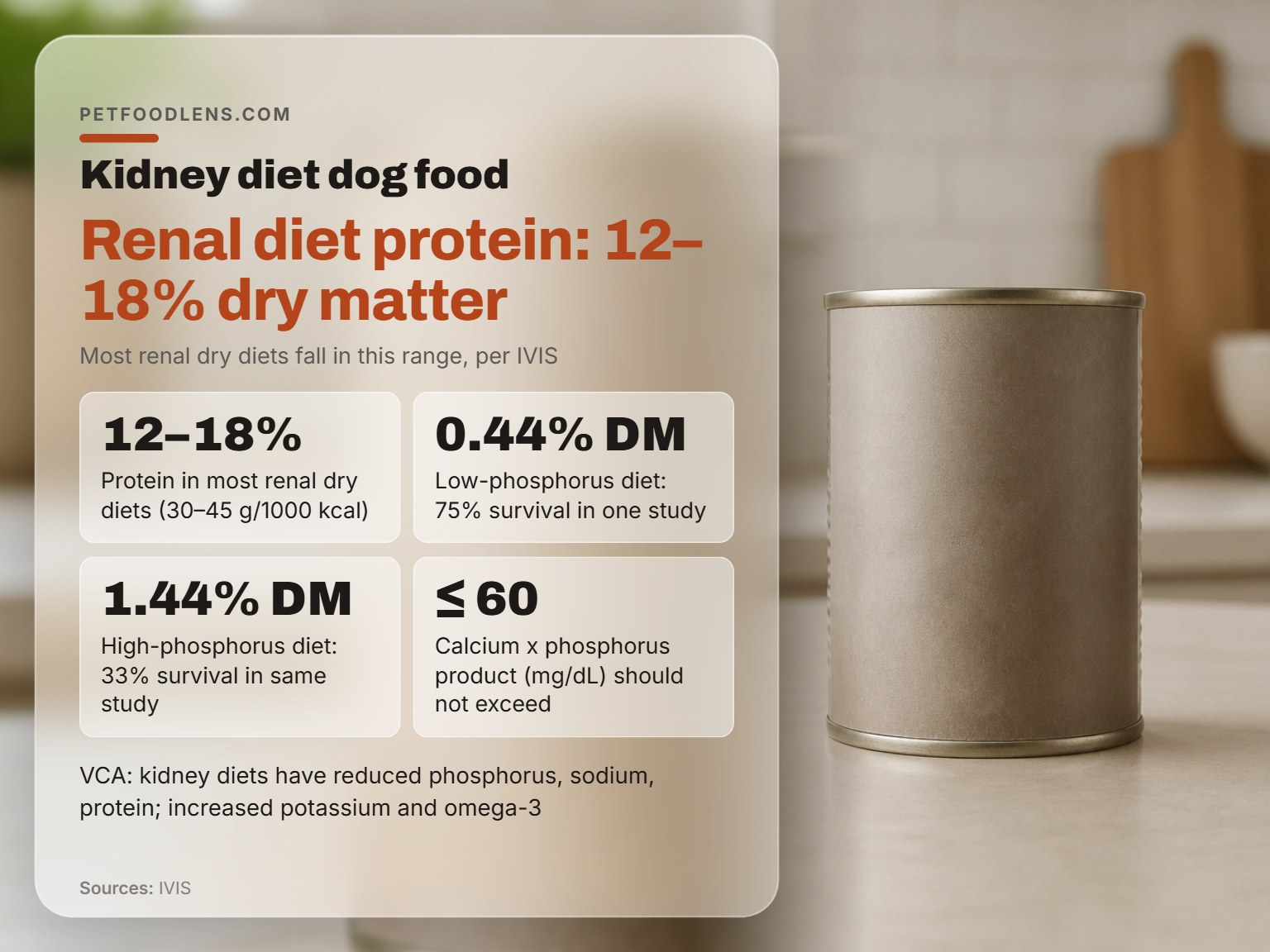
The guaranteed analysis is the only part of the package with numbers you can compare across brands.
Read the label, not the front of the package. Here’s what I check, in order.
- Guaranteed analysis first. Protein, fat, fiber, and moisture minimums and maximums. Moisture is the one that tells you which family the product belongs to.
- The calorie statement. Kilocalories per kilogram and per unit, whether that’s a pouch, a cup, or a tablespoon. Without it you can’t do the 10% math.
- The AAFCO nutritional adequacy statement. This is the line that says whether the product is complete and balanced, or supplemental feeding only.
- Ingredient splitting. “Peas, pea protein, pea fiber” listed as three separate items is a deliberate way to push a real ingredient further down the panel.
- Testing claims. Whether the company runs in-house or third-party testing to confirm the listed ingredients are actually in the finished product.
That last one comes straight from Dr. Casper at the AKC, and it’s the question almost nobody asks. Manufacturing errors happen, and a company that tests its own output catches them before you do.
Read the guaranteed analysis first
The AKC’s split between wet and dry forms maps directly onto the moisture line. A product at 70% maximum moisture is delivering mostly water, which is fine if you wanted hydration and a problem if you wanted protein density.
Ask whether the company tests what it lists
Dr. Casper’s recommendation is to research whether a manufacturer does in-house or third-party testing, because that’s what confirms the products listed on the label are confirmed to be in the final product. It’s a two-minute check that separates the brands doing the work from the ones doing the copywriting.
Do the calorie math before you scoop
Compare the topper’s calories against your dog’s daily allowance, not against the bag’s suggested serving. Those two numbers are set by different parties with different incentives.
While you’re on the label, the dog food additives breakdown covers which supplemental ingredients have a real purpose and which are there for the ingredient panel’s appearance.
One storage note that belongs here. I once emptied a kibble bin and found a yellowish, tacky film on the walls and a sharp crayon-and-paint smell. Months of fresh kibble had been poured over that residue, so every new batch met old oxidized fat on day one. If you keep shelf-stable toppers in a bin, empty it completely and wash it with hot soapy water between bags, then dry it fully. Damp plastic plus fat residue is a bad pairing.
Frequently Asked Questions
What is the healthiest type of dog food topper?
There’s no single healthiest form, because the right one depends on the problem. A dog that needs hydration does well with a low-sodium broth, and a dog that needs protein density does better with a freeze-dried product. The AKC’s Dr. Casper notes that toppers high in omega oils or antioxidants may benefit dogs with environmental allergies specifically. Match the form to the need, then keep it under 10% of daily calories.
Are toppers bad for dogs?
Not inherently, but they’re easy to overfeed. VCA notes that going past 10% of daily calories can unbalance the diet and could lead to obesity. The AKC’s Dr. Casper adds that many toppers are approved only as nutritional supplements and shouldn’t be fed as the main part of the diet. A topper added to a complete and balanced food, within the calorie ceiling, isn’t a problem.
Can I use wet dog food as a topper?
Yes, and Chewy notes that canned dog food used as a topper can provide complete and balanced nutrition. That’s a different product from the thin gravies and broths the AKC groups under wet toppers, which are supplemental. Check the AAFCO statement on the can to know which one you’re holding.
How much topper should I add to my dog’s food?
Work backward from calories. VCA’s example gives a 1,000-calorie dog a 100-calorie allowance for toppers and treats combined. Check the calorie statement on the topper, subtract what you’re already spending on treats, and the remainder is your topper budget. A single high-calorie pouch can consume most of that allowance on its own.
Are raw toppers safe?
Chewy’s vet-authored guide lists raw toppers as not recommended by vets and notes the risks of raw feeding still apply. Dogster flags the Salmonella and pathogen risk while noting raw meat can add nutritional value, and advises talking to a vet first. Puppies face elevated risk, and Chewy specifically warns against raw toppers for them.
Do I need a topper if my dog already eats well?
Usually not. VCA’s position is that if a pet eats all the food offered at each meal, there’s typically no reason to add a topper. Chewy notes toppers aren’t necessary for a healthy dog eating appropriate amounts of a high-quality food, but vets do recommend them under certain circumstances. A topper is a tool for a specific problem.
The Bottom Line
Here’s the threshold that settles most of these decisions. Look up your dog’s daily calorie requirement, take 10% of it, and compare that number to the calorie statement on the topper you’re holding. If one serving exceeds the allowance, the serving is wrong for your dog, regardless of what the pouch says.
Do that math once and you’ll never guess at a portion again.
The concession worth making: none of this tells you whether the manufacturing behind a product is any good. I work from labels and published formulations, so I can’t verify sourcing, batch consistency, or what happens on the plant floor. A clean-looking guaranteed analysis can still sit on top of a sloppy operation, and that’s a gap I have no way to close from the outside.
If your dog has a diagnosed condition, a hydrolyzed or novel-protein diet from a vet beats anything on this list. For everyone else, pick the form that matches the problem, measure it against the 10%, and introduce it slowly enough that you’d notice if it went wrong.
