
Dog Food Toppers Guide: Wet, Dry, or Freeze-Dried?
This post contains affiliate links. As an Amazon Associate, we earn from qualifying purchases.
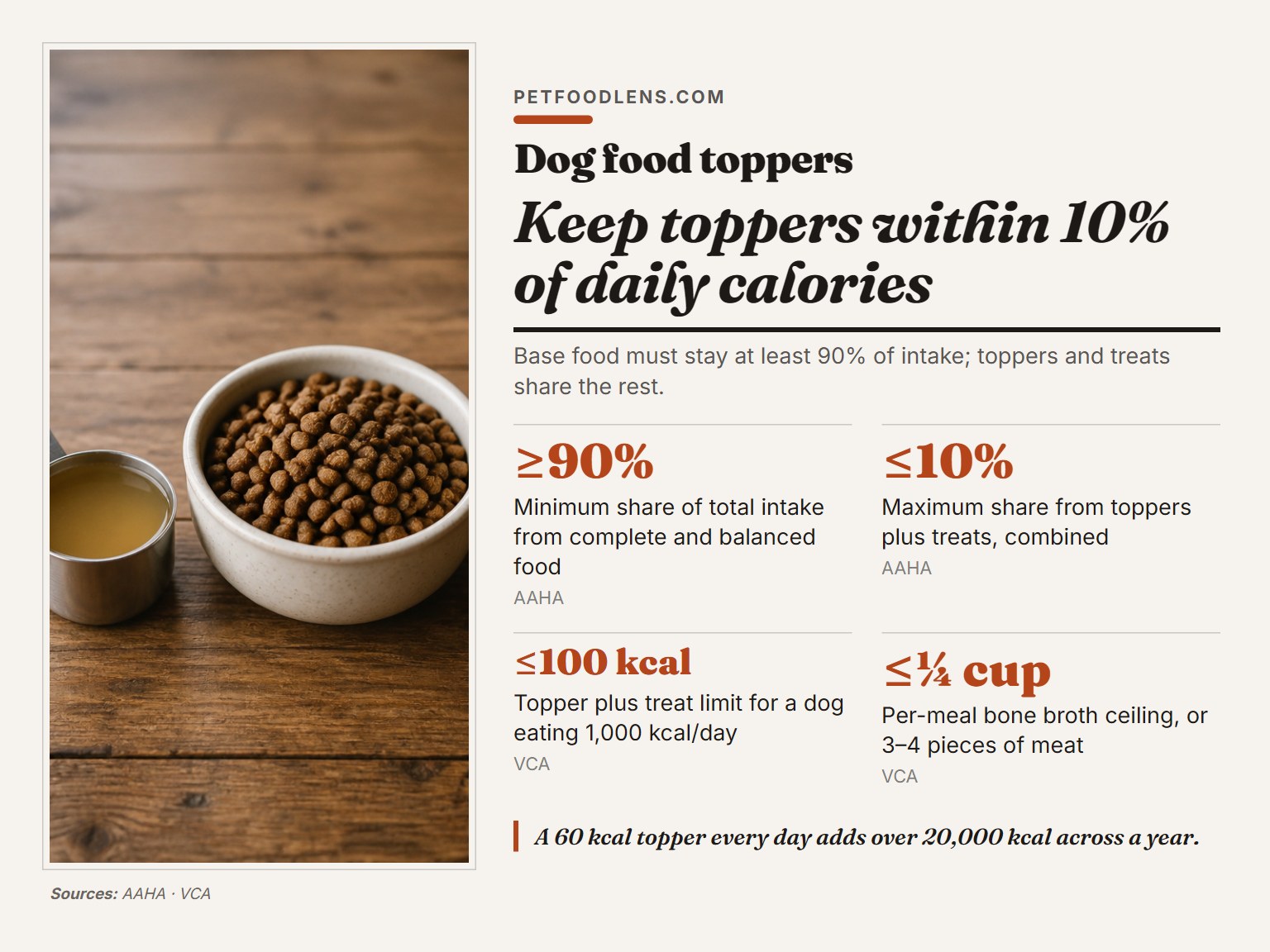
A dog food toppers guide that holds up starts with one number: 90% of a dog’s daily calories come from a complete and balanced food, and no more than 10% from toppers and treats. AAHA notes AAFCO calorie labeling excludes chews, bones, and toys, while DASH Dog Food puts chew toys inside the 10%.
That exclusion is where measured feeding quietly drifts, and it is the first thing a dog food toppers guide should flag. A dental chew carries calories, no label has to print them, and a diet that looks tight on paper can run over budget on biscuits alone.
What follows is the calorie math for a real dog, the label class that separates a food from a supplement, the storage numbers with actual degrees attached, and the routine that stops a picky eater from training you.
Key Takeaways
- Base food carries at least 90% of daily calories; toppers and treats split what’s left.
- A 10 kg dog gets roughly 40-50 kcal of topper-and-treat room per day, which is less than most owners pour.
- “Intermittent or supplemental” on the label means it is not a complete food, whatever the front of the pouch implies.
- Chews and bones don’t appear in the calorie math under AAFCO labeling rules, which exempt them, though DASH Dog Food counts chew toys toward the 10%.
- Store dry food and unopened cans below 80°F, and anything opened at 40°F or below.
What Counts Toward the 10% Ceiling (and What Doesn’t)
Ninety percent of a dog’s calories should come from the base food. The other ten percent is where the arguments start.
AAFCO requires calorie content on labels for snacks and treats, but the requirement explicitly excludes chews, bones, and toys. A daily dental chew therefore adds calories that appear on no label and, under AAHA’s labeling note, inside no 10% calculation, though DASH Dog Food counts chew toys toward the 10%. The same gap covers bully sticks and butcher bones.
The 90/10 split comes from AAHA, and it functions as a ceiling rather than a target. VCA’s worked example makes it concrete: a dog eating 1,000 kcal a day should get 900 kcal from the complete food and no more than 100 kcal from toppers plus treats.
Where the sources part company is scope. AAHA notes that AAFCO requires calorie content on labels for snacks and treats but explicitly excludes chews, bones, and toys. VCA states the 10% as toppers plus treats and says nothing about chews. DASH Dog Food puts treats, toppers, meal enhancers, and chew toys all inside the same 10%.
| Source | What counts toward 10% | What it leaves out |
|---|---|---|
| AAHA / AAFCO labeling | Snacks and treats, which must carry calorie content | Chews, bones, and toys |
| VCA | Toppers and treats | Chews and bones, unmentioned |
| DASH Dog Food | Treats, toppers, meal enhancers, chew toys | Nothing listed |
The Chew and Bone Gap
A dental chew is not a rounding error. It is calories, and under the labeling exemption it is calories nobody has to declare, though DASH Dog Food counts chew toys toward the 10%.
So you count them yourself, or the budget is fiction, whether you follow AAHA’s labeling note or DASH’s stricter reading. If you want the strictest reading, follow DASH and put chews inside the 10%. If you follow AAHA’s labeling note, you’re tracking them outside it. Either way, track them.
How Many Calories Is 10%, Really?
Ten percent is smaller than it sounds, a point any dog food toppers guide makes early.
VCA’s example uses a 1,000 kcal/day dog, which is a big dog. Scale down and the allowance gets tight fast. InnoVet puts a 10 kg dog at roughly 400-500 kcal a day, so the entire topper-and-treat budget lands at 40-50 kcal.
- A 1,000 kcal/day dog: 900 kcal base food, 100 kcal for everything else.
- A 10 kg dog at 400-500 kcal/day: 40-50 kcal total for toppers and treats.
- One ¼ cup of a commercial topper at 50 kcal: the whole daily allowance for that 10 kg dog.
- 60 kcal a day on top of a full meal: over 20,000 extra calories a year.
That third line is the one that stops people. VCA’s example topper runs 50 kcal per ¼ cup, which means a single scoop wipes out the entire budget for a small dog before a single biscuit gets counted.
VCA also gives a per-meal ceiling that’s easier to eyeball than a calorie count: no more than 3-4 pieces of meat, or no more than ¼ cup of bone broth, per meal. VCA gives a hard per-meal number, while AKC gives only the 10% daily ceiling and DASH gives a brand-specific rate.
Here’s where the guidance gets uneven. AKC’s veterinary contributor gives the 10% daily ceiling and no per-meal figure at all. DASH gives a brand-specific rate of 2 tablespoons per 5 lbs of body weight per day. VCA gives a hard per-meal cap, AKC gives only the 10% daily ceiling, and DASH gives a brand-specific rate of 2 tablespoons per 5 lbs per day.
Wet, Dry, or Freeze-Dried: What the Form Actually Changes
Moisture content is the real dividing line between topper forms.
InnoVet puts dry food at roughly 10% moisture and wet food at around 75-80%. That gap changes what the topper does to the bowl. A wet topper adds water. A dry one adds almost none.
AKC splits the category into wet forms (gravies, sauces, broths, meat chunks, vegetables) and dry forms (powders, frozen or dehydrated solids). The commercial shelf maps onto that split fairly cleanly, and the form decides how you store it.
Wet Toppers
Broths and gravies do the hydration job better than anything else on the shelf. Broths and gravies are the plainest version of the idea, and some wet toppers handle the fiber side of the same job.
Canned dog food is the one wet option that arrives complete and balanced, which Chewy flags directly. A can of complete and balanced dog food does a different job than a pouch of gravy, and the label class is why.
Wet dog food toppers also tend to be the strong-smelling ones, which matters in the next section.
Dry and Powdered Toppers
Powders, dehydrated solids, and air-dried pieces all live here. Chewy notes air-dried toppers are gently dried at moderate temperatures to hold nutrition and are shelf-stable, which is why they survive a cupboard better than a broth does.
The FDA warns that storage above 80°F or in humid conditions degrades nutrients. Powders feel that hardest, because there’s no water in them to buffer anything.
Where this goes sideways: A powder topper kept in a warm cupboard cakes into hard pebbles and loses the nutrients the label promised. Move it below 80°F before the bag is half gone.
Raw is the form to be careful with. Chewy’s veterinary source doesn’t recommend raw toppers and flags them as dangerous for puppies. Freeze-dried raw mixers are popular and shelf-stable, but the caution still applies to the raw content.
A shortlist of topper picks by form saves a lot of label squinting, and the different types of toppers break down further by what job each one does.
Why “Intermittent or Supplemental” Is the Line That Matters
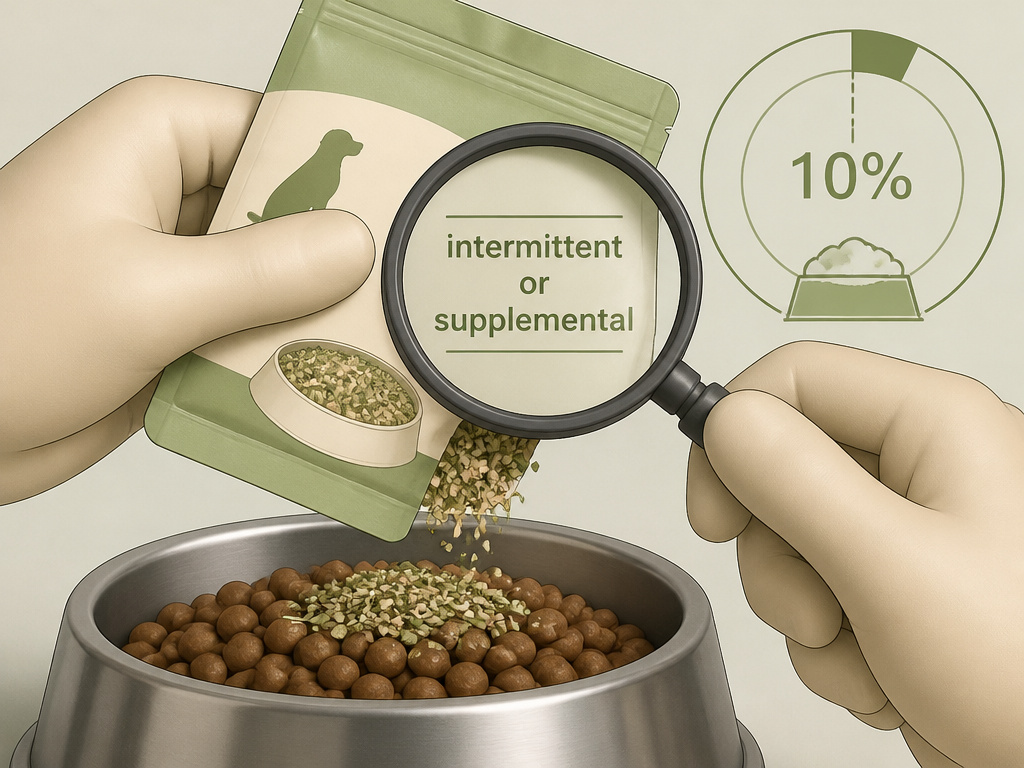
The phrase “intermittent or supplemental” is a legal classification, not a portion size.
Under AAFCO labeling rules, products labeled “100%” and products labeled “intermittent or supplemental” are both explicitly not complete and balanced. That’s the hook that lets a pouch sit in the pet aisle while carrying no nutritional adequacy claim at all.
Dr. Gavin Casper, DVM, makes the practical version of the same point in the AKC guide to dog food toppers: many toppers are only approved as nutritional supplements and should not be fed as the main part of a dog’s diet.
The edge case that trips people is therapeutic diets. They carry the same “intermittent or supplemental” label class, but they aren’t toppers. Feeding one as a topper without veterinary direction is a misuse the label class invites, and it’s an easy mistake to make when the can looks like food.
I once suggested a food swap before asking whether the animal was already on a vet-guided diet. The client had to undo the change, which cost time and caused stress nobody needed. Now I ask about existing medical direction before I say a word about food.
If the label says “intermittent or supplemental,” the product is not dinner. It is a garnish with a legal definition, and the 10% ceiling is the only thing holding it in that role.
One more line from the same AKC piece deserves repeating. Toppers should never be used as DIY correction for a nutritional deficiency or as treatment for a chronic problem like arthritis. That’s a veterinary question, and the pouch can’t answer it.
The line between toppers and dog food additives is thinner than the shelf layout suggests, and how to add supplements to dog food is a separate question with a different set of rules attached.
Do Toppers Actually Help a Dog on Complete and Balanced Food?
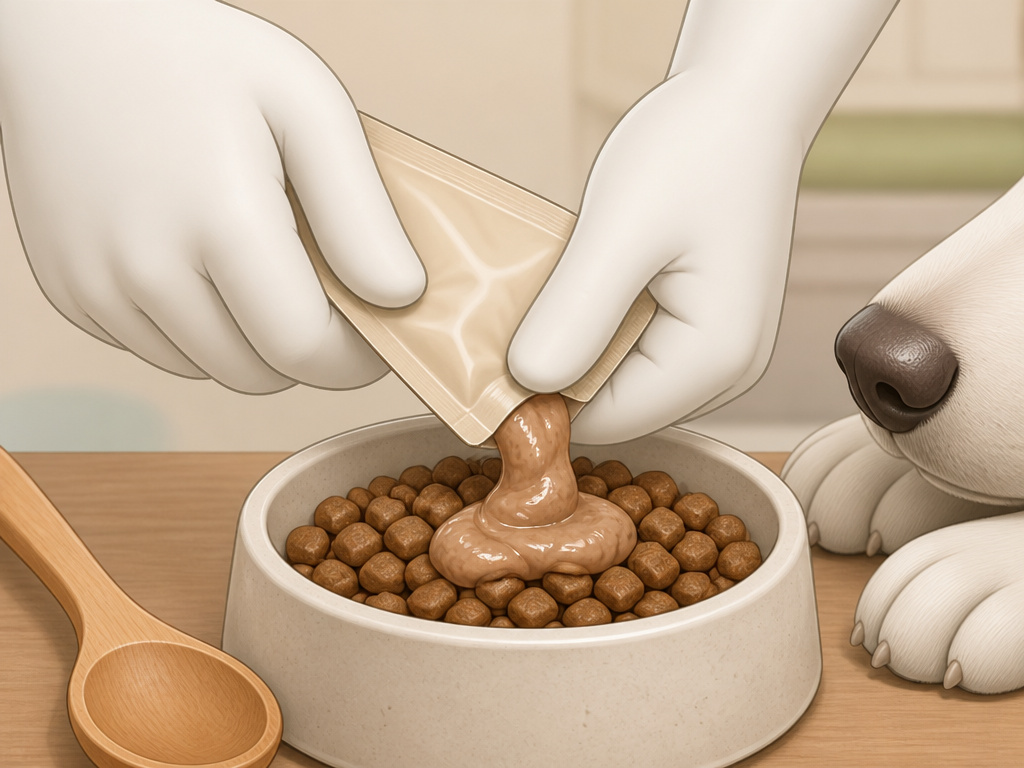
A dog walks away from a full bowl, the owner reaches for a pouch, and dinner disappears. That sequence built the entire topper aisle.
The sources don’t agree here, and the disagreement is worth stating plainly rather than smoothing over.
AKC’s position is that toppers don’t offer much benefit to a dog already eating a complete and balanced diet, and Dr. Casper doesn’t often recommend them. He does concede they can get a picky dog eating more reliably.
VCA’s position is that the primary benefit of toppers is variety, framed as a legitimate benefit rather than a consolation prize.
Chewy’s position sits between the two: toppers aren’t a necessary part of a dog’s diet, but they can offer real benefits in flavor, texture, and moisture.
I land closer to the AKC end, with a caveat. Variety is real, and a dog that eats beats a dog that doesn’t. But most owners reach for a pouch before they’ve changed anything about the routine, and the routine is usually the cheaper variable.
I won’t argue that a topper never helps. I’ll argue that most owners try one before they’ve tested the schedule. Fixed meals, a bowl that comes up after a set window, and enough consistency to see a pattern will tell you more than any pouch.
If the dog is genuinely picky rather than unwell, the mechanics are specific. Chewy recommends wet or fresh toppers with a strong odor for picky dogs, mixed thoroughly into the regular food. InnoVet makes the same point from the other direction: stir it through instead of leaving it on top as a separate prize, because a prize on top teaches the dog to eat around the base food.
Food toppers for picky dogs are usually the strong-smelling ones, and that’s not an accident.
Two rules keep this from becoming a habit you can’t undo. InnoVet advises reducing the topper gradually over a couple of weeks if a healthy dog is holding out for it. And if the appetite change was sudden or has lasted more than a day, rule out a medical cause with a vet before you touch the food at all.
The Storage Numbers Nobody Prints on the Pouch
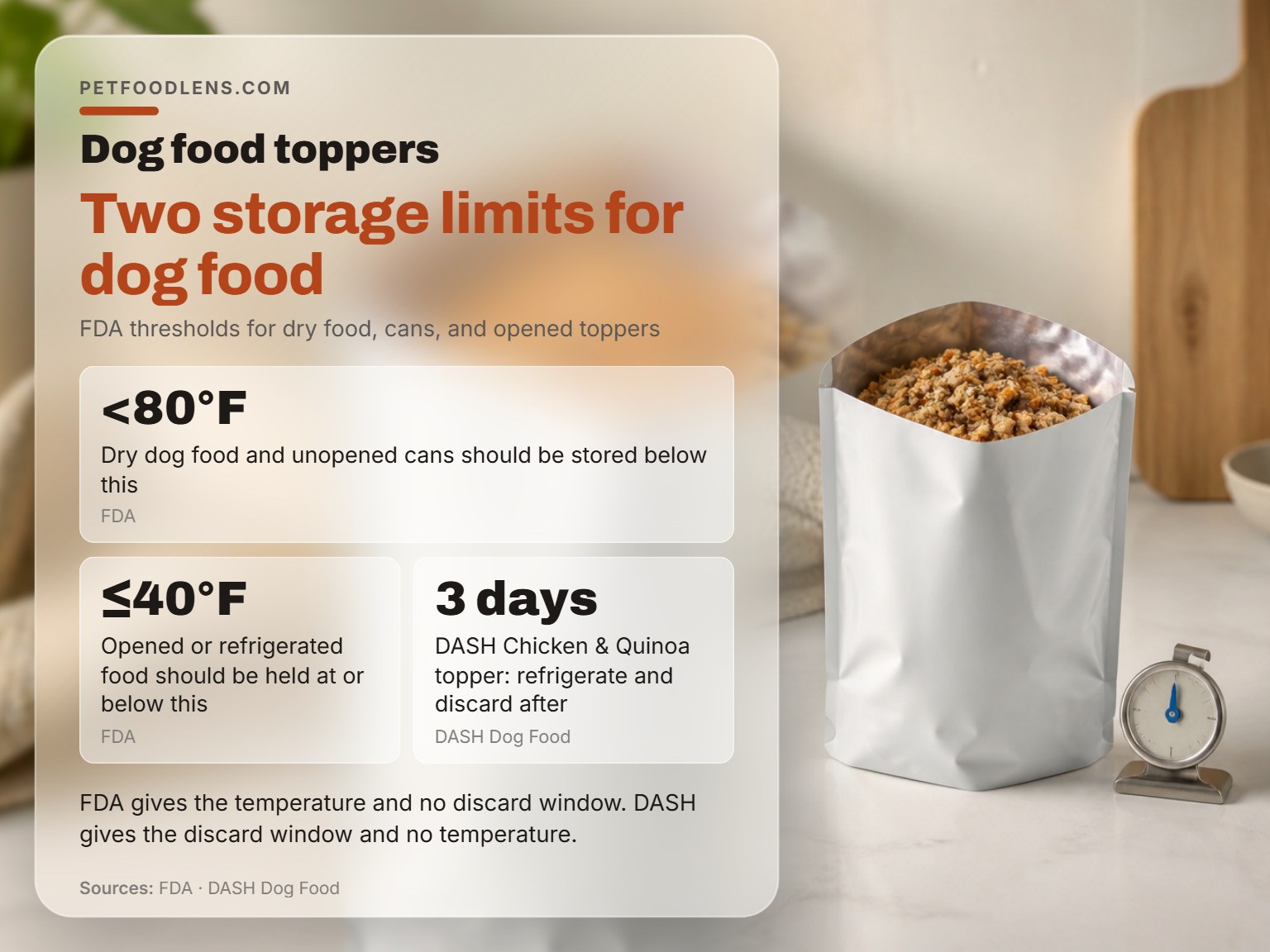
Forty degrees Fahrenheit is the number that matters once a pouch is open.
The FDA sets two thresholds. Dry dog food and unopened cans should be stored below 80°F. Once a product is opened or refrigerated, it should be held at 40°F or below.
Here’s what happens when the temperature side gets ignored. I emptied a pantry bin once and found a yellowish, tacky film on the walls and a sharp crayon-and-paint smell that didn’t belong anywhere near food. Months of fresh kibble had been poured over that residue, so every new bag met old oxidized fat on day one.
| Product state | Storage limit | Source |
|---|---|---|
| Dry food, unopened cans | Below 80°F | FDA |
| Opened or refrigerated food | 40°F or below | FDA |
| DASH Chicken & Quinoa topper | Refrigerate; discard after 3 days | DASH Dog Food |
DASH adds a discard rule with no temperature attached: refrigerate the topper between uses and discard after 3 days. The FDA gives the temperature and no discard window. Use both, because neither one covers the other’s blind spot.
The fix for a bin is unglamorous. Empty it completely between bags, wash it with hot soapy water, and dry it fully. Drying takes longer than people expect, and damp plastic plus fat residue is a bad pairing.
How to Add a Topper Without Unbalancing the Bowl
Four things decide whether a topper helps or quietly unbalances the bowl: the calorie math, the label class, the form, and the routine.
The Five-Step Addition
- Read the manufacturer’s feeding guidelines first. DASH puts this before anything else, and skipping it means you’re dosing by feel. Topper calories are dense enough that feel runs high.
- Measure with a spoon or cup, not a pour. DASH ties overfeeding directly to weight gain, digestive disturbance, and unbalanced vitamin and mineral intake.
- Hold the per-meal ceiling. VCA’s cap is 3-4 pieces of meat or ¼ cup of bone broth per meal. Blow past it and the topper stops being 10% of anything.
- Match protein and fat to the base food. DASH recommends comparing the topper’s macros against the regular diet, especially for dogs with sensitive digestion.
- Stir it through the meal. A topper left sitting on top as a separate reward teaches the dog to eat around the base food, which is the opposite of the goal.
Toppers for sensitive stomachs need that macro match more than the average bowl does, so step four matters most there.
Common mistake: Topping up the bowl whenever the dog cries. That rewards the noise, and the dog learns the plain bowl is a negotiating position rather than a meal.
Sardines as a topper are a common whole-food route, and what they’re packed in changes the fat load considerably.
One caution that doesn’t get said enough: AKC notes that adding toppers makes identifying and controlling a food allergy harder. If you’re mid-elimination trial, a new pouch is the last thing you want in the bowl.
Frequently Asked Questions
How much topper can I give my dog per day?
Keep toppers and treats combined at or under 10% of daily calories. VCA’s worked example puts a 1,000 kcal/day dog at 100 kcal for toppers plus treats. InnoVet puts a 10 kg dog at 40-50 kcal total, which is a much smaller bowl than most owners expect.
Are dog food toppers bad for dogs?
Not inherently, but the sources disagree on how much good they do. AKC’s veterinary contributor says toppers offer little benefit to a dog on a complete and balanced diet. VCA frames variety as a genuine benefit. Chewy calls them unnecessary but potentially useful for flavor, texture, and moisture.
Can I use canned dog food as a topper?
Yes, and it’s the one wet option that arrives complete and balanced. Chewy notes canned dog food can serve as a topper that still delivers complete nutrition, which makes it a different category from a gravy or a broth pouch.
Should I use a topper for a picky eater?
Only after you’ve ruled out a medical cause and tested the routine. InnoVet advises a vet check if the appetite change was sudden or has lasted more than a day. If the dog is healthy and holding out, stir a small amount through the food and reduce it gradually over a couple of weeks.
Do chews and bones count toward the 10%?
The labeling rules don’t count them, though DASH Dog Food puts chew toys inside the 10%. AAFCO requires calorie content on snacks and treats but explicitly excludes chews, bones, and toys, so those calories appear on no label. DASH puts chew toys inside the 10% anyway. Track them yourself either way.
The Bottom Line
If the topper, the treats, and the chews together cross 10% of your dog’s daily calories, cut the topper first. The base food is the part doing the nutritional work, and it’s the part that shouldn’t shrink.
The first move is smaller than it sounds. Measure one serving with the same spoon you’ll use every day, write the number on the lid, and then watch whether the bowl gets finished.
None of this applies to a dog on a therapeutic diet. If a veterinarian put your dog on an “intermittent or supplemental” product for a medical reason, the 10% math isn’t yours to run. That’s a conversation, not a calculation.
And the honest version: most topper purchases solve a problem the schedule created. Fix the mealtime rhythm and much of that aisle stops being relevant.
