
Nyjer Seed for Birds Guide: Read the Bag Before You Buy
This post contains affiliate links. As an Amazon Associate, we earn from qualifying purchases.
This nyjer seed for birds guide starts where the bag does: nyjer is a tiny, high-oil imported seed (roughly 40% oil) that goldfinches and pine siskins take from mesh, sock, or small-port tube feeders. Buy the smallest bag you’ll use in a few weeks and keep it cool and dry.
That oil figure is the whole story. Fat is what makes nyjer worth hanging a feeder for, and fat is what turns a bag rancid in a warm garage, a point the nyjer seed for birds guide emphasizes.
What follows covers the import rules that decide how fresh your bag already is, the feeder types that actually work, the storage numbers, and the spoilage signs that mean you throw the rest out.
Key Takeaways
- Nyjer is not thistle. It’s Guizotia abyssinica, same plant family as sunflowers, and the name itself is a trade trademark.
- Roughly 40% oil makes it high-energy and fast-spoiling. Buy small, rotate often, and don’t stockpile.
- Mesh, sock, or small-port tube feeders work well. Nature’s Way cautions that seed blends block the thin ports, while WBFI endorses these feeders without that warning.
- Store below 80°F (27°C), ideally 40-70°F (4-21°C), in airtight metal or heavy plastic sitting 2-4 inches off the floor.
- Clumping, a mildew smell, dust, or holes in the bag mean the seed is finished. Bin it.
What Is Nyjer Seed for Birds, and Why Is It Always Capitalized?
Guizotia abyssinica is the plant. Nyjer is the trademark, and that distinction explains most of the confusion on the shelf.
Nyjer is the seed of Guizotia abyssinica, an annual herb native to the Ethiopian highlands and now grown mainly in India and Ethiopia. The seed runs roughly 40 percent oil by weight, bears no relation to thistle weeds, and belongs to the same plant family as sunflowers. The official common name is niger; Nyjer is the trade trademark.
The genus includes species native to the Ethiopian highlands. The name Guizotia abyssinica is the botanical name for the plant that produces nyjer.
Nyjer is the only major wild bird feeding ingredient that North America imports rather than grows, according to the Wild Bird Feeding Institute nyjer FAQ. That single fact drives the sterilization rules and the freshness clock.
The capitalization is a trademark issue. WBFI says registration was granted in December 1999. Audubon dates it to 1998. Both are describing the same shift away from “niger,” and the one-year gap is the kind of thing that happens when a trade body and a magazine count from different paperwork. Since January 1, 2023, WBFI has restricted use to members, with non-members applying for an annual fee.
“Thistle” is a marketing holdover with no botanical basis. Nyjer is not derived from any native or non-native thistle plant, and the industry discourages the word for exactly that reason.
Hold two bags side by side and the origin difference is visible immediately: Indian nyjer reads black, Ethiopian reads brown. More on why that matters further down.
Nyjer sits at the small end of the types of bird seed spectrum, which is why the feeder matters as much as the seed.
The 248°F Rule Behind Every Bag You Buy
Four facilities on earth are licensed to heat-treat the nyjer that enters the United States.
WBFI cites USDA treatment schedule T412-a: heat treatment at 248°F (120°C) for fifteen minutes. Audubon’s reporting splits those four facilities geographically, with two in India treating seed before shipment and two in the mid-Atlantic treating it on arrival.
The target is dodder (cuscuta), a noxious weed seed. Dodder contamination in the 1980s pushed the USDA to mandate heat sterilization, and the rules became stricter in the 1990s.
Here is where the sources part company. The production and processing of small seeds bulletin from the UN Food and Agriculture Organization states that niger exported to the USA must undergo heat treatment at 60 °C before shipping to kill cuscuta. That is not 120°C, and neither document reconciles the gap.
The Audubon explainer on nyjer seed describes the USDA heat-sterilization mandate, which may explain why two numbers circulate. It does not reconcile the two temperatures. Treat the USDA figure as the one the trade cites and the FAO figure as a real disagreement rather than a rounding error.
One more processing point worth knowing: the FAO requires that birdseed be free of insects, mould, and noxious weed seeds. Seed that goes into the bag wet starts its decline before it reaches a shelf.
Easy to miss: the sterilization step can dry seed out before it is ever bagged. Nature’s Way notes that nyjer may dry prematurely during heat treatment, which means a bag you just bought can already be past its best.
A common worry is nyjer sprouting under the feeder. Imported nyjer is heat-treated under USDA schedule T412-a, which targets noxious weed seeds such as dodder.
Which Feeder Actually Works for Nyjer?
Mesh and sock feeders win for straight nyjer.
Mesh and Sock Feeders
Both WBFI and Nature’s Way name mesh and fabric sock feeders as the best options for this seed. There’s nothing to clog, you can see the seed level at a glance, and filling takes seconds.
For a first attempt, the Kaytee Mesh Sock Feeder is a simple way to find out whether finches use your yard at all. If they ignore a sock with fresh seed in it, the problem is the seed or the location, not the hardware.
Tube Feeders With Ports Under the Perch
WBFI specifically points to tube feeders with tiny port holes positioned under the perch, because goldfinches will hang upside down to feed. Nature’s Way makes tube feeders that accept a thistle insert for small seed.
Nature’s Way advises against seed blends in a thistle insert, while WBFI endorses these feeders without that caution: no seed blends in a thistle insert is Nature’s Way’s rule. Larger seed blocks the thin ports, and once a port is packed solid the feeder is decorative.
The Tray Question
A seed-catching tray at the bottom catches spill and gives birds a second pass at it. The catch is that the tray needs emptying, or the hulls and leftovers cake into a damp mat.
Three quick rules before you hang anything:
- Mesh or sock: cheapest entry point, easy to inspect, nothing to clog.
- Tube with thistle insert: holds more seed, but the insert has to be fitted and the blend rule has to be followed.
- Anything with a tray: catches waste, and that tray becomes your problem.
The University of Arizona Extension is blunt about why the ports are small: tiny holes make the seed available only to small-beaked finches such as goldfinches, redpolls, and pine siskins. Everyone else gets shut out. The OSU Extension Feed Wild Birds publication adds the economics: special feeders let birds take one seed at a time, which cuts waste on a seed that OSU calls expensive.
Two handling habits reduce spill further. Pour quickly when filling, because pouring slowly scatters more than it delivers. And hang the feeder somewhere stable, since a swinging feeder dumps seed every time it moves.
I’d hang a mesh sock before I’d buy anything with a roof and a perch. The sock tells you in a week whether finches are using your yard, and it costs almost nothing to find out.
If you’re weighing shapes, the sock vs tube feeders comparison is worth a look. For a wider shortlist, these nyjer seed feeders and thistle feeders are two categories to consider.
How Long Does Nyjer Seed Last?
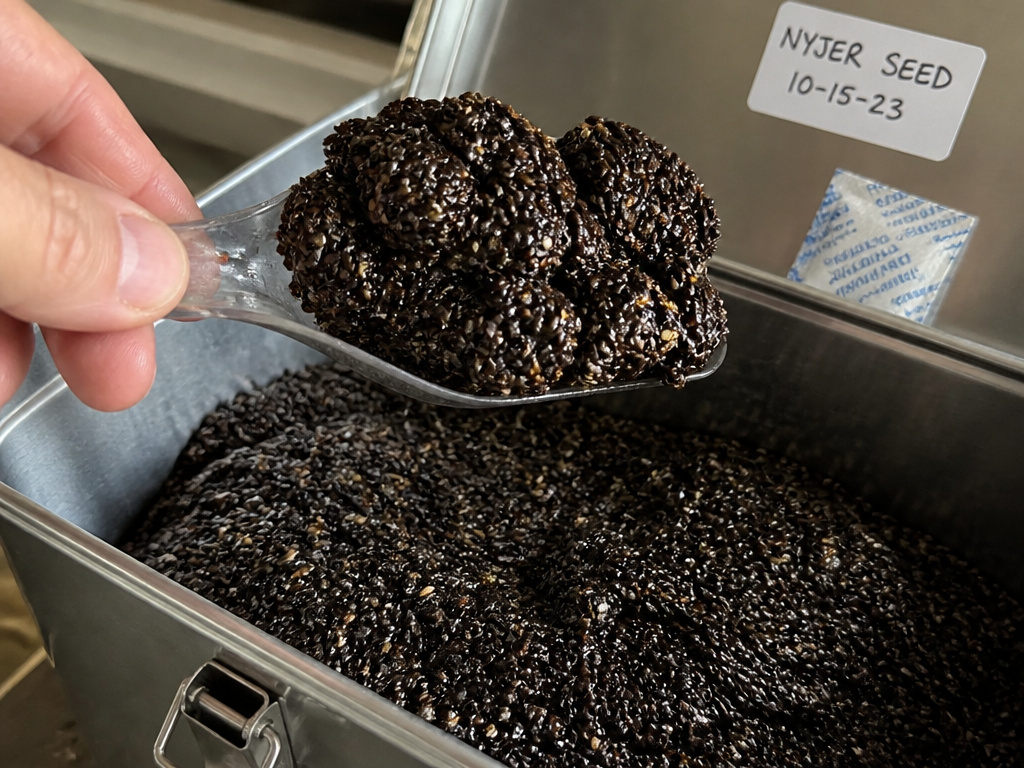
I left half a bag of nyjer in a garage through a humid July. By August it came out of the scoop in lumps, and the birds quit it inside a day. Nothing was visibly wrong with it. It had simply taken on enough moisture to clump, which is the exact failure WBFI flags for this seed.
Ask three sources how long nyjer keeps and you get three different answers.
| Source | Stated shelf life | What it assumes |
|---|---|---|
| WBFI | 6-12 months | Airtight, cool, dry, pest-free storage |
| Birds & Blooms (Kenn and Kimberly Kaufman) | A few months | Seed dries out and birds can detect it |
| Nature’s Way Bird Products | As little as a few days; replace every few weeks | High oil, thin shell, plus heat-treatment drying |
The spread is real, and it comes from different assumptions rather than sloppy reporting. WBFI is describing seed in ideal storage. Nature’s Way is describing seed in a feeder in summer weather.
The mechanism explains it. Nyjer carries roughly 40% oil inside a thin shell, and fats break down when they meet heat, moisture, and air. WBFI notes that nyjer needs extra protection from moisture, since even small amounts of humidity can cause clumping or spoilage.
Open the bag and smell it. Fresh nyjer smells faintly grassy and dry; a bag going off smells like old cooking oil, which is what oxidized fat actually is.
Store It Cold, Store It Dry
WBFI gives two temperature figures that the sources treat as a disagreement: below 80°F (27°C) for freshness, and 40-70°F (4-21°C) as best for freshness and nutritional value. Seed stays freshest below 80°F (27°C), and 40-70°F (4-21°C) is best for holding both freshness and nutritional value.
Nyjer needs more moisture protection than sunflower or suet. WBFI states that even small amounts of humidity can cause clumping or spoilage in this seed specifically.
First In, First Out
The FAO’s storage guidance is written for the seed trade, but it applies to a garage shelf just as well: protect seed from water, sunlight, chemicals and pesticides, and pests; check stored seed frequently for insect attack and monitor moisture.
Here’s the routine that works:
- Decant into metal or heavy plastic. An open bag pulls humidity straight out of the air, and nyjer clumps faster than sunflower does.
- Keep it below 80°F (27°C), ideally 40-70°F (4-21°C). The shelf above a water heater is the worst spot in the house.
- Set the container 2-4 inches off the floor and away from walls. That gap is what stops mice walking straight up to it.
- Put a desiccant pack near the container, not inside it. Direct contact pulls moisture unevenly.
- Mark the purchase date and the open date, and use the oldest first. Without dates you refill from the new bag and the old one quietly dies.
If a bag clumps when you squeeze it, the storage math is already over. Fresh nyjer pours. Clumped nyjer goes in the bin, not the feeder.
Storage is only half the freshness equation. A feeder that lets rain in or dumps seed on the ground undoes good container practice, which is why how to choose a bird feeder matters here too.
When Birds Ignore Fresh Nyjer
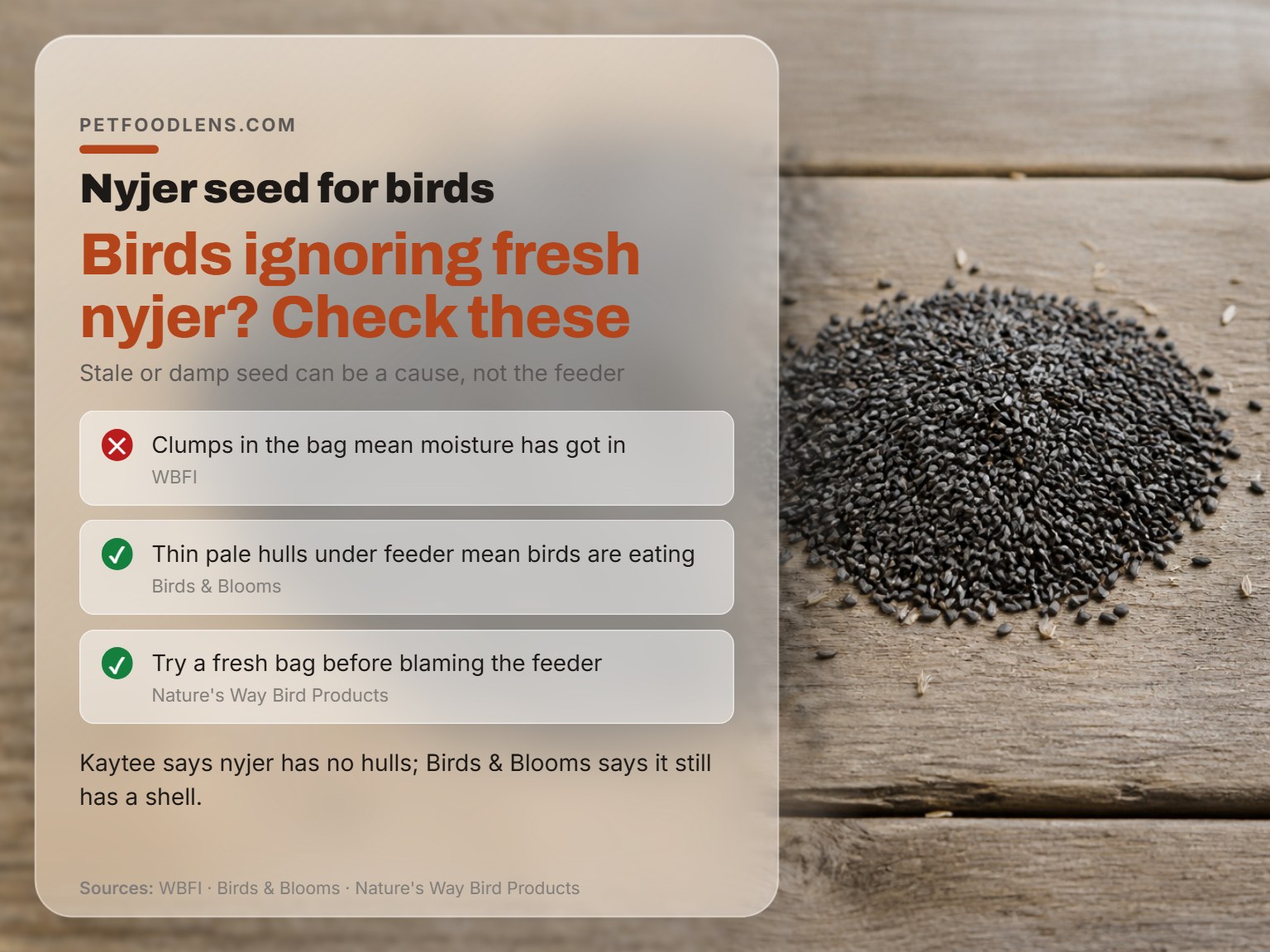
The feeder usually gets blamed for a bag that’s already dead.
Kenn and Kimberly Kaufman make the point plainly: nyjer loses its appeal after it dries out, which can happen within a few months, and birds can tell when seeds have gone dry and stale. Nature’s Way says the same thing from the manufacturer side. If birds aren’t visiting a new feeder filled with nyjer, change the seed or buy a new bag before writing the feeder off.
Before you spend anything, run three checks:
- Squeeze a handful. Clumps mean moisture has already got in.
- Smell it. Old cooking oil means oxidized fat.
- Look under the feeder. Thin pale hulls mean birds are eating. Bare ground means they’re pecking and leaving.
That last check runs into a genuine contradiction in the sources. Kaytee markets nyjer as having no hulls, no messy leftovers, and being 100% edible. Birds & Blooms states that nyjer seeds are tiny but they still have a shell, and recommends checking ground litter for thin hulls to confirm birds are eating rather than just pecking.
Kaytee markets nyjer as having no hulls, while Birds & Blooms states the seeds still have a shell; the sources disagree on which is true. But if you’re using ground litter as your test, the Birds & Blooms reading is the one that gives you a usable signal.
| What you’re seeing | Likely cause | What to do |
|---|---|---|
| Seed clumps in the bag or feeder | Humidity, or seed already drying out | Bin it, scrub the feeder |
| Birds land, peck, leave | Stale or dried seed | Try a fresh bag before blaming hardware |
| No hulls under the feeder | Birds aren’t actually eating | Check freshness and port size |
| Fine dust and a musty smell | Mold or insect activity | Discard, sanitize with the bleach mix |
If the seed is genuinely fresh and still ignored, the Kaufmans suggest putting nyjer in its own feeder and placing it very close to feeders holding other finch-friendly foods such as white proso millet or sunflower chips. OSU notes that mixing sunflower chips with nyjer makes a “finch mix” you can feed year-round.
Where this goes sideways: topping up without emptying. The older seed settles at the bottom, the fresh sits on top, and the birds work down into the layer that’s already past it.
The bird seed for finches breakdown covers what else belongs in that rotation, and if the birds still won’t commit, these notes on how to attract goldfinches to a feeder deal with placement. The feeders for goldfinches shortlist is the hardware side of the same problem.
The Black vs Brown Question Most Retailers Get Wrong
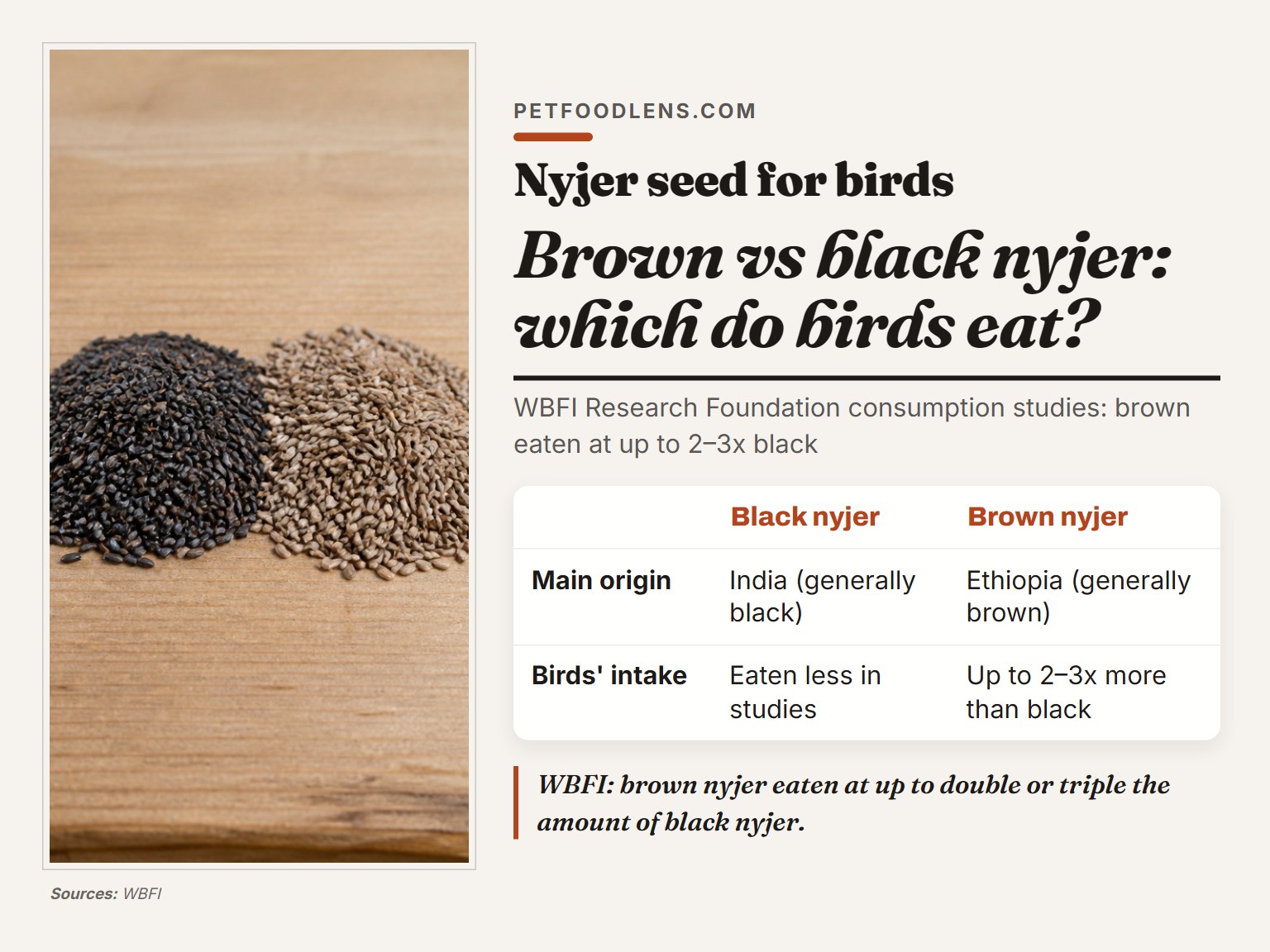
Retailers have sold black nyjer at a premium for decades on an assumption the trade’s own research body now contradicts.
Indian nyjer is generally black. Ethiopian nyjer is generally brown. The long-held belief, and the one buyers and retailers have acted on, is that birds prefer the black seed.
WBFI’s Research Foundation consumption studies are finding the opposite: brown nyjer eaten at up to double or triple the rate of black. WBFI’s Research Foundation consumption studies find brown nyjer eaten at up to double or triple the amount of black nyjer.
Treat that number as a direction rather than a specification. The WBFI Research Foundation consumption studies are the source for the brown-versus-black finding. That’s a real gap, and it’s worth saying so out loud.
What you can act on is the practical consequence. If color isn’t a reliable quality signal, then freshness and origin are the only things worth paying attention to on the label. A brown bag packed recently beats a black bag that’s been on a warm shelf.
That’s the same logic you’d apply to any bag of feed. Marketing is not nutrition, and a color story on the front of a bag tells you very little about what’s inside it. Kaytee recommends using its nyjer in a tube or mesh feeder designed for nyjer, or a Kaytee Mesh Sock Feeder.
Cleaning: The Twice-a-Month Habit That Stops Disease
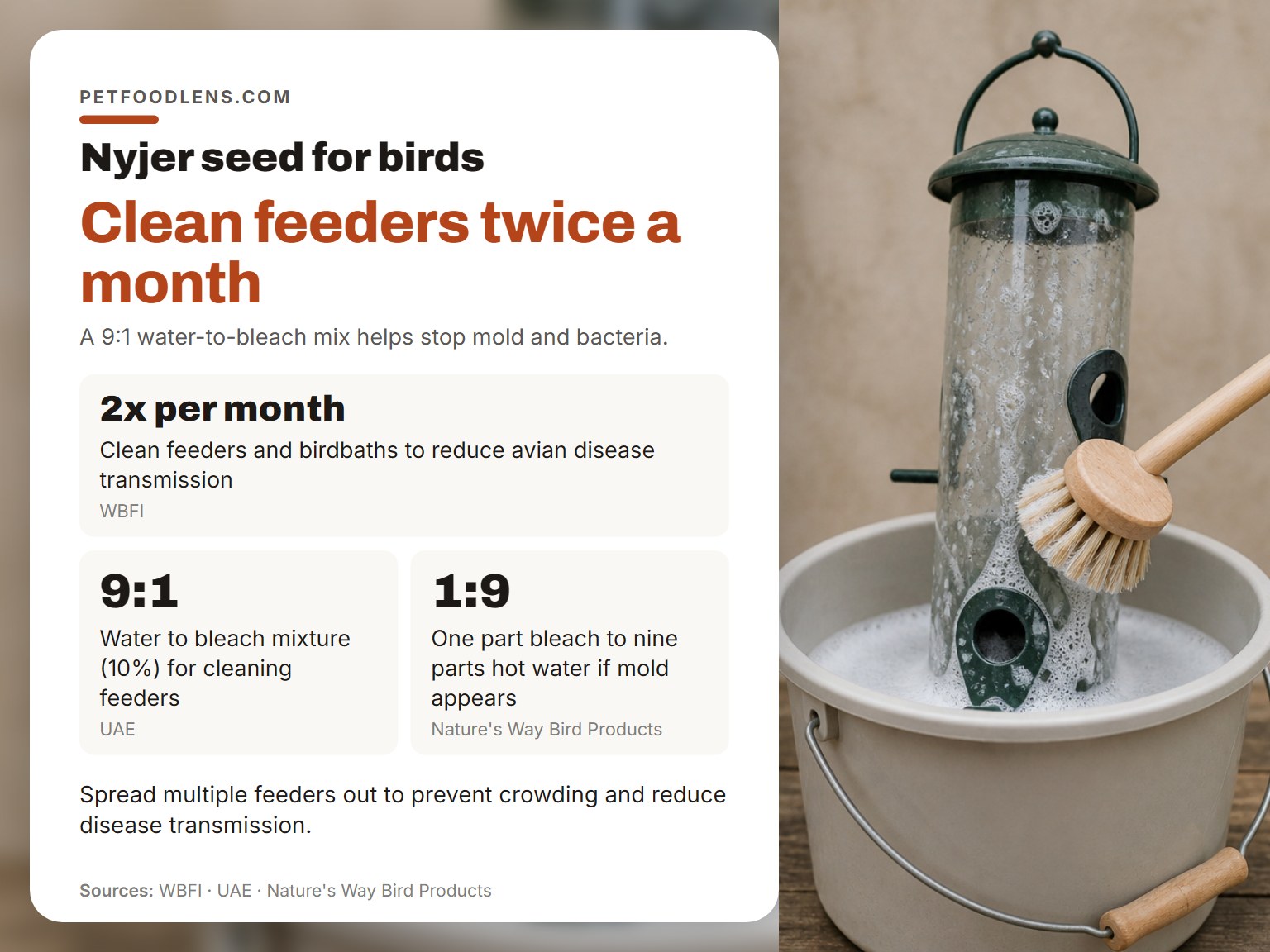
Feeder cleaning has three jobs: stop mold, stop bacteria, and stop the crowding that spreads both.
The University of Arizona Extension recommends cleaning feeders and birdbaths twice per month to reduce avian disease transmission, using a 9:1 water to bleach mixture (10%), while Nature’s Way advises cleaning on a regular basis and discarding seed immediately if mold appears. Nature’s Way gives the same ratio from the other direction, one part bleach to nine parts hot water, and adds the trigger: if you notice mold growth, discard the seed immediately and sanitize the feeder.
The routine, in order:
- Empty the feeder completely before washing anything.
- Scrub with the 9:1 mix, then rinse hard.
- Dry it fully before refilling.
- Rake old seed and hulls out from under the feeder.
- Move a second feeder to the far side of the yard.
That last point isn’t decoration. Arizona Extension notes that spreading multiple feeders out prevents crowding and reduces disease transmission, and asks that old seeds and hulls be cleared from the ground around feeders.
Before you refill: mold in a port means the whole feeder comes apart, not just a rinse. Discard the seed, scrub with the bleach mix, dry it fully, and only then put fresh seed back in.
The University of Arizona backyard birds guide is the source for the twice-monthly interval and the bleach ratio, and it’s worth reading in full if you’re running more than one feeder.
Frequently Asked Questions
Is nyjer seed the same as thistle seed?
No. Nyjer comes from Guizotia abyssinica, which belongs to the sunflower family and has no relation to thistle weeds. “Thistle” is a marketing term the industry discourages because it confuses buyers into thinking they’re planting weeds.
Do I need a special feeder for nyjer?
Yes. The seed is small, so it should be dispensed from a feeder specifically designed for it. Mesh and sock feeders work, and so do tube feeders with tiny ports under the perch. Arizona Extension notes the small holes restrict access to small-beaked finches like goldfinches, redpolls, and pine siskins.
Why won’t finches eat my nyjer?
Check the seed before the feeder. Nyjer dries out and loses appeal within a few months, and birds can detect it. Squeeze a handful: if it clumps, it’s taken on moisture. If it’s fresh and still ignored, try placing it next to feeders holding white proso millet or sunflower chips.
How often should I replace nyjer seed?
Sources disagree, and the honest answer depends on your storage. WBFI puts properly stored birdseed at 6-12 months. Nature’s Way recommends replacing nyjer every few weeks and warns it can spoil in as little as a few days in a feeder. Buy small and let the bag, not the calendar, make the call.
Will nyjer sprout under my feeder?
Unlikely. Imported nyjer is heat-treated under USDA schedule T412-a at 248°F (120°C) for fifteen minutes to kill dodder. WBFI notes that any plant that does come up is stunted and sterile unless bees pollinate it, so it won’t spread.
Does nyjer waste a lot of seed?
Less than most people expect, if the feeder is right. OSU notes that special nyjer feeders let birds take one seed at a time, which helps prevent waste, and a seed-catching tray gives fallen seed a second chance. Pour quickly when filling, since slow pouring scatters more.
The Bottom Line
Here’s the trigger that ends the debate: if a bag clumps when you squeeze it, stop. No storage trick rescues seed that’s already taken on moisture, and no feeder design fixes it.
The concession matters too. Everything above assumes straight nyjer. The moment you buy a blend with nyjer in it, the port-blocking problem from Nature’s Way comes back, and you’ve paid for filler seed your finches will sort out and drop on the ground.
Your first move this week is small: buy the smallest bag of straight nyjer you can find, decant it into a metal tin, and write the open date on the lid with a marker. That single habit does more for your finches than any feeder upgrade you’ll read about.
This nyjer seed for birds guide has one thesis underneath all of it. The front of the bag tells you very little. The back of the bag, the date on the lid, and the smell when you open it tell you everything.
