
Yak Cheese Chews Pros and Cons: Hardness, Safety, Sizing
This post contains affiliate links. As an Amazon Associate, we earn from qualifying purchases.
Yak cheese chews pros and cons split on hardness: a dense milk-and-lime-juice bar lasts hours, and that same density is what a board-certified veterinary dentist lists alongside antlers and bones as a cause of carnassial tooth fractures. They fit moderate chewers over 20 lbs, sized bigger than the mouth, supervised, and pulled once the end piece gets small.
The carnassial teeth are the big shearing pair at the back of the jaw, and their enamel is hard and brittle.
What follows covers what’s actually in the bar, the yak cheese chews pros and cons, why hardness is the number that matters, how to size one, how long to leave it down, and the calorie cost. Where the brands and the dental literature disagree, I’ll show both sides instead of picking the tidier one.
Key Takeaways
- Hardness is the hazard, not the ingredient list. A board-certified veterinary dentist names yak cheese in the same fracture-risk group as antlers, bones, cow hooves, and nylon bones.
- The thumbnail test decides it. The AVMA advises against chews you can’t indent with a thumbnail for unsupervised daily use, and yak cheese sits near that line.
- Buy bigger than feels right. A chew should be larger than the dog’s mouth, and the end piece comes away at 2 inches.
- Count the calories. Mighty Paw puts a stick at 285 calories per 100 g, which is a meal, not a garnish.
- Puppies are where the advice splits. Minimum age guidance runs from 12 weeks to 6 months depending on which source you read.
What Are Yak Cheese Chews Actually Made Of?
Mighty Paw prints three ingredients on its yak cheese chews: milk, lime juice, and salt. Everest Pets prints four and calls its version chemical-free and grain-free. Both are describing the same traditional Himalayan process, which is boiled milk, an acid, and a lot of drying time.
Yak cheese chews are made by boiling milk, adding lime juice to separate curds from whey, then pressing, drying, and cutting the curd into bars. The acid step carries most of the lactose away with the whey, so brands market the finished chew as low-lactose or lactose-free. No preservatives are added at any point in that process.
Everest describes the sequence in more detail: the milk is boiled, lime juice separates the fat, the curd is drained in cloth, cut, and dried. The company also says it cleans and processes its chews with lime juice as an extra step to reduce contamination.
Three Ingredients, or Four?
The count differs by brand, and neither number is a safety issue on its own. What matters more is what the extra ingredient is for.
Everest states that higher fat and salt content makes a chew last longer, and that it deliberately takes the opposite route for health reasons. That’s a brand explaining a trade-off against its own commercial interest, which is worth noting. A longer-lasting chew is not automatically a better one.
Everest also makes a sourcing point that’s easy to verify: chews mass-produced in EU milk factories aren’t yak chews, because there are no yaks in Europe. Everest’s own product is a yak and cow milk blend, mostly cow milk, because yak milk is hard to source at volume.
Lactose is the claim to read closely. Mighty Paw says lactose is removed during curing, making the chews lactose-free. Natural Farm says the lime-juice curing separates and removes most of the lactose. Kiwi Canine says only a small percentage of dogs get loose stool or gas, and that it always resolves. Everest goes furthest: if you see gas or diarrhea after dairy, avoid all dairy including the chews and seek medical attention.
Those four positions don’t agree, and the difference matters if your dog has a sensitive gut. For the wider picture on dairy tolerance, the trade-offs in dairy in pet food are worth reading before you buy a bag of anything cheese-based.
Worth knowing before you start: “Lactose-free” on a yak chew is a manufacturer claim, not a regulated term. One brand states it outright, another says “most,” and a third tells you to stop all dairy at the first sign of gas. If your dog has reacted to cheese before, treat the bar as dairy and skip it.
Why Hardness Beats “Natural” as the Number That Matters
Yak cheese sits in the same fracture-risk bracket as antlers and bones. That’s not a blogger’s opinion. It comes from a board-certified veterinary dentist, Lewis, writing in Veterinary Practice News. He names yak milk and cheese treats directly, alongside antlers, bones, cow hooves, and nylon bones, as hard items that cause carnassial tooth fractures.
His reasoning is about give. Lewis advises owners that items with a certain degree of “give” are better than hard treats like yak cheese. Rubber toys can be durable and still flex enough not to fracture a tooth.
The mechanism is enamel composition. Enamel is roughly 96% mineral with no organic matrix, which makes it hard and brittle. A chew that doesn’t deform sends the whole load into that brittle shell. A chew that dents absorbs some of it.
How hard is a yak bar in practice? Furlyo describes it as harder than bully sticks and harder than most dental chews, sitting in the ballpark of antlers but slightly softer because the cheese gradually softens with saliva. The brands lean on that softening. Everest says the treat gets softer once the hard outer shell has been chewed. Mighty Paw says the chews naturally soften with a dog’s saliva.
Lewis’s clinical position is that the hardness withstands carnassial forces and fractures teeth before any meaningful softening happens. That’s the core contradiction in this category, and no brand FAQ addresses it.
I keep the thumbnail test in the same mental drawer as a car’s window sticker. The brochure sells the dream; the spec sheet tells you what’s under the hood. If the chew won’t take a dent from your nail, the dog’s enamel is carrying the whole load. I’ve watched owners buy the biggest, hardest bar on the shelf and call it durable. Durable is the sales word. Indentable is the safety word.
Natural Farm cites the AVMA recommendation against chews you can’t indent with a thumbnail for unsupervised daily use, and states plainly that yak cheese sits near that threshold. That’s a retailer admitting its own product is borderline. Take it seriously.
Do Yak Cheese Chews Clean Teeth?
No yak chew manufacturer has submitted clinical trial data to the VOHC, the Veterinary Oral Health Council that reviews dental claims. Furlyo states this directly, and it’s the single most useful sentence in the whole yak chew conversation.
I’ve done this exercise on other categories. Nearly all of them said “supports” or “promotes.” Not one said “dissolves.” That one verb is the difference between a marketing claim and a tested diet, and it’s the same trick here. Yak chew bags say the chew “cleans teeth.” None of them say “proven.”
Mechanical scraping is real. EcoKind’s vet-backed guide notes that chewing may help reduce plaque as part of a complete routine, while stating outright that yak chews are not a replacement for brushing or professional cleanings.
So the chew does something. It just doesn’t do the thing the front of the bag implies. If dental claims with testing behind them are the goal, dental chews vs brushing lays out where each one actually earns its place.
Yak Chew vs Bully Stick vs Antler: Which Wins for Your Dog
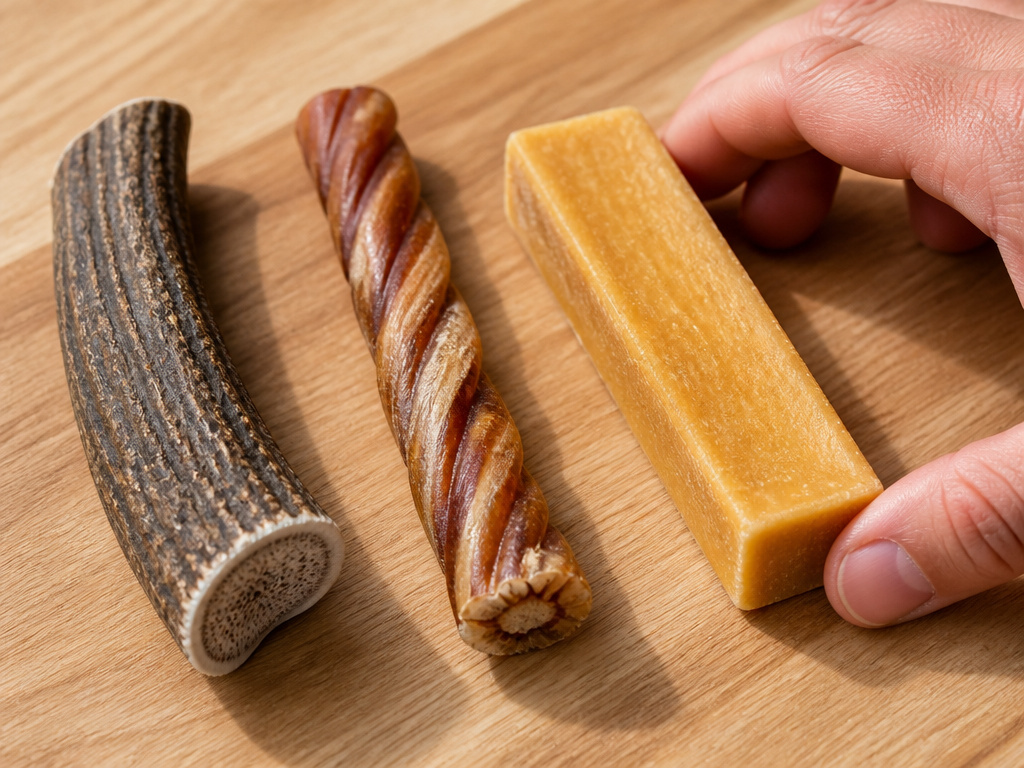
Everyone treats antlers as the toughest chew on the shelf. For fracture risk, that reputation is the problem, not the selling point.
Here’s the honest ranking by job, not by marketing. Devil Dog states that yak chews deliver 10 to 20 times the entertainment duration of a 6-inch bully stick, which most dogs demolish in under an hour. That’s the real case for yak cheese: duration per chew, not dental benefit.
| Dog in front of you | Verdict | Why |
|---|---|---|
| Healthy adult, 20+ lbs, gnaws slowly | Yak chew fits, supervised | Natural Farm sizes the category for moderate to power chewers 20+ lbs |
| Dog that crushes and swallows chunks | Skip it, use a softer chew | Pawstruck flags broken teeth, choking, and obstruction from swallowed chunks |
| Puppy under 4 to 6 months | Wait | Age guidance runs from 12 weeks to 6 months depending on source |
| Senior with worn or missing teeth | Skip hard chews | Pawstruck and Natural Farm both steer seniors to softer options |
| Dog with a diagnosed dairy allergy | Skip entirely | Dr. Whitney Miller of Petco says dairy-sensitive dogs should skip them |
For the dog that crushes everything, a bully stick option is easier on enamel but gone in an hour. For the slow gnawer, yak wins on duration. For a dog with worn molars, neither is right, and collagen chews are the better starting point.
On rawhide, the comparison isn’t close. Yak chews are fully digestible when chewed slowly and carry a low splintering risk compared with cooked bones, per Natural Farm. Rawhide doesn’t dissolve the same way. But “better than rawhide” is a low bar, and no-hide chews exist precisely because that bar wasn’t high enough for a lot of owners.
When the Chew Isn’t the Right Tool at All
Some dogs shouldn’t get a hard chew regardless of size. Natural Farm excludes puppies under 6 months, seniors with dental issues, and dogs with diagnosed dairy allergies. EcoKind excludes puppies under four months, dogs with broken teeth, and dogs recovering from dental surgery.
That last one is the one people miss. A dog three weeks out from a dental extraction has a healing socket and a soft diet order. Handing over a rock-hard cheese bar because the dog seems back to normal is how you end up back at the clinic.
How Big Should the Chew Be? Sizing That Actually Prevents Choking
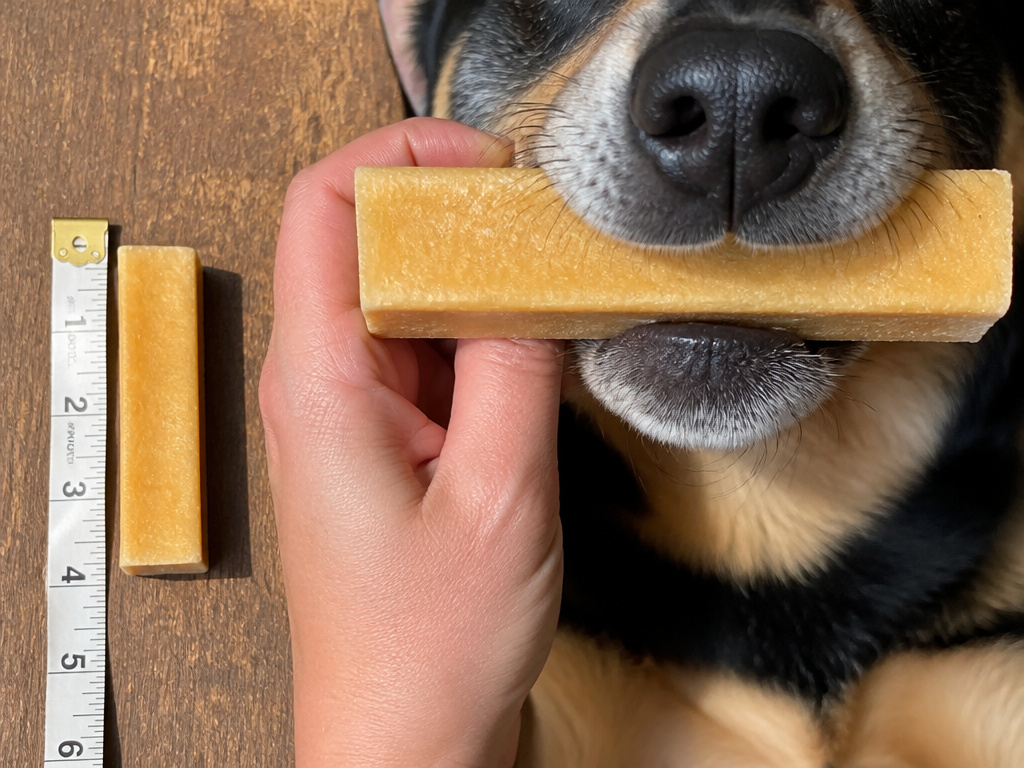
Mighty Paw sells four lengths: 3, 5, 6, and 7 inches, with thickness running from half an inch to one inch depending on size. That’s the closest thing this category has to a spec sheet.
- Small: about 3 inches, and the one most owners should not buy for a dog over 20 lbs.
- Medium: about 5 inches, the reasonable middle for a lab-sized mouth.
- Large: about 6 inches, and the point where a power chewer gets real duration.
- Monster: about 7 inches, built for the dog that finishes everything else in an evening.
The rule that matters more than the chart: Mighty Paw states a chew should always be a little larger than the dog’s mouth to avoid swallowing it whole. Natural Farm’s version of the same rule is to size up whenever in doubt.
Mighty Paw also singles out puppies in the 5 to 7 lb range for extra caution. A 6-inch bar in front of a 6 lb puppy is not a chew, it’s a hazard with a label.
Common mistake: Buying by dog weight instead of mouth width. A 45 lb dog with a narrow muzzle can manage a bar that a 30 lb dog with a wide jaw would try to swallow. Measure the mouth, then go one size up.
What “Larger Than the Mouth” Actually Means
It means the bar can’t be positioned crosswise behind the carnassials and it can’t disappear past the soft palate. In practice, hold the chew against your dog’s muzzle. If both ends sit inside the lip line, it’s too small.
For the full field of options by size and chew style, this best chew treats for dogs comparison covers the categories side by side. Yak cheese is one row in that table, not the whole table.
How Long Should a Session Last? Where the Advice Splits
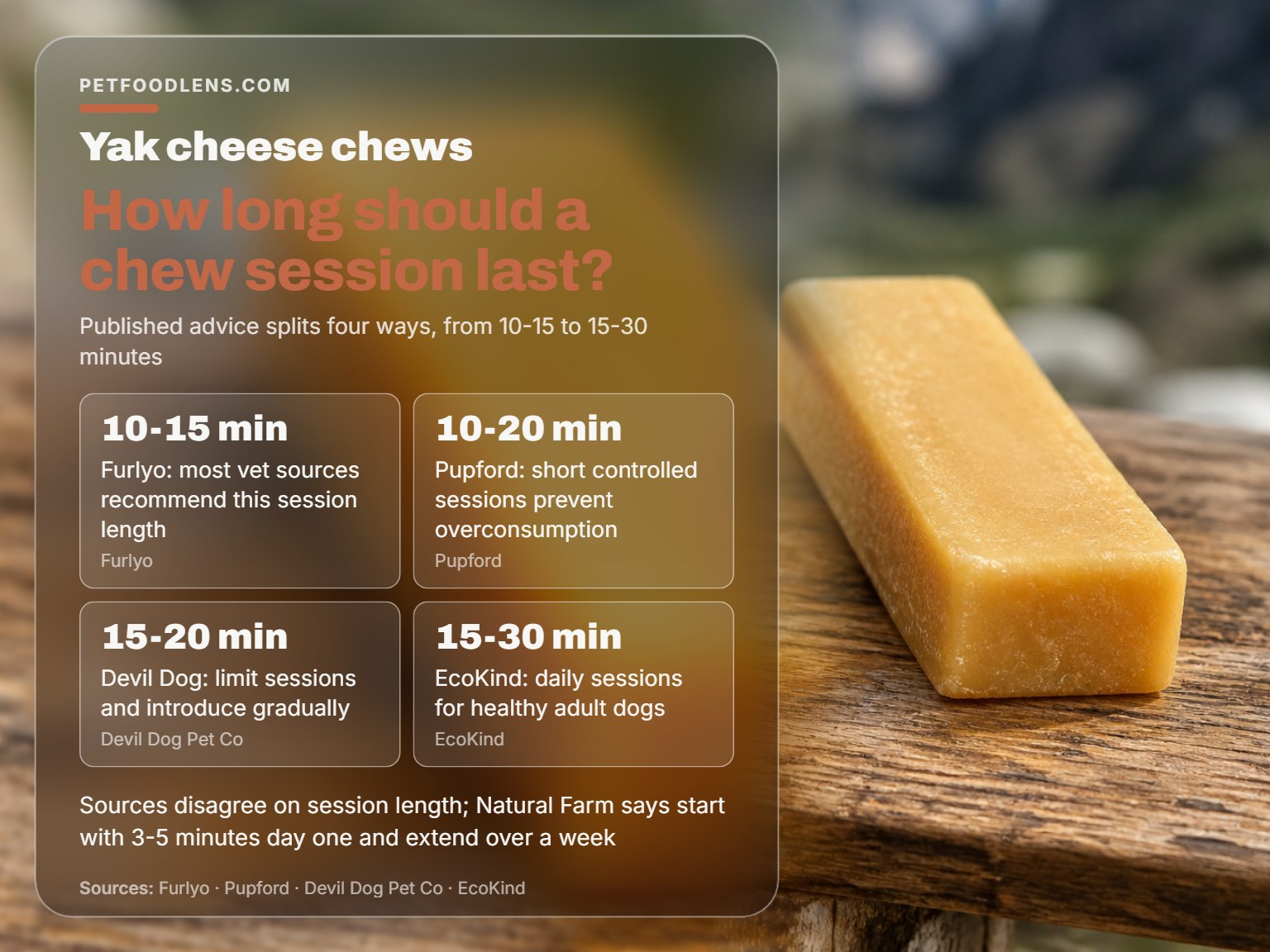
The published session advice splits several ways: 10 to 15 minutes, 10 to 20 minutes, 15 to 20 minutes, and 15 to 30 minutes. Nobody in this category agrees, and the sources that disagree are all confident.
| Question | What the sources say | How to use it |
|---|---|---|
| Minimum puppy age | Devil Dog: 12+ weeks. EcoKind: not under 4 months. Furlyo: 4 to 6 months. Everest and Natural Farm: 6 months | Wait until 6 months unless your vet says otherwise |
| Session length | Furlyo: 10 to 15 min. Pupford: 10 to 20 min. Devil Dog: 15 to 20 min. EcoKind: 15 to 30 min | Start at the low end for the first week |
| Shelf life | Everest: 3 years unopened. Kiwi Canine: 2 years | Use the shorter figure |
| Ingredient count | Mighty Paw: 3. Everest: 4 | Read the actual panel, not the count |
| Lactose | Mighty Paw: lactose-free. Natural Farm: most removed. Kiwi Canine: small percentage react | Treat as dairy if your dog has reacted before |
| Senior dogs | Pawstruck: more caution. Natural Farm: not recommended with dental issues. Devil Dog: softens with saliva, gentler on aging molars | Skip hard chews for a dog with worn teeth |
My read: pick the low end and extend. Natural Farm’s protocol is the most conservative published version, and it’s the one I’d follow for any dog new to the category.
- Day one, 3 to 5 minutes. Natural Farm’s starting point. Cutting it short on day one tells you how the gut reacts before you’ve committed a whole evening to it.
- Extend over a week. Mighty Paw’s version is a few minutes to start, gradually lengthened for aggressive chewers. Skipping the ramp is how you find out about a dairy sensitivity at 2 a.m.
- Cap the session and take it away. Pupford puts controlled sessions at 10 to 20 minutes to prevent overconsumption and dental strain. A chew left down all evening is a chew that gets worked through in one sitting.
- Pull it at 2 inches. Natural Farm says remove or microwave-puff the end piece once it reaches 2 inches or smaller. Below that, it’s swallowable whole.
There’s a sound cue here that owners describe better than any spec sheet. Everest’s own customer reviews mention the noise of a dog working a yak bar as worse than fingernails on a blackboard. That grinding is the chew doing exactly what it’s designed to do, and it’s also the sound of enamel meeting a surface that won’t yield.
Puppies, Seniors, and the Age Argument
Minimum age is disputed: Everest and Natural Farm say 6 months, EcoKind allows from four months, and Devil Dog starts at 12 weeks with oversized bars and 15-minute sessions. EcoKind allows from four months. Devil Dog starts at 12 weeks with oversized bars and 15-minute sessions. Furlyo summarizes most veterinary sources as 4 to 6 months.
The disagreement is real, and I’d resolve it toward the conservative end. A puppy’s adult teeth are still erupting, and the density of yak cheese can cause dental wear in young dogs, per Natural Farm. Oversized bars and short sessions reduce the risk but don’t remove it.
Seniors are the other split. Pawstruck says older dogs need more caution because of worn or missing teeth and that softer treats may fit better. Natural Farm rules out seniors with dental issues outright. Devil Dog argues the chew softens with saliva and is gentler on aging molars. Two of those three positions point the same direction.
The Calorie Math Nobody Puts on the Front of the Bag
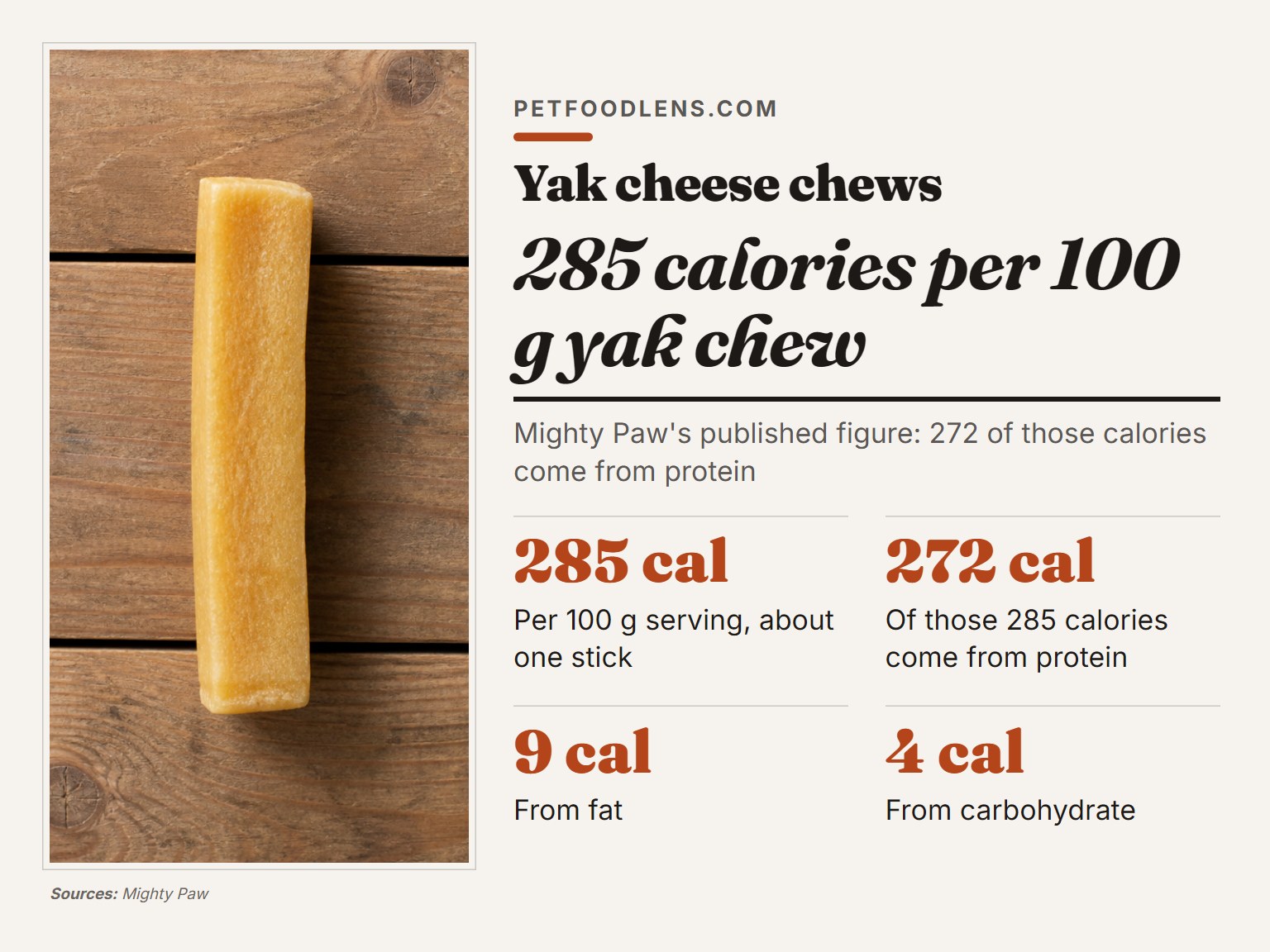
285 calories per 100 grams. That’s Mighty Paw’s published figure, broken down as 9 calories from fat, 4 from carbohydrate, and 272 from protein.
Read that protein number again. Nearly all of the calories in a yak chew come from protein, which is why the bar behaves like a supplement rather than a snack. It’s also why a chew has to be counted against the daily ration instead of handed out on top of it.
There’s a wrinkle in the serving size. Mighty Paw describes the 100 g figure as roughly one stick, but the same brand sells sticks from 3 to 7 inches long. A 3-inch Small and a 7-inch Monster are not the same 100 g. Do the arithmetic on what’s actually in your hand: if a bar is 100 g and 285 calories, a dog that works through a quarter of it has taken in about 70 calories.
For scale, Furlyo cites a 2024 study in Discover Food finding that 100 g of chhurpi, the traditional cheese these chews are made from, delivers the full dietary protein requirement and over 70% of daily calcium, iron, and zinc needs for a child. That’s a human nutrition finding, not a dog one. It still tells you the bar is dense food.
Then there’s the end piece. Everest says end pieces can be microwaved into a large cheesy puff that’s crunchier and easily digestible. Mighty Paw’s instruction is 60 seconds in the microwave, then a careful cut in half with a large kitchen knife while the chew is still warm. Sixty seconds is the whole cook time, and the puff expands fast enough that overshooting turns it into a hard disc.
One caveat on that instruction: no primary safety source in this material validates or warns against microwaving the end piece. It’s a brand instruction, repeated across brands, without independent testing behind it.
Storage: Two Years, Three Years, and the Mould Test
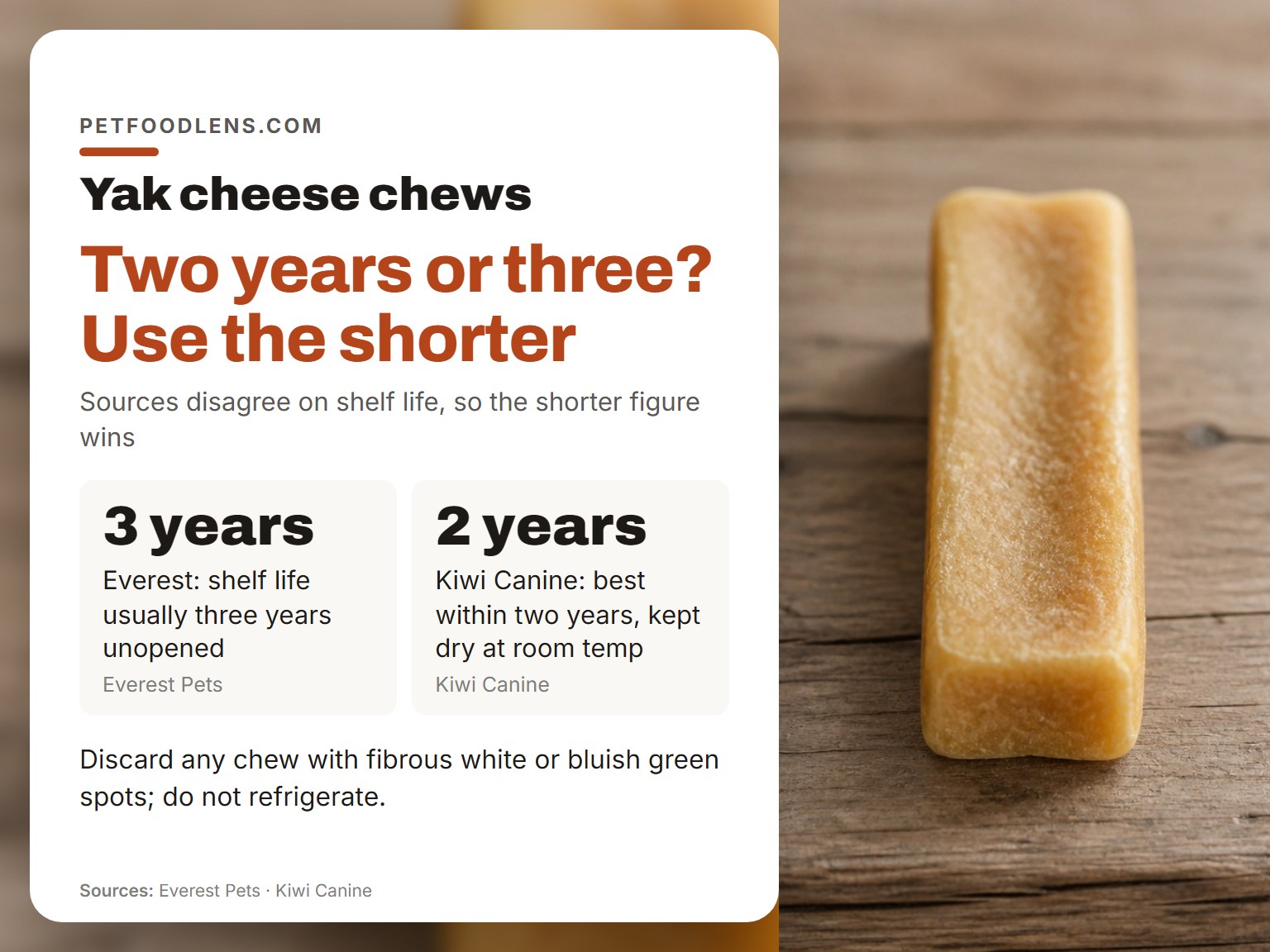
Where does a three-year shelf life come from? Everest says its chews are usually good for three years unopened. Kiwi Canine says best within two years if kept away from moisture and at room temperature. Same product class, two different numbers, no explanation from either.
Sources disagree: Everest says three years unopened, Kiwi Canine says best within two years, so use the shorter figure. A chew that’s fine at 24 months and questionable at 36 isn’t a risk worth taking for the sake of a bar.
Mould is the failure mode that gets skipped in most guides. Kiwi Canine describes it precisely: fibrous white or bluish green spots on the surface. If you see that, don’t feed it. If it happens while the chew is still in the original package, contact the brand for a replacement.
- Keep it dry and at room temperature. Moisture is what grows the mould Kiwi Canine describes.
- Do not refrigerate it. Mighty Paw states outright that refrigerating the chews makes them brittle and can cause cracking, which can be dangerous. That’s the inverse of normal food-safety instinct, and it’s the instruction owners ignore most.
- Check the surface before every session. A dry, chalky bloom is normal on a dried cheese bar. Fibrous patches are not.
- Watch the hands, not just the dog. Natural Farm notes yak chews are odor-free and don’t leave greasy residue or stain carpet. If your fingers come away greasy, something is off with that batch.
I’ll be honest about the refrigeration rule: no source in this material explains the mechanism behind it. Mighty Paw states the outcome, brittleness leading to cracking, without describing why cold changes the cheese matrix. I follow the instruction anyway, because a cracked bar is a sharp edge, and a sharp edge in a dog’s mouth is the exact failure the whole category is trying to avoid.
Easy to miss: A chew that sat in a hot car or a damp garage for a season may look fine and still be compromised. The mould Kiwi Canine describes shows up as fibrous white or bluish green patches, and it doesn’t always appear on the end you’re looking at. Check the whole bar, both ends.
Frequently Asked Questions
Are yak cheese chews safe for puppies?
Guidance varies: Everest and Natural Farm say not before 6 months, EcoKind sets the floor at four months, and Devil Dog starts at 12 weeks with oversized bars and 15-minute sessions. EcoKind sets the floor at four months, and Devil Dog starts at 12 weeks with oversized bars and 15-minute sessions. The conservative answer is to wait for adult teeth, then start with a bar larger than the puppy’s mouth and sessions of 3 to 5 minutes.
How long does a yak cheese chew last?
Longer than most of the competition. Devil Dog puts yak chews at 10 to 20 times the entertainment duration of a 6-inch bully stick, which most dogs finish in under an hour. Everest claims its chews last 4 to 5 times longer than most other yak chew brands. Actual duration depends on the dog’s chewing style, which is why Mighty Paw recommends starting aggressive chewers with just a few minutes.
Can my dog eat the end piece of a yak chew?
Not as a solid stub. Natural Farm says remove or microwave-puff the end piece once it reaches 2 inches or smaller, because below that it’s small enough to swallow whole. Microwaving turns it into a puff that’s crunchier and easier to digest, per Everest. Mighty Paw’s method is 60 seconds on high, then a careful cut while warm.
Are yak cheese chews fattening?
They’re dense. Mighty Paw lists 285 calories per 100 g, with 272 of those calories coming from protein. That’s closer to a meal than a treat, so it belongs inside the daily ration rather than on top of it. A dog working through a quarter of a bar has taken in roughly 70 calories.
What should I do if my dog swallows a chunk of yak chew?
Call your vet. Pawstruck flags choking and bowel obstruction as real risks when dogs break off and swallow chunks, and a piece of hardened cheese can lodge in the throat or the intestine. Supervision exists to prevent exactly this, which is why the chew comes away at 2 inches rather than being left down.
Are yak cheese chews better than rawhide?
On digestibility, Natural Farm and Devil Dog say yes, while Pawstruck warns chunks can cause obstruction if swallowed. Natural Farm states yak chews are fully digestible when chewed slowly and carry a low splintering risk compared with cooked bones, while rawhide doesn’t break down the same way. On tooth safety, neither is a great answer for a dog that crushes hard chews, because the hardness is the problem in both cases.
The Bottom Line
Here’s the trigger that should end the debate for one group of dogs. If your dog has already chipped or fractured a tooth on a chew, the thumbnail test is moot. Everything above assumes intact enamel. A dog with a fracture history shouldn’t see another hard chew, and that’s a conversation for your vet, not a bag.
For everyone else, do one thing tonight. Take your thumbnail to whatever is currently in the chew basket. If it won’t dent, that bar is a durability product, not a dental product, and the dog’s enamel is paying for the difference.
The yak cheese chews pros and cons come down to a single honest trade: you’re buying hours of quiet in exchange for a hardness that sits right at the edge of what a dog tooth tolerates. Size up, supervise, cap the session, pull the stub at 2 inches, and count the calories. Do those five things and the bar does its job. Skip them and you’re running an experiment on your dog’s molars.
